

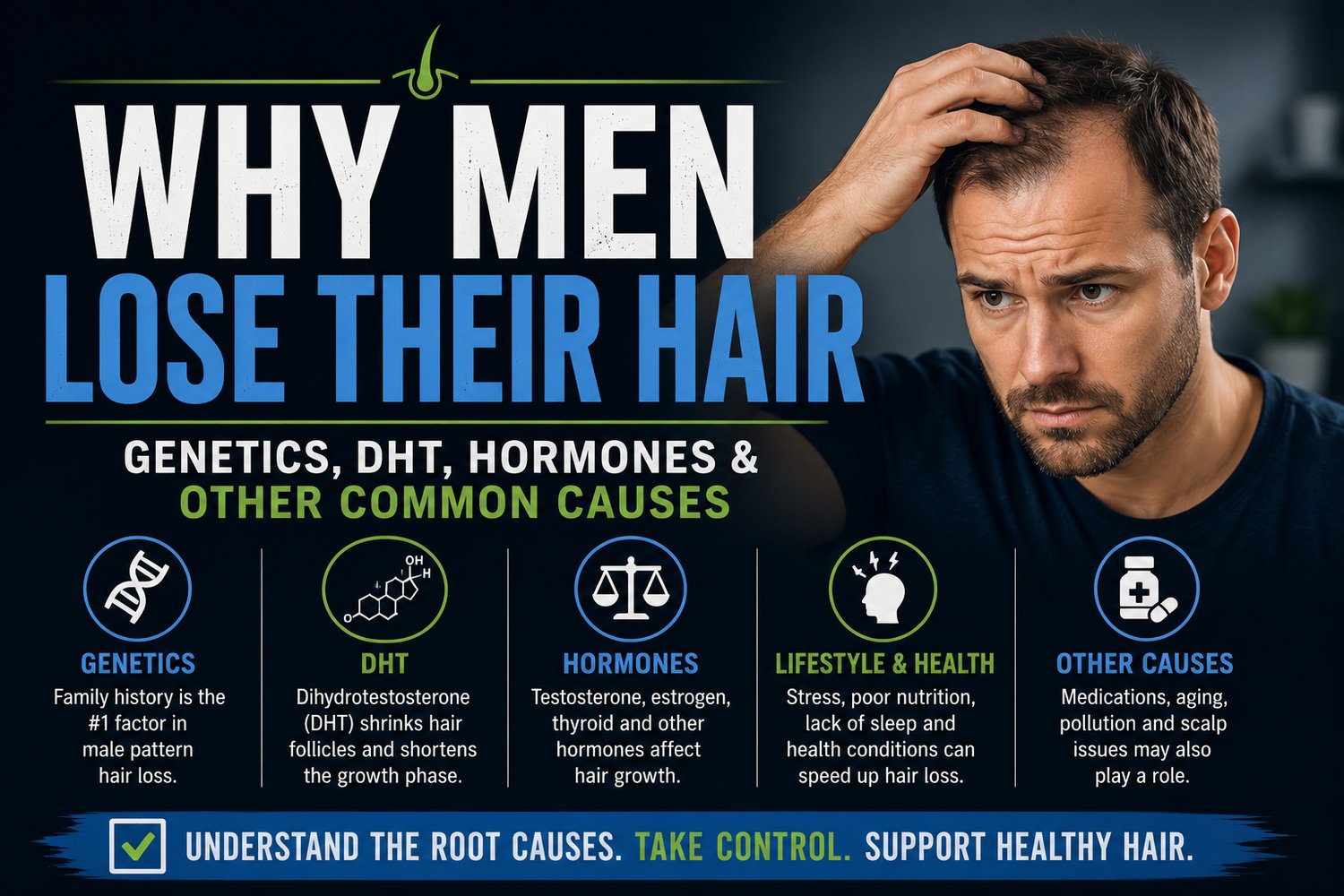
Why Men Lose Their Hair: Genetics, DHT, Hormones & Other Common Causes
Hair loss is one of those things many men assume they understand.
You're getting older.
Your testosterone is high.
Your dad went bald.
Case closed.
Except male hair loss is more complicated than that.
The most common cause of hair loss in men is male pattern hair loss, also called androgenetic alopecia. It is driven largely by genetics and the sensitivity of certain scalp follicles to androgen activity—particularly dihydrotestosterone, or DHT.
But not every man who loses hair has male pattern baldness.
Hair loss can also result from:
- Major physical or emotional stress
- Rapid weight loss
- Autoimmune disease
- Thyroid disease
- Nutritional deficiencies
- Certain medications
- Illness
- Scalp conditions
- Traction or hair damage
- Other medical causes
That distinction matters because treatment depends heavily on why the hair is falling out.
And let's clear up one men's-health myth immediately:
Going bald does not automatically mean your testosterone is high.
Your hairline is not a testosterone test.
If you want the hormone side first, read Testosterone Myths.
Now let's look at what actually causes men to lose their hair.
Some Hair Shedding Is Normal
Hair naturally moves through cycles of:
- Growth
- Transition
- Rest
- Shedding
Seeing some hair:
- In the shower
- On your pillow
- In your brush
- On your hands while washing your hair
doesn't automatically mean you're going bald.
The more useful question is whether you've noticed a persistent change in density, pattern, or shedding rate.
For example:
Gradually receding temples over several years
looks very different from:
Suddenly losing handfuls of hair across your entire scalp.
Pattern matters.
The Most Common Cause: Male Pattern Hair Loss
For men experiencing gradual recession or crown thinning, the most likely explanation is androgenetic alopecia.
You may also hear it called:
- Male pattern baldness
- Male pattern hair loss
- Androgenic alopecia
Typical signs include:
- Receding temples
- An M-shaped hairline
- Thinning around the crown
- Gradual progression
- Increasingly fine hairs in affected areas
In male pattern baldness, susceptible hair follicles gradually shrink.
This process is called miniaturization.
The hairs produced by those follicles become:
- Finer
- Shorter
- Less visible
over time.
MedlinePlus describes the classic male pattern as recession beginning above the temples with thinning around the crown, while affected follicles gradually produce shorter and finer hairs.
For the dedicated guide, read Male Pattern Baldness: Genetics, DHT & How Hair Loss Progresses.
Genetics Matter—But Not Just Your Mother's Side
You've probably heard:
“Look at your mother's father. That's what your hair will do.”
That's an oversimplification.
Male pattern hair loss has a complex genetic basis.
Your susceptibility can reflect genes inherited through multiple parts of your family history.
So look around.
If significant hair loss appears among:
- Your father
- Your brothers
- Maternal relatives
- Paternal relatives
your own risk may be higher.
Genetics still can't perfectly predict:
- When hair loss will begin
- How quickly it will progress
- Which areas will thin first
- How much hair you'll ultimately lose
Two brothers can have dramatically different hairlines despite sharing the same parents.
What Is DHT?
This is where testosterone enters the conversation.
Dihydrotestosterone, or DHT, is an androgen formed when the enzyme 5-alpha reductase converts testosterone into DHT.
DHT has normal biological functions.
But in men genetically susceptible to androgenetic alopecia, certain scalp follicles are unusually sensitive to androgen signaling.
Over time, those follicles miniaturize.
MedlinePlus specifically identifies DHT as an important androgen involved in androgenetic alopecia.
That's why the better explanation for male pattern hair loss is:
Genetic susceptibility + androgen activity + sensitive follicles
not:
High testosterone = bald.
High Testosterone Does Not Automatically Cause Baldness
A man with high-normal testosterone can keep a full head of hair.
Another man with average testosterone can begin balding in his early 20s.
Why?
Because follicle sensitivity matters.
The amount of testosterone circulating in your blood is only one small part of a much more complicated process involving:
- Genetics
- DHT
- 5-alpha reductase activity
- Androgen receptors
- Follicle sensitivity
- Age
So you cannot look at a man's hairline and conclude:
“His testosterone must be through the roof.”
That's not how this works.
Does Low Testosterone Protect You From Hair Loss?
Not necessarily.
Hair loss is not a testosterone meter in either direction.
A man can have relatively modest testosterone levels and still experience substantial androgenetic alopecia if his scalp follicles are genetically susceptible.
Likewise, a man can have higher testosterone and retain most of his scalp hair.
Blood hormones and follicle sensitivity are related.
They aren't interchangeable.
Can TRT Cause Hair Loss?
This is understandably a common concern for men considering testosterone replacement therapy.
TRT increases testosterone exposure.
Some testosterone is converted into DHT.
So in a man who is genetically susceptible to male pattern hair loss, increased androgen exposure could potentially contribute to or accelerate an existing tendency toward hair loss.
But:
TRT does not guarantee baldness.
Some men use testosterone therapy for years without substantial scalp-hair loss.
Others notice progression.
Genetics remain extremely important.
If you're researching testosterone treatment, read What Is TRT? Testosterone Replacement Therapy Explained.
If you notice hair loss while using TRT, don't assume the solution is automatically stopping treatment.
Discuss both issues with the clinician managing your care.
Why Does Male Pattern Hair Loss Target the Temples and Crown?
Not every hair follicle responds to androgens in the same way.
Follicles around the:
- Temples
- Frontal hairline
- Crown
are typically more susceptible to androgen-driven miniaturization.
Follicles around the sides and back of the scalp tend to be more resistant.
That's also part of what makes hair transplantation possible.
Surgeons can relocate follicles from more resistant donor areas into thinning regions.
Not All Hair Loss Looks Like Male Pattern Baldness
This is one of the most useful things to understand.
Gradual recession and crown thinning
Think more strongly about male pattern hair loss.
Sudden diffuse shedding
Think about triggers such as illness, stress, rapid weight loss, nutrition, or medication.
Round or oval bald patches
Autoimmune hair loss such as alopecia areata becomes more relevant.
Pain, redness, scaling, pustules, or scarring
A scalp disorder needs consideration.
The pattern can point you toward very different causes.
Sudden Diffuse Shedding: Telogen Effluvium
Sometimes hair doesn't gradually recede.
Instead, it suddenly feels like:
Hair is coming out everywhere.
That can occur with telogen effluvium.
In telogen effluvium, more hairs than usual shift into the resting and shedding portion of the hair cycle.
Potential triggers include:
- Serious illness
- Surgery
- Major emotional stress
- Rapid weight loss
- Significant calorie restriction
- Nutritional problems
- Other major physiological stressors
Unlike classic androgenetic alopecia, telogen effluvium tends to create diffuse shedding rather than a predictable temple-and-crown pattern.
Hair Loss After Rapid Weight Loss
Rapid weight loss deserves particular attention.
Suppose you:
- Lose a large amount of weight quickly
- Eat very few calories
- Struggle to consume enough protein
- Develop nutritional deficiencies
Several months later, you may notice increased shedding.
That doesn't necessarily mean:
“The diet made me permanently bald.”
Hair follicles can temporarily shift into a shedding phase after major physiological stress.
The underlying trigger matters.
What About GLP-1 Weight Loss and Hair Shedding?
Hair shedding has been reported during substantial weight loss, including among some people using prescription obesity medications.
It's important not to immediately assume the medication is directly damaging the follicles.
Rapid weight loss itself can involve:
- Reduced calorie intake
- Lower protein intake
- Changes in nutritional status
- Physiological stress
which can contribute to telogen effluvium.
If you're losing significant weight and noticing substantial shedding, discuss it with your healthcare professional.
Also make sure you're paying attention to:
- Protein
- Total nutrition
- Rate of weight loss
For the broader weight-loss and nutrition side, use the Complete GLP-1 Success Guide.
Alopecia Areata: Autoimmune Hair Loss
Hair loss that appears as sudden, smooth, round or oval patches may suggest alopecia areata.
This is an autoimmune disorder.
It can affect:
- Scalp hair
- Beard hair
- Eyebrows
- Eyelashes
- Other body hair
That looks very different from a slowly receding hairline.
Sudden patchy hair loss deserves proper medical evaluation.
Beard Hair Can Be Affected Too
A round bald patch suddenly appearing in an otherwise full beard isn't automatically a testosterone problem.
Alopecia areata can affect beard follicles.
If you develop sudden smooth patches in:
- Beard
- Eyebrows
- Scalp
a dermatologist can help determine what you're dealing with.
Again:
Hair distribution isn't a testosterone assay.
Thyroid Problems Can Cause Hair Changes
Thyroid disorders can affect hair growth.
They can also cause symptoms such as:
- Fatigue
- Weight changes
- Temperature intolerance
- Mood changes
- Changes in heart rate
Notice how easily those symptoms could also be blamed on testosterone.
That's why unexplained hair changes plus broader systemic symptoms can warrant medical evaluation rather than assuming:
“It's DHT.”
Nutrition Can Affect Hair
Hair growth requires adequate nutrition.
Severe dietary deficiencies or prolonged under-eating can contribute to shedding.
Potential areas of concern include inadequate:
- Calories
- Protein
- Iron
- Other nutrients
But this is where the hair-supplement industry creates confusion.
If you're truly deficient in something:
Correcting the deficiency matters.
If you're already nutritionally adequate:
Taking triple the amount doesn't magically reverse genetic baldness.
Protein and Hair Health
Hair is composed largely of keratin, a protein.
Your body therefore needs adequate protein to support normal tissue production.
That does not mean:
More protein = more hair.
But chronically inadequate protein—particularly during aggressive dieting—can contribute to poor hair growth or shedding.
For men's protein needs, read Protein for Men.
For meals and broader nutrition guidance, visit the Complete High-Protein Guide.
Iron Deficiency Can Affect Hair
Iron deficiency is less common in adult men than in menstruating women.
But it can occur.
And if an adult man has significant iron deficiency, the more important question is often:
Why?
Potential explanations can include:
- Inadequate intake
- Gastrointestinal blood loss
- Other medical conditions
Don't begin high-dose iron solely because you're losing hair.
Too much iron can cause problems too.
Test when testing makes sense.
Medications Can Cause Hair Loss
Some medications can contribute to increased shedding or other changes in hair growth.
If hair loss begins shortly after:
- Starting medication
- Increasing a dose
- Changing treatment
tell the clinician prescribing it.
Do not stop an important medication because Google told you it can cause hair loss.
The medication may not even be responsible.
And if it is, there may be safer ways to address the problem.
Chemotherapy-Related Hair Loss Is Different
Chemotherapy can disrupt rapidly dividing cells, including cells involved in hair production.
This can produce rapid loss across:
- Scalp
- Facial hair
- Body hair
depending on the specific treatment.
That's a very different mechanism from hereditary male pattern loss.
One symptom:
Hair loss.
Completely different cause.
Completely different treatment.
Scalp Conditions Can Cause Hair Loss
Sometimes the problem isn't primarily genetic or hormonal.
It's located in the scalp itself.
Warning signs can include:
- Scaling
- Redness
- Severe itching
- Pain
- Pustules
- Scarring
- Significant inflammation
That doesn't look like straightforward male pattern hair loss.
Some forms of scarring alopecia can permanently destroy follicles, so unusual or inflammatory hair loss deserves timely evaluation.
Tight Hairstyles Can Damage Hair
Repeated traction on hair follicles can cause traction alopecia.
This can occur with hairstyles such as:
- Tight braids
- Tight buns
- Other styles repeatedly pulling the same areas
Continued traction can eventually damage follicles.
If a hairstyle:
- Hurts
- Pulls
- Causes repeated breakage
- Is thinning the hairline
change it.
Hair Breakage Isn't Always Hair Loss
Sometimes the follicle isn't the primary problem.
The hair shaft is breaking.
Possible causes include:
- Excess heat
- Harsh chemical treatment
- Aggressive brushing
- Repeated traction
That can make hair look:
- Shorter
- Frizzier
- Thinner
without the same underlying follicle miniaturization seen in androgenetic alopecia.
Stress Really Can Cause Hair Shedding
This one isn't entirely a myth.
Major physical or emotional stress can trigger telogen effluvium.
The frustrating part is that the shedding may appear after the triggering event rather than immediately.
But don't automatically blame normal daily stress for every receding temple.
Gradual patterned recession is still more characteristic of androgenetic alopecia.
Does Wearing a Hat Cause Baldness?
No.
Normal hat use doesn't cause male pattern baldness.
Your baseball cap isn't suffocating your follicles.
A very tight or abrasive head covering could potentially create friction or breakage.
That's different.
If your temples are gradually receding in a classic pattern:
Your genetics are a much better suspect than your Brewers hat.
Does Shampoo Cause Hair Loss?
Ordinary shampoo doesn't cause male pattern baldness either.
Men often notice shed hairs while washing and think:
“This shampoo is making my hair fall out.”
But washing often simply makes already-shed hairs more visible.
Certain products can:
- Irritate the scalp
- Damage the hair shaft
in some people.
That's different from genetically driven follicle miniaturization.
Does Masturbation Cause Hair Loss?
No credible evidence supports masturbation as a cause of male pattern baldness.
This myth usually comes from assuming every fluctuation in male hormones directly determines scalp hair.
It doesn't.
Your follicles aren't keeping score.
Does Creatine Cause Hair Loss?
This is one of the most persistent gym myths.
The concern largely traces back to a small study in rugby players that observed changes in DHT after creatine supplementation.
That study did not demonstrate hair loss.
There isn't currently strong evidence showing that normal creatine supplementation causes male pattern baldness.
If you are genetically susceptible to androgenetic alopecia, it's understandable to think carefully about anything involving androgen biology.
But:
Possible mechanism ≠ demonstrated hair loss.
Why Can Androgens Increase Beard Hair but Reduce Scalp Hair?
Human biology is rude like that.
Androgens can promote growth in follicles such as:
- Beard
- Body hair
while contributing to miniaturization in genetically susceptible scalp follicles.
The response depends on:
- Follicle location
- Genetics
- Androgen sensitivity
So a man can have:
Excellent beard growth + rapidly receding scalp hair
without anything contradictory happening hormonally.
Hair Loss Can Affect Confidence
Hair loss is often dismissed as:
“It's only cosmetic.”
But appearance influences quality of life too.
Some men don't care about losing their hair.
Great.
Others care quite a bit.
Also fine.
Hair loss can affect:
- Confidence
- Dating
- Self-image
- Social comfort
- How old someone feels they look
You don't need to pretend you don't care.
And if preserving your hair matters, legitimate treatment options exist.
When Should You See a Dermatologist?
Consider professional evaluation if hair loss is:
- Sudden
- Patchy
- Rapidly progressing
- Associated with redness
- Painful
- Associated with significant scaling
- Scarring
- Affecting your beard or eyebrows unexpectedly
- Occurring alongside unexplained health symptoms
- Difficult to identify
Classic gradual male pattern hair loss can often be diagnosed from history and appearance.
Unusual patterns deserve more investigation.
How Is Hair Loss Diagnosed?
Evaluation may involve:
- Pattern of loss
- Family history
- Medication review
- Recent illness
- Recent weight changes
- Major stressors
- Diet
- Examination of the scalp and hair
Additional testing is sometimes used when the pattern isn't straightforward.
That can include:
- Blood tests
- Hair-pull testing
- Scalp biopsy
Not every receding hairline needs $1,000 of laboratory testing.
But sudden, unusual, or inflammatory hair loss deserves more than randomly ordering minoxidil online.
Should You Test Testosterone Because You're Losing Hair?
Usually not solely because you're losing scalp hair.
Male pattern baldness is common.
It does not imply that blood testosterone is abnormally high or low.
Testosterone testing becomes more relevant if hair loss occurs alongside symptoms such as:
- Persistent low libido
- Fewer spontaneous erections
- Erectile changes
- Other signs compatible with testosterone deficiency
If that's your situation, read:
For broader laboratory information, visit the Men's Bloodwork Hub.
What Treatments Actually Work for Male Pattern Hair Loss?
This depends on the diagnosis.
For androgenetic alopecia, established treatment options include:
- Minoxidil
- Finasteride
- Hair transplantation
MedlinePlus currently lists minoxidil and finasteride among standard treatments for male pattern baldness and notes that treatment benefit generally requires continued use.
Other options may be considered depending on the patient and clinician.
The right treatment for:
male pattern baldness
will not necessarily be the right treatment for:
alopecia areata
or:
telogen effluvium.
That's why identifying the cause comes first.
Exploring Online Hair-Loss Treatment?
If your hair loss looks like gradual male pattern thinning and you want to explore prescription treatment through telehealth, Strut offers several men's hair-loss options through U.S.-licensed clinicians.
Explore Strut Men's Hair Loss Options →
Available options include topical finasteride-based formulas and prescription oral minoxidil, among other treatments. Oral minoxidil is used off-label for hair loss and requires clinician evaluation.
HabitLogics may earn a commission if you use a Strut link and purchase treatment, at no additional cost to you.
Minoxidil
Minoxidil is one of the established medications used to treat male pattern hair loss.
Traditional topical minoxidil is FDA approved for androgenetic alopecia.
It can help some men:
- Slow progression
- Improve density
- Stimulate partial regrowth
The benefit generally depends on continued treatment.
If treatment stops, the gains usually don't remain indefinitely.
Minoxidil also exists as an oral medication.
Oral minoxidil for hair loss is an off-label prescription use.
Strut currently offers prescription oral minoxidil through its telehealth service for eligible patients.
Explore Strut Oral Minoxidil Tablets →
Because oral minoxidil affects the cardiovascular system and can have systemic side effects, it should be used under appropriate medical supervision—not treated like a hair supplement.
For the direct comparison, read Minoxidil vs Finasteride.
Finasteride
Finasteride takes a different approach.
It inhibits 5-alpha reductase, reducing conversion of testosterone into DHT.
That makes it directly relevant to the androgen pathway involved in male pattern hair loss.
Oral finasteride is FDA approved for male pattern hair loss.
Topical finasteride preparations are also used, but topical use for hair loss is not FDA approved in the same way as the oral product.
Strut currently offers a topical finasteride-based hair-loss formula that also incorporates other hair-loss ingredients.
Explore Strut's Finasteride Hair Loss Formula →
Strut describes its current formula as a topical product built around finasteride with other ingredients used for hair loss and scalp treatment.
Finasteride also carries important potential adverse effects and tradeoffs, which deserve more discussion than:
“DHT bad, block DHT.”
That's why we cover the decision in detail in Minoxidil vs Finasteride.
Should You Start Minoxidil or Finasteride?
It depends.
Minoxidil and finasteride attack male pattern hair loss differently.
Very broadly:
Minoxidil helps support hair growth.
Finasteride reduces the DHT pathway contributing to follicle miniaturization.
That means the decision can depend on:
- Pattern of loss
- Severity
- Treatment goals
- Medical history
- Side-effect tolerance
- Preference for topical vs oral treatment
- Whether combination treatment makes sense
Don't assume one medication is automatically best for every man.
Use Minoxidil vs Finasteride for the full comparison.
Earlier Treatment Usually Gives You More to Preserve
Male pattern hair loss is progressive.
Treatments generally work better at:
maintaining and strengthening follicles that still exist
than:
rebuilding an area that has been completely bald for years.
That doesn't mean you need to panic because you found five hairs in the shower.
It means that if preserving your hair is important to you, waiting until the loss is extremely advanced can reduce your options.
Beware of Miracle Hair Supplements
Hair loss is perfect territory for questionable marketing.
Men are worried.
They want their hair back.
They're willing to pay.
So you get:
- Hair vitamins
- Gummies
- Collagen
- “DHT-blocking” shampoo
- Saw palmetto blends
- Natural finasteride alternatives
- Miracle regrowth oils
Some supplements may help if a genuine nutritional deficiency is contributing to hair problems.
That's completely different from reversing genetically driven androgenetic alopecia.
If a product promises dramatic regrowth but never explains which type of hair loss it treats, be skeptical.
Don't Confuse Hair Quality With Follicle Survival
Some products may make hair feel:
- Thicker
- Softer
- Shinier
- Less brittle
That's useful cosmetic improvement.
But improving the appearance of the hair shaft isn't necessarily the same thing as stopping androgen-driven follicle miniaturization.
This distinction is especially important when comparing:
cosmetic hair products
with:
actual hair-loss medications.
Hair Loss Is Part of Men's Wellness
Why include hair loss inside a broader Men's Wellness pillar?
Because wellness isn't only about preventing disease.
It can also include issues affecting:
- Confidence
- Appearance
- Quality of life
- Self-image
We'll treat hair loss the same way we've treated testosterone:
Evidence before hype.
Understand the cause.
Understand the treatment.
Understand the tradeoffs.
Then decide what matters to you.
Frequently Asked Questions
Why Do Men Lose Their Hair?
The most common cause is androgenetic alopecia, or male pattern hair loss.
Genetics and sensitivity of scalp follicles to androgen signaling—particularly DHT—play major roles.
Men can also lose hair because of stress, illness, autoimmune disease, medication effects, nutritional problems, thyroid disease, scalp disorders, and other causes.
Does Baldness Mean Testosterone Is High?
No.
Blood testosterone alone doesn't determine whether a man develops male pattern baldness.
Genetic susceptibility and scalp-follicle sensitivity to DHT are major factors.
Does Baldness Come From Your Mother's Side?
Not exclusively.
Male pattern hair loss has a complex genetic basis and can reflect genes inherited through multiple parts of your family.
Can Stress Really Cause Hair Loss?
Yes.
Major physical or emotional stress can trigger diffuse shedding known as telogen effluvium.
That is different from the gradual recession characteristic of male pattern baldness.
Can Rapid Weight Loss Cause Hair Shedding?
It can.
Substantial weight loss, severe calorie restriction, and poor nutritional intake can contribute to telogen effluvium.
The shedding may occur months after the original trigger.
Can Hair Grow Back?
It depends entirely on the cause.
Temporary shedding can recover after the trigger resolves.
Male pattern baldness can sometimes be slowed and partially reversed with treatment, especially when therapy starts earlier.
Scarring forms of hair loss can permanently destroy follicles.
Does TRT Cause Baldness?
Not automatically.
But increased androgen exposure may potentially accelerate genetically susceptible male pattern hair loss in some men.
TRT does not guarantee that a man will lose his hair.
Does Creatine Cause Hair Loss?
There is not strong evidence demonstrating that normal creatine supplementation causes male pattern baldness.
The concern is largely based on limited research involving DHT rather than direct evidence of hair loss.
Is Minoxidil or Finasteride Better?
They work differently.
Minoxidil primarily supports hair growth, while finasteride reduces the DHT pathway involved in male pattern hair-loss progression.
Some men use one.
Others use combination treatment.
Read Minoxidil vs Finasteride for the detailed comparison.
Can You Take Oral Minoxidil for Hair Loss?
Low-dose oral minoxidil is prescribed off-label for hair loss in some patients.
Because oral minoxidil has systemic cardiovascular effects, treatment requires clinician evaluation and appropriate monitoring.
When Should Hair Loss Be Evaluated?
Get appropriate medical evaluation when hair loss is:
- Sudden
- Rapid
- Patchy
- Painful
- Scarring
- Associated with substantial redness or inflammation
- Affecting unusual areas
- Accompanied by other unexplained health symptoms
Key Takeaways
- Male pattern hair loss is the most common cause of hair loss in men.
- Genetics and DHT-sensitive scalp follicles play major roles.
- Baldness does not automatically mean testosterone is high.
- Hair loss can also result from stress, rapid weight loss, autoimmune disease, illness, medications, nutritional problems, thyroid disorders, or scalp disease.
- Pattern matters: gradual temple and crown thinning looks different from sudden diffuse or patchy loss.
- Identifying the cause matters because different forms of hair loss require different treatments.
- Minoxidil and finasteride are established treatment options for male pattern hair loss.
- Minoxidil and finasteride work through different mechanisms.
- Oral minoxidil is used off-label for hair loss.
- Earlier treatment may provide more opportunity to preserve existing follicles.
- Hair supplements are not interchangeable with treatments for androgenetic alopecia.
Final Thoughts
Hair loss isn't one disease.
That's probably the most important point in this entire article.
If your temples have gradually receded over several years and male pattern baldness runs in your family:
Androgenetic alopecia is a likely explanation.
If your hair suddenly starts shedding everywhere after illness or major weight loss:
That's a different situation.
If smooth circular patches appear on your scalp or beard:
That's different again.
And none of those automatically tells you what your testosterone level is.
Don't treat your hairline like a hormone test.
Figure out what type of hair loss you're dealing with.
Then use treatments that actually match the cause.
Continue the Men's Hair Loss Series
Understand the most common form of male hair loss:
Male Pattern Baldness: Genetics, DHT & How Hair Loss Progresses →
Compare the two major medications:
Review the broader treatment options:
Best Hair Loss Treatments for Men →
If you're already ready to explore telehealth treatment:
Explore Strut Men's Hair Loss Options →
For related men's-health topics:
Affiliate Disclosure
Some links in this article are affiliate links. If you use one of these links and purchase treatment, HabitLogics may earn a commission at no additional cost to you. Affiliate relationships do not determine whether a treatment is medically appropriate for an individual reader.
Educational Disclaimer
This article is intended for educational purposes only and should not be considered medical advice. Hair loss can result from hereditary, autoimmune, nutritional, medication-related, hormonal, infectious, inflammatory, and other medical causes. Prescription hair-loss treatments can have side effects and may not be appropriate for everyone. Sudden, patchy, painful, scarring, rapidly progressing, or otherwise unusual hair loss should be evaluated by a qualified healthcare professional or dermatologist.