

When Does Perimenopause Start? Age, Early Signs & What to Expect
One of the most common questions about perimenopause is also one of the simplest:
“Am I too young for this?”
If you're in your early or mid-40s and suddenly dealing with unpredictable periods, hot flashes, night sweats, lousy sleep, or mood changes, the answer may be no.
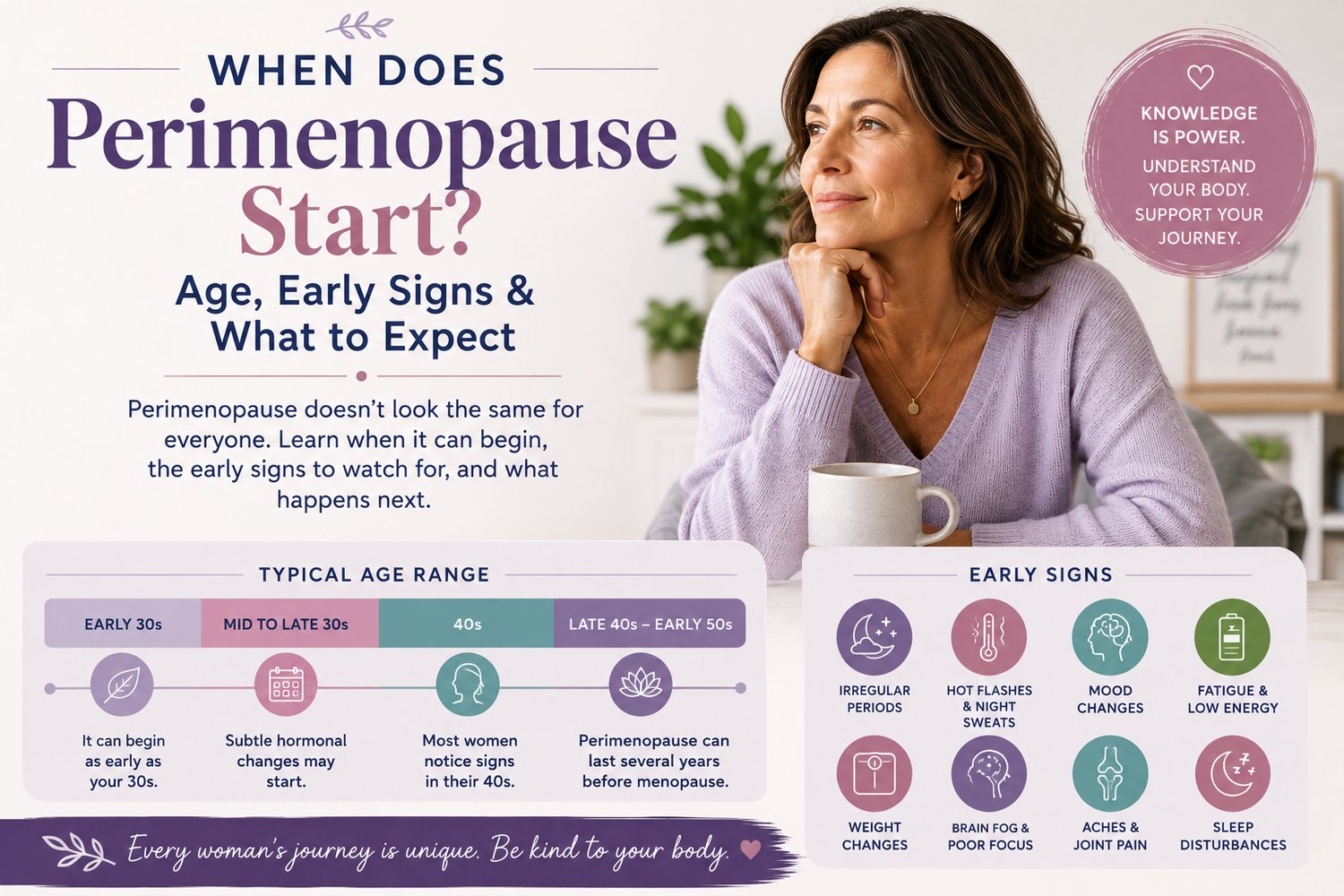
Perimenopause most commonly begins during the 40s, although the exact timing varies considerably.
And here's where things get confusing: there isn't a single birthday when your body officially enters perimenopause.
The transition develops gradually as ovarian function changes and ovulation becomes less predictable. Your menstrual cycle may start changing before you ever think of yourself as being anywhere near menopause.
This guide explains when perimenopause typically starts, what the earliest signs can look like, what it means when symptoms occur before 40, and when it's worth talking with a healthcare professional.
What Age Does Perimenopause Usually Start?
For most women, the menopause transition begins sometime during their 40s.
Natural menopause itself occurs at an average age of around 51 in the United States, but perimenopause begins before the final menstrual period.
The transition can last several years.
That means someone who eventually reaches menopause around 51 may begin noticing changes well before then.
There isn't one universal timeline.
One woman might first notice cycle changes at 42.
Another might still have fairly predictable periods at 47.
Both experiences can fall within the broad range of normal.
That's why your menstrual pattern and symptoms usually tell you more than the number on your birthday cake.
What Exactly Starts During Perimenopause?
Perimenopause isn't simply the moment when estrogen starts steadily dropping.
That's an oversimplification.
During the menopause transition, ovarian function becomes less predictable. Ovulation may occur during some cycles and not others, while estrogen and progesterone levels can fluctuate considerably.
Eventually, ovarian hormone production declines more consistently and menstrual periods stop.
Those changing hormone patterns can affect:
- Menstrual cycles
- Temperature regulation
- Sleep
- Mood
- Vaginal and urinary tissues
- Sexual function
- Bone health
- Other aspects of physical well-being
For the bigger picture, read What Is Perimenopause? Signs, Symptoms & What to Expect.
What Are Usually the First Signs of Perimenopause?
For many women, changes in the menstrual cycle are one of the earliest clues.
Your periods might suddenly become:
- Shorter
- Longer
- Closer together
- Farther apart
- Heavier
- Lighter
- Less predictable
You may eventually begin skipping periods.
Other symptoms that can appear during the transition include:
- Hot flashes
- Night sweats
- Sleep problems
- Mood changes
- Vaginal dryness
- Urinary symptoms
- Changes in sexual function
- Problems with concentration or memory
Not everyone gets all of these.
And you don't need hot flashes to “qualify” for perimenopause.
Some women have obvious vasomotor symptoms. Others primarily notice their menstrual cycle becoming increasingly unpredictable.
For a more complete breakdown, read 35 Perimenopause Symptoms: Common Signs, What’s Normal & When to Get Help.
Your Period May Be the Biggest Early Clue
Imagine you've had a fairly predictable 28-day cycle for years.
Then you start noticing:
25 days.
31 days.
24 days.
38 days.
Maybe one period is surprisingly heavy and the next is barely noticeable.
That changing pattern can be more informative than one isolated symptom like fatigue or irritability.
Why?
Because fatigue can come from dozens of things.
So can headaches, anxiety, weight changes, poor sleep, and brain fog.
A changing menstrual pattern during the typical age range for perimenopause gives those other symptoms more useful context.
But there's an important distinction:
Not every bleeding change should be blamed on perimenopause.
Bleeding between periods, bleeding after sex, unusually heavy or prolonged bleeding, or other concerning changes deserve medical evaluation.
And any vaginal bleeding after menopause should be evaluated by a healthcare professional.
Can Perimenopause Start at 40?
Absolutely.
Starting to notice menstrual changes or other typical symptoms in your early 40s isn't unusually young for the menopause transition.
In fact, this is one reason the idea that menopause is exclusively a “50-something issue” creates so much confusion.
Menopause may occur around the early 50s on average.
Perimenopause happens before menopause.
Those aren't interchangeable terms.
Read Perimenopause vs. Menopause: What’s the Difference? for a deeper explanation.
Can Perimenopause Start at 45?
Yes.
The mid-40s are a very typical time for the menopause transition to become noticeable.
You may begin experiencing:
- More obvious cycle changes
- Hot flashes
- Night sweats
- Sleep disruption
- Vaginal symptoms
- Mood changes
Or you may have relatively few symptoms.
There isn't a required symptom count.
Can Perimenopause Start in Your Late 30s?
This needs a more careful answer than a simple yes or no.
Changes associated with declining ovarian function can occur before age 40, but significant menstrual changes or menopause-like symptoms at that age deserve medical evaluation rather than automatic self-diagnosis.
Other possibilities can include:
- Pregnancy
- Thyroid disorders
- Medication effects
- Significant changes in body weight or energy availability
- Elevated prolactin
- Other reproductive or endocrine conditions
- Premature ovarian insufficiency
Premature ovarian insufficiency (POI) involves loss or significant impairment of normal ovarian function before age 40.
It isn't simply another name for ordinary perimenopause starting a little early.
POI has important implications for fertility, bone health, cardiovascular health, and medical management, which is why symptoms before 40 deserve proper evaluation.
So if you're 37 and your periods have suddenly become erratic, don't panic.
But don't automatically decide, “Well, I guess this is perimenopause,” either.
Talk with a healthcare professional.
What About Menopause Between 40 and 45?
This is another useful distinction.
Early menopause generally refers to menopause occurring between ages 40 and 45.
Premature ovarian insufficiency involves loss of ovarian function before age 40.
Those situations aren't the same as experiencing the typical menopause transition at the usual age, and they may warrant additional evaluation and treatment discussions because earlier loss of estrogen exposure can affect long-term health.
Again, age matters.
Someone experiencing menopause-like changes at 38 shouldn't necessarily receive the same casual “sounds like perimenopause” response as someone experiencing classic cycle changes at 47.
What Factors Can Affect When Menopause Happens?
You can't predict your exact menopause age from a checklist.
But certain factors are associated with earlier menopause.
Family History
Genetics appear to influence menopause timing.
If close female relatives experienced menopause relatively early, your own timing may also trend earlier.
It's a clue—not a guarantee.
Smoking
Smoking is associated with earlier natural menopause.
That's another good reason to quit if you smoke, although obviously menopause timing isn't the biggest health reason to do so.
Cancer Treatment
Certain chemotherapy treatments and radiation involving the pelvis can damage ovarian function and lead to earlier menopause or POI.
The effect depends on factors such as treatment type, dose, and age.
Surgery Involving the Ovaries
Removal of both ovaries causes surgical menopause rather than ordinary natural perimenopause.
Removing the uterus without removing the ovaries is different: menstrual bleeding stops because the uterus is gone, but the ovaries may continue producing hormones until ovarian function eventually declines.
That distinction matters when determining menopause status.
Can Stress Cause Perimenopause to Start?
This is a useful myth to clear up.
Stress can absolutely affect:
- Sleep
- Mood
- Energy
- Appetite
- Menstrual cycles
- How intensely symptoms are experienced
But that doesn't mean a stressful month suddenly caused your ovaries to enter the menopause transition.
Stress can also create symptoms that look like perimenopause.
That's one reason a single symptom isn't very useful for self-diagnosis.
Look at the overall pattern.
Do You Need a Hormone Test to Know When Perimenopause Starts?
Usually not—particularly if you're 45 or older and experiencing typical symptoms and menstrual changes.
Hormone levels fluctuate during perimenopause.
That means one estrogen or FSH measurement can capture what your hormones were doing at that particular moment without neatly answering where you are in a years-long transition.
Healthcare professionals can often identify perimenopause from:
- Age
- Menstrual history
- Symptoms
- Medical history
- The overall clinical picture
Testing becomes more relevant when the situation isn't typical.
For example, a healthcare professional may consider hormone testing when menopause is suspected between ages 40 and 45.
Evaluation is particularly important when symptoms or menstrual changes suggest declining ovarian function before age 40.
Other tests may also be appropriate when symptoms could have another explanation, such as pregnancy, thyroid disease, anemia, or another medical condition.
So don't fall for the idea that you need a giant “female hormone panel” every few months to prove that your hormones are fluctuating.
Sometimes testing is useful.
Sometimes it mostly confirms that hormones fluctuate.
How Long Does Perimenopause Last?
There isn't a fixed duration.
The menopause transition generally lasts several years, but individual timelines vary.
Symptoms don't necessarily follow a smooth progression either.
You may have several months when symptoms are noticeable followed by a stretch when things settle down.
Then they may return.
That's one of the defining frustrations of the transition:
Perimenopause isn't necessarily linear.
Why Do Symptoms Come and Go?
Hormone levels don't simply descend along a perfectly smooth line.
They fluctuate.
That can help explain why symptoms may feel unpredictable.
You might sleep well for two weeks and then suddenly start waking at 3 a.m.
Hot flashes may disappear for a while and return.
Your periods might look almost normal for several cycles before becoming unpredictable again.
That doesn't necessarily mean you're moving backward.
It means the transition itself can be variable.
How Do You Know When Perimenopause Has Ended?
Perimenopause ends when menopause is reached.
For someone having natural menstrual cycles, menopause is identified after 12 consecutive months without a menstrual period, provided another medical or physiological cause doesn't explain the absence of menstruation.
After that point, you're postmenopausal.
That doesn't mean every symptom immediately disappears on day 366.
Hot flashes and other symptoms can continue after the final menstrual period.
Vaginal and urinary symptoms may also persist and can worsen without treatment.
The menstrual transition ends.
Your entire body doesn't flip a switch overnight.
Can You Still Get Pregnant During Perimenopause?
Yes.
This is an important one.
Ovulation becomes less predictable during perimenopause.
Less predictable does not mean impossible.
Pregnancy can still occur until menopause has been reached.
If pregnancy is possible and you miss a period, don't automatically assume perimenopause is responsible.
Likewise, if avoiding pregnancy matters, irregular cycles shouldn't be treated as contraception.
Talk with your healthcare professional about contraception and when it can safely be discontinued based on your individual situation.
Tracking Your Cycle Can Make the Pattern Much Clearer
If your periods and symptoms are changing, trying to reconstruct six months of history from memory is surprisingly difficult.
Tracking can help you record:
- Period start and end dates
- Flow changes
- Skipped periods
- Hot flashes
- Night sweats
- Sleep
- Mood
- Energy
- Headaches
- Other symptoms
- Possible triggers
You're not trying to micromanage your hormones.
You're building a timeline.
That can help you recognize patterns and give your healthcare professional much better information if you eventually need an evaluation.
The FREE Perimenopause Starter Kit includes a symptom tracker, sleep and hot flash log, habit planner, and wellness guide in a 28-page printable PDF.
If you eventually want more detailed tracking in printable and Excel formats, the Perimenopause Symptom Tracker provides a more comprehensive system for monitoring menstrual changes, symptoms, sleep, hot flashes, mood, and patterns over time.
When Should You Talk With a Healthcare Provider?
You don't have to wait until symptoms become unbearable.
Consider talking with a healthcare professional if:
- Symptoms are affecting your sleep, work, relationships, or quality of life
- You're experiencing significant menstrual changes before age 40
- You're concerned about early menopause
- Bleeding is unusually heavy or prolonged
- You bleed between periods
- You bleed after sex
- You experience significant pelvic pain
- Symptoms are severe or unusual for you
- You're unsure whether another condition could be responsible
And again:
Any bleeding after menopause deserves medical evaluation.
Perimenopause is common.
That doesn't mean every new health problem during your 40s is perimenopause.
What Can You Do Once Perimenopause Starts?
You can't stop the natural menopause transition.
You can make the years around it considerably more manageable.
Useful health foundations include:
- Regular physical activity
- Resistance training
- Adequate protein
- Fiber-rich, nutrient-dense foods
- Consistent sleep habits
- Not smoking
- Moderating alcohol when appropriate
- Stress-management strategies that actually fit your life
For the bigger lifestyle picture, read Healthy Habits During Perimenopause: What Actually Matters.
For movement, see Walking During Perimenopause: Benefits for Weight, Mood & Health and Strength Training During Perimenopause: Benefits, Workouts & How to Start.
Nutrition is covered in Best Diet for Perimenopause: What to Eat for Midlife Health and Protein During Perimenopause: How Much Do You Need?.
Healthy habits aren't a cure for perimenopause.
They're the foundation for protecting muscle, bone, cardiovascular health, metabolic health, and general well-being while your body changes.
And when symptoms become bothersome, medical treatments—including hormonal and nonhormonal options—may also be appropriate.
Frequently Asked Questions
What age does perimenopause usually begin?
Perimenopause most commonly begins during the 40s.
The exact age varies considerably, and the transition generally begins several years before the final menstrual period.
Is 40 too early for perimenopause?
No.
The early 40s can fall within the normal age range for the menopause transition.
However, menopause occurring between ages 40 and 45 is considered early menopause and deserves appropriate clinical attention.
Is 35 too early for perimenopause?
Menopause-like symptoms or significant menstrual changes before age 40 deserve medical evaluation.
Premature ovarian insufficiency and several other medical conditions can produce similar changes.
Don't rely on symptoms alone to diagnose yourself with perimenopause at 35.
What is usually the first sign of perimenopause?
Changes in menstrual-cycle patterns are among the most characteristic early signs.
Periods may become shorter, longer, heavier, lighter, closer together, farther apart, or occasionally skipped.
Hot flashes, night sweats, sleep problems, mood changes, and other symptoms may also occur.
Can you be in perimenopause and still have regular periods?
Yes.
Especially earlier in the transition, periods may remain relatively regular while other symptoms begin appearing.
Menstrual patterns generally become more variable as the transition progresses.
Can you have perimenopause without hot flashes?
Yes.
Hot flashes are common but aren't required.
Some women primarily notice menstrual changes or other symptoms.
Do you need bloodwork to diagnose perimenopause?
Often, no.
In otherwise healthy people 45 and older who have typical menopause-associated symptoms, perimenopause can generally be identified clinically without routine hormone testing.
Testing may become more useful between ages 40 and 45 or when symptoms suggest ovarian insufficiency before age 40.
Does perimenopause mean you can't get pregnant?
No.
Ovulation may still occur during perimenopause, so pregnancy remains possible.
Key Takeaways
- Perimenopause most commonly begins during the 40s.
- Menstrual-cycle changes are among the most characteristic early signs.
- Hot flashes, night sweats, sleep problems, mood changes, and vaginal symptoms may also occur.
- Perimenopause doesn't begin at one specific age.
- Symptoms and significant cycle changes before age 40 deserve medical evaluation rather than automatic self-diagnosis.
- Premature ovarian insufficiency before 40 and early menopause between 40 and 45 require additional clinical consideration.
- Routine hormone testing usually isn't necessary for otherwise healthy people over 45 with typical symptoms.
- Pregnancy remains possible during perimenopause.
- Symptoms can come and go because the transition isn't necessarily linear.
- Menopause is reached after 12 consecutive months without a menstrual period when another cause doesn't explain the absence of menstruation.
- Tracking menstrual and symptom patterns can make changes easier to recognize and discuss with a healthcare professional.
Continue Learning
If you're trying to figure out where you are in the menopause transition, continue with:
- What Is Perimenopause? Signs, Symptoms & What to Expect
- 35 Perimenopause Symptoms: Common Signs, What’s Normal & When to Get Help
- Perimenopause vs. Menopause: What’s the Difference?
- Best Diet for Perimenopause: What to Eat for Midlife Health
- Hormone Therapy During Perimenopause: Benefits, Risks & What to Know
Or return to the Complete Perimenopause Guide for the full HabitLogics perimenopause roadmap.
Educational Disclaimer
This article is intended for educational purposes only and is not medical advice, diagnosis, or treatment. Menstrual changes and symptoms associated with perimenopause can overlap with pregnancy, thyroid disorders, premature ovarian insufficiency, medication effects, and other medical conditions. Consult a qualified healthcare professional about new, persistent, severe, or concerning symptoms and for individualized evaluation.