

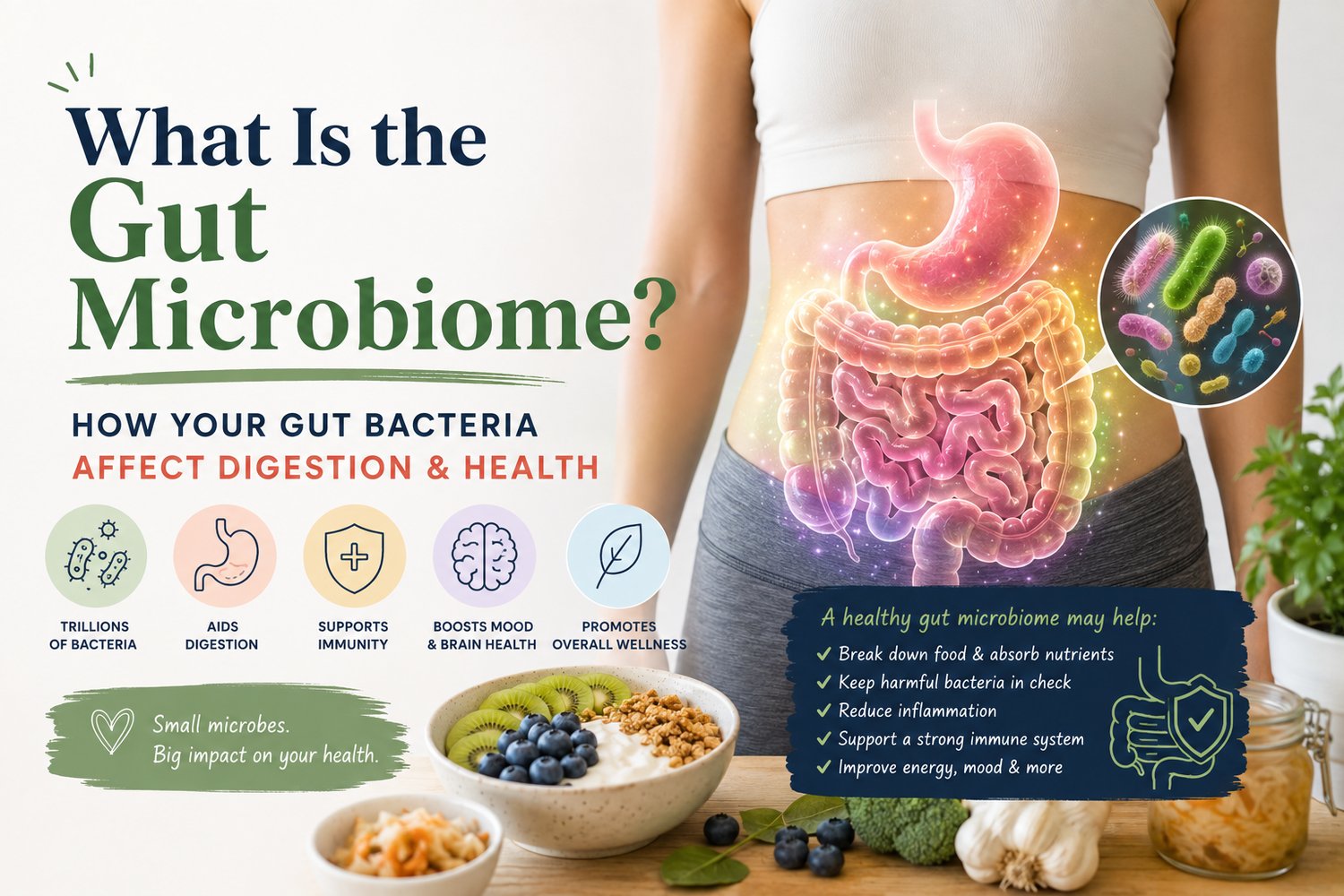
What Is the Gut Microbiome? How Your Gut Bacteria Affect Digestion & Health
Complete Fiber & Gut Health Guide Hub
You aren't eating alone.
Every time you eat:
- Oatmeal
- Beans
- Broccoli
- Berries
- Whole grains
- Nuts
- Seeds
you're providing material not only for your own body, but also for an enormous microbial community living inside your digestive tract.
That's your gut microbiome.
And despite what some wellness marketing would have you believe, it isn't simply a collection of:
good bacteria vs. bad bacteria.
It's an incredibly complicated ecosystem containing bacteria, viruses, fungi, and other microorganisms interacting with each other—and with you.
The National Institute of Environmental Health Sciences defines the microbiome as the collection of microbes, including bacteria, fungi, viruses, and their genes, that naturally live on and inside the human body. These microorganisms can contribute to digestion, protection against pathogens, and development of the immune system.
Your intestines contain the body's largest concentration of these microorganisms.
Researchers are still learning exactly how this ecosystem influences human health.
That's an important point.
Microbiome science is exciting.
It's also developing quickly, and there's a huge difference between:
“The microbiome appears to influence this process.”
and
“We know exactly how to manipulate your microbiome to produce a specific health outcome.”
We aren't at the second one yet.
So instead of promising that you can “heal your microbiome” in seven days, let's look at what we actually know—and what you can realistically do with that information.
If you're brand new to this topic, you may want to read What Is Gut Health? A Beginner’s Guide to Your Microbiome, Digestion & Everyday Habits first.
Otherwise, let's meet your microbes.
What Exactly Is a Microbiome?
Your body contains microbial communities in many places.
Microorganisms live on and around your:
- Skin
- Mouth
- Nose
- Genitals
- Gastrointestinal tract
Each environment can contain a different microbial community.
When we say:
gut microbiome
we're referring primarily to the microbial ecosystem associated with your gastrointestinal tract.
That includes enormous numbers of microorganisms and their genetic material.
The largest concentration exists in your intestines, particularly the large intestine.
Microbiome vs. Microbiota: What's the Difference?
You'll often see two terms:
Microbiota
and
Microbiome.
They're frequently used interchangeably in everyday conversation, although technically there can be a distinction.
Microbiota generally refers to the microorganisms themselves.
Microbiome can refer more broadly to the microorganisms, their genetic material, and the microbial environment.
For the purposes of normal gut-health conversations, you don't need to worry much about the distinction.
If someone says:
gut bacteria
gut flora
gut microbiota
or
gut microbiome
they're usually talking about roughly the same ecosystem.
Your Gut Contains More Than Bacteria
This is one of the first misconceptions worth fixing.
The gut microbiome isn't only bacteria.
It can include:
- Bacteria
- Viruses
- Fungi
- Archaea
- Other microorganisms
NIEHS notes that the human microbiome includes bacteria, fungi, viruses, and their genes.
Even the viruses aren't necessarily just viruses infecting you.
Many are bacteriophages—viruses that infect bacteria.
So inside your intestine, you've essentially got an ecosystem where:
Microbes consume nutrients.
Microbes produce metabolites.
Microbes compete with one another.
Some microbes cooperate.
Some viruses infect bacteria.
Your immune system interacts with the entire environment.
And then you add breakfast.
It's complicated.
Where Do Your Gut Microbes Come From?
Your microbiome begins developing early in life and continues changing.
Many factors can influence it over time, including:
- Age
- Diet
- Environment
- Geography
- Medication
- Illness
- Lifestyle
- Other biological factors
Your microbiome is therefore not something you consciously chose.
And it isn't something you can completely control.
That's actually useful to remember.
Gut health should not become another area where you believe every microscopic change in your body is the result of some lifestyle failure.
You control some inputs.
You don't control everything.
What Do Gut Microbes Actually Do?
This is where the microbiome becomes interesting.
Your digestive system breaks food into components your body can absorb and use.
NIDDK explains that digestion breaks nutrients into smaller components—for example, proteins into amino acids, fats into fatty acids and glycerol, and carbohydrates into simple sugars. Gut bacteria also participate in digestive processes.
But some food components aren't completely digested before reaching the large intestine.
Fiber is the big example.
Certain gut microbes can use these compounds as fuel.
In the process, they can produce substances that interact with your body.
So your diet doesn't just provide nutrients directly to you.
It can also influence:
what your microbes have available to metabolize.
Your Microbes Help Process Fiber
Humans don't possess digestive enzymes capable of breaking down every type of dietary fiber.
That means some fibers survive digestion through much of the gastrointestinal tract.
Eventually they reach the large intestine.
There, certain microbes can ferment them.
Think of it like this:
You eat fiber → fiber reaches the colon → microbes ferment some of it → microbial metabolites are produced.
This is one of the major reasons fiber and microbiome discussions are so closely connected.
Different microbes are better equipped to use different substrates.
And different fibers can produce different effects.
That's why eating more fiber is useful—but eating a variety of fiber-containing foods is also interesting.
We'll cover the practical side in Fiber for Gut Health: Why It Matters & What It Actually Does.
What Are Short-Chain Fatty Acids?
When certain gut microbes ferment carbohydrates such as dietary fibers, they can produce compounds called short-chain fatty acids, or SCFAs.
The major ones include:
- Acetate
- Propionate
- Butyrate
These compounds are involved in several physiological processes.
Butyrate is especially interesting because cells lining the colon can use it as an energy source.
This is one example of the relationship between:
food → microbes → microbial metabolites → human biology.
It's also why microbiome research has become such a large field.
Scientists aren't simply asking:
“Which bacteria are there?”
They're increasingly asking:
“What are those microbes doing?”
That may ultimately be the more useful question.
Microbiome Composition Isn't the Whole Story
Imagine two neighborhoods.
They contain somewhat different groups of people.
But if both neighborhoods still have:
- Grocery stores
- Schools
- Doctors
- Plumbers
- Electricians
- Transportation
they may still perform many of the same basic functions.
Your microbiome can work similarly.
Different people can have different microbial compositions while maintaining overlapping microbial functions.
That's one reason the idea of a single:
“perfect healthy microbiome”
is problematic.
There isn't currently one universally agreed-upon bacterial composition that everyone should attempt to achieve.
There Is No Perfect Gut Bacteria Score
This matters because commercial microbiome tests can make gut health look much more precise than it currently is.
You send in a stool sample.
You receive:
- Bacterial percentages
- Diversity scores
- Food recommendations
- “Good” organisms
- “Bad” organisms
and it looks incredibly scientific.
The problem is interpretation.
Microbiomes vary significantly between healthy people.
Your microbiome can also change over time.
Finding a particular microorganism doesn't necessarily mean:
Good
or
Bad.
The ecosystem and its functions matter.
So don't assume a stool microbiome report is equivalent to:
- A cholesterol test
- A blood glucose measurement
- An A1C
Microbiome science isn't currently that standardized.
Diversity: Is More Always Better?
You'll hear this constantly:
“A healthy microbiome is a diverse microbiome.”
There is some truth behind the interest in microbial diversity.
But:
More diversity = always healthier
is too simplistic.
Different body sites have different healthy microbial communities.
Different populations can also have different microbiome patterns.
And diversity by itself doesn't tell you exactly what those organisms are doing.
So microbial diversity is useful in research.
It shouldn't become another number you're trying to maximize like a video-game score.
Diet Can Influence the Gut Microbiome
Here's where things become actionable.
Diet is one of the environmental factors capable of influencing the microbiome.
In an NIDDK-supported controlled feeding study, researchers compared a diet designed to provide more fiber and other substrates to the gut microbiome with a lower-fiber Western-style diet. The dietary intervention altered microbial composition, diversity, and function.
That doesn't mean one specific diet has been proven to create the ideal microbiome for everyone.
It demonstrates something more useful:
What you regularly eat can influence your microbial ecosystem.
Fiber Is One of the Biggest Dietary Levers
This is why fiber is going to dominate much of this HabitLogics pillar.
Fiber isn't one thing.
There are many different types.
They can differ in:
- Solubility
- Fermentability
- Viscosity
- Chemical structure
Different fibers can therefore affect the microbiome differently.
NIH-supported research has found that health effects from dietary fiber can vary depending on the type of fiber, dose, and individual consuming it.
That's why the goal shouldn't simply be:
Eat as much fiber as humanly possible.
A better strategy is:
Eat adequate fiber from a variety of foods you tolerate well.
Whole Foods Give You More Than Fiber
Consider:
Oats
You get fiber plus vitamins, minerals, and other compounds.
Beans
Fiber + protein + resistant carbohydrates + micronutrients.
Berries
Fiber + vitamins + polyphenols.
Nuts
Fiber + healthy fats + protein + micronutrients.
Vegetables
Fiber + vitamins + minerals + phytochemicals.
That's one reason a varied whole-food diet is more interesting than simply dumping isolated fiber powder into everything you eat.
Fiber supplements can absolutely have legitimate uses.
But they aren't automatically equivalent to eating a varied diet.
Different Plants Provide Different Substrates
This brings us to plant diversity.
Different plant foods contain different combinations of:
- Fibers
- Resistant starches
- Polyphenols
- Other carbohydrates
Those compounds provide different substrates for gut microbes.
That's one reason dietary variety may matter.
Instead of eating:
broccoli every day forever
you might rotate:
- Broccoli
- Carrots
- Peppers
- Beans
- Lentils
- Berries
- Apples
- Oats
- Barley
- Nuts
- Seeds
You don't need every plant at every meal.
Variety accumulates over time.
The 30 Plants Per Week Idea
You've probably seen the recommendation to eat:
30 different plants per week.
The concept became popular after observational microbiome research found associations between greater plant variety and microbial diversity.
It's an interesting challenge.
It is not a magical threshold where:
29 plants = bad microbiome
30 plants = elite microbiome.
Think of 30 as a behavioral target that encourages variety.
And remember that plant foods include much more than vegetables.
You can count:
- Fruit
- Vegetables
- Whole grains
- Beans
- Lentils
- Nuts
- Seeds
- Herbs
- Spices
We'll explore this properly in 30 Plants Per Week: What the Gut Health Challenge Means & How to Do It.
And if you enjoy turning goals into challenges, the 30 Plants Per Week Challenge & Plant Diversity Tracker gives you a structured way to track unique plants and weekly variety.
Your Microbiome Likes Consistency More Than Random “Gut Health” Weeks
Imagine eating:
Monday through Saturday:
Low fiber.
Few plants.
Mostly highly processed food.
Then Sunday:
Kefir.
Kimchi.
Chia.
Flax.
Kombucha.
Blueberries.
Probiotic supplement.
And somehow Sunday is supposed to fix everything.
That's not how long-term health habits work.
Your microbiome is repeatedly exposed to your usual diet.
So instead of occasionally having a “gut health day,” build a dietary pattern that regularly contains:
- Whole grains
- Vegetables
- Fruit
- Legumes
- Nuts
- Seeds
You don't need perfection.
You need repetition.
What About Fermented Foods?
Fermented foods are interesting because microorganisms are involved in their production.
Examples include:
- Yogurt
- Kefir
- Sauerkraut
- Kimchi
- Certain pickled foods
- Some cheeses
But not every fermented food automatically contains live probiotic organisms by the time you eat it.
Processing and heating can kill microbes.
And even when live microorganisms are present, that doesn't automatically mean the food meets the scientific definition of a probiotic with demonstrated health benefits.
Still, fermented foods can absolutely fit into a nutritious, varied diet.
Just don't treat them as microbiome medicine.
Prebiotics Feed Certain Microbes
A prebiotic is not the same thing as a probiotic.
Prebiotics are substrates selectively utilized by host microorganisms that confer a health benefit.
Certain fermentable fibers can have prebiotic properties.
Examples of foods containing compounds with prebiotic potential include:
- Garlic
- Onion
- Leeks
- Asparagus
- Certain whole grains
- Bananas
- Legumes
You don't need a prebiotic supplement to consume prebiotic compounds.
Food works too.
Probiotics Are Live Microorganisms
Probiotics are live microorganisms that provide a health benefit when administered in adequate amounts.
That's fundamentally different from prebiotics.
Easy memory trick:
PREbiotic = food/substrate for microbes
PRObiotic = live microbes
But there's an important catch.
Probiotic effects are often strain-specific.
That means:
“Probiotics are good for your gut.”
isn't a very useful scientific statement.
Which microorganism?
Which strain?
At what dose?
For what condition?
For how long?
Those questions matter.
We'll break this down in Prebiotics vs. Probiotics: What’s the Difference & Which Does Your Gut Need?.
You Probably Don't Need to “Repopulate” Your Gut
This is common supplement language.
You take antibiotics.
Or eat poorly.
Or feel bloated.
Then someone says:
“You need to repopulate your gut with good bacteria.”
That's an enormous oversimplification.
Your microbiome is an ecosystem.
Swallowing several strains of bacteria doesn't necessarily mean those organisms permanently colonize your intestine and rebuild the ecosystem.
Some probiotics may have useful effects while they're being consumed.
That is different from permanently replacing your microbiome.
Antibiotics Can Affect the Microbiome
Antibiotics are designed to kill or inhibit bacteria.
So unsurprisingly, they can also alter bacterial communities in the gut.
That does not mean antibiotics are bad.
Antibiotics can be lifesaving treatments for bacterial infections.
The useful lesson is:
Don't take antibiotics unnecessarily.
And don't avoid medically necessary antibiotics because you're afraid of your microbiome.
The appropriate goal is responsible antibiotic use.
Not antibiotic avoidance.
Medications Can Influence the Gut Too
Antibiotics get most of the attention, but other medications can also influence digestion or microbial communities.
That doesn't mean you should stop:
- Acid-reducing medication
- Diabetes medication
- Antidepressants
- Other prescriptions
because someone online said they damage the microbiome.
Medication decisions should be based on the condition being treated and the risks and benefits of therapy.
Your microbiome does not outrank necessary medical care.
What Is “Dysbiosis”?
Another word you'll encounter constantly is:
dysbiosis.
Broadly, it refers to disruption or imbalance in a microbial community.
Researchers have identified microbiome differences associated with numerous conditions.
But here's the critical distinction:
Association does not automatically prove cause.
If people with a disease have a different microbiome, several possibilities exist:
The microbiome contributes to the disease.
The disease changes the microbiome.
Medication changes the microbiome.
Diet changes because of the disease.
Or several factors interact.
That's why claims such as:
“Dysbiosis causes your symptoms.”
should be treated cautiously unless the specific relationship is well established.
The Microbiome Is Associated With Many Health Conditions
Microbiome research now touches:
- Digestive disorders
- Metabolism
- Obesity
- Diabetes
- Immune function
- Cardiovascular health
- Neurological conditions
- Cancer research
This does not mean gut bacteria have been proven to cause all of these conditions.
It means researchers are investigating relationships between microbial communities, microbial metabolites, environmental exposures, and human physiology.
NIEHS describes the microbiome as an important interface between the body and environment and notes that microbial communities can affect health in complex ways.
The science is exciting.
The marketing usually runs several miles ahead of it.
The Gut-Brain Axis
One particularly interesting research area is the gut-brain axis.
Your brain and gastrointestinal system communicate through multiple pathways involving:
- Nervous-system signaling
- Hormones
- Immune signaling
- Microbial metabolites
That's real.
But the existence of a gut-brain connection does not mean:
Depression = bad gut bacteria.
or:
Anxiety = probiotic deficiency.
Mental health is vastly more complicated.
Gut-health habits can be part of overall health.
They are not replacements for appropriate mental-health care.
Does Stress Affect Your Gut?
Absolutely.
You don't need a microbiome explanation to know this.
Many people notice digestive changes during:
- Anxiety
- Major stress
- Travel
- Public speaking
- Exams
- Relationship problems
The gastrointestinal system is heavily connected with the nervous system.
Stress can affect:
- Motility
- Sensation
- Appetite
- Bowel habits
That's one reason digestive symptoms aren't always explained by a single food.
Your context matters too.
Does Exercise Affect the Microbiome?
Physical activity is associated with differences in the microbiome, although separating exercise from all the other lifestyle differences between active and inactive people can be difficult.
Regardless, exercise already has enormous established benefits.
You don't need to walk because:
“It increases Bifidobacteria by X percent.”
Walk because movement supports:
- Cardiovascular health
- Metabolic health
- Weight management
- Physical fitness
- General health
Any microbiome benefit is a bonus.
Does Sleep Matter?
Sleep and circadian rhythms interact with many aspects of metabolism and physiology.
Poor sleep can also indirectly change your gut environment because it can affect:
- Food choices
- Meal timing
- Stress
- Physical activity
Again, don't turn this into:
“Sleep eight hours to optimize bacterial strain XYZ.”
Just recognize that gut health exists inside your overall lifestyle.
Your Gut Microbiome Is Individual
Two people can eat the same food and respond differently.
Why?
Potential differences include:
- Microbiome composition
- Genetics
- Previous diet
- Medications
- Gastrointestinal conditions
- Food tolerance
NIH-supported research examining different dietary fibers has demonstrated substantial variation in individual responses.
This is one reason rigid gut-health rules often fail.
You aren't trying to eat exactly like someone else's microbiome.
You're building a nutritious pattern that you tolerate well.
This Is Why Tracking Can Be Useful
Suppose someone tells you:
Beans are amazing for gut health.
Great.
But every time you eat a huge bowl of beans after months of eating very little fiber, you feel terrible.
The answer isn't necessarily:
Beans are bad for me forever.
It may be:
- Portion size
- Rapid fiber increase
- Specific carbohydrate tolerance
- Overall meal composition
- Another factor entirely
Track the pattern.
Adjust.
Retest.
That's much more useful than labeling foods:
good
or
bad.
The Gut Health & Microbiome Tracker is designed for exactly this kind of bigger-picture tracking across fiber, plant variety, hydration, symptoms, bowel habits, meals, and lifestyle patterns.
Don't Try to Starve “Bad Bacteria”
This idea sounds intuitive:
Bad bacteria eat sugar.
Therefore:
Eliminate every carbohydrate and starve them.
But microbial ecosystems are considerably more complicated.
Many carbohydrate-rich foods are also major sources of:
- Fiber
- Resistant starch
- Prebiotic compounds
- Polyphenols
Examples include:
- Fruit
- Oats
- Beans
- Lentils
- Whole grains
- Vegetables
Those foods can absolutely belong in a gut-supportive diet.
You don't need to eliminate carbohydrates to have a healthy microbiome.
Highly Restrictive Diets Can Reduce Variety
Some people genuinely need dietary restrictions because of:
- Allergies
- Celiac disease
- Diagnosed gastrointestinal conditions
- Other medical needs
That's different from removing foods because an influencer says they're inflammatory.
Every unnecessary restriction can reduce:
- Food variety
- Fiber sources
- Nutrient diversity
- Enjoyment
If digestive symptoms are driving increasingly restrictive eating, that's a good reason to involve a qualified healthcare professional or registered dietitian.
Should You Get a Microbiome Test?
For most healthy people trying to improve their diet?
Probably not necessary.
A commercial stool test might tell you which microorganisms were detected in a sample.
The harder question is:
What should you actually do differently because of the result?
If the answer is simply:
Eat more plants.
Eat more fiber.
Exercise.
Sleep.
Then you probably didn't need a $300 microbiome analysis to discover that.
Clinical stool testing can absolutely be useful when healthcare professionals are investigating specific medical problems.
That's different from consumer microbiome optimization.
Don't Chase Individual Bacteria
Suppose you discover your level of a particular bacterial species is supposedly low.
Now what?
Buy a supplement?
Eat a special food?
Retest monthly?
This quickly becomes an expensive hobby.
Your microbiome contains an interconnected community.
Instead of trying to micromanage individual organisms, focus on providing a broadly supportive environment through:
- Adequate fiber
- Plant variety
- Nutritious food
- Appropriate hydration
- Physical activity
- Responsible medication use
- Overall healthy habits
That strategy has value even while microbiome science continues evolving.
How to Support Your Gut Microbiome
You don't need to know the names of 200 bacterial species.
Start with these.
1. Eat More Fiber-Rich Foods
Choose:
- Beans
- Lentils
- Whole grains
- Fruit
- Vegetables
- Nuts
- Seeds
If you're currently eating very little fiber, increase gradually.
2. Eat Different Plants
Don't eat the same three plants every day.
Rotate foods.
Try new:
- Fruits
- Vegetables
- Grains
- Beans
- Nuts
- Seeds
- Herbs
- Spices
3. Don't Fear Carbohydrates
Choose more minimally processed, fiber-rich carbohydrate sources.
Oats aren't the enemy.
Beans aren't the enemy.
Fruit isn't the enemy.
4. Include Fermented Foods If You Enjoy Them
Try:
- Yogurt
- Kefir
- Sauerkraut
- Kimchi
You don't need all of them.
And you don't need to force yourself to eat fermented cabbage if you hate it.
5. Move Your Body
Walk.
Strength train.
Exercise.
Do it for your entire body—not just your microbes.
6. Sleep
Your digestive system exists inside the same body you're depriving of sleep.
Take care of the whole system.
7. Don't Take Unnecessary Antibiotics
Use them when medically appropriate.
Don't use them when they aren't.
8. Stop Trying to Detox Your Gut
Your colon doesn't need tea.
Start With One Week
You don't need to overhaul your entire diet tomorrow.
The FREE 7-Day Fiber & Gut Health Kickstart gives you a simple starting structure for:
- Tracking fiber
- Increasing plant variety
- Building digestive-health habits
- Observing patterns
The goal isn't:
Transform your microbiome in seven days.
The goal is:
Start creating a dietary pattern that you can continue after day seven.
Then Track the Bigger Picture
If you want to go deeper, the Gut Health & Microbiome Tracker provides a 30-day planner plus Excel dashboard.
Instead of obsessing over individual bacteria, you can track the inputs that are actually under your control:
- Fiber
- Plant variety
- Hydration
- Meals
- Symptoms
- Bowel habits
- Lifestyle patterns
That's a much more practical definition of microbiome tracking.
Frequently Asked Questions
What is the gut microbiome?
The gut microbiome is the community of microorganisms and their genetic material associated with your gastrointestinal tract.
It includes bacteria, viruses, fungi, and other microbes. These microorganisms can contribute to digestion, immune development, and protection against pathogens.
Where is the gut microbiome located?
Microorganisms exist throughout the digestive tract, but the largest concentration is found in the intestines.
What does the gut microbiome do?
Gut microbes participate in digestion and can metabolize food components humans don't completely digest themselves.
They can also produce metabolites that interact with human physiology. NIDDK notes that gut bacteria participate alongside digestive organs, nerves, hormones, and circulation in processing the foods we eat.
Does fiber feed gut bacteria?
Certain dietary fibers can reach the large intestine and be fermented by gut microbes.
Different fibers can affect the microbiome differently, and individual responses vary.
Can diet change your gut microbiome?
Yes.
Controlled human feeding research has demonstrated that dietary changes can alter microbial composition, diversity, and function.
That doesn't mean you can create a perfect microbiome through one specific diet.
What foods are good for the gut microbiome?
A useful starting point is a varied diet containing fiber-rich plant foods such as:
- Whole grains
- Beans
- Lentils
- Fruit
- Vegetables
- Nuts
- Seeds
Fermented foods can also fit into a healthy dietary pattern.
Do I need a probiotic supplement?
Not necessarily.
Specific probiotic strains may have specific clinical uses, but healthy people don't automatically need a daily probiotic supplement simply because probiotics are associated with gut health.
Food quality, fiber intake, and dietary variety provide a sensible starting point.
Should I take a microbiome test?
Most people don't need a commercial microbiome test simply to begin improving their diet.
The ability to detect microbes has advanced faster than our ability to translate every microbial measurement into an individualized health recommendation.
Is more microbiome diversity always better?
Not necessarily.
Microbial diversity is an important research concept, but there isn't a universally established diversity score everyone should try to maximize.
Microbiome composition varies considerably between healthy people.
Key Takeaways
- The gut microbiome is an ecosystem of microorganisms associated with your gastrointestinal tract.
- It includes bacteria, viruses, fungi, and other microbes—not just bacteria.
- Gut microbes participate in digestion and interact with the human body in complex ways.
- Some dietary fibers reach the large intestine, where microbes can ferment them.
- Different fibers can have different effects, and individual responses vary.
- Diet can alter microbiome composition and function.
- There is no single established “perfect microbiome” everyone should try to achieve.
- Plant variety can provide a broader range of fibers and other compounds.
- Probiotics and prebiotics are different.
- You generally don't need a commercial microbiome test to start improving your diet.
- Microbiome research is promising, but many health claims currently go beyond what the evidence can establish.
- Supporting your microbiome begins with ordinary habits—not expensive optimization.
Final Thoughts
The gut microbiome is legitimately fascinating.
Trillions of microorganisms live inside an ecosystem that interacts with:
- Your food
- Your digestive system
- Your immune system
- Your metabolism
- Your environment
We're going to learn a lot more about that ecosystem over the coming decades.
But you don't need to wait for microbiome science to be finished before doing something useful.
You also don't need to micromanage bacteria you can't see.
Focus on the inputs.
Eat fiber.
Eat different plants.
Choose nutritious foods most of the time.
Move.
Sleep.
Use medications responsibly.
Pay attention to digestive symptoms.
And give those habits enough time to become your normal routine.
Your job isn't to engineer the perfect microbiome.
It's to create a healthy environment and let an incredibly complex biological system do what it does.
Continue the Fiber & Gut Health Series
If you missed the foundation:
What Is Gut Health? A Beginner’s Guide to Your Microbiome, Digestion & Everyday Habits
Next, we're moving from microbiome science into practical action:
How to Improve Gut Health Naturally: 10 Habits That Actually Matter
Then we'll tackle one of the most important pieces:
Fiber for Gut Health: Why It Matters & What It Actually Does
To start building the habits now:
Download the FREE 7-Day Fiber & Gut Health Kickstart
For more detailed long-term tracking:
Gut Health & Microbiome Tracker | 30-Day Planner + Excel Dashboard
Educational Disclaimer
This article is intended for educational purposes only and should not be considered medical advice. Microbiome research is a developing field, and the presence or absence of particular microorganisms should not be used to diagnose or treat a medical condition without appropriate clinical guidance. Persistent or concerning gastrointestinal symptoms should be evaluated by a qualified healthcare professional.