

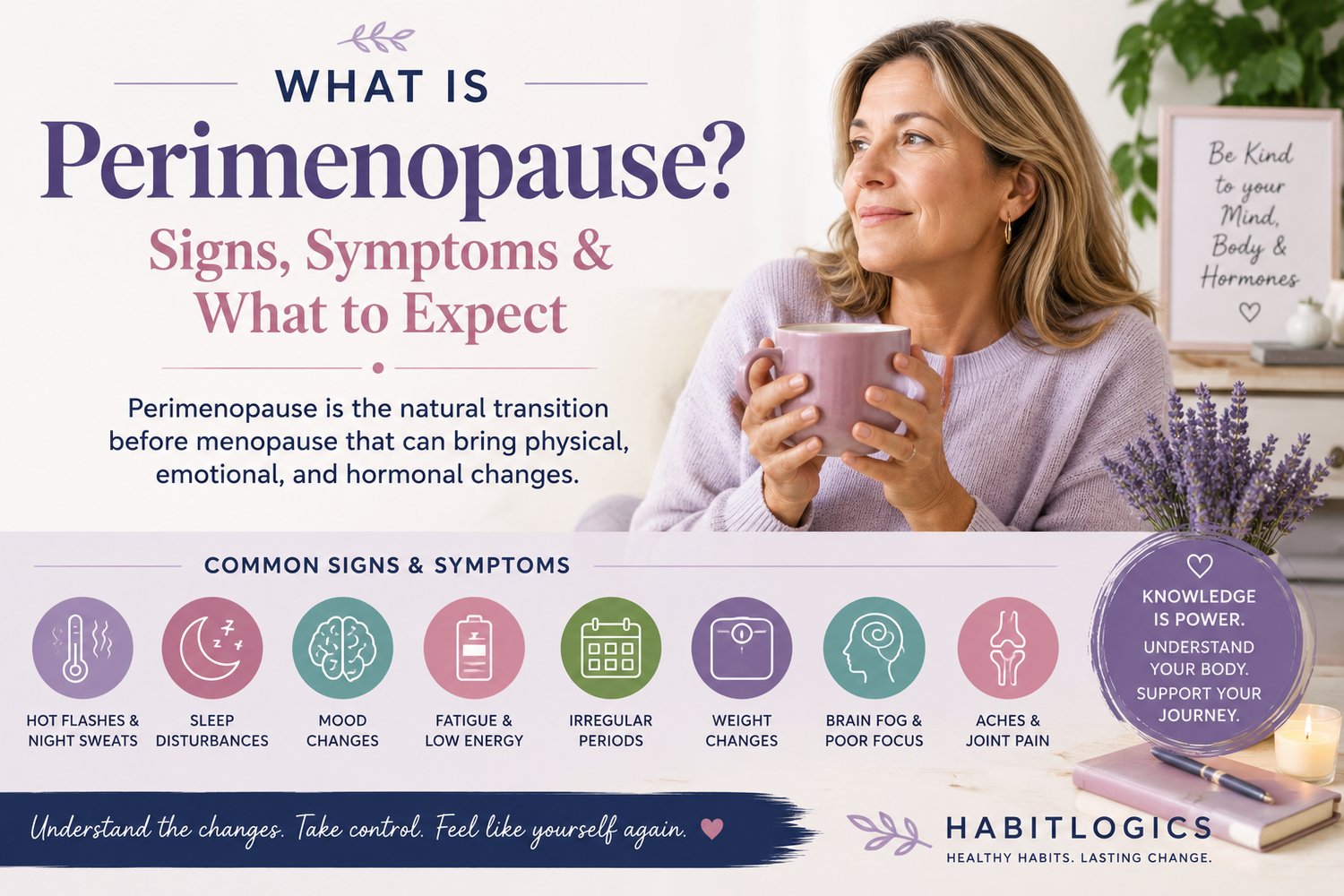
What Is Perimenopause? Signs, Stages, Symptoms & What to Expect
Maybe your periods suddenly aren't as predictable as they used to be.
Maybe you're waking up sweating at 2 a.m.
Maybe your sleep is terrible, your mood feels different, or you've started wondering why your body seems to be changing even though you haven't dramatically changed how you live.
And eventually the question comes up:
“Could this be perimenopause?”
If you're somewhere in your 40s, possibly.
Perimenopause is the transition leading up to menopause. It can last for several years and may affect menstrual cycles, temperature regulation, sleep, mood, vaginal and urinary health, sexual function, and other aspects of well-being.
But perimenopause isn't a diagnosis for every strange thing that happens during midlife.
Understanding what it actually is—and what it isn't—makes the transition considerably less confusing.
What Is Perimenopause?
Perimenopause is the period of transition before menopause.
During the reproductive years, ovarian hormones and ovulation generally follow a repeating menstrual pattern.
As you approach menopause, ovarian function becomes less predictable.
Ovulation may occur during some cycles and not others. Estrogen and progesterone levels can fluctuate considerably, and menstrual cycles often begin changing.
Eventually, ovarian hormone production declines more consistently and menstrual periods stop.
Perimenopause ends when menopause is reached.
Menopause is identified after 12 consecutive months without a menstrual period, assuming there isn't another physiological or medical explanation for the absence of menstruation.
After that point, you're postmenopausal.
So despite the way the words are often used online:
Perimenopause and menopause aren't the same thing.
Read Perimenopause vs. Menopause: What’s the Difference? for the full breakdown.
Why Does Perimenopause Happen?
Perimenopause happens because ovarian function changes as the reproductive years wind down.
One common oversimplification is:
“Your estrogen gets low and causes symptoms.”
Reality is messier.
During the menopause transition, hormone levels can fluctuate substantially rather than simply declining in a straight line.
That changing hormonal environment can influence several systems throughout the body.
Estrogen and other reproductive hormones interact with processes involving:
- Menstrual cycles
- Ovulation
- Temperature regulation
- Vaginal and urinary tissues
- Bone health
- Sexual function
- The brain and nervous system
Eventually estrogen levels become consistently lower after menopause.
During perimenopause, however, fluctuation and changing ovarian function are major parts of the story.
That helps explain why symptoms can sometimes feel so unpredictable.
When Does Perimenopause Start?
Perimenopause most commonly begins during the 40s.
There isn't one exact starting age.
Some women notice changes earlier in their 40s, while others don't recognize obvious symptoms until later.
Changes suggesting declining ovarian function before age 40 deserve additional medical evaluation rather than being automatically labeled ordinary perimenopause.
That's because conditions such as premature ovarian insufficiency (POI) and other medical issues can produce similar changes.
For a detailed age-by-age explanation, read When Does Perimenopause Start? Age, Early Signs & What to Expect.
What Is Usually the First Sign of Perimenopause?
For many women, one of the biggest early clues is a change in menstrual patterns.
A previously predictable cycle may become less predictable.
Periods might become:
- Shorter
- Longer
- Closer together
- Farther apart
- Heavier
- Lighter
- Occasionally skipped
Other women first notice hot flashes, night sweats, sleep disruption, vaginal symptoms, or mood changes.
There isn't one required first symptom.
And despite what enormous internet checklists might suggest, you don't need to accumulate a certain number of symptoms to “qualify.”
The overall pattern matters more.
What Are the Most Common Perimenopause Symptoms?
Perimenopause can affect people very differently.
Some have relatively few symptoms.
Others experience symptoms significant enough to interfere with sleep, work, relationships, sexual health, or quality of life.
Common or recognized symptoms and changes can include:
- Irregular menstrual cycles
- Hot flashes
- Night sweats
- Sleep problems
- Vaginal dryness
- Urinary symptoms
- Mood changes
- Anxiety
- Problems with concentration or memory
- Headaches or changes in migraine patterns
- Changes in sexual desire
- Joint or muscle discomfort
- Changes in body composition
But here's an important distinction:
Experiencing a symptom during perimenopause doesn't automatically mean perimenopause caused it.
Fatigue, headaches, anxiety, palpitations, weight changes, dizziness, hair loss, and many other symptoms can have numerous explanations.
That's why the combination of age + menstrual changes + characteristic symptoms + medical history is much more useful than a symptom checklist alone.
Read 35 Perimenopause Symptoms: Common Signs, What’s Normal & When to Get Help for the detailed version.
Why Can Perimenopause Feel So Unpredictable?
Because the transition itself isn't necessarily linear.
You may have a few difficult months and then feel considerably better.
Your periods might become irregular and then appear relatively predictable again for a while.
Hot flashes may disappear and return.
Sleep may improve and then fall apart again.
That doesn't necessarily mean you're moving backward.
Hormone patterns and ovulation can vary throughout the transition, and symptoms can change along with them.
It can be annoying.
It can also make relying on memory surprisingly unreliable—which is one reason tracking changes can be useful.
What Are the Stages of Perimenopause?
You may hear people talk about early and late perimenopause.
These aren't simply descriptions of symptom severity.
They're primarily related to changes in the menstrual cycle.
Early Menopause Transition
Earlier in the transition, menstrual cycles generally become more variable.
You may still have a period most months, but the timing starts changing noticeably compared with your previous pattern.
Symptoms such as hot flashes may begin during this stage, although not everyone experiences them.
Late Menopause Transition
Later in the transition, longer stretches without a period become more common.
Cycles become increasingly unpredictable as the final menstrual period approaches.
Eventually, a full 12 months pass without menstruation.
At that point, menopause has been reached.
You won't necessarily know which period was your final period when it happens.
You recognize it retrospectively after 12 months have passed.
How Long Does Perimenopause Last?
There isn't one universal duration.
The transition usually lasts several years, but individual experiences vary.
That's another reason “When will this be over?” is frustratingly difficult to answer.
Symptoms may also have their own timelines.
Irregular menstruation ends with menopause because menstrual periods stop.
Hot flashes may continue after menopause.
Vaginal and urinary symptoms can persist or worsen without treatment.
So reaching menopause doesn't necessarily mean every symptom immediately disappears.
How Is Perimenopause Diagnosed?
There isn't one single test that everyone needs.
For otherwise healthy people 45 and older with typical menopause-associated symptoms, healthcare professionals can generally identify perimenopause from the clinical picture.
That can include:
- Age
- Menstrual-cycle changes
- Hot flashes or night sweats
- Other symptoms
- Medical history
- Medications
- Other possible explanations
Routine hormone testing generally isn't necessary in this situation.
Why?
Because hormone levels can fluctuate considerably during perimenopause.
One blood draw can tell you what your hormones were doing at that moment without neatly answering where you are in a transition lasting several years.
Testing becomes more relevant when the situation is less typical—for example, when menopause is suspected between ages 40 and 45 or ovarian insufficiency is suspected before age 40.
A healthcare professional may also order tests when symptoms could indicate something else, such as pregnancy, thyroid disease, anemia, or another medical condition.
Is There a Test You Can Buy to Confirm Perimenopause?
This is worth separating from the medical-testing question because at-home “menopause tests” are increasingly marketed directly to consumers.
Some measure follicle-stimulating hormone (FSH).
FSH changes as ovarian function declines.
The problem is that FSH can also fluctuate during perimenopause.
A single result therefore doesn't provide a perfect yes/no answer to:
“Am I in perimenopause?”
If you're over 45 with characteristic symptoms and menstrual changes, routine biochemical testing usually isn't needed to identify the transition.
If you're younger, your symptoms are unusual, or your menstrual changes need investigation, that's a different situation—and a healthcare professional can determine which tests actually make sense.
More testing isn't automatically better information.
Can You Still Get Pregnant During Perimenopause?
Yes.
Fertility declines with age, and ovulation becomes less predictable during the menopause transition.
But unpredictable ovulation isn't the same as no ovulation.
Pregnancy remains possible until menopause has been reached.
If pregnancy is possible and you miss a period, don't automatically assume perimenopause caused it.
And if you don't want to become pregnant, irregular periods shouldn't be treated as contraception.
Discuss contraception and when it can safely be discontinued with your healthcare professional.
What's the Difference Between Perimenopause and Premature Ovarian Insufficiency?
These terms shouldn't be casually lumped together.
Typical perimenopause occurs as part of the natural menopause transition, most commonly during the 40s.
Premature ovarian insufficiency (POI) involves loss or significant impairment of normal ovarian function before age 40.
POI deserves medical evaluation because earlier loss of ovarian function can affect:
- Fertility
- Bone health
- Cardiovascular health
- Long-term hormone exposure
- Treatment decisions
Likewise, menopause occurring between ages 40 and 45 is considered early menopause and deserves appropriate clinical consideration.
If you're experiencing significant cycle changes or menopause-like symptoms before 40, don't simply diagnose yourself from an online symptom list.
Get evaluated.
What Happens to Your Period During Perimenopause?
This is one of the areas where variation becomes especially obvious.
You may experience:
- Short cycles
- Long cycles
- Missed periods
- Lighter bleeding
- Heavier bleeding
- Less predictable timing
That can all occur during the menopause transition.
But being in perimenopause doesn't make every type of bleeding normal.
Talk with a healthcare professional about bleeding that is unusually heavy, prolonged, occurs between periods, occurs after sex, or otherwise concerns you.
And any vaginal bleeding after menopause should be medically evaluated.
Don't let “it's probably hormones” become a reason to ignore something that deserves attention.
What Happens to Weight and Body Composition?
This is where perimenopause attracts a spectacular amount of bullshit marketing.
You'll see claims that one hormone has “switched off your metabolism” or that a particular diet can “reset menopause hormones” and melt belly fat.
The real picture is more complicated.
Midlife body-composition changes can reflect a combination of:
- Aging
- Changes in muscle mass
- Physical activity
- Nutrition
- Sleep
- Medications
- Stress
- Hormonal changes
- Changes in fat distribution
Menopause appears to influence where body fat tends to accumulate, while aging and energy balance also influence overall weight.
Read Perimenopause Weight Gain: Why It Happens & What Actually Helps for the full discussion.
Does Perimenopause Affect Sleep?
It certainly can.
Hot flashes and night sweats can wake you directly, but they're not the only possible contributors.
Sleep during midlife can also be affected by:
- Mood changes
- Stress
- Insomnia
- Sleep habits
- Alcohol
- Caffeine
- Sleep apnea
- Other medical conditions
That distinction matters because fixing sleep isn't always as simple as fixing hot flashes.
Read Sleep During Perimenopause: Why It Changes & How to Sleep Better.
If you're trying to identify patterns between sleep and nighttime symptoms, the Perimenopause Sleep & Hot Flash Planner provides printable and Excel tools for tracking sleep, night sweats, hot flashes, and bedtime routines.
Does Perimenopause Affect Mood and Brain Fog?
It can.
Some women notice changes involving:
- Irritability
- Mood
- Anxiety
- Concentration
- Memory
- Mental sharpness
Hormonal changes may contribute, but sleep disruption, stress, existing mental health conditions, medications, and other health factors can overlap.
Mild cognitive complaints during the menopause transition are also not the same thing as dementia.
Explore these separately in:
Mood Swings During Perimenopause: Why They Happen & What May Help
Brain Fog During Perimenopause: Why It Happens & What May Help
Significant depression, anxiety, or rapidly worsening cognitive symptoms deserve professional evaluation rather than being dismissed as “just hormones.”
Can Lifestyle Changes Help During Perimenopause?
Yes—with an important qualification.
Healthy habits can support your health during perimenopause.
They cannot prevent the natural menopause transition or guarantee that you'll never experience symptoms.
Useful foundations include:
- Regular physical activity
- Resistance training
- Adequate protein
- Fiber-rich, nutrient-dense foods
- Consistent sleep habits
- Not smoking
- Moderating alcohol when appropriate
- Stress-management strategies that work for you
Walking supports cardiovascular health, mobility, and activity.
Strength training helps preserve muscle, strength, and bone.
Adequate nutrition supports those efforts.
Sleep matters for physical and mental well-being.
None of that requires pretending broccoli and dumbbells can “balance your hormones.”
For practical strategies, see:
- Healthy Habits During Perimenopause: What Actually Matters
- Walking During Perimenopause: Benefits for Weight, Mood & Health
- Strength Training During Perimenopause: Benefits, Workouts & How to Start
- Best Diet for Perimenopause: What to Eat for Midlife Health
- Protein During Perimenopause: How Much Do You Need?
If you prefer having the lifestyle pieces organized in one place, the Perimenopause Lifestyle Reset Workbook combines sleep, energy and stress tracking with walking and strength planning in printable and Excel formats.
Are There Medical Treatments for Perimenopause Symptoms?
Yes.
This is another place where wellness content sometimes does readers a disservice.
Lifestyle habits matter.
Medical treatment also exists.
Depending on the symptom and your individual health history, treatment options can include hormonal and nonhormonal approaches.
Menopausal hormone therapy can be highly effective for bothersome vasomotor symptoms such as hot flashes and night sweats in appropriate candidates.
Local vaginal estrogen and other treatments may be considered for genitourinary symptoms.
Nonhormonal medications are also available for certain symptoms.
Treatment isn't one-size-fits-all, and the appropriate option depends on factors including:
- Which symptoms are bothering you
- Symptom severity
- Age and stage of the menopause transition
- Medical history
- Whether you have a uterus
- Personal risk factors
- Preferences
Read Hormone Therapy During Perimenopause: Benefits, Risks & What to Know for a deeper look at one major treatment option.
Track What's Actually Happening
When symptoms fluctuate, memory gets fuzzy remarkably quickly.
Tracking can help you record:
- Menstrual-cycle dates
- Changes in bleeding
- Hot flashes
- Night sweats
- Sleep
- Mood
- Energy
- Headaches
- Exercise
- Nutrition
- Other symptoms
- Possible triggers
The goal isn't to monitor every twitch your body makes.
It's to create a useful timeline.
That can help you spot patterns and give your healthcare professional better information if you decide to seek treatment.
The FREE Perimenopause Starter Kit includes a symptom tracker, sleep and hot flash log, habit planner, and wellness guide in a 28-page printable PDF.
For more detailed tracking in printable and Excel formats, the Perimenopause Symptom Tracker provides a more comprehensive system for tracking menstrual changes, hot flashes, mood, sleep, symptoms, and patterns over time.
When Should You Talk With a Healthcare Professional?
You don't have to wait until perimenopause becomes unbearable.
Consider talking with a healthcare professional if:
- Symptoms interfere with sleep, work, relationships, sexual health, or quality of life
- You're experiencing significant menstrual changes before age 40
- You're concerned about early menopause
- Bleeding becomes unusually heavy or prolonged
- You experience bleeding between periods
- You experience bleeding after sex
- You have significant pelvic pain
- You develop new or severe symptoms
- You're unsure whether symptoms could have another cause
- You want to discuss treatment options
Any vaginal bleeding after menopause should be evaluated.
And remember:
Seeking treatment doesn't mean you've somehow failed at managing perimenopause naturally.
Sometimes lifestyle changes are enough.
Sometimes they're part of the solution.
Sometimes medication makes a huge difference.
Those things can coexist.
Frequently Asked Questions
Is perimenopause the same thing as menopause?
No.
Perimenopause is the transition leading up to menopause.
Menopause is reached after 12 consecutive months without a menstrual period when another cause doesn't explain the absence of menstruation.
After menopause, you're postmenopausal.
What age does perimenopause usually start?
Perimenopause most commonly begins during the 40s, although individual timing varies.
Significant menstrual changes or menopause-like symptoms before age 40 deserve medical evaluation.
What are the first signs of perimenopause?
Changes in menstrual-cycle patterns are among the most characteristic early signs.
Hot flashes, night sweats, sleep problems, vaginal symptoms, mood changes, and other symptoms may also occur.
How do I know if I'm actually in perimenopause?
Healthcare professionals generally consider your age, menstrual history, characteristic symptoms, medical history, medications, and other possible causes.
For otherwise healthy people 45 and older with a typical presentation, routine hormone testing generally isn't necessary.
Can you still get pregnant during perimenopause?
Yes.
Ovulation becomes less predictable but may still occur, so pregnancy remains possible until menopause has been reached.
How long does perimenopause last?
Usually several years, although individual timelines vary.
Symptoms can also appear and disappear throughout the transition rather than progressing steadily.
Does everyone get hot flashes?
No.
Hot flashes are common but aren't required for perimenopause.
Some women have relatively few vasomotor symptoms.
Does perimenopause cause weight gain?
Midlife weight and body-composition changes have multiple contributors.
Hormonal changes can influence body-fat distribution, while aging, muscle mass, physical activity, nutrition, sleep, medications, and other factors can influence overall weight.
Do you need treatment for perimenopause?
Not necessarily.
Some women have mild symptoms and don't need medical treatment.
Others have symptoms that substantially affect quality of life and benefit from hormonal or nonhormonal treatment.
Treatment decisions should be individualized rather than based on the idea that everyone either needs hormones or should avoid them.
Key Takeaways
- Perimenopause is the transition leading up to menopause.
- It most commonly begins during the 40s and can last several years.
- Ovarian function and reproductive hormone patterns become increasingly variable during the transition.
- Changes in menstrual cycles are among the most characteristic early signs.
- Hot flashes, night sweats, sleep problems, vaginal and urinary symptoms, mood changes, and cognitive complaints may also occur.
- Not every symptom experienced during midlife is caused by perimenopause.
- Pregnancy remains possible until menopause.
- Routine hormone testing generally isn't needed in otherwise healthy people 45 and older with typical symptoms.
- Symptoms before age 40 deserve additional medical evaluation.
- Lifestyle habits can support long-term health but aren't a cure for the menopause transition.
- Hormonal and nonhormonal treatments are available when symptoms become bothersome.
- Tracking menstrual changes and symptoms can make patterns easier to recognize and discuss with a healthcare professional.
Continue Learning
Now that you understand the basics, explore the parts of perimenopause most relevant to you:
- When Does Perimenopause Start? Age, Early Signs & What to Expect
- 35 Perimenopause Symptoms: Common Signs, What’s Normal & When to Get Help
- Perimenopause vs. Menopause: What’s the Difference?
- Managing Hot Flashes During Perimenopause
- Sleep During Perimenopause
- Hormone Therapy During Perimenopause
- Perimenopause Weight Gain
Or return to the Complete Perimenopause Guide for the full HabitLogics perimenopause roadmap.
Educational Disclaimer
This article is intended for educational purposes only and is not medical advice, diagnosis, or treatment. Symptoms associated with perimenopause can overlap with pregnancy, thyroid disorders, premature ovarian insufficiency, medication effects, mental health conditions, and other medical issues. Consult a qualified healthcare professional about new, persistent, severe, or concerning symptoms and for individualized diagnosis and treatment.