

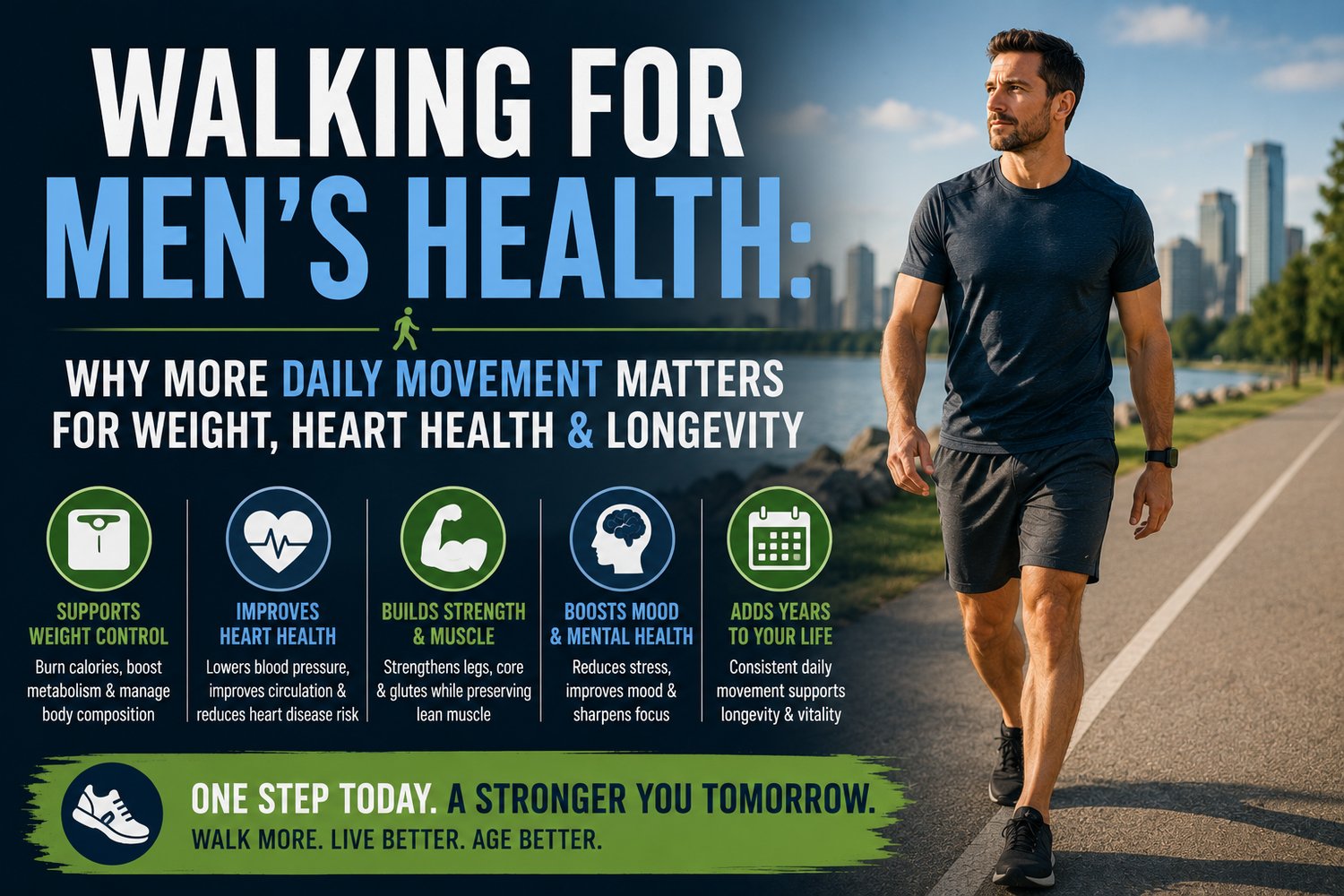
Walking for Men's Health: Why More Daily Movement Matters for Weight, Heart Health & Longevity
Walking gets overlooked because it feels too simple.
Men's fitness culture tends to reward things that look difficult.
Heavy weights.
Hard intervals.
Long runs.
Extreme challenges.
Walking?
It barely feels like exercise.
That's exactly why it deserves more attention.
Walking is one of the simplest ways for men to increase daily physical activity, improve cardiovascular fitness, reduce sedentary time, support weight management, and stay active without creating much recovery demand.
You don't need:
- A gym membership
- Expensive equipment
- Complicated programming
- Significant recovery time
- An advanced fitness level
You need shoes and somewhere to move.
Current U.S. physical-activity guidance recommends adults work toward 150–300 minutes of moderate-intensity aerobic activity per week plus muscle-strengthening activity on at least two days. Brisk walking can count toward that aerobic target.
If you're new to the men's-health pillar, start with:
Together, those habits create a much stronger foundation than chasing one perfect workout or supplement.
Why Walking Belongs in a Men's Fitness Plan
Walking and strength training solve different problems.
Strength training helps build and maintain:
- Muscle
- Strength
- Bone health
- Physical capacity
Walking helps accumulate:
- Aerobic activity
- Daily movement
- Low-fatigue calorie expenditure
- Time away from sitting
- General cardiovascular fitness
You don't have to choose one.
In fact, current physical-activity guidance recommends both aerobic exercise and muscle-strengthening activity.
That's why walking and lifting pair so well.
Walking Lets You Do More Without Destroying Recovery
Hard training creates fatigue.
Walking usually doesn't create much.
That's useful if you're already:
- Strength training
- Working a physical job
- Managing family responsibilities
- Trying to improve fitness without living in a gym
- Recovering between harder workouts
You can often increase walking substantially without interfering with your next strength session.
That's a major practical advantage.
Fitness isn't only about how hard one workout is.
It's about how much useful activity you can repeat consistently.
Walking Supports Cardiovascular Health
You don't need to become a runner to train your cardiovascular system.
Brisk walking can qualify as moderate-intensity aerobic exercise and contribute toward the recommended weekly activity target.
Regular physical activity supports cardiovascular health and can help with risk factors such as:
- Blood pressure
- Blood glucose
- Body weight
- Overall fitness
The American Heart Association continues to promote walking as one of the simplest and most accessible ways to become more active.
For many men, that's much more realistic than suddenly deciding:
“Starting tomorrow, I'm running five miles every morning.”
Walking and Blood Pressure
High blood pressure can exist without obvious symptoms.
That's why knowing your blood pressure matters even when you feel completely fine.
Regular physical activity is part of the broader lifestyle approach used to support cardiovascular health.
Walking isn't a substitute for prescribed blood-pressure medication when medication is needed.
But it can be one part of a larger plan that also includes:
- Nutrition
- Weight management
- Sleep
- Smoking cessation
- Medical treatment when appropriate
If you don't know your blood pressure, that's a more useful health number to learn than your latest smartwatch recovery score.
Walking and Blood Sugar
Your muscles use glucose for energy.
Physical activity can therefore affect post-meal blood glucose.
One particularly practical strategy is walking after meals.
Research comparing exercise timing has found that exercise performed after eating can reduce post-meal glucose excursions, although the size of the effect and clinical importance vary by population and study design.
You don't necessarily need an hour-long session.
A short walk after:
- Breakfast
- Lunch
- Dinner
can add activity while attaching movement to something you're already doing.
Meal finished → walk.
That's a very easy habit cue.
Short Walking Breaks Can Help Break Up Sitting
A man can technically “work out” and still spend most of the day sitting.
You might:
- Drive to work
- Sit eight hours
- Drive home
- Sit at dinner
- Sit watching television
Then wonder why your daily movement is so low.
Current guidance specifically encourages adults to:
Move more and sit less.
And a 2026 meta-analysis found that interrupting prolonged sitting with short activity breaks improved post-meal glucose and insulin responses, with walking breaks producing some of the strongest effects.
That doesn't mean you need to set an alarm every 20 minutes for the rest of your life.
It means short bouts count.
Try:
- Walking during a phone call
- Taking a few minutes to move each hour
- Walking at lunch
- Taking the stairs
- Parking farther away
Small bouts accumulate.
Walking and Weight Loss
Walking burns calories.
But its biggest weight-management advantage may be repeatability.
Imagine two approaches.
Approach A
A brutally difficult workout plan five days per week.
You last two weeks.
Approach B
Thirty to forty-five minutes of walking most days for the next two years.
Which one produces more total activity?
Usually the boring one.
Walking can support fat loss when combined with appropriate nutrition.
But it doesn't override calorie intake.
You can absolutely out-eat your walking routine.
A stronger fat-loss foundation includes:
- Appropriate calorie intake
- Adequate protein
- Strength training
- Walking
- Good sleep
For the deeper weight-loss version, visit the Complete Walking for Weight Loss Guide.
For abdominal fat specifically, read Why Belly Fat Gets Harder to Lose After 30.
Do Men Need 10,000 Steps Per Day?
No.
There is nothing magical about exactly 10,000 steps.
It's a useful round target.
It isn't a biological cliff where:
9,999 = unhealthy
and:
10,000 = healthy.
If you're currently averaging 3,000 steps per day, increasing to 4,000 or 5,000 is progress.
If you're already averaging 8,000 or 9,000, you may not need to reorganize your entire day just to satisfy a watch.
The useful goal is:
Become more active than your current baseline when more activity would benefit you.
How Many Steps Should You Aim For?
Rather than starting with one universal number, establish your normal activity first.
Track a typical week without deliberately changing your routine.
Suppose you average:
2,500 Steps
Try moving toward 3,500–4,000.
5,000 Steps
Try 6,000–7,000.
8,000 Steps
You may already have a solid movement baseline.
Then decide whether more walking serves a specific goal.
These aren't medical thresholds.
They're examples of gradual progression.
The best step target is one that encourages more movement without turning your life into a step-count scavenger hunt.
Walking Minutes May Be More Useful Than Step Goals
You don't actually need to track steps.
Another simple method is tracking walking time.
For example:
- 20 minutes after work
- 10 minutes after lunch
- 30 minutes before dinner
A brisk 30-minute walk five days per week adds up to approximately:
150 minutes
which meets the minimum weekly moderate-intensity aerobic target when the intensity is sufficient.
That may be easier for some people than obsessing over step counts.
Does Walking Pace Matter?
Yes.
But not every walk has to be brisk.
A relaxed walk still gives you:
- Movement
- Time away from sitting
- Light activity
- A break from screens
A brisker walk provides a stronger aerobic stimulus.
One easy method is the talk test.
During moderate-intensity activity, you should generally:
- Notice your breathing increase
- Feel your heart rate rise
- Still be able to speak
- Have more difficulty singing
You don't need a heart-rate monitor for every walk.
Sometimes:
“Walk briskly enough that it feels like exercise”
works just fine.
What About Zone 2 Walking?
Zone 2 has become extremely popular in longevity and fitness content.
At a basic level, it refers to relatively sustainable aerobic work performed below higher-intensity thresholds.
Walking may reach that intensity for some people.
Others may need:
- Faster walking
- Hills
- Incline treadmill work
- Cycling
- Another activity
You don't need every walk to become a metabolic laboratory experiment.
If you're interested in the topic, the Complete Walking for Weight Loss Guide connects to the dedicated Zone 2 walking content.
Walking After Meals Is One of the Easiest Habits to Build
If you struggle to find a 30- or 60-minute exercise window, stop searching for one.
Use smaller windows that already exist.
Try:
10 minutes after breakfast
10 minutes after lunch
10 minutes after dinner
Now you've accumulated 30 minutes without scheduling one traditional workout.
And because the walk follows an existing behavior, it becomes easier to remember.
Recent evidence continues to support post-meal activity as a useful strategy for reducing post-meal glucose excursions, particularly in people with impaired glucose regulation or type 2 diabetes.
It's simple.
That doesn't make it useless.
Morning Walks
Morning walking has practical advantages.
It can help you:
- Get outside early
- Add movement before the day becomes busy
- Build a predictable routine
- Combine light exposure with activity
That also fits nicely with the sleep strategies in Sleep for Men.
Morning isn't magically better for fat loss.
It's just convenient for some people.
Evening Walks
Evening walking works too.
A walk after dinner can:
- Help you decompress
- Give you time away from screens
- Add movement after a sedentary day
- Create a family routine
- Provide post-meal activity
There isn't one universally superior time.
The best time to walk is the time you will actually repeat.
Walking and Stress
Sometimes the best reason to walk has nothing to do with:
- Calories
- Heart rate
- Weight loss
- Steps
Walking gives you:
- Space
- Movement
- Time outdoors
- A break from work
- Fewer screens
- Time to think
Regular physical activity can support mood and stress management.
A 20-minute walk may not solve whatever is stressing you out.
But you may be in a better state to deal with it afterward.
Walking and Sleep
Walking can fit naturally into better sleep habits.
Regular physical activity supports overall health and sleep.
Walking also offers movement without the same recovery cost as hard training.
One useful combination is:
Morning daylight + walking + reasonably consistent sleep schedule.
Simple.
Read Sleep for Men for the full sleep strategy.
Walking Won't Replace Strength Training
Walking is excellent aerobic and general physical activity.
It doesn't provide the same resistance stimulus as strength training.
For healthy aging, preserve both:
Cardiovascular capacity + muscular strength
That's why Strength Training for Men Over 30 belongs right next to this article.
Current guidelines recommend both forms of activity.
Walking and lifting aren't competing philosophies.
They're two pieces of a more complete fitness plan.
Walking Won't Fix a Poor Diet Either
Another common thought:
“I walked five miles. I earned this.”
Exercise doesn't need to become a transaction where food creates debt and movement repays it.
Walking contributes to energy expenditure.
Weight management still depends on the entire picture.
Build most meals around:
- Protein
- Fruits and vegetables
- Fiber-rich carbohydrates
- Healthy fats
For protein specifically, read Protein for Men.
For meal planning, use the Complete High-Protein Guide.
Does Walking Increase Testosterone?
Walking is good for health.
It doesn't need to become another testosterone hack.
Regular activity can support:
- Healthy body composition
- Metabolic health
- Cardiovascular health
- Sleep
- General fitness
Those factors can contribute to a healthier environment for normal hormonal function.
But walking is not a treatment for clinically diagnosed testosterone deficiency.
If hormone health is your concern, read:
- How to Support Testosterone Naturally
- Low Testosterone Symptoms
- How Testosterone Is Tested and Diagnosed
Don't turn your step count into a testosterone test.
A Simple 4-Week Walking Plan
If you're currently doing very little intentional walking, start modestly.
Week 1
20 minutes × 4 days
Week 2
20–25 minutes × 5 days
Week 3
30 minutes × 5 days
Week 4
Continue 30-minute walks or add one longer recreational walk if you enjoy it.
The exact progression isn't important.
The habit is.
If 20 minutes is too much right now, start with 5 or 10.
Some activity is better than none, and activity can be gradually increased over time.
A Simple Walking + Strength Week
You don't necessarily need separate “cardio days.”
Try:
Monday
Strength training
20-minute easy walk
Tuesday
30-minute brisk walk
Wednesday
Strength training
Short easy walk
Thursday
30-minute brisk walk
Friday
Strength training
Short recovery walk
Saturday
Longer recreational walk, hike, or other aerobic activity
Sunday
Easy movement or rest
That gives you:
- Strength
- Aerobic work
- Daily movement
- Recovery
without requiring anything extreme.
What If You Have a Desk Job?
Then creating movement triggers becomes especially useful.
Try:
During Work
Stand and move periodically.
Lunch
Walk 10–15 minutes.
Phone Calls
Walk when practical.
After Work
Walk before settling in for the evening.
After Dinner
Take another short walk.
The American Heart Association continues to emphasize reducing prolonged sedentary time and adding more movement throughout the day.
You don't need to “work out” every time you stand up.
Just move.
What If You Work on Your Feet?
Then context changes.
If your job already includes substantial:
- Walking
- Standing
- Carrying
- Lifting
- Physical labor
you don't need to blindly add another 10,000 intentional steps because an app told you to.
You may benefit more from:
- Structured strength training
- Targeted aerobic work
- Mobility where needed
- Recovery
- Sleep
Activity recommendations aren't intended to erase the physical activity you're already doing.
Your starting point matters.
Make Walking Automatic
The easiest way to walk more is to stop requiring motivation for every walk.
Attach walking to behaviors that already happen.
Coffee → short walk
Lunch → walk
Dinner → walk
Phone call → walk
Podcast → walk
The goal is to make movement a normal part of the day rather than a special event requiring preparation.
That's the same systems-based approach in Healthy Habits for Men.
Track Progress Without Becoming Obsessed
Useful walking metrics can include:
- Daily steps
- Weekly walking minutes
- Distance
- Pace
- Number of walks completed
You don't need all of them.
Pick the one that helps you stay consistent.
Wearables can help some people move more. A 2026 review in people with cardiovascular disease found that app- and wearable-supported programs increased daily steps and moderate-to-vigorous physical activity, though longer-term adherence still needs more research.
The tool isn't the goal.
Movement is.
The Men's Health & Performance Dashboard can help track activity alongside:
- Fitness
- Body composition
- Energy
- Recovery
- Health habits
For a broader habit system, the Men's Momentum System Bundle includes walking, fitness, goal-setting, and habit tracking.
And the FREE Men's Hormone & Energy Starter Kit provides a free starting point.
Common Walking Mistakes
Thinking Walking Doesn't Count
It counts.
Not every useful form of exercise needs to leave you lying on the floor.
Trying to Reach 10,000 Steps Immediately
Increase gradually.
A sustainable increase is more valuable than three heroic days followed by sore feet.
Never Increasing the Challenge
If your fitness goal includes improving aerobic capacity, an occasional harder walking session can include:
- Faster pace
- Longer duration
- Hills
- Incline
You don't need every walk to become harder.
Some can simply remain easy movement.
Ignoring Footwear and Pain
You don't need $250 walking shoes.
You do need footwear that:
- Fits reasonably well
- Is comfortable
- Isn't completely worn out
Persistent:
- Foot pain
- Knee pain
- Hip pain
- Back pain
deserves attention rather than endlessly trying to walk through it.
Using Walking as Punishment for Eating
Walking isn't punishment.
Exercise is something you do because maintaining a capable body is useful.
Don't turn movement into a debt owed because you ate dessert.
Frequently Asked Questions
How Much Should Men Walk Every Day?
There isn't one universal daily step target.
Start with your current activity level and gradually increase it when appropriate.
For general health, work toward meeting the broader aerobic-activity target of at least 150 minutes of moderate-intensity activity per week.
Is 30 Minutes of Walking a Day Enough?
Thirty minutes of brisk walking five days per week equals roughly 150 minutes.
That meets the minimum weekly moderate-aerobic target if your walking intensity qualifies as moderate.
More activity may provide additional benefits.
Can Walking Help Men Lose Belly Fat?
Walking can contribute to calorie expenditure and weight management.
You cannot selectively burn abdominal fat.
Nutrition, total activity, strength training, sleep, and overall calorie balance all matter.
Is Walking Better Than Running?
Neither is universally better.
Running generally provides a stronger aerobic and calorie-expenditure stimulus per minute.
Walking is usually easier to:
- Recover from
- Perform frequently
- Fit into everyday life
Choose based on your goals, preferences, joints, and fitness level.
Should Men Walk on Strength-Training Days?
Absolutely, if you're recovering well.
Easy or moderate walking generally pairs very well with resistance training.
Is Walking Enough Exercise?
Walking can provide a large portion—or potentially all—of your moderate aerobic activity.
For a more complete fitness program, include resistance training too.
Do You Need 10,000 Steps Every Day?
No.
Ten thousand steps is a convenient target, not a universal biological requirement.
Your baseline and overall activity matter more than hitting one exact number.
Does Walking After Meals Help Blood Sugar?
It can.
Research suggests post-meal activity can reduce glucose excursions, and recent evidence in adults with type 2 diabetes supports beneficial effects from post-meal exercise.
Walking after meals is a practical way to combine this with additional daily activity.
Key Takeaways
- Walking is legitimate exercise and one of the easiest ways to increase daily activity.
- Adults should work toward at least 150 minutes of moderate-intensity aerobic activity per week, with additional benefits possible at higher activity levels.
- You don't need exactly 10,000 steps to benefit.
- Walking can support cardiovascular fitness, weight management, metabolic health, mood, sleep, and general activity.
- Short post-meal walks can help reduce post-meal glucose excursions.
- Breaking up long periods of sitting with walking or other activity can improve post-meal glucose and insulin responses.
- Walking and strength training complement one another.
- Easy walking doesn't need to become Zone 2, a calorie-burning challenge, or a testosterone hack.
- The best walking routine is one you can maintain for years.
Final Thoughts
Walking isn't impressive.
That's one of its greatest strengths.
You don't need to psych yourself up.
You don't need a complicated program.
You don't need expensive equipment.
Put your shoes on.
Move.
Then do it again tomorrow.
Combined with:
- Strength training
- Protein-rich nutrition
- Good sleep
- Cardiovascular care
- Appropriate preventive healthcare
walking gives you one of the simplest foundations for remaining healthier and more capable as you age.
Don't underestimate boring habits.
They're often the ones that survive long enough to matter.
Continue the Men's Wellness Series
For the foundation:
- What Is Men's Wellness?
- Healthy Habits for Men
- Sleep for Men
- Strength Training for Men Over 30
- Protein for Men
- Healthy Aging for Men
For body composition:
- Why Belly Fat Gets Harder to Lose After 30
- Building Muscle After 40
- Complete Walking for Weight Loss Guide
For testosterone:
- Low Testosterone Symptoms
- How Testosterone Is Tested and Diagnosed
- How to Support Testosterone Naturally
- What Is TRT?
For tracking:
- Men's Health & Performance Dashboard
- Men's Momentum System Bundle
- FREE Men's Hormone & Energy Starter Kit
For the complete pillar:
Educational Disclaimer
This article is intended for educational purposes only and should not be considered medical advice. Physical-activity needs vary based on health history, fitness level, medications, injuries, and medical conditions. If you have cardiovascular disease, significant exercise-related symptoms, substantial mobility limitations, or other health concerns, discuss appropriate activity with a qualified healthcare professional before substantially increasing exercise.