

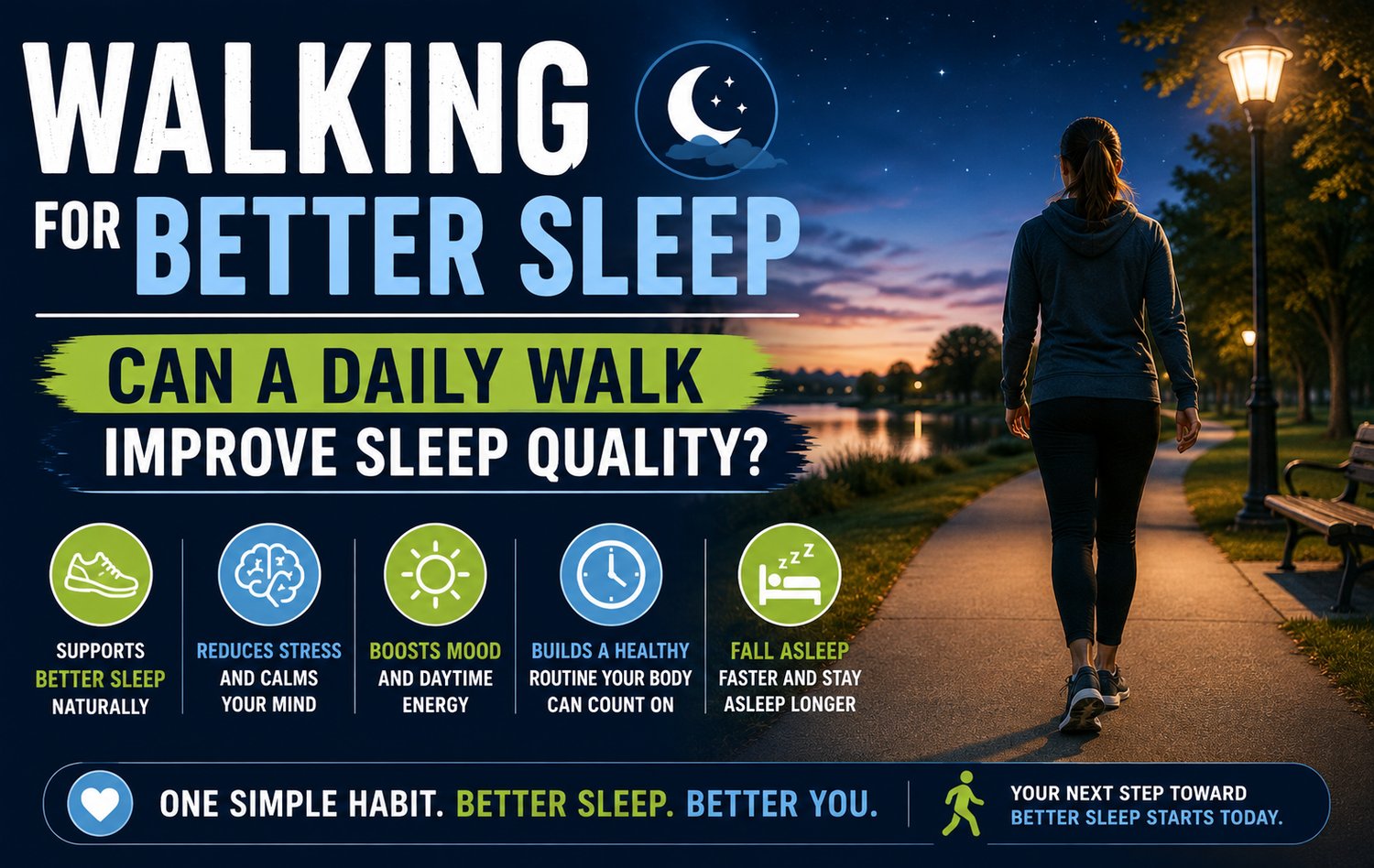
Walking for Better Sleep: Can a Daily Walk Improve Sleep Quality?
The Complete Sleep & Recovery Guide
Walking is probably one of the least glamorous sleep strategies imaginable.
No expensive gadget.
No supplement.
No complicated bedtime routine.
Just:
Put on shoes.
Go outside.
Walk.
And yet, regular walking may support better sleep as part of an overall healthy activity pattern.
Walking can combine several useful ingredients:
Physical activity
Daylight exposure
Stress reduction
Routine
and
less sedentary time
all in one habit.
That makes it especially appealing if you want to improve sleep without turning your entire life upside down.
Our previous article, Exercise and Sleep: Can Working Out Help You Sleep Better?, covered the broader evidence around physical activity and sleep.
Now let's narrow it down to the simplest option:
walking.
Can Walking Help You Sleep Better?
Potentially, yes.
Walking is a form of aerobic physical activity, and regular exercise has repeatedly been associated with better sleep quality.
Recent meta-analytic research examining exercise and sleep has found improvements in subjective sleep quality across several exercise types, including walking-based interventions. (pubmed.ncbi.nlm.nih.gov)
That doesn't mean every walk instantly improves sleep that night.
The more useful interpretation is:
Regular walking may support a healthier overall sleep pattern over time.
And because walking is easy to repeat, that matters.
Why Walking May Help Sleep
There probably isn't one single reason.
Walking can influence several factors that matter for sleep.
Physical Activity
Walking contributes to your total daily activity.
Regular physical activity is one of the habits the CDC and NHLBI include in healthy sleep guidance. (cdc.gov)
Daylight Exposure
If you walk outside, you also get natural light exposure.
That can help support circadian timing, especially earlier in the day.
Stress Reduction
Many people find walking mentally calming.
That can make it useful as a transition between work and evening.
Routine
A daily walk creates another predictable anchor in your day.
Sleep often benefits from regularity.
Less Sedentary Time
Replacing some sitting with movement may also improve overall health and energy regulation.
None of those require high intensity.
That's the beauty of walking.
Walking Is Useful Because It's Sustainable
The biggest strength of walking is not that it's the most powerful possible exercise.
It's that it's easy to keep doing.
You don't need:
- A gym membership
- Special equipment
- Advanced fitness
- A training program
- A recovery plan
- A lot of time
You can walk:
10 minutes.
20 minutes.
30 minutes.
Once a day.
Twice a day.
After meals.
Before work.
After work.
That flexibility makes walking a strong habit.
And habits only help if you actually repeat them.
How Much Walking Do You Need?
There isn't one exact amount of walking required specifically for sleep.
For general health, U.S. physical activity guidelines recommend adults work toward at least 150–300 minutes of moderate-intensity aerobic activity per week, or an equivalent amount of vigorous activity.
Walking can contribute toward that total.
But if you're currently inactive, don't turn that into:
I need 300 minutes immediately.
Start smaller.
Try:
10–20 minutes most days.
Then build from there.
A realistic routine beats an ambitious one you abandon.
Is 10 Minutes of Walking Enough to Help?
It can be a good starting point.
You don't need to hit a giant threshold before walking becomes worthwhile.
A short walk can still:
- Add movement
- Get you outside
- Break up sitting
- Reduce screen time
- Help build a routine
If 10 minutes is easy to maintain, that's useful.
You can always add more later.
Is 30 Minutes Better?
For many people, 20–30 minutes is a practical target.
It's long enough to feel like intentional exercise without taking over your day.
A 30-minute brisk walk can also contribute meaningfully toward weekly aerobic activity goals.
But don't obsess over the number.
If you have 17 minutes:
Walk 17 minutes.
Your body does not reject the session because it wasn't a round number.
Does Walking Speed Matter?
Somewhat.
A faster walk creates a stronger aerobic stimulus than a very slow stroll.
But not every walk has to be brisk.
Different walks can serve different purposes.
Brisk Walk
Useful for:
- Fitness
- Aerobic activity
- Daytime movement
Easy Walk
Useful for:
- Relaxation
- Stress reduction
- Evening transition
- Light recovery
Both can fit into a sleep-supportive routine.
Don't force every walk into a workout.
Morning Walking and Sleep
Morning walking has one particularly useful advantage:
You can combine movement with morning light exposure.
That makes it an efficient sleep habit.
A simple morning walk may provide:
daylight
physical activity
a consistent routine
all at once.
Our guide Morning Habits for Better Sleep: Why Your Daytime Routine Matters at Night explains why early-day light and consistent wake times can support circadian rhythm.
So if you're looking for one high-value habit:
A morning walk is hard to beat.
Do You Need to Walk Immediately After Waking?
No.
You don't need to step outside within a precise number of minutes.
Morning-light advice often becomes absurdly specific.
The useful principle is simply:
Get some daytime light relatively early in your waking period when possible.
If that happens at:
7 a.m.
8 a.m.
or
9 a.m.
that's still useful.
The goal is consistency.
Not stopwatch precision.
What If It's Dark When You Wake Up?
That's common in winter or for early-shift workers.
You can still:
Wake consistently.
Use normal indoor lighting.
Walk outside once daylight is available.
You don't need to skip the habit because sunrise doesn't cooperate with your schedule.
Evening Walking and Sleep
An evening walk can also work well.
This may be especially useful if you need a transition between:
work
and
nighttime.
A relaxed walk after dinner can help you:
- Move your body
- Get away from screens
- Clear your head
- Create a consistent evening routine
- Add light activity without a lot of stimulation
For many people, this is a much easier habit to maintain than a formal workout.
Is Walking Before Bed Bad?
Generally, a light walk close to bedtime is much less stimulating than an intense workout.
There is no strong reason to assume a relaxed walk automatically harms sleep.
If anything, some people find it calming.
The key distinction is intensity.
A gentle walk is different from:
sprints
HIIT
or
hard interval training
right before bed.
If a late walk helps you wind down:
Great.
Keep doing it.
How Close to Bed Can You Walk?
There's no universal cutoff.
A relaxed walk can fit into the evening fairly easily.
You could walk:
30 minutes before bed.
An hour before bed.
Two hours before bed.
The main thing is how you feel afterward.
If you come back calm:
Fine.
If you turn the walk into a hard uphill workout and feel wired:
Move it earlier.
Simple.
Walking After Dinner Can Be a Great Sleep Habit
Walking after dinner has several practical advantages.
It creates a clear pattern:
eat
↓
walk
↓
wind down
↓
bed
It also replaces:
sitting and scrolling
with
movement.
That's useful even if the walk itself isn't directly improving sleep.
You're changing the structure of the evening.
And sometimes that matters more.
Walking Can Help Reduce Screen Time
This is an underrated benefit.
If you walk for 30 minutes after dinner, that's 30 minutes you're not:
Scrolling.
Watching videos.
Working.
Reading stressful news.
Sitting under bright screens.
That can naturally reduce some of the problems we covered in Screen Time and Sleep: Does Your Phone Really Keep You Awake?.
Sometimes improving one habit automatically improves another.
That's ideal.
Walking Can Also Help Your Bedtime Routine
A walk can become the trigger that starts your evening wind-down.
For example:
8:30 p.m. — Walk
9:00 — Shower
9:15 — Prepare tomorrow
9:30 — Read
10:00 — Bed
Now the walk isn't just exercise.
It's part of your routine.
That can make the entire evening more predictable.
Walking and Stress
Stress is one of the biggest practical barriers to sleep.
You can be physically tired and mentally wide awake.
Walking can give you a simple decompression period.
No screens.
No work.
No notifications.
Just movement.
That doesn't mean walking is a treatment for anxiety or insomnia.
But for day-to-day stress, it can be a useful reset.
Walking Outside May Be Better Than Walking Indoors for Circadian Support
If you walk outside, you get light exposure.
That's an advantage.
Indoor walking still counts as physical activity.
Treadmill walking still counts.
Mall walking still counts.
But if sleep is one of your goals and outdoor conditions are reasonable:
Outside gives you movement + light.
That's efficient.
What About Walking on a Treadmill?
Absolutely fine.
If:
The weather is terrible.
It's unsafe outside.
You prefer indoors.
You already own a treadmill.
then use it.
A treadmill walk is still walking.
The sleep benefit from physical activity doesn't disappear because you're indoors.
You just lose the daylight component.
Can Walking Help If You're Sedentary?
This is where walking really shines.
If you're mostly inactive, walking creates a very low barrier to entry.
You don't need to be in shape first.
You get in shape by doing it.
Start with:
5–10 minutes
if that's what you can manage.
Then gradually increase.
This is much better than waiting until you feel motivated enough to start a complicated exercise program.
Walking Is Also Easy to Recover From
Hard training creates recovery demands.
Walking usually doesn't create the same level of fatigue.
That makes it easy to perform frequently.
You can walk:
Most days.
Sometimes multiple times per day.
Without needing extensive recovery.
That makes it especially useful when you're trying to improve sleep and overall activity at the same time.
Does Walking Improve Deep Sleep?
There isn't enough evidence to confidently say:
Walking adds X minutes of deep sleep.
And that probably shouldn't be your goal anyway.
Sleep stages vary.
Consumer wearables estimate them.
Your better indicators are:
How well do you sleep?
Do you wake refreshed?
Is your sleep reasonably continuous?
How do you feel during the day?
If walking improves those things over time:
That's a win.
You don't need your smartwatch to validate it.
Can Walking Help Insomnia?
Exercise in general has shown benefits for insomnia symptoms in research.
Walking may be one accessible way to increase physical activity.
But persistent insomnia deserves more than a walking prescription.
If you've had ongoing difficulty falling asleep or staying asleep for months, evidence-based treatments such as CBT-I may be more appropriate.
Walking can support the system.
It shouldn't become a substitute for proper treatment.
Walking and Sleep Quality
One of the reasons walking is attractive is that it affects several lifestyle factors at once.
Imagine you start a 20-minute morning walk.
Now:
You're waking more consistently.
You're getting daylight.
You're moving.
You're spending less time sedentary.
You may feel better during the day.
Then you become naturally more tired at night.
That's how habits can stack.
Not because walking is a magical sleep treatment.
Because it changes the entire rhythm of the day.
Walking and Weight Management
Walking also creates a natural bridge between sleep and weight management.
It can contribute to:
- Daily activity
- Energy expenditure
- Cardiovascular health
- Routine
- Stress management
And unlike high-intensity exercise, walking is easier for many people to sustain while dieting or dealing with lower energy.
HabitLogics already has a complete walking pillar, so if walking is becoming one of your main health habits, the Complete Walking for Weight Loss Guide goes much deeper into steps, pace, consistency, calories and building a sustainable walking routine.
Sleep and movement don't need to exist as separate projects.
They can reinforce each other.
Walking and Recovery
Walking can also work as light recovery activity.
If you strength train or perform harder workouts, an easy walk can add movement without creating much additional fatigue.
That makes it useful on:
Rest days.
Recovery days.
Low-energy days.
Days after poor sleep.
Instead of:
hard workout or nothing
you have another option.
What If You Slept Badly Last Night?
Don't assume you need to cancel all movement.
If you feel safe and functional, an easy walk may be a good choice.
It gives you:
Light.
Movement.
Routine.
without requiring a demanding workout.
But if you're severely sleepy or physically unwell:
Recovery and safety come first.
Don't force exercise just to maintain a streak.
Should You Walk When You're Exhausted?
Depends on the level of exhaustion.
Mildly Tired
A short walk may actually help you feel more alert.
Severely Sleep Deprived
Keep activity easy.
Prioritize sleep.
Dangerously Sleepy
Don't drive or perform risky exercise.
Safety matters more than hitting steps.
Use common sense.
What About 10,000 Steps?
You do not need exactly 10,000 steps for sleep.
That number is not a sleep threshold.
If you enjoy step goals, use them.
But a meaningful walking routine can exist at many different step totals.
The better question is:
Am I more active than I was before?
And:
Can I sustain this?
Should You Track Steps?
You can.
Step tracking is useful if it motivates you and helps you see patterns.
But don't turn it into another obsession.
You don't need:
9,973 steps at 11:48 p.m.
followed by
27 laps around the kitchen.
😂
A rough daily activity target is enough.
Try the 20-Minute Walking Experiment
For the next two weeks:
Walk for 20 minutes most days.
Preferably outside when practical.
Track:
- Time of walk
- Approximate duration
- Bedtime
- Difficulty falling asleep
- Nighttime awakenings
- Morning energy
- Daytime energy
Keep everything else roughly similar.
Then compare.
If sleep improves:
Great.
If it doesn't:
Walking still has plenty of other benefits.
Try Morning vs. Evening Walking
You can even experiment with timing.
Week 1
Walk earlier in the day.
Week 2
Walk after dinner.
Compare:
energy
bedtime sleepiness
sleep quality
morning energy
You may find one time fits your routine better.
That's more important than identifying a universal winner.
Build Walking Into Something You Already Do
One of the easiest ways to create a walking habit is to attach it to an existing routine.
For example:
After coffee → walk
After lunch → walk
After dinner → walk
After work → walk
This removes the daily decision.
You don't ask:
Should I walk today?
You simply:
eat dinner → walk.
That makes consistency easier.
Walk With Someone
Walking can also be social.
Walk with:
A partner.
Friend.
Coworker.
Dog.
Kids.
This can make the habit more enjoyable and easier to maintain.
And a conversation during a walk may be a much better stress-management tool than another hour of scrolling.
Don't Overcomplicate the Walking Routine
You do not need:
Heart-rate zones.
Weighted vests.
Rucking.
Intervals.
Incline protocols.
Cadence targets.
You can use those later if you enjoy them.
But for sleep:
just walk.
Start simple.
Walking Should Support Sleep, Not Steal It
Same warning as with exercise generally:
Do not sacrifice sleep just to squeeze in a walk.
If you're already underslept and waking at 5 a.m. solely to hit steps:
Reconsider.
Sleep opportunity matters.
Movement matters.
Your health system needs both.
Pair Walking With the Other Sleep Fundamentals
Walking is most useful when it sits inside a broader system.
You still want:
Enough sleep opportunity
A reasonably consistent schedule
Smart caffeine timing
A good bedroom environment
A wind-down routine
Appropriate evening light
Walking doesn't replace those.
It supports them.
Track the Pattern, Not One Night
You may walk 30 minutes today and sleep terribly tonight.
That doesn't prove walking doesn't help.
Maybe:
The room was hot.
You drank caffeine late.
You were stressed.
The dog woke you.
One night means very little.
Look at patterns across one to two weeks.
That's the same approach we use throughout HabitLogics:
Track → Identify → Adjust → Repeat.
Track Walking Alongside Sleep
The FREE 7-Day Sleep Reset | Sleep & Recovery Starter Kit can help you establish your sleep baseline and identify how daily habits like movement interact with your sleep.
For longer-term tracking, the Sleep Recovery Planner | Sleep Tracker and Energy Journal lets you monitor sleep, energy, caffeine and routine consistency over time.
You don't need perfect data.
You need enough to spot a pattern.
When Walking Isn't the Answer
Walking can support sleep.
But it cannot fix:
- Untreated sleep apnea
- Chronic insomnia
- Significant pain
- Severe reflux
- Medication side effects
- Other medical sleep problems
If you're consistently exhausted despite adequate sleep opportunity—or experiencing loud snoring, gasping or significant daytime sleepiness—talk with a qualified healthcare professional.
Don't keep adding more walking to solve a problem that needs evaluation.
Frequently Asked Questions
Does walking help you sleep better?
Regular walking may support better sleep as part of a broader physical-activity routine. Recent exercise research has included walking among interventions associated with improved subjective sleep quality. (pubmed.ncbi.nlm.nih.gov)
How long should I walk for better sleep?
There's no specific sleep-only walking prescription.
Starting with 10–30 minutes most days is a practical approach.
Is a morning walk good for sleep?
Yes, it can be especially useful because it combines physical activity with daytime light exposure.
That may help support circadian timing and build a consistent daytime routine.
Is an evening walk good for sleep?
It can be.
A relaxed evening walk may help reduce sedentary time, lower stimulation and create a transition into your nighttime routine.
Is walking before bed bad?
Usually not if the walk is light and relaxing.
If you're turning it into a hard workout and feeling stimulated afterward, move it earlier.
Does walking increase deep sleep?
There isn't enough evidence to recommend walking specifically to increase a certain amount of deep sleep.
Focus on overall sleep quality rather than trying to manipulate individual stages.
Can walking help insomnia?
Exercise may improve insomnia symptoms, and walking can be one accessible form of physical activity.
But persistent insomnia may require structured treatment such as CBT-I.
Is 10,000 steps necessary for better sleep?
No.
There's no evidence that 10,000 steps is a required threshold for sleep benefits.
Focus on building a sustainable activity pattern.
Is treadmill walking as good as outdoor walking?
Treadmill walking still provides physical activity.
Outdoor walking adds the potential benefit of natural light exposure.
Both are useful.
Should I walk after dinner?
If it fits your routine, yes.
A short after-dinner walk can be an easy way to add activity and create a transition toward your evening wind-down.
Key Takeaways
Walking is one of the simplest habits you can use to support better sleep.
It gives you:
Movement
Routine
Less sedentary time
and—if you walk outside—
daylight exposure.
You don't need:
10,000 steps.
A specific walking speed.
A special heart-rate zone.
An hour-long workout.
Start with:
10–20 minutes.
Do it regularly.
Walk outside when practical.
Try morning or evening.
See what fits.
Then pay attention to your sleep and energy over time.
Walking may not be a magic sleep treatment.
But it's exactly the kind of simple, repeatable habit that fits into a strong sleep system.
And that makes it valuable.
Start With One Daily Walk
If your current activity level is low, don't overbuild the plan.
Choose one time:
Morning
Lunch
or
After dinner
and walk for 10–20 minutes.
Then repeat tomorrow.
If you want to build walking into a bigger health strategy, the Complete Walking for Weight Loss Guide covers how to create a sustainable routine around steps, pace and consistency.
Related Sleep & Recovery Guides
Exercise and Sleep: Can Working Out Help You Sleep Better?
Morning Habits for Better Sleep: Why Your Daytime Routine Matters at Night
How to Sleep Better Naturally: 12 Habits That Actually Matter
Screen Time and Sleep: Does Your Phone Really Keep You Awake?
Next in the Sleep & Recovery series:
Why Do I Wake Up in the Middle of the Night? Common Causes & What May Help
Medical Disclaimer: This article is for educational and informational purposes only and is not intended as medical advice, diagnosis or treatment. If you experience persistent sleep problems, severe daytime sleepiness, loud snoring, gasping during sleep or other concerning symptoms, speak with a qualified healthcare professional.