

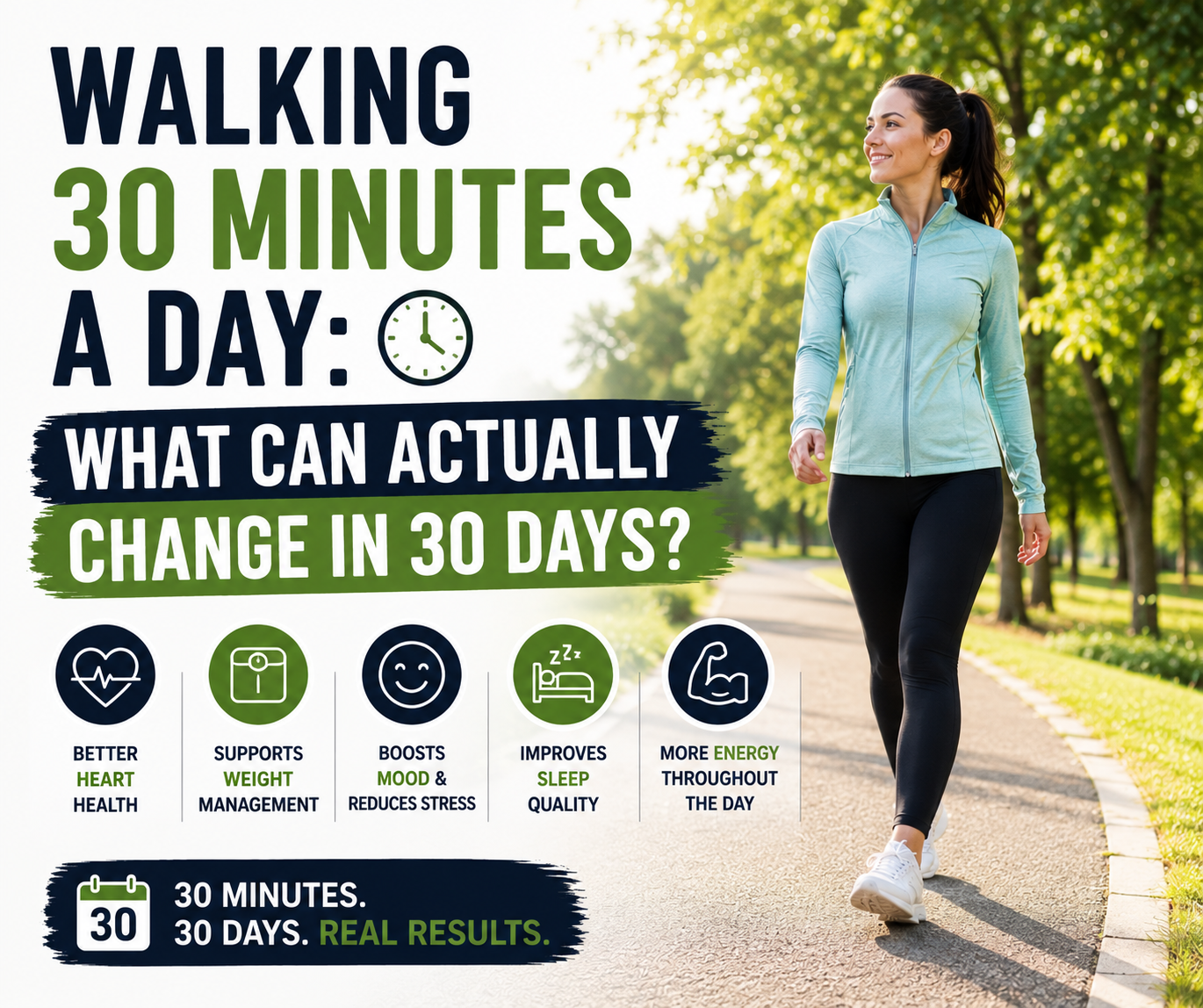
Walking 30 Minutes a Day: What Can Actually Change in 30 Days?
Walking 30 minutes a day for 30 days sounds almost too simple to matter.
No complicated workout plan.
No gym membership.
No brutal intervals.
Just:
30 minutes. Every day. For one month.
So what can actually happen?
Walking 30 minutes a day can meaningfully increase your physical activity, and regular walking has been shown to improve aerobic fitness and several cardiovascular risk factors over time. But 30 days of walking does not guarantee a specific amount of weight loss, a dramatic body transformation, or identical results for everyone.
That's why this article isn't going to tell you:
Walk 30 minutes every day and lose X pounds by Day 30!
Instead, we're going to treat the next month like an experiment.
You'll measure where you are on Day 1.
Walk consistently for 30 days.
Then repeat the same measurements.
The question isn't:
“What is walking supposed to do?”
It's:
“What did 30 days of walking actually change for me?”
Quick Answer: Is Walking 30 Minutes a Day Enough to Make a Difference?
It certainly can be.
Thirty minutes of walking every day adds up to:
210 minutes per week
and:
900 minutes across 30 days.
If the walking is performed at moderate intensity, that's already above the general recommendation that adults accumulate at least 150 minutes of moderate-intensity aerobic activity per week. Public-health guidance also recommends muscle-strengthening activity on at least two days each week.
Research supports walking as legitimate exercise rather than some consolation prize for people who don't run.
A meta-analysis of randomized controlled trials found that walking interventions in previously sedentary adults improved aerobic fitness while producing modest improvements in body weight, BMI, body fat percentage and resting diastolic blood pressure.
A randomized trial specifically using 30 minutes of brisk walking five days per week also examined improvements in health and fitness in previously inactive adults.
So yes:
Thirty minutes matters.
But what changes you notice in 30 days depends on where you're starting, how briskly you walk, what else you do, your nutrition, and your individual response.
Why 30 Minutes Is Such a Useful Walking Target
There's nothing magical about the number 30.
You don't suddenly unlock a secret health benefit at:
29:59 → 30:00.
😂
Thirty minutes is useful because it's:
- Long enough to accumulate meaningful activity
- Short enough to fit into many schedules
- Easy to measure
- Easy to repeat
- Flexible enough to split when necessary
- A practical bridge between casual movement and structured exercise
And if you're currently doing very little purposeful walking, 30 minutes can represent a substantial increase in your activity.
That's important.
Because the effect of adding a 30-minute daily walk depends heavily on what your day looked like before you added it.
Your Starting Point Changes the Experiment
Consider two people.
Person A
Currently:
- Averages 3,000 steps per day
- Has a sedentary job
- Does no structured exercise
- Rarely walks continuously for more than 10 minutes
Adding a 30-minute daily walk is a major lifestyle change.
Person B
Currently:
- Averages 11,000 steps
- Exercises regularly
- Strength trains
- Already performs cardio
Adding another easy 30-minute walk may still have benefits.
But it's a much smaller change relative to their baseline.
That's why generic claims like:
“Here's exactly what walking 30 minutes a day will do to your body”
are misleading.
The more useful question is:
What changed relative to your baseline?
The HabitLogics 30-Day Walking Benchmark
Before we discuss possible benefits, let's create something measurable.
On Day 1, choose a walking route you can reasonably repeat on Day 30.
Ideally, keep these similar:
- Route
- Terrain
- Distance or duration
- Treadmill settings if indoors
- General time of day when practical
Then record five things.
1. Distance Walked in 30 Minutes
How far did you go?
Record it.
Example:
1.42 miles
2. Step Count
How many steps did the 30-minute walk add?
Example:
3,250 steps
This also gives you useful context for your overall daily step goal.
If you're interested in increasing your normal baseline rather than committing to a full 30-minute walk, read:
What Happens If You Add 1,000 Steps a Day? A Practical 30-Day Walking Experiment
3. Perceived Effort
Use a simple 1–10 scale.
1 = almost no effort
10 = maximum effort
Example:
Day 1 effort: 6/10
4. Talk Test
During the walk, ask:
- Can I speak normally?
- Can I speak in complete sentences?
- Am I breathing noticeably harder?
- Would singing be difficult?
This helps you understand the intensity of the walk.
5. Heart Rate — Optional
If you already use a smartwatch or heart-rate monitor, record:
- Average heart rate
- Peak heart rate if useful
Don't buy equipment just for this experiment.
And don't treat one heart-rate number as the final authority on whether your walk “counts.”
If you're specifically trying to determine whether walking qualifies as aerobic Zone 2 training for you, read:
Does Walking Count as Zone 2 Cardio? How to Know If You’re Actually in Zone 2
Save Your Day 1 Numbers
You should now have something like:
Distance: 1.42 miles
Steps: 3,250
Effort: 6/10
Talk test: Can talk, breathing noticeably elevated
Average HR: 128 bpm
That's your baseline.
We're going to repeat this on Day 30.
And that gives us something much more useful than:
I think walking feels better now.
What Could Change After Walking 30 Minutes a Day for 30 Days?
Let's separate reasonable possibilities from internet promises.
1. Walking May Start to Feel Easier
This may be one of the first changes you notice.
A route that initially feels like exercise may gradually feel more manageable.
You might notice:
- Less breathlessness
- Less leg fatigue
- Easier hills
- Faster recovery afterward
- Greater comfort walking continuously
- More confidence taking longer walks
This is your body adapting to repeated activity.
Walking trials have found improvements in aerobic fitness, particularly among previously sedentary adults.
You don't necessarily need laboratory testing to notice this.
If:
Day 1 = 6/10 effort
and:
Day 30 = 4/10 effort
on the same route at approximately the same speed, something changed.
2. You May Walk Farther in the Same 30 Minutes
This is one of my favorite measurements because it's simple.
Suppose:
Day 1
1.42 miles
Day 30
1.55 miles
You covered more ground in the same amount of time.
Or maybe your distance stays:
1.42 miles
but your effort drops from:
6/10 → 4/10.
That's also progress.
This is why we're measuring multiple things.
Fitness improvement doesn't have to mean:
FASTER! HARDER! MORE!
Sometimes it means:
the same work became easier.
3. Your Daily Step Count Could Increase Substantially
A 30-minute walk can add several thousand steps depending on your walking cadence.
So someone previously averaging:
4,000 steps/day
might suddenly find themselves regularly around:
7,000+
without trying to manufacture movement throughout the entire day.
That's a meaningful change in total activity.
And importantly, research increasingly shows that health benefits are not reserved for people who hit exactly 10,000 steps.
For the full step-count discussion, read:
How Many Steps Do You Actually Need?
4. Your Cardiovascular Fitness May Improve
Walking is aerobic exercise when performed at sufficient intensity.
A meta-analysis of randomized walking trials found improvements in estimated aerobic capacity among previously sedentary adults.
A separate randomized trial compared different ways of accumulating 30 minutes of brisk walking and found improvements in aerobic fitness across the walking groups after the intervention.
That's worth emphasizing:
You don't have to run to train your cardiovascular system.
The appropriate walking intensity depends on your current fitness.
For some people:
flat brisk walking
is plenty.
Others may eventually need:
- Faster walking
- Hills
- Treadmill incline
- Intervals
- Another cardio modality
5. Your Blood Pressure May Improve Over Time
Walking has also been studied for its effect on blood pressure.
A large Cochrane review examining walking interventions found moderate-certainty evidence that walking probably reduces systolic blood pressure, with smaller average reductions in diastolic blood pressure and resting heart rate also reported. The average intervention lasted about 15 weeks, so this should not be interpreted as a guaranteed 30-day effect.
That's an important distinction.
Walking can contribute to cardiovascular health.
But don't turn:
walking helps blood pressure over time
into:
my blood pressure will drop X points by Day 30.
If you have hypertension, continue following your healthcare professional's treatment plan.
Walking isn't a replacement for prescribed treatment.
6. Your Weight Might Change
This is the part everyone wants to know.
Will walking 30 minutes a day for 30 days make you lose weight?
Maybe.
Walking increases energy expenditure.
Research has found that walking interventions can produce modest reductions in body weight and body fat, particularly over longer periods.
One randomized exercise study also found that modest amounts of exercise could help prevent weight gain and produce some weight and fat loss even without a dietary intervention.
But there's a problem with predicting your personal result.
Your weight also depends on:
- Food intake
- Hunger
- Other daily movement
- Water retention
- Sodium intake
- Carbohydrate intake
- Sleep
- Stress
- Medications
- Individual physiology
So I'm not going to tell you:
Walking 30 minutes burns X calories, therefore you'll lose exactly X pounds in 30 days.
Human beings aren't calculators with legs.
😂
How to Measure Weight During the Experiment
If weight loss is your goal, don't compare:
Day 1 scale weight
against:
Day 30 scale weight
and call that the result.
Body weight fluctuates.
A better method is to record your weight under reasonably similar conditions and compare weekly averages.
For example:
Week 1 Average
181.4 lbs
Week 2 Average
180.9 lbs
Week 3 Average
180.6 lbs
Week 4 Average
180.1 lbs
Now you can see a trend.
Your numbers may:
- Decline
- Stay flat
- Increase
The experiment is designed to show you what happened.
Not force the result we wanted.
7. Your Waist Measurement Might Change
If body composition or weight loss matters to you, waist circumference can provide another useful measurement.
Take it:
Day 1
and:
Day 30
under similar conditions.
Don't measure it three times every morning.
😂
Thirty days is a short period, so a dramatic change shouldn't be expected.
But combining:
weight trend + waist measurement + walking performance
gives you a broader picture than the scale alone.
8. Your Blood Sugar Response to Meals May Benefit From When You Walk
Here's where timing gets interesting.
If some of your 30 minutes happens after meals, the walk may do more than increase your total activity.
Research has found that walking after eating can help moderate post-meal glucose responses.
That doesn't mean everyone needs one uninterrupted 30-minute walk.
You could potentially divide some walking across meals.
For example:
10 minutes after breakfast
10 minutes after lunch
10 minutes after dinner
For the evidence and practical strategies, read:
Walking After Meals for Blood Sugar: How a Short Walk Can Make a Difference
9. Your 30-Minute Walk May Become a Habit
This might ultimately matter more than what happens to your weight in four weeks.
At first:
I have to find 30 minutes to walk.
By the end of the month:
This is when I walk.
Those are psychologically different.
You may begin automatically associating walking with:
- Morning coffee
- Lunch
- Finishing work
- Dinner
- A podcast
- Calling family
- Getting outside
The less decision-making required, the easier walking becomes to repeat.
That's why I don't want this experiment to end with:
Day 30 → challenge completed → stop walking.
The goal is to discover whether walking can become part of your normal routine.
10. You May Learn That 30 Minutes Isn't Your Best Target
This is also a successful result.
Maybe you discover:
30 continuous minutes is annoying.
But:
15 minutes twice per day is easy.
Great.
Or:
Weekday 30-minute walks don't fit.
But:
20 minutes Monday–Friday + longer weekend walks work beautifully.
Also great.
Research has found benefits when 30 minutes of brisk walking is accumulated in shorter bouts rather than only one continuous session.
The point isn't to worship the number 30.
The point is to build enough activity into your life to matter.
Does Walking 30 Minutes Need to Be Brisk?
No—but intensity changes the training effect.
A casual 30-minute stroll:
still adds movement.
A brisk 30-minute walk:
adds movement + a greater cardiovascular stimulus.
A challenging uphill walk:
adds even more intensity.
So ask:
What am I trying to accomplish?
General Movement
Comfortable walking is perfectly useful.
Cardiovascular Fitness
Make at least some walking purposeful enough to noticeably increase breathing.
Zone 2 Training
Your personal effort needs to fall around the appropriate aerobic intensity.
Weight Management
Both overall movement and sustainable exercise volume matter.
If pace is your main question, read:
Best Walking Speed for Fat Loss: Does Walking Faster Burn More Fat?
The HabitLogics 30-Day Walking Experiment
Now let's actually do it.
Before Day 1
Record:
Average current daily steps: ______
Weight, if relevant: ______
Waist, if relevant: ______
Current purposeful walks/week: ______
Normal energy: Low / Average / High
Then complete the Day 1 benchmark.
Day 1: Benchmark Walk
Walk for 30 minutes.
Record:
Distance: ______
Steps: ______
Average heart rate, optional: ______
Effort 1–10: ______
Talk test: Easy / Moderate / Difficult
How did I feel afterward? ______
Save it.
Don't test yourself again tomorrow.
😂
Days 2–7: Learn the Routine
Your goal is simply:
Complete the walking.
Don't obsess over:
- Speed
- Calories
- Distance records
- Heart-rate zones
- Personal bests
Figure out:
When does this walk actually fit my life?
Morning?
Lunch?
After work?
After dinner?
Days 8–14: Make It Predictable
Now create a repeatable cue.
Examples:
Breakfast → walk
Lunch → walk
Finish work → walk
Dinner → walk
This week isn't about increasing intensity.
It's about reducing friction.
If this is where you struggle, read:
How to Stay Consistent With Walking: 12 Strategies That Actually Work
Days 15–21: Notice Adaptation
Now start paying attention.
Ask:
- Does 30 minutes feel shorter?
- Is my normal pace easier?
- Am I breathing less heavily?
- Are hills easier?
- Am I recovering faster?
- Am I naturally walking faster?
- Am I accumulating more steps outside the walk?
Don't force improvement.
Observe it.
Days 22–29: Hold Steady
This is important.
Don't suddenly decide:
I'm good at walking now. TIME FOR 60 MINUTES.
😂
Keep the experiment stable.
Thirty minutes.
Same basic routine.
We're trying to see what happens when consistency changes while the basic dose remains similar.
Day 30: Repeat the Benchmark
Return to the same route or treadmill setup.
Walk for:
30 minutes.
Record again:
Distance: ______
Steps: ______
Average HR, optional: ______
Effort 1–10: ______
Talk test: Easy / Moderate / Difficult
How did I feel afterward? ______
Now compare.
Your Day 1 vs. Day 30 Scorecard
Distance
Day 1: ______
Day 30: ______
Steps During Walk
Day 1: ______
Day 30: ______
Effort
Day 1: ______ / 10
Day 30: ______ / 10
Heart Rate — Optional
Day 1: ______
Day 30: ______
Weight Trend — Optional
Week 1 average: ______
Week 4 average: ______
Waist — Optional
Day 1: ______
Day 30: ______
Habit
Walking 30 minutes now feels:
Harder / Same / Easier to fit into my life
Now you have actual information.
How to Interpret Your Results
This is where the experiment becomes useful.
Scenario 1: Same Distance, Lower Effort
That's progress.
Your body can perform the same task more comfortably.
Scenario 2: Greater Distance, Similar Effort
Also progress.
You're doing more work without feeling substantially worse.
Scenario 3: Greater Distance + Lower Effort
Excellent.
Your walking capacity likely improved.
Scenario 4: Weight Decreased
Great—if weight loss was one of your goals.
Look at the trend, not one measurement.
Scenario 5: Weight Didn't Change
The experiment didn't automatically fail.
Ask:
- Did fitness improve?
- Did daily steps increase?
- Did walking become easier?
- Did waist measurement change?
- Did food intake increase?
- Was 30 days simply too short?
If weight loss is the primary goal, read:
Is Walking Enough to Lose Weight?
Scenario 6: Nothing Improved and Walking Still Feels Hard
Don't immediately assume you need to work harder.
Review:
- Consistency
- Walking intensity
- Recovery
- Sleep
- Nutrition
- Pain
- Health limitations
Thirty days also isn't very long.
Sometimes the answer is:
keep going.
What If You Can't Walk 30 Minutes Yet?
Then don't.
This challenge should meet you where you are.
Start with:
10 minutes
or:
15 minutes
or:
20 minutes.
Gradually build.
For example:
Week 1
15 minutes
Week 2
20 minutes
Week 3
25 minutes
Week 4
30 minutes
That's still a successful walking experiment.
Your body doesn't care that the article title said 30.
😂
What If You Don't Have 30 Continuous Minutes?
Split it.
You could use:
15 + 15
or:
10 + 10 + 10
or another combination that fits your schedule.
Public-health guidance no longer requires aerobic activity to occur in bouts of at least 10 minutes for it to count toward overall physical activity.
And research comparing continuous versus accumulated brisk walking has found improvements in fitness and blood pressure with multiple approaches.
Do what you're more likely to continue.
What If Walking 30 Minutes Becomes Too Easy?
Good.
That means it's time to decide what you want next.
You could progress:
Duration
30 → 35 minutes
Pace
Walk slightly faster.
Incline
Add hills or treadmill incline.
Frequency
If you aren't already walking most days, add another session.
Structure
Add intervals or dedicated aerobic walks.
But don't progress automatically.
If 30 minutes supports your goals and you enjoy it:
You are allowed to keep walking 30 minutes.
Exercise does not require endless escalation.
Walking 30 Minutes vs. Adding 1,000 Steps
These two HabitLogics experiments answer different questions.
+1,000 Steps
Best for:
- Increasing overall daily movement
- People who dislike structured exercise
- Raising a low step baseline
- Building activity into normal life
30-Minute Daily Walk
Best for:
- Creating structured walking time
- Building endurance
- Tracking walking performance
- Developing a predictable exercise routine
You can even combine them.
A 30-minute walk will usually add substantially more than 1,000 steps for many people.
But you don't need to.
Choose the experiment that solves your problem.
Walking 30 Minutes vs. 10,000 Steps
Again:
Different tools.
10,000 steps measures your total daily movement.
30 minutes measures purposeful walking time.
You could:
walk 30 minutes + finish with 6,500 total steps
or:
never take a 30-minute walk + accumulate 11,000 steps
depending on your lifestyle.
Neither number tells the entire story.
Should You Walk Every Single Day?
You don't have to.
This article uses daily walking because it's a clean 30-day experiment.
But your permanent walking routine doesn't need seven structured sessions every week.
If you need:
- A rest day
- An easier day
- Strength-training days
- Another form of exercise
take them.
The broader goal is a sustainable activity pattern.
For help designing that pattern, read:
How to Build a Sustainable Walking Routine You Can Maintain Long Term
Don't Forget Strength Training
Walking is excellent aerobic activity.
It doesn't train everything.
General physical-activity recommendations also include muscle-strengthening exercise on at least two days per week.
That can include:
- Squats
- Hinges
- Pushes
- Pulls
- Step-ups
- Carries
- Resistance bands
- Dumbbells
- Machines
- Bodyweight training
If weight loss is your goal, strength training becomes particularly useful because preserving lean tissue matters.
Walking and strength training complement each other.
They don't compete.
Don't Ignore Protein Either
If you're walking primarily to support weight loss, remember:
exercise is only one side of the system.
Protein can help support:
- Fullness
- Muscle retention during weight loss
- Recovery
- Higher-quality meal structure
That's why HabitLogics treats walking and nutrition as complementary habits.
Read:
Walking and Protein for Weight Loss: Why They Work Better Together
Or explore the:
Common 30-Day Walking Experiment Mistakes
1. Turning Every Walk Into a Test
You don't need a personal record every day.
2. Changing Your Route Constantly
Variety is fun.
But if you want a useful Day 1 vs. Day 30 benchmark, keep the test route similar.
3. Predicting Weight Loss From Calorie Calculators
Estimated calorie burn is not a guaranteed weight-loss equation.
4. Ignoring Nutrition
Thirty minutes of walking doesn't make food intake irrelevant.
5. Making Up Missed Walks
Miss Tuesday?
Don't punish yourself with a 60-minute Wednesday unless you genuinely want to walk longer.
Continue.
6. Quitting Because the Scale Didn't Move
Look at all the outcomes.
7. Progressing Too Soon
Let 30 minutes become comfortable before deciding it needs to become harder.
8. Ignoring Pain
Muscle fatigue and recurring joint or foot pain aren't the same thing.
Persistent or worsening pain deserves attention.
The HabitLogics Rule: Measure Capacity, Not Just Calories
This is the main idea I want you to take from this experiment.
Walking is often reduced to:
How many calories did I burn?
That's an incredibly narrow way to judge exercise.
Instead ask:
Can I walk farther?
Can I walk faster?
Does the same walk feel easier?
Can I recover more quickly?
Am I moving more during the day?
Is walking easier to fit into my life?
Am I actually repeating it?
Those are measures of capacity.
And improving your capacity makes it easier to remain active long after this 30-day experiment ends.
What Should You Do After Day 30?
Use the same decision framework as our +1,000-step experiment:
Maintain
Keep walking 30 minutes.
Choose this if:
- It fits your schedule
- You're progressing
- You enjoy it
- You're recovering well
Progress
Increase one variable.
Maybe:
- 35 minutes
- Slightly faster pace
- More incline
- One longer weekly walk
- Structured Zone 2 work
Adjust
Change the routine if 30 minutes every day wasn't realistic.
Maybe:
30 minutes × 5 days
works better.
Or:
20-minute weekdays + longer weekends.
The experiment isn't about proving that one schedule works for everyone.
It's about discovering what works for you.
Key Takeaways
- Walking 30 minutes a day can meaningfully increase your physical activity.
- Thirty daily minutes equals 210 minutes per week and 900 minutes across 30 days.
- Walking interventions have been shown to improve aerobic fitness and several cardiovascular risk factors, particularly in previously inactive adults.
- Thirty days does not guarantee a specific amount of weight loss.
- Your starting activity level strongly influences how significant the change is.
- Measure a repeatable 30-minute walk on Day 1 and Day 30.
- Track distance, steps, perceived effort and optionally heart rate.
- Progress can mean walking farther or completing the same walk with less effort.
- A daily walk can substantially increase total step count.
- Walking can be divided into shorter sessions when that better fits your schedule.
- Easy walking still counts as movement; brisk walking provides a greater cardiovascular stimulus.
- Strength training complements walking.
- Don't judge the experiment only by calories or scale weight.
- After Day 30, choose Maintain → Progress → Adjust.
- Measure your capacity, not just your calories.
Frequently Asked Questions
What happens if you walk 30 minutes a day for a month?
You will substantially increase your physical activity if you weren't already walking regularly.
Depending on your starting fitness, intensity and individual response, you may notice improved walking tolerance, greater endurance, easier walking, increased daily steps and potentially changes in cardiovascular fitness or body weight.
Is walking 30 minutes a day enough exercise?
Thirty minutes of moderate-intensity activity every day would exceed the general 150-minute weekly aerobic recommendation.
However, complete physical-activity guidance also recommends muscle-strengthening exercise.
Can I lose weight by walking 30 minutes every day?
Walking can contribute to the calorie deficit required for weight loss, but it doesn't guarantee weight loss.
Nutrition, total activity, appetite and individual factors also matter.
How much weight can I lose walking 30 minutes a day for 30 days?
There is no reliable universal number.
Avoid calculations that convert estimated walking calories directly into guaranteed pounds lost.
Individual results vary substantially.
Will walking 30 minutes a day reduce belly fat?
You cannot choose where your body loses fat.
Walking can contribute to overall energy expenditure and may support body-fat reduction when combined with an appropriate overall lifestyle.
Should I walk fast for the entire 30 minutes?
Not necessarily.
If you're new to walking, start at a comfortable pace.
As your fitness improves, some brisk walking can provide a stronger cardiovascular stimulus.
Can I split 30 minutes into shorter walks?
Yes.
You could use two 15-minute walks, three 10-minute walks, or another arrangement that fits your day.
Does a treadmill count?
Absolutely.
Walking indoors still counts as physical activity.
What if I miss a day?
Continue the next day.
One missed walk doesn't invalidate the experiment.
Don't turn consistency into perfectionism.
What should I do after 30 days?
Review your results and choose:
Maintain, Progress or Adjust.
Your next step depends on your goal and how your body responded.
Try the +1,000-Step Experiment Instead
Not ready to commit to 30 minutes every day?
Try raising your normal activity baseline instead:
What Happens If You Add 1,000 Steps a Day? A Practical 30-Day Walking Experiment
Build Your Complete Walking Routine
Want to turn walking into a long-term program rather than a 30-day experiment?
How to Build a Sustainable Walking Routine You Can Maintain Long Term
Continue With the Complete Walking Guide
For the full HabitLogics Walking library:
Explore the Complete Walking Success Hub
Related Walking Guides
- Does Walking Count as Zone 2 Cardio? How to Know If You’re Actually in Zone 2
- How Many Steps Do You Actually Need?
- Is Walking Enough to Lose Weight?
- Best Walking Speed for Fat Loss: Does Walking Faster Burn More Fat?
- Walking After Meals for Blood Sugar: How a Short Walk Can Make a Difference
- How to Stay Consistent With Walking: 12 Strategies That Actually Work
- Walking and Protein for Weight Loss: Why They Work Better Together
Start With the Free Walking Starter Kit
If you'd rather follow a ready-made progression, the Free HabitLogics Walking Weight Loss Starter Kit includes:
- A progressive 30-day walking plan
- Daily step and walking trackers
- A walking pace guide
- A habit calendar
- Practical consistency tools
Download the Free Walking Starter Kit
Recommended HabitLogics Resource
Want to track the exact things we're measuring in this experiment?
The HabitLogics Walking Weight Loss Dashboard helps you monitor walking activity, steps, weight trends, measurements and progress over time.
Explore the Walking Weight Loss Dashboard
This article is for general educational purposes and is not medical advice. If you have a medical condition, significant mobility limitations, recurring or worsening pain, or concerning symptoms during exercise, talk with an appropriate healthcare professional before beginning or substantially increasing an exercise program.