

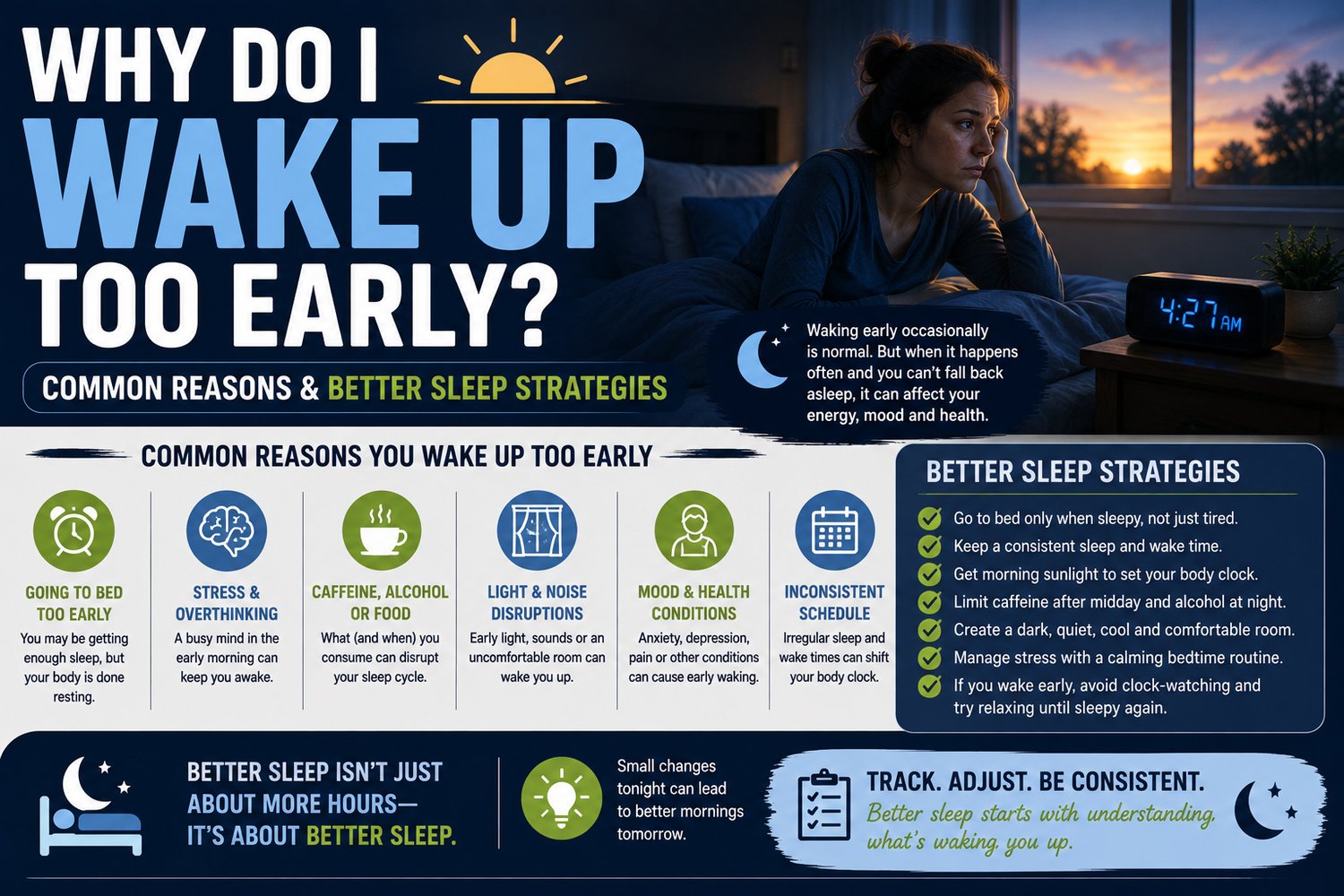
Why Do I Wake Up Too Early? Common Reasons & Better Sleep Strategies
The Complete Sleep & Recovery Guide
Your alarm is set for:
6:30 a.m.
Your eyes open.
You look at the clock.
4:17 a.m.
Excellent.
Two hours you definitely did not ask for.
You close your eyes.
Roll over.
Try to sleep.
Start thinking.
Check the clock again.
4:43.
Eventually you realize:
This isn't happening.
Waking earlier than intended occasionally is normal.
But repeatedly waking much earlier than you want and being unable to return to sleep can become a real problem—especially if you're losing needed sleep and dragging through the next day.
It can also be a form of insomnia. NHLBI specifically lists waking too early in the morning and being unable to get back to sleep as a common insomnia symptom.
But insomnia isn't the only possible explanation.
Sometimes your schedule is the problem.
Sometimes your body clock has shifted earlier.
Sometimes something in your environment wakes you.
Sometimes stress takes over once you're awake.
And sometimes persistent early waking occurs alongside another health or mental-health issue that deserves attention.
Let's figure out which situation looks most like yours.
What Counts as Waking Up “Too Early”?
There isn't one universal clock time.
5 a.m. isn't inherently too early.
If you naturally sleep from 9 p.m. to 5 a.m., wake refreshed and function well during the day:
You may simply have an early schedule.
The problem is more like:
You intended or needed to sleep longer.
You wake considerably earlier anyway.
You can't return to sleep.
You're losing needed sleep or feeling poorly during the day.
That's different.
Waking at 5 a.m. after eight solid hours can be normal.
Waking at 4 a.m. after five and a half hours and feeling exhausted every day deserves more investigation.
Early Waking Is Different From Waking Throughout the Night
These two problems overlap, but they're not identical.
Frequent Nighttime Awakenings
You:
Fall asleep.
Wake at 1 a.m.
Fall asleep again.
Wake at 3.
Fall asleep.
Wake at 5.
Early-Morning Awakening
You:
Fall asleep.
Sleep reasonably well for much of the night.
Wake at 4 or 5 a.m.
Then remain awake despite wanting another hour or two of sleep.
If your problem is the first pattern, see Why Do I Wake Up in the Middle of the Night? Common Causes & What May Help.
This article focuses on that final unwanted awakening.
1. You May Simply Be Going to Bed Too Early
This is one of the least mysterious explanations.
Suppose you normally need around eight hours of sleep.
You go to bed at:
8:30 p.m.
You fall asleep quickly.
Then wake around:
4:30 a.m.
That's eight hours.
Your body may simply be done sleeping.
But because your desired wake time is 6 a.m., it feels like:
I keep waking too early.
Sometimes the problem isn't your wake time.
It's your bedtime.
If you've moved bedtime earlier because you're trying to "get more sleep," you may be spending more time in bed than your actual sleep requirement supports.
Don't Automatically Respond by Going to Bed Even Earlier
This can create a bad cycle.
You wake at 4:30.
You're tired the next day.
So that night you go to bed at:
8 p.m.
Now you wake at:
4 a.m.
So the next night:
7:30?
At some point you've accidentally become a farmer from 1847.
😂
More time in bed isn't always the answer.
If your sleep onset is easy and you're consistently waking after an adequate amount of sleep, experiment with a slightly later bedtime while keeping wake time reasonably stable.
2. Your Circadian Rhythm May Run Earlier
Your internal biological clock helps regulate when you feel sleepy and alert.
Light and darkness are major signals affecting this circadian system.
Some people naturally lean earlier.
They:
Become sleepy earlier in the evening.
Wake earlier in the morning.
And feel best on that schedule.
That's not necessarily a disorder.
It becomes a problem when the timing is so early that it interferes with your life.
Advanced Sleep-Wake Phase Disorder
One circadian rhythm disorder specifically causes very early sleep and wake timing.
NHLBI explains that people with advanced sleep-wake phase disorder may have difficulty staying awake during the early evening and then wake much too early in the morning.
For example:
You become overwhelmingly sleepy at:
7:30 p.m.
Fall asleep at:
8 p.m.
Wake naturally at:
3:30 or 4 a.m.
If you try to stay awake later, it feels extremely difficult.
That's different from:
I randomly woke at 4 a.m. three times this week.
Persistent circadian timing problems can deserve professional evaluation because the appropriate management may involve carefully timed light and other strategies rather than simply "trying to sleep later."
3. Your Sleep Schedule May Be Inconsistent
Your body likes some predictability.
If your schedule looks like:
Monday: bed 10 p.m.
Tuesday: midnight.
Wednesday: 11 p.m.
Thursday: 9:30.
Friday: 1 a.m.
Saturday: sleep until 10.
then your sleep timing is constantly shifting.
Consistent sleep and wake times are part of standard healthy-sleep guidance from CDC/NIOSH.
You don't need bedtime military discipline.
But if early waking has become a problem, reducing large schedule swings is a good place to start.
4. You May Not Need as Much Sleep as You're Trying to Get
This is related to going to bed too early.
Suppose you're consistently spending:
9½ hours in bed
but your body tends to sleep around:
7½–8 hours.
Eventually, some of that extra time may become wakefulness.
This doesn't mean everyone should intentionally shorten sleep.
Most healthy adults still need at least around seven hours, and individual needs vary.
The point is:
Don't assume longer time in bed automatically produces more sleep.
Your bedtime needs to make sense relative to your real sleep requirement.
5. You May Be Carrying Stress Into the Final Part of the Night
Sometimes you wake for a perfectly ordinary reason.
Then stress takes over.
Your brain goes:
Since we're awake, let's discuss your entire life.
Now you're thinking about:
Work.
Money.
Relationships.
Tomorrow.
Deadlines.
Something you forgot.
Something you might forget.
And suddenly you're not remotely sleepy.
Stress is a recognized contributor to insomnia.
The initial awakening may not be the main problem.
The problem may be what happens after you wake.
6. Clock-Watching Makes Early Waking Worse
You wake.
Check clock.
4:08.
Close eyes.
Check again.
4:31.
Now:
If I fall asleep immediately, I can still get one hour and 59 minutes.
4:52.
More calculations.
5:14.
Now you're furious.
Nothing about this process promotes sleep.
If the clock causes anxiety:
Turn it away.
Put the phone out of reach.
Stop giving yourself live updates about how little sleep remains.
Knowing it's exactly 4:38 doesn't improve the situation.
7. Your Phone Can Finish the Job
A brief early-morning awakening might have ended with you falling back asleep.
Then you reach for the phone.
Check the time.
See a notification.
Open email.
Check social media.
Read news.
Now your brain has received:
light
information
novelty
and
mental stimulation.
Congratulations.
Morning has officially begun.
If your goal is to return to sleep:
Don't open the internet.
8. Early Morning Light May Be Waking You
Sometimes the cause is sitting right outside your window.
Sunrise.
Streetlights.
A neighbor leaving for work.
Headlights.
Seasonal changes can make this especially noticeable.
If you're waking earlier during spring and summer as sunrise shifts earlier, experiment with:
- Blackout curtains
- Eye mask
- Better window coverings
- Moving bright electronics
Light is one of the strongest environmental signals affecting circadian rhythms, so controlling unwanted early light is reasonable when it clearly lines up with your waking pattern.
9. Noise May Start Earlier Than You Realize
Maybe your sleep is perfectly fine until:
Garbage pickup.
Birds.
Traffic.
Neighbors.
Construction.
Your partner wakes for work.
Kids begin moving around.
HVAC turns on.
If the awakening happens at the same time as an environmental noise:
Start there.
Try:
- Earplugs
- Fan
- Steady background noise
- Closing windows
- Addressing the source when possible
Don't diagnose yourself with a circadian disorder while the neighbor starts his diesel truck outside your window at 4:45 every morning.
10. Your Bedroom Temperature May Change Overnight
A room can feel perfect at bedtime and become uncomfortable several hours later.
Maybe:
The heat turns on.
Air conditioning shuts off.
Heavy blankets become too warm.
Your partner steals every blanket and somehow also occupies 83% of the bed.
If you wake:
Hot.
Sweaty.
Cold.
Or uncomfortable.
adjust the environment.
Our Best Bedroom Environment for Sleep guide covers temperature, light, noise and comfort in more detail.
11. Alcohol Can Make the Second Half of the Night Worse
Alcohol can make people sleepy initially.
That makes it easy to interpret:
I fall asleep faster after drinking
as:
I sleep better after drinking.
Not necessarily.
Alcohol can contribute to disrupted sleep later in the night, which may show up as more waking after several hours.
If early waking happens more often after drinking:
Test it.
For a week or two:
Reduce evening alcohol.
Keep other variables fairly stable.
Compare.
That's much more useful than guessing.
12. Caffeine Can Still Matter
Late caffeine isn't only about difficulty falling asleep.
Caffeine can remain active for hours.
If your caffeine use extends into:
Late afternoon.
Evening.
Pre-workout.
Energy drinks.
then it deserves attention when troubleshooting any persistent sleep problem.
Our guide Caffeine and Sleep: How Long Does Caffeine Last & When Should You Stop Drinking It? explains how to run a simple cutoff experiment.
You don't need to quit caffeine forever.
Just give yourself enough information to determine whether it's contributing.
13. Bathroom Trips Can Become Your Final Awakening
Maybe you wake at:
4:45 a.m.
because you need to use the bathroom.
Then you return to bed.
But now you're awake enough that sleep never comes back.
The bathroom trip may be the event turning a normal sleep period into an early wake-up.
If that happens regularly:
Look at evening fluids.
Alcohol.
Caffeine.
And whether nighttime urination has become frequent.
Persistent repeated nighttime urination can have medical causes and deserves evaluation if it continues.
14. Pain Can Become More Noticeable Toward Morning
You may sleep comfortably for several hours.
Then:
Back hurts.
Hip hurts.
Neck hurts.
Headache begins.
You reposition.
Wake more fully.
Now you're done sleeping.
If the pattern repeatedly involves pain, the solution probably isn't another sleep habit.
Address the underlying discomfort appropriately.
Sleep advice cannot fix everything.
15. Acid Reflux Can Also Wake You
Reflux can develop or worsen while you're lying down.
Symptoms may include:
- Burning
- Sour taste
- Regurgitation
- Cough
- Throat irritation
- Chest discomfort
If early waking regularly comes with reflux symptoms, examine:
Dinner size.
Meal timing.
Alcohol.
Trigger foods.
And seek appropriate medical evaluation if symptoms persist.
16. Sleep Apnea Can Fragment the Final Part of Your Night
Obstructive sleep apnea can repeatedly disturb sleep without you consciously remembering every event.
You may simply notice:
I wake early and never feel rested.
Possible clues include:
- Loud snoring
- Gasping
- Choking
- Witnessed breathing pauses
- Morning headaches
- Dry mouth
- Significant daytime sleepiness
- Unrefreshing sleep
If those symptoms are present, don't keep assuming your issue is simply an early body clock.
Get evaluated.
17. Depression Can Include Early-Morning Waking
This deserves careful handling.
Waking too early can occur as one possible symptom of depression, but early waking by itself does not mean you have depression.
NIMH lists difficulty sleeping—including waking too early in the morning—among possible depression symptoms. Other symptoms can include persistent low mood, loss of interest or pleasure, fatigue, changes in appetite and difficulty concentrating.
The important point:
Don't diagnose yourself from one sleep symptom.
But if early waking is happening alongside broader, persistent changes in mood or functioning, discuss the whole pattern with a qualified healthcare professional.
18. Insomnia Can Show Up as Early-Morning Awakening
A lot of people think insomnia means:
Can't fall asleep.
It can.
But insomnia can also mean:
Wake too early and can't return to sleep.
NHLBI explicitly identifies waking too early as a common insomnia symptom.
So someone might:
Fall asleep normally at 10:30.
Sleep well until 4:30.
Then remain awake until the alarm.
If this happens frequently and causes daytime problems, insomnia may be part of the picture.
Early-Morning Insomnia Is Still Insomnia
The fact that you fell asleep quickly doesn't mean:
You can't have insomnia.
Insomnia can involve:
- Trouble falling asleep
- Trouble staying asleep
- Early awakening
- Poor-quality sleep despite adequate opportunity
NHLBI defines insomnia broadly around difficulty getting adequate or good-quality sleep despite having enough time and an appropriate environment.
That distinction matters because persistent insomnia may need more than generic sleep hygiene.
19. Age Can Change Sleep Patterns
Sleep tends to change across adulthood.
Older adults may experience:
Earlier sleep timing.
More fragmented sleep.
More nighttime awakenings.
Changes in sleep stages.
That doesn't mean:
Older people don't need sleep.
It means the architecture and timing of sleep can change.
If an older adult is consistently waking early but otherwise getting adequate sleep and functioning well, that may be less concerning than early waking that causes chronic sleep deprivation or daytime impairment.
Context matters.
20. Your Recent Sleep Pattern Matters
Imagine:
Monday: 5 hours.
Tuesday: 6.
Wednesday: 5½.
Thursday: 6.
Friday: 10.
Saturday night:
You go to bed extremely early again.
Your sleep timing and sleep pressure are now bouncing around.
One night's early waking doesn't exist in isolation.
Look at the previous week.
Are you:
Catching up?
Oversleeping?
Going to bed much earlier after bad nights?
Changing wake time constantly?
Patterns tell you more than individual mornings.
Why Do I Wake Up at 4 a.m. Every Day?
There's no universal biological meaning to:
4 a.m.
Despite what the internet may tell you.
It doesn't automatically mean:
Your cortisol is broken.
Your liver is detoxing.
Your blood sugar crashed.
Your body is sending a secret message.
The clock time alone isn't enough to identify the cause.
More useful questions are:
When do I go to sleep?
How many hours have I slept by 4 a.m.?
What wakes me?
Am I sleepy earlier than other people?
What happens when I wake?
How do I feel during the day?
That's your investigation.
Why Do I Wake Up at 5 a.m. No Matter What?
Again, start with sleep timing.
If you:
Fall asleep around 9 p.m.
Wake around 5.
Feel good.
You may simply have an early schedule.
If you:
Fall asleep at midnight.
Wake at 5.
Feel exhausted.
That's different.
If wake time remains unusually early even when bedtime changes—and particularly if you're overwhelmingly sleepy very early in the evening—circadian timing may deserve closer attention.
Should You Stay in Bed When You Wake Too Early?
If you still feel sleepy and relaxed:
Give yourself an opportunity to fall back asleep.
But if you're:
Wide awake.
Frustrated.
Watching the clock.
Lying there for a long time.
then remaining in bed fighting sleep may not help.
Stimulus-control strategies used in cognitive behavioral therapy for insomnia often involve temporarily leaving the bed when you're clearly unable to sleep and returning when sleepiness comes back.
Keep the environment:
Dim.
Quiet.
Boring.
You're not starting your day yet.
What Should You Do Instead?
If you wake too early and can't immediately return to sleep:
Don't Grab Your Phone
Avoid turning on your brain.
Don't Keep Checking the Time
That adds pressure.
Keep Lights Low
Especially if you hope to sleep again.
Try Something Quiet
Read.
Listen to calm audio.
Sit quietly.
Return to Bed When Sleepy
Don't force it.
The goal is to preserve:
bed = sleep
rather than:
bed = two hours of frustration.
Don't Start the Day at Full Brightness If You Want to Sleep Again
If your goal is to return to sleep, this probably isn't the moment for:
All overhead lights on.
Coffee brewing.
Phone at maximum brightness.
News.
Email.
Once you're clearly deciding:
I'm awake for the day
then normal morning light becomes useful.
But while you're still hoping to sleep again:
Keep stimulation low.
Don't Automatically Take a Nap Later
After waking two hours early, a long afternoon nap can feel extremely tempting.
Sometimes a short nap is reasonable.
But if you regularly compensate with long or late naps, you may reduce sleep pressure the following night and continue the cycle.
If early waking is a persistent issue:
Be strategic.
Don't let:
bad night → huge nap → less sleepy at bedtime → another bad night
become the default pattern.
Don't Go to Bed Extremely Early the Next Night
Same problem.
You wake at 4.
Feel tired.
Then decide:
Tonight I'm going to bed at 7:30.
If your normal biological sleep period doesn't support that, you may simply shift the whole cycle earlier.
Instead, keep your schedule reasonably stable.
You can make modest adjustments without turning one bad morning into a complete schedule reset.
A Slightly Later Bedtime May Help Some People
If you:
Fall asleep very quickly.
Spend a long time in bed.
Wake early.
And have trouble returning to sleep.
then a modestly later bedtime may consolidate your sleep into a shorter window.
For example:
Instead of:
9 p.m. → 6 a.m. opportunity
you might experiment with:
10 p.m. → 6 a.m.
assuming that still provides enough opportunity for your actual sleep need.
Do not aggressively restrict sleep on your own if you have significant medical or sleep problems.
But sometimes the simplest explanation for early waking is:
Your sleep window is too long.
Keep Wake Time Relatively Stable
This may seem strange when the problem is waking too early.
But if you start responding by sleeping until:
11 a.m.
whenever you finally get a good night, you may make the overall schedule less predictable.
A consistent intended wake time helps anchor the system.
That doesn't mean getting out of bed at 4 a.m. simply because you accidentally woke.
It means avoiding dramatic daily changes whenever possible.
Be Careful With Morning Light Timing if Your Body Clock Is Already Too Early
Normally, morning light is a useful healthy-sleep habit.
But circadian timing gets more complicated when someone truly has an abnormally advanced sleep-wake schedule.
Light is a powerful signal to the circadian system, and appropriately timed light is actually used clinically to shift sleep schedules. NHLBI notes that light therapy timing depends on which direction a person's sleep-wake rhythm needs to move.
So if your sleep timing is dramatically early every day—not simply occasionally disrupted—don't blindly blast yourself with a therapy light at 4 a.m.
Professional guidance can help determine appropriate timing.
Normal everyday daylight after your intended wake time is a different issue from formal light therapy.
Your Goal Isn't to Sleep Until an Arbitrary Time
Maybe your alarm is:
7 a.m.
But your body naturally wakes:
6:15.
You feel good.
You have plenty of energy.
You're getting enough total sleep.
You don't necessarily have a problem.
The goal isn't:
Stay unconscious until the alarm no matter what.
It's:
Get enough high-quality sleep to function well.
Thirty or 45 minutes earlier than intended can simply happen.
Two or three hours early every day while exhausted is another story.
How to Troubleshoot Early Waking
For the next 7–14 days, track:
Bedtime
Approximate sleep onset
Early wake time
Desired wake time
Whether you returned to sleep
Morning energy
Daytime sleepiness
Caffeine
Alcohol
Evening fluids
Pain or reflux
Stress
Light or noise that woke you
Now ask:
Am I sleeping enough before I wake?
If yes, bedtime may be too early.
Am I getting sleepy extremely early every evening?
Circadian timing may be relevant.
Does alcohol predict worse mornings?
Test it.
Does sunlight or noise wake me?
Fix the environment.
Do I wake stressed?
Work on what happens after awakening.
Am I consistently losing needed sleep?
That's more significant.
Change One Thing First
Suppose your diary shows:
Bedtime: 8:30
Wake: 4:30
Eight hours total
and you want to wake at 6.
Try moving bedtime later.
Or:
Bedtime: 11
Wake: 4
Only five hours
Heavy alcohol most evenings
Test the alcohol.
Or:
Wake: exactly sunrise every day
Try blackout curtains.
This is why tracking works.
It tells you which experiment actually makes sense.
A 7-Day Early-Waking Experiment
Try this:
Days 1–3: Observe
Don't change much.
Track:
Bedtime.
Wake time.
Caffeine.
Alcohol.
Stress.
Environment.
Days 4–7: Change the Biggest Obvious Variable
Maybe:
Move bedtime 30 minutes later.
Stop late alcohol.
Block morning light.
Shift caffeine earlier.
Reduce late fluids.
Then compare.
Did your wake time move?
Did you fall back asleep more easily?
Did morning energy improve?
That's more useful than throwing 12 interventions at the problem.
Sleep Trackers Can Help—But Only a Little
Your wearable may help identify:
I consistently wake around 4:45.
Useful.
It probably cannot tell you:
why.
It cannot reliably distinguish between:
Stress.
Reflux.
Alcohol.
Circadian timing.
Noise.
Depression.
Insomnia.
Sleep apnea.
Use the device for patterns.
Not diagnosis.
Track How You Feel During the Day
This part matters enormously.
Imagine two people.
Person A
Wakes naturally at 5.
Feels great.
Never sleepy.
Gets plenty of sleep.
Person B
Wakes at 5.
Needs another two hours.
Can barely function.
Falls asleep at work.
Same wake time.
Completely different problem.
The CDC emphasizes that sleep quality includes whether sleep is refreshing and whether tiredness or sleepiness persists despite sufficient sleep.
Daytime functioning gives you crucial context.
When Early Waking Deserves Medical Attention
Consider talking with a qualified healthcare professional if:
- You wake much earlier than intended most days
- The problem has persisted for weeks or months
- You regularly cannot return to sleep
- You're getting insufficient total sleep
- Daytime functioning is suffering
- You experience significant daytime sleepiness
- You snore loudly or gasp during sleep
- You have persistent pain or reflux
- Your sleep timing has shifted dramatically earlier
- Early waking occurs alongside persistent low mood, loss of interest or other concerning mental-health symptoms
You do not need to become your own sleep specialist.
Persistent patterns deserve proper evaluation.
Cognitive Behavioral Therapy for Insomnia May Help Persistent Early Waking
If early awakening is part of chronic insomnia, treatment may involve more than generic sleep-hygiene advice.
NHLBI describes CBT-I as a treatment approach for long-term insomnia. It can involve changes to sleep-related behaviors, schedules, thought patterns and relaxation strategies.
This is important because someone with chronic insomnia may already:
Have blackout curtains.
Avoid caffeine.
Keep a routine.
Use a cool bedroom.
And still wake too early.
At that point, telling them to "practice better sleep hygiene" isn't enough.
Frequently Asked Questions
Why do I keep waking up too early?
Possible reasons include going to bed too early, circadian timing, inconsistent sleep schedules, stress, light, noise, alcohol, caffeine, bathroom needs, pain, reflux, insomnia or other sleep and health conditions.
The pattern becomes more important when you're unable to return to sleep and lose needed sleep.
Is waking up too early a sign of insomnia?
It can be.
NHLBI includes waking too early and being unable to return to sleep among common insomnia symptoms.
Why do I wake up at 4 a.m. every night?
There isn't one universal explanation for waking at 4 a.m.
Consider bedtime, total sleep duration, environmental triggers, stress, substance use and whether your sleep-wake timing has shifted unusually early.
Why do I wake at 5 a.m. even when I don't need to?
If you go to bed early enough and feel refreshed, that may simply be your natural schedule.
If you're consistently underslept or exhausted, investigate possible sleep disruption, insomnia or circadian timing issues.
Should I go to bed later if I wake too early?
Possibly.
If you spend more time in bed than your body actually sleeps and fall asleep very easily at night, a modestly later bedtime may help consolidate sleep.
Make sure you still leave enough opportunity to get the sleep you need.
Should I get out of bed if I wake early?
If you're relaxed and still sleepy, give yourself a chance to return to sleep.
If you're clearly awake and frustrated for a prolonged period, getting up briefly for a quiet activity in dim light may be more useful than fighting with sleep.
Can stress make me wake too early?
Yes. Stress is one factor that can contribute to insomnia and make it difficult to return to sleep after waking.
Can depression cause early-morning waking?
Early-morning waking can occur among the sleep symptoms associated with depression, but the symptom alone does not mean you have depression. NIMH lists early waking alongside a much broader group of possible symptoms.
Can my body clock make me wake too early?
Yes.
NHLBI notes that advanced sleep-wake phase disorder can cause people to become sleepy unusually early in the evening and wake unusually early in the morning.
Should I take melatonin if I wake too early?
Don't assume melatonin is automatically appropriate.
Because melatonin and light can affect circadian timing, using them at the wrong time may not address the actual problem.
If you have a persistent circadian timing issue, discuss appropriate treatment and timing with a qualified healthcare professional.
Key Takeaways
Waking early is not automatically a sleep problem.
The important questions are:
Did you get enough sleep?
Do you feel refreshed?
Can you function well during the day?
Can you return to sleep if you still need more?
If the answer is:
I consistently wake two hours early and feel terrible
then start investigating.
Common possibilities include:
Bedtime that's too early
Circadian timing
Irregular schedules
Stress
Morning light
Noise
Alcohol
Caffeine
Bathroom needs
Pain
Reflux
Insomnia
and
other health issues.
Don't obsess over the exact clock time.
Waking at 4 a.m. doesn't contain a secret diagnosis.
Track the pattern.
Find the most obvious contributor.
Change one thing.
Then:
Track → Identify → Adjust → Repeat.
And if early waking continues despite reasonable changes—especially when it's affecting your health or daytime functioning—get proper help instead of endlessly adding sleep hacks.
Track Your Early Waking for One Week
For seven days, record:
When you go to bed
when you fall asleep
when you wake
how long you hoped to sleep
whether you returned to sleep
and
how you felt the next day.
Add caffeine, alcohol, stress and environmental triggers.
The FREE 7-Day Sleep Reset | Sleep & Recovery Starter Kit gives you a simple structure for establishing that baseline.
For a longer-term look at sleep timing, energy, caffeine and evening routines, the Sleep Recovery Planner | Sleep Tracker and Energy Journal provides a fillable PDF and Excel dashboard for following the pattern over time.
Related Sleep & Recovery Guides
Can’t Fall Asleep? What to Do When You’re Tired but Your Brain Won’t Shut Off
Why Do I Wake Up in the Middle of the Night? Common Causes & What May Help
Why Am I Tired After 8 Hours of Sleep? Sleep Quantity vs. Sleep Quality
How Much Sleep Do You Need? A Practical Guide by Age & Lifestyle
Next in the Sleep & Recovery series:
Sleep and Weight Loss: Can Poor Sleep Make Losing Weight Harder?
Medical Disclaimer: This article is for educational and informational purposes only and is not intended as medical advice, diagnosis or treatment. Persistent early waking, chronic insomnia, excessive daytime sleepiness, loud snoring, gasping during sleep, major changes in mood or other concerning symptoms should be discussed with a qualified healthcare professional.