

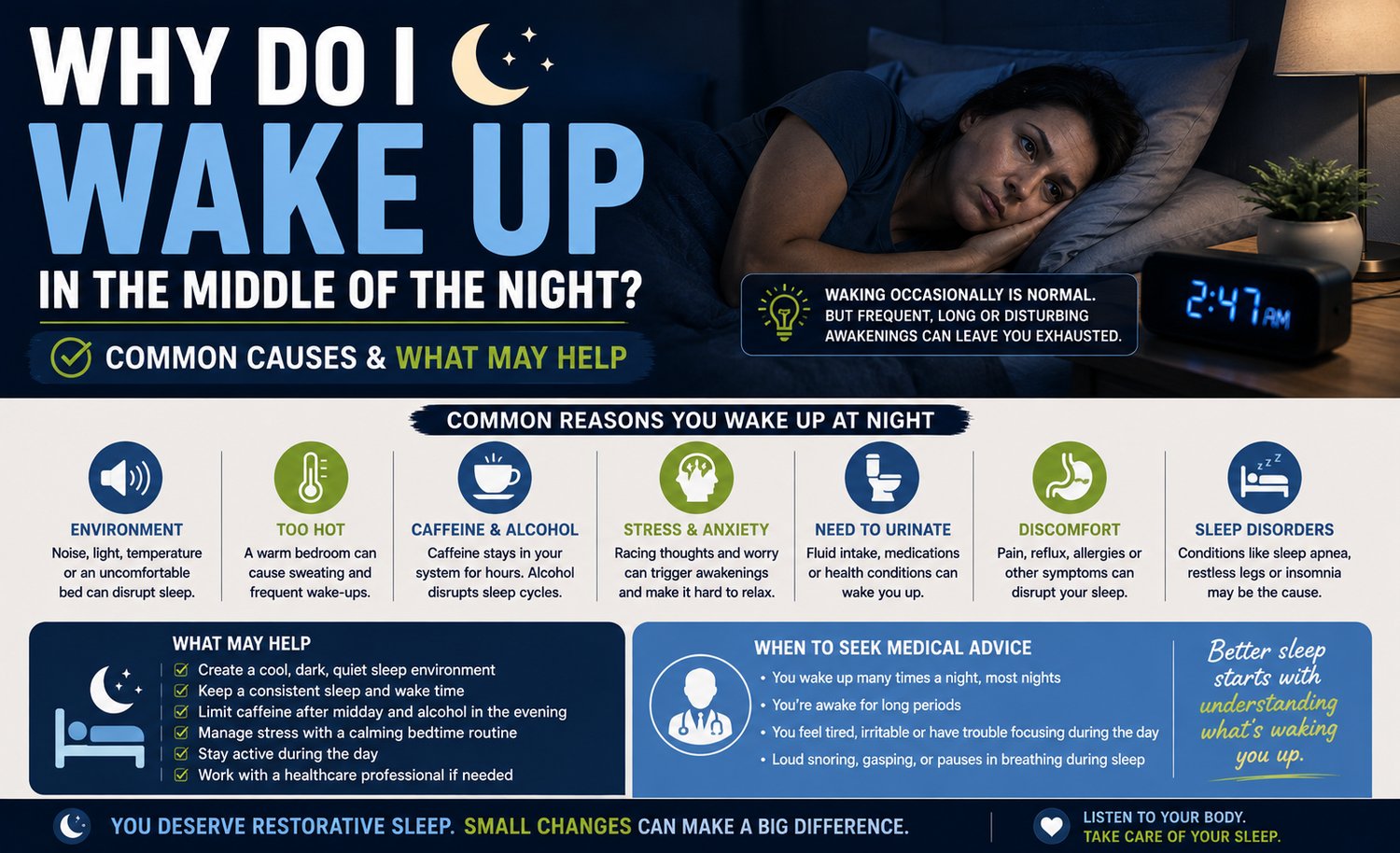
Why Do I Wake Up in the Middle of the Night? Common Causes & What May Help
The Complete Sleep & Recovery Guide
You fall asleep just fine.
Then:
1:47 a.m.
Eyes open.
You roll over.
Eventually fall asleep again.
Then:
3:26 a.m.
Awake.
Then:
4:51 a.m.
Again.
By morning, you've technically spent eight hours in bed—but it feels like you slept in several installments.
Sound familiar?
First, an important distinction:
Waking briefly during the night is not automatically abnormal.
Sleep occurs in repeating cycles, and brief awakenings can happen between them.
The bigger issue is when you:
- Wake frequently
- Stay awake for long periods
- Have trouble returning to sleep
- Wake because of symptoms such as pain, breathing problems or reflux
- Feel consistently exhausted the next day
The CDC specifically includes repeatedly waking during the night among signs of poor sleep quality.
And there are a lot of possible reasons.
Some are simple lifestyle problems.
Some are environmental.
Some involve stress.
And some deserve proper medical evaluation rather than another round of sleep hacks.
Let's sort them out.
Is It Normal to Wake Up During the Night?
Yes—to a point.
Sleep isn't eight uninterrupted hours of identical unconsciousness.
As we covered in Sleep Stages Explained: REM, Deep Sleep & What Happens While You Sleep, your brain moves through repeating sleep cycles throughout the night.
You may become briefly awake between cycles without even remembering it the next morning.
So this:
Briefly wake → roll over → fall back asleep
is very different from:
Wake → check clock → lie awake 90 minutes → fall asleep → repeat.
The second pattern can significantly affect how restorative your sleep feels.
When Nighttime Waking Becomes a Problem
Pay more attention when nighttime awakenings are:
Frequent
Long
Distressing
or
affecting your daytime functioning
You might notice:
- Morning exhaustion
- Daytime sleepiness
- Irritability
- Poor concentration
- Heavy caffeine dependence
- Anxiety about going to bed
- Feeling like you "never sleep through the night"
At that point, the question becomes:
What's waking you?
1. Your Bedroom Is Waking You
Start with the obvious stuff.
Your environment can repeatedly disrupt sleep.
Common problems include:
- Traffic
- Barking dogs
- A snoring partner
- Heating or cooling systems
- Outdoor lights
- A bright alarm clock
- A hot bedroom
- Pets moving around
- Phone notifications
CDC/NIOSH sleep guidance recommends a bedroom that is dark, quiet, cool and comfortable.
Before looking for some mysterious biological explanation, make sure your bedroom isn't simply terrible at being a bedroom.
If the garbage truck wakes you every morning at 4:30:
Your cortisol probably isn't the first suspect.
It's the garbage truck.
2. Your Bedroom May Be Too Hot
Temperature can be especially noticeable after you've already fallen asleep.
Maybe you fall asleep comfortably under several blankets.
A few hours later:
You're hot.
You kick them off.
Wake up.
Cool down.
Fall asleep.
Repeat.
If you're waking sweaty or uncomfortable, experiment with:
- Lower thermostat
- Fan
- Lighter bedding
- More breathable sleepwear
- Better airflow
Our guide to The Best Bedroom Environment for Sleep: Temperature, Light, Noise & Comfort covers these changes in much more detail.
Don't optimize temperature to the decimal point.
Just stop overheating yourself.
3. Alcohol Can Help You Fall Asleep—and Then Disrupt the Rest of the Night
This one fools people.
Alcohol can make you feel sleepy.
So the immediate conclusion is:
Alcohol helps me sleep.
But falling asleep faster and sleeping well all night are not the same thing.
NHLBI advises avoiding alcohol close to bedtime because it can interfere with healthy sleep and contribute to sleep problems.
If you regularly wake during the second half of the night and usually drink in the evening, test the relationship.
For one week:
Reduce or eliminate the bedtime alcohol.
Then track:
- Awakenings
- Time awake
- Morning energy
You may learn something quickly.
4. Caffeine May Still Be Hanging Around
Most people associate caffeine with trouble falling asleep.
But if caffeine is affecting the quality or continuity of your sleep, you may not necessarily notice the problem when your head first hits the pillow.
Caffeine's effects can persist for hours, especially at larger doses or in caffeine-sensitive people.
If you're struggling with fragmented sleep and drinking:
Coffee late afternoon.
Energy drinks.
Pre-workout.
Tea.
Caffeinated soda.
then caffeine deserves a test.
Our full guide, Caffeine and Sleep: How Long Does Caffeine Last & When Should You Stop Drinking It?, explains how to experiment with your cutoff.
Don't automatically quit coffee forever.
Move it earlier.
Observe what happens.
5. You Need to Use the Bathroom
This is one of the most straightforward causes.
You wake up because:
You have to pee.
Occasional nighttime urination isn't necessarily concerning.
But regularly waking multiple times to urinate—often called nocturia—can have several possible contributors and can significantly disrupt sleep.
Potential factors can include:
- Drinking large amounts near bedtime
- Alcohol
- Caffeine
- Certain medications
- Bladder conditions
- Prostate problems
- Other health conditions
NIDDK notes that caffeine, alcohol and some medicines can contribute to nighttime urinary problems.
A simple first experiment:
Hydrate normally during the day.
Then avoid making up your entire daily water intake at 9:45 p.m.
But Don't Just Stop Drinking Water
The answer isn't:
Dehydrate yourself after dinner.
That's unnecessary.
Instead:
Drink fluids regularly throughout the day.
Then reduce excessive drinking close to bedtime if bathroom trips are disrupting sleep.
If you're waking to urinate several times every night despite reasonable fluid timing, talk with a healthcare professional.
It may deserve evaluation.
6. Enlarged Prostate Can Contribute in Men
For men, urinary symptoms can sometimes relate to benign prostatic hyperplasia, or BPH.
As the prostate enlarges, it can affect urine flow and bladder emptying.
Symptoms can include things like:
- Frequent urination
- Urgency
- Weak stream
- Difficulty starting
- Feeling that the bladder hasn't emptied
- Nighttime urination
If nighttime bathroom trips come with other urinary changes, don't write it off as:
I'm just getting older.
Talk with a healthcare professional.
7. Stress Can Wake Your Brain Back Up
Sometimes you wake for no obvious reason.
Then within approximately eight seconds your brain goes:
Excellent. Since we're awake, let's discuss everything that's wrong.
Work.
Money.
Tomorrow.
Relationships.
The thing you forgot.
The thing you might have forgotten.
The embarrassing thing from 14 years ago that apparently required immediate review.
Now you're fully alert.
Stress and emotional strain can contribute to insomnia, and NHLBI identifies stress and changes in schedule or environment among factors that can contribute to sleep difficulty.
You don't need to eliminate stress from your life.
You do need a strategy for not turning 3 a.m. into planning time.
8. Clock-Watching Can Make the Awakening Worse
This pattern is brutal:
2:16 a.m.
Check clock.
Try to sleep.
2:38.
Check again.
Start calculating.
If I sleep now, I can still get three hours and 42 minutes.
3:11.
More calculations.
3:42.
Now you're angry.
The clock didn't cause the original awakening.
But it may be helping you remain mentally engaged with the problem.
Try:
Turn the clock away.
Keep the phone out of reach.
Stop monitoring every minute.
You don't need a live scoreboard for insomnia.
9. Your Phone Can Turn a Brief Awakening Into a Long One
You wake.
Reach for phone.
Check time.
See notification.
Open notification.
Check email.
Look at news.
Open social media.
Twenty-eight minutes later:
You're extremely awake.
A brief sleep interruption just became a full nighttime activity period.
If you regularly do this:
Keep the phone farther away.
Use Do Not Disturb.
Don't treat waking at 2 a.m. as an opportunity to catch up on the internet.
10. Eating Too Close to Bed Can Contribute for Some People
A heavy late meal may leave you:
Full.
Bloated.
Uncomfortable.
Or dealing with reflux.
If you're waking because of digestive discomfort, your evening eating pattern deserves attention.
Our previous nutrition-focused guide, Eating Before Bed: Does Late-Night Eating Affect Your Sleep?, explains why meal size and timing matter more than arbitrary rules like "never eat after 7."
Try moving larger meals earlier.
Then watch whether nighttime waking changes.
11. Acid Reflux Can Wake You
Reflux may be especially noticeable when you're lying down.
Symptoms can include:
- Burning in the chest
- Sour taste
- Regurgitation
- Throat irritation
- Coughing
- Discomfort when lying flat
If reflux is repeatedly waking you, changing meal timing may help—but persistent symptoms deserve medical evaluation.
Don't just keep stacking pillows and hoping the problem disappears.
12. Pain Can Fragment Sleep
Back pain.
Joint pain.
Headaches.
Injury.
Arthritis.
Any source of discomfort can make staying asleep harder.
Sometimes people don't recognize the connection because they aren't lying awake for hours thinking:
I am in terrible pain.
They simply:
Wake.
Reposition.
Fall asleep.
Wake again.
If your awakenings repeatedly coincide with discomfort, the sleep problem may actually be a pain-management problem.
Talk with an appropriate healthcare professional rather than endlessly changing your bedtime routine.
13. Restless Legs and Limb Movements Can Disturb Sleep
Restless legs syndrome usually involves an uncomfortable urge to move the legs while resting.
NINDS also notes that many people with restless legs syndrome experience periodic limb movements during sleep—repetitive leg or sometimes arm movements that can occur throughout the night.
If you experience:
- Strong urge to move your legs at night
- Crawling or uncomfortable leg sensations
- Symptoms that improve when you move
- Repeated leg kicking or jerking during sleep
talk with a healthcare professional.
That's not something you need to solve with a better pillow.
14. Sleep Apnea Can Cause Repeated Sleep Disruption
This is one of the important causes not to miss.
Obstructive sleep apnea involves repeated interruptions in breathing during sleep.
You may not remember waking every time.
Instead, clues might include:
- Loud snoring
- Gasping
- Choking
- Witnessed breathing pauses
- Morning headaches
- Dry mouth
- Significant daytime sleepiness
- Waking unrefreshed despite enough time in bed
Repeated nighttime waking plus these symptoms deserves medical evaluation.
A sleep tracker cannot rule sleep apnea in or out.
And no amount of sleep hygiene fixes an airway repeatedly closing during sleep.
15. Insomnia Isn't Always Trouble Falling Asleep
People often imagine insomnia as:
lying awake at bedtime unable to fall asleep.
That's only one form.
Insomnia can also involve difficulty staying asleep or waking too early.
NHLBI describes insomnia as a condition involving difficulty falling asleep or staying asleep despite having adequate opportunity for sleep.
So if you fall asleep easily but repeatedly spend long stretches awake during the night, insomnia may still be part of the picture.
What Is Sleep-Maintenance Insomnia?
When the primary problem is repeatedly waking and struggling to return to sleep, people often describe it as sleep-maintenance insomnia.
The important part isn't the label.
It's the pattern:
You have enough opportunity to sleep, but you can't maintain sleep consistently.
If this continues for an extended period and affects daytime functioning, basic sleep hygiene may not be enough.
Evidence-based insomnia treatment such as cognitive behavioral therapy for insomnia—CBT-I—may be appropriate.
16. Medications Can Affect Sleep
Some medications can contribute to:
- Insomnia
- Increased urination
- Restlessness
- Changes in sleepiness or alertness
That's why the CDC recommends including medications in a sleep diary when investigating sleep problems.
If nighttime waking began after:
starting a medication
or
changing a dose
mention that to your healthcare professional or pharmacist.
Do not stop a prescribed medication on your own because you think it's affecting sleep.
17. Hormonal Changes Can Affect Sleep
Hormonal transitions can also affect nighttime sleep.
For example, people going through perimenopause may experience:
- Hot flashes
- Night sweats
- Temperature changes
- Insomnia symptoms
- More nighttime awakenings
If that applies to you, the awakenings may be connected to the hormonal transition rather than simply "bad sleep habits."
HabitLogics already has a dedicated guide on Sleep During Perimenopause that explores this relationship in more detail.
Why Do I Wake Up at 3 a.m. Every Night?
This is an enormously popular internet question.
And unfortunately, the internet has produced some spectacular answers.
You may hear:
3 a.m. means your liver is detoxifying.
or:
Your cortisol is broken.
or:
It's a spiritual awakening.
or some very precise organ-clock explanation.
There isn't one universal medical explanation for waking at 3 a.m.
You may simply be waking during a point in your normal sleep architecture when your sleep is lighter—and then something keeps you awake.
That "something" might be:
Stress.
Noise.
Temperature.
Alcohol.
Bathroom needs.
Pain.
Reflux.
A sleep disorder.
Or no obvious cause at all.
Don't diagnose yourself based on the clock.
Why Can I Fall Asleep Fine but Not Stay Asleep?
Falling asleep and staying asleep aren't identical problems.
You may have enough sleep pressure at bedtime to fall asleep quickly.
But something later disrupts sleep.
For example:
Alcohol wears off and sleep becomes fragmented.
Your bladder fills.
Your room gets warmer.
Reflux develops after lying down.
Noise starts outside.
A breathing disorder repeatedly disturbs sleep.
Stress takes over once you're briefly awake.
This is why troubleshooting requires looking at the whole night, not just bedtime.
What Should You Do When You Wake Up at Night?
Start by doing less.
Seriously.
You wake.
The worst response is often:
PHONE. CLOCK. LIGHTS. PROBLEM-SOLVING.
Instead:
Stay relaxed.
Keep lights low.
Avoid checking the time repeatedly.
Don't start scrolling.
Give yourself an opportunity to drift back to sleep.
A brief awakening doesn't need to become an event.
What If You Can't Fall Back Asleep?
If you've been awake long enough that you're becoming frustrated and alert, lying in bed trying harder may not help.
A common behavioral approach used in insomnia treatment is to leave the bed when you're clearly unable to sleep, do something quiet in dim light, and return when sleepiness returns.
Possible activities:
- Read something calm
- Sit quietly
- Listen to soft audio
- Practice a relaxation technique
Not:
Start work.
Clean the garage.
Check social media.
Turn on every light in the house.
You want boring.
Boring is underrated at 3 a.m.
Should You Check the Time?
Usually not repeatedly.
If knowing the time causes you to calculate remaining sleep and become anxious:
Stop looking.
Turn the clock away.
Put the phone down.
The exact minute rarely changes what you should do.
Your job is still:
Return to sleep if you can.
Should You Eat If You Wake Up?
Not automatically.
If you're genuinely hungry, a small snack may be reasonable.
But don't accidentally train yourself into:
2:30 a.m. = snack time
every night.
If you routinely wake hungry, look at the larger daytime eating pattern.
Are you eating enough during the day?
Is dinner too small?
Is late-night hunger part of a larger eating pattern?
Track it.
Should You Take Melatonin at 3 a.m.?
Don't automatically reach for melatonin every time you wake.
Melatonin is involved in circadian timing and is not simply an "instant sleep switch."
The appropriate timing and use depend on the situation.
Taking sleep supplements reactively in the middle of the night without understanding why you're waking isn't a great troubleshooting strategy.
If you're considering regular melatonin or another sleep aid, discuss appropriate use with a healthcare professional.
Stop Trying to Force Sleep
This may sound strange.
But sleep is not an activity you can perform harder.
You can't lie there thinking:
SLEEP.
COME ON.
DO IT.
That's like trying to force yourself to sneeze through determination.
You create the conditions.
Then sleep happens.
If you're awake:
Reduce stimulation.
Stay calm.
Avoid turning it into a crisis.
Keep a Night-Waking Log
This is one of the most useful things you can do.
For 7–14 days, record:
Bedtime
Approximate time you fell asleep
How many times you remember waking
Approximate duration of awakenings
Why you think you woke
Bathroom trips
Alcohol
Caffeine
Dinner timing
Exercise
Morning energy
CDC guidance specifically notes that a sleep diary can help healthcare providers better understand what may be happening and recommends tracking nighttime awakenings along with caffeine, alcohol, exercise and medication use.
Now patterns can emerge.
Look for Repeatable Triggers
After a week, ask:
Do I wake more after alcohol?
Do I always wake to urinate?
Does late eating correspond with reflux?
Does my bedroom get hot overnight?
Do I wake when my partner snores?
Do late caffeine days look worse?
Does stress predict long awakenings?
That's much more useful than searching:
WHY DO I WAKE UP AT 3:17 EVERY NIGHT
and receiving 84 conflicting theories.
Fix One Obvious Cause at a Time
Suppose your diary shows:
You wake twice most nights to urinate.
You drink 40 ounces of water between 8 and 10 p.m.
That's an obvious experiment.
Shift more hydration earlier.
Then compare.
Or:
Your worst nights consistently follow alcohol.
Test reducing alcohol.
Or:
You wake overheated.
Change bedding.
Don't change seven variables simultaneously.
Otherwise, even if sleep improves, you won't know why.
What If There Is No Obvious Pattern?
That happens.
Sleep isn't always easy to reverse-engineer.
If you've:
Created adequate sleep opportunity.
Improved the environment.
Managed caffeine and alcohol.
Established a reasonably consistent schedule.
Tracked for several weeks.
and
Still wake repeatedly and feel poorly during the day...
that's when professional evaluation becomes increasingly reasonable.
You don't have to solve everything yourself.
How to Improve Your Odds of Staying Asleep
Start with the fundamentals.
Give Yourself Enough Sleep Opportunity
Don't confuse fragmented sleep with simply staying in bed too long or maintaining an irregular schedule.
Keep Your Schedule Consistent
Regular sleep and wake times can support a more stable sleep pattern.
Reduce Late Caffeine
Especially if you're sensitive or using high doses.
Be Careful With Alcohol
Particularly if waking occurs during the second half of the night.
Manage Evening Fluids
If bathroom trips are the problem.
Avoid Huge Late Meals
Especially if reflux or discomfort is involved.
Keep the Room Cool, Dark and Quiet
Remove obvious environmental disruptions.
Keep Your Phone Quiet and Out of Reach
Don't turn awakenings into scrolling sessions.
Those are reasonable experiments.
Not guarantees.
When Should You See a Doctor About Waking Up at Night?
Consider talking with a healthcare professional when awakenings are:
- Persistent
- Frequent
- Long-lasting
- Significantly affecting daytime functioning
- Accompanied by excessive daytime sleepiness
- Accompanied by loud snoring or gasping
- Related to persistent pain
- Related to significant reflux
- Related to frequent nighttime urination
- Accompanied by unusual movements or behaviors during sleep
Also seek evaluation if you're getting enough sleep opportunity but remain consistently exhausted.
That's especially important when sleepiness affects:
driving
work
or
operating equipment.
Safety comes first.
Your Sleep Tracker Probably Won't Tell You Why You're Waking
A wearable may show:
Awake — 37 minutes
That's interesting.
It doesn't necessarily tell you:
why.
Maybe you were:
Hot.
Using the bathroom.
Gasping from sleep apnea.
Dealing with reflux.
Stressed.
Awakened by noise.
The device can show a pattern.
It may not identify the cause.
This is another reason subjective tracking still matters.
Write down what actually happened.
Use Your Own Experience Alongside the Data
Your watch says:
Great sleep.
You say:
I woke six times and feel terrible.
Your experience matters.
Likewise:
Your watch says:
Poor sleep.
You feel fantastic.
Don't automatically let the algorithm overrule your body.
Look at trends.
Not one night's grade.
Use a 7-Day Baseline Before You Start Fixing Everything
If nighttime awakenings are becoming frustrating, resist the urge to immediately change your entire routine.
Track first.
The FREE 7-Day Sleep Reset | Sleep & Recovery Starter Kit gives you a structured way to look at:
- Sleep timing
- Awakenings
- Energy
- Caffeine
- Evening habits
- Daily routines
Then identify your most likely trigger.
That gives you a much better starting point.
Longer-Term Tracking Can Help With Fragmented Sleep
If you want to follow the pattern over several weeks, the Sleep Recovery Planner | Sleep Tracker and Energy Journal combines a fillable PDF with an Excel dashboard for tracking sleep, energy, caffeine and routines over time.
That can help answer:
Are awakenings becoming less frequent?
Is morning energy improving?
Does changing one behavior actually matter?
That's what useful tracking looks like.
Frequently Asked Questions
Is it normal to wake up in the middle of the night?
Brief awakenings can occur during normal sleep.
It becomes more concerning when waking is frequent, prolonged, distressing or associated with poor daytime functioning. The CDC lists repeatedly waking during the night as one sign of poor sleep quality.
Why do I wake up every night at the same time?
There isn't one universal explanation.
Normal sleep cycles, environmental disruptions, stress, alcohol, bathroom needs, pain, reflux and sleep disorders can all contribute.
The clock time alone usually isn't enough to identify the cause.
Why do I wake up at 3 a.m.?
There's no special medical rule saying 3 a.m. points to one particular organ, hormone or health problem.
Look instead at your overall sleep pattern and possible triggers.
Why do I wake up to pee every night?
Nighttime urination can be influenced by fluid intake, caffeine, alcohol, medications, bladder problems, prostate conditions and other health factors.
Frequent persistent nighttime urination deserves medical attention.
Can alcohol make me wake up during the night?
Yes. Although alcohol may initially make you sleepy, NHLBI advises avoiding it near bedtime because it can contribute to sleep problems.
Can stress cause nighttime awakenings?
Stress can contribute to insomnia and make it harder to return to sleep after waking.
What should I do if I wake up and can't fall back asleep?
Keep the environment dim and unstimulating.
Avoid clock-watching and phone use.
If you become clearly awake and frustrated, get out of bed briefly and do something quiet until sleepiness returns.
Is waking up at night insomnia?
It can be.
Insomnia can involve difficulty falling asleep or staying asleep despite adequate opportunity for sleep.
Can sleep apnea cause me to wake repeatedly?
Yes. Sleep-disordered breathing can fragment sleep, sometimes without the person remembering every awakening.
Loud snoring, gasping, choking or significant daytime sleepiness should prompt medical evaluation.
Should I track my awakenings?
Yes, especially if the problem persists.
The CDC recommends sleep diaries that include nighttime awakenings as well as caffeine, alcohol, exercise and medication use.
Key Takeaways
Waking up during the night doesn't automatically mean something is wrong.
Brief awakenings can happen.
The problem is when you:
wake frequently
stay awake
feel exhausted afterward
or
wake because of symptoms that deserve attention.
Common contributors include:
Noise
Temperature
Alcohol
Caffeine
Bathroom trips
Stress
Phones
Late meals
Reflux
Pain
Restless legs
Insomnia
and
sleep apnea.
Start by asking:
What is actually waking me?
Then:
Track → Identify → Adjust → Repeat.
Don't chase the clock.
Don't assume waking at 3 a.m. has one mysterious explanation.
And don't spend months trying lifestyle hacks when your symptoms point toward something that deserves medical evaluation.
Track Your Nighttime Awakenings for One Week
For seven days, write down:
When you wake
how long you're awake
what seems to have caused it
and
how you feel the next morning.
The FREE 7-Day Sleep Reset | Sleep & Recovery Starter Kit can help you establish that baseline.
If repeated awakenings are a longer-term issue, the Sleep Recovery Planner | Sleep Tracker and Energy Journal gives you a more detailed way to follow sleep and energy patterns over time.
Related Sleep & Recovery Guides
What Is Sleep Quality? How to Know If You’re Actually Sleeping Well
Sleep Hygiene: What It Is, What Actually Works & What’s Overrated
Eating Before Bed: Does Late-Night Eating Affect Your Sleep?
Walking for Better Sleep: Can a Daily Walk Improve Sleep Quality?
Next in the Sleep & Recovery series:
Why Am I Tired After 8 Hours of Sleep? Sleep Quantity vs. Sleep Quality
Medical Disclaimer: This article is for educational and informational purposes only and is not intended as medical advice, diagnosis or treatment. Persistent nighttime awakenings, excessive daytime sleepiness, loud snoring, gasping or choking during sleep, frequent nighttime urination, chronic pain or other concerning symptoms should be discussed with a qualified healthcare professional.