

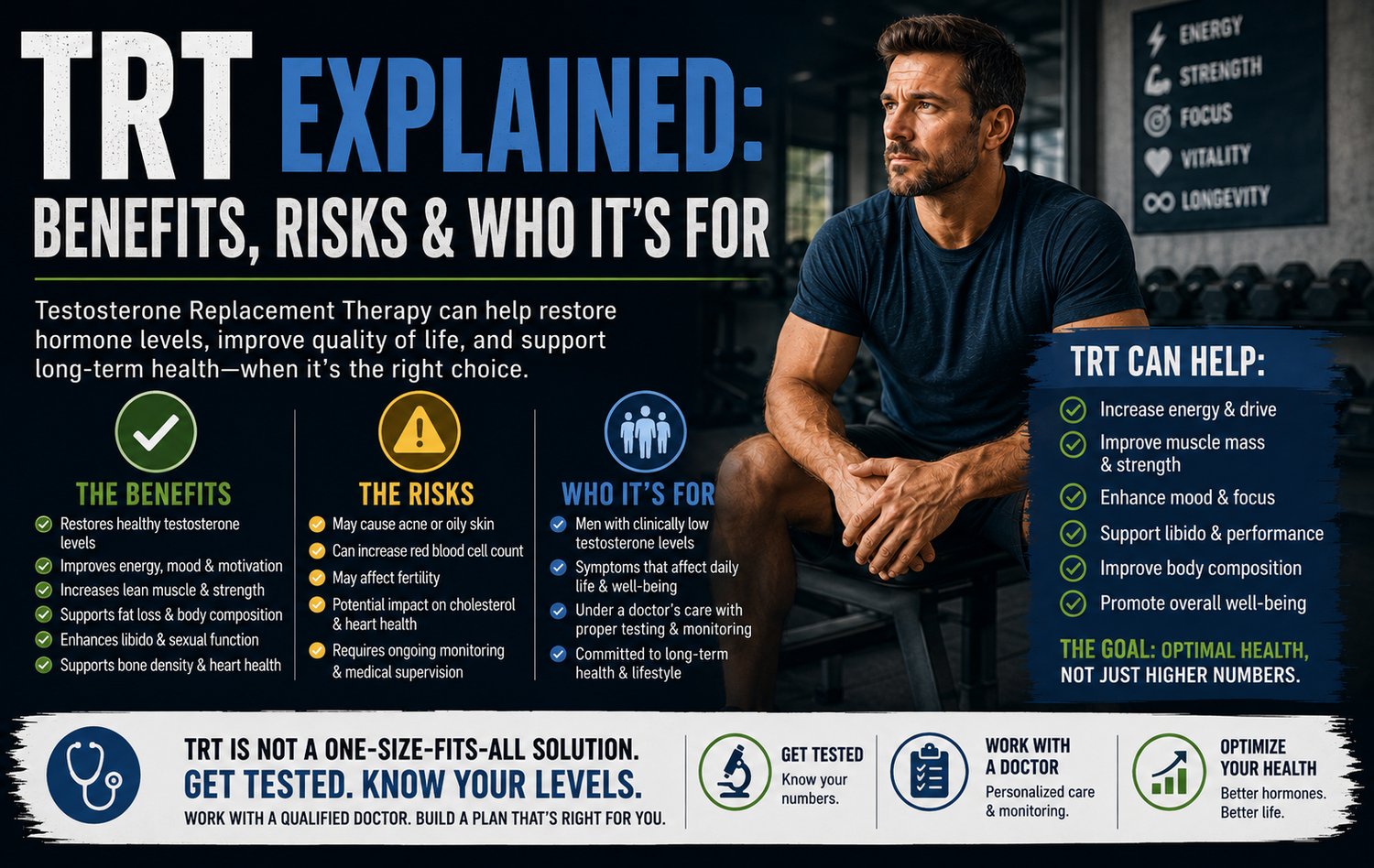
What Is TRT? Testosterone Replacement Therapy Explained
TRT stands for testosterone replacement therapy. It is a prescription medical treatment used to replace testosterone in men with appropriately diagnosed testosterone deficiency, also called hypogonadism.
In simple terms, TRT gives the body testosterone when it is not producing enough on its own. The goal is generally to restore testosterone to an appropriate physiological range and improve symptoms associated with testosterone deficiency—not to maximize testosterone levels or turn normal levels into bodybuilding levels.
For men who truly have hypogonadism, testosterone replacement therapy may improve symptoms such as low libido and can increase lean body mass, bone density, and red blood cell production. But TRT also has important tradeoffs. It can suppress sperm production, raise hematocrit, affect blood pressure, and requires ongoing medical monitoring.
That makes the most useful question less:
“Is TRT good or bad?”
and more:
“Do I actually have testosterone deficiency, and is TRT appropriate for me?”
Diagnosis should come before treatment. If you're still figuring out whether low testosterone could explain your symptoms, start with:
- Low Testosterone Symptoms: 20 Signs Men Shouldn't Ignore
- What Causes Low Testosterone? Common Medical, Lifestyle & Age-Related Reasons
- How Testosterone Is Tested and Diagnosed: A Practical Guide for Men
Those guides cover the symptoms, possible causes, and testing process that should come before deciding whether testosterone treatment makes sense.
Exploring Online TRT?
If you already have symptoms and lab results that have you considering testosterone treatment, you can compare online TRT options, provider features, lab requirements, treatment options, and other factors worth considering before signing up.
Affiliate disclosure: HabitLogics may earn a commission if you purchase through links on our TRT provider page, at no additional cost to you.
Who Is TRT Actually For?
TRT is generally intended for men who have symptoms consistent with testosterone deficiency along with repeatedly low testosterone measurements and an appropriate clinical evaluation.
That evaluation matters because low testosterone can have many causes.
Men who may have hypogonadism include those with:
- Primary testicular disorders
- Pituitary or hypothalamic disorders
- Certain genetic conditions
- Other established causes that interfere with normal testosterone production
A clinician should also investigate potentially reversible contributors and determine whether there are reasons testosterone treatment may not be appropriate.
TRT shouldn't be diagnosed from symptoms alone, and one unexpectedly low testosterone result doesn't necessarily establish hypogonadism.
TRT Isn't Automatically for Every Man With “Low-Normal” Testosterone
This is where modern men's-health marketing can get messy.
Consider a man who has testosterone near the lower end of a laboratory reference range but also has:
- Poor sleep
- Excess body fat
- Chronic stress
- Little physical activity
- Several medications
- Few or no sexual symptoms
That's a different clinical picture from someone with persistent symptoms, repeatedly low morning testosterone, and an identified disorder affecting the testes, pituitary, or hypothalamus.
Testosterone levels also need to be interpreted in context rather than compared with whatever number happens to be popular on social media.
TRT is medical treatment for testosterone deficiency—not simply an “optimization package” for anyone whose testosterone isn't as high as it was when he was 22.
What Benefits Can TRT Provide?
When testosterone deficiency has been appropriately diagnosed, TRT may improve several symptoms and health measures.
Potential benefits can include:
- Improved libido
- Improved sexual function in some men
- Increased lean body mass
- Improved muscle strength in some men
- Increased bone density
- Correction of anemia in some men
- Improvement in other symptoms related to hypogonadism
Response varies considerably.
Some men notice substantial improvements. Others experience more modest changes.
And symptoms such as fatigue, poor motivation, erectile dysfunction, or low mood may persist if testosterone deficiency wasn't their only cause.
That's an important expectation to establish before treatment begins.
TRT and Sex Drive
Reduced sexual desire is one of the symptoms commonly associated with testosterone deficiency.
For men with confirmed hypogonadism, restoring testosterone may improve libido.
But testosterone isn't the only thing controlling sex drive.
Libido can also be affected by:
- Sleep
- Stress
- Depression
- Relationship factors
- Medications
- Chronic illness
- Other hormonal or medical problems
If testosterone normalizes but libido remains low, that doesn't automatically mean the testosterone dose needs to be increased.
The underlying problem may lie somewhere else.
TRT and Erectile Dysfunction
TRT can improve erectile function in some men who have genuine testosterone deficiency, but it isn't a universal treatment for erectile dysfunction.
Erections depend on far more than testosterone.
ED can also be associated with:
- Cardiovascular disease
- Diabetes
- High blood pressure
- Medication effects
- Nerve problems
- Psychological factors
- Other medical conditions
That distinction matters because simply raising testosterone won't necessarily correct an erection problem caused by vascular disease or another underlying condition.
For a deeper look at the many causes of erectile problems, read Erectile Dysfunction: Causes, Treatment & When to Get Help.
TRT and Muscle
Testosterone plays an important role in muscle physiology.
Men with hypogonadism who begin TRT may experience increases in lean body mass and improvements in strength.
But TRT doesn't eliminate the need to train.
If building or preserving muscle is the goal, the fundamentals still matter:
- Resistance training
- Adequate protein
- Appropriate calorie intake
- Sleep
- Recovery
Read Strength Training for Men Over 30: How to Build Muscle, Stay Strong & Age Better.
For nutrition, use the Complete High-Protein Guide.
TRT and Energy
Improved energy is one of TRT's most heavily marketed potential benefits.
Some men with genuine testosterone deficiency may feel more energetic after appropriate treatment.
But TRT shouldn't be viewed as a general-purpose treatment for fatigue.
Low energy can also result from:
- Inadequate sleep
- Sleep apnea
- Depression
- Chronic illness
- Medication effects
- Excessive work or stress
- Poor nutrition
- Low physical activity
If you're exhausted because you're sleeping five hours per night or have untreated sleep apnea, testosterone may not solve the underlying problem.
Persistent fatigue deserves a broader evaluation.
TRT and Bone Health
Long-term testosterone deficiency can contribute to reduced bone density.
Testosterone therapy can increase bone density in men with hypogonadism.
That's one reason severe testosterone deficiency shouldn't be thought of only as a libido or muscle problem.
Sex hormones affect multiple systems throughout the body, including bone.
TRT and Anemia
Testosterone stimulates red blood cell production.
In some men with testosterone deficiency and anemia, treatment can improve anemia.
But that same biological effect creates one of TRT's most important monitoring concerns:
Hematocrit can become too high.
That's why blood counts are routinely relevant before and during testosterone treatment.
TRT Doesn't Automatically Cause Weight Loss
TRT is not a weight-loss medication.
Some men may experience changes in body composition, particularly increases in lean mass, but testosterone shouldn't be treated as a substitute for nutrition and physical activity.
Fat loss still depends heavily on factors such as:
- Energy balance
- Nutrition
- Activity
- Sleep
- Strength training
Excess body fat can itself contribute to lower testosterone in some men. When obesity or another reversible factor appears to be contributing, addressing that underlying problem may be an important part of treatment.
For a simple activity foundation, read Walking for Men's Health.
What Forms of TRT Are Available?
Testosterone replacement therapy can be delivered in several ways.
Common forms include:
- Injections
- Gels
- Patches
- Pellets
- Certain oral testosterone formulations
There isn't one universally best method.
The right option depends on your medical situation, cost, convenience, preferences, side effects, and clinician guidance.
Testosterone Injections
Injections are a common form of TRT.
Potential advantages include:
- Reliable absorption
- Flexible dosing
- Often relatively affordable treatment
Potential drawbacks include:
- Needles
- Injection-site discomfort
- Regular administration
- Peaks and troughs that can vary with the medication and dosing schedule
Injection frequency depends on the testosterone product and treatment plan.
Testosterone Gels
Testosterone gels are applied to the skin, usually every day.
Advantages can include avoiding injections and producing relatively steady testosterone exposure.
Potential drawbacks include:
- Daily application
- Skin irritation
- Risk of transferring testosterone to another person through skin contact
Following application and handling instructions is particularly important around women and children.
Testosterone Pellets
Testosterone pellets are implanted beneath the skin and release testosterone over an extended period.
Their major advantage is convenience.
However, insertion requires a minor procedure, and adjusting the dose isn't as immediate as changing an injection or gel regimen.
Oral Testosterone
Certain oral testosterone products are also available.
Older oral androgen formulations raised particular liver-related concerns. Newer testosterone undecanoate products use different absorption mechanisms but still have their own prescribing considerations and potential risks.
The existence of oral testosterone doesn't mean it's automatically preferable to injections, gels, or other options.
Fertility Is One of the Biggest TRT Issues Younger Men Should Understand
This needs to be discussed before treatment begins.
External testosterone suppresses hormonal signals from the brain that normally stimulate the testes.
That can reduce:
- Luteinizing hormone (LH)
- Follicle-stimulating hormone (FSH)
- The testes' own testosterone production
- Sperm production
For some men, sperm production can fall dramatically.
Men interested in having children should tell their clinician before starting testosterone.
Don't wait until months after treatment begins to bring up fertility.
Depending on the situation, a clinician specializing in male fertility or reproductive endocrinology may need to discuss alternatives and fertility-preservation strategies.
TRT Can Reduce Testicular Size
Because external testosterone suppresses the body's normal hormonal signaling, testicular size may decrease during treatment.
This is related to reduced stimulation of the testes and suppression of sperm production.
It isn't guaranteed to happen to every man, but it is a recognized potential effect that should be included in an informed discussion about treatment.
TRT Can Raise Hematocrit
Testosterone stimulates red blood cell production.
Sometimes that response becomes excessive.
Testosterone therapy can increase:
- Hemoglobin
- Hematocrit
An excessively elevated hematocrit is one of the major reasons men receiving TRT need regular blood testing.
This isn't optional “biohacking data.”
It's part of responsible medical monitoring.
If hematocrit rises too much, the clinician managing treatment may need to reassess the dose, formulation, contributing factors, or treatment plan.
TRT and Blood Clots
Cardiovascular safety has been debated for years.
Large randomized clinical-trial data have been reassuring regarding major cardiovascular events such as heart attack and stroke in appropriately selected men, but that doesn't mean TRT is risk-free.
The large TRAVERSE program did not find a meaningful increase in major cardiovascular events overall compared with placebo, but pulmonary embolism occurred more often in the testosterone-treated group.
That distinction matters.
Neither:
“TRT is perfectly safe”
nor:
“TRT causes heart attacks”
accurately captures the current evidence.
Individual risk factors and appropriate monitoring still matter.
TRT and the Heart
Men considering testosterone treatment often worry about cardiovascular risk.
Current evidence is more reassuring than older headlines sometimes suggest regarding heart attack and stroke in appropriately selected men with hypogonadism.
But your baseline cardiovascular health still matters.
Important risk factors include:
- High blood pressure
- Smoking
- Diabetes
- Abnormal cholesterol levels
- Obesity
- Sleep apnea
- Existing cardiovascular disease
TRT shouldn't distract from managing those larger health risks.
TRT and Blood Pressure
Blood pressure deserves specific attention during testosterone treatment.
FDA-required studies have found that testosterone products can increase blood pressure, leading the agency to require class-wide labeling addressing this risk.
That doesn't mean every man on TRT will develop hypertension.
It does mean blood pressure belongs in the overall monitoring picture—particularly if you already have high blood pressure or other cardiovascular risk factors.
Monitoring may include blood pressure alongside testosterone levels, hematocrit, symptoms, and other markers selected by your clinician.
TRT and the Prostate
A common fear about testosterone is:
“Testosterone causes prostate cancer.”
That's too simplistic.
But prostate health still matters before and during treatment.
Depending on a man's age, medical history, symptoms, and individual risk, evaluation may involve:
- Prostate-specific antigen (PSA)
- Prostate history
- Urinary symptoms
- Additional urological evaluation when appropriate
Known or suspected prostate cancer requires appropriate medical evaluation before testosterone therapy.
This is another reason TRT requires ongoing medical care rather than simply receiving a prescription and disappearing for a year.
TRT and Sleep Apnea
Severe untreated obstructive sleep apnea is an important consideration when evaluating someone for testosterone therapy.
That's especially relevant because symptoms can overlap.
A man with sleep apnea may experience:
- Fatigue
- Poor concentration
- Low energy
- Reduced exercise performance
- Sexual problems
- Poor sleep quality
If you:
- Snore loudly
- Gasp during sleep
- Appear to stop breathing during sleep
- Wake up exhausted despite spending enough time in bed
the sleep problem deserves evaluation.
Don't automatically assume fatigue means you need testosterone.
Read Sleep for Men: Why Better Sleep Matters for Testosterone, Recovery & Health.
TRT Can Cause Acne and Skin Changes
Androgen therapy can increase oil production in the skin.
Some men develop:
- Acne
- Oily skin
- Injection-site or other skin reactions depending on treatment type
These effects may be manageable, but they're still worth discussing with the clinician managing treatment.
TRT May Cause Breast Enlargement
Gynecomastia, or enlargement of male breast tissue, can sometimes occur during testosterone treatment.
Some testosterone is converted into estradiol, and hormone balance can be complicated.
That does not mean every man receiving TRT automatically needs medication to suppress estrogen.
Symptoms, laboratory findings, and the overall clinical picture should guide treatment decisions.
What About Estrogen on TRT?
Men need estradiol too.
Estradiol contributes to:
- Bone health
- Sexual function
- Other normal physiological processes
The goal of TRT shouldn't automatically be to drive estrogen as low as possible.
If symptoms or laboratory findings suggest an estradiol-related issue, it should be evaluated by the clinician managing treatment.
Automatically adding an aromatase inhibitor or other estrogen-blocking medication to every TRT plan isn't a universal standard of care.
Who Should Be Evaluated Carefully Before Starting TRT?
Testosterone treatment isn't appropriate to begin casually.
Conditions and situations requiring particular attention can include:
- Plans for near-term fertility
- Known or suspected prostate or breast cancer
- Concerning prostate findings
- Elevated hematocrit
- Untreated severe obstructive sleep apnea
- Severe urinary symptoms
- Uncontrolled heart failure
- Recent major cardiovascular events
- Thrombophilia or other significant clotting concerns
The exact implications depend on the individual situation.
Some conditions may require additional evaluation rather than representing a permanent prohibition against treatment.
The broader point is simple:
Medical screening matters before TRT begins.
What Should Be Checked Before Starting TRT?
The exact evaluation varies from patient to patient.
Depending on the situation, it may include:
- Repeat morning testosterone testing
- LH
- FSH
- Free testosterone or SHBG when appropriate
- CBC and hematocrit
- PSA when appropriate
- Fertility discussion
- Evaluation for sleep apnea
- Medication review
- Cardiovascular risk assessment
- Investigation of why testosterone is low
If that sounds like more than:
“Take this quiz and we'll mail you testosterone,”
that's the point.
TRT is legitimate medical therapy.
It should be treated like it.
For a deeper explanation of the diagnostic process, read How Testosterone Is Tested and Diagnosed.
Monitoring Doesn't Stop Once TRT Begins
Responsible testosterone treatment includes follow-up.
Monitoring may include:
- Testosterone levels
- Hematocrit
- Hemoglobin
- Symptoms
- Side effects
- PSA when appropriate
- Blood pressure
- Other markers based on your medical situation
Monitoring schedules aren't identical for every patient or testosterone formulation.
The goal isn't simply to make a testosterone number go up.
It's to improve the symptoms you're treating while minimizing risk.
Don't Chase the Highest Testosterone Number
This is one area where online TRT culture can go wrong.
If treatment improves symptoms and testosterone reaches an appropriate physiological range, pushing the dose higher isn't automatically better.
Higher exposure can increase the likelihood of problems such as:
- Elevated hematocrit
- Acne
- Hormone-related side effects
- Other adverse effects
TRT stands for testosterone replacement therapy.
The goal isn't to create supraphysiologic testosterone levels because a higher number looks more impressive on a screenshot.
How Quickly Does TRT Work?
Different effects of testosterone treatment occur on different timelines.
Some men may notice changes in sexual symptoms or other subjective symptoms relatively early.
Changes involving:
- Muscle
- Body composition
- Bone density
generally take longer.
Don't judge an entire treatment plan after a few injections.
At the same time, don't assume every symptom will eventually respond if you simply keep increasing the dose.
If testosterone has normalized and a symptom hasn't improved, testosterone deficiency may not have been its primary cause.
What If TRT Doesn't Make You Feel Better?
Suppose your testosterone normalizes.
But you're still:
- Exhausted
- Sleeping poorly
- Struggling with erections
- Experiencing low mood
- Unmotivated
The broader investigation shouldn't stop.
Possible explanations might include:
- Untreated sleep apnea
- Cardiovascular causes of erectile dysfunction
- Depression or another mental-health condition
- Medication effects
- Metabolic problems
- Lifestyle factors
- Another medical condition
A testosterone prescription doesn't make every other possible diagnosis disappear.
Can Lifestyle Replace TRT?
Sometimes improving underlying lifestyle or health factors can improve testosterone.
Examples may include:
- Losing excess body fat
- Improving sleep
- Treating sleep apnea
- Avoiding severe calorie restriction
- Increasing appropriate physical activity
- Improving metabolic health
But lifestyle cannot reverse every cause of hypogonadism.
A man with permanent testicular damage or a significant pituitary disorder isn't necessarily going to restore normal testosterone simply by sleeping more and lifting weights.
That's why identifying the cause matters.
Read What Causes Low Testosterone? and How Testosterone Is Tested and Diagnosed for the steps that come before treatment.
Lifestyle Still Matters on TRT
Taking testosterone doesn't give you immunity from poor health habits.
You still need:
- Adequate sleep
- Resistance training
- Regular movement
- Adequate protein
- Nutritious food
- Healthy weight management
- Stress management
- Preventive healthcare
TRT should be one component of an overall health plan when treatment is medically appropriate—not the entire plan.
The Testosterone Lifestyle Guide helps organize sleep, nutrition, strength training, stress, and recovery.
For broader tracking, the Men's Health & Performance Dashboard can help organize fitness, energy, body composition, recovery, and overall health data.
Bloodwork Matters Even More Once Treatment Begins
If you're monitoring testosterone over time, keeping results organized can make it easier to see trends and discuss them with your clinician.
Relevant markers may include:
- Testosterone
- Hematocrit
- Hemoglobin
- PSA when appropriate
- Lipids
- Glucose
- Other clinician-selected markers
The Men's Bloodwork Dashboard is designed to organize testosterone, metabolic, lipid, body-composition, and recovery data over time.
If you're still in the testing stage rather than treatment, visit the HabitLogics Men's Bloodwork Hub.
For an at-home initial testosterone option, you can also explore the Everlywell Testosterone Test.
What About Online TRT Clinics?
Telehealth has made testosterone evaluation and treatment much easier to access.
That convenience can be valuable.
But convenience shouldn't replace appropriate medical care.
When evaluating an online TRT provider, consider factors such as:
- How the provider establishes a diagnosis
- Testosterone testing requirements
- Medical-history review
- Fertility counseling
- Baseline bloodwork
- Ongoing laboratory monitoring
- Access to a qualified clinician
- Medication options
- Transparent pricing
- What happens when side effects or problems arise
Be cautious with services that appear more focused on selling an “optimized” testosterone number than determining why you're experiencing symptoms.
If you're researching telehealth treatment, compare online TRT options for provider features, pricing considerations, lab requirements, treatment options, and other factors worth comparing.
Questions to Ask Before Starting TRT
Before beginning testosterone treatment, consider asking your clinician:
- Do I clearly meet the diagnostic criteria for hypogonadism?
- Why do you think my testosterone is low?
- Could a reversible factor be contributing?
- Are there reasonable alternatives to TRT in my situation?
- How could treatment affect my fertility?
- Which form of testosterone do you recommend, and why?
- What side effects should I watch for?
- How often will you monitor my hematocrit?
- How will we monitor my blood pressure?
- What testosterone range are we aiming for?
- What happens if my symptoms don't improve?
- What are the total ongoing costs of treatment?
A good clinician should be comfortable discussing these questions.
Frequently Asked Questions
What does TRT stand for?
TRT stands for testosterone replacement therapy. It is prescription treatment used to replace testosterone in men who have appropriately diagnosed testosterone deficiency.
What is TRT used for?
TRT is used to treat appropriately diagnosed male hypogonadism. The goal is to restore testosterone to an appropriate physiological range and improve symptoms associated with testosterone deficiency.
Is TRT safe?
TRT can be used appropriately in men with diagnosed hypogonadism, but it isn't risk-free.
Potential concerns include elevated hematocrit, increased blood pressure, suppression of sperm production, skin effects, and other risks that depend on the individual.
Appropriate patient selection and ongoing medical monitoring are important.
Does TRT cause infertility?
TRT can significantly suppress sperm production.
Men who want children should discuss fertility before starting testosterone therapy.
Does TRT shrink your testicles?
It can reduce testicular size in some men.
External testosterone suppresses hormonal signals that normally stimulate the testes, which can reduce the testes' own testosterone production and sperm production.
Does TRT increase heart attack risk?
Large randomized clinical-trial data have not shown a significant increase in major cardiovascular events such as heart attack or stroke overall in appropriately selected men with hypogonadism.
However, that doesn't make TRT risk-free. Other cardiovascular and clotting considerations remain important, and individual risk should be evaluated by a clinician.
Does TRT help build muscle?
TRT can increase lean mass in men with testosterone deficiency.
Resistance training, adequate protein, sufficient nutrition, and recovery still matter if building muscle is the goal.
Does TRT help with belly fat?
TRT isn't a weight-loss medication.
Body-composition changes may occur in some men, but losing excess body fat still depends heavily on nutrition, activity, sleep, and overall energy balance.
Do you have to stay on TRT forever?
Not necessarily in every situation.
But if the underlying cause of testosterone deficiency remains, testosterone levels may fall again after treatment is stopped.
External testosterone also suppresses natural hormone signaling, so discontinuation should be discussed with the clinician managing treatment rather than handled casually.
What is the best form of TRT?
There isn't one universally best form.
Injections, gels, pellets, patches, and certain oral preparations each have advantages and disadvantages.
The right option depends on your medical circumstances, cost, convenience, preferences, side effects, and clinician guidance.
Key Takeaways
- TRT means testosterone replacement therapy.
- TRT is prescription medical treatment for appropriately diagnosed testosterone deficiency.
- Diagnosis generally requires compatible symptoms plus consistently low testosterone measurements and appropriate clinical evaluation.
- TRT may improve sexual symptoms, lean mass, bone density, anemia, and other effects of hypogonadism in appropriately selected men.
- TRT isn't a general anti-aging, bodybuilding, energy, or weight-loss treatment.
- Testosterone therapy can suppress sperm production and affect fertility.
- TRT can raise hematocrit and blood pressure, making ongoing monitoring important.
- Current cardiovascular evidence is more reassuring than some older headlines suggest, but treatment isn't risk-free.
- Lifestyle habits continue to matter even when you're receiving TRT.
- The goal is appropriate testosterone replacement and symptom improvement—not maximizing your testosterone number.
Final Thoughts
TRT is neither magic nor poison.
It's medicine.
For a man with appropriately diagnosed testosterone deficiency, testosterone replacement therapy can be genuinely helpful.
But there's a major difference between:
treating hypogonadism
and
selling testosterone as the solution for every tired man who isn't 22 anymore.
A stronger approach is:
Understand your symptoms.
Test properly.
Confirm unexpectedly low results.
Investigate why testosterone is low.
Discuss fertility before treatment.
Understand the potential benefits and risks.
Monitor treatment appropriately.
Then make an informed decision with a qualified healthcare professional.
If you're ready to research treatment options after completing that process, you can compare online TRT providers and treatment options.
Continue the Testosterone & Men's Wellness Series
If you're investigating low testosterone, these guides provide the foundation:
- Low Testosterone Symptoms: 20 Signs Men Shouldn't Ignore
- What Causes Low Testosterone? Common Medical, Lifestyle & Age-Related Reasons
- How Testosterone Is Tested and Diagnosed: A Practical Guide for Men
- How to Support Testosterone Naturally
- Testosterone Myths: What's True, What's Not, and What Actually Matters
For broader men's health:
- What Is Men's Wellness? Building Health for Energy, Strength & Longevity
- Sleep for Men: Why Better Sleep Matters for Testosterone, Recovery & Health
- Strength Training for Men Over 30: How to Build Muscle, Stay Strong & Age Better
- Complete Men's Wellness Guide
Exploring Online TRT?
If you have symptoms and lab results that have you considering testosterone treatment, compare online TRT options, provider features, lab requirements, treatment options, and other factors worth considering before signing up.
HabitLogics may earn a commission if you purchase through links on our TRT provider page, at no additional cost to you.
Affiliate Disclosure
Some links in this article are affiliate links. If you make a purchase through one of these links, HabitLogics may earn a commission at no additional cost to you. Recommendations are included only where they naturally fit the topic.
Educational Disclaimer
This article is intended for educational purposes only and should not be considered medical advice. Testosterone replacement therapy is prescription medical treatment. Diagnosis, treatment selection, fertility counseling, dosing, and monitoring should be individualized by a qualified healthcare professional. Do not start, stop, or change testosterone therapy without appropriate medical guidance.