

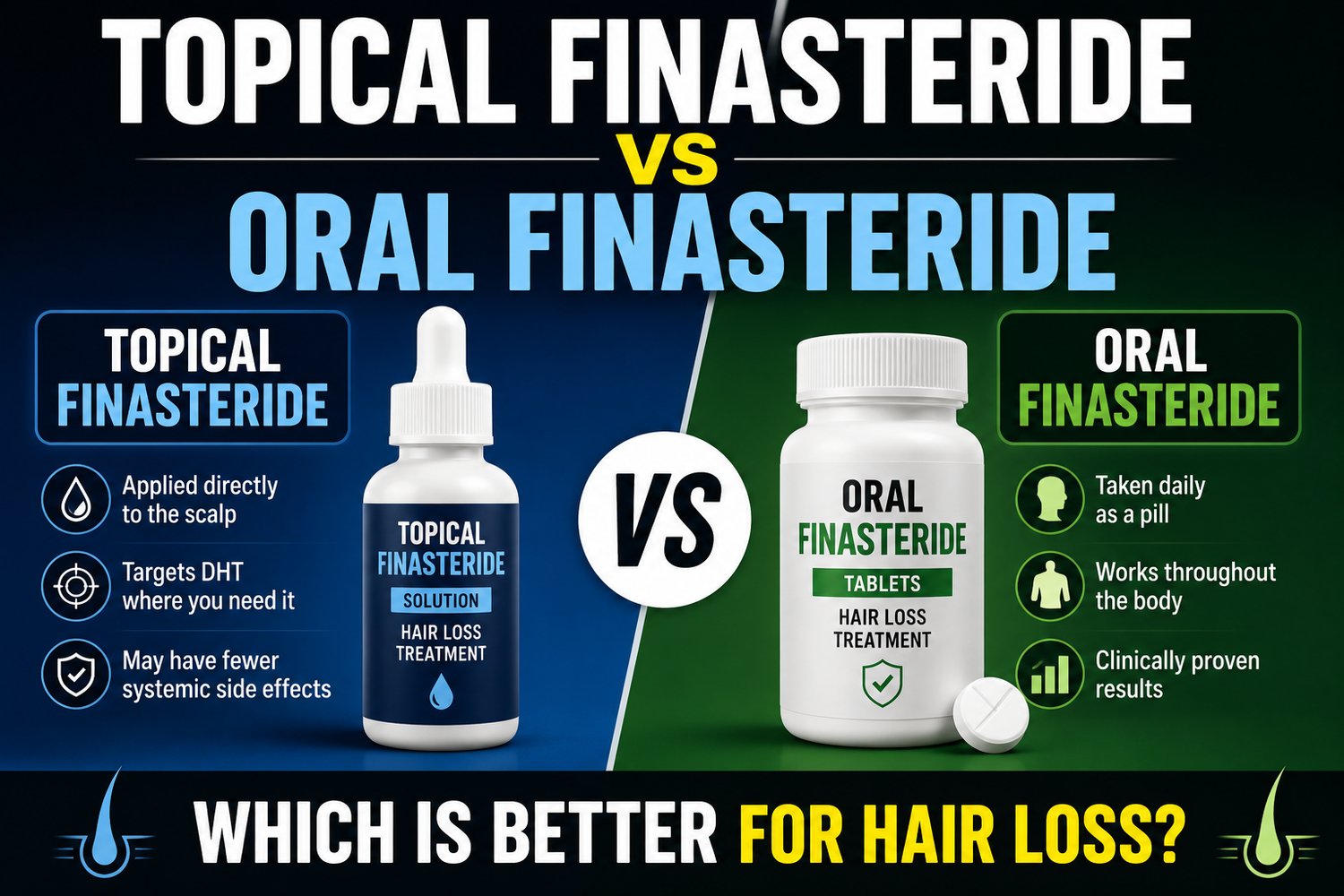
Topical Finasteride vs Oral Finasteride: Which Is Better for Hair Loss?
Finasteride is one of the most established treatments for male pattern baldness.
But men increasingly have two very different ways to use it:
Take finasteride as a tablet.
Or:
Apply finasteride directly to the scalp.
The appeal of topical finasteride is obvious.
If the problem is in your scalp, why expose the entire body to the medication?
That's a reasonable question.
And clinical research suggests topical finasteride can reduce scalp DHT and improve hair growth while producing less systemic exposure than oral finasteride.
But there's an important catch:
Topical finasteride is not simply oral finasteride without systemic effects.
Finasteride can still be absorbed through the skin.
FDA specifically warned in 2025 that compounded topical finasteride products can produce systemic exposure and have been associated with adverse-event reports similar to those seen with oral finasteride. FDA also emphasized that there is currently no FDA-approved topical finasteride formulation in the United States.
So the real comparison is not:
Oral = risky
versus:
Topical = risk-free.
It's:
Oral finasteride has the strongest approval history and standardized dosing.
Topical finasteride may reduce systemic exposure while still targeting scalp DHT—but it is compounded/off-label in the U.S. and does not eliminate systemic risk.
That makes the choice a legitimate treatment tradeoff.
If you're still learning why finasteride works, start with:
For the broader medication comparison:
Topical vs Oral Finasteride: The Quick Answer
For typical male pattern hair loss:
Oral Finasteride
Makes the strongest argument when you want:
- An FDA-approved finasteride treatment for male pattern hair loss
- Standardized dosing
- Decades of clinical use
- Strong evidence for slowing progression
- A simple once-daily treatment
Its main tradeoff is:
Systemic exposure to finasteride.
Topical Finasteride
May make sense when you want:
- Finasteride delivered primarily to the scalp
- Lower systemic exposure than oral treatment
- Potential combination treatment with topical minoxidil
- A topical rather than oral prescription strategy
Its main tradeoffs are:
- No FDA-approved topical finasteride formulation in the U.S.
- Compounded treatment
- Systemic absorption still occurs
- Local scalp reactions are possible
- Handling and transfer to others become considerations
FDA's 2025 warning is especially important here because some patients reported being told topical finasteride carried no systemic risk, which FDA says is not accurate.
What Is Oral Finasteride?
Oral finasteride is a prescription 5-alpha-reductase inhibitor.
It blocks conversion of testosterone into:
Dihydrotestosterone, or DHT.
DHT plays a central role in male pattern baldness in genetically susceptible men.
By reducing DHT, finasteride can help slow the progressive miniaturization of scalp hair follicles.
The FDA-approved 1 mg oral finasteride product for male pattern hair loss has been available in the United States since 1997. FDA's current topical-finasteride safety communication specifically notes that Propecia is an approved oral finasteride product.
That gives oral finasteride a very different regulatory history from compounded topical versions.
How Does Finasteride Work?
Testosterone is converted into DHT through the enzyme:
5-alpha reductase.
Finasteride inhibits primarily the type II form of that enzyme.
Less conversion means:
Lower DHT.
In scalp follicles genetically susceptible to androgenetic alopecia, reducing DHT can slow the miniaturization process.
That makes finasteride different from minoxidil.
Minoxidil
Supports hair growth.
Finasteride
Targets a major androgen pathway driving the loss.
For that direct comparison:
What Is Topical Finasteride?
Topical finasteride uses the same active medication but applies it directly to the scalp rather than swallowing it.
The goal is intuitive:
Produce meaningful finasteride exposure in the scalp while reducing the amount reaching systemic circulation.
That's not a made-up concept.
A phase III randomized trial in men with androgenetic alopecia found topical finasteride significantly improved hair counts compared with placebo, with results numerically similar to oral finasteride. The topical formulation also produced substantially less systemic finasteride exposure and a smaller reduction in serum DHT than oral therapy.
That's the strongest argument for topical treatment.
Not:
“It can't affect the rest of your body.”
But:
“It may expose the rest of your body to less drug.”
Those are very different claims.
Is Topical Finasteride FDA Approved?
No.
This needs to be stated clearly.
FDA says:
There is currently no FDA-approved topical formulation of finasteride in the United States.
Topical finasteride offered by telehealth companies and compounding pharmacies is generally:
Compounded prescription treatment.
That means FDA has not reviewed the finished compounded product for:
- Safety
- Effectiveness
- Quality
before marketing in the same way it reviews an FDA-approved drug.
That doesn't mean compounded topical finasteride is automatically inappropriate.
It means the regulatory distinction should not be hidden.
Oral Finasteride Is FDA Approved for Male Pattern Hair Loss
This is one of oral finasteride's major advantages.
The:
Medication
dose
manufacturing standards
labeling
and:
known adverse-effect information
come from an FDA-approved product framework.
That gives oral finasteride a level of standardization topical compounded products don't currently have in the U.S.
Does Topical Finasteride Work?
Yes, there is meaningful evidence that it can.
The large randomized phase III trial compared:
- Topical finasteride
- Oral finasteride
- Placebo
over 24 weeks.
Topical finasteride significantly increased target-area hair count compared with placebo, and its improvement was numerically similar to oral finasteride.
A 2025 systematic review and meta-analysis also directly evaluated topical versus oral finasteride in androgenetic alopecia, reflecting the growing comparative evidence base.
So topical finasteride is not simply an internet-compounding trend with no supporting science.
But the evidence base is still smaller than the decades of experience behind oral treatment.
Is Topical Finasteride as Effective as Oral Finasteride?
Possibly close in some studies.
But I'd be careful saying:
“They are proven equally effective.”
The phase III study found topical results were numerically similar to oral finasteride—not proof that every topical compounded formulation produces identical results to standard oral therapy.
That's especially important because compounded topical products can differ in:
- Concentration
- Vehicle
- Application amount
- Combination ingredients
- Absorption characteristics
The topical finasteride studied in one clinical trial isn't automatically identical to every product sold online.
Topical Formulation Matters
This is one of the biggest differences from tablets.
A standardized oral tablet is relatively straightforward.
Topical treatment depends on:
- Finasteride concentration
- Volume applied
- Scalp area treated
- Vehicle or base
- Other active ingredients
- Skin condition
- Application frequency
Those factors can influence both:
local effectiveness
and:
systemic absorption.
So you can't simply say:
“Topical finasteride is topical finasteride.”
Formulation matters.
The Main Reason Men Choose Topical Finasteride: Systemic Exposure
This is the real selling point.
Oral finasteride enters systemic circulation intentionally.
Topical treatment attempts to concentrate exposure in the scalp.
In the phase III trial, topical finasteride produced substantially lower plasma finasteride concentrations than oral treatment and reduced serum DHT less dramatically.
That is biologically meaningful.
It suggests topical treatment may offer a way to:
target scalp DHT with less whole-body exposure.
But again:
Less ≠ none.
Topical Finasteride Still Lowers Systemic DHT
This deserves emphasis.
Some topical finasteride reaches the bloodstream.
That's why serum DHT can still decline.
And that's why FDA says systemic adverse effects remain possible.
So if your thinking is:
“I absolutely cannot accept any systemic finasteride exposure.”
topical treatment does not guarantee that.
FDA's 2025 Warning Changed the Conversation
This is the biggest reason a current article on topical vs oral finasteride needs to exist.
In April 2025, FDA issued a warning after receiving adverse-event reports involving compounded topical finasteride.
FDA reported 32 adverse-event cases from 2019 through 2024 involving compounded topical finasteride products.
Reported symptoms included problems also associated with oral finasteride, including:
- Erectile dysfunction
- Decreased libido
- Anxiety
- Depression
- Suicidal ideation
- Brain fog
- Fatigue
- Insomnia
- Testicular pain
FDA also noted that skin absorption into the bloodstream is expected.
A spontaneous adverse-event report does not prove the medication caused every reported symptom.
But it does prove something important:
Topical finasteride should not be marketed as having zero systemic risk.
Oral Finasteride Side Effects
Potential adverse effects of oral finasteride can include sexual symptoms such as:
- Reduced libido
- Erectile dysfunction
- Ejaculatory changes
Mood-related adverse effects have also received regulatory attention.
The existence of potential side effects doesn't mean:
Every man taking finasteride develops them.
And it doesn't mean side effects should be dismissed because many men tolerate the medication well.
A better treatment discussion is:
What is the expected benefit, what are the known risks, and how strongly do you want to preserve your hair?
Does Topical Finasteride Reduce Sexual Side Effects?
Possibly—but we should phrase this carefully.
The biological argument is reasonable:
Lower systemic exposure could plausibly reduce systemic adverse effects.
The phase III topical trial found much lower systemic finasteride exposure than oral treatment.
But FDA's adverse-event warning demonstrates that sexual and neuropsychiatric symptoms have still been reported with compounded topical products.
So the honest conclusion is:
Topical finasteride may reduce systemic exposure, but it does not eliminate the possibility of systemic adverse effects.
That's much stronger than promising a risk-free alternative.
Can Topical Finasteride Cause Erectile Dysfunction?
It can potentially be associated with sexual adverse effects because systemic absorption occurs.
FDA's reported topical-finasteride adverse events included:
- Erectile dysfunction
- Decreased libido
- Other symptoms consistent with oral finasteride exposure.
That doesn't tell us the exact incidence rate.
Spontaneous adverse-event reporting cannot establish that.
But it tells us:
The risk is not biologically impossible simply because the medication touches your scalp instead of your stomach.
Can Topical Finasteride Affect Mood?
FDA reports involving compounded topical finasteride included:
- Depression
- Anxiety
- Suicidal ideation
- Other neuropsychiatric symptoms.
Again, reports don't establish exact causality or frequency.
But clinically significant new mood symptoms deserve prompt discussion with the prescribing clinician.
Topical Finasteride Has Local Side Effects Too
This is an additional tradeoff oral finasteride doesn't have to the same extent.
FDA lists potential topical reactions including:
- Irritation
- Redness
- Dryness
- Scaling
- Stinging
- Burning.
So topical treatment trades some systemic exposure for:
a scalp application routine + potential local irritation.
Topical Finasteride Can Transfer to Other People
This is one of the most overlooked topical risks.
FDA specifically warns that compounded topical finasteride may create greater potential for inadvertent exposure to others through contact with the applied medication.
That becomes especially important around:
pregnant women or women who may become pregnant.
Finasteride exposure during pregnancy can harm development of a male fetus.
With oral tablets, intact coated tablets reduce normal handling exposure.
With a topical medication sitting on:
- Your scalp
- Hands
- Pillow
- Other surfaces
transfer becomes a different practical issue.
Follow application and handling instructions carefully.
Pregnancy Exposure Is a Serious Consideration
Finasteride is contraindicated in pregnancy because of the risk of abnormalities in a male fetus.
FDA's topical-finasteride communication emphasizes that transfer risk may be greater with topical formulations because the medication isn't protected inside a coated tablet.
If someone in your household:
- Is pregnant
- May become pregnant
discuss handling precautions with the prescribing clinician.
This isn't a minor cosmetic-product warning.
Which Is Easier to Use?
For most men:
Oral finasteride.
One pill.
Done.
Topical finasteride requires:
- Scalp application
- Allowing medication to dry
- Washing hands
- Avoiding transfer
- Maintaining the routine
Convenience matters because male pattern baldness treatment generally continues long term.
Which Is Better for Adherence?
Probably oral for many men.
A once-daily tablet is difficult to beat for simplicity.
But some men strongly prefer:
No oral finasteride.
For them, a topical routine may be worth the extra work.
Treatment adherence isn't only about convenience.
It's also about whether the patient is comfortable enough with the treatment to keep using it.
Which Is Better for DHT Suppression?
Oral finasteride produces stronger systemic DHT suppression.
That's expected.
It travels through the body and inhibits 5-alpha reductase systemically.
Topical finasteride can still reduce scalp DHT while producing less serum-DHT reduction in some formulations.
That is essentially the entire rationale for topical treatment.
Is More DHT Suppression Always Better?
Not necessarily.
Hair preservation requires sufficient suppression of the DHT pathway at susceptible scalp follicles.
But:
Maximum whole-body DHT suppression
isn't automatically the goal.
That's one reason topical treatment is attractive.
The hope is to obtain enough scalp effect without unnecessarily creating as much systemic exposure.
Whether a particular compounded formulation achieves that balance depends on the formulation and patient.
Which Is Better for Preserving Hair?
Oral finasteride has the strongest long-term evidence and clinical experience.
Topical finasteride also appears capable of meaningfully slowing male pattern hair loss.
If your priority is:
most established finasteride strategy
oral has the advantage.
If your priority is:
reduce systemic exposure while still using a DHT-blocking treatment
topical may deserve discussion.
Which Is Better for Regrowth?
Finasteride's biggest role is generally:
preventing continued miniaturization.
Some men also see:
- Improved density
- Thicker hair
- Partial regrowth
with either route.
But neither oral nor topical finasteride should be expected to recreate:
a hairline that has been completely bald for 15 years.
Preservation is usually the bigger win.
Earlier Treatment Still Matters
Male pattern baldness is progressive.
A follicle that is:
miniaturized but active
is easier to preserve than one that has been essentially inactive for years.
So whichever route you choose, starting treatment earlier—once androgenetic alopecia is actually established—generally gives you more existing hair to protect.
For the progression mechanism:
Can Topical Finasteride Be Combined With Minoxidil?
Yes.
This is actually one of topical finasteride's strongest practical advantages.
Because both medications can be formulated for scalp application, compounded treatments may combine:
Finasteride + Minoxidil
into one product.
The mechanisms complement each other.
Finasteride
Reduces DHT-driven follicle miniaturization.
Minoxidil
Supports follicle activity and growth.
A 2025 meta-analysis of randomized trials found topical minoxidil-finasteride combination treatment produced better outcomes than minoxidil alone in male androgenetic alopecia.
That's one reason combination topicals have become popular.
Strut's Finasteride Hair Loss Formula
Strut currently offers a compounded topical finasteride formula through its men's hair-loss telehealth service.
Its current product page lists:
Finasteride 0.25%
and:
Minoxidil up to 7.5%
with other possible ingredients including:
- Tretinoin
- Fluocinolone
- Biotin
depending on the clinician-selected prescription.
Strut currently lists the topical formula starting at:
$59/month.
Explore Strut's Finasteride Hair Loss Formula →
HabitLogics may earn a commission if you purchase through this link, at no additional cost to you.
Important: Strut's Formula Is Compounded
This needs to sit right next to the affiliate link rather than buried in a disclaimer.
Strut itself states that its topical finasteride treatment is compounded and uses finasteride topically off-label.
And FDA says:
- No topical finasteride product is currently FDA-approved in the U.S.
- Compounded topical finasteride can be systemically absorbed.
- Adverse effects have been reported.
- Transfer to others is a potential risk.
So the reason to consider Strut's topical product is not:
“This avoids finasteride risks.”
It's:
“This provides a clinician-supervised topical finasteride option that may reduce systemic exposure compared with oral treatment while potentially combining multiple hair-loss medications in one topical formula.”
That's the accurate pitch.
Strut's Formula Is Not Just Finasteride
This matters when comparing outcomes.
The current Strut formula may contain both:
Finasteride + minoxidil
plus other ingredients.
So if someone gets better results on the Strut topical than they previously got from oral finasteride alone, you cannot automatically conclude:
“Topical finasteride works better.”
They're potentially using a multi-drug treatment.
The comparison isn't identical.
Can You Get Oral Finasteride Through Strut Too?
Strut's current men's hair-loss lineup also includes compounded oral finasteride-containing products.
But for this article, I would keep the primary affiliate route focused on:
the topical formula
because that's where Strut provides the most differentiated option relative to standard generic oral finasteride.
For the broader provider lineup:
Explore Strut Men's Hair Loss Options →
Why Not Just Buy Generic Oral Finasteride?
This is a fair question.
Generic oral finasteride is:
- Widely prescribed
- FDA-approved for male pattern hair loss at the standard dose
- Simple
- Often inexpensive
For a man comfortable with oral finasteride and its risk profile:
There may be no compelling reason to complicate the treatment.
Topical finasteride becomes interesting when the patient specifically values:
- Lower systemic exposure
- Topical delivery
- Combination treatment
- Avoiding oral medication
It's an alternative strategy.
Not automatically an upgrade.
Does Topical Finasteride Cost More?
Often, yes.
Generic oral finasteride can be inexpensive depending on:
- Pharmacy
- Insurance
- Discount program
Compounded topical formulations often involve:
- Specialized pharmacy
- Custom formulation
- Telehealth clinician review
- Shipping
That can make topical therapy more expensive.
Strut currently lists its topical finasteride formula starting at $59/month.
For a long-term treatment, that difference matters.
Long-Term Cost Matters
Male pattern baldness treatment generally continues for years.
Suppose treatment costs:
$10/month
That's:
$1,200 over 10 years.
$60/month
That's:
$7,200 over 10 years.
before price changes.
That doesn't mean choose the cheapest treatment automatically.
It means:
Make sure the long-term cost fits your willingness to keep treating your hair.
What Happens if You Stop Oral Finasteride?
The DHT suppression does not permanently alter your genetic susceptibility.
Once treatment stops:
DHT activity returns toward baseline.
Hair that was maintained because of treatment may gradually be lost as androgenetic alopecia resumes.
Think:
management
not:
permanent cure.
What Happens if You Stop Topical Finasteride?
Same general principle.
Strut specifically notes that hair gains from its formula can revert after treatment is discontinued.
The topical route doesn't permanently rewrite the follicles either.
Continued benefit generally requires continued treatment.
How Long Does Finasteride Take to Work?
Hair moves slowly.
Don't judge either treatment after:
three weeks.
Strut currently advises that early changes from its topical formula may become visible after approximately:
2–4 months
with fuller results potentially taking:
6–12 months.
That's broadly consistent with the reality of hair-loss treatment:
Think months, not days.
Take Baseline Photos
Hair memory is terrible.
Before treatment, photograph:
- Front
- Temples
- Top
- Crown
Use:
- Similar lighting
- Similar hair length
- Similar camera angle
- Dry hair
Then compare every few months.
Otherwise you'll spend the year wondering:
“Was my crown always like that?”
Which Is Better if You're Worried About Sexual Side Effects?
This is probably the biggest reason men research topical finasteride.
The strongest accurate answer is:
Topical finasteride may reduce systemic exposure compared with oral finasteride, which could be attractive to someone concerned about systemic adverse effects.
But:
It does not guarantee that sexual side effects cannot occur.
FDA explicitly warns against that assumption.
If your risk tolerance is:
I don't want any exposure to finasteride at all
then topical finasteride probably doesn't satisfy that requirement.
Which Is Better if You Want the Most Studied Option?
Oral finasteride.
It has:
- Longer history
- FDA approval
- Standardized dosing
- More extensive clinical use
- More established long-term data
Topical treatment has promising evidence.
But it doesn't yet match oral treatment's historical evidence base.
Which Is Better if You Hate Taking Pills?
Then topical treatment becomes much more attractive.
Some men simply prefer:
Apply medication to the area I'm treating.
That's a legitimate preference.
As long as the preference isn't built on the false belief:
“Topical means nothing reaches my bloodstream.”
Which Is Better if You Hate Topicals?
Then oral treatment probably wins easily.
If you know you won't consistently:
- Apply it
- Let it dry
- Wash your hands
- Avoid transfer
don't pick a treatment routine you already hate.
Consistency matters more than theoretical perfection.
Which Is Better if You Want Minoxidil Too?
A compounded topical combination may be particularly convenient.
Instead of:
finasteride pill + separate minoxidil foam
you might use:
one topical formulation containing both.
Strut's current finasteride formula may include exactly that combination.
For the minoxidil route comparison:
Oral Minoxidil vs Topical Minoxidil →
Which Is Better if You Have Scalp Sensitivity?
Potentially oral treatment.
Topical formulas can cause:
- Burning
- Itching
- Dryness
- Scaling
- Irritation
FDA specifically identifies local topical reactions as an additional risk of topical finasteride.
However, formulation matters.
Strut currently markets its topical base as propylene-glycol-free, which may be relevant for patients sensitive to that ingredient.
That doesn't guarantee you'll tolerate it.
Which Is Better if Pregnancy Exposure Is Possible in Your Household?
This deserves an actual conversation with the prescriber.
Oral tablets can still pose pregnancy-handling risks if crushed or broken.
Topical medication creates a different transfer concern because drug remains on:
- Scalp
- Hands
- Potentially bedding or surfaces
FDA specifically highlights greater potential for inadvertent exposure with topical formulations.
Follow the medication's handling instructions closely.
What About Fertility?
This is different from testosterone therapy.
Finasteride does not suppress the hypothalamic-pituitary-gonadal axis in the same way exogenous testosterone does.
But oral finasteride can affect semen parameters in some men.
If you're:
- Actively trying to conceive
- Already dealing with infertility
- Concerned about sperm parameters
bring that up before treatment.
Hair and fertility shouldn't be treated as completely unrelated if fertility matters to you.
Does Finasteride Lower Testosterone?
Not in the simplistic way people assume.
Finasteride reduces conversion of testosterone into DHT.
It does not:
remove testosterone from the body.
In fact, serum testosterone may rise modestly because less testosterone is converted into DHT.
The treatment target is:
DHT production.
Not testosterone elimination.
Does Finasteride Affect the Prostate?
Finasteride is also used at a higher oral dose for benign prostate enlargement.
That's because DHT influences prostate tissue as well as susceptible scalp follicles.
This is another reminder that oral finasteride isn't a scalp-only medication.
Systemic exposure means systemic effects.
What About Dutasteride?
Dutasteride blocks both major 5-alpha-reductase isoenzymes and suppresses DHT more strongly than finasteride.
That makes it interesting for hair loss.
It also makes it a different risk/benefit decision.
In the United States, dutasteride use for hair loss is generally off-label.
And it's the subject of the next hair expansion article.
Topical Finasteride vs Oral Finasteride: Side-by-Side
FDA Approval for Male Pattern Hair Loss
Oral finasteride: Yes.
Topical finasteride: No FDA-approved topical product in the U.S.
Prescription Required
Oral: Yes.
Topical: Yes when compounded prescription finasteride is used.
Systemic Exposure
Oral: Higher.
Topical: Lower in some studied formulations, but not zero.
Serum DHT Reduction
Oral: Greater.
Topical: Generally less systemic DHT suppression in studied formulations.
Scalp DHT Targeting
Oral: Yes through systemic exposure.
Topical: Yes through local application.
Hair-Growth Evidence
Oral: Extensive.
Topical: Promising; phase III trial showed significant improvement versus placebo and results numerically similar to oral therapy.
Sexual Side Effects
Oral: Possible.
Topical: Still possible because systemic absorption occurs.
Local Scalp Irritation
Oral: Not typically relevant.
Topical: Possible.
Transfer to Others
Oral: Limited mainly to handling broken/crushed tablets.
Topical: Greater practical concern because medication is applied to exposed skin/hair.
Convenience
Oral: Very easy.
Topical: Requires regular application.
Combination With Minoxidil
Oral: Usually requires a separate medication.
Topical: Can be combined in one compounded formula.
Topical Finasteride vs Oral Finasteride: Which Would I Choose?
If my priority were:
the most established, standardized finasteride treatment with the strongest regulatory history
I'd lean toward:
oral finasteride.
If my priority were:
reducing systemic exposure while still targeting DHT
I'd want to discuss:
topical finasteride.
But I would go into topical treatment understanding three things clearly:
- It is not FDA-approved in topical form in the U.S.
- Systemic absorption still occurs.
- It does not guarantee freedom from systemic side effects.
If I also wanted minoxidil and strongly preferred one topical product?
Then a compounded combination formula becomes much more attractive from an adherence standpoint.
That's exactly where something like Strut's topical finasteride/minoxidil formula fits.
Explore Strut's Finasteride Hair Loss Formula →
Don't Pick Topical Finasteride Because Marketing Says It's Risk-Free
This is the biggest red flag.
If a provider says:
“Topical finasteride can't cause systemic side effects.”
that's inconsistent with FDA's current position.
A better provider should explain:
- Why topical treatment may reduce systemic exposure
- That systemic absorption still occurs
- What adverse effects to watch for
- How to prevent transfer
- What to do if symptoms appear
That's informed consent.
Don't Pick Oral Finasteride Because It's “Stronger”
Same problem in reverse.
More systemic DHT suppression isn't automatically better for every man.
If a lower-systemic-exposure treatment can adequately preserve hair and better matches someone's preferences or risk tolerance, that's a legitimate consideration.
Medicine isn't:
strongest drug wins.
It's:
best balance of benefit, risk, convenience and patient goals.
When to See a Dermatologist First
Before either route, get appropriate evaluation if hair loss is:
- Sudden
- Patchy
- Painful
- Scarring
- Associated with redness or inflammation
- Affecting eyebrows or beard unexpectedly
- Rapidly progressing in an unusual pattern
Finasteride treats androgenetic alopecia.
It isn't the treatment for every hair-loss disorder.
Read:
if you're not sure what you're dealing with.
Frequently Asked Questions
Is Topical Finasteride as Effective as Oral Finasteride?
A large randomized phase III trial found topical finasteride significantly improved hair counts compared with placebo, with results numerically similar to oral finasteride.
That doesn't prove every compounded topical formulation is identical to oral treatment.
Formulation and dose matter.
Is Topical Finasteride Safer Than Oral Finasteride?
It may reduce systemic exposure.
But it should not be described as risk-free.
FDA specifically warns that compounded topical finasteride is absorbed systemically and has been associated with reported adverse events.
Is Topical Finasteride FDA Approved?
No.
FDA says there is currently no FDA-approved topical finasteride formulation in the United States.
Is Oral Finasteride FDA Approved for Hair Loss?
Yes.
Oral finasteride 1 mg has an FDA-approved indication for male pattern hair loss.
Can Topical Finasteride Cause Sexual Side Effects?
Potentially.
Systemic absorption occurs, and FDA adverse-event reports involving compounded topical finasteride have included erectile dysfunction and decreased libido.
Does Topical Finasteride Lower DHT?
Yes.
Topical finasteride can reduce scalp DHT and may also lower serum DHT.
In one phase III study, systemic exposure and serum-DHT reduction were lower with topical than oral treatment.
Can You Combine Topical Finasteride With Minoxidil?
Yes.
Combination topical formulations are used clinically.
A 2025 meta-analysis found topical minoxidil-finasteride combinations improved outcomes compared with minoxidil alone in male androgenetic alopecia.
Does Strut Offer Topical Finasteride?
Yes.
Strut currently offers a compounded topical finasteride formula that may also contain minoxidil, tretinoin, fluocinolone and biotin depending on the clinician-selected prescription.
Explore Strut's Finasteride Hair Loss Formula →
Does Topical Finasteride Have to Be Used Forever?
If it is successfully controlling progressive androgenetic alopecia, continued treatment is generally required to maintain the benefit.
Stopping allows the underlying DHT-sensitive miniaturization process to resume.
Which Has Fewer Side Effects?
Topical treatment may produce lower systemic exposure, which is one reason it is attractive.
But the exact relative rate of systemic adverse effects remains less certain than marketing sometimes suggests.
FDA specifically cautions that systemic side effects can occur with compounded topical finasteride.
Key Takeaways
- Oral and topical finasteride use the same active medication but deliver it differently.
- Oral finasteride is FDA-approved for male pattern hair loss.
- There is currently no FDA-approved topical finasteride formulation in the United States.
- Topical finasteride can significantly improve male pattern hair loss.
- A phase III study found topical results numerically similar to oral finasteride while producing substantially lower systemic exposure.
- Lower systemic exposure does not mean zero systemic exposure.
- FDA has received adverse-event reports involving compounded topical finasteride, including sexual and neuropsychiatric symptoms.
- Topical finasteride can cause scalp irritation.
- Topical formulations create additional transfer concerns, especially around pregnancy.
- Oral treatment is simpler and has a much longer regulatory and clinical history.
- Topical treatment may be attractive for men trying to reduce systemic exposure while still targeting DHT.
- Topical finasteride can be combined with minoxidil in one compounded formulation.
- Strut currently offers a compounded topical finasteride-based formula starting at $59/month.
- Neither route permanently cures male pattern baldness.
- Continued treatment is generally required to maintain benefits.
- The best choice depends on efficacy, systemic exposure, side-effect tolerance, convenience, cost and treatment preferences.
Final Thoughts
Topical finasteride exists because the idea makes sense.
Male pattern baldness happens in the scalp.
So why expose the whole body to as much finasteride as necessary if you can deliver more of the medication locally?
Clinical research suggests that strategy can work.
Topical finasteride can improve hair counts.
It can reduce scalp DHT.
And it can produce substantially less systemic drug exposure than oral finasteride.
But that's where the marketing often goes too far.
Less systemic exposure does not mean no systemic exposure.
FDA has been unusually clear about this.
Compounded topical finasteride can enter the bloodstream.
Systemic adverse effects have been reported.
And no topical finasteride formulation is currently FDA-approved in the United States.
So the decision isn't:
safe topical vs dangerous pill.
It's:
standardized, FDA-approved oral treatment with greater systemic exposure
versus:
compounded topical treatment with potentially lower systemic exposure but less regulatory standardization and its own local and transfer risks.
For some men, oral finasteride remains the obvious choice.
For others, topical treatment is a very reasonable option to discuss.
Just choose it for the right reason.
Continue the Men's Hair Loss Series
Understand Hair Loss
Compare Treatments
Explore Strut
Strut Men's Hair Loss Options →
Strut Finasteride Hair Loss Formula →
For the broader men's-health pillar:
Complete Men's Wellness Guide →
Affiliate Disclosure
HabitLogics participates in affiliate programs with some providers linked from this article. If you use one of these links and purchase treatment, HabitLogics may earn a commission at no additional cost to you. Affiliate relationships do not determine whether a medication is medically appropriate.
Educational Disclaimer
This article is intended for educational purposes only and should not be considered medical advice. Finasteride is a prescription medication and can cause adverse effects. Oral finasteride is FDA-approved for male pattern hair loss, while compounded topical finasteride is not FDA-approved in the United States. Topical finasteride can still be systemically absorbed and may expose other people through contact with treated areas or surfaces. Discuss sexual side effects, mood symptoms, fertility concerns, pregnancy exposure, medication interactions and treatment alternatives with a qualified healthcare professional before beginning or changing finasteride treatment.