

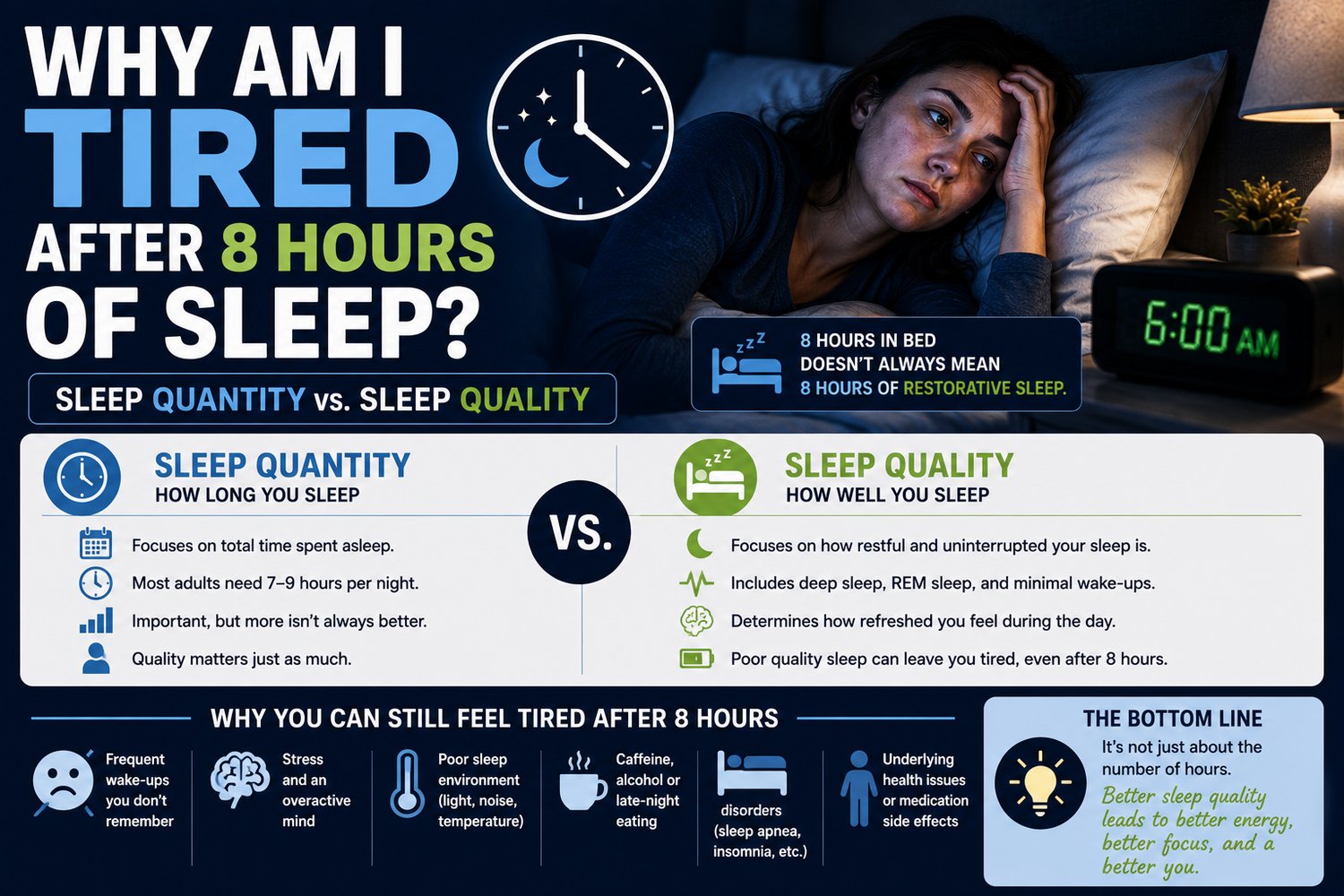
Why Am I Tired After 8 Hours of Sleep? Sleep Quantity vs. Sleep Quality
The Complete Sleep & Recovery Guide
You did everything right.
Went to bed.
Got eight hours.
Alarm goes off.
And somehow you wake up feeling like you slept for:
approximately 14 minutes.
What gives?
The first thing to understand is that:
Eight hours in bed does not automatically equal eight hours of restorative sleep.
Sleep quantity matters.
But so do:
Sleep quality
Sleep continuity
Sleep timing
Your actual individual sleep need
and
what's happening while you're asleep.
The CDC specifically lists feeling sleepy or tired even after getting enough sleep as a potential sign of poor sleep quality.
And sometimes the explanation isn't sleep itself.
Fatigue can have many causes.
So instead of immediately deciding:
I guess I need nine hours.
it helps to investigate what those eight hours actually look like.
First: Eight Hours in Bed Isn't Necessarily Eight Hours Asleep
This is the simplest explanation.
Suppose you:
Get into bed at 10 p.m.
Scroll until 10:30.
Fall asleep around 10:50.
Wake several times.
Lie awake for 20 minutes around 3 a.m.
Wake again at 5:30.
Alarm goes off at 6.
Technically:
10 p.m. → 6 a.m. = 8 hours in bed.
Actual sleep?
Considerably less.
This is why calculating sleep by simply subtracting bedtime from wake time can be misleading.
What matters is actual sleep opportunity and actual sleep, not merely how long your body occupied the mattress.
Sleep Quantity and Sleep Quality Are Different
Sleep quantity answers:
How long did you sleep?
Sleep quality asks:
How well did you sleep?
The CDC describes quality sleep as uninterrupted and refreshing, and notes that repeated awakenings and still feeling tired after enough sleep may signal poor quality.
You need both.
Someone can have:
Short but continuous sleep
They sleep beautifully for five hours.
Still probably not enough.
Long but fragmented sleep
They're in bed nine hours but repeatedly wake.
Plenty of time.
Poor continuity.
Long and continuous sleep
Eight hours of reasonably uninterrupted sleep with good daytime functioning.
Much better.
That's why the number alone doesn't tell you everything.
1. Your Sleep May Be More Fragmented Than You Realize
This is one of the biggest possibilities.
You may be waking repeatedly without remembering every awakening.
Sleep naturally moves through multiple cycles during the night, and brief awakenings can happen.
But frequent or prolonged disruptions can reduce how refreshing sleep feels.
Possible causes include:
- Noise
- Temperature
- Pets
- A partner
- Bathroom trips
- Alcohol
- Reflux
- Pain
- Stress
- Sleep disorders
Our previous article, Why Do I Wake Up in the Middle of the Night? Common Causes & What May Help, goes through those possibilities in detail.
If you're waking exhausted, nighttime fragmentation should be one of the first things you investigate.
2. You May Need More Than Eight Hours
Eight hours isn't a biological law.
Healthy adult sleep needs vary.
Some adults function well near the lower end of the recommended range.
Others consistently feel better with more.
So if you reliably:
Sleep around eight hours.
Wake without an alarm when given the opportunity.
Still naturally sleep longer on free days.
Feel noticeably better after 8½ or 9 hours.
then your individual sleep need may simply be higher.
That isn't a character flaw.
Your body doesn't care that eight hours is a nice round number.
Our guide How Much Sleep Do You Need? A Practical Guide by Age & Lifestyle explains how to think about your personal sleep requirement rather than treating one number as universal.
3. Eight Hours May Be More Than You Actually Need
There's another possibility.
Sometimes people spend a long time in bed because they're tired, not because they actually need that much sleep.
That distinction matters.
If your schedule gives you:
Nine.
Ten.
Eleven hours in bed
but you're awake for large portions of that time, simply adding more time may make your sleep schedule increasingly irregular.
Long sleep duration can also sometimes be a symptom rather than the cause of fatigue.
So don't assume:
Tired = must spend more hours in bed.
First figure out whether you're actually sleeping well.
4. Your Sleep Schedule May Be Working Against You
You can get eight hours at wildly different times.
For example:
10 p.m. → 6 a.m.
or
3 a.m. → 11 a.m.
The duration is identical.
But sleep timing interacts with your circadian system.
NHLBI notes that sleep deficiency isn't only about getting too few hours. It can also occur when you sleep at the wrong time of day, don't sleep well or have a sleep disorder interfering with sleep quality.
This becomes particularly relevant with:
- Shift work
- Frequently changing schedules
- Major weekend sleep-ins
- Travel
- Staying up extremely late
- Irregular work hours
Your body likes some degree of predictability.
5. Your Weekday and Weekend Schedules May Be Completely Different
Maybe you sleep:
11 p.m. → 7 a.m. Monday through Friday
then:
2 a.m. → 10 a.m. Saturday and Sunday.
Technically:
Eight hours either way.
But your sleep timing shifts by several hours.
Then Sunday night arrives and you're trying to sleep early enough for Monday.
Your body isn't impressed.
You don't need identical sleep timing every single day.
But large, repeated schedule swings can make sleep and wakefulness feel less predictable.
This is one reason a reasonably consistent wake time is such a useful anchor.
6. You May Be Waking During Sleep Inertia
Not every groggy morning means your sleep was terrible.
Sometimes you're experiencing sleep inertia.
Sleep inertia is the temporary period of impaired alertness and performance after waking.
CDC/NIOSH notes that it can involve slower thinking, reaction time and memory and commonly lasts around 30–60 minutes, although it can sometimes last longer.
In plain English:
Sometimes your brain takes a little while to boot.
That is different from:
Feeling exhausted until 4 p.m. every day.
If you're groggy for 20 minutes after waking but then feel normal:
Probably not a major concern.
If you're dragging all day:
Look deeper.
7. Your Alarm May Be Waking You at an Unpleasant Point
Sleep stages change throughout the night.
Sometimes your alarm catches you during deeper sleep, and waking can feel rough.
That can contribute to stronger sleep inertia.
But don't take this idea too far.
You do not need to calculate a perfect bedtime based on exact 90-minute sleep cycles.
Sleep cycles don't all last exactly 90 minutes, and they vary throughout the night.
Trying to perfectly time your alarm around estimated sleep cycles can quickly become another form of sleep optimization nonsense.
Focus on:
Enough sleep
and
consistent sleep.
Not alarm mathematics.
8. Alcohol May Be Making Your Eight Hours Worse
Alcohol can make falling asleep easier for some people.
That creates the impression that it helps sleep.
But sedation and restorative sleep are not identical.
Alcohol can contribute to disrupted sleep later in the night.
So you might:
Fall asleep quickly.
Remain in bed eight hours.
Still wake feeling terrible.
If you frequently drink in the evening and wake unrefreshed, it's an easy variable to test.
Try reducing or removing evening alcohol for a week.
Then compare your morning energy.
9. Late Caffeine May Be Affecting More Than Falling Asleep
Caffeine is usually blamed for:
I can't fall asleep.
But caffeine can potentially affect sleep even if you eventually fall asleep normally.
If you're consuming:
Afternoon coffee.
Energy drinks.
Late pre-workout.
Caffeinated soda.
Evening tea.
your sleep may not be as restorative as you assume.
Our guide Caffeine and Sleep: How Long Does Caffeine Last & When Should You Stop Drinking It? explains how to run a simple caffeine-cutoff experiment.
You don't necessarily need to quit coffee.
Start by moving it earlier.
10. Your Bedroom May Be Disrupting You
You may think you're asleep.
Meanwhile:
The room overheats.
The dog moves.
Traffic passes.
Your partner snores.
Outdoor light enters.
Your phone vibrates.
The HVAC turns on.
Some disruptions fully wake you.
Others may produce smaller sleep disturbances you don't clearly remember.
If you consistently wake tired, audit the room.
Ask:
Is it cool?
Dark?
Quiet?
Comfortable?
Our Best Bedroom Environment for Sleep guide walks through those factors in detail.
11. Sleep Apnea Can Leave You Exhausted Despite Enough Time in Bed
This is one of the important possibilities not to miss.
Sleep apnea causes breathing to repeatedly stop and restart during sleep. Those disruptions can prevent sleep from being as restorative as it should be. NHLBI lists symptoms such as loud snoring, gasping for air, breathing that repeatedly stops and starts, and daytime sleepiness or tiredness.
You may spend:
Seven hours.
Eight hours.
Nine hours.
in bed and still wake feeling terrible.
That's because:
time asleep
and
quality of sleep
are not interchangeable.
Signs Sleep Apnea Deserves Consideration
Potential clues include:
- Loud habitual snoring
- Gasping during sleep
- Choking sounds
- Witnessed breathing pauses
- Morning headaches
- Dry mouth
- Frequent nighttime waking
- Significant daytime sleepiness
- Waking unrefreshed despite adequate sleep opportunity
You don't need every symptom.
And not everyone who snores has sleep apnea.
But if several of these sound familiar, talk with a healthcare professional.
Don't try to fix possible sleep apnea with:
Magnesium.
Blackout curtains.
A different pillow.
Or a better sleep score.
It deserves actual evaluation.
12. Insomnia Can Leave You Tired Even When You Spend Plenty of Time in Bed
Insomnia doesn't only mean lying awake until 3 a.m.
It can also involve:
- Repeated nighttime waking
- Difficulty returning to sleep
- Waking earlier than intended
- Nonrefreshing sleep associated with poor sleep continuity
You may still report:
I was in bed for eight hours.
But the quality and continuity of that sleep may be poor.
If this becomes persistent, basic sleep hygiene may not be enough.
Chronic insomnia often benefits from a structured treatment approach such as cognitive behavioral therapy for insomnia, or CBT-I.
13. Restless Legs or Nighttime Movement Can Disrupt Sleep
Not every sleep disruption comes from fully waking.
Some movement disorders can disturb sleep repeatedly.
For example, restless legs syndrome typically causes uncomfortable sensations and an urge to move the legs while resting.
Some people also experience repetitive limb movements during sleep.
If you or a partner notices:
Kicking.
Jerking.
Constant leg movement.
Or you feel uncomfortable leg sensations at night that improve when you move.
mention it to a healthcare professional.
14. Pain Can Reduce Sleep Quality
Back pain.
Neck pain.
Arthritis.
Injuries.
Headaches.
Other physical discomfort.
You may not be awake long enough each time to remember every disruption.
Instead:
Wake.
Move.
Roll over.
Fall asleep.
Repeat.
Then morning arrives and you feel like you barely recovered.
If pain repeatedly interrupts sleep, improving the underlying pain problem may matter more than improving your bedtime routine.
15. Acid Reflux May Be Disturbing Sleep
Reflux can become more noticeable after lying down.
You may experience:
Heartburn.
Coughing.
Sour taste.
Throat irritation.
Chest discomfort.
Repeated nighttime waking.
If you're eating heavy meals close to bedtime and waking with digestive symptoms, experiment with meal timing.
Our guide Eating Before Bed: Does Late-Night Eating Affect Your Sleep? covers this in detail.
Persistent or significant reflux deserves medical evaluation.
16. Frequent Bathroom Trips Can Fragment Sleep
Even if you fall asleep immediately afterward, waking several times to urinate can break up the night.
Potential contributors include:
- Drinking large amounts near bedtime
- Caffeine
- Alcohol
- Certain medications
- Bladder problems
- Prostate issues
- Other health conditions
Try moving more of your normal fluid intake earlier in the day.
Don't intentionally dehydrate yourself.
And if you're waking multiple times every night despite reasonable fluid timing, bring it up with a healthcare professional.
17. Your Medications May Be Affecting Sleep or Energy
Medications can potentially affect:
Sleepiness.
Alertness.
Sleep continuity.
Urination.
Restlessness.
Sleep timing.
Some can also cause fatigue directly.
If your exhaustion began after:
Starting medication.
Changing medication.
Increasing a dose.
mention the pattern to your healthcare professional or pharmacist.
Do not stop prescribed medication on your own because you suspect it's affecting sleep.
18. Fatigue Isn't Always the Same Thing as Sleepiness
This distinction is extremely useful.
Sleepiness means:
You feel like you could fall asleep.
Fatigue can feel more like:
Low energy.
Physical exhaustion.
Weakness.
Lack of motivation.
Mental exhaustion.
They overlap.
But they aren't identical.
If you're saying:
I'm tired all day
ask:
Do I actually want to sleep?
or:
Do I just have no energy?
That distinction can help guide what needs investigating.
If You Could Fall Asleep Anywhere, That's More Concerning
Being generally tired after work is one thing.
Repeatedly fighting sleep while:
Driving.
Working.
Sitting in meetings.
Reading.
Watching television.
Talking to someone.
is different.
NHLBI specifically notes that sleep deficiency can cause substantial daytime tiredness and an inability to feel refreshed and alert after waking.
Excessive daytime sleepiness is also associated with sleep disorders including sleep apnea, narcolepsy and circadian rhythm disorders.
Don't treat severe sleepiness as something you simply need to push through with caffeine.
Driving Sleepy Is a Safety Problem
If you find yourself struggling to stay awake while driving:
Don't normalize it.
NIOSH warns that sleep deprivation and fatigue can lead to involuntary transitions into sleep during critical tasks such as driving.
Pull over safely.
Arrange another way to travel if necessary.
And if this is happening repeatedly despite adequate sleep opportunity:
Get evaluated.
That has moved beyond:
Maybe I need a better morning routine.
19. Your Circadian Timing Could Be Off
Some people get enough hours but sleep at times that don't align well with their biological or required schedule.
Circadian rhythm disorders can produce:
- Trouble sleeping at desired times
- Trouble waking at required times
- Daytime sleepiness
- Irregular sleep patterns
NHLBI notes that these disorders can interfere with getting adequate, uninterrupted, quality sleep.
This can be especially relevant for:
Shift workers.
People with extremely delayed schedules.
People constantly changing work hours.
People experiencing significant jet lag.
If sleep timing seems to be the main issue, simply adding another hour may not solve it.
20. You May Be Carrying Sleep Debt
One good eight-hour night doesn't necessarily erase several nights of insufficient sleep.
Imagine:
Monday — 5½ hours
Tuesday — 6
Wednesday — 5
Thursday — 6
Friday — 8
Then Saturday morning:
I slept eight hours. Why am I still tired?
Because Friday didn't occur in isolation.
Your recent sleep pattern matters.
Look at the whole week.
Not one night.
21. Your Expectations May Be Too High
This one deserves mentioning.
You are not necessarily supposed to wake every morning feeling:
INCREDIBLE!
A little grogginess after waking can be normal.
Some mornings are better than others.
The useful distinction is between:
normal morning sluggishness
and
persistent, significant exhaustion.
If you wake slowly but feel fine after:
Showering.
Eating.
Moving around.
Getting daylight.
that's very different from feeling exhausted until bedtime.
Don't medicalize ordinary human variation.
What About Sleep Trackers?
Your wearable may tell you:
8 hours 11 minutes
Sleep score: 88
Excellent
while you feel terrible.
Don't assume the device must be right and you're somehow imagining your fatigue.
Consumer trackers estimate sleep from signals such as:
Movement.
Heart rate.
Other physiological data.
They are useful for trends.
They cannot explain every cause of fatigue or rule out sleep disorders.
Likewise, if your tracker gives you a bad score and you feel fantastic:
Don't panic.
Your body gets a vote.
Don't Automatically Blame Deep Sleep
A common pattern is:
Wake tired.
Open watch.
See:
Deep sleep: 52 minutes.
Aha!
Problem solved.
Except not necessarily.
Consumer devices estimate sleep stages.
And your fatigue could be caused by:
Fragmented sleep.
Sleep apnea.
Schedule issues.
Medication.
Stress.
Pain.
Or something unrelated to sleep.
Our guide Deep Sleep vs. REM Sleep: What’s the Difference & How Much Do You Need? explains why exact nightly stage targets aren't particularly useful for most people.
Don't reduce your entire health investigation to one wearable number.
What If the Problem Isn't Sleep?
This is important.
Persistent fatigue can have many causes that are not primarily sleep disorders.
Depending on the situation, possibilities can include:
- Anemia
- Thyroid problems
- Infections
- Medication effects
- Nutrient deficiencies
- Mood disorders
- Chronic medical conditions
- Other causes
That's why persistent fatigue deserves appropriate medical evaluation rather than endless self-diagnosis.
Eight hours of good sleep does not guarantee you will never feel tired.
Sleep is one piece of a larger health picture.
How Do You Figure Out What's Making You Tired?
Start by collecting better information.
For 1–2 weeks, track:
Bedtime
Approximate sleep time
Wake time
Nighttime awakenings
Morning energy
Daytime sleepiness
Caffeine
Alcohol
Exercise
Medications
Unusual symptoms
Then ask:
Am I actually getting eight hours of sleep?
Or just spending eight hours in bed?
Is my sleep fragmented?
Do I remember frequent awakenings?
Does someone say I snore or gasp?
Important clue.
Is my schedule consistent?
Or constantly changing?
Is this sleepiness or fatigue?
Do I want to fall asleep, or do I simply lack energy?
Does anything correlate with better mornings?
More sleep?
No alcohol?
Earlier caffeine?
More consistent bedtime?
Those answers are useful.
Try Increasing Sleep Opportunity
If you're consistently getting around eight hours and think you may simply need more:
Test it.
For a week:
Give yourself an additional 30–60 minutes of sleep opportunity.
Don't dramatically change anything else.
Then ask:
Do I feel noticeably better?
If yes:
Great.
Your sleep need may simply be a little higher.
If no:
Stop assuming more hours are automatically the solution.
Look at quality.
Try Stabilizing Your Schedule
If your bedtime and wake time vary dramatically:
Make them more consistent for one to two weeks.
You don't need minute-level precision.
Try keeping your wake time within roughly the same range.
Then compare:
Morning alertness.
Bedtime sleepiness.
Overall energy.
Sometimes consistency matters more than adding another hour.
Try Looking at Your Entire Week
Don't evaluate sleep one night at a time.
Calculate roughly:
How much am I sleeping across seven days?
Maybe you discover:
Weeknight average = 6½ hours
Weekend = 9 hours
Overall picture:
You're repeatedly catching up.
That tells a different story from:
I slept eight hours last night.
Patterns matter.
Track Your Sleep Quality, Not Just Hours
This is where HabitLogics' basic approach works particularly well.
Don't only record:
8 hours.
Record:
Sleep duration
Awakenings
Difficulty falling asleep
Morning energy
Daytime energy
Caffeine
Alcohol
Now your sleep diary tells a story.
The FREE 7-Day Sleep Reset | Sleep & Recovery Starter Kit is built around establishing that baseline before you start changing everything.
Longer-Term Tracking Can Make Patterns More Obvious
A week may reveal obvious problems.
A month can reveal trends.
The Sleep Recovery Planner | Sleep Tracker and Energy Journal combines a fillable sleep planner with an Excel dashboard for tracking sleep, energy, caffeine and routines over time.
That can help you answer:
Am I actually sleeping longer?
Are awakenings decreasing?
Is morning energy improving?
Does alcohol matter?
Does late caffeine matter?
Does schedule consistency matter?
Track to answer questions.
Not just to collect numbers.
When Should You Talk to a Healthcare Professional?
Consider getting evaluated when you:
- Consistently sleep enough but remain exhausted
- Experience significant daytime sleepiness
- Regularly doze unintentionally
- Snore loudly
- Gasp or choke during sleep
- Have witnessed breathing pauses
- Wake with headaches frequently
- Have persistent insomnia
- Need unusually long amounts of sleep and still feel unrefreshed
- Experience new or unexplained fatigue
- Notice symptoms suggesting another medical problem
And again:
If you're struggling to stay awake while driving or doing safety-sensitive work, take that seriously.
Don't wait for your sleep tracker to confirm there's a problem.
Frequently Asked Questions
Why am I still tired after 8 hours of sleep?
Possible reasons include poor sleep quality, frequent nighttime awakenings, needing slightly more sleep, an irregular schedule, sleep apnea, insomnia, medications or causes unrelated to sleep.
The CDC specifically recognizes feeling tired despite enough sleep as one sign of poor sleep quality.
Is 8 hours of sleep enough?
For many adults, yes.
But individual sleep needs vary.
Eight hours isn't guaranteed to be the ideal amount for every person.
Why do I wake up tired every morning?
You may not be getting enough restorative sleep even if you're spending enough time in bed.
Look at sleep continuity, schedule consistency, possible breathing problems, nighttime disruptions and daytime functioning.
Can sleep apnea make you tired after 8 hours?
Yes.
Sleep apnea repeatedly disrupts breathing during sleep and can cause poor sleep quality and significant daytime sleepiness despite adequate time in bed.
Why am I tired even when my sleep tracker says I slept well?
Sleep trackers estimate sleep and cannot identify every cause of poor sleep or fatigue.
How you feel and function during the day remains important.
Is waking up groggy normal?
Some temporary grogginess can be normal because of sleep inertia.
NIOSH notes that sleep inertia commonly lasts around 30–60 minutes, though it can sometimes last longer.
Should I sleep more than 8 hours if I'm tired?
You can experiment with an additional 30–60 minutes of sleep opportunity.
If you're still consistently exhausted despite adequate sleep, investigate sleep quality and consider medical evaluation rather than indefinitely adding more time in bed.
Is fatigue the same as sleepiness?
Not exactly.
Sleepiness is the tendency or desire to fall asleep.
Fatigue can involve low physical or mental energy without necessarily feeling like you'll doze off.
That distinction can help identify what kind of problem you're experiencing.
When should I worry about daytime sleepiness?
Repeatedly struggling to stay awake during normal waking activities—particularly while driving or performing safety-sensitive tasks—deserves attention.
Excessive daytime sleepiness can accompany multiple sleep disorders.
Key Takeaways
Eight hours is not a guarantee of restorative sleep.
If you're waking tired despite apparently sleeping enough, ask:
Did I actually sleep for eight hours?
Was my sleep interrupted?
Do I need slightly more sleep?
Is my schedule inconsistent?
Am I drinking alcohol or caffeine in ways that affect sleep?
Do I snore or gasp?
Am I sleepy—or simply fatigued?
Could something other than sleep be contributing?
Start by looking at the full pattern.
Not one number.
And don't assume the answer is always:
Sleep longer.
Sometimes the problem is:
Sleep better.
Sometimes it's:
Sleep at more consistent times.
And sometimes the right answer is:
Get evaluated.
That's why the real goal isn't achieving exactly eight hours.
It's getting enough good-quality sleep to wake reasonably refreshed and function well during the day.
Track More Than the Number of Hours
For the next seven days, don't simply record:
How long was I in bed?
Also record:
Nighttime awakenings
Morning energy
Daytime sleepiness
Caffeine
Alcohol
and
your actual sleep schedule.
The FREE 7-Day Sleep Reset | Sleep & Recovery Starter Kit gives you a simple way to establish that baseline.
For longer-term pattern tracking, the Sleep Recovery Planner | Sleep Tracker and Energy Journal lets you follow sleep, energy, caffeine and routines over time.
Related Sleep & Recovery Guides
What Is Sleep Quality? How to Know If You’re Actually Sleeping Well
How Much Sleep Do You Need? A Practical Guide by Age & Lifestyle
Why Do I Wake Up in the Middle of the Night? Common Causes & What May Help
Deep Sleep vs. REM Sleep: What’s the Difference & How Much Do You Need?
Next in the Sleep & Recovery series:
Can’t Fall Asleep? What to Do When You’re Tired but Your Brain Won’t Shut Off
Medical Disclaimer: This article is for educational and informational purposes only and is not intended as medical advice, diagnosis or treatment. Persistent fatigue, excessive daytime sleepiness, loud snoring, gasping or choking during sleep, breathing pauses, chronic insomnia or other concerning symptoms should be discussed with a qualified healthcare professional.