

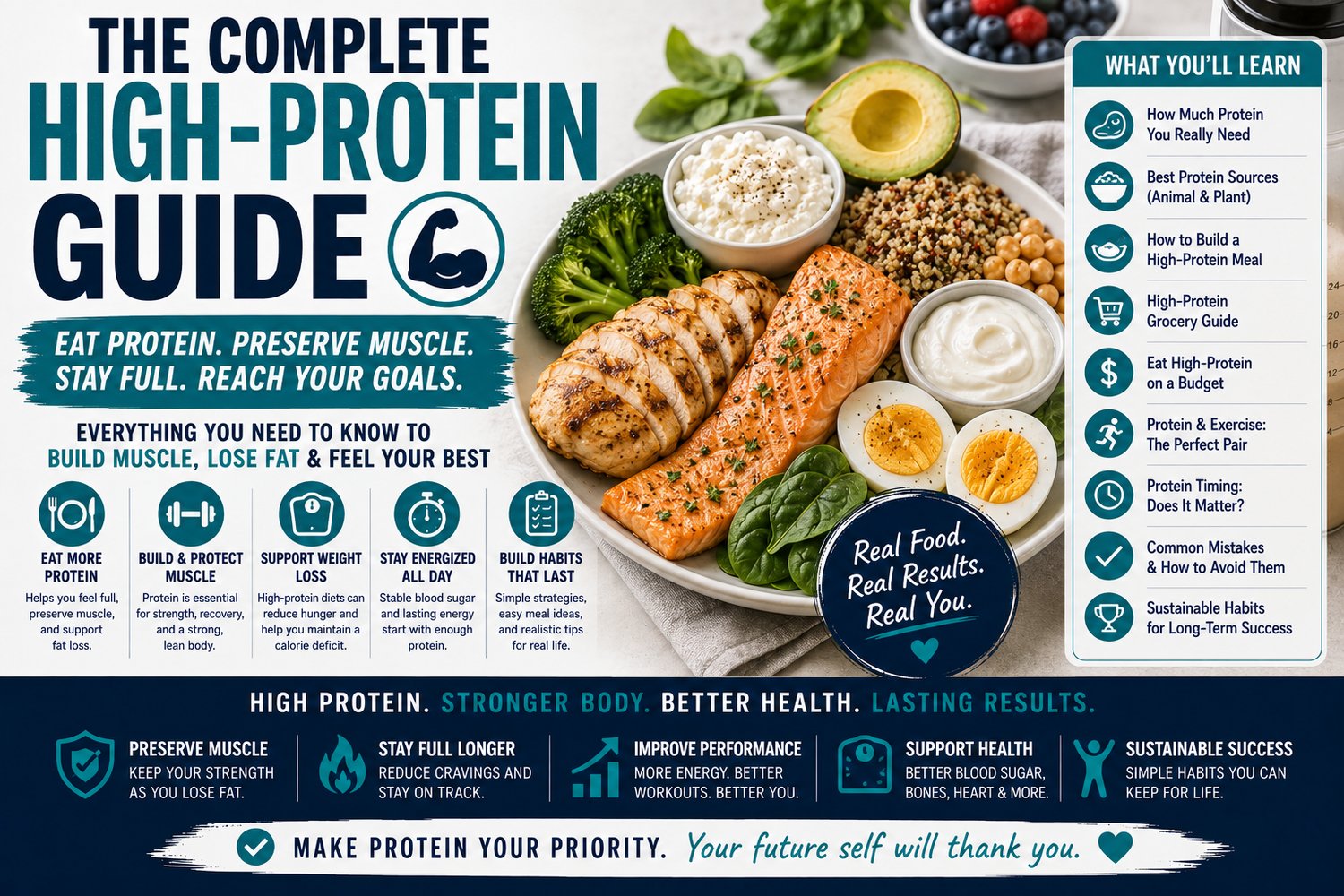
The Complete High-Protein Guide
High-protein eating can help support weight loss, fullness, muscle retention, recovery, and healthy aging—but only when it fits into a balanced diet you can actually maintain.
The hard part usually isn't understanding that protein matters.
It's figuring out:
How much protein do I actually need?
How much should I eat at each meal?
What are the cheapest protein sources?
How do I eat more protein without adding a ton of calories?
Does protein timing matter?
Are animal proteins better than plant proteins?
How do I build meals that are high in protein without living on chicken and shakes?
This Complete High-Protein Guide brings the entire HabitLogics protein library together in one place.
More importantly, it gives you a practical system for using it.
The goal isn't to eat the maximum amount of protein possible.
It's to eat enough protein in a way that supports your health, budget, meals, and daily life.
Quick Answer: What Does a Good High-Protein Diet Look Like?
For most people, a practical high-protein eating pattern includes:
- A realistic daily protein target
- Protein distributed across several meals
- Whole or minimally processed protein foods most of the time
- Vegetables and fruit
- Fiber-rich carbohydrates
- Appropriate fats
- Enough total food
- Meals you enjoy
- A grocery strategy you can afford
- Resistance training when muscle preservation or growth is a goal
Protein should improve the structure of your diet.
It should not become the entire diet.
Start With Your Protein Target
Before buying protein powder, meal-prepping chicken, or calculating the cost per gram of cottage cheese, figure out roughly how much protein you're actually trying to eat.
Protein needs vary based on:
- Body size
- Age
- Activity
- Health
- Calorie intake
- Strength training
- Goals
The standard adult Recommended Dietary Allowance is 0.8 grams per kilogram of body weight, but higher intakes are often used in weight-loss and muscle-preservation contexts.
For many generally healthy adults pursuing weight loss, a practical range may fall around:
1.0–1.6 grams per kilogram per day
depending on individual circumstances.
That's not a universal prescription.
The best target isn't automatically the highest one.
It is the amount that supports your goals without:
- Making meals miserable
- Crowding out other foods
- Increasing grocery costs unnecessarily
- Creating digestive problems
- Turning eating into a full-time math assignment
Start here:
How Much Protein Do You Need for Weight Loss? A Practical Beginner's Guide
Why Protein Can Help With Fullness
Protein often produces greater short-term satiety than the same number of calories from carbohydrate or fat.
That may happen through several mechanisms involving:
- Appetite-related hormones
- Digestion
- Thermic effect
- Meal structure
- Food texture
- Lean-mass preservation
But protein is not an appetite off switch.
You can eat a high-protein meal and still feel hungry if the meal is:
- Too small
- Low in fiber
- Missing carbohydrates
- Missing fat
- Mostly liquid
- Eaten extremely quickly
- Part of an overly aggressive calorie deficit
Sleep, stress, activity, medications, habits, and food environment can also influence hunger.
So don't ask only:
"Did I eat enough protein?"
Also ask:
"Was this a satisfying meal?"
For the full breakdown:
Why Protein Helps You Feel Fuller — and Why It Still Doesn't Guarantee Weight Loss
The HabitLogics High-Protein Meal Formula
A high-protein meal doesn't need to mean:
giant chicken breast + sadness.
😂
Use a four-part structure instead:
Protein + Produce + Fiber-Rich Carbohydrate + Healthy Fat/Flavor
1. Protein Anchor
Choose one primary source.
Examples:
- Chicken
- Turkey
- Fish
- Eggs
- Greek yogurt
- Cottage cheese
- Tofu
- Tempeh
- Beans
- Lentils
2. Produce
Add:
- Vegetables
- Fruit
- Salad
- Frozen produce
This contributes:
- Fiber
- Volume
- Vitamins
- Minerals
- Variety
3. Fiber-Rich Carbohydrate
Examples:
- Potatoes
- Oats
- Rice
- Whole grains
- Beans
- Lentils
- Fruit
Carbohydrates don't need to disappear just because you're eating more protein.
4. Healthy Fat or Flavor
Examples:
- Olive oil
- Avocado
- Nuts
- Seeds
- Cheese
- Sauce
- Dressing
Food still needs to taste good.
For the complete framework:
How to Build a High-Protein Meal: A Simple Formula That Actually Works
How Much Protein Should Be in a Meal?
There isn't one mandatory amount.
A practical starting range for many adults is roughly:
20–40 grams of protein at a main meal
depending on your total daily target and meal frequency.
For example, someone aiming for around:
100 grams per day
might eat:
- Breakfast: 25g
- Lunch: 30g
- Snack: 10g
- Dinner: 35g
Another person might eat three larger meals.
That's fine.
The goal is not perfect symmetry.
It's avoiding the pattern:
almost no protein all day → enormous dinner.
High-Protein Breakfasts
Breakfast is one of the easiest meals to improve.
Many common breakfasts contain relatively little protein:
- Toast
- Cereal
- Pastries
- Granola bars
- Fruit alone
- Coffee drinks
You don't necessarily need a brand-new breakfast.
You may just need a protein anchor.
Examples:
Greek Yogurt Bowl
Greek yogurt + berries + oats
Eggs and Toast
Eggs + whole-grain toast + fruit
Protein Oatmeal
Oats + milk + Greek yogurt or protein powder
Cottage Cheese Bowl
Cottage cheese + fruit + cereal
Egg and Bean Burrito
Eggs + beans + tortilla + salsa
For 20 practical ideas, see:
High-Protein Breakfasts That Keep You Full: Easy Ideas for Busy Mornings
Increase Protein Without Automatically Increasing Calories
One of the most common mistakes is:
normal diet + protein shake + protein bar + extra meat + extra cheese
Protein goes up.
Unfortunately, so do calories.
A better strategy is:
Replace, Don't Just Add
Instead of:
cereal + shake
try:
smaller cereal portion + Greek yogurt + fruit
Instead of:
large pasta serving + tiny amount of protein
try:
moderate pasta + larger protein serving + vegetables
Instead of:
snack + protein bar
replace the original snack with something more protein-rich.
Protein still contains calories.
The goal is to increase protein density, not just total food.
Read:
How to Increase Protein Without Adding Too Many Calories
Protein Timing: Does It Matter?
Yes.
But far less than many people make it sound.
The priority order is generally:
1. Eat enough protein over the full day.
2. Include protein at several meals.
3. Avoid concentrating nearly all of it at dinner.
4. Place protein reasonably close to resistance training.
5. Only then worry about advanced timing strategies.
You do not need:
- Protein every three hours
- A shake within 30 minutes of lifting
- Casein before bed
- Perfectly equal servings
- A timer reminding you when your muscles are apparently about to evaporate
😂
A normal protein-containing meal within a few hours before or after resistance training is practical for most recreational exercisers.
Read:
Protein Timing: Does It Really Matter for Weight Loss, Muscle, and Fullness?
Animal vs. Plant Protein
Both count.
Animal protein tends to provide a concentrated source of essential amino acids and often has higher digestibility.
Plant foods can provide protein while also contributing:
- Fiber
- Carbohydrates
- Phytonutrients
- Dietary variety
Useful animal sources include:
- Poultry
- Fish
- Eggs
- Dairy
- Lean meat
Useful plant sources include:
- Lentils
- Beans
- Tofu
- Tempeh
- Edamame
- Soy milk
- Seitan
For most people, you don't need to turn this into:
TEAM CHICKEN vs. TEAM LENTIL.
A mixed dietary pattern can use both.
Read:
Animal vs. Plant Protein: Which Is Better for Weight Loss, Muscle, and Health?
Protein Doesn't Replace Strength Training
Protein provides the raw materials involved in muscle repair and adaptation.
Resistance training provides the stimulus.
If preserving or building muscle is one of your goals, high protein without resistance training is only part of the equation.
A strong routine can include:
Adequate protein + resistance training + recovery + sleep + enough total nutrition
Walking is excellent for cardiovascular health and daily activity.
It simply doesn't replace progressive strength training.
For the walking side of that system:
Walking and Protein for Weight Loss: Why They Work Better Together
And for the full walking library:
Complete Walking for Weight Loss Guide
Eating High Protein on a Budget
High-protein eating can get expensive if your cart fills up with:
- Premium meat
- Protein bars
- Ready-to-drink shakes
- Individual yogurt cups
- Specialty protein snacks
- Products marketed specifically as "high protein"
Fortunately, none of that is required.
Some of the most useful affordable protein foods include:
- Eggs
- Chicken
- Milk
- Greek yogurt
- Cottage cheese
- Tuna
- Beans
- Lentils
- Tofu
- Soy milk
But sticker price alone doesn't tell you which one provides the best value.
That's why the HabitLogics budget-protein system uses several different comparisons.
Start With Affordable Protein Sources
Our original affordability guide compares foods across:
Value + Convenience + Nutrition + Versatility + Storage
because pure price isn't everything.
A theoretically cheap food isn't a good value if:
- You hate it
- You never cook it
- Half gets thrown away
- It doesn't fit your nutrition goals
See:
Best Affordable Protein Sources: 20 Foods Ranked by Value, Convenience, and Nutrition
Cheapest Protein Sources: Cost per 25g Protein
If you want to focus specifically on protein economics, use:
Cost per 25 Grams of Protein
The formula is:
Package Price ÷ Total Protein in Package × 25
For example:
Food costs:
$5
and contains:
100g total protein
Then:
$5 ÷ 100 × 25 = $1.25 per 25g protein
This lets you compare:
- Chicken
- Eggs
- Tuna
- Greek yogurt
- Cottage cheese
- Beans
- Lentils
- Tofu
- Milk
- Protein powder
using the same protein benchmark.
Read:
Cheapest Protein Sources: Which Foods Give You the Most Protein for Your Money?
Cheap High-Protein Foods at Walmart
We've also started applying the same methodology to individual stores.
The Walmart guide looks at staples such as:
- Frozen chicken
- Eggs
- Tuna
- Greek yogurt
- Cottage cheese
- Milk
- Beans
- Lentils
- Tofu
- Canned chicken
and compares current prices rather than pretending grocery prices stay fixed forever.
Read:
Best Cheap High-Protein Foods at Walmart: What Gives You the Most Protein for Your Money?
Cheap High-Protein Foods at Aldi
The Aldi analysis uses the same basic framework so the comparisons remain consistent.
It looks at affordable Aldi staples including:
- Family-pack chicken
- Eggs
- Milk
- Greek yogurt
- Cottage cheese
- Tuna
- Lentils
- Beans
- Tofu
Because prices change, these store-specific guides are date-stamped rather than written as permanent universal rankings.
Read:
Best Cheap High-Protein Foods at Aldi: What Gives You the Most Protein for Your Money?
Build a High-Protein Grocery List on a Budget
Once you've identified good-value proteins, the next problem is:
What do I actually buy for the week?
A useful grocery list should include:
Protein
4–6 reliable protein anchors
Carbohydrates
Cheap staples such as:
- Oats
- Rice
- Potatoes
- Bread
- Tortillas
- Pasta
Produce
Fresh or frozen foods you'll actually eat
Flavor
Sauces, seasonings, and other ingredients that make meals enjoyable
The real trick is ingredient overlap.
If chicken can become:
- Rice bowl
- Wrap
- Tacos
- Pasta
and Greek yogurt can become:
- Breakfast
- Snack
- Dip
- Sauce
you're getting more usefulness from every grocery item.
Read:
High-Protein Grocery List on a Budget: What to Buy for a Week
Cheap High-Protein Meals
Cheap ingredients aren't enough.
You need cheap meals.
Some of the strongest budget combinations include:
- Eggs + beans + potatoes
- Greek yogurt + oats + fruit
- Cottage cheese + toast + fruit
- Chicken + rice + vegetables
- Tuna sandwich + fruit
- Chicken + beans + rice
- Egg fried rice
- Chicken + lentils
- Tuna + potato
- Chicken + pasta
- Egg + bean burrito
Many of these meals can provide roughly:
20–40+ grams of protein
while using inexpensive staples.
Read the full ranking:
Cheap High-Protein Meals: 15 Budget-Friendly Meals Ranked by Cost and Protein
The HabitLogics Protein Value Framework
Our affordability research uses two different ideas.
Cheapest Protein
Ask:
How little can I pay for a useful amount of protein?
That's where:
cost per 25g protein
helps.
Best Protein Value
Ask:
How useful is this food overall?
Consider:
- Cost
- Protein
- Nutrition
- Convenience
- Versatility
- Storage
- Waste
A slightly more expensive protein can still be the better purchase if it's:
- Easier to use
- Less likely to spoil
- More versatile
- Better suited to your meals
That distinction prevents grocery shopping from becoming an optimization contest that ignores reality.
High-Protein Meal Planning Doesn't Need 21 Different Recipes
Variety is useful.
Chaos isn't.
Try the:
3-3-3 Method
Choose:
3 Breakfasts
Example:
- Greek yogurt bowl
- Eggs + toast
- Protein oatmeal
3 Lunches
Example:
- Tuna sandwich
- Chicken wrap
- Leftovers
3 Dinners
Example:
- Chicken rice bowl
- Chili
- Tofu stir-fry
Repeat them.
Change:
- Sauces
- Seasonings
- Produce
- Sides
You don't need a different recipe every day to eat well.
Protein Powder: Useful or Unnecessary?
Protein powder is optional.
Many people can reach their protein goals through food.
But powder can be useful when:
- You're rushed
- Appetite is low
- You're traveling
- A normal meal isn't available
- You need a convenient way to close a genuine protein gap
The mistake is assuming a shake needs to be added every day.
Instead, ask:
What problem is this solving?
If the answer is:
"None, but the tub says protein."
you probably don't need it.
😂
Protein Bars and High-Protein Snacks
The same rule applies.
Bars, cereal, cookies, chips, and desserts with added protein can be convenient.
They can also be:
- Expensive
- Calorie-dense
- Low in fiber
- Easy to eat when you aren't hungry
- Less satisfying than regular meals
Don't judge a product solely by the grams of protein printed on the front.
Check:
- Calories
- Protein
- Fiber
- Sugar
- Saturated fat
- Sodium
- Serving size
- Cost
Common High-Protein Diet Mistakes
A high-protein diet can still go wrong.
Common problems include:
- Setting an extreme protein target
- Adding protein without accounting for calories
- Treating peanut butter or cheese like lean protein
- Eating too little fiber
- Cutting carbohydrates too aggressively
- Living on bars and shakes
- Saving nearly all protein for dinner
- Ignoring protein quality
- Eating protein without building complete meals
- Expecting protein to replace strength training
- Making the diet unnecessarily expensive
- Ignoring medical concerns
- Expecting protein to eliminate hunger
- Treating one imperfect day as failure
If your protein plan feels harder than it should, start here:
12 Common High-Protein Diet Mistakes That Can Stall Weight Loss and Make Eating Harder
Yes, the article now contains more than 12.
You got bonus mistakes.
😂
How Protein Fits Into Weight Loss
Protein can support weight management by helping with:
- Satiety
- Lean-mass retention
- Meal structure
- Recovery
- Thermic effect
But protein doesn't override energy balance.
You can absolutely eat:
high protein + too many calories
and fail to lose weight.
The goal is not:
maximize protein at any cost.
It's:
eat enough protein while maintaining a dietary pattern appropriate for your goals.
That often means:
replace → rebalance → distribute
rather than:
add → add → add.
Protein and Muscle Preservation
Protein becomes especially important when:
- Losing weight
- Strength training
- Aging
- Recovering from exercise
- Appetite is reduced
During weight loss, the goal isn't merely to make the scale smaller.
Preserving as much lean tissue as reasonably possible matters too.
Resistance training is the major training stimulus.
Protein supports that process.
This becomes particularly relevant for people using appetite-suppressing medications, where total food intake may fall substantially.
For that specific context:
A Simple High-Protein Day
Here's one ordinary example.
Breakfast
Greek yogurt + oats + berries
Protein:
roughly 20–30g, depending on portions
Lunch
Chicken + rice + vegetables
Protein:
roughly 25–35g
Snack
Cottage cheese + fruit
Protein:
roughly 10–20g
Dinner
Chicken, tofu, fish, beans, or lentils + potatoes/rice + vegetables
Protein:
roughly 25–40g
That's already a substantial protein day.
No need for:
- Four shakes
- Three protein bars
- Protein chips
- Protein cereal
- Protein brownie
- Emergency midnight chicken breast
😂
A Simple Weekly Protein System
If you want to make this practical, use five steps.
Step 1: Pick a Daily Protein Range
Not one exact number.
A range.
Step 2: Choose 4–6 Protein Anchors
Examples:
- Eggs
- Greek yogurt
- Chicken
- Tuna
- Beans
- Tofu
Step 3: Build 3–3–3 Meals
Three breakfasts.
Three lunches.
Three dinners.
Step 4: Shop for Ingredient Overlap
Choose foods that work in several meals.
Step 5: Review, Don't Obsess
Ask:
- Am I reaching a reasonable protein intake?
- Are meals satisfying?
- Is fiber adequate?
- Can I afford this?
- Am I eating foods I enjoy?
- Is this routine sustainable?
If yes:
keep going.
Choose Your High-Protein Path
You don't need to read every article in order.
Choose what you're trying to solve.
If You Don't Know How Much Protein You Need
Start with:
How Much Protein Do You Need for Weight Loss?
If You Don't Know How to Build Meals
Start with:
How to Build a High-Protein Meal
Then:
High-Protein Breakfasts That Keep You Full
If You're Hungry All the Time
Read:
Why Protein Helps You Feel Fuller
If Increasing Protein Is Increasing Your Calories
Read:
How to Increase Protein Without Adding Too Many Calories
If Your Grocery Bill Is the Problem
Start with:
Then:
Best Affordable Protein Sources
Then:
High-Protein Grocery List on a Budget
Then:
If You Shop at Walmart
Read:
Best Cheap High-Protein Foods at Walmart
If You Shop at Aldi
Read:
Best Cheap High-Protein Foods at Aldi
If You're Worried About Timing
Read:
Protein Timing: Does It Really Matter?
If You're Choosing Between Plant and Animal Protein
Read:
If Your High-Protein Diet Isn't Working
Read:
12 Common High-Protein Diet Mistakes
Free High Protein Starter Kit
If you're ready to stop reading and actually build a protein routine, start here.
The FREE HabitLogics High Protein Starter Kit includes:
- Beginner's Protein Guide
- Protein Target Calculator
- 7-Day Protein Tracker
- Grocery Checklist
- High-Protein Swap Sheet
- Meal Planning Worksheet
Download the Free High Protein Starter Kit
Recommended HabitLogics Resources
High Protein Meal Builder & Macro Planner
Turn your daily protein target into actual meals while accounting for calories, carbohydrates, and fat.
Explore the High Protein Meal Builder & Macro Planner
High Protein on a Budget
Plan affordable protein foods, grocery lists, meal ideas, leftovers, and weekly spending.
Explore High Protein on a Budget
Complete High Protein System Bundle
Combine protein targets, meal building, grocery planning, tracking, and weekly nutrition tools.
Explore the Complete High Protein System Bundle
Frequently Asked Questions
How much protein do I need per day?
Protein needs vary substantially.
The standard adult RDA is 0.8g/kg, while many higher-protein weight-loss and muscle-preservation approaches use higher amounts.
A practical range for many generally healthy adults pursuing weight loss may fall around 1.0–1.6g/kg/day, but individual needs depend on health, size, age, training, and other factors.
Is 100 grams of protein a day enough?
It may be.
For some people, 100g is plenty.
For others, it may be too little or more than necessary.
Use your body size, activity, health, and goals to establish an appropriate range.
Do I need 30 grams of protein at every meal?
No.
Twenty to forty grams at main meals can be a practical range for many people, but your daily target and meal pattern matter more than hitting the exact same number every time.
Can you eat too much protein?
Yes.
An unnecessarily high target can:
- Add calories
- Increase cost
- Crowd out other foods
- Cause digestive discomfort
- Make eating harder to sustain
More isn't automatically better.
Does protein help with weight loss?
It can.
Protein may improve fullness and help preserve lean mass during weight loss.
But weight loss still depends on your overall energy intake and dietary pattern.
What are the cheapest protein sources?
Common affordable options include:
- Eggs
- Chicken
- Milk
- Greek yogurt
- Cottage cheese
- Tuna
- Beans
- Lentils
- Tofu
The cheapest option changes with local prices.
Use cost per 25g protein for a more useful comparison.
Is protein powder necessary?
No.
Protein powder is a convenience tool.
Many people can meet their needs through food.
Is animal protein better than plant protein?
Neither is universally better.
Animal proteins are often more concentrated in essential amino acids, while many plant protein foods also provide fiber and other nutrients.
A mixed diet can use both.
Does protein timing matter?
Somewhat.
Total daily intake generally matters more than precise timing.
Eating protein across several meals and reasonably close to resistance training can be useful without obsessing over exact minutes.
Do I need protein after walking?
Usually not immediately.
A normal balanced meal is generally enough after ordinary walking.
More demanding endurance or resistance training may justify a more deliberate recovery meal.
Is a high-protein diet expensive?
It doesn't have to be.
Store brands, eggs, chicken, dairy, tuna, legumes, tofu, sales, frozen foods, and ingredient overlap can keep costs much lower than a diet built around premium protein products.
The HabitLogics High-Protein Framework
If all of this feels like too much information, use this:
Target → Build → Balance → Budget → Repeat
Target
Choose a realistic protein range.
Build
Put a clear protein anchor in your main meals.
Balance
Add produce, fiber-rich carbohydrates, and appropriate fats.
Budget
Choose foods that provide good protein value without creating waste.
Repeat
Use meals you actually enjoy and can afford.
That's it.
You don't need protein to become your personality.
😂
Explore the Complete HabitLogics Wellness Library
High-protein eating works even better when it fits into a broader health routine.
Continue with:
Complete Walking for Weight Loss Guide
Complete Sleep & Recovery Guide
Complete Fiber & Gut Health Guide
Final Thoughts
High-protein eating doesn't need to be complicated.
You don't need:
perfect macros
premium supplements
six meals a day
chicken breast at every meal
or:
200 grams of protein because somebody on TikTok said more is better.
Start with a reasonable target.
Build balanced meals.
Use affordable protein foods.
Keep enough variety to enjoy eating.
Strength train when muscle preservation or growth matters.
And judge the diet by whether you can actually live with it.
Target → Build → Balance → Budget → Repeat
That's how protein becomes a useful part of your diet instead of another nutrition project you eventually quit.
This guide is for general educational purposes and isn't individualized medical or nutrition advice. Protein needs can vary substantially based on age, body size, health conditions, kidney function, medications, pregnancy, activity level, dietary restrictions, and other individual factors. Consult an appropriate healthcare professional or registered dietitian when personalized guidance is needed.