

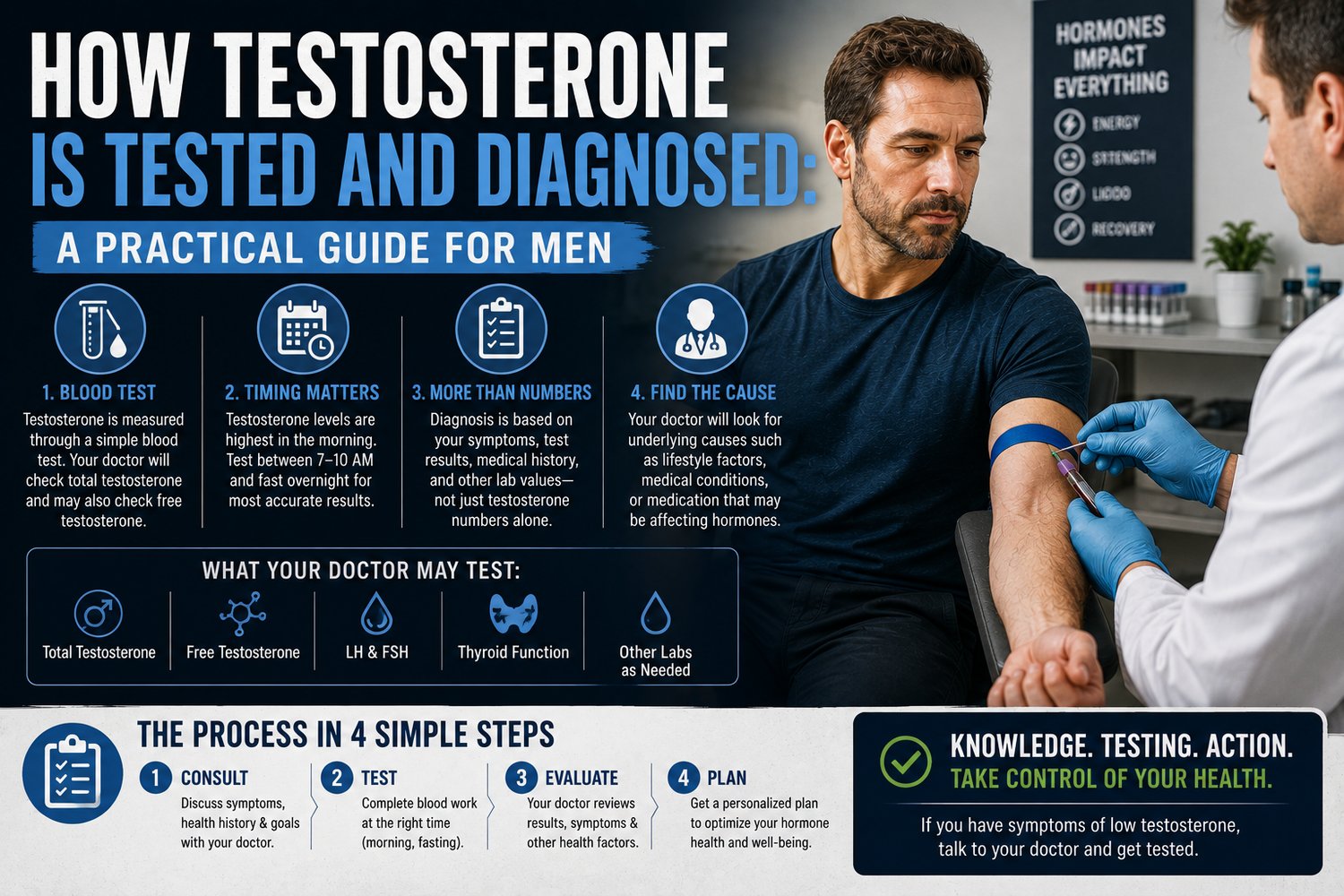
How Testosterone Is Tested and Diagnosed: A Practical Guide for Men
Testosterone testing usually starts with a morning total testosterone blood test, but diagnosing low testosterone requires more than one number. Men are generally diagnosed with testosterone deficiency, or hypogonadism, when they have compatible symptoms or signs along with consistently low testosterone levels confirmed with appropriate repeat testing.
If the first testosterone result is low, clinicians typically want to answer several questions:
- Was the test performed under appropriate conditions?
- Is testosterone still low when the measurement is repeated?
- Do the symptoms fit testosterone deficiency?
- Is free testosterone or SHBG relevant?
- Is the problem primarily in the testes or in brain-to-testes signaling?
- Could a medication, illness, obesity, pituitary disorder, or another condition be contributing?
- Does fertility affect the treatment plan?
That's why proper testosterone diagnosis isn't:
One test → low number → TRT.
It's closer to:
Symptoms → appropriate testing → confirmation → determine the cause → discuss treatment if indicated.
If you're still figuring out whether your symptoms fit the picture, start with Low Testosterone Symptoms: 20 Signs Men Shouldn't Ignore.
And if you've already confirmed a low result and want to understand why, read What Causes Low Testosterone? Common Medical, Lifestyle & Age-Related Reasons.
When Should Men Get Their Testosterone Tested?
Testosterone testing is most useful when there are symptoms, signs, or medical circumstances that make testosterone deficiency plausible.
Reasons to discuss testing with a healthcare professional can include:
- Persistent reduced libido
- Fewer spontaneous or morning erections
- Erectile problems
- Unexplained loss of muscle mass
- Reduced body or facial hair
- Infertility
- Gynecomastia
- Loss of bone density
- Persistent fatigue when clinically relevant
- Other signs or symptoms consistent with hypogonadism
Certain medical conditions or treatments may also increase the likelihood of testosterone deficiency.
Routine screening of every man simply because he reaches a particular age isn't generally recommended.
Testing should answer a meaningful clinical question rather than serve as another wellness score to optimize.
What Test Is Used to Check Testosterone?
For most men being evaluated for possible hypogonadism, total testosterone is the usual starting measurement.
Testosterone circulates in several forms.
Some is:
- Tightly bound to sex hormone-binding globulin, or SHBG
- More loosely bound to albumin
- Unbound, or “free”
Total testosterone measures the overall amount circulating in the blood.
It's widely available and useful as the initial test.
But in some situations, total testosterone doesn't tell the entire story.
What Is the Best Time to Test Testosterone?
Testosterone follows a daily rhythm.
For men with typical daytime schedules, testosterone levels are generally higher earlier in the day.
That's why suspected testosterone deficiency is commonly evaluated using an early-morning blood sample, often between approximately 7 and 10 a.m.
Morning testing reduces some of the normal variation that occurs throughout the day and makes repeat measurements easier to compare.
If you work night shifts or have an unusual sleep-wake schedule, tell the clinician ordering the test.
Testing may need to be interpreted relative to your actual sleep schedule rather than blindly applying a 7 a.m. rule to someone who works all night.
Does Testosterone Testing Need to Be Fasting?
Endocrine Society guidance recommends confirming suspected testosterone deficiency with morning fasting total testosterone measurements.
Standardizing the conditions around repeat tests can improve comparability.
That means your clinician may ask you to:
- Test in the morning
- Fast beforehand
- Avoid testing during significant illness
- Repeat the test under similar conditions if the first result is low
Follow the specific instructions from the laboratory and healthcare professional ordering your test.
Why One Low Testosterone Test Usually Isn't Enough
Testosterone isn't a fixed number.
It can vary from day to day and can be influenced by factors such as:
- Time of day
- Acute illness
- Severe calorie restriction
- Sleep
- Certain medications
- Recent physiological stress
- Laboratory variation
- Other health factors
So if your testosterone comes back unexpectedly low, the next step usually isn't:
“Start testosterone.”
It's:
“Confirm the result.”
Professional guidance recommends repeating a low morning testosterone measurement before diagnosing hypogonadism.
In practical terms, a diagnosis generally requires at least two appropriately performed low testosterone measurements together with compatible symptoms or signs.
What Testosterone Level Is Considered Low?
You'll frequently see 300 ng/dL used as a practical reference point for low total testosterone.
That's useful—but it isn't a magical biological wall.
Current Endocrine Society discussion supports two early-morning testosterone levels below approximately 300 ng/dL as evidence supporting hypogonadism when the broader clinical picture fits.
But laboratory methods and reference ranges vary.
That means:
299 ng/dL doesn't automatically prove you have hypogonadism.
And:
301 ng/dL doesn't automatically prove that testosterone couldn't be relevant.
Consider two very different scenarios.
Scenario 1
A man has:
- Persistent low libido
- Fewer spontaneous erections
- Two appropriately performed low morning testosterone measurements
That's a meaningful clinical pattern.
Scenario 2
Another man has:
- No clear testosterone-deficiency symptoms
- One testosterone result of 295 ng/dL
- Testing performed late in the day
- Severe sleep deprivation
- An acute illness
That's a much less convincing diagnosis.
The number matters.
The context around the number matters too.
Total Testosterone vs. Free Testosterone
Total and free testosterone measure different parts of the same hormone picture.
Total Testosterone
Total testosterone represents all circulating testosterone, including both protein-bound and unbound testosterone.
It's generally the starting point for evaluation.
Free Testosterone
Free testosterone refers to the small fraction that isn't tightly bound to proteins.
Free testosterone can provide useful additional information when:
- Total testosterone is borderline
- Symptoms and total testosterone don't seem to match
- SHBG is unusually high or low
- A medical condition is likely to affect SHBG
Not every man needs free testosterone measured.
It becomes more useful when total testosterone alone may be misleading.
What Is SHBG?
Sex hormone-binding globulin, or SHBG, is a protein produced primarily by the liver.
It binds testosterone tightly in the bloodstream.
If SHBG becomes unusually high or low, total testosterone can become harder to interpret.
For example, someone may have a total testosterone level that appears relatively reassuring while the amount of biologically available testosterone is lower than expected.
In another situation, total testosterone may appear low partly because SHBG is low.
SHBG can be influenced by factors including:
- Age
- Obesity
- Thyroid disease
- Liver disease
- Certain medications
- Other hormonal and metabolic conditions
That's why some evaluations include:
- Total testosterone
- SHBG
- Free testosterone
together.
What Happens After Low Testosterone Is Confirmed?
Once testosterone deficiency is confirmed, the next job is figuring out why testosterone is low.
That's where additional testing becomes important.
A clinician may evaluate hormones such as:
- LH
- FSH
- Prolactin
and, depending on the situation:
- SHBG
- Free testosterone
- Thyroid markers
- Iron studies
- Other pituitary hormones
- Additional laboratory tests
The exact workup depends on symptoms, age, medical history, medications, physical examination, fertility goals, and the testosterone pattern itself.
What Does LH Tell You?
Luteinizing hormone, or LH, is produced by the pituitary gland.
Its job includes signaling the testes to produce testosterone.
When testosterone is low, the LH result can help reveal where the problem may be occurring.
Low Testosterone + High LH
This pattern can suggest that the pituitary is sending a stronger signal but the testes aren't responding adequately.
That points toward primary hypogonadism, meaning the problem originates mainly in the testes.
Low Testosterone + Low or Inappropriately Normal LH
This can suggest that the testes aren't receiving enough stimulation from the hypothalamus or pituitary.
That points toward secondary hypogonadism.
The pattern isn't interpreted in isolation, but LH provides important diagnostic information.
What Does FSH Tell You?
Follicle-stimulating hormone, or FSH, is also produced by the pituitary.
FSH plays an especially important role in sperm production.
It can provide information about:
- Testicular function
- Fertility
- Primary vs. secondary hypogonadism
- The broader reproductive hormone system
LH and FSH are frequently interpreted together.
What About Prolactin?
Prolactin is another pituitary hormone.
Abnormally high prolactin can suppress normal reproductive hormone signaling and contribute to low testosterone.
A clinician may be particularly interested in prolactin when testosterone is low and LH is low or unexpectedly normal.
Elevated prolactin can have several causes, including:
- Certain medications
- Pituitary tumors
- Other medical conditions
A significantly abnormal result may lead to additional evaluation.
When Is Pituitary Imaging Considered?
Not every man with low testosterone needs a brain MRI.
Pituitary imaging is usually reserved for situations where the hormone pattern, symptoms, or other findings raise concern about a pituitary or hypothalamic disorder.
Possible reasons for additional investigation can include:
- Very low testosterone with a secondary-hypogonadism pattern
- Markedly elevated prolactin
- Other pituitary hormone abnormalities
- Headaches
- Visual changes
- Other concerning neurological or endocrine findings
This is why identifying the cause matters.
A testosterone prescription wouldn't treat an underlying pituitary tumor.
Why Thyroid Testing May Be Relevant
Thyroid disorders can cause symptoms that overlap substantially with low testosterone.
These can include:
- Fatigue
- Weight changes
- Mood changes
- Reduced libido
- Sexual dysfunction
- Difficulty concentrating
Thyroid disorders can also influence SHBG, which may alter how total testosterone should be interpreted.
Depending on your symptoms and medical history, thyroid testing may be part of a broader evaluation.
Why Iron Studies May Be Relevant
Iron overload disorders such as hemochromatosis can sometimes damage endocrine tissues, including the pituitary gland.
In selected cases, clinicians may evaluate iron status using tests such as:
- Ferritin
- Serum iron
- Transferrin saturation
Not every man with low testosterone needs these tests.
They're used when the clinical picture makes iron overload or another related condition plausible.
Fertility Changes the Testosterone Evaluation
This is one of the most important conversations to have before TRT begins.
External testosterone suppresses LH and FSH signaling.
That can dramatically reduce sperm production.
If fertility matters to you, tell your healthcare professional before starting testosterone.
A fertility-focused evaluation may include:
- LH
- FSH
- Semen analysis
- Physical examination
- Other reproductive testing
Men actively planning fertility may require a different treatment strategy from men who don't have future fertility goals.
For a broader discussion of this issue, read What Is TRT? Testosterone Replacement Therapy Explained.
What Bloodwork Is Usually Checked Before TRT?
If testosterone replacement therapy is being considered, the evaluation generally extends beyond testosterone itself.
The exact baseline workup varies by patient.
Depending on age, medical history, symptoms, treatment plan, and individual risk, clinicians may consider:
- Confirmed testosterone measurements
- CBC and hematocrit
- PSA when appropriate
- Blood pressure
- Relevant metabolic testing
- Additional hormone testing
- Evaluation for sleep apnea or other conditions when indicated
The point isn't that every patient needs the exact same lab panel.
The point is that TRT should follow a real medical evaluation.
It shouldn't be:
Low number → prescription → disappear for a year.
Why Hematocrit Matters Before and During TRT
Testosterone stimulates red blood cell production.
As a result, testosterone treatment can increase:
- Hemoglobin
- Hematocrit
If hematocrit becomes excessively elevated, treatment may need to be reassessed.
That's why a CBC or hematocrit measurement is often relevant before treatment and during follow-up.
It's not optional “optimization data.”
It's part of monitoring a known effect of testosterone therapy.
For the full treatment and monitoring discussion, read What Is TRT? Testosterone Replacement Therapy Explained.
Why Blood Pressure Matters Before TRT
Blood pressure belongs in the baseline health picture too.
FDA-required studies have found that testosterone products can increase blood pressure, and current testosterone labeling addresses that risk.
That makes knowing your baseline blood pressure useful before treatment begins.
It also gives you something meaningful to monitor after starting therapy.
TRT shouldn't be evaluated separately from the rest of your cardiovascular health.
Why PSA May Matter
Prostate-specific antigen, or PSA, may be considered before and during testosterone treatment depending on a man's:
- Age
- Prostate history
- Symptoms
- Individual risk factors
- Clinical situation
That doesn't mean testosterone automatically causes prostate cancer.
It means prostate health can be part of the risk assessment before treatment is started.
Can You Test Testosterone at Home?
Yes.
At-home testosterone tests can provide an initial data point.
The Everlywell Testosterone Test is one option.
You can also visit the HabitLogics Men's Bloodwork Hub for additional testing and bloodwork resources.
The important distinction is:
An at-home testosterone result can provide data. It doesn't by itself diagnose hypogonadism.
If your result is low, borderline, or doesn't fit your symptoms, appropriate follow-up matters.
When Does At-Home Testosterone Testing Make Sense?
At-home testing may be useful when:
- You want an accessible first data point
- You're curious about your testosterone level
- You're monitoring a marker you've previously discussed with a clinician
- You're willing to follow up appropriately if the result is abnormal
It becomes less useful when it's treated as:
- A complete medical diagnosis
- A reason to self-prescribe testosterone
- A substitute for evaluation
- Proof that every symptom you're experiencing is hormonal
Think of an at-home result as information, not a treatment plan.
Don't Test Under Terrible Conditions and Panic
Imagine that you:
- Slept four hours
- Have a significant illness
- Are aggressively dieting
- Are badly under-recovered
- Test at an inappropriate time of day
and the result comes back unexpectedly low.
That result may deserve attention.
But it may not represent your normal baseline.
That's precisely why low testosterone should generally be confirmed under appropriate conditions before making a diagnosis.
One number isn't your testosterone identity.
Track Testosterone in Context
Lab values become much more useful when you can compare them over time and alongside other health information.
That may include:
- Testosterone
- Hematocrit
- Weight
- Waist circumference
- Blood pressure
- Sleep
- Energy
- Lipids
- Glucose
- Other relevant biomarkers
The Men's Bloodwork Dashboard is designed to help organize testosterone, metabolic markers, lipids, body composition, and recovery data over time.
For broader health tracking, the Men's Health & Performance Dashboard combines bloodwork context with fitness, energy, habits, recovery, and body-composition tracking.
If you want a simpler starting point, download the FREE Men's Hormone & Energy Starter Kit.
Don't Chase “Optimal” Testosterone Numbers
One of the stranger trends in men's health is replacing diagnosis with optimization.
Instead of asking:
“Do I actually have testosterone deficiency?”
the question becomes:
“Why isn't my testosterone 1,000?”
That's not the same thing.
The purpose of diagnostic testing is to determine whether:
- Compatible symptoms or signs exist
- Testosterone is consistently low
- The result has been measured appropriately
- An underlying cause can be identified
- Treatment is warranted
You're evaluating a health problem.
You're not competing on a hormone leaderboard.
Can You Have Low-T Symptoms With Normal Testosterone?
Absolutely.
Symptoms commonly marketed as evidence of low testosterone can result from many other conditions.
Examples include:
- Fatigue
- Reduced libido
- Erectile dysfunction
- Difficulty concentrating
- Poor mood
- Poor exercise performance
If appropriately repeated testosterone measurements are normal, that doesn't mean your symptoms aren't real.
It means testosterone may not be the explanation.
The investigation may need to focus on areas such as:
- Sleep
- Sleep apnea
- Mental health
- Cardiovascular health
- Thyroid function
- Medications
- Metabolic health
- Relationship or psychological factors
- Other medical conditions
A normal testosterone result can be useful because it can prevent you from chasing the wrong diagnosis.
Can You Have Low Testosterone Without Symptoms?
You can have a low laboratory result without obvious symptoms.
But professional guidelines distinguish a low laboratory value from clinically diagnosed hypogonadism.
The diagnosis generally requires:
compatible symptoms or signs + consistently low testosterone measurements.
That's important because treating every low laboratory result would risk medicalizing men who don't have a clinically meaningful testosterone-deficiency syndrome.
When Does TRT Enter the Conversation?
TRT should generally come after diagnosis, not before it.
A sensible sequence looks like this:
- Identify symptoms or signs compatible with testosterone deficiency.
- Measure testosterone appropriately.
- Repeat an unexpectedly low result.
- Determine whether the pattern supports hypogonadism.
- Investigate why testosterone is low.
- Discuss fertility goals.
- Review relevant medical risks and contraindications.
- Consider treatment options if appropriate.
If you've reached that stage, read What Is TRT? Testosterone Replacement Therapy Explained.
And if you're actively comparing telehealth treatment options, visit Compare Online TRT Options.
What Can You Work on While Testosterone Is Being Evaluated?
You don't have to put your entire health on hold while waiting for laboratory answers.
Continue improving the fundamentals that matter regardless of your testosterone result:
- Sleep
- Resistance training
- Regular physical activity
- Nutrition
- Adequate protein
- Body composition
- Stress management
- Metabolic health
Useful guides include:
- Sleep for Men: Why Better Sleep Matters for Testosterone, Recovery & Health
- Strength Training for Men Over 30
- Walking for Men's Health
- How to Support Testosterone Naturally
The Testosterone Lifestyle Guide can also help organize sleep, nutrition, strength training, stress, and recovery habits.
Frequently Asked Questions
How do you test for low testosterone?
Testing usually begins with a total testosterone blood test performed in the morning.
If the result is low and symptoms are compatible with testosterone deficiency, the measurement should generally be repeated before diagnosis.
Additional tests such as LH, FSH, SHBG, free testosterone, or prolactin may then be used depending on the situation.
What is the best time to test testosterone?
Early morning is generally preferred for men with typical sleep schedules because testosterone tends to be highest earlier in the day.
Testing is commonly performed between approximately 7 and 10 a.m.
People with unusual sleep schedules should discuss appropriate timing with their healthcare professional.
Do you need two testosterone tests to diagnose low T?
A low testosterone result should generally be confirmed with another appropriately performed measurement.
Current professional guidance emphasizes consistently low testosterone rather than relying on a single measurement.
Does testosterone testing need to be fasting?
Endocrine Society guidance recommends morning fasting total testosterone measurements when confirming suspected testosterone deficiency.
Follow the testing instructions provided by your healthcare professional and laboratory.
What testosterone level is considered low?
A total testosterone level around 300 ng/dL is commonly used as a clinical reference point.
But diagnosis shouldn't be made from one number alone.
Symptoms, repeat measurements, assay quality, laboratory reference ranges, and the overall clinical picture matter.
What's the difference between total testosterone and free testosterone?
Total testosterone measures all testosterone circulating in the bloodstream.
Free testosterone refers to the small fraction that isn't tightly bound to proteins.
Free testosterone can provide additional information when total testosterone is borderline or SHBG is abnormal.
What is SHBG?
SHBG stands for sex hormone-binding globulin.
It is a protein that binds testosterone in the bloodstream.
Unusually high or low SHBG can affect how total testosterone results should be interpreted.
What are LH and FSH testing for?
LH and FSH are pituitary hormones involved in testosterone production and fertility.
Their pattern can help distinguish a primarily testicular problem from one involving the hypothalamus or pituitary.
What happens after a low testosterone test?
The result will generally need to be confirmed.
If testosterone remains low and compatible symptoms are present, clinicians may perform additional evaluation to determine the cause.
That can include LH, FSH, prolactin, SHBG, free testosterone, thyroid testing, iron studies, or other testing depending on the circumstances.
Can I diagnose low testosterone with an at-home test?
No.
An at-home testosterone test can provide useful information, but a single result doesn't establish hypogonadism.
Appropriate diagnosis requires clinical context and confirmatory testing.
What bloodwork is needed before TRT?
There isn't one universal panel for every man.
Evaluation commonly includes confirmation of testosterone deficiency and assessment of relevant baseline risks.
Depending on the individual, that may involve CBC or hematocrit, PSA when appropriate, blood pressure, additional hormones, and other testing based on medical history and planned treatment.
Key Takeaways
- Testosterone deficiency isn't diagnosed from symptoms alone or from one isolated blood test.
- Total testosterone is usually the starting laboratory measurement.
- Testosterone testing is generally performed in the early morning.
- A low result should usually be confirmed with another appropriately performed measurement.
- A level around 300 ng/dL is commonly used as a clinical reference point, but context matters.
- Free testosterone and SHBG can provide additional information in selected cases.
- LH and FSH help distinguish primary testicular problems from secondary hypothalamic or pituitary causes.
- Prolactin, thyroid testing, iron studies, and other tests may help identify underlying causes when appropriate.
- Fertility goals should be discussed before starting testosterone therapy.
- Baseline health—including hematocrit and blood pressure—matters when TRT is being considered.
- At-home testing can provide information but doesn't replace proper diagnosis.
- The goal of testing is to determine whether testosterone deficiency actually exists and why—not to chase the highest possible number.
Final Thoughts
Getting a testosterone test is easy.
Interpreting it correctly is the important part.
A testosterone number is one piece of evidence.
Your symptoms matter.
Testing conditions matter.
Repeat measurements matter.
LH and FSH may matter.
SHBG may matter.
Your medications, sleep, body composition, fertility goals, medical history, and overall health may matter.
That's why a good testosterone evaluation asks more than:
“What's your number?”
It asks:
Is testosterone actually low?
Is it consistently low?
Do the symptoms fit?
Why is it low?
And what treatment—if any—makes sense?
That's the level of context you want before making a potentially long-term medical decision.
Continue the Testosterone Series
If you're working through the testosterone cluster in order:
Low Testosterone Symptoms: 20 Signs Men Shouldn't Ignore →
What Causes Low Testosterone? Common Medical, Lifestyle & Age-Related Reasons →
Next, understand treatment:
What Is TRT? Testosterone Replacement Therapy Explained →
For the lifestyle side:
How to Support Testosterone Naturally →
For testing and tracking resources:
- HabitLogics Men's Bloodwork Hub
- Everlywell Testosterone Test
- Men's Bloodwork Dashboard
- FREE Men's Hormone & Energy Starter Kit
And if you've already completed appropriate evaluation and are researching treatment providers:
Affiliate Disclosure
Some links in this article are affiliate links. If you make a purchase through one of these links, HabitLogics may earn a commission at no additional cost to you. Recommendations are included only where they naturally fit the topic.
Educational Disclaimer
This article is intended for educational purposes only and should not be considered medical advice. Testosterone testing and diagnosis should be individualized based on symptoms, properly performed repeat laboratory measurements, medical history, medications, fertility goals, and clinical evaluation. Consult a qualified healthcare professional for individualized testing, diagnosis, or treatment, and do not start, stop, or change testosterone therapy without appropriate medical guidance.