

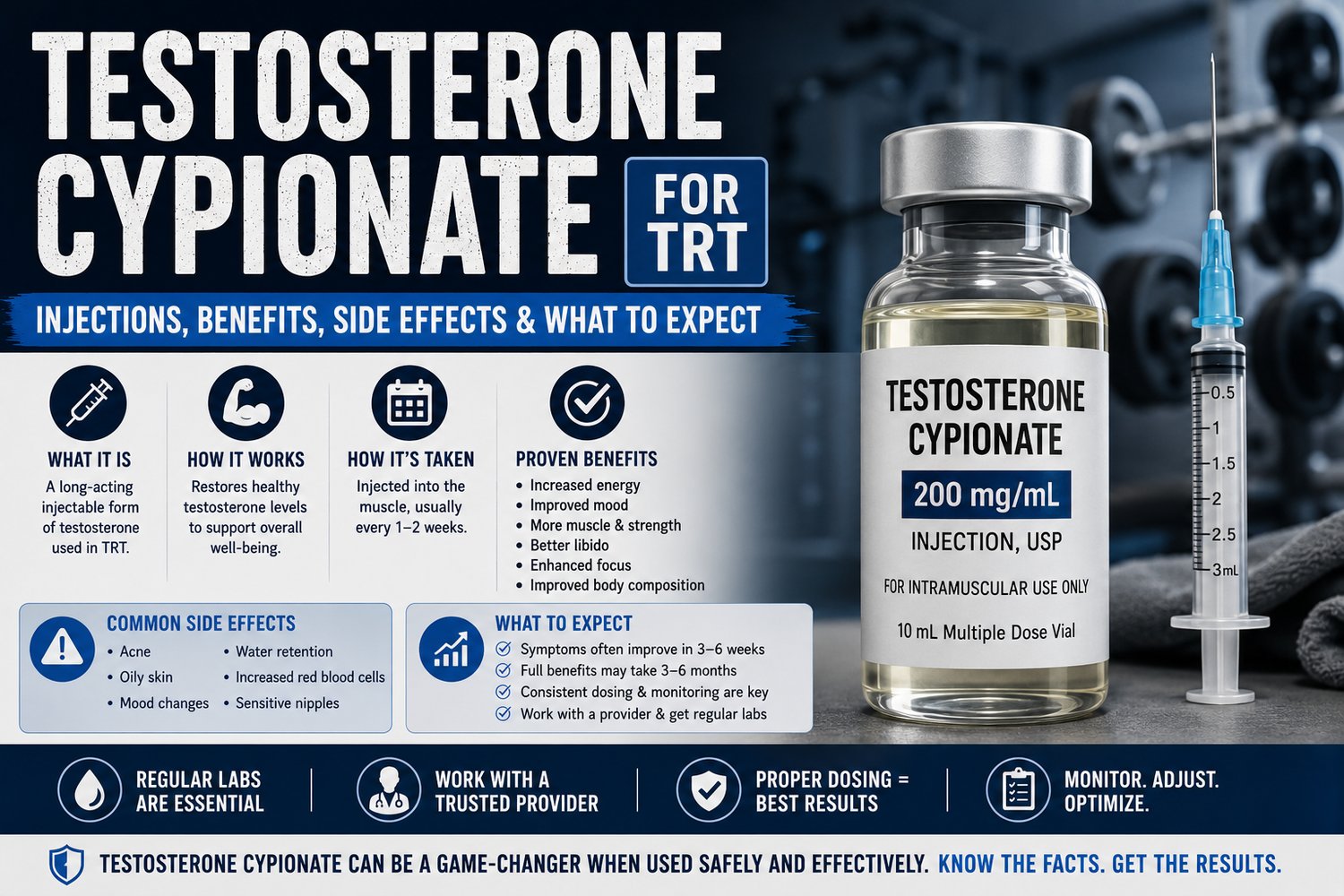
Testosterone Cypionate for TRT: Injections, Benefits, Side Effects & What to Expect
If you start researching testosterone replacement therapy, one medication appears almost immediately:
Testosterone cypionate.
It's one of the most commonly used injectable forms of testosterone in the United States.
And on the surface, it sounds simple:
Low testosterone → inject testosterone → testosterone goes up.
That's technically true.
But it leaves out most of what actually matters.
Testosterone cypionate is an FDA-approved injectable testosterone used for replacement therapy in certain forms of male hypogonadism. It is delivered in an oil-based solution, absorbed gradually after injection, and has an intramuscular half-life of roughly eight days according to current prescribing information.
The practical questions are:
- Who is testosterone cypionate appropriate for?
- How is it injected?
- Why do some men inject more frequently than others?
- What happens to LH, FSH and fertility?
- What benefits should you realistically expect?
- Why does hematocrit matter so much?
- How should testosterone levels be monitored?
- What side effects deserve attention?
That's what this guide covers.
If you haven't actually confirmed testosterone deficiency yet, start with:
For the broader treatment overview:
What Is TRT? Testosterone Replacement Therapy Explained →
What Is Testosterone Cypionate?
Testosterone cypionate is testosterone attached to a cypionate ester.
That ester slows the release of testosterone after injection.
The medication is dissolved in oil and injected into muscle according to the FDA-approved labeling.
Current DailyMed labeling describes testosterone cypionate as an oil-soluble testosterone ester intended for intramuscular injection. Because it is absorbed gradually from the injected oil depot, testosterone cypionate can remain active for days rather than disappearing immediately.
That's why testosterone cypionate doesn't need to be injected several times per day.
The ester creates a longer-lasting medication.
Is Testosterone Cypionate the Same as Testosterone?
Once the ester is removed in the body, the active hormone is testosterone.
The cypionate portion mainly changes:
how long the medication remains available after injection.
So:
Testosterone cypionate ≠ a different male hormone.
It's a longer-acting delivery form of testosterone.
Other testosterone esters include:
- Testosterone enanthate
- Testosterone undecanoate
Different formulations have different pharmacokinetics and dosing schedules.
What Is Testosterone Cypionate Approved For?
Current testosterone-cypionate labeling lists replacement therapy for men with testosterone deficiency caused by conditions such as:
Primary Hypogonadism
The problem originates mainly in the testes.
Examples in the labeling include testicular failure related to conditions such as:
- Orchitis
- Bilateral torsion
- Removal of the testes
- Other congenital or acquired testicular disorders
Hypogonadotropic Hypogonadism
The problem involves inadequate hormonal signaling from the hypothalamus or pituitary.
Examples include:
- Gonadotropin deficiency
- Pituitary-hypothalamic injury
- Tumors
- Trauma
- Radiation
The current product label still states that safety and efficacy for so-called age-related hypogonadism have not been established for that specific testosterone-cypionate product.
That's an important distinction from simply saying:
“I'm older and my testosterone isn't what it used to be.”
A legitimate diagnosis still matters.
Testosterone Cypionate Is a Prescription Controlled Substance
Testosterone cypionate is a:
Schedule III controlled substance.
That reflects its potential for misuse and abuse.
Medical TRT and anabolic-steroid abuse are not the same thing.
TRT aims to replace testosterone to an appropriate physiological range in a patient with genuine testosterone deficiency.
Abuse typically involves:
- Supraphysiologic doses
- Stacking multiple anabolic agents
- Using testosterone for performance enhancement rather than treating hypogonadism
The current label specifically warns about abuse at doses higher than recommended for approved medical use.
How Does Testosterone Cypionate Work?
This is the simplest part.
You inject testosterone cypionate.
The medication is gradually absorbed.
The ester is cleaved.
Testosterone enters circulation.
That testosterone can then act on androgen-sensitive tissues throughout the body.
This bypasses the need for the testes to produce all of the testosterone themselves.
That's what makes TRT fundamentally different from something like enclomiphene.
Testosterone Cypionate Replaces Testosterone—It Doesn't Stimulate Production
This distinction matters enormously.
Testosterone cypionate provides exogenous testosterone.
Your body sees the additional androgen and responds through negative feedback.
Pituitary signaling falls.
That usually means:
- LH falls
- FSH falls
- Endogenous testicular testosterone production falls
- Sperm production can fall
Current prescribing information explicitly notes that exogenous testosterone suppresses pituitary LH, and at sufficient exposure can suppress spermatogenesis through FSH inhibition.
For the comparison with a treatment that tries to preserve that signaling:
Enclomiphene vs Testosterone Cypionate →
How Is Testosterone Cypionate Injected?
FDA-approved testosterone cypionate labeling specifies:
intramuscular injection.
The label specifically calls for deep intramuscular administration and says the drug should not be given intravenously.
That means the medication is deposited into muscle tissue, where the oil-based testosterone ester is gradually absorbed.
Common clinical injection sites can include larger muscles such as the gluteal region, depending on the product instructions and treatment plan.
Injection technique should be taught by an appropriate healthcare professional.
What About Subcutaneous Testosterone Injections?
You will absolutely encounter men injecting testosterone cypionate subcutaneously rather than intramuscularly.
Clinical practice has evolved beyond the wording of many older product labels, and the AUA guideline specifically discusses monitoring men using short-acting intramuscular or subcutaneous testosterone cypionate or enanthate.
That doesn't mean every testosterone-cypionate product is FDA-labeled for subcutaneous use.
The current product labels I checked specify intramuscular administration.
So if a clinician recommends subcutaneous injections, understand that the route may differ from the labeled administration instructions for the specific product.
Follow the prescriber's instructions rather than copying someone's injection routine from Reddit.
IM vs Subcutaneous Testosterone Cypionate
The practical difference is mostly where the medication is deposited.
Intramuscular
Medication goes into muscle.
Potential advantages:
- FDA-labeled route for standard testosterone-cypionate products
- Long history of use
- Familiar technique
Potential disadvantages:
- Longer needle depending on body composition and site
- Some men dislike deeper injections
- Injection-site discomfort can occur
Subcutaneous
Medication goes into the fatty tissue beneath the skin.
Potential advantages for some patients:
- Smaller needles may be possible
- Some find it easier or more comfortable
Potential disadvantages:
- Not the labeled route for many testosterone-cypionate products
- Local irritation or nodules can occur
- Technique still matters
Neither route should be improvised.
How Often Is Testosterone Cypionate Injected?
This is where the internet gets chaotic.
You'll encounter schedules such as:
- Every two weeks
- Weekly
- Twice weekly
- Every few days
- Even more frequently
The FDA label allows a broad replacement range of 50–400 mg every two to four weeks, individualized according to diagnosis, response and adverse effects.
But that labeled range is not the same thing as saying:
“Every man should inject every two to four weeks.”
Modern clinical practice often individualizes injection frequency to produce more stable testosterone exposure and symptom control.
The exact schedule should come from the prescribing clinician.
Why Do Some Men Split Their Injections?
Testosterone cypionate doesn't produce a perfectly flat testosterone concentration.
After an injection:
Testosterone rises.
Then as the drug is metabolized:
Testosterone gradually falls.
Larger, less frequent injections can therefore create more noticeable differences between:
peak
and:
trough
levels.
Some clinicians use smaller, more frequent injections in an effort to reduce those swings.
But don't confuse:
“Some patients do better with more frequent dosing”
with:
“Everyone should inject every other day.”
More frequent dosing also means:
- More injections
- More supplies
- More opportunities for injection-site problems
Treatment should solve an actual problem.
Testosterone Cypionate Has an Approximately Eight-Day Half-Life
Current prescribing information lists an intramuscular half-life of approximately:
eight days.
Half-life does not mean:
“The medication stops working after eight days.”
It means the amount of drug declines progressively over time.
This is part of why injection timing affects both:
- Symptoms
- Blood-test interpretation
Testosterone Lab Timing Matters
Suppose two men both have:
Testosterone = 800 ng/dL.
One blood draw occurred shortly after an injection.
The other occurred much later in the dosing interval.
Those measurements don't necessarily represent the same exposure.
The AUA recommends waiting until short-acting testosterone cypionate or enanthate has reached several dosing cycles before initial treatment-level assessment and emphasizes consistent timing relative to injections.
This is why:
Testosterone number + injection timing
is much more useful than the testosterone number alone.
Don't Copy Someone Else's TRT Dose
This is probably the most important dosing section in the article.
You'll see people online say:
“100 mg is nothing.”
or:
“200 mg is standard TRT.”
or:
“I need 160 mg to feel optimal.”
None of those statements determines your dose.
Dose depends on:
- Testosterone response
- Symptoms
- Injection schedule
- SHBG
- Side effects
- Hematocrit
- Other clinical factors
The product label explicitly says dosing should be adjusted according to the individual patient's response and adverse reactions.
TRT isn't bodybuilding dosage trivia.
The Goal Isn't the Highest Testosterone Level
A testosterone prescription should not become:
How high can we get this number without someone stopping us?
The AUA guideline uses a physiological therapeutic target rather than advocating supraphysiologic testosterone and recommends ongoing testosterone measurement once treatment is established.
The goal is:
adequate replacement + symptom improvement + acceptable safety
not:
win the lab report.
What Benefits Can Testosterone Cypionate Provide?
When testosterone deficiency is genuine and treatment is appropriate, testosterone therapy may improve some symptoms and physiological outcomes.
Potential benefits can include improvement in:
- Libido
- Some aspects of sexual function
- Lean body mass
- Bone density
- Anemia in selected men
- Other symptoms associated with androgen deficiency
But response varies.
And not every symptom blamed on low testosterone improves simply because testosterone normalizes.
TRT Is Usually Better at Treating Certain Symptoms Than Others
Sexual symptoms tend to be more specific to testosterone deficiency than complaints such as:
- Fatigue
- Brain fog
- Low motivation
- Poor gym performance
Why?
Because those nonspecific symptoms can result from dozens of other conditions.
A man can normalize testosterone and remain exhausted because the real problem was:
- Sleep apnea
- Depression
- Anemia
- Thyroid disease
- Poor sleep
- Medication effects
TRT can't fix a diagnosis you never had.
How Fast Does Testosterone Cypionate Work?
Blood testosterone can rise relatively quickly.
That doesn't mean every clinical effect occurs immediately.
Different outcomes happen on different timelines.
Some men may notice changes in:
- Libido
- Sexual symptoms
- General well-being
earlier.
Changes involving:
- Muscle
- Body composition
- Bone
generally require much more time.
Don't judge treatment after:
three injections and one good gym session.
What If Testosterone Improves but You Don't Feel Better?
This is a very important scenario.
Suppose:
Before TRT:
250 ng/dL
After TRT:
650 ng/dL
But your:
- Energy
- Libido
- Mood
- Other original symptoms
haven't meaningfully improved.
That deserves reassessment.
The question becomes:
Was testosterone actually causing the symptoms?
A pretty lab number is not enough reason to continue ineffective medical treatment indefinitely.
TRT and Muscle Gain
Testosterone contributes to muscle physiology.
Correcting genuine testosterone deficiency can support improvements in lean mass.
But medical TRT is not the same thing as a bodybuilding steroid cycle.
Your results still depend heavily on:
- Resistance training
- Protein
- Calories
- Sleep
- Recovery
If you're interested in the training side:
TRT doesn't replace training.
TRT and Fat Loss
Testosterone therapy is not an obesity medication.
Correcting hypogonadism can affect body composition in some men.
But losing abdominal fat still depends heavily on:
- Nutrition
- Energy intake
- Physical activity
- Sleep
- Other health factors
Don't use testosterone as a substitute for treating obesity.
For the broader discussion:
Why Belly Fat Gets Harder to Lose After 30 →
TRT and Libido
Low libido is one of the more recognizable symptoms associated with testosterone deficiency.
Men with genuine hypogonadism may experience improvement after appropriate replacement.
But libido is influenced by far more than testosterone.
It can also be affected by:
- Relationship factors
- Depression
- Medications
- Sleep
- Stress
- Other medical conditions
So:
normal testosterone ≠ guaranteed perfect libido.
TRT and Erectile Dysfunction
Testosterone deficiency can contribute to erectile dysfunction in some men.
But ED is often heavily influenced by:
- Cardiovascular disease
- Diabetes
- Blood pressure
- Neurological problems
- Medication effects
- Psychological factors
If erections remain poor despite appropriate testosterone treatment, don't simply keep increasing the testosterone dose.
Read:
Erectile Dysfunction: Causes, Treatment & When to Get Help →
TRT and Morning Erections
Changes in spontaneous morning erections can provide useful information about:
- Hormonal health
- Sleep
- Vascular function
- Neurological function
But they aren't a perfect testosterone test either.
For the full explanation:
Morning Erections: What They Can Tell You About Your Health →
Testosterone Cypionate Suppresses Fertility
This is one of the biggest tradeoffs of TRT.
Exogenous testosterone suppresses the hypothalamic-pituitary-gonadal axis.
That reduces:
- LH
- FSH
- Intratesticular testosterone
- Spermatogenesis
The AUA recommends evaluating fertility goals before testosterone therapy, and exogenous testosterone is a poor default choice for men actively trying to conceive.
If children are even a possibility in your future, discuss that before starting.
TRT Can Reduce Testicular Size
Because LH stimulation falls during exogenous testosterone use, the testes receive less stimulation.
Some men notice:
- Testicular shrinkage
- Reduced semen volume
- Reduced sperm production
The degree varies.
This is expected endocrine physiology rather than proof that something has gone catastrophically wrong.
But it matters if fertility or testicular function is important to you.
Can Fertility Recover After Stopping TRT?
Often, sperm production can recover.
But it may take:
- Months
- Occasionally longer
and recovery isn't perfectly predictable.
This is one reason fertility should be discussed before TRT rather than waiting until someone decides to conceive.
If preserving fertility is a major priority, read:
Enclomiphene vs Testosterone Cypionate →
Testosterone Cypionate Can Raise Hematocrit
This is one of the most important safety issues to understand.
Testosterone stimulates red blood cell production.
That can increase:
- Hemoglobin
- Hematocrit
Current AUA guidance recommends measuring both before treatment and monitoring hematocrit during therapy. A baseline hematocrit above 50% deserves evaluation, and a treatment hematocrit of 54% or higher warrants intervention.
This is why CBC monitoring is not optional fluff.
What Happens if Hematocrit Gets Too High?
The response depends on:
- Testosterone level
- Dose
- Injection schedule
- Other medical factors
- Cause of the elevated hematocrit
A clinician may consider:
- Adjusting treatment
- Changing dose
- Changing formulation
- Investigating sleep apnea
- Investigating smoking or hypoxia
- Other appropriate management
Don't automatically turn:
“hematocrit is high”
into:
“I should donate blood every eight weeks forever.”
Address why it's high.
Sleep Apnea Can Matter Here
Obstructive sleep apnea can contribute to elevated hematocrit through intermittent low oxygen.
It also commonly overlaps with:
- Obesity
- Fatigue
- Low libido
- Low testosterone
So if you're on TRT and your hematocrit is climbing while you also:
- Snore loudly
- Gasp at night
- Stop breathing during sleep
- Wake exhausted
the answer may not simply be:
more phlebotomy.
Read:
Testosterone Can Increase Blood Pressure
This is an important current update.
In 2025, FDA removed older class-wide warning language suggesting increased cardiovascular outcomes after reviewing the large TRAVERSE cardiovascular-safety trial.
But FDA simultaneously required broader labeling regarding increases in blood pressure observed across testosterone products.
So the updated message isn't:
“TRT is proven completely cardiovascular-risk free.”
It's more nuanced.
The TRAVERSE trial did not show a meaningful increase in major adverse cardiovascular events compared with placebo in the studied population, but testosterone can raise blood pressure and still requires appropriate cardiovascular risk management.
Know your blood pressure.
What Did the TRAVERSE Trial Show?
TRAVERSE included more than 5,000 men with hypogonadism and cardiovascular disease or cardiovascular risk factors.
FDA's current summary reports major adverse cardiovascular events in:
7.0% of testosterone-treated participants
versus:
7.3% of placebo participants.
FDA concluded that the trial did not demonstrate a new signal for increased major cardiovascular events.
That's reassuring.
But don't turn it into:
“TRT prevents heart disease.”
It doesn't establish that either.
Testosterone and Blood Clots
Testosterone product labeling includes warnings about reported:
- Deep vein thrombosis
- Pulmonary embolism
Current testosterone-cypionate labeling advises evaluation for symptoms consistent with venous thromboembolism.
Seek urgent medical attention for concerning symptoms such as:
- Sudden unexplained shortness of breath
- Significant one-sided leg swelling
- Leg pain with warmth or redness
Those aren't “wait until the next TRT appointment” symptoms.
Testosterone Cypionate and Acne
Androgens can increase sebaceous-gland activity.
That can contribute to:
- Oily skin
- Acne
- Body acne
Current testosterone-cypionate labeling includes acne and seborrhea among reported androgen adverse effects.
Sometimes acne improves with treatment adjustment.
Don't automatically build another medication stack around an excessive testosterone dose.
Testosterone and Hair Loss
Testosterone can be converted into:
DHT.
DHT contributes to male pattern hair loss in genetically susceptible men.
So testosterone treatment may accelerate hair loss in some men who are already predisposed.
It does not guarantee baldness.
Genetics and follicle sensitivity matter enormously.
For the full explanation:
Testosterone and Estradiol
Some testosterone is converted into estradiol through the enzyme:
aromatase.
So when testosterone rises:
estradiol may rise too.
That's normal physiology.
Estradiol has important roles in men, including:
- Bone health
- Sexual function
- Other physiological processes
The goal of TRT is not:
maximize testosterone + eliminate estrogen.
Does Everyone on TRT Need Anastrozole?
No.
Anastrozole is an aromatase inhibitor.
It reduces conversion of testosterone into estradiol.
Some men may have clinical situations where an aromatase inhibitor is considered.
That doesn't mean every TRT patient needs one automatically.
Treating a laboratory estradiol number without symptoms or context can create problems of its own.
More medication isn't always better medicine.
Can Testosterone Cause Gynecomastia?
Gynecomastia—growth of male breast tissue—has been reported during androgen therapy and is included in current testosterone-cypionate labeling.
If you develop:
- New breast tenderness
- A lump
- Noticeable tissue growth
tell the clinician managing treatment.
Don't self-prescribe an aromatase inhibitor because your chest felt strange for two days.
Testosterone Can Cause Fluid Retention
Androgens can cause retention of:
- Sodium
- Water
- Other electrolytes
Current labeling specifically warns that edema can be a significant issue in people with certain cardiac, renal or hepatic conditions.
Rapid swelling or unexpected shortness of breath deserves medical attention.
Prostate Monitoring
Testosterone and prostate health have a complicated history.
The simplistic old narrative was:
“Testosterone causes prostate cancer.”
The current picture is more nuanced.
Appropriate baseline risk assessment and monitoring still matter, particularly depending on age and individual prostate-cancer risk.
The Endocrine Society recommends prostate-risk assessment before treatment and follow-up monitoring in men who choose prostate surveillance.
TRT shouldn't mean ignoring prostate health.
What About PSA?
PSA—prostate-specific antigen—is one tool used in prostate evaluation.
It isn't:
a perfect prostate-cancer test.
An elevated PSA can occur for reasons other than cancer.
A significant rise during treatment may warrant further evaluation rather than automatically blaming testosterone or automatically stopping treatment.
Interpret it in context.
What Bloodwork Do You Need on Testosterone Cypionate?
At minimum, TRT monitoring commonly involves attention to:
- Testosterone
- Hemoglobin
- Hematocrit
- PSA/prostate monitoring when appropriate
- Other tests based on individual risk and symptoms
Diagnosis before treatment may additionally involve:
- Repeat morning testosterone
- LH
- FSH
- Free testosterone or SHBG when appropriate
- Prolactin when indicated
For the broader overview:
For testing resources:
Enclomiphene vs Testosterone Cypionate →
How Much Does Testosterone Cypionate TRT Cost?
The medication itself may be relatively inexpensive.
The complete treatment process can include:
- Medication
- Labs
- Provider visits
- Injection supplies
- Shipping
- Membership fees
- Additional medications
That's why the advertised vial price rarely tells you the true cost of TRT.
For the full breakdown:
Online TRT vs Local Care
Testosterone cypionate can be prescribed through:
- Primary-care clinicians
- Urologists
- Endocrinologists
- Men's-health clinics
- Telehealth TRT providers
Traditional local care may be cheaper if:
- Insurance covers visits
- Labs are covered
- Testosterone is covered
Telehealth may offer advantages such as:
- Convenience
- Specialized workflows
- Medication delivery
- Transparent cash pricing
Neither is automatically better.
What Should an Online TRT Program Include?
If you're considering online testosterone cypionate treatment, look beyond the monthly price.
You should understand:
Diagnostic Testing
How is low testosterone confirmed?
Cause
Are LH and other appropriate tests used when needed?
Medication
Exactly what testosterone product?
Dosing
Who adjusts it?
Monitoring
What labs are required?
Hematocrit
How is elevated hematocrit handled?
Fertility
Is sperm suppression discussed?
Follow-Up
Can you speak to an actual clinician?
Cost
What isn't included?
You can compare current online treatment options here:
HabitLogics participates in affiliate programs with some providers featured on this page. If you use one of our links and purchase treatment, HabitLogics may earn a commission at no additional cost to you.
Red Flags in TRT Care
Be cautious if a clinic:
- Diagnoses low testosterone from one poorly timed test
- Guarantees you'll feel dramatically better
- Treats a target testosterone number as the entire goal
- Automatically adds multiple drugs
- Never discusses fertility
- Rarely monitors hematocrit
- Doesn't care about blood pressure
- Has no clear follow-up plan
- Treats every man with essentially the same dose
TRT should be individualized medical care.
Not a subscription box with needles.
Frequently Asked Questions
What Is Testosterone Cypionate?
Testosterone cypionate is a long-acting injectable ester of testosterone used for testosterone replacement therapy.
Current FDA labeling specifies intramuscular administration.
How Long Does Testosterone Cypionate Last?
The current prescribing information lists an intramuscular half-life of approximately eight days.
That does not mean the medication disappears after eight days.
How Often Is Testosterone Cypionate Injected?
Injection frequency is individualized.
The current FDA label lists a broad replacement range administered every two to four weeks, while contemporary clinical practice may use different schedules based on response, formulation and monitoring.
Follow your prescriber's schedule rather than copying someone else's.
Can Testosterone Cypionate Be Injected Subcutaneously?
Standard testosterone-cypionate product labeling specifies intramuscular use.
However, AUA guidance also discusses patients using short-acting testosterone cypionate or enanthate subcutaneously in clinical practice.
Use the route prescribed for your specific treatment.
Does Testosterone Cypionate Shut Down Natural Testosterone?
Exogenous testosterone suppresses pituitary LH signaling.
That reduces endogenous testicular testosterone production while treatment is active.
Does Testosterone Cypionate Reduce Sperm Count?
It can.
Suppression of LH and FSH can substantially reduce spermatogenesis.
Men interested in fertility should discuss reproductive goals before beginning exogenous testosterone.
Does Testosterone Cypionate Cause Testicular Shrinkage?
Reduced pituitary stimulation can lead to decreased testicular activity and reduced testicular volume in some men.
The amount varies.
Does Testosterone Cypionate Increase Hematocrit?
Yes, testosterone can increase red blood cell production.
AUA guidance recommends baseline hemoglobin/hematocrit testing and intervention if hematocrit reaches 54% or higher during therapy.
Does TRT Increase Heart-Attack Risk?
Current evidence is more reassuring than older warning language suggested.
FDA removed class-wide language about increased major cardiovascular outcomes after reviewing the TRAVERSE trial, which found no meaningful increase in major cardiovascular events in the studied population.
Testosterone can still increase blood pressure, so cardiovascular risk factors require appropriate monitoring.
Does Testosterone Cypionate Cause Hair Loss?
It may accelerate male pattern hair loss in genetically susceptible men because testosterone can be converted to DHT.
It does not make every man bald.
Can Testosterone Cypionate Help Build Muscle?
Correcting true testosterone deficiency can support improvements in lean mass.
Medical TRT is not equivalent to supraphysiologic anabolic-steroid use, and muscle growth still depends heavily on training and nutrition.
Can Testosterone Cypionate Help With Erectile Dysfunction?
It may help men whose ED is partly related to genuine testosterone deficiency.
Many cases of ED involve vascular, neurological, medication-related or psychological causes and may persist even after testosterone normalizes.
Do You Need TRT Forever?
Not necessarily in every case.
But when the underlying cause of testosterone deficiency remains present, testosterone replacement is often long-term treatment.
Stopping exogenous testosterone also requires time for the hypothalamic-pituitary-gonadal axis to recover.
Key Takeaways
- Testosterone cypionate is a long-acting injectable testosterone ester used for TRT.
- Current standard product labeling specifies intramuscular administration.
- The intramuscular half-life is approximately eight days.
- Dosing and injection frequency should be individualized rather than copied from another patient's protocol.
- Testosterone cypionate directly replaces testosterone rather than stimulating endogenous production.
- Exogenous testosterone suppresses LH and can suppress FSH and sperm production.
- Fertility goals should be discussed before starting TRT.
- Testosterone can increase hemoglobin and hematocrit.
- AUA guidance calls for intervention at hematocrit 54% or higher during treatment.
- Testosterone levels should be interpreted relative to injection timing.
- Once therapy is stable, AUA guidance recommends testosterone measurement every 6–12 months.
- TRT can improve some symptoms in appropriately diagnosed men, but a normal testosterone level doesn't guarantee that every nonspecific symptom will improve.
- FDA's current cardiovascular position is more reassuring after TRAVERSE, but testosterone can still raise blood pressure.
- Medical TRT is not the same thing as anabolic-steroid abuse.
- The goal is appropriate replacement and symptom improvement—not the highest possible testosterone level.
Final Thoughts
Testosterone cypionate isn't complicated because the medication itself is mysterious.
The basic mechanism is simple:
Inject testosterone → testosterone rises.
The complexity comes from everything surrounding it.
Why was testosterone low?
Is replacement actually appropriate?
How often should it be injected?
When should bloodwork be drawn?
Is hematocrit climbing?
Has blood pressure changed?
Are symptoms improving?
Does fertility matter?
Those questions determine whether TRT is being managed well.
Don't judge treatment by:
how high your testosterone number gets
or:
how complicated your injection schedule sounds.
Good testosterone replacement should be boring.
Appropriate diagnosis.
Reasonable dose.
Consistent administration.
Useful bloodwork.
Symptom improvement.
Safety monitoring.
Then you get on with your life.
Continue the Testosterone & TRT Series
Diagnosis
Treatment
- What Is TRT? Testosterone Replacement Therapy Explained
- Enclomiphene vs Testosterone Cypionate
- How to Support Testosterone Naturally
Cost & Testing
Compare Providers
Affiliate Disclosure
HabitLogics participates in affiliate programs with some providers linked from this article. If you use one of these links and purchase treatment, HabitLogics may earn a commission at no additional cost to you. Affiliate relationships do not determine whether TRT is medically appropriate.
Educational Disclaimer
This article is intended for educational purposes only and should not be considered medical advice or individualized dosing guidance. Testosterone cypionate is a prescription controlled substance that requires appropriate diagnosis and clinical monitoring. Dose, injection route, injection frequency, laboratory timing and treatment decisions should be determined by a qualified healthcare professional based on the specific product, symptoms, laboratory results, medical history, fertility goals and response to therapy. Do not change your testosterone dose, injection route or schedule based on information in this article.