

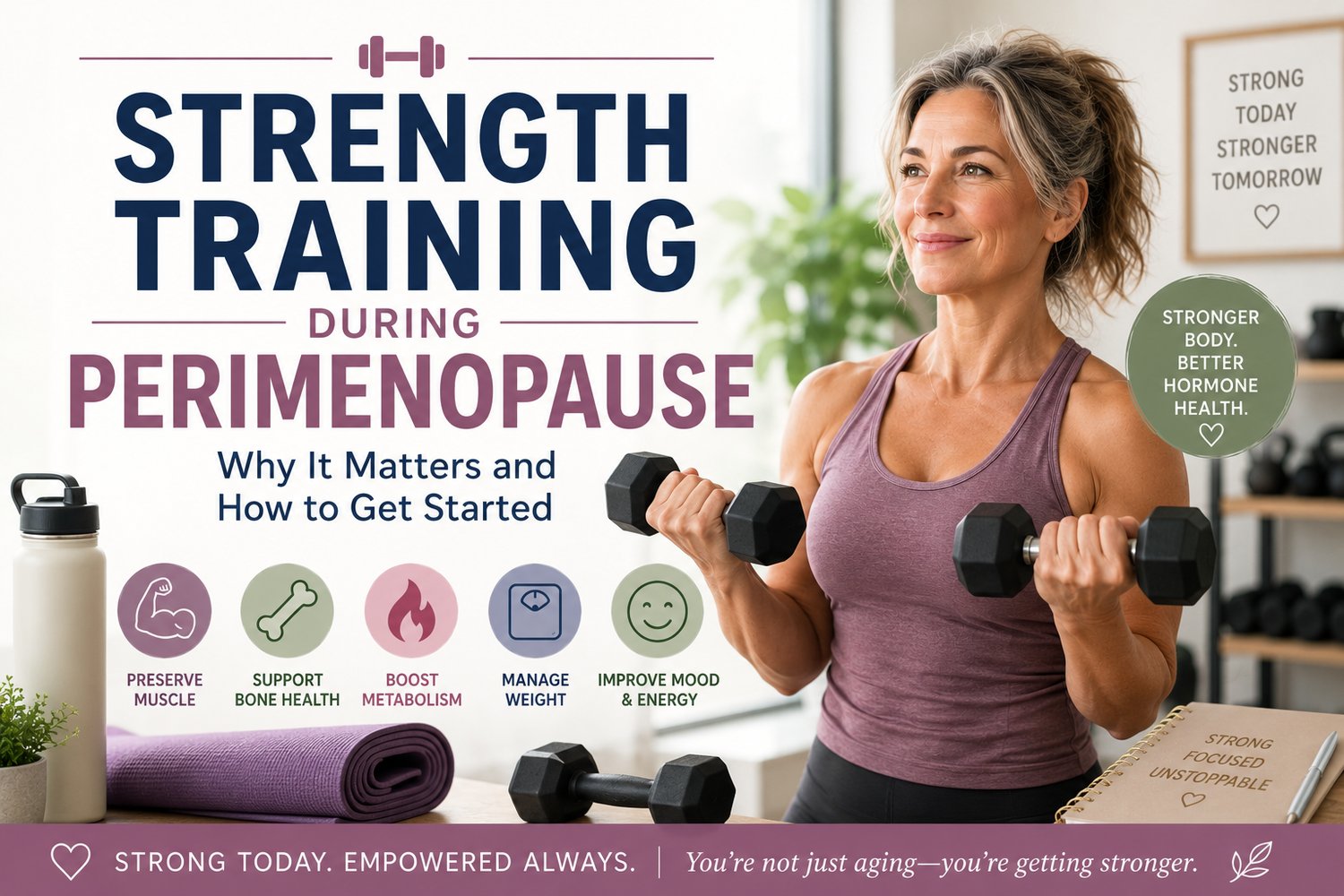
Strength Training During Perimenopause: Benefits, Workouts & How to Start
Strength training during perimenopause is one of the most useful forms of exercise you can add for preserving muscle, supporting bone health, maintaining strength, and staying physically capable as you age.
You do not need to become a powerlifter.
You do not need to train six days a week.
And you do not need to stop walking or doing cardio.
But if your current exercise routine consists entirely of walking, running, cycling, or fitness classes, adding some form of progressive resistance training can fill an important gap.
During midlife, aging, changing hormone patterns, physical activity, nutrition, sleep, and other health factors can all affect muscle and body composition.
Strength training gives your muscles—and to some extent your bones—a reason to adapt to physical demand.
For the nutrition side of the equation, read Protein During Perimenopause: How Much Do You Need for Muscle, Fullness & Healthy Aging?.
Why Strength Training Matters During Perimenopause
Muscle isn't just something that changes how your body looks.
It helps you:
- Carry groceries
- Get off the floor
- Climb stairs
- Lift objects overhead
- Maintain balance
- Walk faster
- Recover from illness or injury
- Stay independent as you age
Muscle mass and strength gradually change with age.
The menopause transition may contribute to body-composition changes, but it overlaps with aging, activity, nutrition, sleep, and other factors.
Rather than arguing about exactly what percentage of muscle change belongs to menopause versus aging, the practical conclusion is much simpler:
Maintaining strength becomes increasingly valuable during midlife.
Resistance training is one of the strongest tools available for doing that.
What Are the Benefits of Strength Training During Perimenopause?
A consistent resistance-training program can support:
- Muscle maintenance
- Muscle growth
- Strength
- Bone health
- Balance
- Mobility
- Physical function
- Glucose regulation
- Body composition
- Healthy aging
- Independence later in life
That list matters much more than whether your arms look slightly more “toned.”
The long-term goal is a body that can continue doing useful things.
Does Perimenopause Cause Muscle Loss?
Not in the simplistic sense that estrogen suddenly disappears and your muscles begin wasting away.
Age-related muscle loss occurs gradually across adulthood.
During the menopause transition, changes in reproductive hormones may contribute to changes in muscle mass, quality, and body composition.
But those changes occur alongside:
- Reduced activity
- Less resistance exercise
- Nutrition
- Weight changes
- Sleep disruption
- Medical conditions
- Aging itself
So don't think:
“Perimenopause is eating my muscle.”
Think:
“Midlife is a good time to deliberately protect strength and muscle.”
Strength Training and Protein Work Together
Resistance exercise provides the training stimulus.
Protein supplies the amino acids needed to support repair and adaptation.
Neither one needs to be extreme.
A useful strategy is:
regular resistance training + adequate protein + enough recovery
For many healthy midlife women, protein intakes around 1.0–1.2 g/kg/day may be a reasonable practical range to discuss, depending on body size, activity, health, and goals.
Read Protein During Perimenopause: How Much Do You Need for Muscle, Fullness & Healthy Aging? for the detailed version.
Strength Training Is Important for Bone Health Too
Bone is living tissue.
It responds to mechanical loading.
Resistance training causes muscles to pull against bone, while weight-bearing activity loads the skeleton through gravity and movement.
ACOG recommends both strength training and weight-bearing exercise as part of maintaining bone health around menopause.
A complete bone-health strategy can also involve:
- Adequate calcium
- Vitamin D
- Adequate protein
- Weight-bearing activity
- Not smoking
- Limiting excessive alcohol
- Appropriate bone-density screening
- Medical treatment when indicated
Strength training helps.
It does not make osteoporosis impossible.
Does Strength Training Prevent Osteoporosis?
Not completely.
Resistance and weight-bearing exercise can support bone strength and slow age-related bone loss.
But osteoporosis risk is also influenced by:
- Age
- Genetics
- Menopause timing
- Previous fractures
- Body weight
- Smoking
- Alcohol
- Medications
- Medical conditions
- Calcium and vitamin D status
Someone with osteopenia or osteoporosis should still strength train when appropriate—but exercise selection and loading may need to be modified.
More on that below.
How Often Should You Strength Train During Perimenopause?
For most beginners, two or three full-body strength-training sessions per week is an excellent place to start.
General adult activity guidance recommends muscle-strengthening exercise involving the major muscle groups on at least two days per week.
That might look like:
Monday: full-body strength
Tuesday: walk
Wednesday: rest or light activity
Thursday: full-body strength
Friday: walk
Weekend: walking, cardio, recreation, or optional third strength session
You do not need a dedicated “perimenopause workout split.”
Basic training principles still work.
Do You Need to Lift Heavy Weights?
You need resistance that is challenging enough.
That is not the same thing as saying every woman must train with very heavy weights.
Muscle can adapt across a range of resistance levels when the exercise becomes sufficiently challenging.
For a beginner, that may mean:
- Bodyweight squats
- Resistance bands
- Light dumbbells
- Machines
Six months later, those same weights may no longer be challenging.
At that point, something needs to progress.
You might:
- Add weight
- Add repetitions
- Add another set
- Improve range of motion
- Use a more difficult variation
- Improve technique and control
The important concept isn't heavy.
It's progressive.
What Does “Progressive Overload” Mean?
Progressive overload sounds much more complicated than it is.
It means gradually asking your body to do more than it previously could.
For example:
Week 1:
Goblet squat: 15 pounds × 8 reps
Later:
15 pounds × 12 reps
Then:
20 pounds × 8 reps
That's progression.
You don't have to increase weight every workout.
Progress can happen gradually over weeks and months.
How Hard Should a Set Feel?
You don't need every set to end in complete muscular failure.
But the final repetitions should generally feel meaningfully challenging.
If you finish 12 repetitions and honestly could have done another 25, the resistance probably isn't providing much challenge anymore.
For beginners, leaving a few good repetitions “in reserve” while maintaining solid technique is perfectly reasonable.
That gives you room to learn without making every workout a survival event.
How Many Sets and Reps Should You Do?
There isn't one magic combination.
A simple beginner approach is:
2–3 sets of roughly 8–12 repetitions per exercise
That range is easy to understand and works well for many people.
But strength and muscle can be developed using other repetition ranges too.
The precise number matters less than:
- Good technique
- Sufficient challenge
- Gradual progression
- Consistency
Don't let optimization prevent you from doing basic effective training.
What Are the Best Strength Exercises During Perimenopause?
There isn't a special menopause exercise list.
Build your routine around major movement patterns.
Squat or Knee-Dominant Movement
Examples:
- Chair squat
- Goblet squat
- Leg press
- Step-up
- Split squat
These train your:
- Quadriceps
- Glutes
- Hips
and help with movements like sitting, standing, climbing stairs, and getting off the floor.
Hip Hinge
Examples:
- Romanian deadlift
- Hip hinge
- Deadlift variation
- Glute bridge
These emphasize:
- Glutes
- Hamstrings
- Hips
- Back musculature
Push
Examples:
- Wall push-up
- Incline push-up
- Dumbbell chest press
- Machine chest press
- Overhead press
Pull
Examples:
- Dumbbell row
- Cable row
- Machine row
- Lat pulldown
- Resistance-band row
Carry or Core Stability
Examples:
- Farmer carry
- Suitcase carry
- Bird dog
- Dead bug
- Pallof press
You don't need 19 exercises.
A handful of well-chosen movements trained consistently can accomplish a lot.
A Simple Beginner Full-Body Workout
Here's one straightforward example.
1. Goblet Squat or Chair Squat
2–3 sets × 8–12 reps
2. Romanian Deadlift
2–3 sets × 8–12 reps
3. Dumbbell or Machine Row
2–3 sets × 8–12 reps
4. Chest Press or Incline Push-Up
2–3 sets × 8–12 reps
5. Step-Ups
2 sets × 8–12 reps per side
6. Overhead Press
2 sets × 8–12 reps
7. Farmer Carry
Walk while holding challenging weights for roughly 20–40 seconds.
Repeat 2–3 times.
That's a legitimate full-body workout.
You don't need another 45 minutes of random exercises afterward.
An Even Simpler At-Home Routine
No gym?
No problem.
You could do:
- Chair squats
- Resistance-band rows
- Glute bridges
- Incline push-ups against a counter
- Step-ups
- Resistance-band shoulder presses
- Loaded carries with dumbbells or household objects
The equipment isn't the important part.
The muscles don't know whether the resistance came from:
a $4,000 cable machine
or
a dumbbell in your basement.
They respond to tension and effort.
Are Resistance Bands Enough?
They can be, particularly for beginners or certain exercises.
Bands can provide useful resistance for:
- Rows
- Presses
- Lateral movements
- Hip exercises
- Arm exercises
The limitation is progression.
Eventually, you need a way to continue increasing the challenge.
That might mean:
- Stronger bands
- More stretched resistance
- More reps
- More sets
- Different exercises
- Adding weights
Bands aren't “less legitimate.”
You just need a progression strategy.
Do Bodyweight Exercises Count?
Absolutely.
Especially when you're starting.
Bodyweight exercises can include:
- Squats
- Lunges
- Step-ups
- Push-ups
- Glute bridges
- Planks
But bodyweight is simply another form of resistance.
Once an exercise becomes easy, the same progression principle applies.
If you can perform 50 effortless chair squats, doing 60 next month may not be the best use of your time.
Adding external resistance may eventually become more practical.
Do Women Need to Train Differently During Perimenopause?
Not nearly as dramatically as social media suggests.
You may encounter claims that women over 40 must:
- Stop doing cardio
- Train only with very heavy weights
- Never do HIIT
- Avoid long workouts because of cortisol
- Train according to a hormone-specific schedule
- Completely redesign exercise after entering perimenopause
There isn't evidence supporting one universal perimenopause training formula.
Individual programming should reflect:
- Fitness level
- Training experience
- Health
- Injuries
- Recovery
- Goals
- Preferences
Being in perimenopause provides useful health context.
It doesn't invalidate ordinary exercise physiology.
Should You Stop Doing Cardio?
No.
This false choice needs to die.
Strength training and aerobic exercise have different benefits.
Aerobic activity supports:
- Heart health
- Cardiorespiratory fitness
- Endurance
- Blood pressure
- Metabolic health
Strength training supports:
- Muscle
- Strength
- Bone
- Physical function
General adult guidance recommends both, not one instead of the other.
You don't need to choose a side.
Walking and Strength Training Work Extremely Well Together
Walking is one of the easiest forms of activity to combine with resistance training because it usually creates relatively little recovery burden.
A practical weekly routine might include:
2–3 strength sessions
plus:
regular walking throughout the week
Walking supports:
- Cardiovascular health
- Daily movement
- Endurance
- Energy expenditure
- Overall activity
Strength training supplies the resistance stimulus walking largely doesn't.
Read Walking During Perimenopause: Benefits for Weight, Mood & Health.
For broader walking guidance, visit the Complete Walking for Weight Loss Guide.
What About HIIT?
High-intensity interval training can absolutely be included if:
- You enjoy it
- You're appropriately conditioned
- You recover well
- It fits your goals
It isn't required.
And it isn't inherently harmful because you're in perimenopause.
The idea that hard exercise automatically raises cortisol and therefore causes menopause belly fat is far too simplistic.
Use HIIT because it serves a purpose in your fitness program.
Not because someone told you it “hacks female hormones.”
Strength Training and Weight Loss
Strength training is valuable during weight loss, but not primarily because it burns huge numbers of calories.
Its bigger job is helping preserve lean mass while body weight comes down.
If you're intentionally losing weight, a strong plan includes:
- An appropriate calorie deficit
- Adequate protein
- Resistance training
- Regular physical activity
- Adequate recovery
Read Perimenopause Weight Gain: Why It Happens, Belly Fat & What Actually Helps.
Can Strength Training Reduce Belly Fat?
Not specifically.
You cannot spot-reduce abdominal fat.
Doing:
- Crunches
- Planks
- Squats
- Deadlifts
doesn't instruct your body to remove fat from your waist first.
Resistance training can support overall body composition while helping preserve or build muscle.
Fat loss still depends on the broader weight-management picture.
Can You Build Muscle During Perimenopause?
Yes.
Perimenopause does not close the muscle-building department.
Progress may depend on:
- Training experience
- Program quality
- Protein
- Energy intake
- Genetics
- Sleep
- Consistency
- Health
Beginners can often make meaningful strength and muscle gains relatively quickly because the body is responding to a new stimulus.
You aren't too old.
You just need training that actually progresses.
What If You Are Starting at 45, 50, or Later?
Start.
That's the answer.
You didn't miss a deadline.
Begin with:
- Manageable exercises
- Two sessions per week
- Conservative resistance
- Good technique
- Gradual progression
Someone beginning resistance training in midlife can still become substantially stronger.
The body retains the ability to adapt.
What If You're Very Sore After Strength Training?
Some soreness can occur when you introduce a new exercise or increase training.
Severe soreness isn't proof of an effective workout.
And being unable to sit down normally for four days isn't a badge of honor.
If you're new:
- Start conservatively
- Use fewer sets
- Progress gradually
- Keep moving between sessions
- Give your body time to adapt
As training becomes more familiar, soreness often decreases even while you're still making progress.
How Much Recovery Do You Need?
Recovery depends on:
- Training volume
- Intensity
- Experience
- Sleep
- Nutrition
- Stress
- Age
- Individual recovery
Beginners often do well leaving at least a day between full-body sessions.
For example:
Monday + Thursday
or
Monday + Wednesday + Friday
You can still walk and perform light activity on other days.
Rest doesn't mean lying motionless until the next workout.
Sleep Matters for Training Too
Poor sleep can affect:
- Energy
- Motivation
- Exercise performance
- Recovery
- Mood
If perimenopause symptoms are repeatedly disrupting sleep, address the sleep problem too.
Read Sleep During Perimenopause: Why You Can’t Sleep & What Actually Helps.
What If You Have Osteopenia or Osteoporosis?
Strength training can still be extremely valuable.
But the program may need to be individualized.
People with osteoporosis or elevated fracture risk may need guidance around:
- Exercise selection
- Spinal loading
- Bending and twisting movements
- Balance training
- Progression
- Fall prevention
ACOG specifically recommends strength and weight-bearing exercise for bone health, while also advising individualized guidance when needed.
If you've been diagnosed with osteoporosis, have experienced a fragility fracture, or aren't sure what loading is safe, consider working with:
- Your healthcare professional
- A physical therapist
- A trainer experienced in osteoporosis-safe exercise
The goal isn't to avoid resistance.
It's to load safely and intelligently.
What If You Have Joint Pain?
Joint discomfort doesn't automatically mean strength training is off-limits.
Appropriate resistance exercise can often improve:
- Strength
- Function
- Stability
- Confidence with movement
But exercise choice matters.
For example:
If lunges hurt, you might use:
- Step-ups
- Leg press
- Chair squats
- Supported split squats
You don't get bonus points for forcing a particular exercise.
Train the movement pattern in a way you can tolerate.
Persistent or significant joint pain deserves appropriate evaluation.
Do You Need a Personal Trainer?
No.
A good trainer can be helpful if:
- You've never lifted before
- You're nervous about technique
- You have injuries
- You want help programming progression
- Accountability helps you
But hiring one isn't mandatory.
If you do choose a trainer, look for someone who:
- Understands progressive resistance training
- Adapts exercise to your ability
- Doesn't market hormone “hacks”
- Doesn't treat soreness as the objective
- Can explain why you're doing each exercise
A trainer should make training clearer.
Not more mystical.
Strength Training at Home vs. the Gym
Both work.
Home
Advantages:
- Convenient
- Private
- No commute
- Easy to fit into the day
Potential limitation:
- Eventually you may need more resistance or equipment
Gym
Advantages:
- More weight options
- Machines
- Cables
- Easier long-term progression
Potential limitation:
- Travel
- Cost
- Feeling intimidated when you're new
Choose the environment you'll actually use.
A Simple 8-Week Progression Idea
You don't need a complicated periodized program when you're beginning.
Weeks 1–2
Learn the exercises.
Do:
2 sets per movement
Use a manageable resistance.
Weeks 3–4
Aim to improve repetitions and technique.
Weeks 5–6
Add resistance when the current weight becomes relatively easy.
Weeks 7–8
Consider adding a third set to some major movements or progressing resistance again.
Then repeat the process.
Your program should gradually evolve as your ability improves.
Common Strength-Training Mistakes During Perimenopause
Only Doing Cardio
Cardio is valuable.
It simply doesn't provide the same resistance stimulus.
Do both.
Using Weights That Never Become Challenging
Starting light is sensible.
Staying permanently easy isn't progression.
Progressing Too Fast
The opposite problem.
Trying to add large amounts of weight every session can compromise technique and recovery.
Build over months.
Changing the Workout Constantly
Muscle confusion is mostly marketing.
Repeating important exercises gives you the opportunity to actually become better and stronger at them.
Turning Every Set Into Maximum Effort
Hard training can be useful.
Exhaustion isn't the objective.
You should be able to recover and train again.
Ignoring Protein and Nutrition
Training creates demand.
Nutrition supports recovery.
Read Protein During Perimenopause: How Much Do You Need for Muscle, Fullness & Healthy Aging?.
Thinking Two Workouts a Week “Isn't Enough”
Two consistent full-body sessions every week can provide substantial benefit.
Doing two for an entire year is much more useful than doing five for two weeks and quitting.
Track Progress in Ways That Matter
Useful strength metrics include:
- Weight lifted
- Repetitions
- Sets
- Exercise technique
- Range of motion
- How difficult the set feels
- Everyday function
You may notice:
The groceries feel lighter.
Stairs are easier.
You can pick something up from the floor without worrying.
Those are real training outcomes.
The Perimenopause Lifestyle Reset Workbook includes printable and Excel tools for planning strength sessions, walking, habits, stress, sleep, and other lifestyle routines.
Frequently Asked Questions
How often should women strength train during perimenopause?
For most beginners, two or three full-body sessions each week is a practical starting point.
General adult physical-activity recommendations call for muscle-strengthening activity involving major muscle groups at least twice weekly.
Do women need to lift heavy during perimenopause?
Not maximally heavy.
But resistance should eventually be challenging enough to stimulate adaptation.
As you become stronger, gradually increase the difficulty through weight, repetitions, sets, range of motion, or exercise variation.
Is strength training better than cardio during perimenopause?
Neither needs to “win.”
Strength training and aerobic exercise provide overlapping but different benefits.
A well-rounded program usually includes both.
Can lifting weights prevent muscle loss?
Resistance training is one of the strongest tools for maintaining and building muscle with age.
Adequate protein and nutrition support that training response.
Does strength training improve bone density?
Resistance exercise supports bone strength and is recommended as part of a bone-health strategy.
The effect varies by exercise, loading, site, training program, and individual risk.
Can I strength train if I have osteoporosis?
Often, yes—but the program may need modification based on fracture risk, medical history, and current bone health.
Get individualized guidance if you've been diagnosed with osteoporosis or have a history of fragility fractures.
Can I start strength training if I've never exercised?
Yes.
Begin with easy-to-learn movements, manageable resistance, and two sessions per week.
Increase difficulty gradually.
Is 30 minutes of strength training enough?
It can be.
An efficient full-body workout performed consistently doesn't need to last an hour.
Workout quality and progression matter more than simply accumulating gym time.
Will strength training help me lose weight?
It can support weight management and body composition, particularly by helping preserve muscle.
Weight loss still depends on the broader balance between food intake, activity, sleep, medications, health, and other factors.
Can strength training get rid of menopause belly fat?
Not specifically.
Spot reduction isn't possible.
Resistance training supports muscle and overall body composition while fat loss occurs according to the larger energy-balance picture.
Will lifting weights make me bulky?
For most women, resistance training produces gradual improvements in strength and muscle rather than sudden dramatic muscularity.
Building large amounts of muscle takes substantial time and deliberate training.
Key Takeaways
- Strength training during perimenopause is one of the best tools for preserving muscle, strength, bone health, and physical function.
- Perimenopause doesn't require a special resistance-training method.
- General guidance recommends muscle-strengthening work for all major muscle groups at least twice weekly.
- Two or three full-body sessions per week are a practical starting point for many beginners.
- You don't need to lift maximally heavy weights, but resistance should become progressively challenging.
- Progressive overload can come from more weight, repetitions, sets, range of motion, or harder exercise variations.
- Resistance training and adequate protein work together.
- Walking and cardio should complement strength training rather than being eliminated.
- Strength training supports body composition but cannot spot-reduce abdominal fat.
- Beginners can make meaningful strength gains during midlife.
- People with osteoporosis, fractures, significant medical conditions, or substantial pain may benefit from individualized exercise guidance.
- Consistency and gradual progression matter more than perfect workouts.
Continue Learning
Build the rest of the perimenopause movement and body-composition strategy with:
- Protein During Perimenopause: How Much Do You Need for Muscle, Fullness & Healthy Aging?
- Walking During Perimenopause: Benefits for Weight, Mood & Health
- Perimenopause Weight Gain: Why It Happens, Belly Fat & What Actually Helps
- Best Diet for Perimenopause: What to Eat for Weight, Muscle, Bone & Heart Health
For broader walking guidance, visit the Complete Walking for Weight Loss Guide.
If you want a structured way to plan strength workouts, walking sessions, sleep, stress, and other habits, the Perimenopause Lifestyle Reset Workbook includes printable and Excel planning and tracking tools.
Or return to the Complete Perimenopause Guide for the full HabitLogics roadmap.
Educational Disclaimer
This article is intended for educational purposes only and is not medical advice or individualized exercise programming. Exercise needs and safety considerations vary according to fitness level, injuries, cardiovascular health, bone density, osteoporosis or fracture history, medications, chronic conditions, and other factors. Consult a qualified healthcare professional, physical therapist, or appropriately trained exercise professional when individualized guidance is needed.