

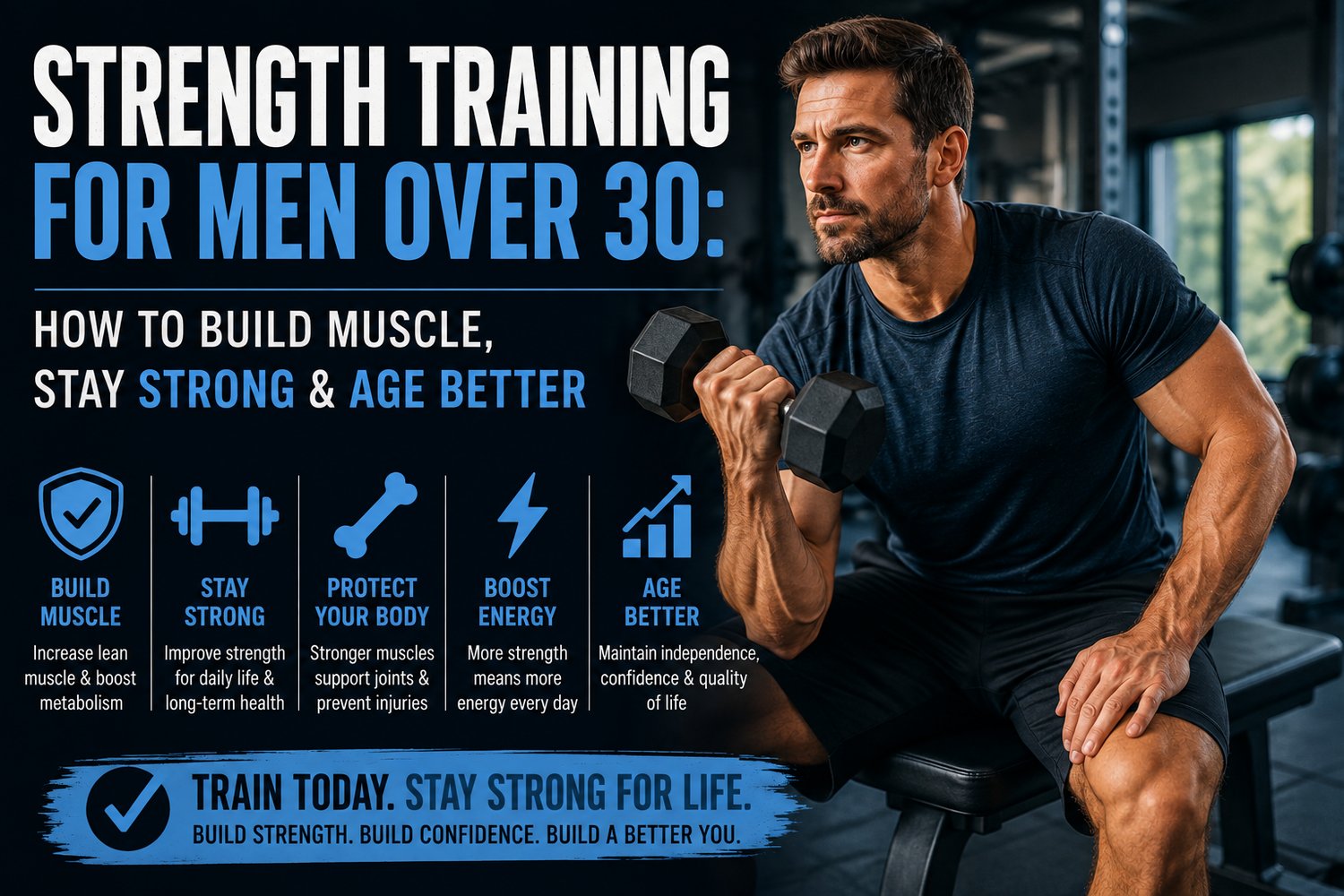
Strength Training for Men Over 30: How to Build Muscle, Stay Strong & Age Better
Turning 30 doesn't suddenly make you old.
You don't wake up on your birthday with:
- A broken metabolism
- Low testosterone
- Disappearing muscle
- Bad joints
- A mandatory prescription for reading glasses
But something does become more important:
You can't rely forever on the physical capacity you built when you were younger.
Muscle and strength become increasingly valuable through your 30s, 40s, 50s, and beyond.
Strength training helps you build and preserve that capacity.
And despite what fitness social media may suggest, you don't need:
- Six workouts per week
- Two-hour gym sessions
- An advanced bodybuilding split
- A garage full of equipment
- Testosterone replacement therapy
- A giant supplement stack
You need a resistance-training program that challenges your muscles, progresses over time, and is simple enough to repeat consistently.
That's good news because the American College of Sports Medicine's 2026 resistance-training position stand emphasizes essentially the same thing:
Consistency matters more than unnecessary complexity.
ACSM notes that one of the largest improvements comes simply from moving from no resistance training to regular resistance training, and that the best program is one that fits your goals, preferences, and ability to stick with it.
If you're new to this pillar, start with What Is Men's Wellness?.
And because training only works if you can recover from it, read Sleep for Men.
Why Strength Training Matters More as You Age
Many men start lifting for appearance.
That's fine.
Wanting:
- Bigger arms
- A broader chest
- Less body fat
- A stronger-looking physique
isn't inherently shallow.
But the long-term benefits are much bigger.
Resistance training supports:
- Muscle mass
- Strength
- Bone health
- Physical function
- Balance
- Body composition
- Metabolic health
- Athletic performance
- Healthy aging
Muscle is essentially physical capacity.
It helps determine how easily you can:
- Carry groceries
- Move furniture
- Pick up your kids
- Climb stairs
- Perform physical work
- Travel
- Recover from periods of inactivity
- Remain independent later in life
Building muscle now creates more physical reserve for the decades ahead.
Does Muscle Really Decline With Age?
Yes.
But the process is gradual and strongly affected by activity.
The useful message isn't:
“You're over 30, so muscle loss is inevitable.”
It's:
“You're old enough that maintaining muscle should become intentional.”
Men who stop challenging their muscles are more likely to lose:
- Muscle mass
- Strength
- Power
- Physical capacity
over time.
Resistance training can help maintain—and often improve—these traits well into later adulthood.
Age changes the context.
It doesn't eliminate your ability to adapt.
You Can Absolutely Build Muscle After 30
There's a strange internet belief that your muscle-building years end somewhere around 25.
They don't.
Men can build meaningful muscle in their:
- 30s
- 40s
- 50s
- 60s
- Beyond
Age may influence:
- Recovery
- Injury history
- Training volume
- Exercise selection
- How aggressively you progress
But your body doesn't suddenly stop responding to resistance training.
A previously sedentary 45-year-old may actually experience dramatic early progress because he has so much room to improve.
For the more age-specific version, read Building Muscle After 40.
How Often Should Men Over 30 Strength Train?
Current U.S. physical-activity guidance recommends adults perform muscle-strengthening activity involving all major muscle groups on at least two days per week. Adults should also get at least 150 minutes of moderate-intensity aerobic activity weekly, or an equivalent amount of vigorous activity.
For many men, two to four resistance-training sessions per week is plenty.
Two-Day Schedule
Monday: Full Body
Thursday: Full Body
Three-Day Schedule
Monday: Full Body
Wednesday: Full Body
Friday: Full Body
Four-Day Schedule
A more experienced lifter might use:
Monday: Upper
Tuesday: Lower
Thursday: Upper
Friday: Lower
There isn't one correct schedule.
The right one is the schedule you can recover from and consistently perform.
Full-Body Training Is Underrated
For busy adults, full-body training is one of the easiest ways to train efficiently.
A session might include:
- One squat or knee-dominant movement
- One hip-hinge movement
- One press
- One pull
- One additional upper-body movement
- One core or carry exercise
For example:
Workout A
- Goblet squat
- Romanian deadlift
- Dumbbell bench press
- One-arm dumbbell row
- Shoulder press
- Farmer carry
Workout B
- Leg press
- Hip thrust or deadlift variation
- Incline dumbbell press
- Lat pulldown
- Cable row
- Plank
You don't need 14 exercises.
Cover the major movement patterns.
Train them consistently.
Progress them over time.
Focus on Movement Patterns, Not Sacred Exercises
There is no mandatory exercise every man must perform.
Learn the basic movement patterns instead.
Squat or Knee-Dominant Movement
Examples:
- Goblet squat
- Back squat
- Leg press
- Split squat
- Step-up
Hinge
Examples:
- Romanian deadlift
- Trap-bar deadlift
- Hip thrust
- Back extension
Push
Examples:
- Bench press
- Push-up
- Dumbbell press
- Overhead press
Pull
Examples:
- Cable row
- Dumbbell row
- Lat pulldown
- Pull-up
Carry or Core
Examples:
- Farmer carries
- Planks
- Pallof presses
- Dead bugs
Pick movements that:
- Fit your equipment
- Feel good on your joints
- Allow good technique
- Can be progressively challenged
You don't need to force an exercise simply because someone online considers it essential.
Progressive Overload: The Principle That Actually Matters
Your body adapts when you gradually ask it to do more.
That's progressive overload.
Progress can come from:
- Adding weight
- Adding repetitions
- Adding a set
- Improving range of motion
- Improving technique
- Improving control
- Performing the same work with less effort
Suppose you're dumbbell pressing 40-pound dumbbells for:
8 reps
8 reps
8 reps
Over time you reach:
12 reps
12 reps
12 reps
Then increase the dumbbells slightly.
Your repetitions may fall back to:
9
9
8
Then you build upward again.
That's called double progression.
No advanced programming required.
You simply became stronger.
How Heavy Should You Lift?
The answer depends partly on the goal.
ACSM's 2026 guidance notes that heavier loads are particularly useful for maximizing strength, while muscle growth can occur across a wider range of loads when enough challenging work is performed.
For general muscle and fitness goals, many men do well spending much of their training in ranges such as:
- 6–8 repetitions
- 8–12 repetitions
- 10–15 repetitions
But there is no magic cutoff.
A set of:
5 reps
isn't automatically “strength only.”
And:
12 reps
isn't automatically “muscle only.”
Use a load that challenges the target muscles while allowing controlled technique.
You Don't Need to Train to Failure Every Set
Another endless fitness argument:
Should every set go to failure?
No.
ACSM's 2026 review found that training to momentary muscle failure isn't consistently required for strength or hypertrophy outcomes in the average healthy adult.
For many working sets, stopping with roughly:
1–3 solid repetitions still available
can provide a strong stimulus without creating unnecessary fatigue.
That doesn't mean you must calculate your exact “reps in reserve” perfectly.
It just means:
A hard set doesn't need to become a near-death experience.
How Many Sets Do You Need?
You don't need enormous volume to benefit from resistance training.
Beginners can make excellent progress with relatively modest amounts of work.
A practical starting point may be:
- 2–3 sets per exercise
- 5–7 exercises per session
- 2–3 training days each week
Men focused specifically on maximizing muscle growth may eventually benefit from more weekly training volume.
ACSM's 2026 position stand notes that hypertrophy can be enhanced with higher weekly volume, with roughly 10 sets per muscle group per week serving as a useful general target for people specifically prioritizing muscle growth.
But don't confuse:
“more can sometimes produce more growth”
with:
“everyone needs maximum volume.”
Start with enough training to progress.
Add more only when there's a reason.
Technique Comes Before Ego
Your muscles don't know how impressive the number on the dumbbell looks.
Use a range of motion you can control.
Progress gradually.
Don't turn every exercise into a competition.
If a movement causes persistent joint pain:
- Check technique
- Reduce the load
- Modify the range
- Try another variation
- Get professional evaluation when appropriate
You aren't competing with the person next to you.
You're trying to become stronger than you were six months ago.
Don't Chase Soreness
Soreness isn't the goal.
You can have a productive workout without struggling to walk downstairs the next day.
Delayed-onset muscle soreness often becomes less intense as your body adapts.
That doesn't mean the program stopped working.
Evaluate your training using:
- Strength progress
- Repetition progress
- Improved technique
- Muscle development
- Consistency
Not:
“How destroyed am I?”
Recovery Matters More Than It Used To
A lot of men discover this through experience.
At 20 you may have gotten away with:
- Terrible sleep
- Random nutrition
- Too much training
- Questionable technique
- Minimal recovery
and trained again tomorrow.
As you move through your 30s and 40s, the entire system often demands more respect.
That includes:
- Sleep
- Nutrition
- Protein
- Rest days
- Stress
- Training volume
- Injury management
This doesn't mean you need to train gently.
It means training stress and recovery need to match.
Read Sleep for Men.
Protein Matters if You Want to Build or Preserve Muscle
Resistance training creates the signal.
Protein provides amino acids that support muscle repair and remodeling.
Useful protein sources include:
- Chicken
- Beef
- Fish
- Eggs
- Greek yogurt
- Cottage cheese
- Milk
- Beans
- Lentils
- Tofu
Protein powder can be useful for convenience.
It isn't required.
For a practical men's framework, read Protein for Men.
For meal-building ideas, use the Complete High-Protein Guide.
Strength Training and Fat Loss
Many men begin lifting because they want to lose belly fat.
Unfortunately, there is no exercise that tells your body:
“Take the calories specifically from my love handles.”
Fat loss depends largely on overall energy balance.
But strength training becomes extremely valuable during weight loss because it provides a stimulus to maintain lean mass.
A strong fat-loss foundation often includes:
- Appropriate calorie deficit
- Adequate protein
- Strength training
- Walking or other aerobic activity
- Good sleep
Read Why Belly Fat Gets Harder to Lose After 30.
Don't Stop Walking Because You Lift
Strength training and aerobic activity aren't competitors.
They solve different problems.
Strength training develops:
- Muscle
- Strength
- Physical capacity
Walking and aerobic activity support:
- Cardiovascular fitness
- Daily movement
- Energy expenditure
- Metabolic health
- General fitness
Current physical-activity guidance recommends both aerobic activity and muscle-strengthening activity.
Read Walking for Men's Health.
Cardio Won't Automatically Kill Your Gains
The “cardio kills muscle” myth refuses to disappear.
For most recreational lifters, reasonable amounts of cardiovascular exercise can coexist perfectly well with muscle and strength training.
Problems are more likely when you're combining:
- Very high endurance-training volume
- High lifting volume
- Inadequate calories
- Poor sleep
- Inadequate recovery
Walking, cycling, jogging, swimming, or other appropriate aerobic training isn't automatically going to erase your muscle.
For most men, being:
strong + aerobically fit
is considerably more useful than choosing one and ignoring the other.
Strength Training and Testosterone
Resistance exercise can cause temporary hormonal changes.
That's interesting physiologically.
It isn't why you should lift.
Strength training is valuable because it directly improves:
- Muscle
- Strength
- Physical function
- Body composition
- Bone health
You don't need to turn every healthy behavior into a testosterone hack.
If you're concerned about hormone health, read How to Support Testosterone Naturally.
Slow Gym Progress Doesn't Automatically Mean Low Testosterone
If you're disappointed with your muscle growth, first look at:
- Training consistency
- Progressive overload
- Protein
- Total calorie intake
- Sleep
- Recovery
- Programming
- Expectations
Poor biceps growth isn't a diagnostic criterion for hypogonadism.
If you have broader symptoms that genuinely suggest testosterone deficiency, start with:
For testing resources, visit the Men's Bloodwork Hub.
The Everlywell Testosterone Test provides one at-home testing option.
Do You Need TRT to Build Muscle After 30?
No.
TRT is medical treatment for appropriately diagnosed testosterone deficiency.
Men with normal testosterone can absolutely build muscle after 30, 40, 50, and beyond.
If genuine hypogonadism is diagnosed, treatment may be appropriate for medical reasons.
That's a different question from:
“Would higher testosterone help me get bigger?”
Read What Is TRT? Testosterone Replacement Therapy Explained.
Supplements Come After Training
A supplement can't replace:
- Progressive overload
- Protein
- Calories
- Sleep
- Consistency
Some sports supplements have evidence behind them.
Creatine is one example.
Protein powder can be useful.
But your program needs to work before supplements become the interesting part.
Read Healthy Habits Every Man Should Build Before Buying Supplements.
Build the Program Around Your Real Life
One of the biggest reasons men quit is that the program only works in an ideal week.
Maybe the plan says:
Monday: Push
Tuesday: Pull
Wednesday: Legs
Thursday: Upper
Friday: Lower
Then work gets busy.
Your kid has practice.
You miss Tuesday.
You're exhausted Thursday.
Now the entire split feels ruined.
A two- or three-day full-body plan is often much harder to derail.
Miss Wednesday?
Train Thursday.
Nothing collapses.
The program should fit your life.
Your life shouldn't have to fit the program.
Use a Minimum Effective Dose
You don't need to squeeze every possible percentage point of progress out of training.
You need enough training to improve.
For many men, a highly effective baseline looks like:
- 2–3 strength sessions per week
- 5–7 movements per workout
- 2–3 working sets per movement
- Gradual progression
- Regular aerobic activity
- Adequate recovery
More advanced lifters can add complexity when it solves a real problem.
Beginners usually don't need complexity.
They need consistency.
What About Men Over 40?
The principles remain the same.
Train. Recover. Progress.
But you may need to pay more attention to:
- Warm-ups
- Exercise selection
- Previous injuries
- Joint tolerance
- Training volume
- Recovery
You don't need to train like you're fragile.
You also don't need to train like you're 19 and indestructible.
A smart 45-year-old can train very hard.
He simply learns when:
“push through it”
is useful and when:
“this movement is irritating my shoulder every week”
deserves adjustment.
For the dedicated guide, read Building Muscle After 40.
Warm Up Without Turning It Into Another Workout
A warm-up should prepare you to train.
It doesn't need to take half an hour.
A simple approach:
5 Minutes
Walk, cycle, row, or otherwise get moving.
Movement Preparation
Perform a few controlled movements for the joints and muscles you'll train.
Ramp-Up Sets
Before a heavier compound exercise, perform several progressively heavier practice sets.
Then train.
If you have significant injuries or mobility limitations, your warm-up may need to be individualized.
Train Around Pain, Not Through It
Hard muscular effort isn't the same thing as sharp or persistent joint pain.
If an exercise consistently hurts:
- Check your form
- Reduce the load
- Modify the range of motion
- Try another variation
- Seek appropriate evaluation if the issue persists
No exercise is mandatory.
You don't receive extra points for repeatedly irritating the same joint.
The goal is training you can continue for decades.
Track Your Training
Memory is terrible.
You probably don't remember exactly what you rowed eight weeks ago.
Write it down.
Track:
- Exercise
- Weight
- Repetitions
- Sets
- Date
- Useful notes
Then gradually improve.
The Men's Health & Performance Dashboard combines workout tracking with:
- Recovery
- Energy
- Body composition
- Habits
- Overall health trends
The 90 Day Dad Fitness Planner provides a more structured 90-day fitness, nutrition, and habit system.
And the FREE Men's Hormone & Energy Starter Kit provides a free starting point.
A Practical 3-Day Strength Plan
Here's one simple example.
Day 1
- Goblet Squat — 3 sets of 8–12
- Dumbbell Bench Press — 3 sets of 8–12
- One-Arm Row — 3 sets of 8–12
- Romanian Deadlift — 2–3 sets of 8–12
- Farmer Carry — 3 rounds
Day 2
- Leg Press — 3 sets of 8–12
- Shoulder Press — 3 sets of 8–12
- Lat Pulldown — 3 sets of 8–12
- Hip Thrust — 2–3 sets of 8–12
- Plank — 3 rounds
Day 3
- Split Squat — 3 sets of 8–12 per side
- Incline Dumbbell Press — 3 sets of 8–12
- Cable Row — 3 sets of 8–12
- Hamstring Curl or Romanian Deadlift — 2–3 sets of 8–12
- Pallof Press — 3 rounds
Use loads you can control.
You don't have to max out.
When you consistently reach the top of the repetition range with solid technique, increase the resistance slightly.
Then build back up.
What If You Only Have 20 Minutes?
Train for 20 minutes.
A short workout still counts.
Try:
- Squat
- Press
- Row
- Hinge
Perform 2–3 sets of each.
Done.
One of the worst fitness beliefs is:
“If I don't have an hour, it isn't worth doing.”
That's how one missed workout turns into three weeks off.
Something useful beats the perfect workout you never perform.
What If You Train at Home?
Home resistance training can work extremely well.
ACSM's 2026 guidance specifically notes that bodyweight exercises, elastic resistance, and home-based training can all be effective; you don't need a traditional gym to gain strength and function.
Useful equipment might include:
- Adjustable dumbbells
- Resistance bands
- A bench
- Pull-up bar
You can build a full program around:
- Goblet squats
- Split squats
- Dumbbell Romanian deadlifts
- Push-ups
- Dumbbell presses
- Rows
- Shoulder presses
- Carries
The gym offers more options.
It isn't required for progress.
Don't Program-Hop
New workout.
New app.
New split.
New influencer.
Every two weeks.
That's a good way to remain permanently entertained and poorly trained.
You need consistent exposure to exercises long enough to:
- Improve technique
- Add repetitions
- Add resistance
- Measure progress
Unless your program clearly isn't working or doesn't fit your needs, give it time.
Adjust from evidence.
Not boredom.
Strength Training Is One Piece of Men's Wellness
A strong man who:
- Sleeps terribly
- Never does aerobic activity
- Eats poorly
- Smokes
- Ignores high blood pressure
- Avoids preventive healthcare
doesn't have a complete wellness plan.
Strength training is one pillar.
Not the whole building.
That's why the men's-health cluster connects:
- Sleep
- Strength
- Walking
- Nutrition
- Body composition
- Hormone health
- Bloodwork
- Healthy aging
They support one another.
Frequently Asked Questions
How Many Days a Week Should Men Over 30 Lift?
Two to four days per week works well for many men.
Beginners can make excellent progress with two or three full-body sessions.
Federal guidelines recommend muscle-strengthening exercise on at least two days per week.
Can You Build Muscle After 30?
Absolutely.
Men can build muscle well beyond their 30s with:
- Progressive resistance training
- Adequate protein
- Enough calories
- Good recovery
- Consistency
Age changes some practical considerations.
It does not eliminate your ability to build muscle.
Is Full-Body Training Better Than a Split?
Neither is universally better.
Full-body routines are often useful for:
- Beginners
- Busy adults
- People training two or three days weekly
because they allow frequent training of major muscle groups without requiring many gym days.
More advanced lifters may prefer splits.
Do Men Over 40 Need to Lift Lighter Weights?
Not automatically.
Men over 40 can still train hard and heavy when appropriate.
Exercise selection, technique, recovery, joint tolerance, and injury history become increasingly important.
Should You Lift Weights While Trying to Lose Weight?
Yes.
Resistance training provides a stimulus to preserve lean mass during weight loss.
A good fat-loss plan typically combines:
- Calorie control
- Adequate protein
- Strength training
- Regular activity
Do You Need Protein Shakes to Build Muscle?
No.
Protein shakes are convenient.
Whole-food protein sources work perfectly well if your total intake is adequate.
Do You Need to Train to Failure to Build Muscle?
No.
Training close enough to failure to create a challenging stimulus can work well without taking every set to complete muscular failure.
ACSM's current resistance-training review does not find consistent added benefit from requiring momentary failure for the average healthy adult.
Is Strength Training Enough Exercise by Itself?
It's an important part of fitness, but current guidelines recommend both:
- Muscle-strengthening activity
- Aerobic activity
Walking, cycling, jogging, swimming, or other cardiovascular activity can complement resistance training.
Key Takeaways
- Strength training becomes increasingly valuable as men age.
- You can build meaningful muscle and strength well beyond 30.
- Two or three consistent sessions per week are enough for many men.
- Current guidelines recommend muscle-strengthening activity on at least two days each week.
- Progressive overload matters more than constantly changing exercises.
- You don't need to train every set to failure.
- More complicated programming isn't automatically better.
- Home training, bands, bodyweight exercise, machines, and free weights can all work.
- Protein and sleep support training and recovery.
- Walking and aerobic activity complement strength training rather than competing with it.
- You don't need TRT simply because you're over 30 or want to gain muscle.
- A program that fits your actual life is more valuable than a theoretically perfect program you won't follow.
Final Thoughts
You don't need to train like a professional athlete.
You need to train like someone who wants his body to keep working.
Build muscle now.
Maintain it later.
Get stronger.
Protect your physical capacity.
Make training part of your normal week rather than something you occasionally become motivated to do.
The goal isn't to peak at 32.
It's to still be strong at:
And beyond.
Continue the Men's Wellness Series
For the foundation:
- What Is Men's Wellness?
- Healthy Habits for Men
- Sleep for Men
- Walking for Men's Health
- Protein for Men
- Healthy Aging for Men
For muscle and body composition:
For testosterone:
- Low Testosterone Symptoms
- How Testosterone Is Tested and Diagnosed
- How to Support Testosterone Naturally
- What Is TRT?
For tracking:
- Men's Health & Performance Dashboard
- 90 Day Dad Fitness Planner
- FREE Men's Hormone & Energy Starter Kit
For the full pillar:
Educational Disclaimer
This article is intended for educational purposes only and should not be considered medical advice. Exercise needs vary based on health history, injuries, fitness level, medical conditions, and current physical ability. Consult an appropriate healthcare or fitness professional before beginning a new program if you have significant health concerns, and seek evaluation for persistent or severe pain rather than repeatedly training through it.