

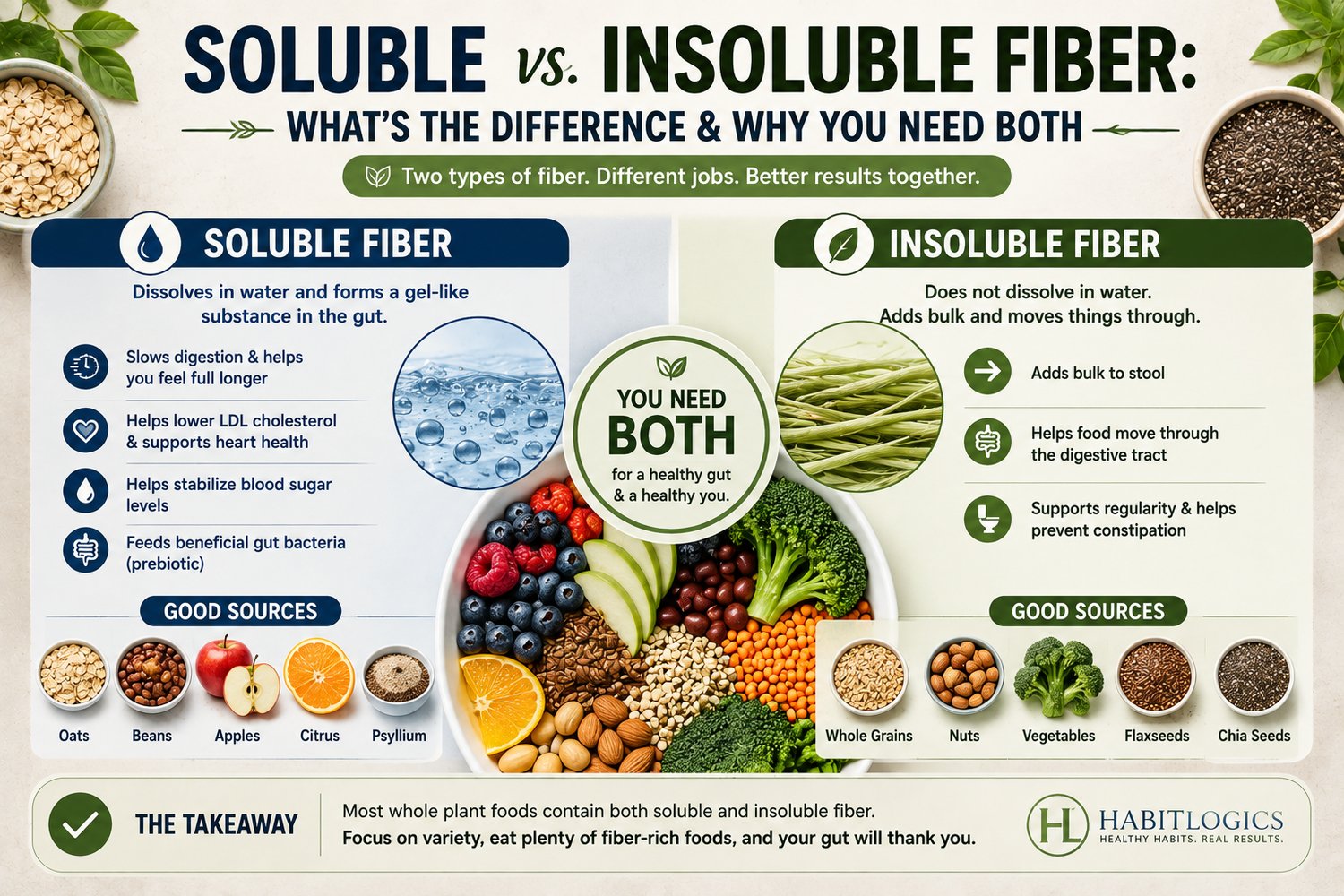
Soluble vs. Insoluble Fiber: What’s the Difference & Why You Need Both
Complete Fiber & Gut Health Guide Hub
If you've started paying attention to fiber, you've probably encountered two terms almost immediately:
Soluble fiber.
Insoluble fiber.
The usual explanation goes something like this:
Soluble fiber dissolves in water.
Insoluble fiber doesn't.
Technically correct.
Not particularly helpful.
The real question is:
What difference does that make when you actually eat it?
Soluble and insoluble fibers can behave differently in the digestive tract.
Some soluble fibers:
- Form gel-like material
- Slow digestion
- Help lower cholesterol
- Influence blood-glucose response
- Can be fermented by gut microbes
Insoluble fibers often:
- Add bulk to stool
- Help move material through the digestive system
- Support bowel regularity
Mayo Clinic describes soluble fiber as dissolving in water and forming a gel-like material that can slow digestion, while insoluble fiber promotes movement through the digestive system and increases stool bulk.
But here's the part that matters most:
Most fiber-rich foods contain a mixture of fiber types.
You do not need to build one “soluble fiber meal” and another “insoluble fiber meal.”
You need a varied diet containing:
- Whole grains
- Beans
- Lentils
- Fruit
- Vegetables
- Nuts
- Seeds
and enough total fiber to support your goals.
If you're new to this series, start with Fiber for Gut Health: Why It Matters & What It Actually Does, then read How Much Fiber Do You Need Per Day? A Practical Guide for Men & Women.
Now let's separate the two major fiber categories without making them more complicated than they need to be.
First: What Is Dietary Fiber?
Dietary fiber is a type of carbohydrate that isn't easily digested in the small intestine.
The FDA's definition includes nondigestible soluble and insoluble carbohydrates that are naturally present in plants, along with certain isolated or synthetic nondigestible carbohydrates shown to provide beneficial physiological effects.
That's important because fiber isn't one single molecule.
It's a broad category containing many different compounds.
And those compounds vary in:
- Solubility
- Viscosity
- Fermentability
- Chemical structure
- Physiological effects
So the soluble-versus-insoluble distinction is useful.
It's just not the entire story.
What Is Soluble Fiber?
Soluble fiber interacts with water.
Some soluble fibers dissolve and form a thick, gel-like material inside the gastrointestinal tract. Mayo Clinic notes that this gel can slow digestion and contribute to lower cholesterol and blood glucose.
Common soluble fiber sources include:
- Oats
- Barley
- Beans
- Peas
- Apples
- Citrus fruit
- Carrots
- Psyllium
- Avocado
Different soluble fibers behave differently, so even this category contains a lot of variety.
Think of Soluble Fiber Like a Sponge or Gel
This isn't perfect biology, but it's useful.
Imagine soluble fiber interacting with water and becoming more gel-like.
That can influence:
- How quickly food moves through parts of the digestive tract
- How quickly certain nutrients are absorbed
- Stool consistency
- Cholesterol absorption
Some soluble fibers are also readily fermented by gut microbes.
Others are much less fermentable.
That's why:
soluble fiber
does not automatically mean:
prebiotic fiber.
What Is Insoluble Fiber?
Insoluble fiber does not dissolve in water in the same way.
Instead, it tends to remain more structurally intact as it moves through the digestive tract.
That helps it:
- Add bulk to stool
- Support movement through the intestines
- Promote regular bowel movements
Common insoluble fiber sources include:
- Wheat bran
- Whole grains
- Nuts
- Beans
- Vegetables
- Fruit skins
Again, most of these foods contain mixtures of fiber rather than one pure type.
Think of Insoluble Fiber Like Structural Material
Insoluble fiber is sometimes called:
roughage.
That's an old-fashioned word, but it captures part of the idea.
It helps add physical material to stool.
That can support bowel movement regularity.
If soluble fiber behaves somewhat like:
gel
then insoluble fiber behaves more like:
bulk.
That simplified distinction is useful as long as you remember that real foods contain combinations.
Soluble Fiber vs. Insoluble Fiber at a Glance
The simplest comparison looks like this:
Soluble Fiber
Generally:
- Interacts with water
- May form gels
- Can slow digestion
- Can help lower cholesterol
- Can help moderate blood glucose
- Some types are highly fermentable
Insoluble Fiber
Generally:
- Doesn't dissolve in water
- Adds stool bulk
- Helps food and waste move through the digestive tract
- Supports bowel regularity
Both matter.
And neither category is universally “better.”
Which Type of Fiber Is Better for Constipation?
It depends.
This is where simple fiber advice starts becoming more nuanced.
NIDDK notes that fiber may help constipation in people with IBS by making stool softer and easier to pass, and specifically identifies soluble fiber in foods such as beans and fruit and insoluble fiber in foods such as whole-grain products and vegetables.
But different fibers affect stool differently.
For example:
Psyllium
is a soluble, gel-forming fiber that can help hold water in stool.
Wheat bran
is predominantly insoluble and adds bulk.
Both may support bowel function through different mechanisms.
The better option can depend on:
- Stool consistency
- Bloating
- Fiber tolerance
- Underlying condition
- Overall diet
More Insoluble Fiber Isn't Always the Answer
If you're constipated, it's tempting to think:
More roughage = better.
But piling large amounts of wheat bran into your diet isn't automatically ideal for everyone.
For some people, especially those with sensitive digestive systems, large amounts of coarse insoluble fiber can increase:
- Bloating
- Gas
- Discomfort
That's why fiber recommendations sometimes differ in conditions such as IBS.
The type of fiber matters.
Soluble Fiber Can Help Soften Stool
Because certain soluble fibers interact with water, they can help stool retain moisture.
That can make stool:
- Softer
- Easier to pass
This is one reason psyllium is commonly used in fiber supplements.
Again, though:
If you're increasing fiber and barely drinking anything, don't expect fiber to perform miracles.
Fluid intake matters too.
Insoluble Fiber Can Increase Stool Bulk
Insoluble fiber helps increase the physical volume of stool.
That increased bulk can stimulate intestinal movement and help material pass through the colon.
Foods that can contribute include:
- Whole grains
- Wheat bran
- Vegetables
- Nuts
- Seeds
This is one reason diets dominated by very low-fiber refined foods can sometimes produce smaller, harder stools.
Fiber and Water Work Together
Both soluble and insoluble fiber exist inside a digestive system that depends heavily on fluid.
As fiber intake increases, adequate hydration becomes more important.
You don't need a universal gallon-per-day rule.
But fiber plus chronically low fluid intake is not an ideal combination.
NIDDK recommends adequate liquids as part of dietary management for constipation.
So when you increase fiber:
Also pay attention to:
- Water
- Other beverages
- Activity
- Overall bowel habits
Soluble Fiber and Cholesterol
This is one of soluble fiber's most established benefits.
Certain soluble, viscous fibers can reduce LDL cholesterol.
They appear to do this partly by affecting bile acid and cholesterol handling in the digestive tract.
Foods commonly associated with cholesterol-lowering soluble fiber include:
- Oats
- Barley
- Beans
- Psyllium
Mayo Clinic specifically notes that soluble fiber can help lower cholesterol levels.
This is why fiber isn't just a digestive-health nutrient.
It's also relevant to cardiovascular health.
Oats Are a Great Example
Oats contain a type of soluble fiber called:
beta-glucan.
Beta-glucan is one of the better-studied soluble fibers for cholesterol management.
That's why oatmeal shows up so often in heart-health recommendations.
It isn't because oatmeal has mystical properties.
It's because the food contains a useful combination of:
- Soluble fiber
- Whole-grain carbohydrates
- Micronutrients
A boring bowl of oats is doing more work than its marketing budget suggests.
Barley Is Underrated
Barley also provides beta-glucan.
It gets far less attention than oats, mostly because people don't eat it nearly as often.
You can use barley in:
- Soup
- Grain bowls
- Side dishes
- Salads
If your fiber sources never change, barley is an easy way to add variety.
Beans Provide Both Fiber Types
Legumes are one of the best examples of why the soluble-versus-insoluble distinction shouldn't become obsessive.
Beans contain mixtures of:
- Soluble fiber
- Insoluble fiber
- Resistant carbohydrates
They also provide:
- Protein
- Potassium
- Folate
- Other micronutrients
That's why legumes are so useful for building a high-fiber diet.
One food can contribute in several ways.
Fruit Usually Provides Both Too
Take an apple.
The flesh contains soluble fibers including pectin.
The skin contributes more insoluble material.
So when you eat the entire apple, you're getting a combination.
You don't need to ask:
Is this a soluble-fiber food or an insoluble-fiber food?
It's both.
That's normal.
Vegetables Are Mixed Fiber Foods
Carrots.
Broccoli.
Brussels sprouts.
Peas.
Leafy greens.
Vegetables contain different combinations of fiber depending on:
- Plant
- Part of the plant
- Preparation
Again, the useful nutrition advice is not:
Classify every vegetable.
It's:
Eat different vegetables.
Nuts and Seeds Contribute Too
Nuts and seeds provide:
- Fiber
- Healthy fats
- Protein
- Micronutrients
Examples include:
- Almonds
- Pistachios
- Walnuts
- Chia
- Flax
Seeds such as chia and flax can be especially useful when you want to add fiber to:
- Oatmeal
- Yogurt
- Smoothies
without substantially changing the meal.
Psyllium Is a Special Fiber
Psyllium deserves attention because it's one of the most useful supplemental fibers.
It is:
- Soluble
- Highly viscous
- Gel-forming
Unlike some highly fermentable fibers, psyllium is not rapidly fermented to the same extent.
That combination makes it useful for:
- Stool consistency
- Constipation
- Cholesterol
This is why psyllium appears in products such as Metamucil and many generic fiber supplements.
Inulin Behaves Very Differently
Inulin is also soluble.
But it is much more readily fermented by gut bacteria.
That makes it useful as a prebiotic-type fiber.
The downside?
Fermentation can generate gas.
Some people tolerate inulin well.
Others notice:
- Bloating
- Gas
- Abdominal discomfort
especially at larger doses.
This is a perfect example of why saying:
“Soluble fiber is soluble fiber.”
isn't enough.
Two soluble fibers can behave very differently.
Fermentability May Matter More Than Solubility for Gut Symptoms
This is where modern fiber science gets more interesting.
Traditionally, we classify fiber as:
soluble
or
insoluble.
But when you're talking about:
- Gut bacteria
- Gas
- Bloating
- Prebiotic effects
another property becomes extremely important:
Fermentability.
How readily can gut microbes metabolize the fiber?
Highly fermentable fiber may:
- Feed certain microbes
- Increase short-chain fatty acid production
- Increase gas
Less-fermentable fiber may have a stronger physical effect on stool without producing as much gas.
This is why two foods with similar fiber grams can feel very different in your digestive system.
Viscosity Matters Too
Another important property is:
viscosity.
Viscous fibers create thicker gel-like material.
That can influence:
- Gastric emptying
- Nutrient absorption
- Cholesterol
- Blood glucose
- Stool consistency
Psyllium is a good example of a highly viscous fiber.
Not all soluble fibers are equally viscous.
Again:
Fiber science becomes much more complicated than two categories.
But you don't need to master the chemistry to eat well.
Do You Need to Track Soluble and Insoluble Fiber Separately?
For most people?
No.
If you're:
- Eating enough total fiber
- Eating a variety of plant foods
- Having normal bowel movements
- Feeling good
there is very little reason to calculate:
11 grams soluble + 17 grams insoluble.
Nutrition labels generally list:
Total Dietary Fiber
not necessarily the exact breakdown.
That's perfectly adequate for most people.
When the Distinction Becomes More Useful
Knowing the difference can help when you're trying to solve a specific issue.
For example:
High LDL Cholesterol
A viscous soluble fiber such as:
- Psyllium
- Oat beta-glucan
may deserve more attention.
Hard Stool
Gel-forming soluble fiber plus adequate fluid may help.
Low Stool Bulk
More insoluble fiber from:
- Whole grains
- Vegetables
- Nuts
may contribute.
Significant Bloating
You may need to pay attention to highly fermentable fibers and how rapidly you're increasing them.
The distinction becomes useful when solving a problem.
Not when micromanaging normal meals.
Soluble Fiber and the Gut Microbiome
Many soluble fibers are fermentable.
That means they can reach the colon and become substrates for gut microorganisms.
Microbial fermentation can produce:
- Acetate
- Propionate
- Butyrate
and other metabolites.
This is one reason soluble and prebiotic fibers receive so much attention in gut-health research.
But not every soluble fiber is fermented equally.
And:
more fermentation
doesn't automatically mean:
better gut health.
Your symptoms and tolerance matter too.
Insoluble Fiber and the Microbiome
Insoluble fiber gets less attention in microbiome marketing because it's often considered less fermentable.
But that's too simplistic too.
Some insoluble fibers can still be partially fermented.
And insoluble-fiber foods also bring:
- Other fiber fractions
- Resistant starch
- Polyphenols
- Micronutrients
So don't think:
Soluble feeds the microbiome. Insoluble does nothing.
Real foods don't divide themselves that neatly.
Why Whole Foods Make This Easier
Imagine trying to manually design your perfect fiber blend.
You'd need:
- Soluble
- Insoluble
- Viscous
- Non-viscous
- Fermentable
- Less fermentable
That's exhausting.
Now imagine eating:
- Oats
- Beans
- Apples
- Whole-grain bread
- Vegetables
- Nuts
- Seeds
Congratulations.
You naturally consumed different fiber types.
This is one of those situations where ordinary food makes the science easier.
Fiber-Rich Foods Usually Contain a Mix
Mayo Clinic notes that fruits, vegetables, grains, beans, peas and lentils contain mixtures of different types of fiber.
That's exactly why I wouldn't build a diet around isolated fiber categories unless you have a specific clinical reason.
If your plant-food variety is good, the different fiber types largely take care of themselves.
Which Foods Are Highest in Soluble Fiber?
Useful sources include:
- Oats
- Barley
- Beans
- Lentils
- Apples
- Citrus
- Carrots
- Psyllium
- Peas
- Avocado
That doesn't mean these foods contain only soluble fiber.
Think:
good source
not:
pure soluble fiber.
Which Foods Are Highest in Insoluble Fiber?
Useful sources include:
- Wheat bran
- Whole wheat
- Whole grains
- Nuts
- Seeds
- Green beans
- Cauliflower
- Potatoes with skin
- Many vegetables
Again, these foods often contain some soluble fiber too.
Should You Peel Fruit and Vegetables?
Not necessarily.
Skins can contribute:
- Fiber
- Plant compounds
So eating edible skins can increase fiber.
Examples:
- Apples
- Pears
- Potatoes
But if:
- You dislike the skin
- A digestive condition makes it harder to tolerate
- The food needs peeling for preparation
that's fine.
Your gut-health plan does not collapse because you peeled a potato.
Is White Bread Completely Fiber-Free?
Not necessarily.
Refined grains often contain less fiber because the bran and germ have been removed.
But products vary.
Some refined products are also fortified or have fiber added.
Look at the label.
Still, whole grains typically make it easier to obtain naturally occurring fiber.
Is Brown Rice Much Higher in Fiber Than White Rice?
Usually somewhat higher.
But the difference is not always enormous.
This is why high-fiber eating shouldn't depend on one grain swap.
You can eat white rice and pair it with:
- Beans
- Vegetables
- Lentils
- Avocado
and still create a high-fiber meal.
Total meal structure matters.
What About Resistant Starch?
Resistant starch complicates the fiber conversation even further.
It's starch that escapes digestion in the small intestine and reaches the large intestine.
There, gut microbes can ferment it.
Sources can include:
- Legumes
- Certain whole grains
- Green bananas
- Cooked and cooled potatoes
- Cooked and cooled rice
Resistant starch behaves more like a fermentable fiber than a typical digestible starch.
Again, the gut sees more complexity than the Nutrition Facts label makes obvious.
Do You Need Resistant Starch Hacks?
No.
You may see recommendations to:
Cook potatoes.
Cool them.
Reheat them.
Optimize resistant starch.
Interesting?
Sure.
Necessary?
No.
You can obtain fiber and resistant carbohydrates from an ordinary varied diet.
Don't let gut health become meal-prep chemistry unless you enjoy that.
What About Fiber Supplements?
Supplements are where fiber properties become particularly important.
A label may say:
5 grams of fiber
but that doesn't tell you everything.
The fiber might be:
- Psyllium
- Inulin
- Wheat dextrin
- Methylcellulose
- Glucomannan
- Another isolated fiber
Different products can therefore produce different:
- Stool effects
- Gas
- Fullness
- Cholesterol effects
Don't choose a fiber supplement solely by the highest gram number.
Ask:
What kind of fiber is it?
Psyllium vs. Wheat Dextrin
These are both common fiber-supplement ingredients.
But they are not interchangeable.
Psyllium
Gel-forming and highly viscous.
Often useful for stool consistency and cholesterol.
Wheat Dextrin
Soluble and more easily mixed into foods or beverages.
Different physical properties mean different effects.
Neither is universally best.
What About Methylcellulose?
Methylcellulose is another supplemental fiber.
It is less fermentable than fibers such as inulin.
That may make it useful for people who experience significant gas with more fermentable fibers.
Again, there's no universally superior supplement.
The right choice depends on what problem you're trying to solve.
Do Fiber Gummies Count?
If they contain dietary fiber?
Yes.
But check the serving.
Some products require several gummies to provide only a few grams.
They may also contain:
- Sugar alcohols
- Added sugars
- Other ingredients
that can themselves affect digestion.
Don't assume:
gummy = convenient full fiber solution.
Read the label.
What If Soluble Fiber Makes Me Bloated?
The problem may not be solubility itself.
It may be:
fermentability.
For example, a highly fermentable soluble fiber like inulin may cause much more gas for some people than psyllium.
Try asking:
- What exact fiber am I eating?
- How much?
- How quickly did I increase it?
- Is the symptom consistent?
If you can't identify the pattern, food-and-symptom tracking can be useful.
What If Insoluble Fiber Makes Me Feel Worse?
Some people with sensitive digestive systems may tolerate coarse insoluble fiber poorly.
That doesn't mean vegetables and whole grains are inherently bad.
It may mean:
- Portion size needs adjustment
- Cooking method matters
- A different fiber source works better
- An underlying digestive condition needs evaluation
If symptoms are severe or persistent, don't endlessly self-experiment.
Seek appropriate care.
Cooking Can Change Texture and Tolerance
Raw vegetables may feel much harder on your digestive system than cooked vegetables.
Cooking can:
- Soften plant structure
- Change texture
- Make some foods easier to chew and digest
So if a giant raw salad destroys you but cooked carrots and zucchini are fine?
Eat the cooked vegetables.
You don't receive extra health points for suffering through raw kale.
Blending Doesn't Remove All Fiber
A smoothie still contains much of the fiber from whole fruit and vegetables if the entire food is blended.
Juicing is different because much of the solid fiber is removed.
So:
Smoothie
Usually retains fiber.
Juice
Usually contains much less.
Still, drinking your food can affect fullness differently from chewing it.
Both can fit.
Soluble Fiber and Blood Sugar
Viscous soluble fiber can slow nutrient absorption.
That can reduce the speed at which glucose enters the bloodstream after a meal.
Mayo Clinic notes that soluble fiber may help lower blood glucose.
That doesn't mean:
Add fiber and eat unlimited sugar.
It means fiber is one factor affecting how a mixed meal is digested.
Fiber and Fullness
The FDA notes that both soluble and insoluble dietary fiber can contribute to fullness, which may help lower calorie intake.
Again, the effect depends heavily on the food.
Compare:
Whole apple.
vs.
Fiber-fortified candy.
Both may contain fiber.
They're not nutritionally identical.
Food context matters.
Which Fiber Is Better for Weight Loss?
Neither type directly burns fat.
Fiber may help because high-fiber foods can:
- Increase fullness
- Add food volume
- Slow eating
- Improve dietary quality
Some viscous fibers may have stronger effects on satiety.
But weight loss still depends on overall energy balance.
You do not need to pick:
soluble fiber for fat loss
and
insoluble fiber for digestion.
Eat a balanced diet containing both.
Build a Mixed-Fiber Breakfast
Try:
Oatmeal
Soluble beta-glucan plus other fibers.
Berries
Mixed fiber.
Chia
Soluble and insoluble fiber.
Now you've got multiple fiber sources in one bowl.
Add Greek yogurt if you want more protein.
Simple.
Build a Mixed-Fiber Lunch
Try:
- Whole-grain wrap
- Black beans
- Vegetables
- Avocado
- Lean protein
You've got:
- Whole-grain fiber
- Legume fiber
- Vegetable fiber
- Fruit fiber from avocado
You never needed to calculate which fraction was soluble.
Build a Mixed-Fiber Dinner
Try:
- Salmon
- Potato with skin
- Broccoli
- Lentils
Again:
Multiple plant foods.
Multiple fiber types.
Done.
A Better Goal Than “Eat More Insoluble Fiber”
Try this instead:
Eat legumes several times per week.
Eat whole grains regularly.
Eat fruit daily.
Eat vegetables daily.
Include nuts or seeds.
If you do that, you'll naturally consume a broad fiber mixture.
Food patterns beat fiber micromanagement.
Use the Total Fiber Target First
Before worrying about soluble versus insoluble, ask:
Am I even getting enough fiber?
For many people, the answer is:
No.
If you're averaging 12 grams per day, the priority isn't optimizing fiber ratios.
It's increasing total fiber gradually.
Use How Much Fiber Do You Need Per Day? to set a realistic daily target.
Track the Foods, Not Just the Grams
Imagine two people both eat:
30 grams of fiber.
Person A gets almost all of it from:
- One supplement
- Fiber-fortified bars
Person B gets it from:
- Oats
- Beans
- Fruit
- Vegetables
- Whole grains
- Nuts
The number is identical.
The dietary pattern is not.
That's why tracking plant variety alongside total fiber can be useful.
Start With the Free Fiber & Gut Health Kickstart
If you're still figuring out your baseline, use the FREE 7-Day Fiber & Gut Health Kickstart.
It gives you a simple way to track:
- Daily fiber
- Plant variety
- Gut-health habits
without turning nutrition into a full-time job.
Want More Detailed Fiber Tracking?
The High-Fiber Meal Builder & 30-Day Fiber Tracker is the better fit if your main goal is:
- Building higher-fiber meals
- Tracking a daily fiber target
- Creating consistency over a full month
You don't need to track soluble and insoluble fiber separately.
Instead, use:
total fiber + food variety
as your practical system.
Frequently Asked Questions
What is the difference between soluble and insoluble fiber?
Soluble fiber interacts with water and can form a gel-like substance that slows digestion. Certain soluble fibers can help lower cholesterol and blood glucose.
Insoluble fiber does not dissolve in water in the same way and tends to add stool bulk and support movement through the digestive tract.
Which is better: soluble or insoluble fiber?
Neither is universally better.
They have different properties and can provide different benefits.
Most fiber-rich foods contain mixtures of both types.
A varied diet naturally provides both.
Which fiber is best for constipation?
Different fibers can help in different ways.
Gel-forming soluble fiber such as psyllium can help soften and normalize stool, while insoluble fiber can add bulk.
The ideal type depends on your symptoms, diet, and underlying digestive health.
Which fiber is best for cholesterol?
Certain viscous soluble fibers, including those found in oats, barley, and psyllium, can help lower LDL cholesterol. Mayo Clinic specifically identifies soluble fiber as beneficial for cholesterol.
Does soluble fiber feed gut bacteria?
Many soluble fibers are fermentable and can serve as substrates for gut microbes.
But not all soluble fibers are fermented equally.
Fiber properties such as fermentability matter in addition to solubility.
Does insoluble fiber feed gut bacteria?
Some insoluble fibers can be partially fermented, but many primarily influence stool bulk and intestinal movement.
Whole foods containing insoluble fiber also usually contain other fibers and plant compounds that interact with the digestive system.
Do I need both soluble and insoluble fiber every day?
You don't need to calculate each category daily.
Eating a varied diet containing whole grains, legumes, fruits, vegetables, nuts, and seeds will generally provide a mixture of fiber types.
Is psyllium soluble or insoluble fiber?
Psyllium is primarily a soluble, viscous, gel-forming fiber.
It is commonly used to support bowel regularity and cholesterol management.
Is wheat bran soluble or insoluble?
Wheat bran is primarily an insoluble-fiber source.
It can help increase stool bulk.
Key Takeaways
- Dietary fiber includes both soluble and insoluble carbohydrates that resist digestion.
- Soluble fiber interacts with water and may form gel-like material.
- Insoluble fiber doesn't dissolve in water in the same way and helps add stool bulk.
- Certain soluble fibers can help lower cholesterol and blood glucose.
- Insoluble fiber can help promote movement through the digestive tract.
- Both soluble and insoluble fiber can contribute to fullness.
- Fermentability and viscosity are also important fiber characteristics.
- Highly fermentable fibers may produce more gas in some people.
- Psyllium is a soluble, viscous, gel-forming fiber.
- Inulin is soluble and highly fermentable.
- Wheat bran is primarily insoluble.
- Most fruits, vegetables, whole grains, legumes, nuts, and seeds contain mixtures of different fiber types.
- You generally don't need to track soluble and insoluble fiber separately.
- Focus first on adequate total fiber and food variety.
- If one fiber type causes persistent symptoms, adjust the source, amount, and rate of increase rather than assuming all fiber is the problem.
Final Thoughts
Soluble versus insoluble fiber sounds like something you need to memorize.
You really don't.
Here's the useful version:
Soluble fiber tends to interact with water, form gels, influence nutrient absorption, and sometimes feed gut microbes.
Insoluble fiber tends to provide structure and bulk that helps material move through your digestive system.
You want both.
Fortunately, food already solved that problem for you.
Eat:
Oats.
Beans.
Fruit.
Vegetables.
Whole grains.
Nuts.
Seeds.
Rotate them.
Hit a reasonable total fiber target.
Pay attention to how you feel.
That's enough for most people.
The goal isn't to build the scientifically perfect soluble-to-insoluble fiber ratio.
It's to create a varied, high-fiber diet your digestive system actually tolerates.
Continue the Fiber & Gut Health Series
Already published:
- What Is Gut Health? A Beginner’s Guide to Your Microbiome, Digestion & Everyday Habits
- What Is the Gut Microbiome? How Your Gut Bacteria Affect Digestion & Health
- How to Improve Gut Health Naturally: 10 Habits That Actually Matter
- Fiber for Gut Health: Why It Matters & What It Actually Does
- How Much Fiber Do You Need Per Day? A Practical Guide for Men & Women
Coming next in the series:
30 Best High-Fiber Foods: Easy Foods to Help You Reach Your Fiber Goal
Then:
How to Increase Fiber Without Bloating, Gas or Digestive Discomfort
Useful HabitLogics resources:
Educational Disclaimer
This article is intended for educational purposes only and should not be considered individualized medical or nutrition advice. Fiber tolerance can vary substantially, particularly for people with irritable bowel syndrome, inflammatory bowel disease, bowel narrowing, chronic constipation, or other gastrointestinal conditions. Persistent, severe, or unexplained digestive symptoms should be evaluated by a qualified healthcare professional.