

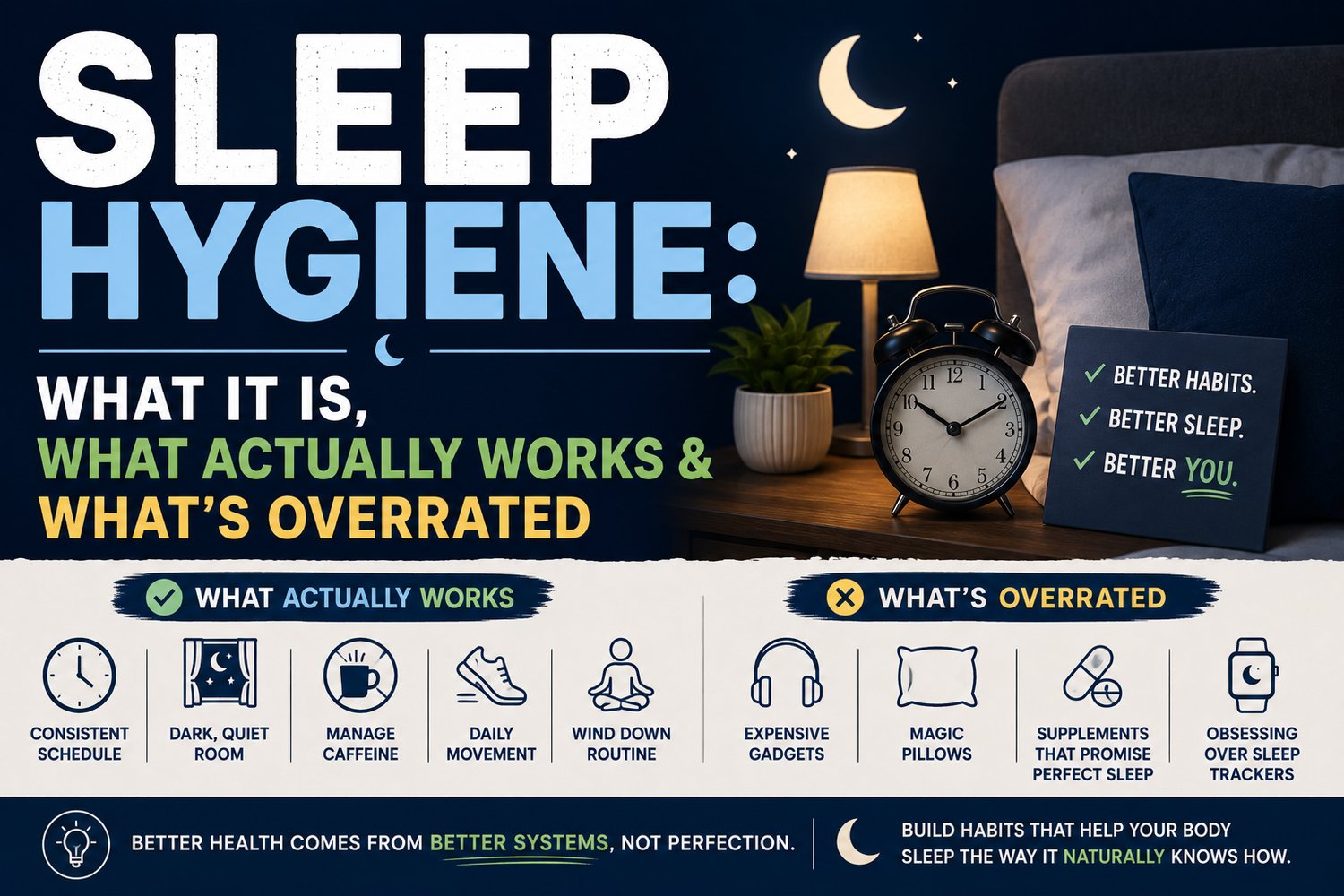
Sleep Hygiene: What It Is, What Actually Works & What’s Overrated
The Complete Sleep & Recovery Guide
"Improve your sleep hygiene."
It's one of those phrases that sounds slightly medical and slightly like someone is about to tell you to wash your sheets.
Fortunately, that's not what it means.
Sleep hygiene is simply the collection of habits, routines and environmental factors that help create good conditions for sleep.
That includes things like:
- Keeping a reasonably consistent sleep schedule
- Giving yourself enough time to sleep
- Managing caffeine
- Getting regular physical activity
- Creating a dark, quiet and comfortable bedroom
- Avoiding habits that repeatedly interfere with sleep
- Developing a predictable transition into bedtime
The CDC recommends many of these same basic behaviors, including consistent sleep and wake times, a cool and relaxing bedroom, limiting electronics before bed, avoiding large meals and alcohol before bedtime, avoiding caffeine later in the day and exercising regularly.
None of that is particularly exciting.
That's probably why the internet has spent years turning sleep into something considerably more complicated.
Today you can buy:
Cooling mattresses.
Sleep headphones.
Weighted blankets.
Blue-light glasses.
Special pillows.
Red-light devices.
Sunrise lamps.
Sleep supplements.
Essential oils.
Smart rings.
Bed cooling systems.
Sleep robots.
And presumably, somewhere, a subscription service that mails you artisanal moon dust.
Some of those things may be useful.
But good sleep hygiene starts much earlier.
Before you optimize sleep, make sure you're actually doing the basics.
What Is Sleep Hygiene?
Sleep hygiene refers to behaviors and environmental conditions that support healthy sleep.
Think of it as your sleep setup.
Your body already knows how to sleep.
Your job is largely to avoid repeatedly creating conditions that make that process harder.
For example:
If you're trying to fall asleep at dramatically different times every night...
Drinking a giant coffee at 7 p.m...
Scrolling in bed until 1 a.m...
Sleeping in until noon on weekends...
And keeping your bedroom bright and hot...
you probably don't need an exotic sleep hack yet.
You need a better system.
That's sleep hygiene.
Why Does Sleep Hygiene Matter?
Sleep isn't controlled by one single switch.
Several systems interact to influence when you feel awake and when you feel sleepy.
Two of the big ones are:
Your circadian rhythm — your internal roughly 24-hour timing system.
Sleep pressure — the biological drive to sleep that generally builds the longer you're awake.
Your behavior can work with those systems—or against them.
Light exposure, caffeine, sleep timing, activity and your environment all provide signals that can influence sleep.
This is why sleep hygiene isn't simply a list of arbitrary bedtime rules.
The best habits help your body recognize:
Daytime = awake and active
and
Nighttime = time to wind down and sleep
The problem comes when people treat every sleep-hygiene recommendation as equally important.
They're not.
Some fundamentals matter much more than whether you bought the perfect pillow spray.
The Sleep Hygiene Habits That Matter Most
Let's start with the highest-impact basics.
1. Get Enough Sleep Opportunity
Sleep hygiene doesn't matter much if you simply aren't leaving enough time for sleep.
You could have:
Blackout curtains.
The perfect pillow.
No phone.
No caffeine after noon.
A beautiful bedtime routine.
And a bedroom maintained at precisely 67.3 degrees.
But if you're going to bed at midnight and getting up at 5:30 a.m., you're still giving yourself only five and a half hours in bed.
For healthy adults, getting at least seven hours of sleep regularly is the general public-health recommendation.
Our previous guide, How Much Sleep Do You Need? A Practical Guide by Age & Lifestyle, goes much deeper into how sleep needs vary.
But before optimizing anything:
Make sure your schedule actually allows enough sleep.
2. Keep Your Sleep Schedule Reasonably Consistent
Consistency is one of the most commonly recommended sleep habits.
The CDC recommends going to bed and waking at the same time each day, while NHLBI also encourages keeping weekday and weekend schedules relatively similar.
That doesn't mean you need a rigid bedtime down to the minute.
You're allowed to have a life.
But imagine two schedules.
Schedule A
Monday: 10:45 p.m.
Tuesday: 11:10 p.m.
Wednesday: 10:50 p.m.
Thursday: 11:15 p.m.
Friday: 11:30 p.m.
Schedule B
Monday: 10:30 p.m.
Tuesday: 1:45 a.m.
Wednesday: midnight.
Thursday: 9:45 p.m.
Friday: 2:30 a.m.
Saturday: sleep until noon.
The second schedule asks your body to constantly adjust.
You don't have to become obsessive.
But predictability helps.
3. Treat Wake Time as an Anchor
Most people trying to improve sleep obsess over bedtime.
Wake time may actually be the easier place to start.
Why?
Because your required wake time is often less flexible.
You need to get to work.
The kids need to get to school.
The dog has already filed a formal complaint if breakfast arrives after 6:14 a.m.
Keeping wake time reasonably stable helps establish a more consistent daily rhythm.
Then bedtime can gradually organize itself around the amount of sleep you actually need.
If your entire schedule is chaotic, start here.
4. Get Daytime Light
Sleep hygiene isn't only about what happens at night.
Daytime behavior matters.
NHLBI recommends spending time outdoors when possible as part of healthy sleep habits.
Light provides important timing information to your circadian system.
One simple strategy:
Get some natural outdoor light earlier in the day.
You don't need a special ritual.
Walk outside.
Take the dog out.
Drink coffee on the porch.
Walk during your lunch break.
Open the blinds.
Daytime should look like daytime.
5. Move Regularly
Regular physical activity belongs in a good sleep routine.
Both the CDC and NHLBI recommend regular exercise or daytime physical activity as part of healthy sleep habits.
You don't need to become an athlete.
Walking is useful.
Strength training is useful.
Cycling is useful.
Playing outside with your kids counts.
The goal isn't:
Destroy yourself at the gym so you'll pass out tonight.
The goal is:
Build regular movement into your life.
Exercise supports far more than sleep, which makes this one of the better habits to prioritize.
6. Manage Caffeine Instead of Pretending It Doesn't Affect You
This one gets interesting.
People love caffeine.
Including us.
So sleep advice around caffeine often produces two extreme camps:
Camp 1: Never consume caffeine after noon.
Camp 2: Coffee doesn't affect me. I can drink espresso in bed.
Reality is less convenient.
Caffeine is a stimulant, and NHLBI notes that its effects can last for hours—potentially up to about eight hours.
At the same time, people differ substantially in caffeine sensitivity, and not every observational study finds identical effects at every timing window. One NHLBI-highlighted study, for example, did not find a significant association between caffeine consumed within four hours of bedtime and the measured sleep outcomes in that particular cohort.
So don't turn caffeine timing into religion.
Experiment.
If you're struggling to fall asleep and drinking caffeine late in the day:
Move your cutoff earlier.
Track what happens.
That's much smarter than arguing about whether the universal caffeine cutoff is noon, 2 p.m. or 4:37 p.m.
We have a full caffeine-and-sleep article coming later in this pillar.
7. Be Careful With Alcohol Before Bed
Alcohol is tricky because it can make you feel sleepy.
That creates the impression:
Alcohol helps me sleep.
It may help some people fall asleep faster.
But that doesn't mean the rest of the night improves.
NHLBI notes that alcohol can contribute to lighter sleep and increase the likelihood of waking during the night.
The CDC also recommends avoiding alcohol before bedtime as part of healthy sleep habits.
If you drink, don't just evaluate:
How quickly did I fall asleep?
Track:
Did I wake more?
Was my sleep fragmented?
How did I feel the next morning?
That's the more useful experiment.
8. Make Your Bedroom Dark, Quiet and Comfortable
Your bedroom is one area where "optimize your environment" is genuinely sensible.
You don't need perfection.
But obvious disruptions matter.
NHLBI recommends a bedroom that is quiet, cool and dark, while the CDC similarly recommends a quiet, relaxing environment at a comfortable cool temperature.
Think practical.
Too bright?
Try:
- Blackout curtains
- An eye mask
- Covering bright electronics
Too noisy?
Try:
- Earplugs
- A fan
- Consistent background noise
Too warm?
Try:
- Lowering the thermostat
- Lighter bedding
- Improving airflow
Uncomfortable?
Fix whatever obvious physical problem is keeping you awake.
Notice that none of those require rebuilding your bedroom into a Scandinavian sleep laboratory.
9. Create a Wind-Down Routine
Your bedtime routine should signal:
The day is ending.
NHLBI recommends using the hour before bed for quieter activities and avoiding bright artificial light during that period.
But your routine does not need to be elaborate.
A perfectly good bedtime routine might be:
10:00 — Stop work.
10:10 — Shower.
10:20 — Brush teeth and prepare clothes for tomorrow.
10:30 — Read.
10:50 — Lights out.
That's it.
You don't have to:
Meditate for 27 minutes.
Write three pages in a gratitude journal.
Perform breathwork.
Diffuse lavender.
Drink mushroom tea.
Stand barefoot under the moon.
Unless you genuinely enjoy those things.
Then knock yourself out.
Metaphorically.
10. Reduce Electronics When They're Actually Causing a Problem
The CDC recommends turning off electronic devices at least 30 minutes before bedtime.
That's reasonable.
But this topic gets oversimplified.
People often assume the only problem with phones is blue light.
The behavior itself may matter just as much.
Your phone can:
Keep you awake longer than intended.
Stimulate you.
Expose you to stressful information.
Pull you into work.
Turn "I'll check one thing" into 47 minutes of videos.
So if you regularly intend to sleep at 10:30 but somehow end up scrolling until midnight, the problem doesn't require advanced sleep science.
Your phone is stealing sleep opportunity.
Later we'll look specifically at screen time and sleep and separate the legitimate concerns from the exaggerated ones.
11. Avoid Huge Meals Right Before Bed
The CDC recommends avoiding large meals before bedtime, and NHLBI advises against heavy or large meals within a couple of hours of going to sleep.
This doesn't mean:
Eating after 7 p.m. destroys sleep.
Meal timing depends on your schedule.
Someone going to bed at 9 p.m. has different circumstances from someone going to bed at midnight.
The more practical question is:
Does eating heavily right before bed make you uncomfortable or interfere with your sleep?
If yes, move dinner earlier or reduce the size of the late meal.
If you're hungry at bedtime, a small snack may be perfectly reasonable.
Again:
Patterns over arbitrary rules.
12. Stop Watching the Clock
You wake up.
You glance at the clock.
2:18 a.m.
Then:
2:37.
Now you're calculating.
If I fall asleep immediately, I can still get three hours and 53 minutes.
At:
3:06
you're calculating again.
Congratulations.
You've turned insomnia into a math test.
Clock-watching can increase frustration and anxiety around sleep.
If you're frequently awake overnight, consider turning the clock away from your bed or placing your phone where you can't constantly check it.
You don't need minute-by-minute updates about your failure to be unconscious.
What Sleep Hygiene Is NOT
Now we get to the part where sleep advice often goes sideways.
Sleep hygiene is useful.
But it is not:
A cure for every sleep disorder.
A guarantee of perfect sleep.
A reason to blame yourself for insomnia.
A requirement to create a flawless bedtime routine.
A shopping list.
That's especially important for people with chronic insomnia.
Sleep Hygiene Alone May Not Fix Chronic Insomnia
This distinction matters enough to emphasize.
If you have persistent insomnia, simply being told to:
"Practice better sleep hygiene"
may be inadequate.
The American Academy of Sleep Medicine's clinical guideline for chronic insomnia recommends behavioral and psychological treatments, with cognitive behavioral therapy for insomnia (CBT-I) receiving a strong recommendation.
CBT-I is much more structured than basic sleep-hygiene advice.
It can include components such as:
- Stimulus control
- Sleep scheduling
- Cognitive strategies
- Relaxation approaches
- Education around sleep
So if you've been struggling with insomnia for months despite already doing all the obvious things right, don't assume you simply need:
better curtains
or
more discipline.
The problem may require actual treatment.
What's Overrated in Sleep Hygiene?
Now for the fun part.
Some things get dramatically more attention than their likely importance deserves.
Overrated: The Perfect Bedroom Temperature
A cooler bedroom generally supports sleep, and major sleep organizations recommend keeping the room comfortably cool.
What doesn't follow from that is:
Every human must sleep at exactly 65°F.
You'll see very precise temperature recommendations online.
Human comfort isn't that precise.
Your bedding matters.
Humidity matters.
Clothing matters.
Individual preference matters.
The better guideline:
Make the room comfortably cool rather than noticeably hot.
You don't need to install laboratory climate control.
Overrated: Obsessing Over Blue Light Alone
Artificial light at night can affect sleep timing.
That's legitimate.
But sometimes "blue light" becomes a distraction from the bigger problem.
If you're lying in bed until midnight watching 90 minutes of videos, switching your phone screen to orange doesn't magically restore the lost sleep.
The major issue may be:
You're still awake.
Reduce brightness.
Use nighttime settings if you like.
But also address what you're doing and how long you're doing it.
Overrated: Expensive Bedding as the First Solution
A comfortable mattress and pillow matter.
If your mattress causes pain or keeps you awake, replacing it makes sense.
But a $4,500 mattress will not fix:
Five-hour nights.
Late caffeine.
Heavy alcohol use.
Untreated sleep apnea.
Chronic insomnia.
A wildly inconsistent schedule.
Start with obvious behavioral problems before assuming your bedding is the missing ingredient.
Overrated: Complicated Nighttime Routines
You've probably seen them.
THE PERFECT 12-STEP NIGHT ROUTINE
7:30 — blue-light glasses.
8:00 — herbal tea.
8:15 — hot shower.
8:30 — stretching.
8:40 — meditation.
9:00 — journaling.
9:15 — skincare.
9:30 — reading.
9:45 — breathing exercises.
At some point, getting ready for bed becomes a second job.
If that routine genuinely relaxes you, great.
But you don't need it.
A routine works partly because it's predictable and repeatable.
Simple wins.
Overrated: Chasing Perfect Sleep Tracker Numbers
We covered this extensively in Deep Sleep vs. REM Sleep: What’s the Difference & How Much Do You Need?.
Your watch giving you a 74 instead of an 87 isn't necessarily a problem.
Consumer devices estimate sleep stages.
They don't provide a clinical diagnosis.
If you're waking refreshed and functioning well, don't let an algorithm convince you that your night was a disaster.
Track trends.
Not grades.
Overrated: Fixing Everything at Once
This may be the biggest one.
Someone decides:
My sleep needs work.
So tomorrow they:
Quit caffeine.
Stop all screens.
Change bedtime.
Change wake time.
Start exercising.
Buy blackout curtains.
Begin meditating.
Take supplements.
Stop eating after 7.
And start wearing a sleep tracker.
If their sleep improves...
Which thing worked?
No idea.
If their sleep doesn't improve...
Which thing failed?
Also no idea.
That's why our previous guide, How to Sleep Better Naturally: 12 Habits That Actually Matter, recommends changing the highest-impact problem first.
Think:
Track → Identify → Adjust → Repeat.
What's Underrated?
A few boring habits deserve considerably more attention.
Underrated: Actually Going to Bed
This sounds absurd.
But bedtime procrastination is real.
People are tired.
They know they need sleep.
And they still stay awake.
Why?
Sometimes nighttime is the only time that feels like their own.
Sometimes content is entertaining.
Sometimes we're avoiding tomorrow.
Sometimes Netflix automatically starts another episode and apparently removes all human free will.
Whatever the reason:
Sleep hygiene can't help if you repeatedly choose to remain awake long past the time you planned to sleep.
Sometimes the highest-impact sleep intervention is simply:
Put yourself in bed on time.
Underrated: Morning Behavior
Everyone focuses on nighttime.
Your morning matters too.
Wake time.
Daylight.
Movement.
These things help establish the rhythm that eventually affects how sleepy you feel later.
A better night can begin hours before bedtime.
Underrated: Tracking Caffeine Honestly
People often underestimate how much caffeine they're consuming.
Coffee.
Energy drinks.
Pre-workout.
Tea.
Soda.
Chocolate.
Some medications.
Instead of saying:
"Caffeine doesn't affect me."
track the actual timing and amount for a week.
Then experiment.
You may be right.
Or you may discover that your 4 p.m. energy drink is doing exactly what energy drinks are designed to do.
Underrated: Looking at Daytime Energy
Sleep isn't only about what happened overnight.
Ask:
How do I feel during the day?
The CDC describes poor sleep quality as potentially involving feeling tired or sleepy despite getting enough sleep.
That means a wearable saying:
Sleep score: 92
doesn't automatically override the fact that you're barely staying awake at your desk.
Your daytime functioning matters.
Underrated: Keeping Sleep Simple
People love complicated solutions because complicated feels powerful.
But a good sleep system might look like:
Wake around the same time.
Get some daylight.
Move during the day.
Stop caffeine early enough for you.
Give yourself enough time to sleep.
Wind down.
Sleep somewhere dark, quiet and comfortable.
That's not a very exciting Instagram infographic.
It is, however, a pretty decent foundation.
A Simple Sleep Hygiene Audit
Instead of memorizing 30 rules, ask yourself ten questions.
1. Am I giving myself enough time to sleep?
If not, start there.
2. Is my wake time reasonably consistent?
If not, stabilize it.
3. Am I getting daylight and movement during the day?
If not, add some.
4. Am I consuming caffeine too late?
If you're unsure, move it earlier and test.
5. Am I regularly drinking alcohol near bedtime?
Track whether it corresponds with worse sleep.
6. Is my bedroom dark enough?
Fix obvious light problems.
7. Is my bedroom quiet enough?
Reduce disruptive noise.
8. Am I comfortable?
Address heat, bedding or pain issues.
9. Am I staying up on my phone longer than intended?
If yes, create a boundary.
10. Do I have persistent sleep problems despite doing these things?
If yes, stop endlessly tweaking sleep hygiene and consider professional evaluation.
That last one is important.
Track Your Sleep Hygiene Before Trying to Perfect It
Most people don't need more sleep information.
They need to identify which behavior actually applies to them.
That's where a short baseline can help.
The FREE 7-Day Sleep Reset | Sleep & Recovery Starter Kit helps you track your sleep, energy and several of the behaviors discussed in this article for one week.
You may discover that your sleep problem isn't mysterious at all.
Maybe you're:
Going to bed too late.
Using caffeine much later than you realized.
Sleeping on completely different schedules throughout the week.
Or waking more often on nights you drink alcohol.
Find the pattern first.
Then work on it.
When Longer-Term Tracking Makes Sense
Some patterns take longer than seven days to become obvious.
That's especially true when you're trying to build consistency.
The Sleep Recovery Planner | Sleep Tracker and Energy Journal combines a fillable PDF and Excel dashboard so you can monitor sleep, energy, caffeine, evening routines and recovery trends over time.
This can help you answer questions like:
Am I actually becoming more consistent?
Is my morning energy changing?
Does my caffeine cutoff matter?
Do certain evening behaviors repeatedly correspond with better or worse sleep?
Again:
Don't track because more data is automatically better.
Track because you have a question you want answered.
Sleep Hygiene and Weight Management
Sleep hygiene isn't a weight-loss method.
But sleep habits can interact with behaviors involved in weight management.
Poor or insufficient sleep may affect energy, appetite and activity patterns, while late-night wakefulness can create more opportunities for eating.
That relationship is complicated and shouldn't be reduced to:
Sleep more and lose weight.
But if you're repeatedly struggling with hunger or eating late at night while also sleeping poorly, examining both together may be useful.
The Sleep + Weight Loss System is designed to track sleep alongside hunger and night-eating patterns so you can look for those connections without assuming one automatically causes the other.
We'll examine sleep and weight loss directly later in this pillar.
When Sleep Hygiene Isn't Enough
Good sleep hygiene can help create favorable conditions for sleep.
But it cannot diagnose or treat every cause of poor sleep.
Consider professional evaluation if you regularly experience:
- Persistent difficulty falling asleep
- Persistent difficulty staying asleep
- Significant daytime sleepiness
- Loud snoring
- Gasping or choking during sleep
- Repeated unexplained nighttime awakenings
- Unusual sleep behaviors
- Sleep problems that significantly interfere with daily life
For chronic insomnia specifically, CBT-I is an evidence-based treatment recommended by the American Academy of Sleep Medicine rather than relying on sleep hygiene alone.
And conditions such as sleep apnea require proper diagnosis and treatment.
You cannot sleep-hygiene your way out of every medical sleep problem.
Frequently Asked Questions
What does sleep hygiene mean?
Sleep hygiene refers to habits, routines and environmental conditions that support healthy sleep.
Examples include maintaining a consistent sleep schedule, managing caffeine, exercising regularly and creating a dark, quiet and comfortable bedroom.
What are examples of good sleep hygiene?
Good sleep hygiene can include:
- Consistent sleep and wake times
- Enough sleep opportunity
- Regular physical activity
- Daytime light exposure
- Limiting late caffeine
- Avoiding alcohol close to bedtime
- A dark, quiet and cool bedroom
- A simple wind-down routine
These are consistent with recommendations from the CDC and NHLBI.
Does sleep hygiene really work?
Sleep-supportive habits can improve the conditions for good sleep.
However, sleep hygiene alone isn't necessarily sufficient treatment for chronic insomnia or other sleep disorders.
For chronic insomnia, structured treatments such as CBT-I have stronger evidence.
What is the most important sleep hygiene habit?
There isn't one universal winner.
But getting enough sleep opportunity and maintaining a reasonably consistent schedule are good places to start.
If you're only allowing five hours for sleep, optimizing smaller details probably won't solve the larger issue.
Should I avoid screens before bed?
Reducing electronics before bedtime can be useful, particularly if screen use exposes you to bright light or keeps you awake longer than intended.
The CDC recommends turning electronic devices off at least 30 minutes before bedtime.
Should my bedroom be cold?
Major sleep recommendations generally suggest keeping the bedroom comfortably cool.
You do not need to hit one precise temperature.
Comfort matters.
Does alcohol help you sleep?
Alcohol may make you sleepy and sometimes help you fall asleep faster, but it can contribute to lighter, more disrupted sleep later.
So "it knocks me out" doesn't necessarily mean it improves sleep quality.
Is sleep hygiene enough for insomnia?
Not necessarily.
Persistent insomnia may require structured treatment such as CBT-I, which the AASM recommends as an effective behavioral treatment for chronic insomnia.
Key Takeaways
Sleep hygiene is useful.
But it isn't magic.
The habits that matter most are generally straightforward:
Give yourself enough time to sleep.
Keep your schedule reasonably consistent.
Get daylight.
Move during the day.
Manage caffeine.
Be careful with alcohol near bedtime.
Keep your bedroom dark, quiet and comfortable.
Create a simple wind-down routine.
Reduce screens when they're stealing your bedtime.
Avoid turning sleep into a complicated nightly performance.
Then remember the most important limitation:
Good sleep hygiene creates better conditions for sleep. It does not cure every sleep problem.
If you're already doing the basics and still struggling significantly, endlessly adding new sleep hacks may not be the answer.
Sometimes it's time to investigate the actual problem.
For everyone else:
Start simple.
Fix the biggest issue first.
Then:
Track → Identify → Adjust → Repeat.
That's a much more sustainable sleep strategy than trying to achieve bedtime perfection.
Put Your Sleep Habits to the Test
If you're unsure which parts of your sleep hygiene need work, start with a baseline instead of guessing.
The FREE 7-Day Sleep Reset | Sleep & Recovery Starter Kit helps you track sleep, energy and daily habits for one week so you can identify the highest-impact changes.
Previously in the Sleep & Recovery series:
What Is Sleep Quality? How to Know If You’re Actually Sleeping Well
How Much Sleep Do You Need? A Practical Guide by Age & Lifestyle
Sleep Stages Explained: REM, Deep Sleep & What Happens While You Sleep
Deep Sleep vs. REM Sleep: What’s the Difference & How Much Do You Need?
How to Sleep Better Naturally: 12 Habits That Actually Matter
Next in the Sleep & Recovery series:
How to Build a Better Bedtime Routine for Sleep
Medical Disclaimer: This article is for educational and informational purposes only and is not intended as medical advice, diagnosis or treatment. Persistent insomnia, excessive daytime sleepiness, loud snoring, gasping during sleep or other concerning sleep symptoms should be discussed with a qualified healthcare professional. Do not change prescribed medications or begin sleep treatments without appropriate medical guidance.