

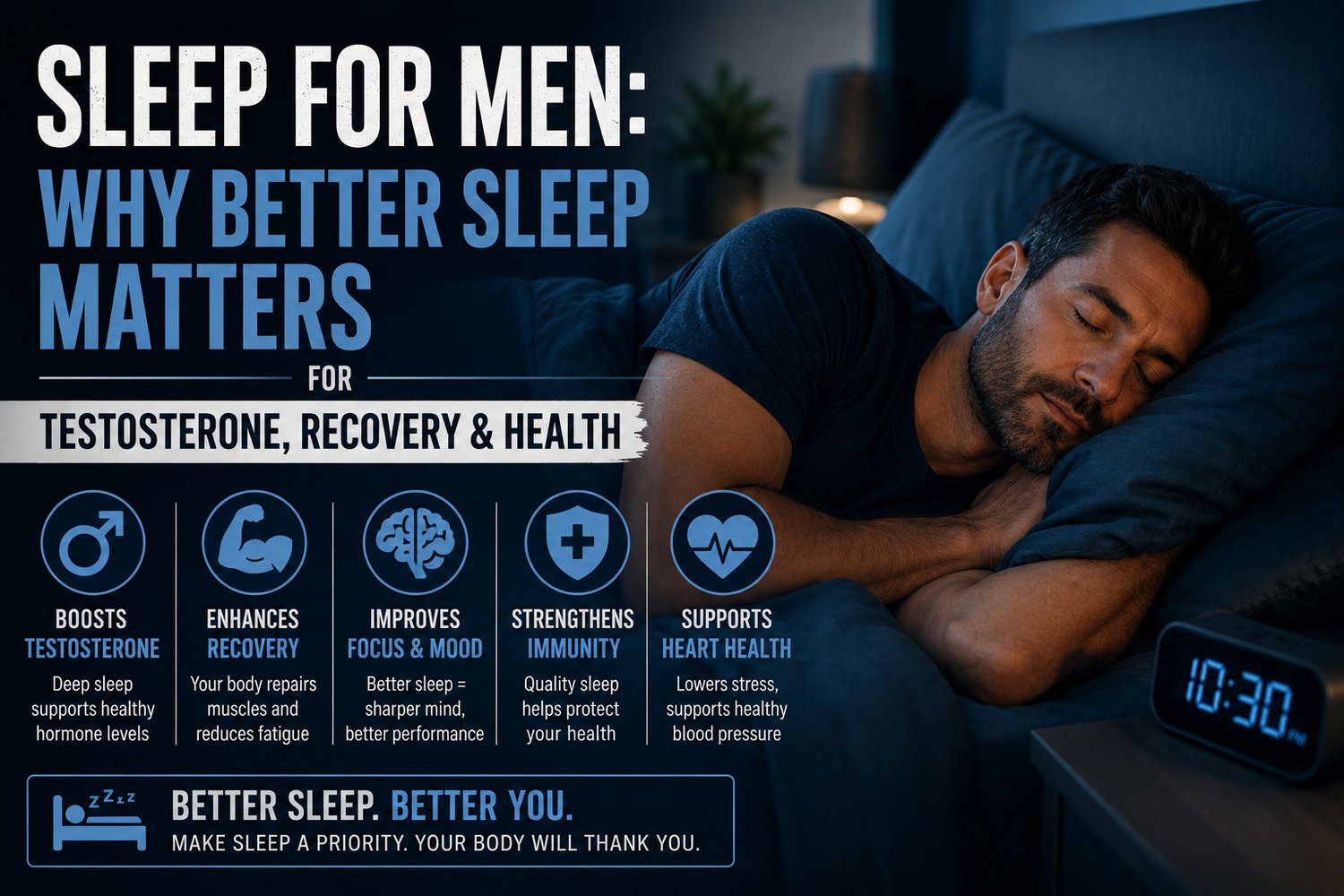
Sleep for Men: Why Better Sleep Matters for Testosterone, Recovery & Health
Men will spend hundreds of dollars trying to improve testosterone.
Supplements.
Workout programs.
Macros.
Protein.
Cold plunges.
Wearables.
Then sleep five or six hours a night.
That's backwards.
Sleep is one of the foundations of men's health because it influences energy, recovery, mood, exercise performance, appetite, cardiovascular health, metabolic health, sexual function, and hormone regulation.
And yes, sleep and testosterone are connected.
But the useful takeaway isn't:
“Sleep eight hours and your testosterone will skyrocket.”
It's:
Chronically poor sleep makes almost every other men's-health goal harder.
Before trying to optimize hormones, body composition, or performance, make sure you're giving your body enough opportunity to recover.
If you're new to the men's-health pillar, start with What Is Men's Wellness?.
And if your supplement cabinet is growing faster than your healthy routines, read Healthy Habits Every Man Should Build Before Buying Supplements.
How Much Sleep Do Men Need?
For adults, at least seven hours of sleep per night is a useful baseline target.
CDC guidance recommends:
- Ages 18–60: 7 or more hours
- Ages 61–64: 7–9 hours
- Age 65+: 7–8 hours
Individual needs still vary.
Some men function well near seven hours.
Others clearly do better with eight or nine.
The better question isn't:
“What's the minimum amount of sleep I can survive on?”
It's:
“How much sleep lets me consistently function, recover, and feel reasonably alert?”
If you routinely need:
- Several alarms
- Huge amounts of caffeine
- Long weekend catch-up sleep
- Naps just to function
your weekday sleep may deserve attention.
Sleep Isn't Wasted Time
Busy men often treat sleep as negotiable.
Work needs another hour.
The kids need something.
There's another episode to watch.
Your phone somehow requires 45 minutes of scrolling at midnight.
Sleep gets whatever time remains.
The problem is that cutting sleep doesn't magically create more useful time.
You may simply trade sleep for:
- Worse concentration
- Lower energy
- Poorer training
- More irritability
- Worse decision-making
- Reduced recovery
- Greater daytime sleepiness
Sometimes staying awake longer gives you less productive time the next day.
Sleep and Testosterone
Testosterone secretion follows a daily rhythm and is connected with sleep.
Research has found associations between:
- Sleep duration
- Sleep fragmentation
- Sleep disorders
- Testosterone levels
A small controlled study in healthy young men found that a week of severe sleep restriction reduced daytime testosterone.
Interesting?
Yes.
Proof that every short night gives you low testosterone?
No.
What it doesn't mean:
- One late night causes hypogonadism.
- Sleeping eight hours cures low testosterone.
- Fatigue automatically means low T.
- Improving sleep guarantees a specific testosterone increase.
The useful takeaway is simpler:
Chronically inadequate sleep is not a good foundation for healthy hormone function.
Fix Sleep Before Blaming Testosterone
Imagine you're sleeping five hours per night.
You're:
- Exhausted
- Irritable
- Less motivated
- Performing worse in the gym
- Struggling to concentrate
- Noticing lower libido
Search those symptoms online and you'll quickly be told:
Low testosterone.
Maybe.
But sleep deprivation can produce many of those same complaints.
That's why symptoms need context.
If testosterone genuinely concerns you, use:
Current Endocrine Society guidance still requires compatible symptoms or signs plus consistently low testosterone, confirmed with repeat morning testing, before diagnosing hypogonadism.
Sleep and Muscle Recovery
You don't build muscle while you're performing the set.
Training creates the stimulus.
Recovery allows adaptation.
Sleep is one part of that recovery process.
If you're training hard while chronically undersleeping, you're making things harder than they need to be.
Good recovery also depends on:
- Adequate protein
- Enough calories
- Appropriate training volume
- Rest between hard sessions
- Hydration
- Stress management
Sleep doesn't replace those.
It works alongside them.
Read Strength Training for Men Over 30.
If you're in midlife, Building Muscle After 40 goes deeper into the recovery side.
For nutrition, use Protein for Men or the Complete High-Protein Guide.
Sleep and Exercise Performance
You know the feeling.
You walk into the gym after a terrible night and immediately think:
“This is going to suck.”
Sleep loss can affect:
- Alertness
- Reaction time
- Mood
- Perceived effort
- Coordination
- Some aspects of physical performance
That doesn't mean one poor night requires canceling every workout.
And it definitely doesn't mean your sleep tracker gets to decide whether you're allowed to exercise.
But repeatedly combining:
Hard training + poor sleep + inadequate recovery
isn't a great long-term plan.
Sleep and Appetite
Poor sleep can also make nutrition harder.
After a bad night you may notice:
- More hunger
- Stronger cravings
- Less motivation to cook
- Greater reliance on convenience foods
- Less desire to exercise
That's where sleep and body composition overlap.
Sometimes a weight-management problem isn't solely:
“I need more discipline with food.”
It may also involve:
“I'm exhausted and making every decision while tired.”
Sleep and Belly Fat
You'll sometimes see dramatic claims that poor sleep:
“causes belly fat.”
That's too simplistic.
Body fat is influenced by many factors, including:
- Energy intake
- Physical activity
- Genetics
- Age
- Sleep
- Stress
- Medications
- Medical conditions
But chronically poor sleep can make behaviors that support healthy body composition much harder to maintain.
For the broader midlife picture, read Why Belly Fat Gets Harder to Lose After 30.
Sleep and Mental Performance
Men often think about sleep mainly in terms of physical recovery.
Your brain needs it too.
Poor sleep can affect:
- Concentration
- Memory
- Patience
- Decision-making
- Reaction time
- Mood
That matters if you're:
- Driving
- Operating equipment
- Managing employees
- Raising children
- Studying
- Running a business
- Making important decisions
Better sleep isn't only about feeling rested.
It's about functioning better while you're awake.
The Sleep Problem Men Shouldn't Ignore: Sleep Apnea
One sleep issue deserves particular attention in men's health:
Obstructive sleep apnea.
Sleep apnea causes breathing to repeatedly stop and restart during sleep.
NHLBI lists common symptoms including:
- Breathing that starts and stops
- Frequent loud snoring
- Gasping for air
- Daytime sleepiness
- Problems concentrating
- Sexual dysfunction or decreased libido
NHLBI also notes that frequent loud snoring is more common among men.
The tricky part?
You may have no idea it's happening.
Often a partner notices first.
Snoring Isn't Always Harmless
Snoring doesn't automatically mean you have sleep apnea.
But:
Loud habitual snoring + breathing pauses + gasping + significant daytime sleepiness
deserves attention.
NHLBI recommends discussing symptoms with a healthcare provider and notes that a sleep study may be needed for diagnosis.
Don't try to solve suspected sleep apnea with:
- Testosterone boosters
- Energy supplements
- More caffeine
- Pre-workout
- Melatonin
- A new wearable
An underlying breathing disorder needs an actual evaluation.
Sleep Apnea, Obesity, and Testosterone Can Overlap
This is where men's-health problems stop fitting into neat boxes.
Imagine a man with:
- Obesity
- Loud snoring
- Poor sleep
- Daytime fatigue
- Reduced libido
- Low testosterone
Is the answer simply:
“Give him testosterone”?
Not necessarily.
Obesity, sleep apnea, poor sleep, metabolic health, medications, age, and testosterone can overlap.
That's why good evaluation considers the whole picture instead of treating one laboratory result as the entire diagnosis.
Should You Test Testosterone?
Testosterone testing may make sense when you have persistent symptoms or signs compatible with testosterone deficiency.
More useful symptoms can include:
- Reduced libido
- Fewer spontaneous erections
- Other sexual-function changes
- Unexplained changes in muscle or other compatible signs
Fatigue by itself is much less specific.
If testing is warranted, read How Testosterone Is Tested and Diagnosed.
For testing resources, visit the Men's Bloodwork Hub.
The Everlywell Testosterone Test provides one at-home option.
Remember:
A test result provides information.
It doesn't automatically provide a diagnosis.
Build Your Sleep Baseline First
Before buying anything, spend a week or two observing your sleep.
Track:
- Bedtime
- Wake time
- Estimated sleep duration
- Night awakenings
- Morning energy
- Daytime energy
- Caffeine
- Alcohol
- Exercise
Don't obsess over exact sleep-stage percentages.
Look for patterns.
Maybe you discover:
- You sleep much worse after alcohol.
- You're routinely allowing only six hours in bed.
- Your bedtime shifts by several hours.
- Afternoon caffeine is interfering.
- You actually feel much better on nights when you give yourself enough sleep opportunity.
That's useful information.
The FREE Men's Hormone & Energy Starter Kit provides a simple way to track sleep, energy, habits, strength, nutrition, and bloodwork.
Step 1: Give Yourself Enough Time to Sleep
This sounds painfully obvious.
Many sleep problems still begin here.
If you need to wake at 5:30 a.m. but routinely go to bed at midnight, a supplement can't manufacture another two hours of biological sleep.
Work backward from your wake time.
If you need roughly seven-and-a-half or eight hours of sleep, your actual bedtime needs to allow for that.
And remember:
Time in bed is not always identical to time asleep.
Build enough opportunity into the schedule.
Step 2: Keep a Reasonably Consistent Schedule
Your circadian system responds to regular patterns.
A relatively consistent wake time can help anchor the day.
That doesn't mean:
- Never sleep later
- Never stay up late
- Become obsessive about a 10-minute variation
It means avoid enormous swings when you can.
Going from:
5:30 a.m. weekdays
to:
11:00 a.m. weekends
can make the schedule harder to stabilize.
Consistency helps.
Perfection isn't required.
Step 3: Get Light Earlier in the Day
Light is one of the strongest environmental signals for your circadian rhythm.
Getting outdoors earlier in the day is a simple way to combine:
Light + movement.
Try:
- A morning walk
- Drinking coffee outside
- Walking the dog
- Taking a brief outdoor break
CDC also recommends getting natural light earlier in the day as part of healthy sleep habits.
For the activity side, read Walking for Men's Health.
Step 4: Pay Attention to Caffeine Timing
Caffeine can be useful.
Timing matters.
If you drink caffeine late in the day and struggle to fall asleep, try moving your last dose earlier.
You don't necessarily need to eliminate coffee.
You do need to know whether caffeine is contributing to a loop:
Sleep poorly → use more caffeine → caffeine interferes with sleep → sleep poorly again
Sometimes fixing that cycle is more useful than adding a sleep supplement.
Step 5: Watch What Alcohol Does to Your Sleep
Alcohol can make you feel sleepy.
That doesn't necessarily mean your sleep is better.
If you drink, pay attention to whether alcohol is associated with:
- More awakenings
- Worse snoring
- Poorer morning energy
- Worse perceived sleep quality
You don't need an ideology about alcohol to notice:
“When I drink this much, I sleep worse.”
Your own pattern matters.
Step 6: Build a Wind-Down Routine
Your brain isn't a light switch.
If you're:
- Answering work emails
- Watching stimulating television
- Scrolling social media
- Arguing with strangers online
at 10:59 p.m., expecting to instantly fall asleep at 11:00 may be optimistic.
Create a transition.
Possible options include:
- Lowering the lights
- Showering
- Reading
- Stretching
- Preparing tomorrow's clothes
- Writing tomorrow's priorities
- Putting the phone away
The exact routine matters less than repeating it consistently.
Step 7: Make the Bedroom Sleep-Friendly
You don't need a luxury sleep cave.
Start with the basics.
Aim for a room that's:
- Dark
- Quiet
- Comfortable
- Cool enough for sleep
And if your phone routinely steals 45 minutes from bedtime:
Move the phone.
Sometimes sleep optimization is complicated.
Sometimes it's:
Stop scrolling and go to bed.
Step 8: Exercise Regularly
Exercise and sleep belong in the same system.
Regular physical activity supports overall health and can also support healthy sleep.
A balanced routine should include:
- Walking
- Resistance training
- Aerobic activity
- General daily movement
You don't need to annihilate yourself.
You need consistency.
Use:
to build that side of the foundation.
Step 9: Manage Stress Before Bed
Sometimes the bedroom isn't the problem.
Your brain is still at work.
If you lie down and immediately start thinking about:
- Work
- Money
- Family responsibilities
- Tomorrow's schedule
- Problems you haven't solved
move some of that thinking out of bed.
Before your wind-down period, write down:
- Tomorrow's priorities
- Things you need to remember
- Problems that can wait
- Your first task tomorrow
The goal isn't magically removing stress.
It's giving your brain somewhere else to store the information besides:
“Repeat this thought for the next 90 minutes.”
Step 10: Track Sleep Without Letting the Tracker Control You
Sleep wearables can be useful.
They may help you notice trends in:
- Sleep duration
- Bedtime
- Wake time
- Consistency
- Nighttime disruption
But consumer wearables aren't perfect medical sleep studies.
Don't let one questionable sleep score convince you that you're broken when you feel fine.
Use the data for:
patterns
not:
judgment.
A simple journal may be enough.
When Should You Talk to a Healthcare Professional?
Don't spend years trying to optimize around a potentially treatable sleep problem.
Consider discussing your sleep with a healthcare professional if you have:
- Loud persistent snoring
- Gasping or choking during sleep
- Witnessed breathing pauses
- Severe daytime sleepiness
- Persistent insomnia
- Regularly waking exhausted despite enough sleep opportunity
- Difficulty staying awake while driving
- Significant impairment at work or in daily life
NHLBI specifically advises people with frequent daytime sleepiness, unrefreshing sleep, difficulty adapting to shift work, loud snoring, or gasping to discuss those symptoms with a clinician.
That's healthcare.
Not a discipline failure.
Don't Supplement Your Way Around Bad Sleep
Magnesium.
Melatonin.
Herbal sleep blends.
Recovery products.
Testosterone boosters.
Some may have legitimate uses in certain situations.
None changes the need for:
- Enough sleep opportunity
- A functional schedule
- Management of an actual sleep disorder
- Reasonable caffeine habits
- A decent sleep environment
Before building a nighttime supplement stack, read Healthy Habits Every Man Should Build Before Buying Supplements.
Fix obvious problems first.
Does TRT Improve Sleep?
TRT isn't a general treatment for poor sleep.
If a man has properly diagnosed hypogonadism, appropriate testosterone treatment may improve some symptoms related to that condition.
That doesn't mean testosterone treats:
- Insomnia
- Sleep apnea
- Stress-related sleep problems
- Poor sleep habits
- An inadequate sleep schedule
And testosterone therapy requires appropriate medical evaluation and monitoring.
Read What Is TRT? Testosterone Replacement Therapy Explained.
If you're already appropriately evaluated and researching providers, you can compare online TRT options.
HabitLogics may earn a commission if you purchase through links on our TRT provider page, at no additional cost to you.
A Simple Evening Routine
Your nighttime routine doesn't need 17 steps.
Try something simple.
60 Minutes Before Bed
Finish unnecessary work and reduce stimulation.
30 Minutes Before Bed
Prepare:
- Tomorrow's clothes
- Lunch
- Gym bag
- Priorities
15 Minutes Before Bed
Dim the lights.
Put the phone away.
Do something relaxing.
Bedtime
Go to bed at roughly the same time most nights.
That's enough.
The best sleep routine is the one you'll actually repeat.
Turn Sleep Into a Measurable Habit
If you want to improve sleep, track it alongside behaviors that influence it.
The Testosterone Lifestyle Guide focuses on:
- Sleep
- Nutrition
- Strength
- Stress
- Recovery
The Men's Health & Performance Dashboard combines sleep, energy, fitness, body composition, recovery, and broader health tracking.
For a free starting point, use the FREE Men's Hormone & Energy Starter Kit.
Frequently Asked Questions
How Much Sleep Should a Man Get?
Most adults should get at least seven hours per night.
CDC currently recommends:
- 7+ hours for adults 18–60
- 7–9 hours for adults 61–64
- 7–8 hours for adults 65 and older
Individual needs vary.
Does Sleep Increase Testosterone?
Sleep and testosterone regulation are connected.
Severe sleep restriction has reduced testosterone in controlled research, but sleeping more isn't a guaranteed treatment for clinically low testosterone.
If symptoms persist or testosterone results are abnormal, appropriate evaluation matters.
Can Poor Sleep Cause Low Testosterone?
Sleep restriction, sleep fragmentation, and sleep disorders have been associated with lower testosterone.
But testosterone is influenced by many factors.
Poor sleep should be addressed regardless because its effects extend far beyond hormones.
Is Snoring Normal?
Occasional snoring can happen without sleep apnea.
Frequent loud snoring becomes more concerning when it occurs with:
- Gasping
- Breathing pauses
- Significant daytime sleepiness
- Unrefreshing sleep
NHLBI recommends discussing those symptoms with a healthcare provider.
Does Testosterone Improve Sleep?
TRT isn't a general sleep treatment.
If poor sleep is caused by insomnia, sleep apnea, stress, poor scheduling, or another condition, the underlying problem still needs to be addressed.
Should I Track My Sleep?
You can.
Tracking:
- Bedtime
- Wake time
- Sleep duration
- Daytime energy
may reveal useful patterns.
You don't necessarily need a wearable.
A basic sleep journal can be enough.
Can Exercise Help Sleep?
Regular physical activity can support sleep and overall health.
The bigger goal is a consistent combination of daily movement, aerobic activity, and resistance training.
Key Takeaways
- Sleep is a foundation of men's health, not wasted time.
- Most adults need at least seven hours of sleep.
- Sleep and testosterone are connected, but poor sleep doesn't automatically mean low testosterone.
- Chronic sleep restriction can affect energy, mood, recovery, appetite, exercise performance, and overall health.
- Sleep apnea is an important condition men should not ignore.
- Loud snoring, gasping, breathing pauses, and excessive daytime sleepiness deserve medical attention.
- Strength training, nutrition, stress management, and sleep all work together in recovery.
- Before buying sleep supplements, establish enough sleep opportunity and a workable routine.
- Consumer sleep trackers can show trends but aren't diagnostic medical devices.
- Persistent sleep problems deserve proper evaluation.
Final Thoughts
You can spend a lot of money trying to optimize men's health.
Or you can start by going to bed.
That's obviously an oversimplification.
Just not by as much as you might think.
If you're consistently undersleeping, improving sleep gives you a stronger foundation for:
Training.
Recovery.
Nutrition.
Energy.
Body composition.
Mood.
Sexual health.
Hormone health.
You don't need a perfect sleep score.
You don't need an elaborate nighttime ritual.
And you don't need to panic about every imperfect night.
Give yourself enough opportunity to sleep.
Keep a reasonably consistent schedule.
Pay attention to caffeine and alcohol.
Move during the day.
Make the bedroom work for sleep.
And don't ignore symptoms of a sleep disorder.
Then let sleep do what it's supposed to do:
Help you recover so you can function better tomorrow.
Continue the Men's Wellness Series
For the foundation:
- What Is Men's Wellness?
- Healthy Habits for Men
- Strength Training for Men Over 30
- Walking for Men's Health
- Protein for Men
- Healthy Aging for Men
For testosterone:
- Low Testosterone Symptoms
- How Testosterone Is Tested and Diagnosed
- How to Support Testosterone Naturally
- What Is TRT?
For body composition and recovery:
For tracking:
- Men's Health & Performance Dashboard
- Testosterone Lifestyle Guide
- FREE Men's Hormone & Energy Starter Kit
For the complete pillar:
Affiliate Disclosure
Some links in this article are affiliate links. If you purchase through one of these links, HabitLogics may earn a commission at no additional cost to you. Recommendations are included only where they naturally fit the topic.
Educational Disclaimer
This article is intended for educational purposes only and should not be considered medical advice. Persistent fatigue, insomnia, loud snoring, breathing interruptions during sleep, excessive daytime sleepiness, sexual dysfunction, or other symptoms can have many possible causes. Consult a qualified healthcare professional for individualized evaluation, diagnosis, testing, or treatment.