

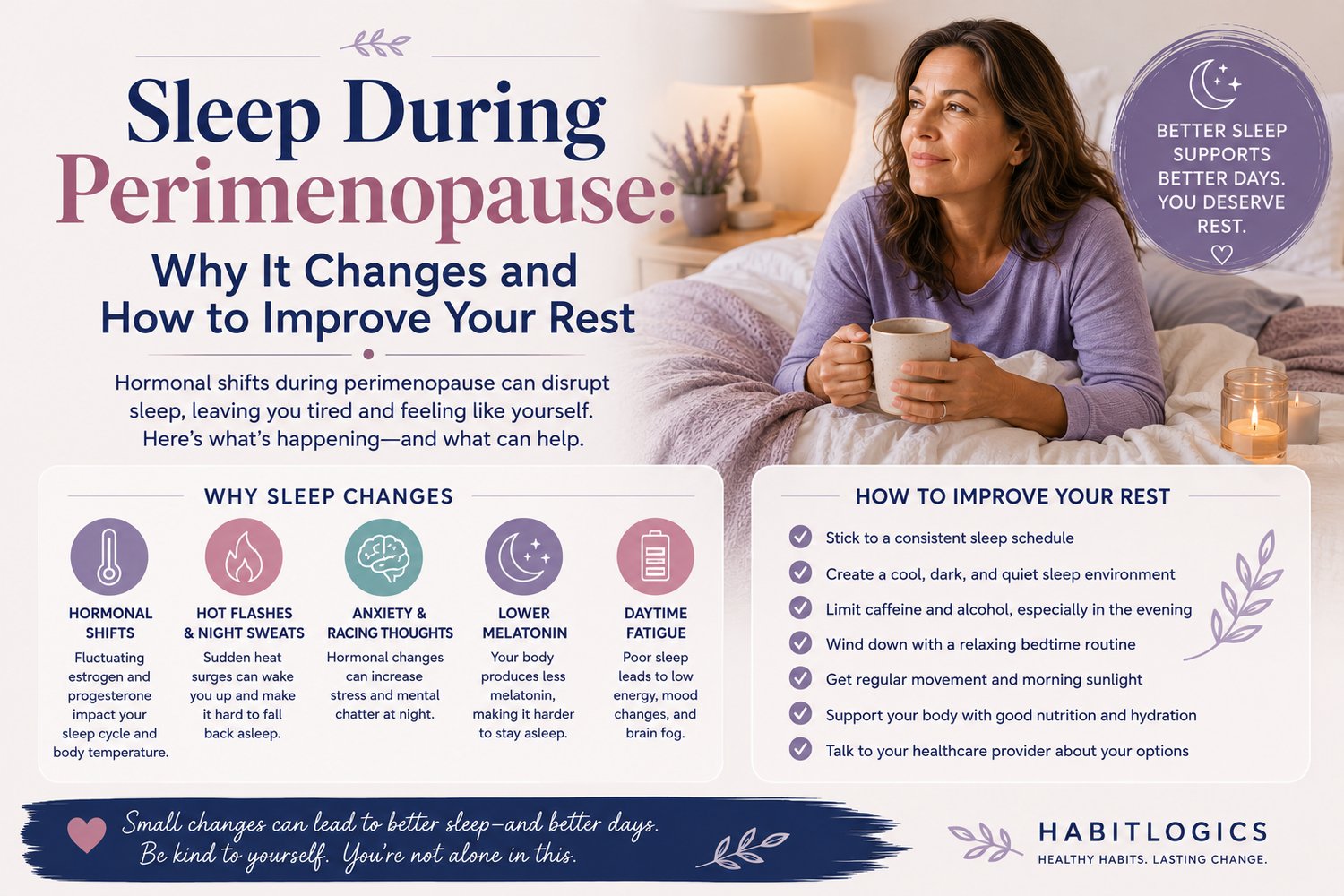
Sleep During Perimenopause: Why You Can’t Sleep & What Actually Helps
Sleep problems during perimenopause can show up in several frustrating ways.
Maybe you fall asleep normally but wake up at 3 a.m. and can't get back to sleep.
Maybe night sweats keep waking you.
Maybe you're suddenly taking much longer to fall asleep.
Or maybe you're spending eight hours in bed but waking up feeling like you barely slept.
Sleep disturbances are common during the menopause transition, but there's an important distinction:
Perimenopause can contribute to poor sleep. That doesn't mean every midlife sleep problem is caused by hormones.
Hot flashes, insomnia, sleep apnea, restless legs syndrome, anxiety, depression, medications, alcohol, caffeine, pain, stress, and ordinary age-related changes can overlap.
Figuring out why you're not sleeping is often more useful than buying another sleep supplement.
If you're experiencing several new symptoms at once, start with 35 Perimenopause Symptoms: Common Signs, What’s Normal & When to Get Help.
Is Poor Sleep Common During Perimenopause?
Yes.
Women may experience several different types of sleep problems during the menopause transition, including:
- Difficulty falling asleep
- Waking repeatedly during the night
- Waking earlier than intended
- Trouble falling back asleep
- Night sweats
- Unrefreshing sleep
- Daytime fatigue or sleepiness
But “poor sleep” isn't one diagnosis.
Someone waking because of repeated night sweats may need a different solution from someone with chronic insomnia.
And someone whose partner reports loud snoring and pauses in breathing needs a very different evaluation from either of them.
That's why the first question shouldn't simply be:
“What helps menopause sleep?”
It should be:
“What's actually disrupting my sleep?”
Why Does Sleep Change During Perimenopause?
There isn't one cause.
Several things can overlap during midlife.
Hormonal Changes
Estrogen and progesterone patterns change during the menopause transition.
Those hormonal changes can influence sleep directly and indirectly.
But hormones aren't acting in isolation.
Hot Flashes and Night Sweats
Vasomotor symptoms are one of the clearest menopause-related causes of sleep disruption.
A nighttime hot flash may wake you because you're suddenly:
- Hot
- Sweating
- Uncomfortable
- Throwing off blankets
- Changing clothes or bedding
Then the hot flash ends—but you're awake.
And sometimes staying asleep becomes the bigger problem than the hot flash itself.
Read Hot Flashes During Perimenopause: Causes, Triggers & Treatments That Actually Help if nighttime vasomotor symptoms are driving your sleep problems.
Mood and Anxiety
Anxiety, depression, irritability, and changing mood can overlap with sleep problems during perimenopause.
The relationship can also run both directions.
Anxiety can make sleep harder.
Poor sleep can make anxiety and mood symptoms harder to manage.
Life Stress
Perimenopause often arrives during an unusually busy stage of adulthood.
Work.
Children.
Parents.
Relationships.
Finances.
Health.
Aging.
Your ovaries aren't responsible for every thought running through your head at 2:47 a.m.
Sometimes perimenopause and ordinary life stress simply arrive at the same party.
Other Sleep Disorders
Conditions such as obstructive sleep apnea and restless legs syndrome also become important during midlife.
Don't automatically blame hormones if the pattern points somewhere else.
What Is Perimenopause Insomnia?
Having a few bad nights doesn't necessarily mean you have insomnia disorder.
Insomnia involves persistent difficulty:
- Falling asleep
- Staying asleep
- Waking too early
despite having adequate opportunity to sleep, with the problem causing daytime distress or impairment.
You might notice:
- Fatigue
- Irritability
- Trouble concentrating
- Worry about sleep
- Reduced work performance
- Difficulty functioning during the day
And here's where insomnia becomes particularly annoying:
The original thing that disrupted your sleep can disappear while the insomnia continues.
For example, night sweats may initially start waking you.
You begin worrying about whether you'll sleep.
You spend longer in bed trying to catch up.
You start napping.
You watch the clock.
You become frustrated whenever you're awake.
Eventually, the behaviors and anxiety surrounding sleep can help perpetuate insomnia even when the night sweats aren't as bad.
That's why treating chronic insomnia often requires more than improving your bedroom environment.
Night Sweats Can Wreck Sleep
Night sweats are hot flashes that occur during sleep.
They're also called nocturnal vasomotor symptoms.
They may cause:
- Sudden heat
- Sweating
- Damp clothing
- Wet bedding
- Chills afterward
- Repeated awakenings
Hot flashes and night sweats can persist for years during and after the menopause transition.
If they're repeatedly waking you, treating the vasomotor symptoms themselves may improve sleep more effectively than continually adding sleep hacks.
Hormone therapy and several nonhormonal treatments are available for bothersome hot flashes.
That's an important distinction:
Sometimes the sleep problem needs sleep treatment.
Sometimes the thing waking you needs treatment.
Sometimes you need both.
Could Your Sleep Problem Be Sleep Apnea?
This one deserves much more attention than it usually gets in menopause content.
Obstructive sleep apnea (OSA) causes repeated episodes in which the airway becomes blocked or narrowed during sleep.
Possible signs include:
- Loud snoring
- Gasping or choking during sleep
- Witnessed pauses in breathing
- Morning headaches
- Dry mouth on waking
- Unrefreshing sleep
- Excessive daytime sleepiness
- Difficulty concentrating
And women don't always show the stereotypical picture of someone dramatically falling asleep during the day.
Symptoms may sometimes be interpreted as:
- Fatigue
- Insomnia
- Mood problems
- Poor concentration
In other words, exactly the kinds of symptoms people may already be blaming on perimenopause.
If you snore loudly, gasp during sleep, have witnessed breathing pauses, or remain extremely sleepy despite adequate time in bed, talk with a healthcare professional about sleep apnea evaluation.
A sleep study may be appropriate.
Don't spend a year treating presumed “menopause insomnia” while an untreated breathing disorder is repeatedly waking you.
What About Restless Legs Syndrome?
Restless legs syndrome can also interfere with sleep.
It typically causes an uncomfortable urge to move the legs, often accompanied by sensations described as:
- Crawling
- Tingling
- Pulling
- Aching
- Restlessness
Symptoms tend to occur while resting and often become worse in the evening or at night.
Movement temporarily relieves them.
Restless legs can have several contributors, including iron deficiency and certain medications.
If that sounds more like your sleep problem than hot flashes or classic insomnia, mention it to your healthcare professional.
Start With the Basics—But Don't Stop There
Good sleep habits still matter.
They create conditions that support sleep.
Useful foundations include:
- Keeping a relatively consistent wake time
- Giving yourself adequate opportunity to sleep
- Keeping the bedroom dark and quiet
- Maintaining a comfortable room temperature
- Exercising regularly
- Limiting caffeine later in the day if it affects you
- Limiting alcohol near bedtime
- Avoiding very large meals immediately before bed
But here's the distinction the internet often misses:
Sleep hygiene is a foundation. It isn't necessarily treatment for chronic insomnia.
If you've been struggling with persistent insomnia for months, another lavender pillow spray probably isn't the breakthrough you've been waiting for.
Keep Your Wake Time Consistent
If you're going to prioritize one schedule anchor, your wake time is especially useful.
Getting up at roughly the same time each morning helps reinforce your circadian rhythm—the roughly 24-hour internal clock regulating sleep and wakefulness.
That includes weekends when possible.
You don't have to wake at exactly 6:03 every morning for the rest of your life.
We're aiming for consistency, not military precision.
Get Light During the Day
Light is one of the strongest environmental signals controlling your circadian rhythm.
Bright light during the daytime—particularly earlier in the day—helps reinforce the distinction between:
daytime = awake
and
nighttime = sleep
A morning walk can conveniently combine:
- Daylight exposure
- Physical activity
For practical walking guidance, read Walking During Perimenopause: Benefits for Weight, Mood & Health.
Exercise Regularly
Regular physical activity is associated with better sleep and provides numerous other benefits during midlife.
Walking is accessible.
Strength training supports muscle and bone.
Cardiovascular exercise supports fitness and heart health.
You don't need to annihilate yourself with exercise to earn the right to sleep.
Consistency matters more.
Explore:
Walking During Perimenopause: Benefits for Weight, Mood & Health
and
Strength Training During Perimenopause: Benefits, Workouts & How to Start.
Watch Caffeine Timing
Caffeine can stay in your system for hours.
That doesn't mean everyone needs an arbitrary:
“NO COFFEE AFTER 10 A.M.”
rule.
People metabolize caffeine differently.
But if you're having trouble sleeping, caffeine is one of the easiest variables to test.
Track:
- How much you consume
- What time you consume it
- Whether sleep changes when you stop earlier
If your 4 p.m. coffee doesn't affect your sleep, fine.
If removing it dramatically improves your nights, you've learned something useful.
Alcohol Can Make Sleep Worse
Alcohol can be deceptive.
It may make you feel sleepy initially.
But later in the night it can:
- Fragment sleep
- Increase awakenings
- Worsen snoring or sleep-disordered breathing
- Make sleep less restorative
Alcohol may also trigger hot flashes for some women.
If you're repeatedly waking during the second half of the night, alcohol is worth considering as a contributor.
Again, track the pattern rather than assuming.
What Is CBT-I?
Cognitive behavioral therapy for insomnia (CBT-I) is one of the most effective evidence-based treatments for chronic insomnia.
And despite the name, it isn't simply:
“Talk about why you're stressed.”
CBT-I is a structured treatment specifically designed to change behaviors and thought patterns that perpetuate insomnia.
Depending on the program, it may include:
- Stimulus control
- Sleep scheduling
- Reducing excessive time awake in bed
- Addressing unhelpful beliefs about sleep
- Relaxation strategies
- Improving sleep-related behaviors
The goal is to retrain the relationship between:
bed + nighttime + sleep
rather than:
bed + frustration + clock watching + trying desperately to sleep.
CBT-I can be delivered by trained clinicians and through some structured digital programs.
For persistent insomnia, this deserves considerably more attention than another list of generic bedtime tips.
What Is Stimulus Control?
Stimulus control is one component commonly used in CBT-I.
The basic idea is to strengthen the association between your bed and sleep.
That can involve principles such as:
- Going to bed when sleepy
- Using the bed primarily for sleep and sex
- Getting out of bed temporarily when you're unable to sleep for an extended period
- Returning when you feel sleepy
- Keeping a consistent wake time
If you've spent months lying awake in bed worrying, scrolling, working, or watching the clock, your brain can begin associating the bed with wakefulness.
Stimulus control helps rebuild the opposite association.
Why “Just Go to Bed Earlier” Can Backfire
When you're exhausted, going to bed two hours earlier seems logical.
Sometimes it backfires.
If your body isn't ready to sleep, you've just added two more hours of lying awake.
Then you become frustrated.
Then you start thinking:
“Great. Here we go again.”
That anxiety can make sleep even harder.
This is one reason CBT-I sometimes works on reducing excessive time in bed rather than simply adding more.
Importantly, formal sleep-restriction or sleep-compression strategies should be used thoughtfully, particularly in people with certain health conditions or safety-sensitive jobs.
This isn't a contest to see how little you can sleep.
Stop Watching the Clock
Clock watching gives your half-awake brain a mathematics assignment.
“It's 2:13.”
“Now it's 2:46.”
“If I fall asleep RIGHT NOW, I'll get four hours and fourteen minutes.”
None of that helps.
If nighttime clock watching increases your anxiety, turn the clock away or keep your phone out of reach.
You don't need minute-by-minute evidence that you're awake.
Treat Hot Flashes If They're Causing the Problem
If night sweats repeatedly wake you, treating the vasomotor symptoms themselves may improve sleep.
Menopausal hormone therapy is the most effective treatment for bothersome hot flashes in appropriate candidates and may improve sleep when vasomotor symptoms are contributing to nighttime disruption.
Nonhormonal treatments for hot flashes also exist.
Read:
Hot Flashes During Perimenopause: Causes, Triggers & Treatments That Actually Help
and
Hormone Therapy During Perimenopause: Benefits, Risks & What to Know.
Don't automatically reach for a sleeping pill if the thing repeatedly waking you is an untreated hot flash.
Can Hormone Therapy Improve Sleep?
It can for some women, particularly when hot flashes and night sweats are contributing to sleep disruption.
Systemic menopausal hormone therapy is highly effective for vasomotor symptoms.
Reducing nighttime hot flashes may reduce the awakenings they cause.
But hormone therapy isn't primarily a universal sleeping medication, and it isn't appropriate for everyone.
The decision should be based on your overall menopause symptoms, health history, age, risk factors, and treatment goals.
If insomnia exists independently of hot flashes, treating the insomnia itself may still be necessary.
What About Prescription Sleep Medication?
Prescription medications can have a role in treating insomnia.
Depending on the situation, clinicians may consider medications from several different classes.
But medication choice depends on factors such as:
- Whether you struggle to fall asleep or stay asleep
- Other medical conditions
- Other medications
- Age
- Side effects
- Fall risk
- Next-day impairment
- How long treatment is expected to continue
Some sleep medications can cause:
- Drowsiness
- Dizziness
- Memory problems
- Next-day impairment
- Dependence or tolerance with certain drugs
The answer isn't “sleep medication is bad.”
It's:
Sleep medication is medical treatment—not a substitute for figuring out why you can't sleep.
Persistent insomnia deserves an actual evaluation and treatment plan.
What About Melatonin?
Melatonin gets marketed as though it's a general-purpose knockout pill.
It isn't.
Melatonin is a hormone involved in regulating circadian timing.
It can be useful in certain situations involving the timing of sleep, but evidence for treating chronic insomnia is much less impressive than the marketing suggests.
It can also cause side effects and interact with medications.
If you're considering melatonin regularly because you've been unable to sleep for months, it's worth discussing the underlying sleep problem with a healthcare professional rather than continually increasing the dose on your own.
What About Magnesium?
Magnesium has become another extremely popular “sleep” supplement.
If you have a magnesium deficiency, correcting it matters.
That doesn't mean taking magnesium automatically treats perimenopause-related insomnia in someone who isn't deficient.
Evidence for magnesium supplements as a general insomnia treatment is limited.
And supplements can still cause side effects or interact with medications.
This is another place where:
popular ≠ proven.
Nutrition Still Matters—Just Don't Turn Dinner Into Sleep Medicine
A balanced diet supports overall health during perimenopause.
For sleep specifically, practical considerations include:
- Avoid going to bed extremely hungry
- Avoid very large meals immediately before bedtime if they bother you
- Watch alcohol
- Pay attention to caffeine
- Stay reasonably hydrated during the day
But there's no magical menopause dinner that guarantees eight uninterrupted hours of sleep.
For the broader nutrition picture, read Best Diet for Perimenopause: What to Eat for Midlife Health.
If you want more structure around meals, protein, fiber, and meal prep, the Perimenopause Nutrition & Meal Planner combines printable planning tools with an Excel tracker.
Track Your Sleep Before Guessing
Sleep memory is surprisingly unreliable.
After several bad nights, it can feel like:
“I haven't slept all week.”
Tracking gives you something more useful.
Record:
- Bedtime
- Approximate time you fell asleep
- Nighttime awakenings
- Wake time
- Night sweats
- Caffeine
- Alcohol
- Exercise
- Stress
- Medications or supplements
- How rested you feel the next day
You don't need to track forever.
A few weeks may be enough to reveal useful patterns.
The FREE Perimenopause Starter Kit includes a sleep and hot-flash log plus symptom and habit tracking.
If sleep and night sweats are major problems, the Perimenopause Sleep & Hot Flash Planner provides more detailed printable and Excel tools for tracking sleep quality, bedtime routines, nighttime symptoms, and possible triggers.
When Should You See a Healthcare Professional About Sleep?
You don't need to wait until you're completely exhausted.
Consider seeking evaluation if:
- Sleep problems persist despite basic changes
- Insomnia is affecting daytime functioning
- You regularly struggle to stay awake during the day
- You snore loudly
- Someone notices pauses in your breathing
- You wake gasping or choking
- You have uncomfortable nighttime leg sensations
- Night sweats are repeatedly waking you
- Anxiety or depression is affecting sleep
- You're relying regularly on alcohol or medication to sleep
- You're unsure what's causing the problem
Seek prompt medical attention for symptoms such as chest pain, severe breathing difficulty, or other acute concerning symptoms.
Frequently Asked Questions
Is insomnia common during perimenopause?
Yes.
Difficulty falling asleep, staying asleep, waking too early, and unrefreshing sleep can all occur during the menopause transition.
Hot flashes, hormonal changes, mood symptoms, stress, sleep apnea, other sleep disorders, and medical conditions can overlap.
Why do I keep waking up at 3 a.m. during perimenopause?
There isn't one specific “3 a.m. hormone.”
Nighttime awakenings can result from hot flashes, insomnia, alcohol, stress, anxiety, sleep apnea, environmental disruption, pain, needing to urinate, and other factors.
The timing alone doesn't identify the cause.
Why can't I fall back asleep after a night sweat?
The hot flash may be what wakes you, but once you're awake, alertness, frustration, clock watching, temperature discomfort, and insomnia patterns can make returning to sleep difficult.
Treating both the vasomotor symptoms and persistent insomnia may be necessary.
What is the best treatment for perimenopause insomnia?
It depends on the cause.
For chronic insomnia, CBT-I is one of the strongest evidence-based treatments.
If night sweats are driving the awakenings, treating vasomotor symptoms may also help.
Sleep apnea, restless legs syndrome, mood disorders, medication effects, and other causes require their own treatment.
Does hormone therapy help perimenopause insomnia?
Hormone therapy may improve sleep for some women, particularly when hot flashes and night sweats are contributing to nighttime awakenings.
It isn't appropriate for everyone and shouldn't automatically be used as a general sleep medication.
Should I take melatonin during perimenopause?
Melatonin may be useful in certain circumstances, particularly when circadian timing is involved, but evidence for chronic insomnia is limited.
Discuss regular use with a healthcare professional, particularly if you take other medications.
Does magnesium help perimenopause sleep?
Evidence that magnesium supplements reliably treat insomnia in people without a deficiency is limited.
Correcting a deficiency is different from assuming everyone with poor sleep needs a magnesium supplement.
Can perimenopause cause sleep apnea?
The relationship between menopause and sleep-disordered breathing is more complicated than saying perimenopause directly “causes” sleep apnea.
Sleep apnea risk becomes increasingly relevant during midlife.
Loud snoring, gasping, breathing pauses, and excessive daytime sleepiness deserve evaluation rather than being blamed on hormones.
Can exercise improve sleep during perimenopause?
Regular physical activity is associated with better sleep and provides major cardiovascular, muscle, bone, mood, and metabolic benefits.
Walking and strength training are both excellent options.
Key Takeaways
- Sleep problems during perimenopause are common, but hormones aren't always the only cause.
- Hot flashes and night sweats can repeatedly disrupt sleep.
- Chronic insomnia can persist even after the original sleep disruption improves.
- Sleep apnea, restless legs syndrome, mood disorders, medications, pain, caffeine, alcohol, and other factors can overlap with menopause-related sleep problems.
- Sleep hygiene supports healthy sleep but isn't sufficient treatment for everyone with chronic insomnia.
- CBT-I is one of the strongest evidence-based treatments for chronic insomnia.
- Treating nighttime hot flashes can improve sleep when vasomotor symptoms are causing awakenings.
- Hormone therapy may improve sleep for appropriate candidates when hot flashes and night sweats are contributing.
- Prescription insomnia medications can have a role but should be individualized.
- Evidence for melatonin and magnesium as universal solutions for perimenopause insomnia is limited.
- Loud snoring, gasping, breathing pauses, or significant daytime sleepiness deserve evaluation for sleep apnea.
- Tracking sleep for several weeks can help distinguish patterns and guide treatment discussions.
Continue Learning
If poor sleep is part of a larger group of perimenopause symptoms, continue with:
- Hot Flashes During Perimenopause: Causes, Triggers & Treatments That Actually Help
- 35 Perimenopause Symptoms: Common Signs, What’s Normal & When to Get Help
- Hormone Therapy During Perimenopause: Benefits, Risks & What to Know
- Mood Swings During Perimenopause: Why They Happen & What May Help
- Healthy Habits During Perimenopause: What Actually Matters
Or return to the Complete Perimenopause Guide for the full HabitLogics perimenopause roadmap.
Educational Disclaimer
This article is intended for educational purposes only and is not medical advice, diagnosis, or treatment. Sleep problems can have many causes, including insomnia, sleep apnea, restless legs syndrome, mood disorders, medical conditions, medications, substance use, and menopause-related symptoms. Consult a qualified healthcare professional about persistent or severe sleep problems, significant daytime sleepiness, breathing problems during sleep, or before starting or changing medical treatment.