

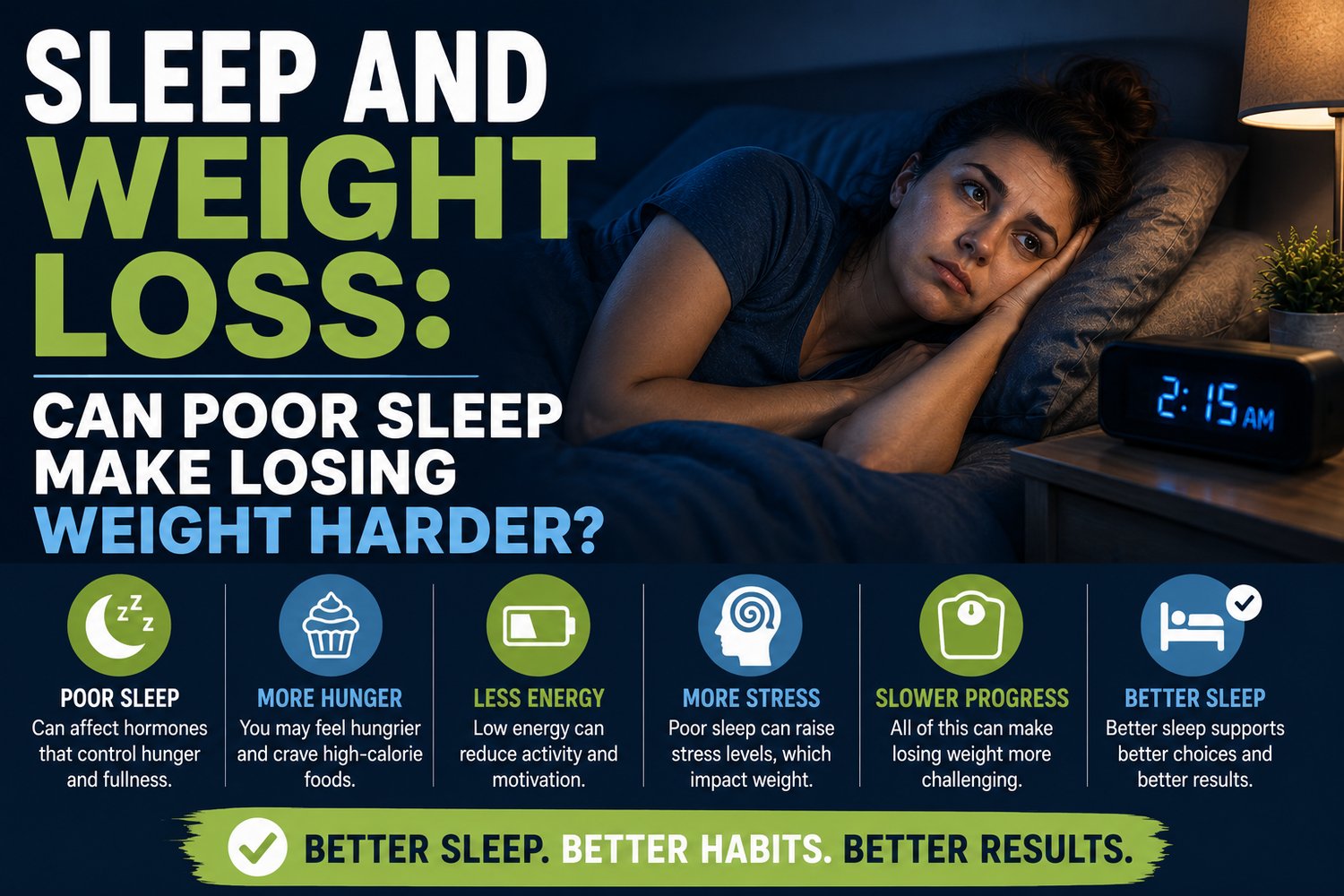
Sleep and Weight Loss: Can Poor Sleep Make Losing Weight Harder?
The Complete Sleep & Recovery Guide
Weight loss advice usually focuses on two things:
Eat better.
Move more.
Both matter.
A lot.
But there's a third part of the system that gets considerably less attention:
Sleep.
Poor sleep doesn't magically create body fat.
And sleeping eight hours doesn't cause weight to disappear.
But consistently insufficient or poor-quality sleep can affect several of the behaviors and biological processes involved in weight management—including appetite, food intake, energy and your ability to stick with healthy habits.
Large observational studies have repeatedly found associations between short sleep and obesity, and recent prospective meta-analysis data continue to find an association between short sleep and greater risk of central obesity in adults.
Even more interestingly, experimental research suggests the connection isn't just theoretical.
When researchers extended sleep in adults with overweight who habitually slept too little, participants spontaneously consumed fewer calories without being instructed to diet.
That doesn't make sleep a weight-loss hack.
It makes sleep another part of the environment in which weight-management decisions happen.
And that's a much more useful way to think about it.
Does Sleep Really Affect Weight Loss?
Yes—but probably not in the simplistic way social media sometimes presents it.
You may hear claims such as:
Poor sleep makes weight loss impossible.
That's not true.
People can lose weight while sleeping poorly.
Energy balance still matters.
You may also hear:
Just sleep more and the weight will come off.
Also not true.
Sleep is not a substitute for nutrition, activity or an appropriate calorie deficit.
The more accurate statement is:
Poor sleep can make some of the behaviors required for weight management harder to sustain.
That can happen through several pathways.
You may:
- Feel hungrier
- Eat more
- Have stronger cravings
- Have more opportunities to eat because you're awake longer
- Feel less energetic
- Exercise less
- Rely more heavily on convenience foods
- Struggle more with consistency
None of those guarantee weight gain.
But stack enough of them together for months or years and the environment becomes less favorable.
Sleep and Weight Are Associated—But Association Isn't Causation
This distinction matters.
People who sleep less tend, on average, to have higher rates of overweight and obesity.
CDC surveillance data and research reviews have repeatedly found this association. The CDC also currently lists insufficient sleep among factors linked with increased risk of obesity.
But observational research alone can't prove that:
short sleep directly caused the weight gain.
People who sleep less may also differ in:
- Work schedules
- Stress
- Diet
- Physical activity
- Medical conditions
- Socioeconomic circumstances
- Alcohol use
- Shift work
- Mental health
- Parenting demands
That's why experimental sleep research is especially valuable.
It allows researchers to manipulate sleep and observe what changes.
Sleep Restriction Can Increase How Much People Eat
One of the most consistent findings from controlled sleep-restriction studies is that people often eat more when their sleep is restricted.
A systematic review and meta-analysis of experimental studies found that partial sleep restriction increased daily energy intake by roughly 250 calories on average compared with normal sleep conditions. Participants also reported greater hunger.
That's meaningful.
Not because 250 calories automatically translates into a predictable amount of weight gain.
Human energy balance is more complicated than that.
But because an extra:
200–300 calories
can be surprisingly easy to consume.
That's:
A snack.
A larger portion.
A sugary drink.
A handful of something while watching TV.
A little extra here and there.
You may not even perceive it as:
I'm overeating because I slept badly.
You may simply feel hungrier.
Why Does Poor Sleep Make You Hungrier?
This is where the science gets interesting—and messy.
Researchers have investigated several possible mechanisms.
Sleep restriction may affect:
- Appetite-regulating hormones
- Brain responses to food
- Reward processing
- Glucose metabolism
- Opportunities to eat
- Decision-making
Early laboratory research found that restricting sleep in healthy young men decreased leptin, increased ghrelin and increased reported hunger and appetite.
Those hormones became extremely popular in weight-loss content.
You've probably seen:
Leptin = fullness hormone
Ghrelin = hunger hormone
and therefore:
Bad sleep breaks your hormones and makes you fat.
That's too simplistic.
Later research has shown that hormonal responses aren't identical across every study.
The relationship between sleep and appetite likely involves multiple mechanisms, not one two-hormone switch.
So instead of obsessing over leptin and ghrelin, focus on the practical outcome:
Insufficient sleep can increase hunger and food intake in at least some people.
That's something you can actually notice.
Sleep Loss May Make High-Calorie Foods More Appealing
This may sound familiar.
After a great night of sleep:
Oatmeal, eggs or yogurt sound perfectly fine.
After four hours:
Suddenly your brain wants:
donuts.
pizza.
chips.
something involving cheese.
Experimental brain-imaging research has found that sleep deprivation can alter activity in brain regions involved in food evaluation and increase desire for higher-calorie foods.
That doesn't mean sleep deprivation removes free will.
It means the food environment may feel different when you're exhausted.
This matters because successful weight management depends on thousands of repeated food decisions.
If poor sleep makes those decisions slightly harder every day, that adds friction.
Being Awake Longer Also Gives You More Time to Eat
Sometimes we don't need a complex hormonal explanation.
If you normally sleep:
10:30 p.m. → 6:30 a.m.
but instead stay awake until:
1:00 a.m.
you've created another two and a half hours in which eating can occur.
And late-night eating often happens during:
TV.
Gaming.
Scrolling.
Stress.
Boredom.
Not necessarily because someone is experiencing extreme physical hunger.
So part of the sleep-weight connection may simply be:
More awake time = more opportunities to eat.
Very sophisticated science.
😂
Sometimes the boring explanation matters too.
Poor Sleep Can Make Night Eating Harder to Manage
This is particularly relevant if your challenging period is already the evening.
Suppose your normal pattern is:
Eat reasonably well all day.
Get tired at night.
Stay up late.
Start snacking.
Now add poor sleep.
The next day:
You're more tired.
Maybe hungrier.
Maybe less motivated.
Then the next evening:
Same pattern.
That's how sleep and eating behaviors can reinforce each other.
It doesn't require some dramatic hormone malfunction.
It's simply a loop.
Sleep and Night Eating Can Become a Cycle
The pattern might look like:
Poor sleep
↓
Low daytime energy
↓
More caffeine / less activity
↓
More hunger or cravings
↓
Late-night eating
↓
Stay awake later
↓
Poorer or shorter sleep
↓
Repeat
When that's happening, focusing exclusively on food misses part of the system.
Sometimes improving the sleep routine makes the eating routine easier to manage.
And sometimes improving daytime nutrition makes nighttime sleep easier.
These behaviors interact.
This Is Why Tracking Sleep and Hunger Together Can Be Useful
Most people rely on memory.
They think:
I snack at night because I have no discipline.
Maybe.
Or maybe the pattern is:
Every night-eating episode follows a six-hour night.
That's useful information.
Or:
Night eating happens when dinner is too small.
Different problem.
Or:
You sleep poorly after large late meals.
Again, different problem.
If sleep, hunger and nighttime eating are all part of the same struggle, the Sleep + Weight Loss System is specifically designed to track those variables together using sleep, hunger and night-eating logs rather than treating them as unrelated problems.
The point isn't to obsess over every bite.
It's to identify the pattern.
Poor Sleep Can Reduce Your Energy to Exercise
Here's another practical mechanism.
You slept terribly.
The alarm goes off.
You were planning to work out after work.
Then 5 p.m. arrives.
Your brain says:
Absolutely not.
That's understandable.
Research examining sleep within behavioral weight-loss programs has found that better sleep health is associated with better adherence to physical activity and dietary goals, although those data are observational within the intervention and don't prove sleep was the sole cause.
Still, the behavior makes sense.
When you're exhausted:
Exercise requires more effort.
Meal prep requires more effort.
Grocery shopping requires more effort.
Every healthy choice costs a little more mental energy.
You Don't Need to Exercise Hard After a Bad Night
If you slept poorly, you don't have to choose between:
intense workout
and
doing absolutely nothing.
You can:
Walk.
Reduce workout intensity.
Shorten the session.
Do light movement.
Then prioritize sleep that night.
Our Walking for Better Sleep: Can a Daily Walk Improve Sleep Quality? guide explains why walking can be such a useful fallback habit.
Consistency doesn't mean every day has to be heroic.
Sleep Deprivation Doesn't Necessarily Lower Energy Expenditure
Here's an interesting nuance.
You might assume:
Poor sleep causes weight gain because it dramatically slows metabolism.
That's not the whole story.
Controlled research suggests sleep restriction may actually slightly increase total energy expenditure because you're awake longer.
The problem is that increases in energy intake can exceed that additional expenditure. Reviews of experimental research have estimated that sleep restriction may raise intake by considerably more than it raises energy expenditure.
So the practical problem may not be:
Your metabolism stopped working.
It may be:
You ate more than the additional energy you burned.
Much less dramatic.
Much more useful.
Does Poor Sleep Slow Your Metabolism?
You'll see this claim constantly.
The reality is more nuanced.
Sleep restriction can influence metabolic processes, including glucose regulation and insulin sensitivity, particularly in controlled experimental settings.
But saying:
Bad sleep destroys your metabolism
is an exaggeration.
Your metabolism does not suddenly shut down after a rough night.
The more practical concern is that repeated insufficient sleep may influence several metabolic and behavioral systems over time.
Again:
Think patterns.
Not one night.
One Bad Night Isn't Going to Ruin Your Weight Loss
This is important.
You sleep badly Tuesday.
Wednesday morning:
Scale goes up.
Do not conclude:
Sleep made me gain fat overnight.
Body weight changes from day to day because of:
- Water
- Sodium
- Carbohydrate intake
- Digestion
- Bowel contents
- Hormonal fluctuations
- Inflammation
- Training
- Hydration
One rough night does not instantly create meaningful body fat.
Look at the trend.
Chronic Poor Sleep Is Different
Occasional sleep loss is part of life.
Kids wake up.
Work happens.
Travel happens.
You get sick.
The concern is the long-term pattern:
5–6 hours
night after night
week after week
month after month.
That's the pattern that research most consistently associates with unfavorable weight and metabolic outcomes.
Don't panic about one night.
Pay attention to your default system.
Can Sleeping More Actually Reduce How Much You Eat?
This is one of the more interesting intervention studies.
Researchers enrolled adults with overweight who habitually slept fewer than about 6½ hours per night.
Participants assigned to personalized sleep-hygiene counseling increased their sleep duration by about 1.2 hours per night.
And without being instructed to restrict calories, they consumed roughly 270 fewer calories per day on average compared with the control group during the intervention.
That's impressive.
But we need to interpret it correctly.
The study does not prove that everyone who sleeps an extra hour will automatically eat exactly 270 fewer calories.
It shows that in habitually short-sleeping adults with overweight, extending sleep influenced energy intake under real-world conditions.
That's very different from:
Sleep nine hours and lose weight effortlessly.
Sleep Is Not a Replacement for a Calorie Deficit
This deserves its own heading.
You cannot:
Sleep eight hours.
Eat substantially more energy than you expend.
And expect sleep to override energy balance.
Sleep does not violate physics.
Better sleep may make it easier to maintain behaviors that create an appropriate energy deficit.
That's the role.
Think:
Sleep supports the process.
Not:
Sleep replaces the process.
Can You Lose Weight While Sleeping Poorly?
Yes.
Absolutely.
If your energy intake is appropriately lower than your expenditure over time, weight loss can occur even when sleep isn't ideal.
But the process may feel harder.
You may experience:
More hunger.
More cravings.
Less energy.
Less motivation to exercise.
More late-night eating opportunities.
Less patience for meal preparation.
So the question isn't:
Is weight loss physically possible with bad sleep?
It is.
The better question is:
Why make it harder than it already is?
How Much Sleep Should You Get for Weight Loss?
There isn't a special:
weight-loss sleep requirement.
For healthy adults, established sleep recommendations still apply.
Most adults should regularly get at least seven hours of sleep, and many people function best with more. The CDC currently recommends seven or more hours for adults ages 18–60, with age-specific recommendations thereafter.
Your target should be based on:
your actual sleep need
not
a special fat-loss number.
If you naturally function best around eight hours:
Aim for eight.
Don't cut yourself to six because you think waking earlier will create more time to exercise.
That's a questionable trade.
Don't Sacrifice Sleep to Exercise More
Imagine:
You currently sleep from:
11 p.m. → 6 a.m.
Seven hours.
You decide weight loss requires a 5 a.m. workout.
So now:
11 p.m. → 4:30 a.m.
Then workout.
You've taken a reasonably adequate sleep window and turned it into chronic sleep restriction.
That may make:
Hunger.
Recovery.
Energy.
And adherence
harder.
A 30-minute walk later in the day may be a much better system than stealing 90 minutes from sleep.
Don't Sacrifice Sleep for Meal Prep Either
Same idea.
Healthy habits should support each other.
If you're staying up until:
12:30 a.m.
every night meal prepping perfectly portioned food for tomorrow:
Something is off.
Simplify the meals.
Use leftovers.
Buy convenient high-protein foods.
Prep earlier.
A sustainable weight-loss routine shouldn't require chronically undermining another major health behavior.
Poor Sleep Can Make Food Choices Feel Harder
Think about two versions of you.
Well-Rested You
Plans dinner.
Goes grocery shopping.
Takes a walk.
Makes lunch.
Stops eating when satisfied.
Severely Tired You
Doesn't want to cook.
Orders something.
Grabs whatever is easiest.
Skips the walk.
Stays on the couch.
Snacks late because you're still awake.
This doesn't happen every time.
But if that's your pattern:
Sleep matters.
Not because it magically alters fat loss.
Because behavior happens in a context.
Better Sleep Can Improve the Context
When sleep improves, you may find it easier to:
Plan meals.
Exercise.
Manage cravings.
Avoid staying up snacking.
Recover from workouts.
Make decisions.
Stick with routines.
That's where the value is.
And that fits the broader HabitLogics philosophy perfectly:
Better systems make healthy behaviors easier to repeat.
What About Sleep and Insulin Resistance?
Insufficient sleep has been studied for its effects on glucose metabolism and insulin sensitivity.
Experimental sleep-restriction research has found impaired insulin sensitivity under some conditions.
This matters for metabolic health.
But don't jump from that to:
One bad night made me insulin resistant and stopped fat loss.
These studies are examining biological responses under controlled conditions.
Weight loss in real life remains influenced by a much larger set of factors.
The takeaway is:
Chronic adequate sleep belongs alongside nutrition and physical activity in a healthy metabolic lifestyle.
Not:
Sleep is the secret metabolic hack.
What About Cortisol?
Cortisol gets blamed for almost everything online.
Bad sleep.
Belly fat.
Cravings.
Stress.
Weight plateaus.
You will inevitably see:
Poor sleep raises cortisol, and cortisol makes you store belly fat.
That's far too simple.
Cortisol is a normal hormone with essential functions.
Sleep deprivation and circadian disruption can affect stress-hormone patterns, but body-fat regulation cannot be reduced to one hormone.
If your weight isn't changing as expected, don't diagnose:
high cortisol
from TikTok.
Look at the entire system.
What About “Belly Fat From Poor Sleep”?
There is evidence linking short sleep with central obesity at the population level.
A 2024 systematic review and meta-analysis of prospective cohort studies found short sleep duration was associated with a modestly higher risk of central obesity in adults.
That is an association.
It does not mean:
Sleeping six hours automatically sends fat directly to your abdomen.
Body-fat distribution is affected by many factors.
Use the finding as another reason to take chronic sleep seriously—not as a diagnostic rule.
Sleep and Weight Loss Plateaus
If weight loss stalls, sleep is worth looking at.
But don't automatically assume it's the cause.
A plateau can occur because:
- Energy needs changed after weight loss
- Portions increased
- Tracking became less accurate
- Activity decreased
- Water retention is masking fat loss
- Adherence changed
- The timeline is too short
- Normal body-weight fluctuations are obscuring the trend
Poor sleep can contribute to some of those behaviors.
But it isn't the universal explanation.
Investigate rather than assume.
Don't Use the Scale to Judge Last Night's Sleep
You sleep badly.
Scale rises 1.8 pounds.
That's almost certainly not 1.8 pounds of fat created overnight because you missed REM sleep.
Day-to-day weight fluctuations are normal.
Use:
multi-week trends
for weight
and
multi-night trends
for sleep.
Don't overinterpret either one.
What About GLP-1 Medications and Sleep?
If you're using a GLP-1 medication for weight management, sleep still matters.
The medication may reduce appetite substantially, but it doesn't replace:
- Adequate nutrition
- Protein
- Physical activity
- Resistance training
- Recovery
- Sleep
Fatigue can also have many possible causes during weight loss, including eating too little, dehydration, medication effects, illness and poor sleep.
Don't automatically attribute every low-energy day to one factor.
If fatigue is persistent or significant, discuss it with your healthcare provider.
Weight Loss Itself Can Change Sleep
The relationship can also go the other direction.
Weight changes may influence sleep, particularly when conditions such as obstructive sleep apnea are involved.
Obesity is a major risk factor for obstructive sleep apnea, and sleep-disordered breathing can in turn seriously disrupt sleep quality.
That creates another potential loop:
Poor sleep
↔
weight-related health issues
This is one reason weight and sleep shouldn't always be treated as completely separate conversations.
Sleep Apnea Matters Especially in Weight Management
If you're trying to lose weight and you:
Snore loudly.
Gasp during sleep.
Have witnessed breathing pauses.
Wake with headaches.
Feel exhausted despite adequate time in bed.
Fall asleep unintentionally during the day.
do not assume:
I just need to lose weight and it'll fix itself.
Sleep apnea deserves proper evaluation and treatment.
Weight management may be part of the long-term strategy for some people, but untreated sleep apnea should not simply be ignored while waiting for future weight loss.
Better Sleep Is Not a Diet
This is the central message.
Do not turn sleep into another weight-loss obsession.
You do not need:
perfect REM
perfect deep sleep
exactly 8.3 hours
or
a $600 sleep tracker
to lose weight.
You need a sustainable system.
Sleep can help make that system easier to maintain.
That's enough.
Start With Your Biggest Sleep Problem
If sleep is clearly poor, don't rebuild everything at once.
Ask:
Am I simply not sleeping enough?
Create more sleep opportunity.
Is caffeine too late?
Move it earlier.
Am I staying up scrolling?
Create a screen cutoff.
Is my schedule inconsistent?
Stabilize wake time.
Am I waking repeatedly?
Investigate the cause.
Am I going to bed stuffed?
Move larger meals earlier.
Am I exhausted despite adequate sleep?
Consider whether a medical evaluation is appropriate.
Fix the biggest leak first.
Pair Sleep With the Weight-Loss Fundamentals
A solid system looks more like:
Adequate sleep
Reasonable calorie intake
Enough protein
Fiber-rich foods
Regular walking
Strength training
Consistency
rather than:
Find one secret lever and optimize it to death.
Your habits should reinforce each other.
Walking Is a Particularly Useful Bridge
Walking fits beautifully between sleep and weight management because it can:
Increase daily activity.
Get you outside.
Provide daytime light.
Support routine.
Require little recovery.
And contribute to energy expenditure.
If you're building a sustainable weight-management routine, the Complete Walking for Weight Loss Guide goes much deeper into creating a practical walking system.
You don't need to choose:
sleep or exercise.
Build a routine where both fit.
Nutrition Still Matters Most Directly for Weight Loss
Sleep can support your eating behavior.
It doesn't replace nutrition.
If you're trying to lose weight, adequate protein can help with satiety and muscle preservation, while fiber-rich foods can help build filling meals.
HabitLogics' Complete High-Protein Guide covers the protein side of the equation.
And the Fiber & Gut Health Guide provides a practical framework for increasing fiber and plant foods.
Sleep makes the system easier.
Nutrition still needs to be there.
Build a “Bad Sleep Day” Plan
This is practical.
You will occasionally sleep poorly.
Instead of abandoning the entire weight-loss routine:
Have a fallback plan.
For example:
Breakfast
Normal high-protein meal.
Don't respond to poor sleep by skipping everything and becoming ravenous later.
Caffeine
Use it—but don't keep escalating it into the evening.
Exercise
If you're too tired for the planned hard workout, walk.
Food
Have easy meals available.
Evening
Don't try to compensate by going to bed absurdly early.
Return to your normal routine.
One bad night doesn't need to become a bad week.
Watch the “I'm Tired, So I Deserve It” Pattern
This is human.
Terrible day.
Poor sleep.
Work stress.
You get home.
Brain says:
We've suffered enough. Order the pizza.
There's nothing wrong with pizza.
The useful question is whether this becomes the automatic response every time you're tired.
If so:
Create easier fallback foods.
Frozen meals.
Greek yogurt.
Pre-cooked protein.
Fruit.
Microwave rice.
Bagged salad.
Whatever fits your plan.
Make the healthy choice require less energy.
Because on bad-sleep days:
You have less energy to spend.
Track Sleep Alongside Hunger
For one to two weeks, record:
Sleep duration
Sleep quality
Morning energy
Daytime hunger
Evening hunger
Night eating
Exercise
Caffeine
Then look for patterns.
You may discover:
Short sleep = noticeably more hunger
or:
Poor sleep doesn't change hunger much, but destroys exercise motivation
or:
Night eating is mainly connected to staying awake too late
or:
Sleep isn't your biggest issue at all.
That's useful.
The Sleep + Weight Loss System
If this is exactly the pattern you're trying to understand, the Sleep + Weight Loss System | Sleep Tracker, Hunger and Night Eating Log combines sleep tracking with hunger and nighttime-eating logs in a fillable workbook and Excel dashboard.
The goal isn't:
Track every possible variable forever.
It's:
Figure out how your sleep and eating patterns interact.
Then adjust what matters.
Start With Sleep if You're Chronically Underslept
If you're routinely sleeping:
5–6 hours
there's a pretty obvious experiment available.
For the next two weeks:
Create another 30–60 minutes of sleep opportunity.
Keep the rest of your weight-management routine roughly the same.
Then observe:
Hunger.
Cravings.
Energy.
Exercise.
Night eating.
Food choices.
You may notice a difference.
You may not.
Either way, you now have better information.
Don't Expect Instant Weight Loss From Better Sleep
You improve sleep for three nights.
Scale doesn't change.
That does not mean:
Sleep doesn't matter.
Likewise, if the scale drops:
You cannot conclude:
Sleep caused the weight loss.
Better sleep is about improving the conditions supporting your long-term behavior.
Think weeks and months.
Not Tuesday morning.
What If You're Already Sleeping Well?
Then don't optimize it to death.
If you:
Get enough sleep.
Wake reasonably refreshed.
Have stable daytime energy.
Don't experience concerning symptoms.
then sleep may not be an important weight-loss bottleneck.
Great.
Focus on the parts of the system that actually need work.
That's the whole point of tracking before intervening.
What If You're Sleeping 8 Hours but Still Exhausted?
That's a different situation.
Adequate time in bed does not guarantee adequate-quality sleep.
Our guide Why Am I Tired After 8 Hours of Sleep? Sleep Quantity vs. Sleep Quality covers possible reasons including fragmented sleep, schedule problems, sleep apnea and non-sleep causes of fatigue.
Don't simply add more sleep indefinitely.
Investigate why you aren't feeling restored.
When Poor Sleep Deserves Medical Attention
Weight-loss frustration is one thing.
Persistent sleep problems are another.
Talk with a healthcare professional if you experience:
- Loud habitual snoring
- Gasping or choking during sleep
- Witnessed breathing pauses
- Significant daytime sleepiness
- Persistent insomnia
- Repeated nighttime awakenings
- Severe fatigue despite adequate sleep
- Unexplained changes in health or energy
If you're dangerously sleepy while driving or operating machinery:
Treat that as a safety issue.
Do not try to solve it with more caffeine.
Frequently Asked Questions
Does sleep affect weight loss?
Yes, sleep can influence several factors involved in weight management, including appetite, food intake, energy and behavioral adherence.
Short sleep is also consistently associated with higher obesity risk at the population level.
That doesn't mean sleep alone determines whether you lose weight.
Can poor sleep cause weight gain?
Poor sleep may contribute to circumstances that favor weight gain, including increased food intake and appetite.
Experimental sleep-restriction studies have found increased hunger and higher calorie intake under restricted-sleep conditions.
But weight gain is multifactorial and cannot be attributed to sleep alone.
Can sleeping more help you lose weight?
Potentially, if you're habitually underslept.
In one randomized trial, adults with overweight who extended their sleep consumed fewer calories on average without being instructed to restrict food intake.
That doesn't mean additional sleep automatically causes weight loss.
How much sleep do you need for weight loss?
There isn't a special weight-loss sleep requirement.
Most adults should follow standard healthy-sleep recommendations. The CDC recommends at least seven hours for adults ages 18–60.
Individual needs can vary.
Does lack of sleep increase hunger?
It can.
Experimental sleep restriction has been associated with increased subjective hunger and increased energy intake.
Individual responses vary.
Does poor sleep increase cravings?
Experimental research suggests sleep deprivation can change brain responses to food and increase desire for higher-calorie foods.
That doesn't mean everyone experiences the same cravings.
Does poor sleep slow metabolism?
Sleep loss can affect metabolic processes, including glucose regulation and insulin sensitivity, but the statement that poor sleep simply "slows your metabolism" is too simplistic.
Can you lose weight on 5 hours of sleep?
It's possible to lose weight while sleeping five hours.
But five hours is below standard adult sleep recommendations, and chronic short sleep may make appetite, energy and healthy behaviors harder to manage.
Does sleeping burn fat?
Your body continues using energy while you sleep, but sleep itself isn't a fat-loss technique.
Long-term fat loss still depends on overall energy balance.
Is sleep more important than diet for weight loss?
That's the wrong comparison.
Nutrition has a direct role in creating the energy balance required for weight loss.
Sleep can support the behaviors that make a sustainable nutrition and activity plan easier to follow.
You want both working together.
Key Takeaways
Poor sleep does not make weight loss impossible.
And better sleep does not make weight loss automatic.
The relationship is more practical than that.
Insufficient sleep may contribute to:
More hunger
More calorie intake
Stronger desire for high-calorie foods
More opportunities to eat
Lower energy
Less exercise
Harder adherence
Research also consistently associates short sleep with greater obesity risk, and experimental studies suggest that extending sleep in habitually short-sleeping adults may reduce food intake.
So don't think:
Sleep is the secret to weight loss.
Think:
Sleep helps create an environment where healthy weight-management behaviors are easier to repeat.
That's valuable enough.
You don't need another miracle.
You need a better system.
Track Sleep and Hunger Together
For the next seven days, track:
Sleep duration
sleep quality
morning energy
hunger
night eating
and
activity.
The FREE 7-Day Sleep Reset | Sleep & Recovery Starter Kit can help you establish your sleep baseline.
If weight management and nighttime eating are your main concerns, the Sleep + Weight Loss System gives you a more targeted way to track sleep, hunger and night-eating patterns together.
Related Sleep & Recovery Guides
Why Am I Tired After 8 Hours of Sleep? Sleep Quantity vs. Sleep Quality
Eating Before Bed: Does Late-Night Eating Affect Your Sleep?
Exercise and Sleep: Can Working Out Help You Sleep Better?
Walking for Better Sleep: Can a Daily Walk Improve Sleep Quality?
Next in the Sleep & Recovery series:
Sleep and Muscle Recovery: Why Sleep Matters for Strength, Performance & Muscle Growth
Medical Disclaimer: This article is for educational and informational purposes only and is not intended as medical advice, diagnosis or treatment. Weight management, fatigue and sleep problems can have many causes. Persistent insomnia, severe fatigue, excessive daytime sleepiness, loud snoring, gasping during sleep or other concerning symptoms should be discussed with a qualified healthcare professional.