

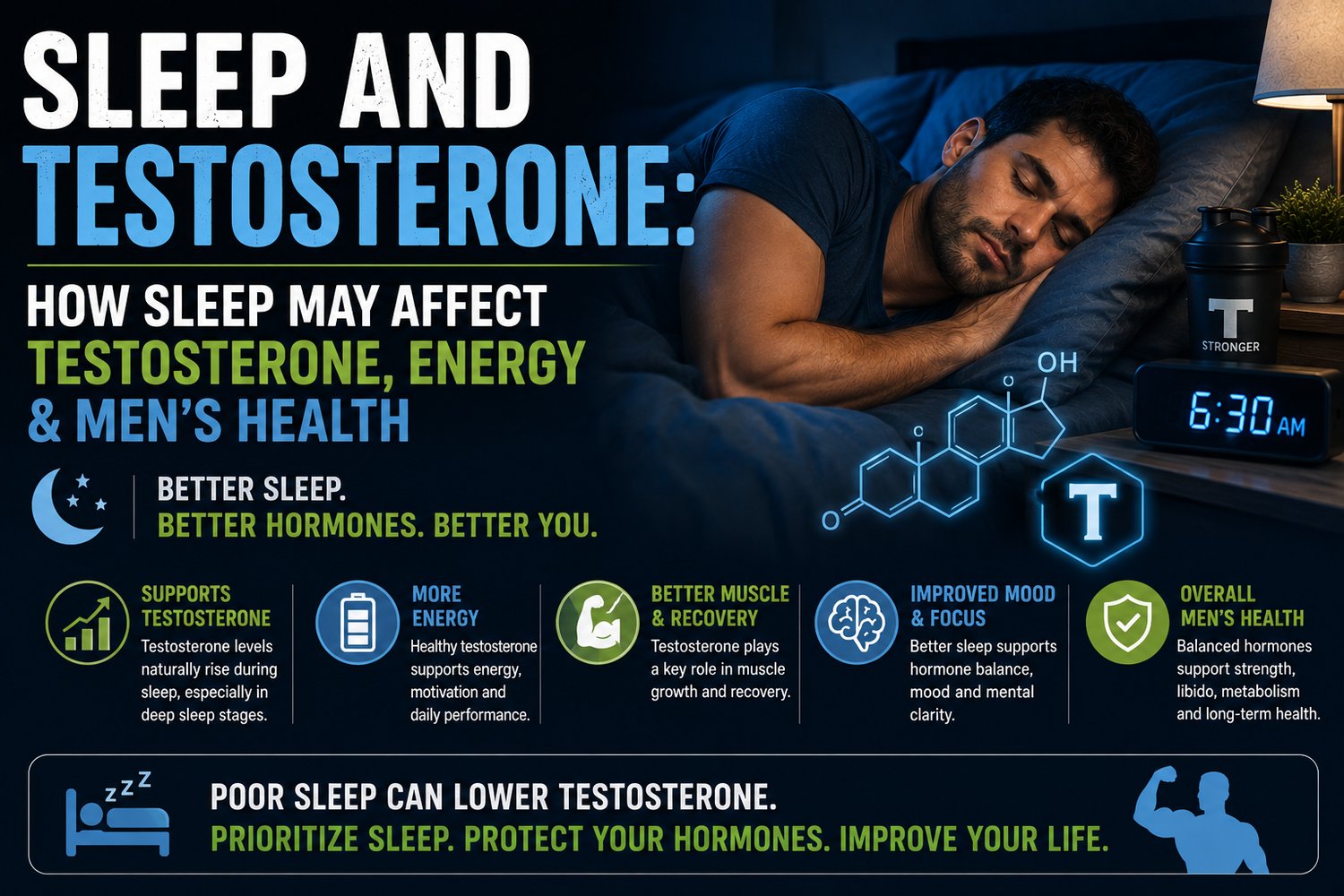
Sleep and Testosterone: How Sleep May Affect Testosterone, Energy & Men’s Health
The Complete Sleep & Recovery Guide
Testosterone gets blamed for a lot.
Low energy?
Testosterone.
Bad workout?
Testosterone.
Low motivation?
Testosterone.
Poor sleep?
Probably testosterone.
And sometimes hormones are part of the picture.
But sleep and testosterone have a more complicated relationship than:
sleep more = higher testosterone
or
low testosterone = bad sleep.
Research suggests that sleep duration and sleep quality can influence testosterone levels, and sleep disorders—especially obstructive sleep apnea—can complicate the picture further.
At the same time, fatigue, low energy and poor performance are not specific symptoms of low testosterone.
Poor sleep by itself can cause many of the same complaints.
So if you're exhausted, sleeping badly and wondering whether your testosterone is low, the smartest move is usually to look at both sides of the equation rather than jumping to a hormone conclusion.
Does Sleep Affect Testosterone?
Yes.
Testosterone secretion follows a daily rhythm, and sleep appears to play an important role in that pattern.
Testosterone levels tend to rise during sleep and are generally higher in the morning than later in the day.
Research has shown that sleep restriction can reduce daytime testosterone levels in men under controlled conditions.
One small but frequently cited study restricted healthy young men to around five hours of sleep per night for one week. Daytime testosterone levels fell by roughly 10–15% compared with their rested baseline. (jamanetwork.com)
That's meaningful.
But don't turn it into:
Sleeping five hours automatically lowers testosterone by exactly 15%.
The study involved only a small number of participants.
Still, it supports the broader idea that chronic short sleep can affect hormone regulation.
Testosterone Has a Daily Rhythm
Testosterone is not static.
Levels fluctuate throughout the day.
In most men, testosterone is generally highest in the morning and declines later.
That's one reason testosterone blood testing is often performed earlier in the day.
The Endocrine Society recommends measuring fasting morning total testosterone when evaluating possible testosterone deficiency and confirming low levels with a repeat morning measurement. (endocrine.org)
Sleep timing matters here because disrupted or irregular sleep can interfere with normal hormonal rhythms.
That is especially relevant for:
- Shift workers
- People with highly irregular schedules
- People sleeping very short nights
- People with untreated sleep disorders
How Does Sleep Influence Testosterone?
The exact relationship is complex.
Testosterone production is regulated through the hypothalamic-pituitary-gonadal axis, often abbreviated HPG axis.
Sleep influences several hormones and signaling systems involved in this process.
During normal sleep, testosterone rises and generally reaches higher concentrations during the night and early morning.
Disrupted sleep can alter that pattern.
Research suggests both:
sleep duration
and
sleep continuity
may matter.
So eight hours spent in bed with repeated awakenings is not necessarily the same as eight hours of consolidated sleep.
Poor Sleep Quality May Matter Too
People often focus only on hours.
But fragmented sleep can also affect hormonal regulation.
If you're repeatedly waking because of:
- Sleep apnea
- Alcohol
- Reflux
- Pain
- Nighttime urination
- Environmental noise
your sleep may not be as restorative even if you're technically spending enough time in bed.
This is one reason our guide What Is Sleep Quality? How to Know If You’re Actually Sleeping Well emphasizes quality and continuity, not just duration.
You need to look at the whole night.
Sleep Deprivation and Testosterone
Controlled sleep restriction studies provide some of the strongest evidence for a direct effect.
In the 2011 JAMA study mentioned earlier, one week of restricted sleep in healthy young men was associated with lower daytime testosterone concentrations. (jamanetwork.com)
That doesn't mean one late night tanks your testosterone.
The body is more resilient than that.
The bigger concern is:
Repeated short sleep
night after night
week after week.
Think:
chronic pattern
not
one bad Tuesday.
One Bad Night Is Not a Hormone Emergency
You slept four hours.
The next morning you feel:
Tired.
Weak.
Unmotivated.
Foggy.
Do not immediately conclude:
My testosterone crashed.
Those symptoms can happen from sleep loss alone.
A single rough night can impair:
- Alertness
- Mood
- Exercise performance
- Concentration
- Energy
without indicating chronic hormone deficiency.
You don't need to order bloodwork every time you sleep badly.
Fatigue Does Not Automatically Mean Low Testosterone
This is one of the biggest men's-health mistakes.
Symptoms often attributed to low testosterone can include:
- Low energy
- Reduced motivation
- Poor exercise recovery
- Reduced sex drive
- Mood changes
- Difficulty concentrating
But those symptoms are nonspecific.
They can also occur with:
- Poor sleep
- Sleep apnea
- Depression
- Stress
- Overtraining
- Calorie restriction
- Medication effects
- Anemia
- Thyroid problems
- Chronic illness
- Other causes
That's why diagnosis requires more than:
I feel tired.
The Endocrine Society recommends diagnosing hypogonadism only when a man has consistent symptoms and unequivocally and consistently low serum testosterone levels. (endocrine.org)
Symptoms alone aren't enough.
Poor Sleep Can Mimic “Low T” Symptoms
This is where things get confusing.
Imagine someone who:
Sleeps five and a half hours.
Snores heavily.
Wakes unrefreshed.
Drinks lots of caffeine.
Feels tired.
Lifts poorly.
Has low motivation.
Now they search:
low testosterone symptoms
and think:
That's me.
Maybe.
But poor sleep alone can explain a lot of that picture.
Before assuming hormones are the primary cause:
Look at sleep.
Low Testosterone Can Also Affect How You Feel
This doesn't mean low testosterone isn't real.
It is.
Men with genuine testosterone deficiency can experience symptoms involving:
- Sexual function
- Energy
- Body composition
- Mood
- Bone health
- Muscle mass
But those symptoms need to be interpreted in context.
HabitLogics already has a detailed guide to Low Testosterone Symptoms that goes much deeper into what low T can actually look like.
The important point here is:
Don't confuse symptom overlap with diagnosis.
Sleep Apnea Is a Huge Part of the Testosterone Conversation
This is probably the most important overlap between sleep and men's hormones.
Obstructive sleep apnea causes repeated breathing interruptions during sleep.
It is associated with:
- Fragmented sleep
- Oxygen drops
- Daytime sleepiness
- Cardiometabolic problems
- Hormonal changes
Research has repeatedly found associations between obstructive sleep apnea and lower testosterone levels, although obesity and other factors complicate the relationship. (pubmed.ncbi.nlm.nih.gov)
This creates a potential trap.
A man has:
Low energy.
Low libido.
Poor workouts.
Low testosterone on labs.
He assumes:
TRT fixes everything.
But he also snores loudly and stops breathing during sleep.
That sleep problem deserves attention too.
Obesity Can Confound the Relationship
Obstructive sleep apnea is more common in people with obesity.
Obesity itself is also associated with lower total testosterone in many men.
So when research finds:
sleep apnea + low testosterone
the relationship isn't always simple.
Is the lower testosterone related to:
Sleep fragmentation?
Low oxygen?
Obesity?
Metabolic dysfunction?
All of the above?
That's why researchers are careful not to reduce the relationship to one mechanism.
You should be too.
Signs Sleep Apnea Deserves Attention
Potential warning signs include:
- Loud habitual snoring
- Gasping
- Choking
- Witnessed breathing pauses
- Morning headaches
- Dry mouth
- Frequent nighttime waking
- Severe daytime sleepiness
- Waking unrefreshed despite enough time in bed
If several of those apply:
Talk with a healthcare professional.
Don't assume low energy means testosterone is the only problem.
Untreated sleep apnea can significantly affect health.
Can Treating Sleep Apnea Raise Testosterone?
This is where the evidence gets nuanced.
You might expect that treating obstructive sleep apnea with CPAP would reliably increase testosterone.
But meta-analyses have generally not found a consistent significant increase in testosterone after CPAP therapy alone. (pubmed.ncbi.nlm.nih.gov)
That's important because it prevents overpromising.
Treating sleep apnea is still valuable for many health reasons.
But don't frame CPAP as:
natural testosterone therapy.
Treat the sleep disorder because the sleep disorder matters.
Not because you're guaranteed a hormone boost.
Weight Loss May Affect Both Sleep Apnea and Testosterone
Weight management can interact with both sides.
For some men with overweight or obesity:
Weight loss may reduce sleep apnea severity.
It may also improve testosterone levels.
But again:
No guarantees.
And if someone already has significant sleep apnea, they should not simply wait for future weight loss before getting evaluated.
Treat current health problems appropriately.
Does More Sleep Raise Testosterone?
If you're chronically sleep deprived:
Improving sleep may help restore more normal physiology.
But that does not mean:
Every extra hour of sleep increases testosterone by X%.
Human hormonal systems do not work that neatly.
The strongest practical message is:
Chronic insufficient sleep can be unfavorable for testosterone regulation.
So if you're sleeping five hours per night, getting closer to your actual sleep need is reasonable.
If you're already sleeping eight solid hours:
Trying to force ten purely to "optimize testosterone" probably isn't necessary.
How Much Sleep Do You Need for Healthy Testosterone?
There isn't a special testosterone-specific sleep requirement.
General adult sleep recommendations still apply.
Healthy adults should generally get at least seven hours regularly, and many function better with more.
If you're:
Training hard.
Dieting.
Working physically.
Under substantial stress.
you may personally feel and recover better closer to eight hours or more.
The useful goal is:
adequate, good-quality, consistent sleep.
Not:
hit a testosterone sleep number.
Is Deep Sleep Important for Testosterone?
Testosterone increases during sleep, and sleep architecture matters.
But don't turn this into:
more deep sleep = more testosterone.
The relationship isn't that simple.
Your body cycles through multiple sleep stages.
And consumer wearables only estimate:
Deep sleep.
REM.
Light sleep.
If your watch says:
Deep sleep: 56 minutes
that is not a testosterone test.
Our guide Deep Sleep vs. REM Sleep: What’s the Difference & How Much Do You Need? explains why exact sleep-stage targets shouldn't become another health obsession.
Don't Use a Sleep Tracker to Diagnose Low Testosterone
Same principle.
A wearable cannot tell you:
Your testosterone is low.
It can help identify:
Short sleep.
Late bedtimes.
Frequent awakenings.
Resting heart-rate trends.
But testosterone deficiency requires actual clinical evaluation.
If symptoms are significant:
Get appropriate labs.
Don't reverse-engineer hormone status from your smartwatch.
Testosterone Testing Should Be Done Properly
Because testosterone varies across the day, timing matters.
The Endocrine Society recommends:
morning fasting total testosterone
for initial evaluation
and
repeat confirmation
when the first result is low. (endocrine.org)
That matters because one random afternoon lab doesn't automatically diagnose testosterone deficiency.
If you're investigating symptoms:
Do it properly.
HabitLogics' Testosterone Testing Guide explains the broader testing process.
Don't Diagnose Low T From One Lab
Hormones fluctuate.
Illness.
Sleep.
Calorie intake.
Medications.
Stress.
Time of day.
All can affect measurements.
That's why guidelines recommend repeat testing when testosterone is low.
The diagnosis is based on:
symptoms + consistently low testosterone
not
one number.
Poor Sleep Before a Testosterone Test Can Matter
Because sleep can affect hormone levels, a terrible night before testing may potentially influence the result.
That doesn't mean you should postpone every lab because you slept seven instead of eight hours.
But if you had:
Total sleep deprivation.
Acute illness.
Severe stress.
you should mention the context to your healthcare provider.
Clinical interpretation matters.
Does TRT Improve Sleep?
Not necessarily.
Testosterone replacement therapy is treatment for appropriately diagnosed hypogonadism.
It is not a general sleep treatment.
If poor sleep is being caused by:
Caffeine.
Insomnia.
Sleep apnea.
A terrible schedule.
TRT doesn't automatically fix those problems.
And in men with untreated severe obstructive sleep apnea, testosterone therapy requires particular caution.
The Endocrine Society recommends against starting testosterone therapy in men with untreated severe obstructive sleep apnea. (endocrine.org)
That is an important safety point.
Can TRT Worsen Sleep Apnea?
There is concern that testosterone therapy may worsen sleep-disordered breathing in some susceptible men, particularly in certain clinical contexts.
The evidence isn't perfectly straightforward, but major guidelines still advise caution around untreated severe obstructive sleep apnea. (endocrine.org)
So if you're considering TRT and you:
Snore loudly.
Gasp.
Wake exhausted.
Experience severe daytime sleepiness.
mention it to your healthcare provider.
Sleep should be part of the evaluation.
Don't Use TRT to Treat Fatigue Without a Diagnosis
This should be obvious.
But it's worth stating.
Fatigue is not a TRT indication by itself.
Neither is:
Low motivation.
Poor workout recovery.
Brain fog.
Feeling older.
These may be symptoms worth investigating.
They are not enough to diagnose testosterone deficiency.
A proper evaluation matters.
What About “Boosting Testosterone Naturally” With Sleep?
Sleep is absolutely one of the healthy lifestyle factors worth addressing.
But the phrase:
boost testosterone naturally
often gets stretched way too far.
Improving sleep may help normalize hormone regulation if sleep deprivation is part of the problem.
That does not mean:
Go from 7 to 9 hours and your testosterone doubles.
It won't.
Sleep is foundational.
Not magical.
Other Lifestyle Factors Matter Too
Testosterone levels can also be influenced by:
- Body composition
- Energy intake
- Severe calorie restriction
- Illness
- Medications
- Alcohol
- Exercise
- Age
- Metabolic health
That's why evaluating testosterone through one lifestyle factor alone is incomplete.
Sleep matters.
It isn't the whole story.
Severe Calorie Restriction Can Affect Hormones Too
This becomes particularly relevant during aggressive dieting.
If someone is:
Sleeping poorly.
Eating far too little.
Training hard.
Losing weight rapidly.
and
Feeling exhausted.
it may not make sense to attribute everything to testosterone.
The entire recovery system is under stress.
Our Sleep and Weight Loss: Can Poor Sleep Make Losing Weight Harder? guide explains why sleep and dieting behaviors can interact.
The goal is a sustainable system.
Not maximum stress from every direction.
Resistance Training Is Still Important
If you're concerned about:
Strength.
Muscle.
Body composition.
healthy aging.
resistance training matters regardless of testosterone optimization.
HabitLogics' Strength Training for Men Over 30 explains why maintaining strength and muscle becomes increasingly important as men age.
Sleep supports that process.
Training creates the stimulus.
Protein Matters Too
Same relationship.
Testosterone does not replace adequate nutrition.
Sleep does not replace protein.
Protein does not replace training.
You need the system.
The Complete High-Protein Guide covers practical ways to build a high-protein diet.
And our previous article, Sleep and Muscle Recovery: Why Sleep Matters for Strength, Performance & Muscle Growth, explains why sleep belongs alongside training and nutrition.
Can Poor Sleep Affect Libido?
Yes, potentially.
Sleep deprivation can affect:
Energy.
Mood.
Hormonal regulation.
And sexual function.
But libido is influenced by many factors beyond testosterone alone.
These include:
- Stress
- Relationship factors
- Medications
- Mental health
- Sleep
- Physical health
- Hormones
So:
low libido = low testosterone
is another oversimplification.
Investigate the full picture.
Erectile Dysfunction Is Not Automatically Low Testosterone Either
Erectile dysfunction can be influenced by:
- Vascular health
- Diabetes
- Medications
- Stress
- Anxiety
- Sleep apnea
- Hormonal factors
- Other medical conditions
Low testosterone can play a role in some men, especially when libido is also low.
But ED alone doesn't prove testosterone deficiency.
HabitLogics' Erectile Dysfunction Guide covers that broader picture.
Again:
Symptoms overlap.
Diagnosis matters.
Morning Erections and Sleep
Morning erections are related to normal nocturnal erectile physiology and often occur around REM sleep.
That means changes in sleep can affect when you notice them.
But presence or absence of morning erections is not a perfect home testosterone test.
Our Morning Erections Guide explains why they can provide some information about sexual physiology without functioning as a standalone diagnosis.
Better Sleep Helps More Than Testosterone
This is one of the most important points.
Suppose improving sleep doesn't dramatically change your testosterone level.
You may still gain:
Better energy.
Better training.
Improved mood.
Improved concentration.
Better appetite control.
Better recovery.
Less daytime sleepiness.
So don't treat sleep as worthwhile only if it moves a hormone number.
Sleep matters on its own.
A Better Way to Think About Sleep and Testosterone
Instead of:
How do I hack testosterone through sleep?
think:
Am I creating a healthy sleep environment that supports normal hormone regulation and overall health?
That means:
Enough sleep
Consistent sleep
Good sleep quality
Addressing sleep disorders
That's the foundation.
If You’re Tired, Start With the Obvious Questions
Before concluding:
Low T.
Ask:
How much am I sleeping?
Five hours is different from eight.
Do I wake repeatedly?
Fragmentation matters.
Do I snore?
Important.
Does anyone notice breathing pauses?
Very important.
Am I using alcohol or caffeine heavily?
Could affect sleep.
Am I dieting aggressively?
Could affect energy.
Am I overtraining?
Could affect recovery.
Am I depressed or highly stressed?
Could affect energy and motivation.
Have I actually had testosterone tested?
If not, you don't know.
That's a much better investigation.
Track Sleep Before You Blame Hormones
For 1–2 weeks, track:
Bedtime
Wake time
Nighttime awakenings
Morning energy
Daytime sleepiness
Training performance
Caffeine
Alcohol
Snoring or gasping if reported
Then ask:
Is sleep obviously poor?
If yes:
Address it.
If symptoms persist despite good sleep:
That's useful information too.
The FREE 7-Day Sleep Reset Can Help Establish the Baseline
If you're not sure whether sleep is part of the problem, the FREE 7-Day Sleep Reset | Sleep & Recovery Starter Kit gives you a simple way to track:
- Sleep timing
- Energy
- Evening habits
- Caffeine
- Recovery patterns
You don't need perfect data.
You need enough to answer:
Is poor sleep actually part of this?
Men’s Bloodwork Can Help Clarify the Bigger Picture
If you're investigating persistent:
Low energy.
Low libido.
Poor recovery.
Other hormone-related symptoms.
appropriate bloodwork may be part of the evaluation.
HabitLogics' Men’s Blood Work Guide explains common labs used to assess men's health beyond testosterone alone.
And if you're specifically trying to understand testosterone testing, use the Testosterone Testing Guide.
Don't reduce men's health to one hormone.
When Should You Talk to a Healthcare Professional?
Consider evaluation if you have:
- Persistent fatigue
- Low libido
- Erectile dysfunction
- Reduced strength or muscle mass
- Significant mood changes
- Persistent poor sleep
- Loud snoring
- Gasping during sleep
- Witnessed breathing pauses
- Excessive daytime sleepiness
- Consistently low testosterone results
A clinician can help distinguish:
Sleep problem.
Hormonal problem.
Both.
Or something else entirely.
That's much more useful than self-diagnosing from symptoms.
Frequently Asked Questions
Does sleep affect testosterone?
Yes.
Sleep plays a role in testosterone regulation, and experimental sleep restriction has been shown to reduce daytime testosterone levels in healthy men. (jamanetwork.com)
How much sleep do you need for testosterone?
There isn't a special testosterone-specific requirement.
Most adults should follow standard sleep recommendations and aim for enough good-quality sleep to function and recover well.
Can 5 hours of sleep lower testosterone?
Research has found lower daytime testosterone after one week of roughly five hours of sleep per night in healthy young men. (jamanetwork.com)
That does not mean every man will experience the exact same change.
Can one bad night lower testosterone?
Acute sleep loss can affect hormone regulation, but one bad night is not evidence of chronic testosterone deficiency.
Look at your long-term pattern.
Does sleep apnea lower testosterone?
Sleep apnea is associated with lower testosterone in some studies, although obesity and other factors complicate the relationship. (pubmed.ncbi.nlm.nih.gov)
Does CPAP increase testosterone?
Not consistently.
Meta-analyses generally have not found a significant testosterone increase from CPAP alone. (pubmed.ncbi.nlm.nih.gov)
CPAP should be used to treat sleep apnea, not as a testosterone-boosting strategy.
Can low testosterone cause fatigue?
Yes, fatigue can occur with testosterone deficiency.
But fatigue is nonspecific and can also result from poor sleep, sleep apnea, depression, medical conditions, medications and other causes.
Can poor sleep feel like low testosterone?
Absolutely.
Poor sleep can cause low energy, poor concentration, reduced training performance and low motivation—symptoms that overlap with low testosterone.
Should testosterone be tested in the morning?
Yes.
The Endocrine Society recommends morning fasting total testosterone testing when evaluating possible testosterone deficiency, with repeat confirmation if the result is low. (endocrine.org)
Can TRT improve sleep?
TRT is not a general sleep treatment.
If poor sleep is caused by insomnia, caffeine, an irregular schedule or sleep apnea, those problems need to be addressed directly.
Is TRT safe with sleep apnea?
Guidelines recommend caution. The Endocrine Society recommends against starting testosterone therapy in men with untreated severe obstructive sleep apnea. (endocrine.org)
Key Takeaways
Sleep and testosterone are connected.
But the relationship is not:
sleep more = endlessly higher testosterone.
The more useful picture is:
Chronic insufficient sleep may reduce testosterone regulation.
Poor sleep can mimic symptoms people often blame on low testosterone.
Sleep apnea can complicate both sleep quality and hormone health.
Fatigue alone does not diagnose low T.
Proper testosterone diagnosis requires symptoms plus consistently low laboratory values.
So if you're:
Tired.
Recovering poorly.
Low in motivation.
Concerned about testosterone.
start by asking:
Am I actually sleeping well?
Then:
Am I getting tested properly?
And:
Could a sleep disorder be part of the problem?
Don't chase one hormone while ignoring the system around it.
Sleep.
Training.
Nutrition.
Body composition.
Stress.
Medical health.
They all matter.
Track Sleep Before You Guess
For the next week, track:
sleep duration
nighttime awakenings
morning energy
daytime sleepiness
and
training recovery.
The FREE 7-Day Sleep Reset | Sleep & Recovery Starter Kit can help you establish that baseline.
For longer-term tracking, the Sleep Recovery Planner | Sleep Tracker and Energy Journal lets you monitor sleep, energy, caffeine and recovery patterns over time.
Related Sleep & Men’s Health Guides
Sleep and Muscle Recovery: Why Sleep Matters for Strength, Performance & Muscle Growth
Next in the Sleep & Recovery series:
The Complete Sleep & Recovery Guide: How to Sleep Better, Improve Recovery & Build Better Daily Habits
Medical Disclaimer: This article is for educational and informational purposes only and is not intended as medical advice, diagnosis or treatment. Testosterone deficiency, sleep apnea and persistent fatigue require proper clinical evaluation. Do not start, stop or change testosterone therapy or other prescribed treatment without guidance from a qualified healthcare professional.