

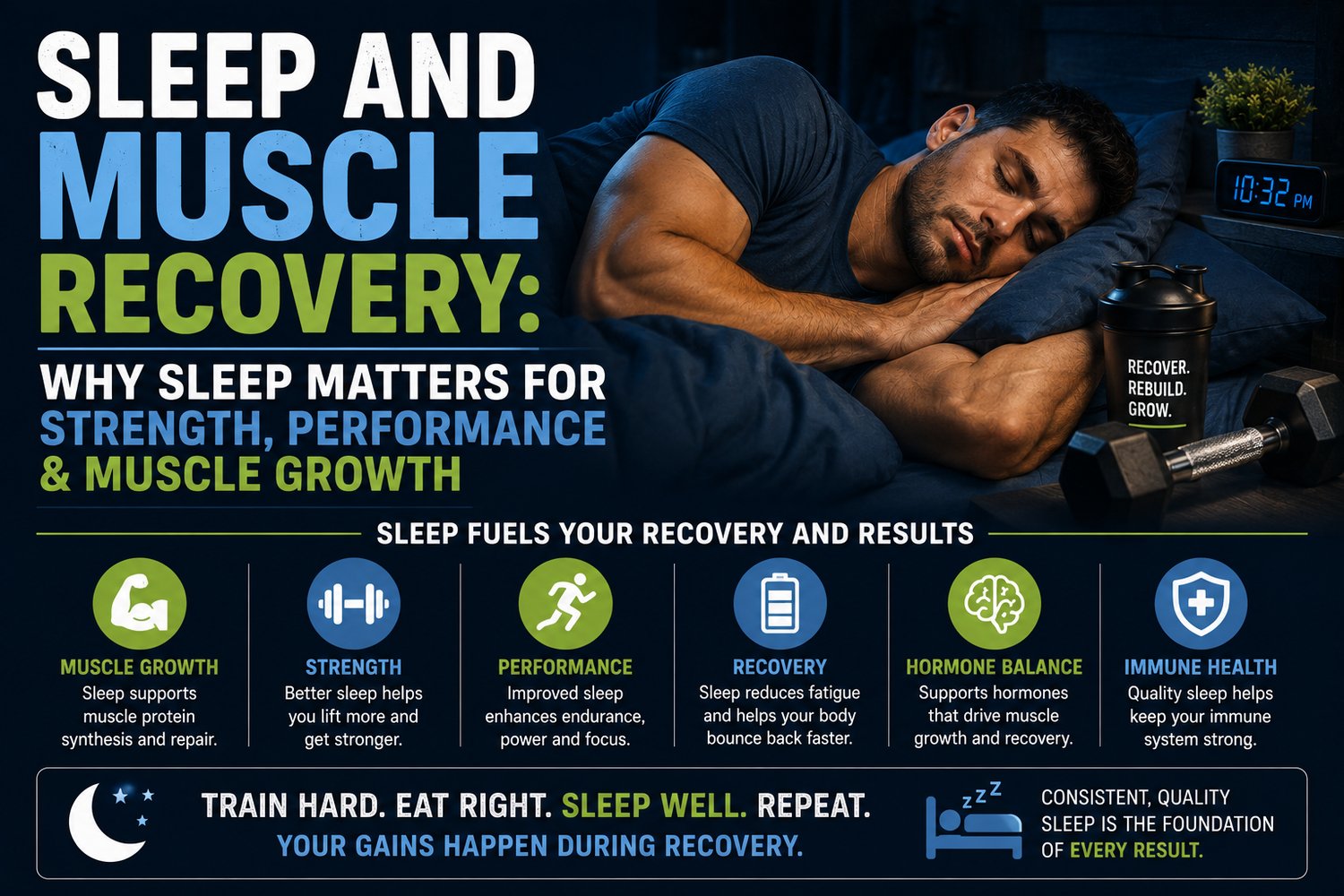
Sleep and Muscle Recovery: Why Sleep Matters for Strength, Performance & Muscle Growth
The Complete Sleep & Recovery Guide
Train hard.
Eat enough protein.
Recover.
Repeat.
Most people understand the first two.
The third one tends to get treated like an optional extra.
It isn't.
Sleep is one of the major recovery periods your body gets after training.
That doesn't mean muscle magically grows only while you're asleep.
And one rough night isn't going to erase months of progress.
But chronically poor sleep can affect several things that matter for training:
- Muscle protein synthesis
- Strength
- Perceived effort
- Exercise performance
- Recovery quality
- Training motivation
- Hormonal and metabolic responses
A 2025 systematic review found that sleep loss generally has detrimental effects on strength performance, although the size of the effect varies by task and study design.
Human experimental research has also shown that acute sleep deprivation can reduce skeletal-muscle protein synthesis.
So if you're trying to build or preserve muscle, sleep belongs in the plan.
Not because sleep is a secret muscle-building hack.
Because training creates the stimulus, nutrition supplies the raw materials, and recovery gives your body the opportunity to adapt.
Why Does Sleep Matter for Muscle Recovery?
Exercise creates stress.
Resistance training in particular challenges muscle tissue and the nervous system.
Afterward, your body begins adapting.
That process involves:
- Repairing damaged tissue
- Replenishing energy stores
- Remodeling muscle proteins
- Restoring nervous-system function
- Regulating inflammatory and hormonal responses
Sleep is part of the environment in which those processes occur.
The American College of Sports Medicine specifically includes adequate sleep as part of a well-rounded recovery approach alongside nutrition, hydration and activity.
That makes sleep a recovery habit—not simply a bedtime habit.
Muscle Growth Depends on More Than the Workout
A workout does not build muscle by itself.
The workout provides a stimulus.
Your body then adapts to that stimulus during recovery.
Very simplified:
Resistance training
↓
Muscle protein remodeling
↓
Recovery
↓
Adaptation
If the recovery side of the equation is consistently poor, you're making the process harder.
That doesn't mean:
Bad sleep = no gains.
It means sleep can influence how effectively your body responds to training.
What Is Muscle Protein Synthesis?
Muscle protein synthesis—often abbreviated MPS—is the process through which your body builds new muscle proteins.
Your muscle tissue is constantly undergoing:
protein synthesis
and
protein breakdown.
Over time, gaining muscle requires the balance to favor building enough new muscle tissue.
Resistance training and protein intake both strongly stimulate muscle protein synthesis.
Sleep may influence that process too.
Sleep Deprivation Can Reduce Muscle Protein Synthesis
One of the strongest pieces of human evidence comes from a randomized crossover study involving healthy young adults.
After one night of total sleep deprivation, researchers found a significant reduction in skeletal-muscle protein synthesis compared with a normal sleep condition.
The study involved only 13 participants, so we shouldn't turn it into a universal prediction.
But it provides direct human evidence that severe sleep loss can affect one of the processes involved in maintaining and building muscle.
That's much more compelling than simply saying:
Sleep is good for gains.
Several Nights of Restricted Sleep Can Matter Too
Researchers have also looked at repeated partial sleep restriction.
In one controlled study, participants were restricted to roughly four hours in bed per night for five nights.
The sleep-restricted group showed lower rates of myofibrillar protein synthesis compared with the normal-sleep condition. Interestingly, participants who performed high-intensity interval exercise during the restriction period maintained protein-synthesis rates closer to control levels.
Again:
This was a laboratory sleep-restriction protocol.
It does not mean sleeping six and a half hours one night will instantly shut down muscle growth.
What it does show is that repeated severe sleep restriction can alter skeletal-muscle biology.
One Bad Night Is Not a Muscle-Loss Emergency
This needs to be said immediately.
You slept terribly last night.
You did not wake up without your gains.
Your muscles did not vanish.
Your workout is not wasted.
The studies showing biological effects usually involve:
total sleep deprivation
or
multiple nights of substantial restriction.
Real life includes:
Occasional bad nights.
Travel.
Kids.
Stress.
Illness.
Late events.
You do not need perfect sleep every night to build muscle.
We're worried about the default pattern, not occasional disruption.
Chronic Poor Sleep Is the Bigger Problem
Consider these two people.
Person A
Usually sleeps 7½–8 hours.
Occasionally gets a bad night.
Person B
Sleeps 5–6 hours almost every night for years.
Those aren't remotely the same situation.
The second pattern is much more likely to create problems with:
Recovery.
Energy.
Training consistency.
Appetite.
Performance.
And potentially muscle-related adaptation.
Your goal isn't perfection.
It's avoiding chronic sleep deprivation.
Sleep Loss Can Affect Strength Performance
Sleep doesn't only affect what happens after a workout.
It can affect the workout itself.
A 2025 systematic review examining sleep deprivation and strength performance concluded that sleep loss generally impairs strength performance, although results vary depending on the movement, duration of sleep loss and study conditions.
An earlier review similarly found evidence that inadequate sleep can impair maximal strength, particularly during compound movements.
That matters because training quality drives adaptation.
If sleep loss causes you to repeatedly perform worse:
Less load.
Fewer reps.
Worse technique.
Lower motivation.
Higher perceived effort.
you may accumulate less useful training over time.
Not Every Type of Performance Declines Equally
Sleep research is messy.
Some studies show obvious performance declines.
Others show surprisingly little change.
A major review of sleep loss and exercise performance found that many types of performance appear impaired after sleep loss, but the effect varies substantially by task and circumstance.
Another review in military populations found stronger negative effects on aerobic capacity, muscular endurance and military-specific performance, while some strength measures were more resistant to sleep loss.
So avoid the claim:
One bad night reduces your strength by X percent.
The science doesn't support one universal number.
The safer takeaway:
Sleep loss can reduce physical performance, but how much depends on what you're doing.
Training Can Feel Harder When You're Underslept
This may matter as much as raw strength.
You know the feeling.
After good sleep:
The warm-up feels normal.
Weights move.
You feel motivated.
After terrible sleep:
The empty bar somehow feels disrespectful.
😂
Even if your maximum strength hasn't dramatically changed, the workout can feel harder.
That can affect:
- Motivation
- Training volume
- Exercise selection
- Willingness to push
- Technique
- Consistency
Repeated often enough, those behavioral effects matter.
Sleep and Nervous-System Recovery
Strength isn't purely muscular.
Your nervous system plays a major role in:
- Coordination
- Motor control
- Force production
- Reaction time
- Skill execution
Sleep loss can impair cognitive and motor performance as well as physical performance.
That matters for exercises requiring:
Technical skill.
Balance.
Coordination.
Heavy compound lifts.
Athletic movements.
You don't want your recovery plan to focus only on muscle tissue while ignoring the system controlling the muscles.
Sleep and Muscle Soreness
Does better sleep make soreness disappear?
No.
Delayed-onset muscle soreness—DOMS—is influenced by:
- Training novelty
- Exercise volume
- Eccentric loading
- Training intensity
- Recovery status
Sleep is one part of recovery.
It is not a guaranteed soreness cure.
Research looking specifically at sleep deprivation after exercise-induced muscle damage has produced nuanced results. One study found that total sleep deprivation altered inflammatory and hormonal responses but did not clearly delay recovery of maximal voluntary contraction.
That's a useful reminder:
Recovery is multi-dimensional.
Don't use soreness alone to judge whether your muscles have recovered.
Does Muscle Repair Happen During Deep Sleep?
You will often hear:
Your muscles repair during deep sleep.
There's some truth behind why people say this, but it can become oversimplified.
Deep or slow-wave sleep is associated with physiological processes involved in restoration, and anabolic hormone patterns vary across sleep stages.
But muscle recovery does not occur exclusively during one sleep stage.
Your body is continuously regulating:
Protein turnover.
Energy balance.
Hormones.
Inflammation.
Tissue repair.
throughout the day and night.
The better goal is:
Get enough overall sleep.
Not:
Maximize one stage on your watch.
Don't Chase Deep Sleep for Muscle Growth
This is worth emphasizing.
Your smartwatch may tell you:
Deep sleep: 47 minutes.
That does not automatically mean:
Poor recovery.
Consumer devices estimate sleep stages rather than measuring them directly using clinical polysomnography.
Our guide Deep Sleep vs. REM Sleep: What’s the Difference & How Much Do You Need? explains why chasing nightly stage targets isn't particularly useful.
Your better recovery indicators are:
Are you sleeping enough?
Are you waking reasonably refreshed?
Is performance stable or improving?
Are you recovering between workouts?
Can you train consistently?
That's the bigger picture.
How Much Sleep Do You Need for Muscle Recovery?
There isn't a universally prescribed:
muscle-building sleep number.
General adult sleep recommendations still apply.
The CDC recommends at least seven hours per night for adults ages 18–60, with age-specific ranges beyond that.
Many active people may personally feel and perform better with:
7½ hours
8 hours
or
more
depending on training load and individual sleep need.
Don't ask:
What is the minimum amount of sleep I can get away with while building muscle?
That's a strange recovery strategy.
Ask:
How much sleep lets me consistently recover, train well and function well?
Do Athletes Need More Sleep?
Sometimes.
Higher training loads create larger recovery demands.
Research reviews on sleep and athletic recovery suggest that extending sleep can improve some performance outcomes, particularly in individuals who were not previously getting enough.
That doesn't mean every recreational lifter needs ten hours.
An elite athlete training twice per day has a completely different recovery demand than someone lifting three evenings per week.
Match sleep to your actual life.
Sleep Extension Can Help When You're Underslept
This is an important distinction.
If you already sleep:
8–9 good hours
adding another two hours probably isn't some secret performance enhancer.
But if you regularly sleep:
5½–6 hours
then increasing sleep opportunity may provide a meaningful improvement in recovery and performance.
The low-hanging fruit matters most.
Don't optimize what isn't broken.
Can Naps Help Muscle Recovery?
Naps can be useful when nighttime sleep has been inadequate.
They may help:
- Reduce sleepiness
- Restore alertness
- Improve some aspects of performance
But naps shouldn't routinely replace adequate nighttime sleep if you have the ability to get it.
A huge late-afternoon nap can also make bedtime more difficult for some people.
Use naps strategically.
Not as a permanent workaround for a bad sleep schedule.
What About Sleeping After a Workout?
You don't need to fall asleep immediately after training.
Your body continues recovering for hours and days after a workout.
The useful goal is simply:
Get adequate sleep that night and across the rest of your training week.
You don't need to schedule:
Workout → protein → exactly 37 minutes → unconsciousness.
Recovery isn't that fragile.
Does Going to Bed Late After Training Hurt Gains?
Not because the clock says midnight.
The issue is usually:
Does going to bed late reduce your total sleep?
If you train at 8 p.m., stay up until 1 a.m. and still get eight hours because your schedule allows it:
That's very different from waking at 5:30 a.m.
Sleep timing matters for circadian health, but for many recreational lifters, the immediate recovery problem is simply not getting enough sleep.
Start there.
What About Evening Workouts?
Evening training does not automatically ruin sleep.
A systematic review found that evening exercise generally did not impair sleep in healthy adults, although vigorous exercise finishing within about an hour of bedtime may affect some sleep outcomes.
Our guide Exercise and Sleep: Can Working Out Help You Sleep Better? covers this in detail.
If you train at night and sleep well:
Great.
No problem to solve.
If evening workouts leave you wired:
Move them earlier if practical.
What About Training After a Bad Night?
This depends on how bad the night was.
Slightly Underslept
You may train normally.
Very Tired
Reduce volume or intensity.
Severely Sleep Deprived
Technique, judgment and performance may suffer.
It may make sense to perform:
A lighter session.
Walking.
Mobility.
Or simply recover.
You don't have to prove toughness every time you sleep poorly.
Autoregulate the Workout
One useful strategy is to adjust training based on readiness.
Suppose the program says:
5 sets of heavy squats.
But you:
Slept four hours.
Feel awful.
Warm-ups feel terrible.
Instead of forcing the planned session exactly, you could:
Reduce load.
Reduce volume.
Use a simpler movement.
Do an easier session.
Return to normal training after better recovery.
Consistency over months matters more than winning one miserable Tuesday.
Don't Use Caffeine to Completely Hide Sleep Deprivation
Caffeine can absolutely improve alertness and performance.
That's useful.
But there's a difference between:
Morning coffee
and
using 600 mg of caffeine to pretend chronic sleep deprivation doesn't exist.
Caffeine can mask sleepiness.
It doesn't replace recovery.
And excessive late-day caffeine can create another problem:
worse sleep tonight.
Then:
More caffeine tomorrow.
You've created a loop.
Our Caffeine and Sleep guide explains how to manage that tradeoff.
Protein Still Matters
Sleep cannot replace protein.
Protein cannot replace sleep.
You want both.
Resistance training increases the stimulus for muscle adaptation.
Adequate protein provides amino acids needed for muscle protein remodeling.
HabitLogics' Complete High-Protein Guide explains how to build a practical high-protein eating pattern without obsessing over perfection.
Recovery works best as a system:
Training
Protein
Enough calories
Sleep
Time
That's much more realistic than hunting for one secret variable.
Does Eating Protein Before Bed Help Muscle Recovery?
This is a legitimate area of research.
Studies have shown that protein consumed before sleep can be digested and absorbed overnight and can increase overnight muscle protein synthesis, particularly after evening resistance exercise.
A systematic review also concluded that pre-sleep protein can increase overnight muscle protein synthesis, although long-term effects depend on the broader training and dietary context.
That doesn't mean everyone needs a protein shake at 10 p.m.
Your total daily protein intake remains extremely important.
Pre-sleep protein is an optional strategy.
Not a requirement.
Don't Force Food Before Bed If It Hurts Your Sleep
Suppose pre-sleep protein gives you:
Reflux.
Bloating.
Discomfort.
Now you've created a sleep problem in the name of recovery.
That's not ideal.
If you want protein before bed:
Keep the serving comfortable.
Use a food you tolerate.
And remember:
You can distribute protein throughout the day.
No single timing window determines whether you build muscle.
Sleep Matters During Fat Loss Too
This becomes especially important when you're dieting.
You're already asking your body to:
Train.
Recover.
And maintain muscle
while consuming fewer calories.
Poor sleep adds another stressor.
Our previous article, Sleep and Weight Loss: Can Poor Sleep Make Losing Weight Harder?, explains how insufficient sleep may increase hunger and make weight-management behaviors harder to maintain.
During fat loss, the basic muscle-preservation system becomes:
Adequate protein
Resistance training
Reasonable calorie deficit
Recovery
Sleep
You don't want to neglect any of those if preserving muscle is a priority.
Sleep Matters More as Training Volume Increases
Someone doing:
Two light gym sessions per week
has different recovery demands from someone doing:
Five hard lifting sessions.
Running.
Sports.
Physical labor.
The harder and more frequently you train, the more important recovery management becomes.
That's why athletes often treat sleep as part of the training program rather than simply what happens after it.
You don't need to behave like an elite athlete.
But the principle still applies:
More stress requires more recovery.
Your Job Can Count as Physical Stress Too
Recovery isn't based only on gym workouts.
If you:
Work construction.
Stand all day.
Lift boxes.
Walk 20,000 steps at work.
Perform manual labor.
then your body is already accumulating physical stress before you ever enter the gym.
That matters.
Your weekly recovery demand is:
training + work + life
not simply:
sets and reps.
Sleep needs to support the whole load.
Psychological Stress Counts Too
Work deadlines.
Family problems.
Financial stress.
Poor mental health.
These don't create the same muscle damage as squats.
But they still affect recovery, sleep and perceived fatigue.
A program that's perfectly recoverable during a calm month may feel overwhelming during a stressful one.
Don't evaluate recovery in a vacuum.
Life matters.
Signs Your Recovery May Be Falling Behind
No single symptom proves you're under-recovered.
But pay attention to patterns such as:
- Persistent performance decline
- Workouts repeatedly feeling much harder
- Unusual fatigue
- Reduced motivation
- Soreness that seems excessive for your training
- Poor sleep
- Irritability
- Difficulty concentrating
One rough session doesn't mean anything.
Several weeks of declining performance plus poor sleep deserves attention.
How to Tell Whether Sleep Is the Problem
Track for two weeks.
Record:
Sleep duration
Morning energy
Workout performance
Training difficulty
Soreness
Caffeine
Training volume
Now look for trends.
Do poor-sleep nights repeatedly correspond with:
Lower performance?
Skipped workouts?
Higher perceived effort?
Worse recovery?
If yes:
Sleep may be one of your limiting factors.
Try Adding 30–60 Minutes of Sleep
If you're currently getting:
6 hours
and struggling with recovery:
Don't begin with supplements.
Try:
6½–7 hours.
Then possibly:
7–7½.
See what happens.
Look at:
Strength.
Energy.
Motivation.
Soreness.
Training consistency.
You may find the boring solution works pretty well.
You Don't Need Perfect Sleep to Make Progress
This is worth repeating.
People build impressive strength and muscle while:
Working shifts.
Raising kids.
Traveling.
Managing stressful jobs.
Living real lives.
The goal isn't:
8 hours and 43 minutes every single night.
It's:
Make adequate sleep your default whenever possible.
Perfect is unnecessary.
Chronic deprivation is what we're trying to avoid.
Build a Recovery Hierarchy
If muscle recovery is poor, I'd troubleshoot in roughly this order:
1. Training Load
Are you simply doing too much?
2. Sleep
Are you routinely underslept?
3. Calories
Are you eating enough to support your goal?
4. Protein
Are you getting enough consistently?
5. Stress
Is life overwhelming the training plan?
6. Hydration
Are basic needs being met?
7. Supplements
Only after the fundamentals.
People love starting at #7.
Usually not the best move.
Supplements Don't Fix Four Hours of Sleep
Recovery products are a massive industry.
You can buy:
Magnesium.
Creatine.
Tart cherry juice.
Electrolytes.
Adaptogens.
Sleep powders.
Recovery drinks.
None of those makes chronic severe sleep restriction a good recovery strategy.
Some supplements may have legitimate uses.
But fundamentals dominate.
Creatine Isn't a Substitute for Sleep Either
Creatine is one of the best-supported performance supplements available.
Still:
Creatine + 5 hours of sleep
isn't somehow equivalent to:
Creatine + adequate sleep.
Use evidence-based supplements if appropriate.
Just don't let them distract from the obvious stuff.
Walking Can Support Recovery Too
Not every recovery day requires complete inactivity.
Light walking can help you:
Stay active.
Get outside.
Reduce stiffness.
Maintain routine.
Without adding much training fatigue.
HabitLogics' Walking for Better Sleep: Can a Daily Walk Improve Sleep Quality? explains why walking fits so well into both sleep and recovery routines.
Some days:
walk + eat + sleep
is exactly what you need.
Your Sleep Environment Still Matters
You can understand recovery perfectly and still sabotage it with:
A hot bedroom.
Street noise.
Bright light.
Notifications.
A terrible sleep schedule.
If recovery is a priority, make sleep easy.
The Best Bedroom Environment for Sleep guide covers the practical environmental side.
Don't over-optimize.
Remove obvious friction.
A Simple Muscle-Recovery Sleep System
You don't need anything sophisticated.
Try:
Morning
Wake at a reasonably consistent time.
Get some daylight.
Day
Train appropriately.
Eat enough protein.
Stay hydrated.
Afternoon
Avoid escalating caffeine too late.
Evening
Eat normally.
Reduce stimulation.
Night
Give yourself enough sleep opportunity.
Repeat
That's not exciting.
It's very effective system design.
What About Rest Days?
Rest days are part of training.
They don't mean:
You failed to work hard enough.
Adaptation requires recovery.
Depending on your program, rest days can include:
- Walking
- Mobility
- Easy cycling
- Light recreational activity
- Nothing structured
Use them to arrive at the next hard session capable of actually training hard.
When Poor Recovery Deserves Medical Attention
Don't assume every fatigue problem is:
overtraining
or
bad sleep.
Talk with a healthcare professional if you experience:
- Severe unexplained fatigue
- Persistent muscle weakness
- Significant unexplained performance decline
- Excessive daytime sleepiness
- Loud snoring or gasping
- Persistent insomnia
- Unexplained weight loss
- Ongoing pain
- Other new or concerning symptoms
You shouldn't have to diagnose every recovery problem yourself.
Frequently Asked Questions
Does sleep help muscle recovery?
Yes.
Sleep is an important component of recovery, and inadequate sleep can affect strength performance and muscle-related biological processes.
How much sleep do you need for muscle growth?
There isn't a special muscle-growth sleep requirement.
Most adults should get at least seven hours regularly, and some active people may function and recover better with more.
Does lack of sleep reduce muscle growth?
Severe acute sleep deprivation and repeated sleep restriction have been shown in human studies to reduce skeletal-muscle protein synthesis.
That does not mean one bad night prevents muscle growth.
Can you build muscle on 6 hours of sleep?
Yes, it is possible.
But six hours is below general adult sleep recommendations, and chronic short sleep may make training, performance and recovery less favorable.
Does sleep increase muscle protein synthesis?
Normal sleep supports the overall environment for muscle recovery. Human studies have shown that severe sleep deprivation or restriction can reduce muscle protein synthesis.
Is deep sleep when muscles grow?
Muscle recovery isn't restricted to one specific sleep stage.
Deep sleep is involved in restorative physiology, but you shouldn't chase a precise deep-sleep target for muscle growth.
Does poor sleep reduce strength?
Research suggests sleep loss can impair strength performance, although the effect depends on the movement and degree of sleep loss.
Should I skip the gym after a bad night?
Not automatically.
For mild sleep loss, you may train normally.
If you're severely fatigued, reducing volume or intensity—or choosing a lighter activity—may be more sensible.
Does protein before bed help muscle growth?
Research shows that pre-sleep protein can increase overnight muscle protein synthesis, especially around resistance training.
It is optional, and total daily protein intake still matters greatly.
Is evening exercise bad for sleep?
Usually not.
Research generally does not support the idea that all evening exercise disrupts sleep, although vigorous exercise ending very close to bedtime may affect some people.
Key Takeaways
Muscle recovery does not come from:
training alone.
It comes from the full system.
Training provides the stimulus.
Protein and food provide the raw materials.
Recovery provides the opportunity to adapt.
And sleep is a major part of that recovery.
Poor sleep can affect:
Muscle protein synthesis
Strength
Training quality
Perceived effort
Motivation
and
overall recovery.
But don't panic over occasional bad nights.
The bigger problem is chronic sleep restriction.
So instead of asking:
What's the best recovery supplement?
start with:
Am I getting enough sleep?
Am I eating enough protein?
Am I training appropriately?
Am I giving my body enough recovery time?
Those basics will take you a long way.
Track Sleep Alongside Your Training
If you're trying to determine whether sleep is affecting your recovery, don't judge it from one workout.
Track for a couple of weeks.
Record:
Sleep duration
morning energy
training performance
soreness
caffeine
and
workout difficulty.
The FREE 7-Day Sleep Reset | Sleep & Recovery Starter Kit gives you a simple place to establish your sleep baseline.
For longer-term sleep and recovery tracking, the Sleep Recovery Planner | Sleep Tracker and Energy Journal lets you follow sleep, energy and routines over time.
Related Sleep & Recovery Guides
Exercise and Sleep: Can Working Out Help You Sleep Better?
Sleep and Weight Loss: Can Poor Sleep Make Losing Weight Harder?
Deep Sleep vs. REM Sleep: What’s the Difference & How Much Do You Need?
Walking for Better Sleep: Can a Daily Walk Improve Sleep Quality?
Next in the Sleep & Recovery series:
Sleep and Testosterone: How Sleep May Affect Testosterone, Energy & Men’s Health
Medical Disclaimer: This article is for educational and informational purposes only and is not intended as medical advice, diagnosis or treatment. Training and recovery needs vary by individual. Persistent fatigue, excessive daytime sleepiness, significant unexplained weakness, loud snoring, gasping during sleep or other concerning symptoms should be discussed with a qualified healthcare professional.