

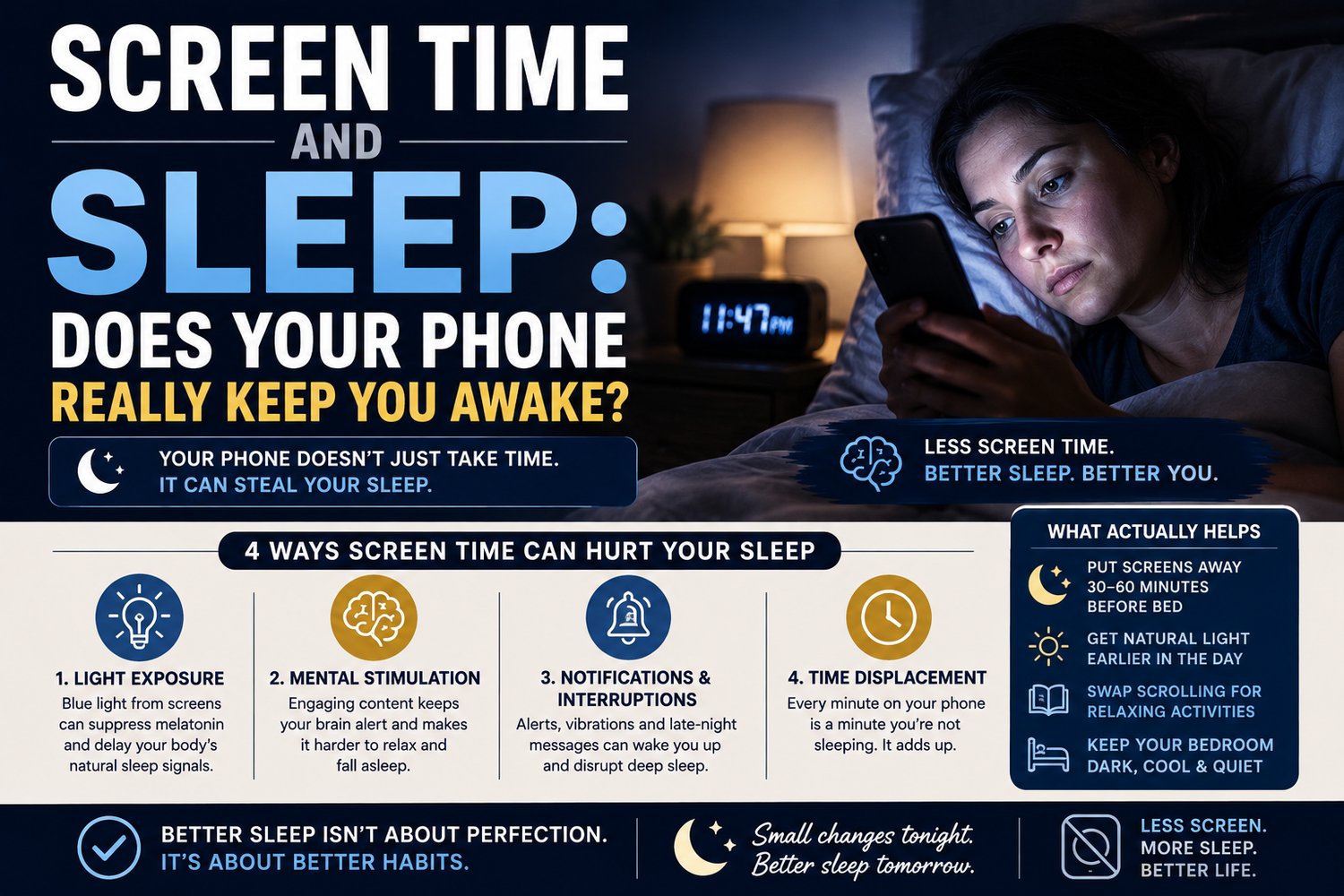
Screen Time and Sleep: Does Your Phone Really Keep You Awake?
The Complete Sleep & Recovery Guide
Your phone has become one of the easiest things in the world to blame for poor sleep.
Can't fall asleep?
Phone.
Tired in the morning?
Phone.
Bad deep-sleep score?
Probably the phone.
And there is a legitimate connection between screen use and sleep.
But the common explanation—
"Blue light from your phone destroys melatonin and ruins your sleep"
—is too simplistic.
Screens can interfere with sleep through several different mechanisms:
Light exposure
Mental stimulation
Notifications and interruptions
and probably the biggest one for many people:
They keep you awake longer than you intended.
The CDC currently recommends turning off electronic devices at least 30 minutes before bedtime as one practical healthy-sleep habit.
That's reasonable advice.
But you don't necessarily need to ban every screen after sunset.
Let's separate the real problems from the exaggerated ones.
Does Screen Time Really Affect Sleep?
It can.
Research has repeatedly found associations between screen use and poorer sleep outcomes.
In adults, bedtime mobile-phone use has been associated with worse sleep outcomes, while broader research in younger populations has linked device use with shorter sleep duration, delayed sleep timing and poorer sleep quality.
But "screen time" is a broad category.
Watching television from across the room at 8 p.m. is different from:
lying in bed at midnight
with a bright phone six inches from your face
while scrolling highly stimulating content.
That's why the useful question isn't simply:
Are screens bad?
It's:
How, when and why are you using them?
There Are Really Four Screen Problems
Instead of blaming one thing, think about four separate mechanisms.
1. Light
Screens emit light, including short-wavelength light that can influence circadian signaling.
2. Time Displacement
Every minute you spend scrolling instead of sleeping is a minute of sleep opportunity you've lost.
3. Mental Stimulation
What you're doing may keep your brain alert.
4. Interruptions
Notifications, sounds and vibrations can disturb sleep after you've already gone to bed.
For many people, all four overlap.
Problem #1: Light Can Affect Your Circadian System
Your circadian rhythm responds strongly to light.
Light during the daytime helps signal wakefulness.
At night, darkness helps support the transition toward sleep.
Research has shown that evening light exposure can suppress melatonin and alter circadian timing. Controlled laboratory research has also demonstrated effects from light-emitting electronic screens on melatonin and biological rhythms.
So yes:
Light from a screen can matter.
But that doesn't automatically mean your phone screen is the only—or even the biggest—light source affecting you.
Your room may also contain:
Bright overhead LEDs.
Television.
Computer monitors.
Lamps.
Bathroom lights.
Kitchen lights.
The larger issue is evening light exposure, not simply one glowing rectangle.
What Is Melatonin?
Melatonin is a hormone involved in signaling biological night.
Its production normally rises in the evening under appropriate conditions and helps coordinate circadian timing.
Light exposure during the biological night can suppress melatonin.
That doesn't mean:
Melatonin = sleeping pill produced by darkness.
Its role is more complicated.
But evening light can shift the signals your body uses to determine when nighttime has arrived.
This is why reducing bright evening light can make sense as part of a broader sleep routine.
Is Blue Light Really the Problem?
Partly.
But this topic has been dramatically oversimplified.
Short-wavelength light—often called blue light—has a particularly strong effect on the circadian system.
CDC/NIOSH guidance notes that blue wavelengths from LED lights and backlit screens can affect circadian rhythms and recommends avoiding these lights during sensitive periods when sleep problems are present.
Controlled research has also found that evening computer-screen exposure enriched in shorter wavelengths can suppress melatonin and alter biological rhythms.
So blue light is not imaginary.
But:
Blue light is not the entire screen-and-sleep story.
The Bigger Problem May Be That You're Still Awake
Imagine two people.
Person A
At 9:30 p.m., they read a few pages on a dim e-reader.
At 10 p.m., they put it down and sleep.
Person B
At 9:30 p.m., they open TikTok.
At 10:30 they're still scrolling.
At 11:15 they open Instagram.
At 11:45 they check email.
At 12:10 they're watching a video about how submarines make oxygen.
At 12:37:
Why am I tired every morning?
😂
For Person B, blue light isn't necessarily the main problem.
The phone just stole two and a half hours of sleep opportunity.
Research on bedtime technology use commonly identifies this time-displacement mechanism as one plausible way screens impair sleep.
That's a very practical problem.
And unlike your melatonin curve, it's easy to see.
Bedtime Procrastination Matters
Sometimes you're tired.
You know you should sleep.
But you keep scrolling anyway.
Why?
Because the phone provides:
Entertainment.
Novelty.
Social interaction.
News.
Games.
Work.
Shopping.
And nearly unlimited content.
There's always something else.
The result is often not:
I physically couldn't sleep.
It's:
I didn't stop being awake.
That distinction matters.
If your biggest issue is bedtime procrastination, you may not need a sophisticated light-management strategy.
You need a boundary.
Problem #2: Screens Can Keep Your Brain Alert
Screen content isn't neutral.
Compare:
Reading a boring article about municipal zoning rules.
with:
Watching a horror movie.
Arguing on social media.
Playing a competitive video game.
Checking work email.
Watching rapid-fire short-form videos.
Reading breaking news.
Those activities don't produce the same level of mental arousal.
Research on technology and sleep has proposed cognitive and emotional arousal as another mechanism linking device use with poorer sleep.
The device matters.
But so does what you're doing on it.
Doomscrolling Is Not a Relaxation Technique
You know the pattern.
You decide to relax before bed.
Then spend 45 minutes reading:
Political outrage.
War.
Crime.
Economic disasters.
Celebrity drama.
Internet arguments.
Suddenly your brain is extremely engaged.
Then you put the phone down and say:
Okay, sleep now.
Your brain may disagree.
A better wind-down activity is usually one that reduces stimulation rather than continually feeding you new information.
Work Screens Are Particularly Tricky
Your phone or laptop may not simply entertain you.
It may bring work directly into bed.
Checking one email can turn into:
A problem.
A response.
Another message.
Tomorrow's task.
An unfinished project.
Now you're mentally back at work.
This is one reason our How to Build a Better Bedtime Routine for Sleep guide recommends creating a clear endpoint to work before bedtime.
Sometimes the issue isn't the screen itself.
It's that the office followed you into bed.
Problem #3: Notifications Can Interrupt Sleep
Even if you fall asleep fine, your phone may continue doing phone things all night.
Buzz.
Light.
Ding.
Vibrate.
Another notification.
Maybe you don't fully wake.
Maybe you do.
Either way, this is one of the easiest sleep-environment problems to solve.
Use:
Do Not Disturb
Sleep Mode
Silent Mode
or
Charge the phone farther away.
You can usually allow emergency contacts through while silencing everything else.
Instagram can survive until morning.
Should You Keep Your Phone Out of the Bedroom?
You don't have to.
But for some people, it's a fantastic strategy.
Keeping the phone outside the bedroom can eliminate:
- Bedtime scrolling
- Notifications
- Middle-of-the-night checking
- Morning scrolling before getting up
The downside:
Many people use their phone as an alarm.
Easy solution:
Buy a cheap alarm clock.
You don't need to exile your phone if it isn't causing a problem.
But if every night begins:
I'll just check one thing...
then physical distance may be much more effective than willpower.
How Long Before Bed Should You Stop Using Screens?
The CDC currently recommends turning electronic devices off at least 30 minutes before bedtime.
That's a reasonable starting point.
You may benefit from longer if:
- Screens routinely delay your bedtime
- You're highly sensitive to evening light
- The content keeps you mentally stimulated
- You already have trouble falling asleep
You don't need to immediately impose:
NO TECHNOLOGY AFTER 7 P.M.
Try 30 minutes first.
See what happens.
Is One Hour Better Than 30 Minutes?
Possibly.
NIOSH guidance has recommended reducing light and backlit electronic screen use during the one to two hours before bed, especially when trying to facilitate sleep.
But your routine needs to be realistic.
If you currently scroll until the second you fall asleep, jumping to a two-hour phone ban may last approximately one evening.
Try:
30 minutes
Then perhaps:
45 minutes
Then:
60 minutes
if the extra separation seems useful.
Behavior you actually maintain beats an ideal rule you ignore.
What About Night Shift and Night Mode?
Most smartphones include features such as:
Night Shift
Night Light
Eye Comfort
or similar settings.
These reduce short-wavelength light and often make the display appear warmer.
That's not pointless.
Reducing short-wavelength exposure may reduce some circadian impact.
But don't make the mistake of thinking:
Orange screen = unlimited nighttime phone use.
The device can still:
Emit light.
Keep you awake.
Stimulate you.
Deliver notifications.
Steal time.
So night mode is best viewed as:
one small improvement
not:
permission to scroll until 2 a.m.
Do Blue-Light Glasses Work?
This is another area where marketing gets ahead of certainty.
Filtering short-wavelength light can theoretically reduce circadian stimulation under some conditions, and some experimental research has found effects from filtering or altering evening light spectra.
But blue-light glasses are not a substitute for:
putting the phone down.
If you're wearing amber glasses while watching videos until midnight instead of sleeping at 10:30, you've solved the smaller problem while preserving the larger one.
Priorities matter.
Is Watching TV Before Bed Bad?
Not automatically.
Television is usually viewed farther away than a phone or tablet.
And some people find a calm television show genuinely relaxing.
The bigger questions are:
Does TV delay your bedtime?
Does the content stimulate you?
Do you fall asleep with it playing all night?
Is the television bright enough to bother you?
If you watch one quiet show and go to bed normally:
Fine.
If you routinely say:
One more episode.
until 1 a.m.:
That's a sleep problem.
Not necessarily a television-light problem.
Is Reading on a Tablet Before Bed Bad?
It depends.
A bright tablet close to your face may provide significant evening light.
But content and timing also matter.
If you prefer digital reading:
- Lower brightness
- Use warmer display settings
- Keep the room dim
- Avoid reading much longer than intended
- Consider a non-backlit e-reader if you prefer
Again:
You don't need perfection.
What About E-Readers?
E-readers vary.
Some use reflected-light displays and may be less visually stimulating than brightly backlit phones or tablets.
Others include built-in front lighting.
If an e-reader allows you to read quietly without getting pulled into:
Email.
Social media.
Videos.
News.
Shopping.
That's already a practical advantage.
Sometimes the best technology is the one that does fewer things.
Is Social Media Worse Than Other Screen Use?
Potentially, depending on how you use it.
Social media is unusually good at:
- Encouraging endless scrolling
- Delivering emotionally engaging content
- Creating social comparison
- Triggering notifications
- Removing natural stopping points
A book has a chapter ending.
A television episode has credits.
A social feed essentially says:
There is no end. Good luck.
That makes it easy to displace sleep.
Does Screen Time Affect Deep Sleep?
This question comes up constantly because wearables now display sleep stages every morning.
Screen use can affect overall sleep timing and duration, and evening light can influence circadian physiology.
But don't reduce the problem to:
Phone = less deep sleep.
Your sleep stages are affected by many factors.
And consumer wearables estimate deep sleep rather than directly measuring it with clinical polysomnography.
If you're worried about your deep-sleep number, read Deep Sleep vs. REM Sleep: What’s the Difference & How Much Do You Need?.
Fix your overall sleep first.
Don't chase one stage.
The Best Screen Strategy Is Often Behavioral
Instead of obsessing over exact wavelength exposure, try these.
Set a "Phone Away" Time
Example:
10 p.m.
Your phone goes on charge.
Done.
Use Do Not Disturb Automatically
Schedule it every night.
Remove the decision.
Charge the Phone Outside Arm's Reach
Even across the room is better than:
directly next to your face.
Remove the Most Addictive Apps From Your Home Screen
Make mindless scrolling slightly less automatic.
Stop Work Notifications at Night
Unless your job genuinely requires them.
Use an Alarm Clock
This removes the classic excuse:
I need my phone next to me because it's my alarm.
Problem solved for about $12.
Try the 30-Minute Screen Experiment
Instead of debating whether screens ruin sleep:
Test it.
For seven nights:
Turn off recreational screens 30 minutes before bedtime.
Use that time for:
- Reading
- Showering
- Preparing tomorrow
- Stretching
- Quiet music
- Talking with your partner
- Literally doing nothing
Track:
- Bedtime
- Difficulty falling asleep
- Nighttime awakenings
- Morning energy
- Whether you actually went to bed earlier
Then compare.
If your sleep improves:
Useful.
If nothing changes:
Also useful.
Then Test 60 Minutes If Needed
If 30 minutes helps—or if you're still struggling—try extending the window.
You may discover that:
30 minutes is enough.
or:
An hour works noticeably better.
or:
Screen timing doesn't seem to matter much, but late caffeine does.
That's exactly why tracking beats generic rules.
What If You Need Screens at Night?
Maybe you work late.
Maybe you're studying.
Maybe your family communicates through your phone.
Maybe you aren't going to stop watching TV at night.
Fine.
You can still reduce the downside.
Try:
- Lowering brightness
- Using warmer display settings
- Reducing unnecessary overhead lighting
- Avoiding highly stimulating content right before bed
- Silencing notifications
- Stopping screens when your actual wind-down begins
Health advice needs to survive contact with real life.
Don't Turn Screen Rules Into Another Sleep Obsession
This is important.
You don't need to panic because you checked one text at 10:14 p.m.
Your sleep is not ruined.
The goal is to improve the overall pattern.
A rule like:
No recreational phone use during the final 30 minutes before bed
is useful because it's simple.
A rule like:
If I accidentally see blue light after 9:03 p.m., tonight is destroyed
is not.
We're trying to reduce sleep anxiety.
Not create a new version of it.
Screens Are Only One Part of Sleep Hygiene
If your phone is fine but you're:
Sleeping five hours.
Drinking caffeine at 7 p.m.
Using alcohol every night.
Keeping your bedroom at 80 degrees.
Waking at random times.
then screen time probably isn't your highest priority.
Our Sleep Hygiene: What It Is, What Actually Works & What’s Overrated guide covers the larger picture.
Fix the largest leak first.
Pair Screen Changes With a Real Bedtime Routine
Removing your phone creates a question:
Now what?
That's why screen boundaries work best as part of a routine.
For example:
9:45 p.m. — Phone on charger.
9:50 — Shower.
10:05 — Prepare tomorrow.
10:15 — Read.
10:30 — Bed.
That's much easier than:
9:45 p.m. — Phone forbidden. Sit quietly and contemplate existence for 45 minutes.
😂
Our How to Build a Better Bedtime Routine for Sleep shows how to build that transition.
Don't Forget Morning Light
There's another side to the light equation.
Reducing bright evening light may help support nighttime signaling.
Getting appropriate daytime light, especially earlier in your day, also helps reinforce the difference between day and night.
That's why Morning Habits for Better Sleep: Why Your Daytime Routine Matters at Night emphasizes morning and daytime light exposure.
Think:
Bright day.
Dimmer evening.
Dark night.
That's a much more useful circadian principle than becoming terrified of every blue pixel.
Track Screen Time Alongside Sleep
You don't need perfect screen-time data.
Just record:
Last major screen use
Bedtime
Approximate sleep duration
Difficulty falling asleep
Morning energy
You may discover:
Your phone routinely delays bedtime by 45 minutes.
That's actionable.
Or:
You stop screens early but still can't sleep.
That tells you to investigate something else.
The FREE 7-Day Sleep Reset | Sleep & Recovery Starter Kit gives you a simple framework for tracking sleep and evening habits for one week.
Longer-Term Tracking Can Help Too
If you're trying to build a consistent evening routine over several weeks, the Sleep Recovery Planner | Sleep Tracker and Energy Journal lets you track sleep, energy, caffeine and evening routines using a fillable PDF and Excel dashboard.
That can help answer:
Am I actually getting off my phone earlier?
Is bedtime becoming more consistent?
Is my morning energy improving?
The point isn't to track screen time forever.
It's to learn enough to change the behavior.
What About Kids and Teenagers?
Screen use deserves even more attention in younger people.
A systematic review of school-age children and adolescents found that screen time was associated with poorer sleep outcomes—especially shorter sleep duration and later sleep timing—in the large majority of studies reviewed.
A later meta-analysis also found that access to or use of portable media devices around bedtime was associated with inadequate sleep, poorer sleep quality and excessive daytime sleepiness in children and adolescents.
More recent CDC data continue to note associations between high screen use and poor sleep-related outcomes among teenagers.
That doesn't mean technology must disappear.
But bedtime boundaries can be especially useful for children and teens.
When Screen Changes Won't Fix Your Sleep
Putting your phone away is not treatment for every sleep problem.
If you have:
- Persistent insomnia
- Severe daytime sleepiness
- Loud snoring
- Gasping during sleep
- Repeated unexplained awakenings
- Significant fatigue despite adequate sleep opportunity
don't assume screens are the only cause.
You may need proper medical evaluation.
A phone cutoff can't fix untreated sleep apnea.
Frequently Asked Questions
Does screen time affect sleep?
It can.
Screen use may affect sleep through evening light exposure, delaying bedtime, increasing mental stimulation and creating nighttime interruptions. Research has associated bedtime device use with poorer sleep outcomes in both adults and younger populations.
How long before bed should I stop using my phone?
The CDC recommends turning off electronic devices at least 30 minutes before bedtime.
If you're still struggling, experiment with a longer 60-minute wind-down period.
Is blue light from phones bad for sleep?
Short-wavelength light can influence circadian signaling and melatonin, especially during sensitive evening periods.
But light is only one reason screens can affect sleep.
The device may also keep you awake or mentally stimulated.
Does night mode make phones safe before bed?
Night mode may reduce short-wavelength light, but it doesn't eliminate every potential sleep issue.
You can still stay awake too long, consume stimulating content and receive notifications.
Think of night mode as helpful—not magical.
Should I wear blue-light glasses at night?
Filtering short-wavelength light may reduce some evening light exposure, but glasses aren't a replacement for good sleep habits.
If your phone keeps you awake two hours past bedtime, putting it down is probably the higher-impact change.
Is watching TV before bed bad?
Not necessarily.
If television relaxes you and doesn't delay bedtime, it may not be a major problem.
If you repeatedly stay awake watching additional episodes or sleep with bright television running all night, it's worth changing.
Is reading on a phone before bed bad?
It may be more stimulating or brighter than other reading methods.
If you prefer digital reading, reduce brightness, use warmer settings and avoid getting distracted into other apps.
Should I leave my phone outside the bedroom?
You don't have to.
But it can be useful if scrolling, notifications or nighttime checking are regularly interfering with sleep.
Does screen time reduce melatonin?
Evening light, particularly short-wavelength light, can suppress melatonin under experimental conditions.
The actual effect of normal screen use depends on factors including brightness, distance, duration and surrounding light.
What is worse for sleep: blue light or scrolling?
For many people, time displacement may be the bigger practical problem.
If your phone keeps you awake an hour longer than intended, that lost hour of sleep opportunity matters regardless of the screen's color setting.
Key Takeaways
Yes, your phone can interfere with sleep.
But not because screens contain some mysterious sleep-destroying force.
There are several possible problems:
Light can affect circadian signaling.
Content can keep your brain stimulated.
Notifications can interrupt sleep.
And most importantly:
Screens can keep you awake when you should already be sleeping.
So don't make this more complicated than necessary.
Try:
Stop recreational screens 30 minutes before bed.
Dim evening lighting.
Use Do Not Disturb.
Keep the phone out of arm's reach if you keep scrolling.
Use night mode if you want—but don't treat it like a free pass.
Then track what happens.
If your sleep improves:
Keep doing it.
If it doesn't:
Move on to the next likely problem.
That's how you improve sleep without turning your phone into the villain of your entire life.
Try a 7-Day Screen Cutoff
For the next week, pick a simple rule:
No recreational phone use during the final 30 minutes before bed.
Then watch your bedtime and morning energy.
The FREE 7-Day Sleep Reset | Sleep & Recovery Starter Kit gives you a structured way to track your sleep, evening routine and daily habits while you run the experiment.
For longer-term tracking, the Sleep Recovery Planner | Sleep Tracker and Energy Journal can help you monitor sleep, energy, caffeine and evening-routine consistency over time.
Previously in the Sleep & Recovery series:
What Is Sleep Quality? How to Know If You’re Actually Sleeping Well
How Much Sleep Do You Need? A Practical Guide by Age & Lifestyle
Sleep Stages Explained: REM, Deep Sleep & What Happens While You Sleep
Deep Sleep vs. REM Sleep: What’s the Difference & How Much Do You Need?
How to Sleep Better Naturally: 12 Habits That Actually Matter
Sleep Hygiene: What It Is, What Actually Works & What’s Overrated
How to Build a Better Bedtime Routine for Sleep
Morning Habits for Better Sleep: Why Your Daytime Routine Matters at Night
The Best Bedroom Environment for Sleep: Temperature, Light, Noise & Comfort
Caffeine and Sleep: How Long Does Caffeine Last & When Should You Stop Drinking It?
Next in the Sleep & Recovery series:
Eating Before Bed: Does Late-Night Eating Affect Your Sleep?
Medical Disclaimer: This article is for educational and informational purposes only and is not intended as medical advice, diagnosis or treatment. Persistent insomnia, excessive daytime sleepiness, loud snoring, gasping during sleep or other concerning sleep symptoms should be discussed with a qualified healthcare professional.