

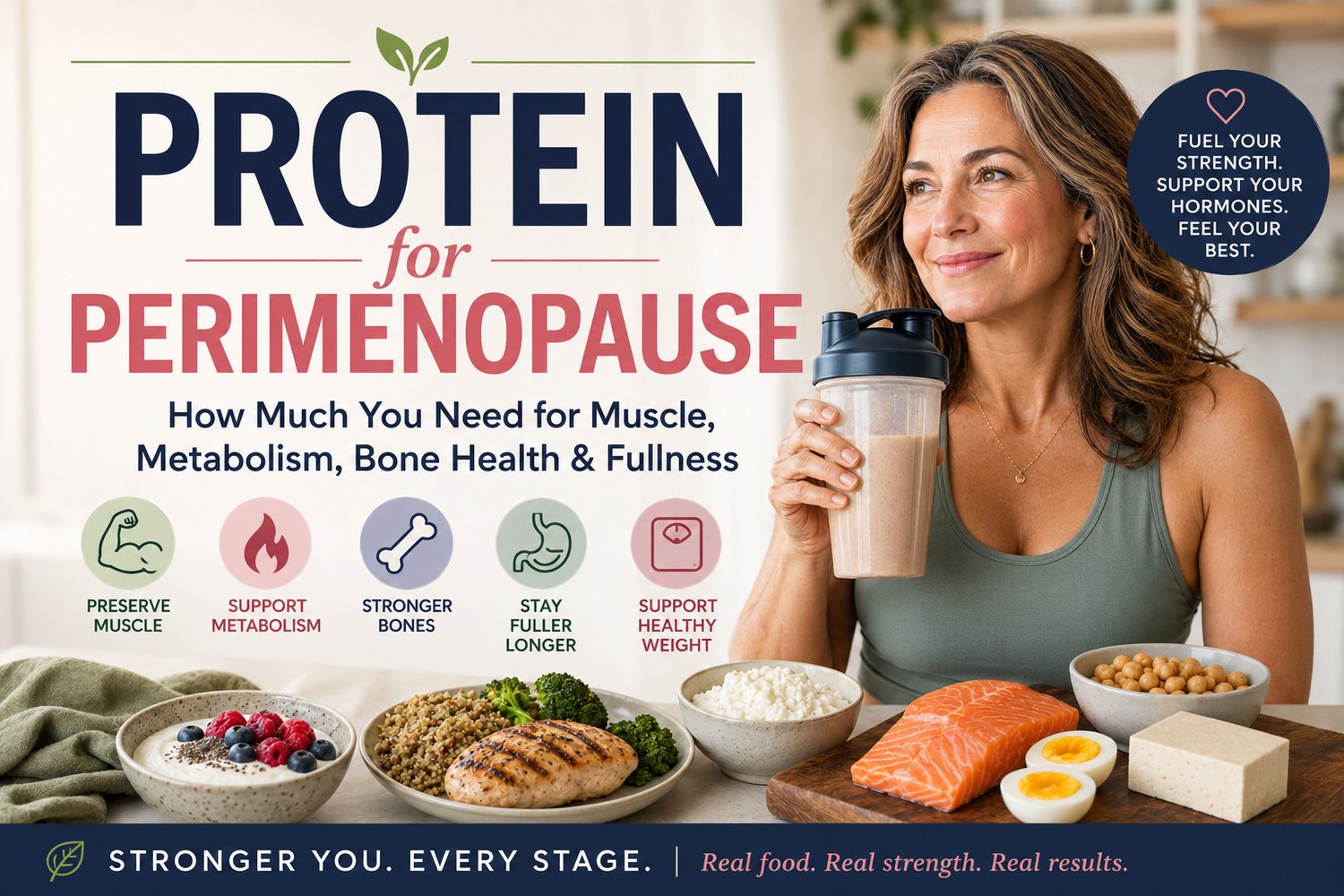
Protein During Perimenopause: How Much Do You Need for Muscle, Fullness & Healthy Aging?
Protein during perimenopause matters primarily because midlife is a time when preserving muscle, strength, bone health, and physical function becomes increasingly important.
But let's clear up one thing immediately:
Perimenopause does not create one special protein requirement that every woman must hit.
You may see recommendations ranging from the standard adult 0.8 grams per kilogram of body weight all the way to very high bodybuilding-style targets.
The useful answer sits somewhere between “the RDA is all anyone ever needs” and “every woman over 40 needs 150 grams a day.”
For many healthy midlife women, a practical intake around 1.0–1.2 grams of protein per kilogram of body weight per day is a reasonable range to discuss, particularly when maintaining muscle and strength is a priority.
Some women may benefit from more.
Others may need less or require individualized guidance because of kidney disease, total calorie needs, body size, activity, or other medical factors.
And protein works best when paired with the thing that gives your body a reason to maintain muscle:
resistance training.
For the broader nutrition picture, read Best Diet for Perimenopause: What to Eat for Weight, Muscle, Bone & Heart Health.
Why Protein Matters During Perimenopause
Protein matters throughout life.
It doesn't suddenly become important because estrogen starts fluctuating.
What changes is the context.
During midlife, several things may overlap:
- Age-related loss of muscle
- Changes in body composition
- Lower physical activity
- Intentional weight loss
- Changes in exercise habits
- Menopause-related changes
- Greater importance of maintaining bone and physical function
Protein provides the amino acids your body uses to maintain and repair muscle and other tissues.
Adequate intake can support:
- Muscle maintenance
- Recovery from exercise
- Fullness
- Weight-management efforts
- Bone health as part of a complete diet
- Long-term physical function
But protein is not:
- A menopause treatment
- A metabolism hack
- A fat burner
- A hormone-balancing nutrient
- A guarantee against muscle loss
It is one part of a bigger strategy.
Does Perimenopause Cause Muscle Loss?
This needs nuance.
Muscle mass tends to decline gradually with age.
The menopause transition may contribute to changes in body composition and muscle quality, but it happens at the same time as changes involving:
- Aging
- Physical activity
- Diet
- Body weight
- Health
- Exercise habits
So I wouldn't reduce midlife muscle loss to:
“Low estrogen eats your muscle.”
That's too simplistic.
What matters practically is that preserving muscle becomes increasingly important as you move through midlife.
And two of the strongest tools you have are:
resistance training + adequate protein.
Why Strength Training Matters as Much as Protein
Eating more protein without challenging your muscles isn't the same as having a muscle-preservation plan.
Resistance training tells your body:
“We still need this tissue.”
Protein supplies the amino acids used to repair and maintain it.
Research consistently shows that protein and resistance training work well together, with increased protein intake producing modest additional benefits for lean mass and strength in people performing resistance exercise.
In other words:
Protein supports the adaptation.
Training creates the reason to adapt.
You don't need to become a bodybuilder.
A useful resistance program might include:
- Squats or chair stands
- Rows
- Push-ups or chest presses
- Hip hinges
- Step-ups
- Overhead presses
- Loaded carries
For the full training strategy, read Strength Training During Perimenopause: Benefits, Workouts & How to Start.
How Much Protein Do Women Need During Perimenopause?
There isn't one number that applies to every woman.
Protein needs can vary based on:
- Body size
- Age
- Activity
- Resistance training
- Total calorie intake
- Weight-loss goals
- Health
- Kidney function
- Food preferences
The Adult RDA: 0.8 g/kg
The standard adult Recommended Dietary Allowance for protein is:
0.8 grams per kilogram of body weight per day
That is the amount designed to meet the needs of nearly all healthy adults and prevent inadequacy.
It should not automatically be interpreted as:
“the perfect intake for maximizing muscle preservation in every active midlife adult.”
Those are different questions.
A Practical Midlife Range: About 1.0–1.2 g/kg
Healthy-aging guidance often discusses protein intakes around:
1.0–1.2 grams per kilogram per day
for supporting muscle and physical function.
The Menopause Society currently suggests approximately 1.2 g/kg/day in its midlife weight-management guidance.
That makes 1.0–1.2 g/kg a useful practical range for many healthy midlife women.
It is not a mandatory medical prescription.
How Do You Calculate Protein Needs?
First convert pounds to kilograms:
Body weight in pounds ÷ 2.2 = kilograms
Then multiply that number by your target.
For example, someone weighing 165 pounds weighs approximately 75 kilograms.
At:
0.8 g/kg: about 60 g/day
1.0 g/kg: about 75 g/day
1.2 g/kg: about 90 g/day
So for this example, moving from the standard RDA to a practical midlife target might mean roughly:
60 grams → 75–90 grams per day
Not:
60 grams → 180 grams because TikTok said women over 40 need their goal bodyweight in protein.
Context matters.
Should You Use Current Weight or Goal Weight?
This is where simple gram-per-kilogram formulas can become awkward.
For someone living in a larger body, multiplying current weight by a higher protein target can produce a number that is unnecessarily high or difficult to use.
A dietitian or healthcare professional may instead consider:
- Goal body weight
- Adjusted body weight
- Lean body mass
- A fixed practical range
- Meal-based targets
There is no benefit in producing a mathematically impressive protein target you can't realistically eat.
The calculation is a tool.
It's not a law.
Do Active Women Need More Protein?
Potentially.
Women who:
- Strength train regularly
- Perform significant endurance exercise
- Are intentionally losing weight
- Are trying to preserve or build muscle
may benefit from protein intake toward the higher end of a reasonable range.
That still doesn't mean more is endlessly better.
Once protein needs are adequately covered, additional calories may be more useful coming from:
- Carbohydrates for training
- Healthy fats
- Fruits
- Vegetables
- Other nutrient-dense foods
Protein is important.
It doesn't need to consume the entire diet.
Should You Eat More Protein While Losing Weight?
This is one of the situations where higher protein intake can be particularly useful.
When you lose weight, you generally lose a combination of:
- Fat
- Water
- Lean tissue
The goal is usually to lose as much excess fat as practical while preserving as much muscle as possible.
Adequate protein and resistance training both help support that goal.
Protein can also increase fullness, which may make a calorie deficit easier to maintain.
That's why protein deserves extra attention during intentional weight loss.
Read Perimenopause Weight Gain: Why It Happens, Belly Fat & What Actually Helps.
Protein Does Not Cancel Calories
This sounds obvious, but high-protein weight-loss marketing occasionally forgets it.
Protein can support:
- Fullness
- Muscle preservation
- Dietary structure
But adding a 400-calorie protein shake on top of a diet that already meets your protein needs doesn't somehow become calorie-free because the bottle says 30g PROTEIN in giant letters.
Sometimes the better strategy is substitution.
Instead of:
pastry → plus protein shake
you might choose:
Greek yogurt + fruit + oats
or:
eggs + whole-grain toast + fruit
Protein works within the overall diet.
Should You Spread Protein Across the Day?
Probably.
Many people eat something like:
Breakfast: 8 grams
Lunch: 15 grams
Dinner: 55 grams
The total may be decent, but spreading protein more evenly throughout the day can make intake easier and may better support repeated muscle-protein synthesis.
You don't need to eat protein every two hours.
A practical approach is simply:
include a meaningful protein source at breakfast, lunch, and dinner.
Depending on your overall needs, snacks can fill gaps.
How Much Protein Should You Eat at Each Meal?
There isn't one mandatory number.
For many women, something in the neighborhood of 20–30 grams per meal can be a practical way to distribute a daily target.
Someone with higher total protein needs may choose somewhat larger servings.
Someone smaller or less active may need less.
The more important principle is:
Don't make dinner responsible for your entire protein intake.
What Does 20–30 Grams of Protein Look Like?
Approximate amounts vary by brand and serving size, but practical examples include:
- 3–4 oz chicken
- 3–4 oz fish
- 1 cup Greek yogurt plus toppings
- Cottage cheese with fruit
- Eggs combined with additional egg whites
- Tofu or tempeh in a substantial serving
- Lentils or beans combined with other protein-containing foods
- A protein shake when convenient
You don't need every meal to land on exactly 27.4 grams.
Close enough works.
Breakfast Is Usually the Easiest Place to Improve
Breakfast is often the lowest-protein meal.
Common options such as:
- Toast
- Cereal
- Fruit
- Pastries
- Oatmeal made with water
may contain some protein but often not very much.
Easy upgrades include:
- Greek yogurt with berries and oats
- Eggs with whole-grain toast
- Cottage cheese with fruit
- Overnight oats made with Greek yogurt
- Oatmeal made with milk or soy milk
- Eggs plus egg whites
- A smoothie with a useful protein source
The goal isn't to force down a steak at 7 a.m.
It's to avoid accidentally reaching lunchtime having consumed approximately six grams of protein.
Good Animal-Based Protein Sources
Animal foods can be convenient sources of high-quality protein.
Options include:
- Chicken
- Turkey
- Eggs
- Salmon
- Tuna
- Shrimp
- White fish
- Lean beef
- Greek yogurt
- Cottage cheese
- Milk
- Cheese
You don't need to eat animal protein.
It is simply one way to meet protein needs.
Good Plant-Based Protein Sources
Plant-based diets can absolutely provide enough protein.
Useful sources include:
- Tofu
- Tempeh
- Edamame
- Soy milk
- Lentils
- Beans
- Chickpeas
- Split peas
- Seitan
- Nuts
- Seeds
- Whole grains
Soy foods are especially useful because they provide substantial high-quality plant protein.
Plant proteins can vary in amino-acid composition and protein density, but you do not need to obsessively combine complementary proteins at every meal.
Eating enough total protein from a varied diet across the day is what matters.
Do Vegetarians Need More Protein?
Not necessarily in a simple “add 30%” sense.
But women following vegetarian or vegan diets may need to pay more attention to:
- Total protein
- Protein density
- Food variety
- Vitamin B12
- Iron
- Calcium
- Vitamin D
- Omega-3 fats
Someone eating plenty of:
- Tofu
- Tempeh
- Soy milk
- Lentils
- Beans
- Seitan
may have no trouble reaching an appropriate protein intake.
Someone living primarily on salads, fruit, crackers, and occasional beans may.
“Plant-based” tells you the dietary pattern.
It doesn't tell you whether the diet is nutritionally complete.
Is Soy Protein Safe During Perimenopause?
For most women, whole soy foods can fit comfortably into a healthy diet.
Examples include:
- Tofu
- Tempeh
- Edamame
- Soy milk
Soy contains compounds called isoflavones, which interact with estrogen receptors.
That has generated an enormous amount of confusion.
Soy foods are not the equivalent of taking prescription estrogen.
And eating tofu doesn't mean you're “messing up your hormones.”
For most people, soy can simply be treated as what it is:
a nutritious protein-containing food.
Protein and Fullness
Protein tends to be more satiating than many lower-protein foods.
That can help when you're trying to avoid being ravenously hungry an hour after eating.
Compare:
sweetened coffee + pastry
with:
Greek yogurt + berries + oats + walnuts
The second meal gives you:
- More protein
- More fiber
- More micronutrients
- Usually better staying power
That's useful.
But it doesn't mean every meal needs to become enormous because it contains protein.
Protein and Bone Health
Bone discussions often focus entirely on calcium and vitamin D.
Protein matters too.
Bone contains a substantial protein matrix, while maintaining muscle supports:
- Strength
- Balance
- Physical function
- Fall prevention
The larger bone-health strategy includes:
- Adequate protein
- Calcium
- Vitamin D
- Resistance training
- Weight-bearing exercise
- Avoiding smoking
- Appropriate screening
Protein isn't a replacement for calcium or resistance exercise.
All of these pieces have different jobs.
Do Protein Shakes Help?
They can.
Protein shakes are convenient food products.
They're not mandatory.
A shake can be useful when:
- You're short on time
- Appetite is low
- You're traveling
- You struggle to meet protein needs
- You want an easy post-workout option
Whole foods often provide more nutritional variety and may be more filling.
But pretending protein powder is somehow “less real” than other food isn't useful either.
Use it when convenience helps.
What Should You Look for in a Protein Powder?
Compare:
- Protein per serving
- Total calories
- Added sugar
- Ingredients
- Cost
- Taste
- Digestive tolerance
You don't automatically need:
- Collagen
- Greens
- Adaptogens
- Hormone support
- Fat burners
- Twelve proprietary ingredients
Sometimes protein powder should just be protein powder.
Whey vs. Plant Protein
Both can work.
Whey
Whey is:
- High in essential amino acids
- Rich in leucine
- Quickly digested
- Convenient for supporting resistance-training nutrition
Plant Protein Powders
Common sources include:
- Soy
- Pea
- Rice
- Blends
Well-formulated plant proteins can also support protein needs effectively.
The most important factors are:
- Total intake
- Overall diet
- Training
- Consistency
- Tolerance
You don't need to pick a team.
What About Collagen Protein?
Collagen is protein.
But it's not equivalent to higher-quality complete protein sources for supporting muscle.
Collagen is relatively low in certain essential amino acids and isn't the ideal primary protein source for muscle-protein synthesis.
That doesn't mean collagen has no potential uses.
It means:
don't count a giant collagen drink as though it were nutritionally identical to whey, soy, eggs, dairy, fish, or other high-quality proteins.
If muscle preservation is the goal, complete protein sources deserve priority.
Does Leucine Matter?
Leucine is an essential amino acid that helps trigger muscle-protein synthesis.
High-quality protein foods such as:
- Whey
- Dairy
- Eggs
- Meat
- Fish
- Soy
provide leucine.
This is biologically interesting.
It does not mean you need to start calculating leucine grams at breakfast.
Most women eating an adequate amount of varied, high-quality protein don't need to micromanage individual amino acids.
Start with total protein.
Do You Need Protein Immediately After Exercise?
No.
The old “30-minute anabolic window” has been exaggerated.
You do not need to sprint from your last set of squats directly into the locker room with a protein shake in hand.
Eating adequate protein throughout the day is the bigger priority for most recreational exercisers.
A protein-containing meal or snack within a few hours of training can be perfectly practical.
The window is more like a patio door than a mail slot.
Should You Eat Protein Before Bed?
You can.
You don't have to.
Foods such as Greek yogurt or cottage cheese can make a useful evening snack if:
- You're hungry
- It helps you meet your protein target
- It fits your calorie needs
There is no universal perimenopause rule requiring bedtime protein.
If you already meet your needs comfortably, don't manufacture another meal just because you saw a muscle-building study online.
How Much Protein Is Too Much?
More is not always better.
Once protein needs are adequately met, very high intakes don't necessarily produce additional benefits.
Extremely high protein can also crowd out:
- Fiber-rich foods
- Fruits
- Vegetables
- Healthy fats
- Other nutrients
And it may produce a calorie intake that works against weight-management goals.
The goal is adequate-to-useful.
Not maximum possible.
What About Kidney Health?
This needs a more careful answer than:
“Protein damages your kidneys.”
For people with healthy kidney function, reasonable higher-protein diets haven't been shown to automatically cause kidney disease.
But people with chronic kidney disease may need different protein recommendations depending on the stage of disease and medical treatment.
So if you have:
- Known kidney disease
- Reduced kidney function
- A medical condition affecting kidney health
don't use a generic internet protein calculator as your prescription.
Get individualized guidance.
Protein and GLP-1 Weight Loss
Protein becomes particularly important to think about during significant medication-assisted weight loss.
GLP-1–based medications can substantially reduce appetite and total food intake.
That creates a practical challenge:
when you're eating less food, it's easier to accidentally eat less protein too.
During substantial weight loss, preserving lean mass becomes important.
Useful strategies include:
- Prioritizing protein at meals
- Strength training
- Avoiding unnecessarily aggressive calorie restriction
- Monitoring overall nutrition
Protein doesn't eliminate lean-mass loss.
It is part of the preservation strategy.
For broader GLP-1 guidance, visit the Complete GLP-1 Success Guide.
Affordable Protein Counts Too
Protein doesn't need to come from expensive powders or premium meat.
Budget-friendly options include:
- Eggs
- Tuna
- Canned salmon
- Greek yogurt
- Cottage cheese
- Milk
- Beans
- Lentils
- Tofu
- Peanut butter
- Frozen chicken
- Ground turkey
- Canned chicken
Useful budget strategies include:
- Compare cost per serving
- Buy larger containers when practical
- Use beans or lentils to stretch meat dishes
- Freeze meat in portions
- Buy store brands
- Build meals around weekly sales
For more, visit the Complete High-Protein Guide.
A Sample 90-Gram Protein Day
This is an example—not a prescription.
Breakfast
Greek yogurt + berries + oats
About 25 g
Lunch
Chicken salad with beans
About 30 g
Snack
Cottage cheese + fruit
About 15 g
Dinner
Salmon + vegetables + potato
About 25 g
Total:
roughly 95 g
The exact numbers vary by serving size and brand.
The point isn't the arithmetic.
It's showing that 80–100 grams doesn't necessarily require eating six chicken breasts or drinking three shakes.
A Plant-Based Example
Breakfast
Oatmeal with soy milk, peanut butter, and seeds
Lunch
Lentil and quinoa bowl
Snack
Edamame
Dinner
Tofu stir-fry with rice and vegetables
Again, the exact amount depends on portions.
Plant-based protein intake becomes much easier when meals deliberately contain substantial protein foods rather than relying on incidental protein from grains and vegetables.
Make Protein Easier With Meal Planning
Protein intake often falls apart because the refrigerator contains:
ingredients
but no obvious meal.
A simple weekly approach can help.
Choose:
- Three or four main protein sources.
- Two easy breakfast proteins.
- Two backup options.
- One protein-rich snack.
- Several meals that can be repeated.
For example:
Main proteins: chicken, salmon, tofu
Breakfast: eggs, Greek yogurt
Backup: canned tuna, cottage cheese
Snack: edamame
The Perimenopause Nutrition & Meal Planner includes printable and Excel tools for planning meals, tracking protein and fiber, building grocery lists, prepping food, and keeping a food journal.
Common Protein Mistakes During Perimenopause
Chasing a Huge Number
You don't need 150 grams just because another woman on Instagram eats 150 grams.
Your needs are individual.
Treating Protein as the Entire Diet
Protein doesn't replace:
- Fiber
- Vegetables
- Fruit
- Whole grains
- Healthy fats
- Calcium
- Vitamin D
A balanced diet still matters.
Ignoring Resistance Training
Protein is useful.
Protein plus resistance training is much more useful for muscle preservation.
Saving Everything for Dinner
A more balanced distribution generally makes hitting your target easier.
Relying Entirely on Protein Products
Bars and shakes can help.
They don't need to become breakfast, lunch, dinner, and personality.
Assuming Every “High Protein” Food Is Low Calorie
Nuts, cheese, bars, nut butters, and fatty meats can contain meaningful protein.
They can also be very calorie-dense.
That doesn't make them unhealthy.
It means portion size still exists.
Frequently Asked Questions
How much protein should a woman in perimenopause eat?
There isn't one requirement unique to perimenopause.
The adult RDA is 0.8 g/kg/day.
For many healthy midlife women, around 1.0–1.2 g/kg/day is a reasonable practical range to discuss for supporting muscle and physical function, particularly when combined with resistance training.
Individual needs vary.
Is 100 grams of protein enough during perimenopause?
It depends on your body size, activity, health, total calorie intake, and goals.
For many women, 100 grams falls within a perfectly reasonable intake.
For others it may be more than needed or not enough.
Use body size and context rather than treating 100 grams as a universal benchmark.
Do women over 40 need more protein?
There isn't a magical protein threshold at age 40.
Protein needs and the value of higher protein intake become more relevant as aging, exercise, muscle preservation, and weight-management goals change.
Is the protein RDA too low?
The RDA of 0.8 g/kg/day is designed to meet the needs of nearly all healthy adults and prevent inadequate intake.
It isn't necessarily the optimal target for every active older or midlife adult trying to maximize muscle preservation.
Those are different standards.
Should protein be based on current body weight?
Not always.
Using current body weight in someone living in a larger body can produce unnecessarily high targets.
Goal weight, adjusted weight, lean mass, or practical meal-based goals may sometimes be more useful.
How much protein should I eat at breakfast?
There is no mandatory breakfast target.
For many women, roughly 20–30 grams is a useful practical goal because breakfast is often the lowest-protein meal.
Do I need protein right after strength training?
No.
Total daily protein matters more than hitting a tiny post-workout window.
A protein-rich meal or snack around the training session can still be convenient.
Are protein shakes healthy?
They can be.
A protein shake is simply a convenient way to consume protein.
Look at the overall nutrition, ingredients, calories, cost, taste, and how it fits your diet.
Does collagen count as protein?
Yes, but collagen is not an ideal primary protein source for preserving or building muscle because its essential amino-acid profile differs from complete proteins such as dairy, eggs, meat, fish, soy, or well-designed protein blends.
Is plant protein enough?
Yes.
A well-planned vegetarian or vegan diet can provide adequate protein.
Total intake, variety, and protein-rich plant foods matter.
Can eating more protein help with perimenopause weight gain?
Protein can support fullness and muscle preservation during weight management.
It doesn't guarantee weight loss and doesn't override total calorie intake.
Can too much protein damage your kidneys?
Higher protein intake isn't automatically harmful to people with healthy kidneys.
People with chronic kidney disease or impaired kidney function may need individualized protein recommendations.
Key Takeaways
- Protein during perimenopause supports muscle, fullness, recovery, bone health, and healthy aging, but there is no unique universal “perimenopause protein requirement.”
- The adult RDA is 0.8 g/kg/day.
- Around 1.0–1.2 g/kg/day is a practical range often discussed for healthy aging and midlife muscle preservation.
- The Menopause Society currently suggests approximately 1.2 g/kg/day in its midlife weight-management guidance.
- Individual protein needs depend on body size, health, activity, training, calorie intake, and goals.
- Extremely high targets aren't automatically better.
- Protein and resistance training work together.
- Spreading protein across meals is generally more practical than eating most of it at dinner.
- Roughly 20–30 grams per meal can be a useful practical target for many women, though it isn't a universal rule.
- Animal and plant-based diets can both provide adequate protein.
- Protein shakes can be useful but aren't required.
- Collagen shouldn't be treated as nutritionally equivalent to complete high-quality protein for muscle preservation.
- Protein can support weight management but doesn't cancel calories.
- People with chronic kidney disease may require individualized protein guidance.
Continue Learning
Build the rest of the nutrition and body-composition strategy with:
- Best Diet for Perimenopause: What to Eat for Weight, Muscle, Bone & Heart Health
- Perimenopause Weight Gain: Why It Happens, Belly Fat & What Actually Helps
- Strength Training During Perimenopause: Benefits, Workouts & How to Start
- Walking During Perimenopause: Benefits for Weight, Mood & Health
For broader protein guidance, visit the Complete High-Protein Guide.
If you want a structured way to plan meals and monitor both protein and fiber, the Perimenopause Nutrition & Meal Planner includes printable and Excel meal-planning, grocery, tracking, meal-prep, and food-journal tools.
Or return to the Complete Perimenopause Guide for the full HabitLogics roadmap.
Educational Disclaimer
This article is intended for educational purposes only and is not medical or individualized nutrition advice. Protein needs vary according to body size, age, activity, medical conditions, kidney function, total calorie intake, pregnancy status, weight goals, and other factors. Consult a qualified healthcare professional or registered dietitian for individualized nutrition recommendations, particularly if you have kidney disease or another condition affecting protein needs.