

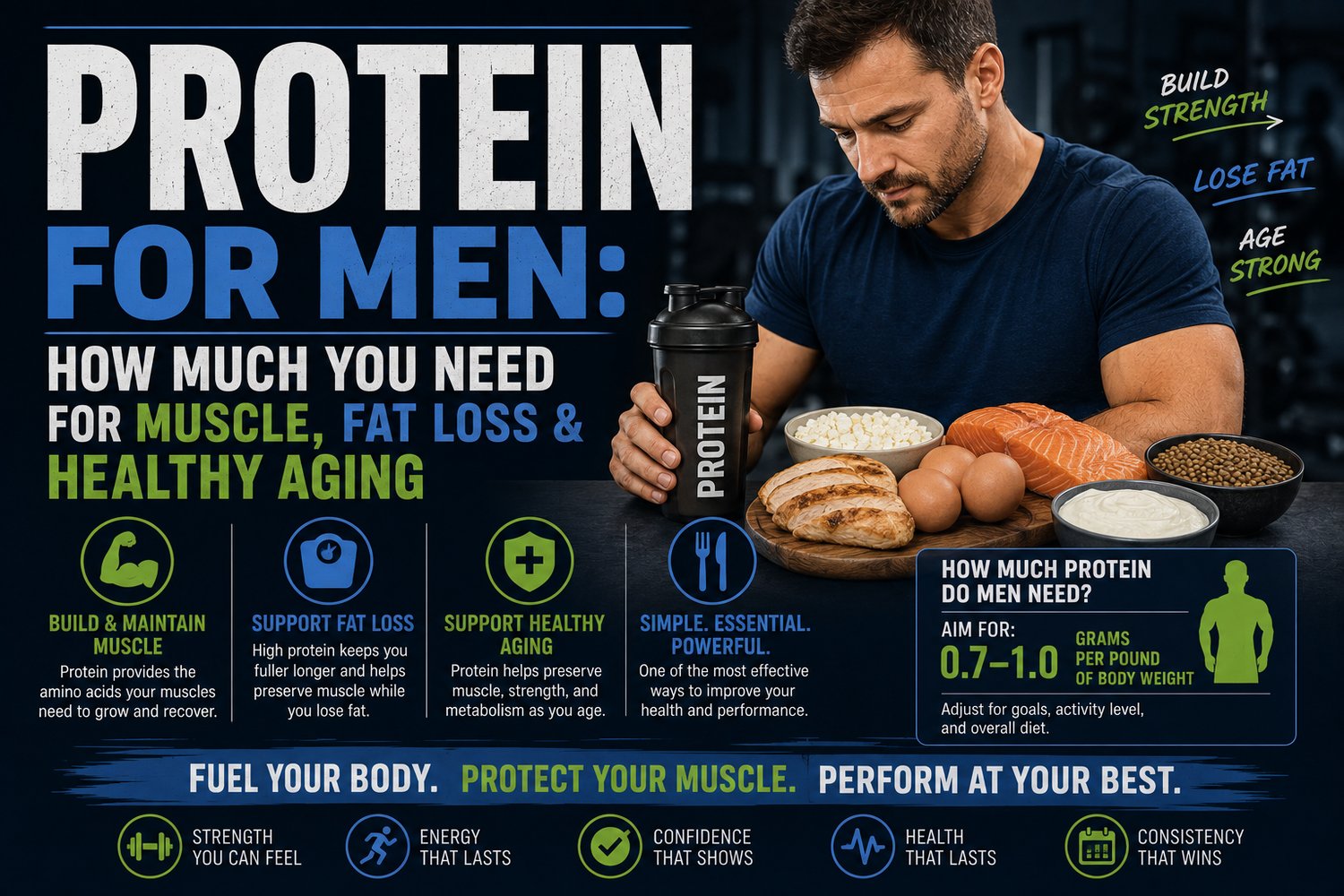
Protein for Men: How Much You Need for Muscle, Fat Loss & Healthy Aging
Protein might be the least controversial part of men's fitness.
Pretty much everyone agrees you need it.
The disagreement starts immediately afterward.
One guy says:
“Just eat the RDA.”
Another says:
“One gram per pound or you're wasting your workouts.”
Then somebody else tells you protein needs to arrive every two hours or your muscles will begin evaporating.
Reality is considerably less dramatic.
Protein is essential for maintaining and repairing body tissues, including skeletal muscle. The standard adult Recommended Dietary Allowance is 0.8 grams per kilogram of body weight per day, but that number is designed as a basic adequacy recommendation for healthy adults—not as a universal target for maximizing muscle growth, supporting hard resistance training, or preserving lean mass during weight loss.
For active men, particularly those who resistance train, diet for fat loss, or want to preserve muscle with age, a higher intake often makes sense.
A practical target for many healthy active men is roughly:
1.2–1.6 grams of protein per kilogram of body weight per day.
Men focused specifically on muscle growth often do well near the upper end of that range.
You don't need:
- Six shakes
- Chicken breast at every meal
- A protein bar in your pocket at all times
- Exactly 30 grams every three hours
- One gram per pound simply because gym culture says so
You need:
Enough protein + resistance training + sufficient overall nutrition + consistency.
For the broader nutrition pillar, visit the Complete High-Protein Guide.
And if body composition is your main concern, read Why Belly Fat Gets Harder to Lose After 30.
Why Protein Matters for Men
Protein gets associated almost entirely with muscle building.
That's important.
But protein also contributes to:
- Maintaining existing muscle
- Repairing tissue
- Producing enzymes and other proteins
- Exercise recovery
- Satiety
- Healthy aging
That makes protein relevant whether you're:
- 25 and trying to build muscle
- 42 and trying to lose fat
- 55 and trying to preserve strength
- 70 and trying to stay physically independent
The goal changes.
Protein remains important.
The RDA Is a Minimum Adequacy Target—Not a Muscle-Building Prescription
The standard adult protein RDA is:
0.8 g/kg/day
For a 175-pound man, that's roughly:
64 grams per day.
That number is often misunderstood.
It is not:
“The maximum amount anyone benefits from.”
And it is not:
“The perfect target for every fitness goal.”
A man who:
- Strength trains
- Is dieting
- Wants to gain muscle
- Wants to preserve muscle as he ages
may reasonably benefit from more.
Research on resistance training has repeatedly found greater lean-mass gains with increased protein intake, with benefits tending to level off around roughly 1.6 g/kg/day for many healthy adults.
That's why arguing between:
0.8 g/kg
and:
1 gram per pound
creates a false choice.
There is a large useful middle ground.
A Practical Protein Range for Men
For many healthy active men:
1.2–1.6 g/kg/day
is a reasonable starting range.
For someone strongly focused on:
- Resistance training
- Muscle gain
- Preserving lean mass during dieting
being closer to:
1.6 g/kg/day
may make sense.
Here's what that looks like.
150-Pound Man
68 kg
82–109 grams/day
175-Pound Man
79 kg
95–126 grams/day
200-Pound Man
91 kg
109–146 grams/day
225-Pound Man
102 kg
122–163 grams/day
These aren't mandatory prescriptions.
They're useful starting ranges.
Your exact target depends on:
- Body size
- Training
- Goal
- Calorie intake
- Age
- Health conditions
Do You Need One Gram of Protein Per Pound?
Usually not.
One gram per pound equals roughly:
2.2 g/kg/day
Healthy active men can certainly consume that amount.
But current resistance-training evidence doesn't suggest most men need that much to maximize muscle growth.
For many people, protein's additional muscle-building benefit appears to flatten substantially around roughly:
1.6 g/kg/day
That doesn't mean one gram per pound is automatically:
- Dangerous
- Wasteful
- Wrong
It means you probably don't need to force-feed yourself because a gym rule says:
“200 pounds = 200 grams or your workout didn't count.”
Current Body Weight Isn't Always the Best Protein Calculator
Protein formulas become less useful when someone carries a large amount of excess body fat.
Consider two men who both weigh 250 pounds.
One is:
- Very muscular
- Relatively lean
The other has:
- Less lean mass
- Substantially more body fat
Blindly assigning both men the exact same protein target based on total body weight may not make much sense.
If you have significant weight to lose, a more practical target might use:
- Goal weight
- A reasonable target body weight
- An absolute daily protein target
rather than multiplying current body weight by an aggressive number.
Protein and Muscle Growth
Building muscle requires two major things:
Training stimulus + recovery resources
Protein supplies amino acids.
Resistance training tells your body:
“Keep and build this tissue.”
That's why protein and strength training work so well together.
Protein supplementation can modestly enhance lean-mass gains from resistance training when protein intake would otherwise be insufficient.
Notice the order:
Resistance training first.
Protein supports the adaptation.
It doesn't replace the stimulus.
Read Strength Training for Men Over 30.
Protein Is Especially Useful During Weight Loss
When you lose body weight, you're not automatically losing only fat.
Weight loss can also include:
- Water
- Glycogen
- Lean tissue
Preserving lean mass therefore matters.
Higher protein intake can help reduce lean-mass loss during calorie restriction, particularly when paired with resistance training.
That's an important distinction.
A good fat-loss plan isn't simply:
Lose as much weight as possible.
It's closer to:
Lose excess fat while preserving as much useful lean tissue as practical.
That generally favors:
- Appropriate calorie deficit
- Adequate protein
- Resistance training
- Regular movement
- Good recovery
For the broader body-composition strategy, read Why Belly Fat Gets Harder to Lose After 30.
Protein Can Help With Fullness
One of protein's biggest practical advantages during fat loss is appetite control.
Higher-protein meals often feel more filling than lower-protein alternatives.
Compare:
Toast + juice
with:
Eggs + Greek yogurt + fruit
The second meal provides substantially more protein and often more staying power.
Protein doesn't eliminate hunger.
It can make a calorie deficit easier to maintain without relying entirely on willpower.
Protein Doesn't Automatically Cause Weight Loss
This needs to be clear.
You can gain body fat on a high-protein diet.
Calories still matter.
Adding:
- Protein shakes
- Protein bars
- Cheese
- Nuts
- Large meat portions
on top of everything else you're already eating can raise calorie intake substantially.
Protein is useful because it can support:
- Satiety
- Muscle retention
- Training recovery
It isn't a fat-burning loophole.
Protein and Healthy Aging
Protein becomes increasingly valuable when preserving muscle becomes a bigger priority.
The issue isn't that men suddenly become frail at 40.
It's that decades of:
- Inactivity
- No resistance training
- Poor nutrition
- Illness
- Weight cycling
can gradually reduce muscle reserve.
Resistance training plus adequate dietary protein is one of the strongest lifestyle combinations available for preserving muscle and strength with age.
That's why protein belongs in the healthy-aging conversation.
Read Healthy Aging for Men.
How Much Protein Should Men Over 40 Eat?
There isn't a magical protein switch at age 40.
A healthy 41-year-old doesn't suddenly need a completely different diet from a healthy 39-year-old.
But preserving muscle becomes increasingly valuable.
For many active men over 40, a range around:
1.2–1.6 g/kg/day
is a useful starting point, particularly when resistance training.
The bigger question is whether you're actually:
- Eating enough protein
- Strength training
- Sleeping
- Eating enough overall
- Maintaining a sensible body composition
A perfect protein number can't rescue a poor overall plan.
Total Daily Protein Matters More Than Obsessing Over Timing
Protein timing gets discussed endlessly.
Questions include:
- Protein immediately after lifting?
- Protein every three hours?
- Casein before bed?
- Thirty grams per meal?
- Fifty grams too much at once?
Total daily protein is the first priority.
Once that's handled, distributing protein across several meals is a practical way to provide repeated amino-acid availability and makes the daily target easier to reach.
You don't need to panic about an exact anabolic window.
If you finish training and don't drink a shake for 31 minutes:
Your muscles will survive.
A Simple Protein Distribution Strategy
Instead of calculating the perfect amino-acid curve, try something like:
Breakfast
25–40 grams
Lunch
30–40 grams
Dinner
30–50 grams
Snack or Shake
20–30 grams if needed
That can put many men around:
105–160 grams per day
without eating every two hours.
Simple enough.
Breakfast Is Often the Weakest Protein Meal
A common breakfast might be:
- Cereal
- Toast
- Coffee
Protein?
Not much.
That forces dinner to carry nearly the entire day.
Easy higher-protein breakfasts include:
- Eggs + Greek yogurt
- Cottage cheese + fruit
- Greek yogurt + oats
- Egg-and-meat breakfast burrito
- Protein smoothie
- Leftover dinner
There is no rule saying breakfast must contain traditional breakfast foods.
Chicken at 8 a.m. will not damage the space-time continuum.
Build Lunch Around Protein
Lunch is where busy men often lose the plot.
You're working.
You're rushed.
You grab something.
Protein becomes accidental.
Instead, choose one obvious protein anchor:
- Chicken
- Turkey
- Tuna
- Lean beef
- Greek yogurt
- Cottage cheese
- Beans
- Lentils
- Tofu
Then build around it with:
- Produce
- Fiber-rich carbohydrates
- Healthy fats
Think:
Protein first. Build outward.
Dinner Is Usually Easy
Dinner naturally tends to contain more protein.
The mistake is assuming:
One enormous steak at night
perfectly compensates for barely eating protein all day.
You don't need perfectly equal meals.
But spreading intake across the day makes the total target much easier to hit.
Best High-Protein Foods for Men
There isn't one perfect protein source.
Variety works well.
Poultry and Lean Meat
- Chicken
- Turkey
- Lean beef
- Pork loin
Seafood
- Salmon
- Tuna
- Shrimp
- White fish
Dairy
- Greek yogurt
- Cottage cheese
- Milk
- Cheese
Eggs
Simple.
Versatile.
Relatively inexpensive.
Plant Proteins
- Beans
- Lentils
- Tofu
- Tempeh
- Edamame
Healthy protein intake does not require eating meat at every meal.
Animal Protein vs. Plant Protein
Both can contribute meaningfully to protein intake.
Animal proteins generally provide all essential amino acids in favorable proportions.
Plant-based diets can also provide adequate protein when:
- Total intake is sufficient
- Protein-rich foods are eaten regularly
- Diet variety is good
You don't need to turn protein into a culture war.
Choose a dietary pattern that fits your:
- Preferences
- Ethics
- Budget
- Health goals
The Complete High-Protein Guide goes deeper into animal versus plant protein.
What About Red Meat?
Red meat can provide:
- Protein
- Iron
- Zinc
- Vitamin B12
That doesn't mean:
Every meal should be steak.
Use a variety of protein sources.
That can include:
- Fish
- Poultry
- Dairy
- Legumes
- Plant proteins
- Lean red meat
The goal isn't merely hitting a protein number.
It's hitting the number inside an overall nutritious diet.
What About Protein Powder?
Protein powder is useful because it's convenient.
That's mostly it.
It can help when:
- Breakfast is rushed
- Appetite is low
- You need a portable option
- Food alone makes hitting your target difficult
Protein powder isn't automatically superior to whole food.
Think:
Convenient protein
not:
Muscle powder.
Whey Protein
Whey is popular because it's:
- Convenient
- Rich in essential amino acids
- Easy to mix
- Often relatively inexpensive per gram of protein
It's an effective option.
It isn't mandatory.
Casein Protein
Casein digests more slowly than whey.
Some people enjoy it:
- Before bed
- As a thicker shake
- For satiety
That's fine.
You still don't need multiple kinds of protein powder to build muscle.
Plant Protein Powder
Plant powders can work too.
Examples include:
- Pea
- Soy
- Rice blends
Blended products can provide a complementary amino-acid profile.
If you prefer plant-based nutrition, you don't need whey simply because bodybuilding culture says so.
Protein Bars
Protein bars can be convenient.
They can also be candy bars wearing gym clothes.
Look at:
- Protein
- Calories
- Added sugar
- Fiber
- Ingredients
- Cost
A 400-calorie bar with 15 grams of protein may not be particularly efficient if fat loss is the goal.
Protein and Testosterone
Protein supports:
- Nutrition
- Muscle
- Recovery
It isn't testosterone treatment.
Eating more chicken doesn't turn a testosterone level of 250 ng/dL into 800.
Likewise, consuming extreme protein amounts isn't a proven way to “optimize” testosterone in men already eating adequately.
Hormone health depends on a much broader system.
Read How to Support Testosterone Naturally.
Can Too Much Protein Lower Testosterone?
Normal higher-protein intakes used by healthy active adults aren't established as a general cause of low testosterone.
The more realistic issue is whether an extreme diet crowds out:
- Healthy fats
- Carbohydrates
- Micronutrients
- Fiber
- Total calories
Overall dietary adequacy still matters.
Don't turn your diet into:
protein + protein + protein
and then wonder why something feels off.
Does High Protein Damage Your Kidneys?
For healthy adults without chronic kidney disease, available randomized-trial evidence does not show consistent biochemical evidence that higher-protein diets cause kidney injury.
A June 2026 systematic review and meta-analysis of 22 randomized trials found that higher-protein diets increased estimated GFR but did not significantly change serum creatinine compared with lower-protein diets. The authors cautioned that much of the research is relatively short-term and that the long-term renal effects remain uncertain.
That's a more accurate conclusion than either extreme:
“Protein destroys your kidneys.”
or:
“Eat unlimited protein forever; there are zero questions.”
If you have:
- Chronic kidney disease
- Impaired kidney function
- Another condition requiring protein management
your recommendations may be very different.
A 2025 umbrella review found that protein restriction can play an important role in CKD management.
Don't use a bodybuilding protein calculator if your healthcare team has told you your kidneys require individualized nutrition guidance.
Does Protein Dehydrate You?
Eating more protein doesn't mean you're destined for dehydration.
Hydration needs depend on:
- Body size
- Activity
- Climate
- Sweat losses
- Diet
- Medical conditions
Drink enough to meet your needs.
You don't need a gallon jug because you ate chicken at lunch.
Protein Isn't Just for Bodybuilders
A sedentary older adult may have a stronger long-term reason to care about protein than a 22-year-old physique athlete.
Why?
Because maintaining physical function matters.
You want enough muscle and strength to:
- Carry things
- Climb stairs
- Stay active
- Recover from illness or inactivity
- Maintain independence
Protein and resistance training support that goal.
This is men's wellness.
Not just bodybuilding.
Protein During Aggressive Weight Loss
Preserving lean mass becomes particularly important during large or rapid weight loss.
That applies whether weight loss comes from:
- Lifestyle changes
- Bariatric treatment
- Prescription obesity medications
- Other approaches
When appetite becomes very low, protein can become harder to consume.
The useful strategy is usually to prioritize:
protein + strength training + sufficient overall nutrition
rather than simply celebrating the lowest possible calorie intake.
If you're using GLP-1 medication or researching it, the Complete GLP-1 Success Guide covers nutrition, muscle preservation, exercise, side effects, and treatment considerations.
Don't Let Protein Crowd Out the Rest of Your Diet
This happens surprisingly often.
You become so focused on protein that meals turn into:
Meat + shake + protein bar
Meanwhile:
- Fiber drops
- Fruit disappears
- Vegetables disappear
- Diet variety disappears
Protein is one nutrient.
You still need:
- Fiber
- Vitamins
- Minerals
- Healthy fats
- Carbohydrates
- Fruits
- Vegetables
Hit your protein goal inside a balanced diet.
Don't make protein your personality.
Cheap Protein Exists
High-protein eating does not need to be expensive.
Budget-friendly options include:
- Eggs
- Milk
- Greek yogurt
- Cottage cheese
- Canned tuna
- Canned chicken
- Beans
- Lentils
- Peanut butter
- Bulk chicken
- Protein powder when cost-effective
For much deeper budget coverage, use:
- Cheapest Protein Sources
- Cheap High-Protein Meals
- High-Protein Grocery List on a Budget
- Complete High-Protein Guide
A Practical 150-Gram Protein Day
Here's what roughly 150 grams can look like without eating every two hours.
Breakfast
3 eggs — ~18 g
Greek yogurt — ~20 g
≈38 g
Lunch
5 ounces chicken — ~40 g
Running total: ~78 g
Snack
Cottage cheese — ~25 g
Running total: ~103 g
Dinner
6 ounces fish or lean meat — ~40–45 g
Total: ~143–148 g
Small amounts from other foods will usually take the total higher.
Nothing extreme.
What If You Only Need 100 Grams?
Then eat 100 grams.
There is no award for eating more protein than your goals require.
A smaller man who:
- Doesn't train aggressively
- Is focused mostly on general health
- Already maintains muscle well
may not need an enormous target.
Your nutrition should solve your problem.
Not somebody else's Instagram problem.
Increase Protein Gradually
If you currently eat very little protein, don't jump from:
60 grams
to:
200 grams
tomorrow.
Try:
Week 1
Improve breakfast.
Week 2
Improve lunch.
Week 3
Add a higher-protein snack if needed.
You may move naturally from:
70 grams
to:
120–140 grams
without obsessively tracking everything.
That's usually easier to maintain.
Track Protein Temporarily if You're Unsure
You don't necessarily need to log food forever.
Tracking protein for a week can be useful.
Men often fall into one of two groups.
Group 1
“I eat tons of protein.”
Actual intake:
78 grams.
Group 2
“I'm probably not eating enough.”
Actual intake:
190 grams.
A week of data can solve the mystery.
Once you understand your normal portions, continual tracking may not be necessary.
The Simplest Protein Habit
If you hate tracking, do this:
Every major meal starts with a protein source.
Ask:
Breakfast
Where's the protein?
Lunch
Where's the protein?
Dinner
Where's the protein?
If each meal consistently contains a meaningful protein serving, many men will naturally land in a useful range.
Simple systems often outperform perfect calculations.
Pair Protein With Strength Training
Protein without strength training is still useful nutrition.
But:
Protein + progressive resistance training
creates a much stronger muscle-building and muscle-preservation strategy.
If you aren't lifting yet, read Strength Training for Men Over 30.
If daily movement is low, add Walking for Men's Health.
Together:
Protein + strength + movement + sleep
creates a much more complete men's-health foundation.
Use Tracking Tools Only if They Help
Knowing what to do is easy.
Doing it consistently is harder.
The Men's Health & Performance Dashboard helps organize:
- Fitness
- Body composition
- Energy
- Recovery
- Daily health habits
The 90 Day Dad Fitness Planner provides a more structured fitness, nutrition, and habit framework.
And the FREE Men's Hormone & Energy Starter Kit includes nutrition, strength, sleep, energy, habit, and bloodwork trackers.
Frequently Asked Questions
How Much Protein Should a Man Eat Per Day?
The standard adult RDA is 0.8 g/kg/day.
Active men and those focused on building or preserving muscle often use higher amounts.
A practical range for many healthy active men is approximately:
1.2–1.6 g/kg/day
with around 1.6 g/kg/day serving as a reasonable evidence-based target for many resistance-trained men.
How Much Protein Should a Man Eat to Build Muscle?
Around:
1.6 g/kg/day
is a reasonable target for many healthy men who resistance train.
More protein isn't automatically better for muscle growth once intake is already sufficient.
How Much Protein Should a Man Eat to Lose Weight?
There isn't one universal number.
Higher protein can support:
- Satiety
- Muscle preservation
- Resistance-training recovery
during calorie restriction.
For many healthy active men, 1.2–1.6 g/kg/day can be a practical starting range.
People carrying substantial excess body fat may find goal-weight or individualized calculations more practical than multiplying current body weight by a high number.
Do You Need Protein Immediately After a Workout?
No.
Protein around training can be useful.
But you don't need to sprint to your shaker bottle the second your final set ends.
Total daily intake is more important than hitting an extremely narrow post-workout window.
Is Protein Powder Necessary?
No.
Protein powder is simply a convenient food product that makes increasing protein easier.
Whole-food sources work perfectly well.
Is 200 Grams of Protein Too Much?
It depends on:
- Body size
- Training volume
- Goal
- Overall diet
- Health status
For many average-sized men, 200 grams may offer little additional muscle-building benefit beyond a lower adequate intake.
People with kidney disease or other relevant conditions need individualized guidance.
Does High Protein Damage Healthy Kidneys?
Available randomized-trial evidence does not show consistent biochemical evidence of kidney injury in adults without chronic kidney disease, although much of the evidence is relatively short-term and long-term effects remain less certain.
Protein recommendations can be very different for people with existing kidney disease.
Is Protein More Important After 40?
Protein doesn't suddenly become a different nutrient at 40.
But preserving muscle becomes increasingly important with age, making adequate protein plus resistance training particularly useful.
Key Takeaways
- Protein supports muscle maintenance, recovery, satiety, and healthy aging.
- The adult RDA of 0.8 g/kg/day is an adequacy recommendation, not necessarily the best target for every fitness goal.
- Many healthy active men can reasonably use approximately 1.2–1.6 g/kg/day as a practical range.
- Around 1.6 g/kg/day is a reasonable evidence-based muscle-building target for many resistance-trained adults.
- One gram per pound isn't required for most men.
- Higher protein can help preserve lean mass during weight loss.
- Protein can improve fullness, but it doesn't override calorie balance.
- Total daily intake matters more than obsessing over exact timing.
- Protein powder is optional.
- Strength training provides the stimulus that makes higher protein especially useful for muscle growth.
- Current evidence doesn't show consistent biochemical kidney injury from higher-protein diets in adults without chronic kidney disease, but long-term data remain less certain.
- People with kidney disease may require very different protein recommendations.
- Protein belongs inside a balanced diet—not in place of one.
Final Thoughts
Protein matters.
It just doesn't need to become complicated.
If you're an active man trying to:
- Build muscle
- Preserve strength
- Lose fat without sacrificing lean mass
- Age with more physical capacity
eat enough protein consistently.
You probably don't need 250 grams.
You don't need to eat every two hours.
You don't need expensive supplements.
Start with:
Protein at breakfast.
Protein at lunch.
Protein at dinner.
Add a snack or shake when needed.
Then:
Lift.
Walk.
Sleep.
Repeat.
That's a much stronger strategy than spending all day arguing over whether the optimal number is:
1.63 or 1.71 grams per kilogram.
Continue the Men's Wellness Series
For fitness and body composition:
- Strength Training for Men Over 30
- Walking for Men's Health
- Building Muscle After 40
- Why Belly Fat Gets Harder to Lose After 30
For nutrition:
- Complete High-Protein Guide
- Cheapest Protein Sources
- Cheap High-Protein Meals
- High-Protein Grocery List on a Budget
For testosterone:
- How to Support Testosterone Naturally
- Low Testosterone Symptoms
- How Testosterone Is Tested and Diagnosed
For broader men's health:
For tracking:
- Men's Health & Performance Dashboard
- 90 Day Dad Fitness Planner
- FREE Men's Hormone & Energy Starter Kit
For the complete pillar:
Educational Disclaimer
This article is intended for educational purposes only and should not be considered medical or individualized nutrition advice. Protein needs vary based on body size, age, activity, calorie intake, training goals, medical conditions, and medications. People with chronic kidney disease or other conditions requiring dietary protein management should consult their healthcare team before substantially increasing protein intake.