

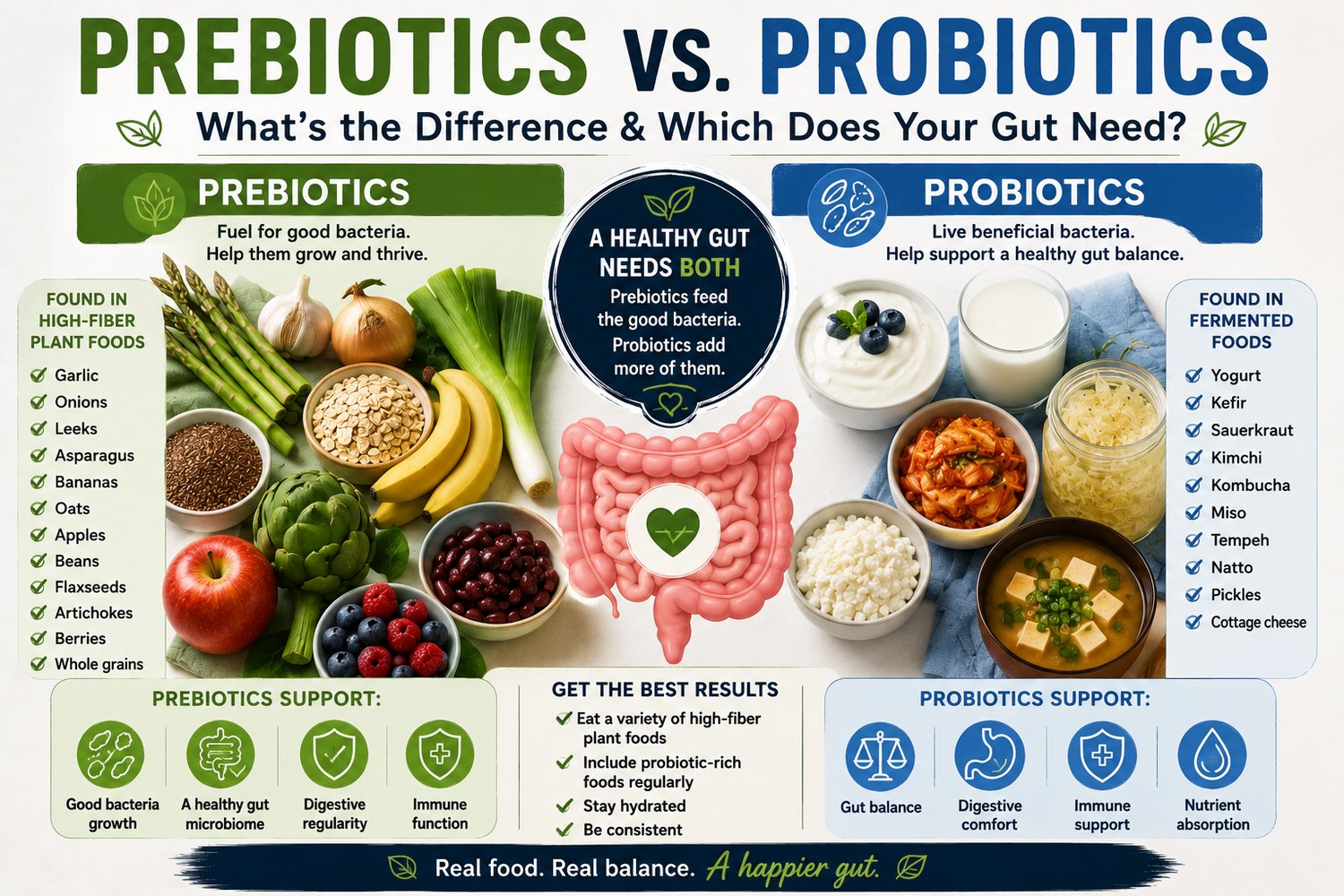
Prebiotics vs. Probiotics: What’s the Difference & Which Does Your Gut Need?
Complete Fiber & Gut Health Guide Hub
Prebiotics.
Probiotics.
Two words separated by three letters.
And somehow an entire supplement industry has managed to make the difference between them feel considerably more complicated than it needs to be.
Here's the simple version:
Probiotics are live microorganisms that can provide a health benefit when consumed in adequate amounts.
Prebiotics are substances that certain microorganisms already living in or on your body can use in a way that provides a health benefit.
In everyday gut-health terms:
Probiotics provide specific beneficial microorganisms.
Prebiotics feed selected microorganisms already living in your gut.
That's the basic distinction.
And no, that doesn't automatically mean you need to buy one bottle of each.
In fact, if you've followed this entire fiber and gut-health series, you've already been working on one of the biggest pieces of the prebiotic equation:
eating fiber-rich plant foods.
Before we get into probiotics, this article follows Fiber for Constipation: How Fiber Helps, Best Foods & Why More Isn’t Always Better.
Now let's finish the main series by sorting through one of the most heavily marketed areas of gut health.
What Are Prebiotics?
The International Scientific Association for Probiotics and Prebiotics—ISAPP—defines a prebiotic as a substrate that is selectively used by microorganisms in the host and produces a health benefit.
That's the scientific definition.
In normal-person language:
Prebiotics are food for particular beneficial microbes.
Many established prebiotics are specific types of dietary fiber.
But this distinction matters:
Not all fiber is prebiotic.
ISAPP specifically distinguishes prebiotics from dietary fiber generally. A fiber qualifies as a prebiotic when evidence shows that microorganisms selectively use it and that this produces a health benefit.
So:
fiber is the broad category.
prebiotic fiber is a more specific category within it.
What Are Probiotics?
Probiotics are different.
ISAPP defines probiotics as:
live microorganisms that, when administered in adequate amounts, confer a health benefit on the host.
The important parts are:
- They're alive.
- They're microorganisms.
- They're consumed in an adequate amount.
- There must be evidence of a health benefit.
That last part gets overlooked constantly.
Something containing bacteria isn't automatically a probiotic.
ISAPP emphasizes that a true probiotic needs to be tested and shown to provide a health benefit.
The Simplest Prebiotic vs. Probiotic Explanation
Think of your gut microbiota like a community.
Probiotic
You're introducing particular microorganisms into the community.
Prebiotic
You're providing a substrate that selected microorganisms in the community can use.
Very simplified:
Probiotic = microorganisms.
Prebiotic = food for microorganisms.
That's enough to understand most of the conversation.
But Probiotics Don't Necessarily “Colonize Your Gut”
This is another common misconception.
People sometimes imagine taking a probiotic capsule and permanently adding billions of new residents to their intestinal microbiome.
That's generally not how it works.
ISAPP notes that probiotics can interact with resident gut microbes and produce useful effects as they move through the digestive tract, but they typically don't remain there permanently.
That's important.
A probiotic doesn't necessarily need to permanently colonize your gut to have an effect.
Your Gut Already Contains an Enormous Microbial Community
You don't have an empty digestive tract waiting for a probiotic capsule to populate it.
Your gut already contains an enormous and highly individualized microbial ecosystem.
Those organisms interact with:
- Food
- Fiber
- Your intestinal environment
- Other microorganisms
- Your immune system
- Microbial metabolites
That's one reason diet matters so much.
You're feeding an ecosystem that's already there.
This Is Where Prebiotics Become Interesting
Humans can't fully digest certain carbohydrates.
Some reach the large intestine.
Microorganisms can then use them.
Certain substrates that are selectively utilized by microorganisms and produce demonstrated health benefits qualify as prebiotics.
That's one of the reasons fiber and the microbiome are so closely connected.
But remember:
fermentable does not automatically mean prebiotic.
A carbohydrate needs evidence meeting the prebiotic definition.
What Foods Contain Prebiotics?
Naturally occurring prebiotic compounds can be found in foods including:
- Onions
- Garlic
- Beans
- Whole grains
- Chicory root
- Artichokes
ISAPP also identifies foods such as bananas and Jerusalem artichokes as sources of prebiotic compounds.
Conveniently, these overlap heavily with the foods we've already been talking about throughout this series.
You don't need a completely separate:
PREBIOTIC DIET.
A varied, fiber-rich diet can already provide prebiotic compounds.
Onions
Onions contain naturally occurring prebiotic compounds.
They're also ridiculously easy to add to:
- Chili
- Soup
- Tacos
- Stir-fry
- Pasta
- Eggs
- Sandwiches
You don't need to eat a raw onion like an apple.
Use normal food.
Garlic
Garlic is another commonly cited prebiotic-containing food.
Add it to:
- Vegetables
- Meat
- Soup
- Pasta
- Beans
- Grain bowls
Again:
This is food.
Not a gut-health protocol.
Beans
Beans are especially useful because they can contribute:
- Fiber
- Plant protein
- Prebiotic substrates
- Plant diversity
Examples include:
- Black beans
- Chickpeas
- Kidney beans
- Pinto beans
If you've been working on increasing fiber, beans have probably already appeared repeatedly in your diet.
That's another reason the different parts of gut health overlap.
Whole Grains
Whole grains can also contain prebiotic compounds.
Examples include:
- Oats
- Barley
- Whole wheat
ISAPP includes whole grains among foods that can provide prebiotics.
Once again:
You may already be eating prebiotic foods without ever using the word.
Bananas
Bananas are another simple option.
They're:
- Inexpensive
- Portable
- Easy to find
- Easy to combine with other fiber-rich foods
Add them to oatmeal.
Add them to yogurt.
Or perform the highly advanced preparation technique known as:
peeling one and eating it.
Gut health doesn't need to be complicated.
Chicory Root
This one deserves special attention because you'll see it frequently in packaged foods.
Chicory-root fiber is often added to:
- Protein bars
- Fiber bars
- Cereals
- Snacks
- Low-sugar products
It can provide prebiotic fiber.
It can also cause substantial:
- Gas
- Bloating
- Digestive discomfort
in some people when consumed in larger amounts.
If a “healthy” high-fiber bar makes your stomach feel like a weather balloon, read the ingredient list.
You may find:
chicory root fiber
or:
inulin.
What Is Inulin?
Inulin is a type of fermentable fiber commonly used as a prebiotic.
You'll find it naturally in some plants and concentrated in certain supplements and processed foods.
It's useful.
It's also one of those ingredients where:
more is not necessarily better.
If you're sensitive to fermentable carbohydrates, large amounts may cause:
- Gas
- Bloating
- Cramping
That's particularly relevant after the last few articles in this series.
Common Prebiotic Ingredients on Labels
If you're looking at supplements or fortified foods, you may see:
- Inulin
- Chicory root fiber
- Fructooligosaccharides (FOS)
- Galactooligosaccharides (GOS)
- Oligofructose
ISAPP identifies these among common prebiotic names consumers may encounter on labels.
You don't need to memorize them.
But knowing what they are can help explain why a product suddenly contains:
10 grams of fiber.
Are All Fiber-Rich Foods Prebiotic?
No.
This distinction is worth repeating.
All prebiotic fibers may fall within the broader fiber conversation, but not every dietary fiber qualifies as a prebiotic.
ISAPP's updated educational materials explicitly distinguish prebiotics as a special category whose health effects come through selective utilization by specific microorganisms.
That doesn't make non-prebiotic fiber less valuable.
Fiber can still help with:
- Stool bulk
- Stool consistency
- Bowel regularity
- Satiety
- Overall dietary quality
You don't need every gram of fiber to be “prebiotic.”
What Foods Contain Probiotics?
Now we switch categories.
Probiotics are live microorganisms.
They're available in certain:
- Yogurts
- Fermented milks
- Other foods containing documented probiotic cultures
- Dietary supplements
NCCIH notes that probiotics are commonly found in yogurt, other fermented foods and dietary supplements.
But here's where marketing gets messy.
Not Every Fermented Food Is a Probiotic Food
This is a big one.
People often use:
fermented
and:
probiotic
as if they mean the same thing.
They don't.
A fermented food may contain live microorganisms.
But that doesn't automatically mean those microorganisms have been:
- Identified
- Present at an adequate dose
- Tested for a specific health benefit
And therefore it doesn't automatically meet the scientific definition of a probiotic.
So:
fermented food ≠ automatically probiotic.
Yogurt Can Contain Probiotics
Some yogurts contain specific live microorganisms that meet probiotic criteria.
Others simply contain cultures used to ferment the milk.
Look at the product label.
If you're specifically buying yogurt for probiotics, look for information about:
- Live cultures
- Specific organisms
- Strain information when available
The more specific the product is about what it contains, the more useful that information becomes.
What About Kefir?
Kefir is a fermented milk beverage containing microorganisms.
It's a nutritious food for many people.
But again:
Don't assume every kefir product automatically qualifies as a scientifically validated probiotic for a particular health outcome.
Enjoy fermented foods because they're foods you like and tolerate.
Specific probiotic claims require specific evidence.
What About Sauerkraut and Kimchi?
Fermented vegetables can contain live microorganisms when they haven't been heat-treated in a way that kills them.
They can also be useful additions to a varied diet.
But:
live microorganisms present
doesn't automatically equal:
proven probiotic.
That's the distinction to remember.
What About Kombucha?
Same issue.
Kombucha is fermented.
That doesn't automatically mean every bottle contains a clinically validated probiotic strain at an effective dose.
You can drink kombucha because you enjoy it.
You don't need to treat it like a microbiome prescription.
Probiotic Strains Matter
This is probably the most important concept if you're considering a probiotic supplement.
Probiotics aren't interchangeable.
NCCIH notes that different probiotics may have different effects, and evidence for one microorganism doesn't automatically apply to another—even within the same broader bacterial group.
So:
“I take Lactobacillus.”
isn't particularly specific.
The exact:
- Genus
- Species
- Strain
can matter.
More CFUs Doesn't Automatically Mean Better
CFU means:
colony-forming units.
You'll see bottles advertising:
10 BILLION CFU
50 BILLION CFU
100 BILLION CFU
which naturally encourages the assumption:
100 billion must be ten times better than 10 billion.
Not necessarily.
The relevant question is:
Was this specific probiotic strain studied at this dose for the outcome you're trying to improve?
A giant number on the front of a bottle isn't the same thing as evidence.
More Strains Doesn't Automatically Mean Better Either
Another bottle might advertise:
15 STRAINS!
Again:
More isn't automatically better.
A product containing:
one well-studied strain
may make considerably more sense for a particular purpose than a random mixture containing 15 strains with little relevant evidence.
Probiotics are not Pokémon.
You don't need to collect them all.
So Do Probiotics Actually Work?
Sometimes.
For some purposes.
With some specific probiotics.
That's the answer the marketing department doesn't like.
NCCIH notes that probiotics have been studied for many conditions and that some evidence is promising, but researchers often still don't know which probiotics are most useful, which people benefit most or what dose is ideal.
That's a much more accurate picture than:
“Probiotics fix your gut.”
Probiotics and Antibiotic-Associated Diarrhea
One area with meaningful research is diarrhea associated with antibiotic use.
NCCIH reports evidence suggesting probiotics can reduce the risk of C. difficile-associated diarrhea in adults and children receiving antibiotics, although questions remain about which probiotics, doses and treatment durations are best.
Notice how specific that statement is.
Not:
probiotics improve everything.
It's:
certain probiotics may help with a particular outcome under particular circumstances.
That's how probiotic evidence should be interpreted.
What About Probiotics for Constipation?
There's some evidence here too, but it's not nearly as simple as:
constipated = take probiotic.
NCCIH summarizes research suggesting possible benefits from certain probiotics for constipation in adults, while also noting substantial differences between studies and uncertainty around which microorganisms are most useful.
If constipation is your primary issue, remember what we covered in Fiber for Constipation: How Fiber Helps, Best Foods & Why More Isn’t Always Better.
Start with the basics.
Don't assume a $40 refrigerated bottle is automatically the missing piece.
What About Probiotics for Bloating?
This is another area where people frequently experiment.
But bloating has many possible causes.
A probiotic isn't guaranteed to help.
And some people may initially experience:
- Gas
- Bloating
- Changes in bowel habits
when introducing a probiotic.
If you're already struggling with symptoms, don't add:
- New probiotic
- New prebiotic supplement
- Fiber supplement
- Five new fermented foods
all at once.
You'll have no idea what's doing what.
Prebiotics Can Cause Bloating Too
This is especially important.
Prebiotic fibers are often fermented by gut microorganisms.
That can produce gas.
So someone buys a prebiotic supplement because they want:
better gut health
and suddenly develops:
more bloating.
That doesn't necessarily mean something is wrong.
It may simply mean:
- The dose is too high
- The increase was too fast
- That specific ingredient isn't well tolerated
Start small.
Don't Add Prebiotic Fiber Aggressively
Suppose you currently eat very little fiber.
Then you add:
- Inulin powder
- High-fiber bar
- Beans
- Chia
- Large amounts of vegetables
in the same week.
You're not giving your microbiome a gentle supportive nudge.
You're throwing a fiber festival.
If you're sensitive, your digestive system may respond accordingly.
Gradual change still applies.
Food First Usually Makes Sense for Prebiotics
For most generally healthy adults looking to support their diet, I'd start with foods.
Eat more:
- Beans
- Whole grains
- Fruits
- Vegetables
- Nuts
- Seeds
Include foods naturally containing prebiotic compounds.
That's consistent with everything we've built throughout this pillar.
You don't need a separate supplement for every biological mechanism.
Build a Prebiotic-Rich Breakfast
Example:
Oatmeal + banana + berries
Now you have:
- Whole grain
- Fruit
- Fiber
- Plant variety
Add:
Greek yogurt with an appropriate live culture
and you may also be adding microorganisms from a fermented food.
That's a pretty reasonable breakfast.
No powdered microbiome optimization stack required.
Build a Prebiotic-Rich Lunch
Try:
- Whole-grain wrap
- Chicken
- Black beans
- Onion
- Greens
- Avocado
Now you're combining:
- Fiber
- Legumes
- Whole grains
- Multiple plants
Again:
ordinary food.
Build a Prebiotic-Rich Dinner
Try:
- Salmon
- Barley
- Roasted asparagus
- Garlic
- Onion
Or:
- Chicken
- Brown rice
- Beans
- Peppers
- Onion
You don't need every meal to contain an official prebiotic ingredient.
The bigger goal is a varied, fiber-rich eating pattern.
This Is Why Plant Variety Matters
Remember our earlier article on How to Eat More Plant Variety: Simple Ways to Add More Fruits, Vegetables, Beans, Grains, Nuts & Seeds.
Different plant foods provide different:
- Fibers
- Carbohydrates
- Polyphenols
- Micronutrients
Your gut microbes interact with that diverse food environment.
That's a much more useful long-term strategy than assuming:
one probiotic capsule = gut health.
Should You Take a Prebiotic Supplement?
Maybe.
But ask why.
A prebiotic supplement can be useful when you want a specific, measurable dose of a particular prebiotic.
But if your current diet contains:
11 grams of fiber and six plant foods per week
I'd work on the foundation first.
More:
- Beans
- Oats
- Fruits
- Vegetables
- Whole grains
may accomplish much more broadly than simply adding a scoop of inulin.
Should You Take a Probiotic Supplement?
Again:
Maybe.
But ask:
For what?
“Gut health” is too vague.
A better question is:
Is there evidence that this specific probiotic strain at this dose helps the problem I'm trying to address?
NCCIH emphasizes that effects can differ between probiotic types and that evidence remains incomplete for many conditions.
That's how I'd evaluate a product.
How to Read a Probiotic Label
Look for:
Genus
Example:
Lactobacillus
Species
More specific identification.
Strain
Even more specific.
CFU Amount
How many viable microorganisms the product is intended to provide.
Storage Instructions
Some products require particular storage conditions.
Expiration Information
Live microorganisms aren't especially useful if the product no longer contains the amount advertised.
The more transparent the label, the better.
Don't Shop by the Biggest Number
Avoid making your decision based on:
100 BILLION CFU!!!
alone.
Instead ask:
- What organism?
- What strain?
- What evidence?
- What dose was studied?
- What health outcome?
- Is this product delivering that dose?
That's a much smarter way to evaluate probiotics.
Do You Need Both Prebiotics and Probiotics?
Not necessarily.
They're complementary concepts, but there isn't a universal rule that every person needs to consume both as supplements.
You may already consume prebiotic compounds through food.
You may consume live microorganisms through certain fermented foods.
And you may have no specific reason to take a probiotic supplement.
The supplement aisle would prefer a different answer.
Your wallet may appreciate this one.
What Is a Synbiotic?
Since we're here, you'll probably see this word too.
A synbiotic combines live microorganisms with a substrate designed to be used by microorganisms.
NCCIH describes synbiotics simply as products combining probiotics and prebiotics.
There are more precise scientific definitions, but that's enough for understanding the label.
So if you see:
PRE + PROBIOTIC
on a supplement bottle?
You're looking at the general synbiotic concept.
And What Are Postbiotics?
Because apparently we needed another “biotic.”
Postbiotics refer to preparations of inanimate microorganisms and/or their components that provide a health benefit.
You don't need to understand postbiotics to build a healthy diet.
But you'll increasingly see the word in:
- Supplements
- Skincare
- Functional foods
Don't assume:
newer terminology = better product.
Evidence still matters.
Fermented Foods Are Their Own Category
This is worth emphasizing.
Scientific consensus treats:
- Probiotics
- Prebiotics
- Synbiotics
- Postbiotics
- Fermented foods
as distinct concepts.
That's helpful because consumer marketing often throws all five into the same:
GUT HEALTH
bucket.
They aren't interchangeable.
Do You Need Fermented Foods?
You don't need yogurt, kefir, kimchi or sauerkraut specifically to have a nutritious diet.
But if you enjoy and tolerate fermented foods, they can absolutely fit.
Try:
- Yogurt
- Kefir
- Sauerkraut
- Kimchi
as part of your normal diet.
Don't force yourself to drink kombucha you hate because someone told you your microbiome needs it.
Can Prebiotics and Probiotics “Fix” Your Microbiome?
That's much too strong.
The microbiome is extraordinarily complex.
And there's no simple consumer test that tells you:
Your microbiome is 73% healthy.
In fact, a 2026 ISAPP expert consensus defined gut health around normal gastrointestinal function without active gastrointestinal disease or gut-related symptoms that impair quality of life, while noting that no single test can establish gut health.
That's a useful correction to the way gut health is often marketed.
You Don't Need to “Reset” Your Gut
Your digestive system isn't a Wi-Fi router.
There's no:
factory reset microbiome
button.
Be skeptical of products promising to:
- Reset your gut
- Detox your gut
- Completely rebuild your microbiome
- Remove all “bad bacteria”
Microbial ecosystems don't work in such simple good-versus-bad categories.
Don't Try to Eliminate “Bad Bacteria”
Another common misconception is:
good bacteria = good
bad bacteria = bad
The reality is more complicated.
Microbial behavior depends on:
- Species
- Strains
- Abundance
- Location
- Interactions with other organisms
- Host factors
You don't need to wage war against your microbiome.
You need to support normal gastrointestinal function and overall health.
Your Diet Matters More Than Gut-Health Branding
This is probably the main takeaway from the entire pillar.
You could buy:
- Probiotic gummies
- Prebiotic powder
- Synbiotic capsules
- Kombucha
- Gut-health shots
while eating almost no:
- Fruits
- Vegetables
- Beans
- Whole grains
That's backwards.
Start with food.
Then decide whether a specific supplement solves a specific problem.
A Simple Gut-Health Foundation
Instead of building a supplement stack, focus on:
Fiber
Eat enough.
Plant Variety
Rotate different plant foods.
Fluids
Stay adequately hydrated.
Movement
Be physically active.
Bowel Habits
Pay attention to persistent changes.
Sleep
Protect it.
Symptoms
Track problems instead of guessing.
That's much less exciting than a $49 microbiome powder.
It's also a much better foundation.
Use the Free Fiber & Gut Health Kickstart
If you want a simple way to put the entire series into practice, start with the FREE 7-Day Fiber & Gut Health Kickstart.
It gives you a structured way to start paying attention to:
- Fiber
- Plant variety
- Gut-health habits
without turning your diet into a science experiment.
Track Your Overall Gut-Health Routine
If you want to go beyond seven days, the Gut Health & Microbiome Tracker | 30-Day Planner + Excel Dashboard gives you a longer system for monitoring your gut-health habits and patterns.
The point isn't to “score” your microbiome.
It's to track the behaviors you can actually control.
Track Fiber Specifically
If fiber intake is your main focus, use the High-Fiber Meal Builder & 30-Day Fiber Tracker.
That helps you move beyond:
“I think I eat enough fiber.”
and actually see:
how much you're getting consistently.
Track Plant Diversity
If you've enjoyed the plant-variety part of this series, the 30 Plants Per Week Challenge | Gut Health Plant Diversity Tracker + Excel Dashboard gives you a structured way to track different plant foods across the week.
Again:
30 isn't magic.
Use it as a challenge.
Not a diagnosis.
Track Symptoms When Something Isn't Working
If increasing:
- Fiber
- Prebiotic foods
- Fermented foods
- Supplements
leaves you bloated or uncomfortable, don't keep adding more.
Use the Bloating, Digestion & Food Trigger Tracker to track:
- Foods
- Portions
- Symptoms
- Bowel habits
- Timing
- Potential triggers
Then change one variable at a time.
Probiotic Safety Matters
For generally healthy people, probiotics have a long history of use, but “natural” doesn't mean completely risk-free.
NCCIH notes that the risk of harmful effects is greater in people with severe illnesses or compromised immune systems. Serious infections from probiotic organisms have been reported in vulnerable populations, including premature infants.
If you have a significant medical condition or weakened immune system, talk with a healthcare professional before using probiotic supplements.
Don't Give Probiotic Supplements to Vulnerable People Casually
This is especially important for:
- Premature infants
- Critically ill people
- People with significantly compromised immune systems
The assumption that:
“It's just beneficial bacteria, so it can't hurt”
isn't medically sound.
Context matters.
Frequently Asked Questions
What's the difference between prebiotics and probiotics?
Probiotics are live microorganisms that provide a health benefit when administered in adequate amounts.
Prebiotics are substrates selectively used by microorganisms in a way that provides a health benefit.
In simple terms:
Probiotics provide microorganisms.
Prebiotics feed selected microorganisms.
Is fiber a prebiotic?
Some fiber is prebiotic.
Not all fiber qualifies as a prebiotic.
Prebiotics need to be selectively utilized by microorganisms and produce a demonstrated health benefit.
What foods contain prebiotics?
Foods containing naturally occurring prebiotic compounds include:
- Onion
- Garlic
- Beans
- Whole grains
- Chicory root
- Artichokes
- Bananas
among others.
What foods contain probiotics?
Specific probiotics may be present in some:
- Yogurts
- Fermented milk products
- Other foods formulated with documented probiotic cultures
But not every fermented food automatically qualifies as a probiotic food.
Are fermented foods the same as probiotics?
No.
Fermentation involves microorganisms, but a food doesn't automatically meet the scientific definition of a probiotic merely because it's fermented.
Probiotics require specific live microorganisms with demonstrated health benefits.
Do I need a probiotic every day?
Not necessarily.
Whether a probiotic makes sense depends on:
- Why you're taking it
- Which microorganism it contains
- The strain
- The dose
- Evidence for your specific goal
There's no universal requirement that every healthy adult take a daily probiotic supplement.
Do I need a prebiotic supplement?
Not necessarily.
Prebiotic compounds occur naturally in foods, and many people can increase their intake through a varied, fiber-rich diet.
A supplement may be useful for a specific purpose, but it isn't automatically necessary.
Can prebiotics cause bloating?
Yes.
Because many prebiotic fibers are fermented by intestinal microorganisms, increasing them quickly can produce:
- Gas
- Bloating
- Abdominal discomfort
Start gradually if you're sensitive.
Can probiotics cause bloating?
Some people experience temporary digestive changes after beginning a probiotic.
If symptoms are severe or persistent, stop assuming they're a normal adjustment and discuss them with a healthcare professional.
Is a 100-billion-CFU probiotic better than a 10-billion-CFU probiotic?
Not automatically.
The appropriate dose depends on the:
- Specific microorganism
- Strain
- Product
- Health outcome being studied
More CFUs aren't automatically more effective.
Should I take prebiotics and probiotics together?
You can, but you don't automatically need to.
Products combining prebiotic substrates and probiotics fall under the general concept of synbiotics.
Whether one makes sense depends on the specific product and goal.
Key Takeaways
- Prebiotics and probiotics are not the same thing.
- Probiotics are live microorganisms that provide a demonstrated health benefit when administered in adequate amounts.
- Prebiotics are substrates selectively used by microorganisms in a way that produces a health benefit.
- Many established prebiotics are fibers, but not all fiber is prebiotic.
- Prebiotic compounds occur naturally in foods including onions, garlic, beans, whole grains, bananas, chicory root and artichokes.
- Inulin, FOS and GOS are common prebiotic ingredients.
- Prebiotic fibers can cause gas and bloating in some people.
- Probiotics are strain-specific; one probiotic shouldn't automatically be assumed to have the effects of another.
- More CFUs don't automatically mean a better probiotic.
- More strains don't automatically mean a better probiotic.
- Fermented foods aren't automatically probiotics.
- Probiotics typically don't need to permanently colonize your gut to have an effect.
- Evidence for probiotics varies significantly depending on the health condition and microorganism being studied.
- You don't automatically need a prebiotic or probiotic supplement.
- A varied, fiber-rich diet remains an excellent foundation for supporting your gut microbial ecosystem.
- People who are severely ill or immunocompromised should use extra caution with probiotic supplements.
Final Thoughts
If you remember only two things from this article, make them these:
Prebiotics feed microbes.
Probiotics are microbes.
And if you remember a third:
You probably don't need to turn either one into a complicated supplement routine.
Start with your diet.
Eat:
- Fruits
- Vegetables
- Beans
- Whole grains
- Nuts
- Seeds
Rotate them.
Get enough fiber.
Include fermented foods if you enjoy and tolerate them.
Then, if you're considering a probiotic for a specific problem, look for evidence on the:
specific strain + specific dose + specific outcome.
Not:
“50 BILLION GUT HEALTH SUPER BLEND.”
The gut microbiome is complicated.
Your basic strategy doesn't need to be.
Feed yourself well.
Give your gut microbes a diverse supply of substrates.
Pay attention to how your digestive system actually functions.
And use supplements strategically rather than assuming more “biotics” automatically means better gut health.
Continue the Fiber & Gut Health Series
Recently published:
- Fiber for Constipation: How Fiber Helps, Best Foods & Why More Isn’t Always Better
- Bloating After Eating: How to Track Foods, Symptoms & Possible Triggers
- Fiber and Bloating: Why Fiber Can Make You Bloated & What to Do About It
That completes the 18 supporting articles in the Fiber & Gut Health pillar.
Next up:
Complete Fiber & Gut Health Guide — HUB
That hub can now link across the entire cluster—from gut-health fundamentals and fiber intake through high-fiber meals, plant diversity, bloating, constipation and prebiotics/probiotics—without us having to go back later and insert links to articles that didn't exist yet.
Educational Disclaimer
This article is intended for educational purposes only and should not be considered individualized medical or nutrition advice. Probiotic and prebiotic products vary substantially in composition and evidence. People with significant medical conditions, compromised immune systems or persistent gastrointestinal symptoms should discuss supplements and symptoms with a qualified healthcare professional.