

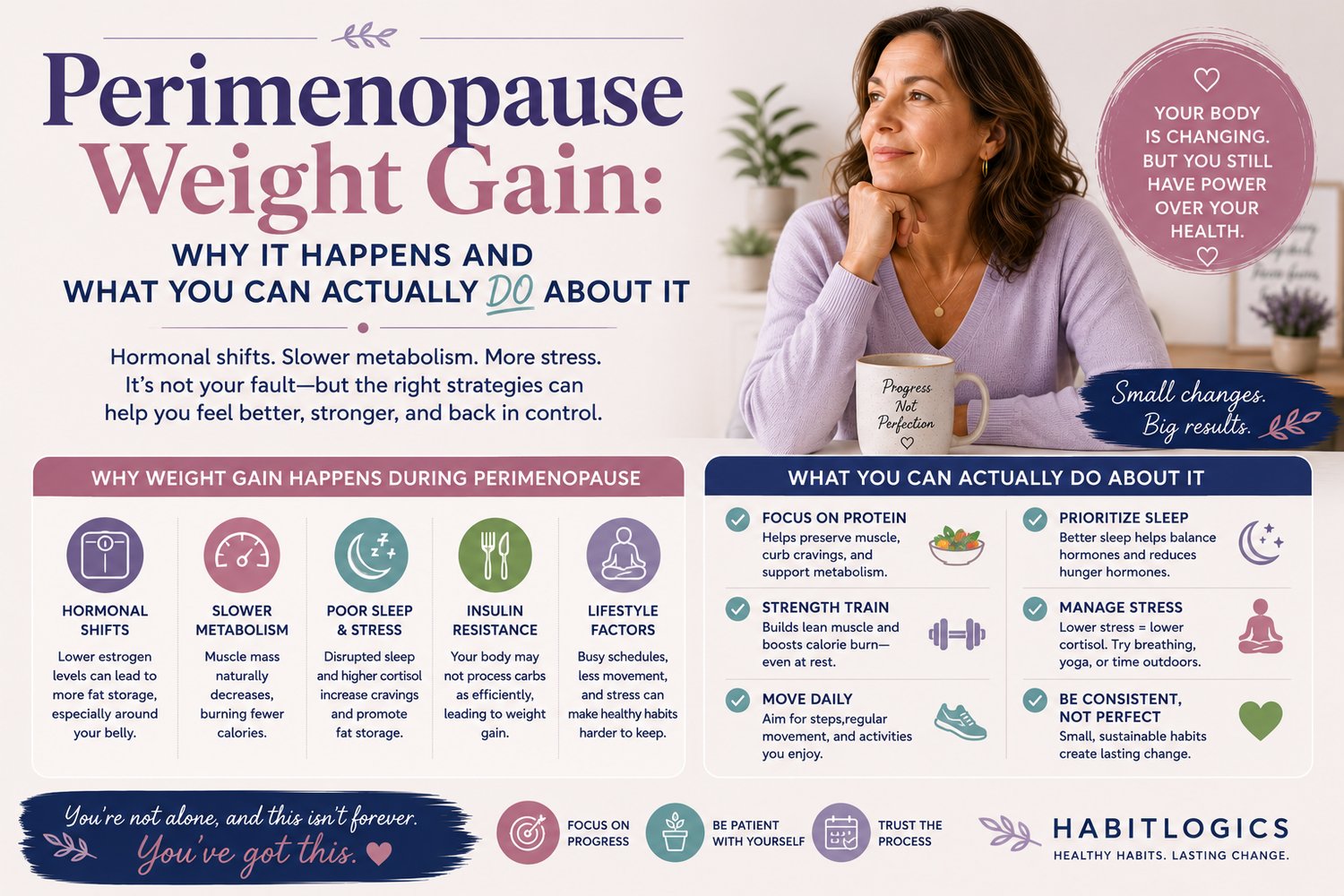
Perimenopause Weight Gain: Why It Happens, Belly Fat & What Actually Helps
Perimenopause weight gain can be especially frustrating when your habits haven't changed much but your body suddenly seems to have different ideas.
Maybe the scale is creeping upward.
Maybe your weight hasn't changed dramatically, but your waistline has.
Maybe fat that once tended to sit around your hips and thighs now seems determined to move directly into your abdomen.
And then the internet explains it with one convenient sentence:
“Your hormones ruined your metabolism.”
That's not a very good explanation.
Weight and body composition often change during midlife, and the menopause transition can play a real role—particularly in the shift toward more abdominal and visceral fat.
But menopause isn't acting alone.
Aging, physical activity, muscle mass, food intake, sleep, medications, genetics, stress, medical conditions, and changing estrogen levels can all contribute.
The useful takeaway isn't:
“Hormones don't matter.”
It's:
“Hormones matter, but they aren't the only thing that matters—and many of the other factors can be addressed.”
Does Perimenopause Actually Cause Weight Gain?
The answer requires a distinction between body weight and body composition.
Women commonly gain weight during midlife.
But much of the increase in total body weight appears to be strongly related to aging and lifestyle factors occurring at the same time as menopause.
The menopause transition itself has a particularly important effect on where fat tends to accumulate.
As estrogen levels decline, body composition tends to shift toward:
- More abdominal fat
- More visceral fat
- Less favorable fat distribution
- Loss of lean mass with aging
So menopause doesn't suddenly override the basic principles governing body weight.
But it can change the environment in which you're trying to manage that weight.
That's why:
“Nothing changes during menopause”
is wrong.
And:
“Estrogen is why I gained 30 pounds”
is usually too simple.
Why Does Belly Fat Increase During Perimenopause?
This is one of the more consistent body-composition changes associated with the menopause transition.
Before menopause, women tend to store proportionally more fat around the:
- Hips
- Buttocks
- Thighs
As estrogen exposure declines, fat distribution tends to shift toward the abdomen.
That includes visceral fat—fat located deeper in the abdominal cavity around internal organs.
This matters for reasons beyond appearance.
Higher visceral fat is associated with increased risks involving:
- Insulin resistance
- Type 2 diabetes
- High blood pressure
- Abnormal cholesterol
- Cardiovascular disease
- Metabolic syndrome
So when women say:
“My body shape changed even though my weight barely moved,”
that can be a very real phenomenon.
The scale isn't measuring where fat is stored.
Is Menopause Belly Fat Inevitable?
No.
Your risk of accumulating more abdominal fat may increase.
That doesn't mean your body is destined to follow one predetermined trajectory.
Body composition remains influenced by:
- Overall energy intake
- Physical activity
- Resistance training
- Muscle preservation
- Sleep
- Genetics
- Medications
- Health conditions
- Smoking
- Alcohol
- Other lifestyle factors
You can't control menopause.
You can still influence many of the variables around it.
Does Your Metabolism Slow Down During Perimenopause?
Metabolism changes with age, but the popular version of this story is usually exaggerated.
Your metabolism doesn't suddenly fall off a cliff because you turned 45.
Several gradual changes can affect how much energy you use:
- Lean mass may decline with age
- People often become less physically active
- Everyday movement can decrease
- Body size changes
- Energy expenditure changes with aging
Muscle does use energy at rest, which is one reason preserving muscle matters.
But the useful conclusion isn't:
“If I lose five pounds of muscle, my metabolism is destroyed.”
It's:
Maintaining muscle and staying active become increasingly important as you age.
That is a much more accurate—and much less hopeless—message.
Muscle Loss Matters for More Than Calories
One reason I don't want this entire conversation reduced to “muscle burns calories” is that muscle does far more than slightly increase resting energy expenditure.
Maintaining muscle supports:
- Strength
- Mobility
- Independence
- Glucose metabolism
- Bone health
- Physical function
- Exercise capacity
- Healthy aging
And when you're intentionally losing weight, preserving muscle becomes even more important.
Weight loss generally doesn't consist entirely of fat.
Without an appropriate strategy, some lean tissue can be lost too.
That's why two habits matter so much during weight management:
adequate protein + resistance training
Read:
Protein During Perimenopause: How Much Do You Need?
and
Strength Training During Perimenopause: Benefits, Workouts & How to Start.
Why Can Weight Gain Happen Even If You're “Eating the Same”?
Because “the same” doesn't necessarily interact with the same body or lifestyle forever.
Maybe you really are eating roughly what you ate ten years ago.
But other things may have changed.
You may now:
- Move less during the workday
- Have less muscle
- Sleep worse
- Exercise less consistently
- Spend more time sitting
- Take a medication that influences weight
- Drink more alcohol
- Experience more stress
- Have a health condition affecting weight
Even relatively modest differences repeated over months and years can add up.
That doesn't mean you're secretly overeating massive amounts of food.
It means energy balance can shift gradually.
Poor Sleep Can Make Weight Management Harder
Perimenopause and sleep problems frequently arrive together.
Hot flashes.
Night sweats.
Insomnia.
Early waking.
And once sleep deteriorates, weight-management behaviors can become harder.
Poor sleep can affect:
- Hunger
- Appetite
- Food choices
- Energy
- Exercise
- Recovery
- Mood
- Decision-making
Think about the difference between planning dinner after a good night's sleep and doing it when you're exhausted, irritated, and have already been awake since 3:30 a.m.
That's not a character flaw.
Sleep affects behavior and physiology.
If sleep is becoming a major issue, read Sleep During Perimenopause: Why You Can’t Sleep & What Actually Helps.
Stress Matters—But Not Because “Cortisol Creates Belly Fat”
This deserves some myth-busting.
Stress can influence weight.
But the internet often turns that into:
“Cortisol is why you can't lose menopause belly fat.”
That's a massive oversimplification.
Stress can make weight management harder through ordinary mechanisms such as:
- Emotional eating
- Reduced sleep
- Less physical activity
- More alcohol
- Reduced meal preparation
- Increased convenience eating
- Difficulty maintaining routines
Chronic stress also has physiological effects.
But treating “cortisol” as the single explanation for midlife weight gain creates an entire market for supplements that supposedly “balance” it.
You usually don't need a cortisol detox.
You need a sustainable plan that still works when life gets stressful.
Do Hot Flashes Cause Weight Gain?
Not directly.
But symptoms can influence the behaviors around weight.
For example:
night sweats → poor sleep → fatigue → less activity → harder food decisions
That's not the same as saying a hot flash creates body fat.
Perimenopause symptoms often interact.
Treating disruptive symptoms may make healthy behaviors easier to maintain.
Read Hot Flashes During Perimenopause: Causes, Triggers & Treatments That Actually Help.
What Is the Best Diet for Perimenopause Weight Loss?
There isn't one special perimenopause diet.
No unique combination of foods switches menopause off.
And you don't need to:
- Remove all carbohydrates
- Stop eating fruit
- Eliminate dairy
- Fast for 20 hours
- “Detox estrogen”
- Buy hormone-balancing powders
Different eating approaches can produce weight loss when they help someone maintain an appropriate calorie deficit.
The best approach is usually the one that:
- Provides adequate nutrition
- Helps control hunger
- Preserves muscle
- Fits your life
- Can be maintained
For most people, useful foundations include:
- Adequate protein
- Plenty of vegetables
- Fruit
- Beans and legumes
- Whole grains
- Other fiber-rich carbohydrates
- Healthy fats
- Minimally processed foods most of the time
Read Best Diet for Perimenopause: What to Eat for Midlife Health for the full nutrition discussion.
Do Calories Still Matter During Perimenopause?
Yes.
Hormones don't repeal energy balance.
If body fat is being lost over time, the body is using more energy than it's taking in.
But that doesn't mean:
“Just eat less.”
is useful weight-management advice.
How easy or difficult it is to maintain an energy deficit can be influenced by:
- Hunger
- Food environment
- Sleep
- Medications
- Genetics
- Activity
- Stress
- Biology
- Previous dieting
- Medical conditions
- Obesity itself
Energy balance explains what has to happen.
It doesn't explain how difficult making it happen may be for one individual.
Those are different questions.
Do You Have to Count Calories?
No.
Calorie tracking is one tool.
Some people find it extremely useful because it shows them where their intake is actually coming from.
Others hate it.
Weight loss can also be approached through habits that tend to reduce energy intake without tracking every number.
For example:
- Build meals around protein
- Increase fiber-rich foods
- Eat more vegetables
- Reduce liquid calories
- Moderate highly calorie-dense snack foods
- Control portions
- Prepare more food at home
- Plan meals before you're starving
If you're making progress without counting, there's no prize for making the process more complicated.
If you've made no progress for months and genuinely don't know what you're consuming, short-term tracking can provide useful information.
Use tools when they're useful.
Protein Helps With More Than “Boosting Metabolism”
Protein is particularly useful during weight management because it can help with:
- Fullness
- Muscle maintenance
- Recovery
- Meeting overall nutrition needs
But protein isn't magic.
Eating 160 grams of protein doesn't make total calories irrelevant.
And there is no special “menopause protein” your body suddenly requires because estrogen changed.
The goal is adequate intake distributed through a diet that supports your overall needs.
Read Protein During Perimenopause: How Much Do You Need?.
Fiber Can Make Weight Management Easier Too
Protein gets most of the attention, but fiber deserves a seat at the table.
Fiber-rich foods can help meals feel more filling while supporting:
- Digestive health
- Cholesterol management
- Blood-sugar control
- Overall dietary quality
Useful sources include:
- Beans
- Lentils
- Vegetables
- Fruit
- Whole grains
- Nuts
- Seeds
This is why a useful midlife eating strategy isn't simply:
“eat more protein.”
It's often:
protein + fiber + foods you actually enjoy eating.
For more on fiber, visit the Complete Fiber & Gut Health Guide.
Meal Planning Makes Consistency Easier
The hardest food decisions are often made when you're:
- Tired
- Hungry
- Busy
- Stressed
- Short on time
You don't need seven days of perfectly portioned meal-prep containers.
Even basic planning helps.
Try deciding ahead of time on:
- Several protein sources
- A few vegetables
- Fruit
- Fiber-rich carbohydrates
- Breakfast options
- Easy lunches
- A few backup meals
The Perimenopause Nutrition & Meal Planner includes printable and Excel tools for meal planning, high-protein and high-fiber tracking, meal prep, grocery planning, and food journaling.
Strength Training Should Be Part of the Plan
If weight loss is the goal, don't focus exclusively on burning more calories.
Think about what you want your body to keep while weight comes off.
Resistance training provides a strong reason for the body to preserve muscle.
That can include:
- Free weights
- Machines
- Resistance bands
- Bodyweight exercises
You don't need a bodybuilding program.
But some form of progressive resistance training is an excellent investment in midlife health.
Read Strength Training During Perimenopause: Benefits, Workouts & How to Start.
Walking Is Still Excellent—Just Not Magical
Walking gets underestimated because it doesn't look dramatic on social media.
That's actually one of its strengths.
Walking is:
- Accessible
- Repeatable
- Low impact
- Easy to recover from
- Easy to combine with daily life
It can increase overall energy expenditure while also supporting cardiovascular fitness and physical activity.
But one walk doesn't “burn menopause belly fat.”
No exercise can selectively remove fat from your abdomen.
Walking works because it's something many people can do consistently.
Read Walking During Perimenopause: Benefits for Weight, Mood & Health.
For a deeper walking strategy, see the Complete Walking for Weight Loss Guide.
Do You Need HIIT During Perimenopause?
No.
High-intensity interval training can be useful if you enjoy it, recover well, and it's appropriate for your fitness level.
It is not mandatory.
You may see claims that women in perimenopause must:
“stop doing cardio and only lift heavy”
or that:
“HIIT is the only way to fight hormonal belly fat.”
Neither is a universal rule.
A good program can include:
- Walking
- Moderate cardio
- Strength training
- Higher-intensity exercise when appropriate
- Activities you enjoy
The best exercise plan is one that improves your fitness without being so miserable you abandon it in three weeks.
Can You Spot-Reduce Menopause Belly Fat?
No.
Crunches don't selectively burn abdominal fat.
Neither does:
- A special supplement
- A detox
- A waist trainer
- A particular food
- A “cortisol workout”
- A menopause-specific fasting schedule
You can strengthen the muscles underneath your abdomen.
You can lose body fat overall.
You cannot tell the body exactly which fat cells to empty first.
Unfortunately, biology has declined to provide that setting.
Should You Measure Your Waist?
It can be useful.
The scale tells you total body mass.
It doesn't tell you where fat is being carried.
Because abdominal fat is relevant to cardiometabolic risk, waist measurement can add useful information.
You might track:
- Weight
- Waist circumference
- Strength
- Fitness
- How clothes fit
- Blood pressure
- Relevant bloodwork
You don't need to measure everything.
Choose metrics that actually help you make decisions.
What About the Scale?
The scale is neither evil nor magical.
It's one data point.
Body weight naturally fluctuates because of:
- Hydration
- Food in the digestive tract
- Sodium
- Menstrual-cycle changes
- Glycogen
- Bowel movements
A single weigh-in doesn't tell you whether you've gained or lost body fat.
If you use a scale, look at the trend over time rather than panicking over Tuesday morning.
And if weighing yourself is psychologically counterproductive, use other measures.
Can You Gain Muscle While Losing Fat?
Yes, particularly in certain situations.
Someone who is:
- New to strength training
- Returning after a long break
- Carrying excess body fat
- Following an effective resistance program
- Eating adequate protein
may be able to gain or preserve muscle while losing fat.
This is often called body recomposition.
That means the scale may change more slowly while:
- Waist circumference decreases
- Strength improves
- Clothes fit differently
- Body composition improves
Weight is useful.
It isn't the entire scoreboard.
Does Hormone Therapy Prevent Perimenopause Weight Gain?
Hormone therapy isn't a weight-loss treatment.
It shouldn't be prescribed simply because someone wants to lose body fat.
Hormone therapy may influence body composition and fat distribution, and treating severe menopause symptoms can indirectly make healthy behaviors easier.
For example:
fewer night sweats → better sleep → more energy for activity
But don't turn that into:
“Take estrogen to lose menopause belly fat.”
That's not what menopausal hormone therapy is for.
Read Hormone Therapy for Perimenopause: Benefits, Risks, Types & Who It May Help.
What About Weight-Loss Medications?
This deserves a place in an evidence-based weight-management article.
For some adults with overweight or obesity, prescription anti-obesity medications can be appropriate medical treatment.
These medications aren't a moral failure.
They're also not appropriate for everyone.
Depending on the medication, they can help through mechanisms involving:
- Appetite
- Fullness
- Food intake
- Gastrointestinal signaling
- Brain pathways involved in eating
Several different classes exist.
Among the most discussed today are medications that target the GLP-1 pathway, including semaglutide, as well as dual-pathway drugs such as tirzepatide.
These medications can produce substantial weight loss for appropriate patients, but they also involve:
- Eligibility requirements
- Side effects
- Contraindications
- Cost
- Ongoing medical treatment
- The need to preserve muscle and nutrition during weight loss
They should be treated as medications—not as menopause supplements.
And they are not specifically “perimenopause drugs.”
Someone can qualify for obesity treatment during perimenopause for the same medical reasons an adult at another life stage might.
If you want to understand this medication category, see the Complete GLP-1 Success Guide.
Do GLP-1 Medications Fix Hormonal Weight Gain?
No.
GLP-1–based medications can help treat obesity.
They don't reverse menopause or “rebalance estrogen.”
That's an important distinction because marketing can easily turn:
effective obesity treatment
into
special menopause hormone solution.
Those aren't the same thing.
If medication-assisted weight loss is appropriate, preserving lean mass becomes especially important through adequate nutrition and resistance training.
What About Weight-Loss Supplements?
This category deserves substantial skepticism.
Be cautious with products claiming to:
- Melt menopause belly fat
- Boost metabolism
- Balance estrogen
- Lower cortisol
- Detox hormones
- Burn fat while you sleep
- Mimic GLP-1 naturally
The supplement industry can take a real biological concept and stretch it until the original science is barely recognizable.
For example:
GLP-1 is an important biological pathway.
That does not mean a supplement labeled “natural GLP-1 booster” produces medication-level weight loss.
Claims require evidence on the actual product.
What About Intermittent Fasting?
Intermittent fasting can be a useful eating structure for some people.
It isn't uniquely effective because you're in perimenopause.
If a shorter eating window helps you:
- Control overall intake
- Reduce snacking
- Simplify meals
- Maintain a calorie deficit
then it may work well.
If it causes:
- Extreme hunger
- Binge eating
- Poor workouts
- Difficulty meeting protein needs
- An eating pattern you hate
then it's probably not the right strategy.
The magic isn't the clock.
It's whether the eating pattern helps you consistently accomplish your goals.
Do Carbs Cause Perimenopause Weight Gain?
No.
Carbohydrates are not uniquely converted into menopause belly fat.
Foods such as:
- Fruit
- Beans
- Lentils
- Oats
- Potatoes
- Whole grains
can absolutely fit into a healthy weight-management diet.
Carbohydrate-heavy foods can also be highly calorie-dense when they're combined with lots of refined fat and sugar.
That's a food-pattern issue—not evidence that carbohydrates themselves are incompatible with menopause.
What Rate of Weight Loss Makes Sense?
There isn't one correct rate for everyone.
A reasonable plan should prioritize:
- Sustainability
- Adequate nutrition
- Muscle preservation
- Health
- Adherence
Faster isn't automatically better.
If an aggressive plan leaves you exhausted, hungry, losing strength, and unable to maintain it, the speed isn't helping.
The goal is not to win a three-week diet.
It's to build a body-composition strategy you can live with.
Stop Trying to “Get Your Old Body Back”
This phrase can create a miserable target.
You're not trying to recreate your exact body at 27.
You have a different body, age, schedule, health history, and life.
A more useful goal may be:
- Reduce excess body fat
- Preserve or build muscle
- Improve cardiovascular fitness
- Improve blood pressure
- Improve blood sugar
- Improve strength
- Improve energy
- Maintain mobility
That's not settling.
It's choosing outcomes that matter.
Track Progress Beyond Weight
Depending on your goals, useful measures can include:
- Body weight trend
- Waist circumference
- Strength
- Walking pace
- Exercise performance
- Blood pressure
- Lab values
- Energy
- Sleep
- Habit consistency
You don't need all of them.
And “progress photos” are completely optional.
Health doesn't require documenting your body from three angles every Sunday.
When Should Weight Gain Be Medically Evaluated?
Weight gain during midlife can be common.
Rapid or unexplained change deserves more attention.
Talk with a healthcare professional if you experience:
- Rapid unexplained weight gain
- Significant swelling
- Severe fatigue
- Shortness of breath
- Major changes in appetite
- Symptoms suggesting thyroid disease
- Persistent digestive symptoms
- New medication-associated weight changes
- Difficulty managing weight despite sustained efforts
- Concerns about obesity-related health risks
Possible contributors can include:
- Medications
- Thyroid disease
- Fluid retention
- Sleep disorders
- Depression
- Other medical conditions
A clinician can also help determine whether structured weight-management treatment, medication, or referral to a specialist is appropriate.
Frequently Asked Questions
Does perimenopause cause weight gain?
Perimenopause can contribute to body-composition changes, particularly increased abdominal and visceral fat.
Overall midlife weight gain is also strongly influenced by aging, physical activity, food intake, muscle mass, sleep, medications, genetics, and other factors.
Why am I suddenly gaining belly fat during perimenopause?
Declining estrogen exposure appears to contribute to a shift in fat storage toward the abdomen during the menopause transition.
That can occur even when total body weight changes only modestly.
Is menopause belly fat permanent?
No.
Menopause may increase the tendency toward central fat accumulation, but body fat can still be reduced through appropriate weight-management strategies.
You cannot choose exactly where fat will come off first.
Why am I gaining weight when I eat the same amount?
Your physical activity, lean mass, sleep, medications, health, and total energy expenditure may have changed even when your eating habits feel similar.
Small changes accumulated over time can affect body weight.
Is my metabolism broken?
No.
Energy expenditure changes gradually with aging and body composition, but the idea that menopause suddenly “breaks” metabolism is misleading.
Weight loss remains physiologically possible during and after menopause.
What's the best diet for perimenopause weight loss?
There isn't one universally superior menopause diet.
A sustainable eating pattern that provides adequate protein, fiber, and overall nutrition while creating an appropriate calorie deficit can work.
Should I eat more protein during perimenopause?
Adequate protein becomes especially useful for preserving muscle during midlife and weight loss.
The ideal amount depends on body size, overall diet, activity, health, and individual goals.
Is walking enough to lose weight during perimenopause?
Walking can contribute meaningfully to physical activity and energy expenditure.
Whether it produces weight loss depends on the overall energy balance.
Combining walking with resistance training and an appropriate eating pattern is often a strong approach.
Should women over 40 stop doing cardio?
No.
Aerobic exercise supports cardiovascular health and fitness.
There is no evidence-based rule that women must stop cardio when they enter perimenopause.
Strength training deserves a place in the plan too.
Does HRT help you lose menopause belly fat?
Hormone therapy is not a weight-loss treatment.
It may affect body composition and fat distribution and can improve symptoms that otherwise interfere with healthy behaviors, but it shouldn't be prescribed simply to produce weight loss.
Can you take GLP-1 medications during perimenopause?
Perimenopause itself isn't a reason someone cannot receive obesity treatment.
Eligibility for GLP-1–based or other anti-obesity medication depends on the medication, medical indications, health history, contraindications, and clinician evaluation.
These medications treat obesity or overweight with qualifying health risks—not perimenopause itself.
Is intermittent fasting better for menopause weight loss?
Not inherently.
Intermittent fasting can work when it helps someone consistently reduce overall energy intake.
It isn't uniquely required for women during perimenopause.
Do I need to eliminate carbs?
No.
Fiber-rich carbohydrate foods such as fruit, beans, oats, potatoes, and whole grains can fit easily into a healthy eating pattern.
Key Takeaways
- Perimenopause weight gain is influenced by both menopause-related body-composition changes and the broader effects of aging and lifestyle.
- The menopause transition appears particularly important for the shift toward more abdominal and visceral fat.
- Overall weight gain should not be blamed entirely on estrogen.
- Metabolism doesn't suddenly “break” during perimenopause.
- Preserving muscle matters for strength, metabolic health, function, and healthy aging—not just calorie burning.
- Resistance training and adequate protein are especially useful during intentional weight loss.
- Walking and other aerobic activity support cardiovascular health and overall energy expenditure.
- Sleep problems can make weight-management behaviors substantially harder.
- There is no special menopause diet required for fat loss.
- Calories still matter, but calorie counting is only one possible tool.
- Protein and fiber can make a weight-loss diet more satisfying and nutritionally useful.
- Hormone therapy isn't a weight-loss treatment.
- Prescription anti-obesity medications, including GLP-1–based treatments, may be appropriate for some adults and should be viewed as legitimate medical treatments rather than shortcuts or menopause cures.
- Supplements promising to “balance hormones,” “lower cortisol,” or melt menopause belly fat deserve skepticism.
- Weight, waist circumference, fitness, strength, and metabolic health can all provide useful measures of progress.
- Rapid or unexplained weight changes deserve medical evaluation.
Continue Learning
For a practical midlife weight-management foundation, continue with:
- Best Diet for Perimenopause: What to Eat for Midlife Health
- Protein During Perimenopause: How Much Do You Need?
- Strength Training During Perimenopause: Benefits, Workouts & How to Start
- Walking During Perimenopause: Benefits for Weight, Mood & Health
- Sleep During Perimenopause: Why You Can’t Sleep & What Actually Helps
For more information about GLP-1–based weight-management treatment, visit the Complete GLP-1 Success Guide.
If you want a structured system for planning meals while tracking protein and fiber, the Perimenopause Nutrition & Meal Planner includes printable and Excel tools for meal planning, meal prep, grocery planning, nutrition tracking, and food journaling.
Or return to the Complete Perimenopause Guide for the full HabitLogics perimenopause roadmap.
Educational Disclaimer
This article is intended for educational purposes only and is not medical advice, diagnosis, or individualized weight-management treatment. Body-weight changes can be influenced by nutrition, physical activity, aging, menopause, medications, sleep, genetics, medical conditions, and other factors. Prescription weight-management medications have indications, contraindications, potential side effects, and monitoring requirements. Consult a qualified healthcare professional about rapid or unexplained weight changes or before starting medical weight-loss treatment.