

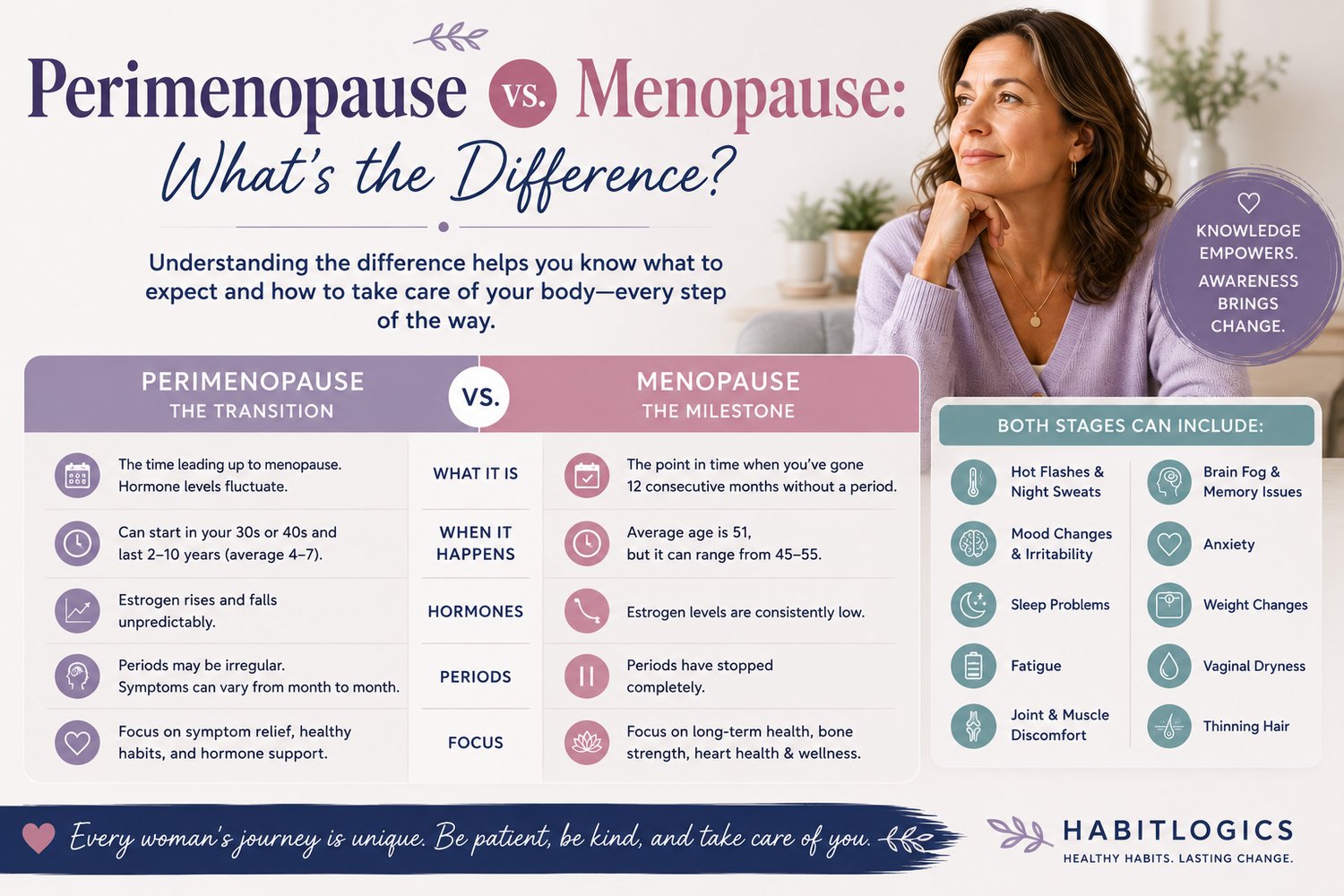
Perimenopause vs. Menopause: What’s the Difference?
The words perimenopause and menopause are often used as though they mean the same thing.
They don't.
The easiest way to think about it is:
Perimenopause is the transition.
Menopause is the milestone.
Postmenopause is what comes afterward.
During perimenopause, you may still have periods—even very unpredictable ones—and pregnancy can still occur.
Menopause is reached after 12 consecutive months without a menstrual period when another cause doesn't explain why menstruation stopped.
After that point, you're postmenopausal.
That distinction matters for more than terminology. It can affect how bleeding is evaluated, whether contraception may still be necessary, how symptoms are interpreted, and which health concerns become increasingly important.
If you're still learning the basics, start with What Is Perimenopause? Signs, Stages, Symptoms & What to Expect.
Perimenopause vs. Menopause at a Glance
Here is the simplest version.
Perimenopause
Perimenopause is the years-long transition leading up to menopause.
During this time:
- Menstrual cycles may become irregular
- Ovulation becomes less predictable
- Hormone levels fluctuate
- Hot flashes and night sweats may begin
- Sleep may change
- Vaginal and urinary symptoms may appear
- Mood and cognitive symptoms may occur
- Pregnancy is still possible
Menopause
Menopause is the point reached after 12 consecutive months without a menstrual period, assuming another cause doesn't explain the absence of menstruation.
It marks the end of natural menstrual cycles.
Postmenopause
Postmenopause is the stage after menopause.
Periods have permanently stopped, but some menopause-related symptoms may continue.
Long-term considerations involving bone, cardiovascular, vaginal, urinary, and other aspects of health also become increasingly important.
What Is Perimenopause?
Perimenopause—also called the menopause transition—is the period leading up to the final menstrual period.
It most commonly begins during the 40s, although timing varies.
During the transition, ovarian function becomes less predictable.
Ovulation may occur during some cycles and not others, while estrogen and progesterone patterns can fluctuate considerably.
As a result, menstrual cycles may become:
- Shorter
- Longer
- Closer together
- Farther apart
- Heavier
- Lighter
- Occasionally skipped
Symptoms such as hot flashes, night sweats, sleep problems, vaginal dryness, or mood changes may appear during this time.
Perimenopause typically lasts several years, but there is no universal timeline.
For a deeper look at timing, read When Does Perimenopause Start? Age, Early Signs & What to Expect.
What Is Menopause?
Menopause is often described as a stage, but medically it's more useful to think of it as a specific point in the reproductive timeline.
For someone experiencing natural menstrual cycles, menopause is identified retrospectively after 12 months have passed without a menstrual period.
You don't necessarily know that you've had your final period when it happens.
Imagine your last period occurs in March.
In April, you don't know it was your final period.
Six months later, you still don't know for certain.
Only after 12 consecutive months without another period can natural menopause generally be identified.
In the United States, the average age of natural menopause is around 52, although individual timing varies.
Once menopause has been reached, you enter postmenopause.
For the rest of this article, when I say someone has “reached menopause,” I'm referring to that transition point rather than treating menopause as a multi-year period.
What Is Postmenopause?
Postmenopause is the stage beginning after menopause has been reached.
You remain postmenopausal for the rest of your life.
Hormonal fluctuations generally become less dramatic than during perimenopause, but that doesn't mean every symptom immediately disappears.
Some women continue experiencing:
- Hot flashes
- Night sweats
- Sleep disruption
- Vaginal dryness
- Pain or discomfort during sex
- Urinary symptoms
- Other menopause-related concerns
Vaginal and urinary changes deserve particular attention because they can persist or worsen without treatment.
Postmenopause also makes preventive health increasingly important because age and lower estrogen exposure can affect areas such as:
- Bone health
- Cardiovascular health
- Vaginal and urinary health
- Sexual health
The end of periods isn't the end of healthcare related to menopause.
What Is the Biggest Difference Between Perimenopause and Menopause?
The most obvious practical difference is menstruation.
During perimenopause, periods still occur, although they can become increasingly unpredictable.
After menopause, natural menstrual periods have stopped permanently.
That difference becomes clinically important when bleeding occurs.
During perimenopause, changes in menstrual timing and flow are common.
After menopause, vaginal bleeding is not considered another menstrual period and should be evaluated by a healthcare professional.
Even light spotting counts.
That's one reason knowing which stage you're in actually matters.
Do Perimenopause and Menopause Have Different Symptoms?
There is substantial overlap.
Symptoms associated with the menopause transition can include:
- Hot flashes
- Night sweats
- Sleep disruption
- Vaginal dryness
- Urinary symptoms
- Changes in sexual comfort or desire
- Mood changes
- Problems with concentration or memory
The major symptom unique to perimenopause is the changing menstrual pattern because periods are still occurring.
You may notice:
- Changing cycle lengths
- Missed periods
- Heavier or lighter periods
- Less predictable menstruation
After menopause, menstrual changes disappear because there are no more menstrual periods.
That doesn't mean other symptoms disappear.
For the broader symptom picture, read 35 Perimenopause Symptoms: Common Signs, What’s Normal & When to Get Help.
Can Hot Flashes Continue After Menopause?
Yes.
This is one of the most common misconceptions about the transition.
Reaching the 12-month menopause milestone doesn't mean:
“Congratulations, your hormones have finished changing and all symptoms shut off tomorrow.”
Hot flashes and night sweats may continue into postmenopause.
For some women they improve relatively quickly.
For others they persist for years.
Symptom duration varies considerably.
If hot flashes are bothering you, read Managing Hot Flashes During Perimenopause.
Can Sleep Problems Continue After Menopause?
Yes.
Sleep problems can occur during perimenopause and continue afterward.
Several factors may overlap:
- Night sweats
- Insomnia
- Mood changes
- Stress
- Sleep habits
- Sleep apnea
- Other medical conditions
That matters because not every sleep problem during midlife is solved simply by waiting for menopause to arrive.
Read Sleep During Perimenopause: Why It Changes & How to Sleep Better.
If you're trying to identify patterns between sleep and nighttime symptoms, the Perimenopause Sleep & Hot Flash Planner provides printable and Excel tools for tracking sleep, night sweats, hot flashes, and bedtime routines.
Can You Still Get Pregnant During Perimenopause?
Yes.
Fertility generally declines with age, and ovulation becomes increasingly unpredictable during perimenopause.
But unpredictable ovulation isn't the same as no ovulation.
Pregnancy remains possible.
That's why a missed period during perimenopause shouldn't automatically be attributed to hormones when pregnancy is possible.
If avoiding pregnancy matters, talk with your healthcare professional about contraception and when it can safely be discontinued.
Can You Get Pregnant After Menopause?
Natural pregnancy no longer occurs after menopause because ovulation has stopped.
That is different from pregnancy achieved through assisted reproductive technology using donor eggs or previously preserved eggs or embryos.
So in everyday terms:
Perimenopause: pregnancy is still possible.
Postmenopause: spontaneous natural pregnancy is no longer possible.
How Do You Know Whether You're in Perimenopause or Menopause?
Your menstrual history is usually the biggest clue.
During perimenopause, you are still having periods—even if they're irregular.
If you've gone 12 consecutive months without menstruating and another explanation isn't responsible, you've reached menopause.
Healthcare professionals may also consider:
- Age
- Menstrual history
- Symptoms
- Medications
- Contraceptive use
- Medical history
- Surgical history
- Other possible explanations for absent periods
For otherwise healthy people 45 and older with a typical menopause presentation, routine hormone testing generally isn't necessary.
Hormone levels fluctuate during perimenopause, so one blood test often isn't a clean yes/no menopause test.
Testing may be more useful in situations involving younger ages, unusual symptoms, or another possible medical explanation.
What If You Don't Have Periods to Track?
The usual “12 months without a period” rule becomes less straightforward if something else already prevents menstrual bleeding.
Examples include:
- Hysterectomy
- Certain hormonal contraceptives
- Some medications
- Other medical treatments
Someone who has had a hysterectomy but still has functioning ovaries can still experience the natural menopause transition even though there are no periods available to track.
Likewise, hormonal contraception can alter or stop menstrual bleeding without meaning the ovaries have naturally reached menopause.
In situations like these, age, symptoms, medical history, medications, and sometimes laboratory testing may help a healthcare professional determine what's happening.
Is Perimenopause the Same as Premenopause?
Not exactly.
Premenopause broadly describes the reproductive years before menopause and is sometimes used simply to mean “not yet menopausal.”
Perimenopause specifically refers to the transition approaching menopause, when menstrual patterns and ovarian hormone function begin changing.
The terms aren't interchangeable.
In practical health information, perimenopause is the more useful term when discussing the menopause transition.
What Is Early Menopause?
Early menopause means reaching menopause before the usual age range, generally between ages 40 and 45.
That means the final menstrual period occurs during this age range and 12 months pass without another period.
Early menopause deserves clinical attention because spending more years with low estrogen levels can have implications for bone and cardiovascular health, among other considerations.
Menopause occurring at the typical age isn't a disease.
Menopause occurring considerably earlier deserves a closer look.
Is Premature Ovarian Insufficiency the Same as Early Menopause?
No.
This distinction is important.
Premature ovarian insufficiency (POI) occurs when the ovaries stop functioning normally before age 40.
It used to be commonly called “premature ovarian failure,” but POI is the preferred term because ovarian function can sometimes occur intermittently.
POI isn't simply ordinary perimenopause arriving early.
And it isn't perfectly interchangeable with the idea of permanent menopause before 40.
POI can affect:
- Fertility
- Bone health
- Cardiovascular health
- Hormone exposure
- Treatment decisions
Significant cycle changes or menopause-like symptoms before age 40 deserve medical evaluation rather than an automatic assumption that you've entered routine perimenopause.
What Is Surgical Menopause?
Surgical menopause occurs when both ovaries are removed before natural menopause.
Because the ovaries are removed rather than gradually changing over several years, estrogen levels fall much more abruptly than during a typical natural menopause transition.
This can cause symptoms to begin suddenly and sometimes intensely.
Removing the uterus alone is different.
A hysterectomy without removal of both ovaries stops menstrual bleeding because the uterus is gone, but it doesn't automatically cause immediate menopause.
The ovaries may continue producing hormones until their function eventually declines.
That's another reason “Do you still have a period?” doesn't answer every menopause question.
Does Menopause Happen Immediately After Chemotherapy?
Not necessarily.
Certain chemotherapy and radiation treatments can damage ovarian function.
For some people, menstrual periods temporarily stop and later return.
For others, treatment leads to permanent loss of ovarian function and earlier menopause.
The effect depends on factors including:
- Age
- Treatment type
- Dose
- Location of radiation
- Individual ovarian reserve
Anyone experiencing treatment-related menstrual changes should discuss menopause status and long-term health implications with their medical team rather than relying on the normal natural-menopause timeline.
Why Does Knowing Your Stage Matter?
Because these aren't just vocabulary words.
Your stage can affect real decisions.
Contraception
Pregnancy remains possible during perimenopause.
After natural menopause, spontaneous pregnancy no longer occurs.
Vaginal Bleeding
Changing periods can occur during perimenopause.
Bleeding after menopause requires medical evaluation.
Symptom Treatment
Hot flashes and other symptoms can occur both before and after menopause, and treatment decisions may depend partly on age, timing, medical history, and risk factors.
Vaginal and Urinary Health
Vaginal dryness, discomfort during sex, urinary symptoms, and recurrent UTIs may persist after menopause and can often be treated.
Bone Health
Declining estrogen exposure around and after menopause can contribute to bone loss.
Cardiovascular Health
Cardiovascular risk increases with age, and changes around menopause can affect several risk factors.
Knowing your stage helps put those health decisions into context.
Does Treatment Change After Menopause?
Sometimes.
But treatment isn't determined by the label alone.
What matters includes:
- Your symptoms
- Age
- How long it has been since menopause
- Medical history
- Whether you have a uterus
- Risk factors
- Treatment goals
- Personal preferences
Menopausal hormone therapy is one option for certain symptoms and is particularly effective for vasomotor symptoms such as hot flashes and night sweats in appropriate candidates.
Other hormonal and nonhormonal treatments are available depending on the symptom.
For example, vaginal symptoms may be treated differently from hot flashes.
Read Hormone Therapy During Perimenopause: Benefits, Risks & What to Know for a more detailed discussion.
Healthy habits matter too.
They just shouldn't be marketed as a substitute for medical treatment when someone actually needs treatment.
Lifestyle Still Matters Before and After Menopause
The fundamentals don't suddenly stop mattering when you cross the 12-month mark.
Useful health foundations include:
- Regular physical activity
- Strength training
- Adequate protein
- Fiber-rich, nutrient-dense foods
- Consistent sleep habits
- Avoiding smoking
- Moderating alcohol when appropriate
- Keeping up with recommended preventive care
Strength training becomes especially valuable for preserving muscle, function, and bone health.
Walking supports cardiovascular fitness, mobility, and overall activity.
Nutrition supports both.
Explore:
- Healthy Habits During Perimenopause: What Actually Matters
- Walking During Perimenopause: Benefits for Weight, Mood & Health
- Strength Training During Perimenopause: Benefits, Workouts & How to Start
- Best Diet for Perimenopause: What to Eat for Midlife Health
- Protein During Perimenopause: How Much Do You Need?
If you prefer having the lifestyle pieces organized into one system, the Perimenopause Lifestyle Reset Workbook includes sleep, energy and stress tracking plus walking and strength planning in printable and Excel formats.
Track the Transition Instead of Trying to Remember It
Perimenopause can last years.
Your memory of what happened six months ago will probably be less precise than you think.
Tracking can help you record:
- Period dates
- Cycle length
- Flow changes
- Skipped periods
- Hot flashes
- Night sweats
- Sleep
- Mood
- Energy
- Headaches
- Other symptoms
- Possible triggers
The point isn't to turn your life into a medical spreadsheet.
It's to create a timeline you can actually use.
The FREE Perimenopause Starter Kit includes a symptom tracker, sleep and hot flash log, habit planner, and wellness guide in a 28-page printable PDF.
For more detailed tracking, the Perimenopause Symptom Tracker provides printable and Excel tools for monitoring menstrual changes, symptoms, hot flashes, mood, sleep, and patterns over time.
For the broader collection of tracking and planning tools, the Perimenopause Planner Bundle combines symptom, sleep, hot flash, nutrition, and lifestyle resources.
When Should You Contact a Healthcare Professional?
Talk with a healthcare professional if symptoms are affecting your quality of life or you're unsure whether changes are actually related to perimenopause.
Bleeding deserves particular attention.
Seek evaluation for:
- Bleeding or spotting between periods
- Bleeding after sex
- Very heavy bleeding
- Bleeding that lasts substantially longer than usual
- Significant pelvic pain
- Menopause-like symptoms at an unusually young age
- Symptoms that are severe or unusual for you
And one rule is especially important:
Any vaginal bleeding after menopause should be evaluated by a healthcare professional.
Not just heavy bleeding.
Not just bright-red bleeding.
Even spotting after menopause deserves evaluation.
Frequently Asked Questions
Is perimenopause part of menopause?
Perimenopause is the transition leading up to menopause.
The terms are often grouped together when people talk broadly about the “menopause transition,” but perimenopause and menopause aren't technically the same stage.
When are you officially in menopause?
For someone experiencing natural menstrual cycles, menopause is identified after 12 consecutive months without a period when another explanation isn't responsible.
You then enter postmenopause.
What is the average age of menopause?
The average age of natural menopause in the United States is around 52.
Individual timing varies.
How long does perimenopause last before menopause?
Perimenopause generally lasts several years, although duration varies considerably.
Some women experience a shorter transition while others have changing menstrual patterns and symptoms for considerably longer.
Can you still have symptoms after menopause?
Yes.
Hot flashes, sleep problems, vaginal dryness, urinary symptoms, and other concerns may persist into postmenopause.
Menopause marks the end of natural menstrual periods—not necessarily the immediate end of symptoms.
Can you still have a period after menopause?
No.
Once natural menopause has been reached, menstrual periods don't resume.
Any vaginal bleeding after menopause should be medically evaluated rather than assumed to be another period.
Can you get pregnant during perimenopause?
Yes.
Ovulation can still occur unpredictably, so pregnancy remains possible during perimenopause.
Do you still need birth control during perimenopause?
Potentially, yes.
Irregular periods don't mean pregnancy is impossible.
Talk with your healthcare professional about contraception and when it can safely be discontinued based on age, menstrual history, contraceptive method, and individual circumstances.
Is menopause a disease?
Natural menopause is a normal biological stage, not a disease.
That does not mean symptoms have to go untreated or that menopause-related health changes should be ignored.
Medical treatment can be appropriate when symptoms are bothersome or other health concerns need attention.
Does reaching menopause mean hormones are finally “balanced”?
Not in the way wellness marketing often uses that phrase.
Hormonal fluctuations generally become less dramatic after the menopause transition, while estrogen and progesterone levels remain substantially lower than during the reproductive years.
Some symptoms improve.
Others may continue.
And vaginal, urinary, bone, and other health considerations can become more important rather than disappearing.
Key Takeaways
- Perimenopause is the transition leading up to menopause.
- Menopause is the point reached after 12 consecutive months without a menstrual period when another explanation isn't responsible.
- Postmenopause is the stage after menopause.
- Perimenopause most commonly occurs during the 40s and may last several years.
- Periods still occur during perimenopause, although they may become highly irregular.
- Pregnancy remains possible during perimenopause.
- Menopause doesn't mean every symptom immediately disappears.
- Vaginal and urinary symptoms may persist or worsen after menopause without treatment.
- Any vaginal bleeding after menopause should be medically evaluated.
- Early menopause generally refers to menopause between ages 40 and 45.
- Premature ovarian insufficiency before age 40 isn't simply ordinary perimenopause starting early.
- Hysterectomy without removal of both ovaries doesn't automatically cause menopause.
- Hormonal and nonhormonal treatments are available for bothersome symptoms.
- Nutrition, physical activity, strength training, sleep, and preventive care remain important before and after menopause.
Continue Learning
Now that the stages are clear, continue with the part most relevant to you:
- What Is Perimenopause? Signs, Stages, Symptoms & What to Expect
- When Does Perimenopause Start? Age, Early Signs & What to Expect
- 35 Perimenopause Symptoms: Common Signs, What’s Normal & When to Get Help
- Managing Hot Flashes During Perimenopause
- Sleep During Perimenopause
- Hormone Therapy During Perimenopause
Or return to the Complete Perimenopause Guide for the full HabitLogics perimenopause roadmap.
Educational Disclaimer
This article is intended for educational purposes only and is not medical advice, diagnosis, or treatment. Menstrual changes and menopause-related symptoms can overlap with pregnancy, premature ovarian insufficiency, medication effects, thyroid disorders, abnormal uterine bleeding, and other health conditions. Consult a qualified healthcare professional about new, persistent, severe, or concerning symptoms and for individualized evaluation and treatment.