

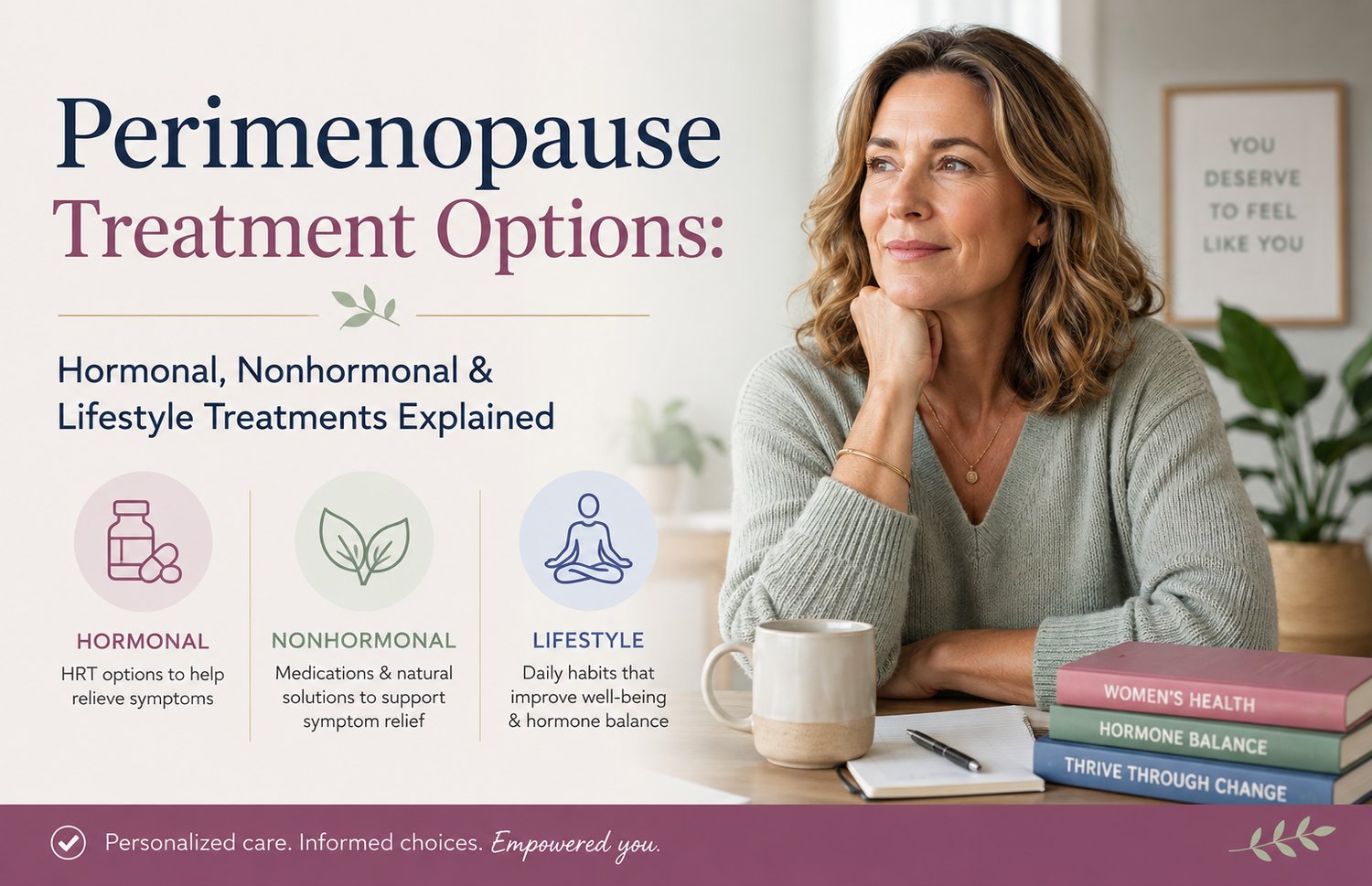
Perimenopause Treatment Options: Hormonal, Nonhormonal & Lifestyle Treatments Explained
Perimenopause treatment options can include menopausal hormone therapy, nonhormonal prescription medications, symptom-specific treatments, behavioral approaches, and lifestyle changes.
Which one makes sense depends heavily on what you're actually trying to treat.
Hot flashes are treated differently from vaginal dryness.
Insomnia may need a different approach than mood symptoms.
Heavy or abnormal bleeding deserves a different conversation altogether.
And sometimes the most useful treatment isn't a menopause treatment at all—because fatigue, sleep problems, mood changes, palpitations, or other symptoms may have another cause.
That's why asking:
“What's the best treatment for perimenopause?”
is a little like asking:
“What's the best tool in a toolbox?”
For what?
This guide breaks down the major options, what they're actually good for, and where the evidence is considerably weaker than the marketing.
Does Perimenopause Need Treatment?
Not necessarily.
Perimenopause is the transition leading up to menopause.
It is not a disease that automatically requires medication.
Some women experience relatively mild changes and don't feel a need for treatment.
Others develop symptoms that significantly affect:
- Sleep
- Work
- Relationships
- Mood
- Sexual health
- Daily comfort
- Quality of life
Those symptoms can absolutely deserve treatment.
You don't need to wait until you've reached menopause.
ACOG notes that hormone therapy can help relieve symptoms of both menopause and perimenopause.
And you don't have to prove that your symptoms are sufficiently miserable before discussing them with a healthcare professional.
What Symptoms Can Be Treated During Perimenopause?
Treatment depends on the symptom.
Common reasons women seek treatment include:
- Hot flashes
- Night sweats
- Sleep disruption
- Vaginal dryness
- Pain during sex
- Mood symptoms
- Abnormal or bothersome bleeding
- Urinary or vaginal symptoms
Other common concerns such as:
- Weight gain
- Brain fog
- Fatigue
- Joint discomfort
- Changes in body composition
may require a broader approach because there isn't necessarily one medication that simply “treats perimenopause” and makes everything disappear.
If you're still trying to determine whether your symptoms fit the transition, start with Common Perimenopause Symptoms: What to Expect & When to See a Doctor.
The Main Types of Perimenopause Treatment
It helps to think about treatment in several broad categories.
Menopausal Hormone Therapy
Usually involves estrogen, with a progestogen added when needed to protect the uterine lining.
Nonhormonal Prescription Treatment
Certain medications can treat specific symptoms without using estrogen.
Local Vaginal Treatment
Used primarily for vaginal and urinary symptoms rather than whole-body symptoms such as hot flashes.
Behavioral Treatment
Some evidence-based behavioral interventions can help particular symptoms, especially insomnia and vasomotor symptoms.
Lifestyle Support
Exercise, nutrition, sleep habits, smoking cessation, alcohol moderation, and other healthy behaviors support overall midlife health.
But they should not automatically be presented as substitutes for effective symptom treatment.
Let's separate those jobs.
Menopausal Hormone Therapy During Perimenopause
Menopausal hormone therapy is also commonly called:
- MHT
- Hormone therapy
- HT
- Hormone replacement therapy
- HRT
The terminology varies.
The basic treatment generally involves estrogen.
If you have a uterus and use systemic estrogen, a progestogen is generally needed to protect the endometrium from estrogen-related overgrowth and increased endometrial cancer risk. ACOG notes that adding progestin reduces this risk.
Hormone therapy isn't one standardized pill.
Treatment can differ by:
- Hormone
- Dose
- Route
- Formulation
- Symptoms
- Medical history
What Does Hormone Therapy Treat Best?
Systemic hormone therapy is the most effective treatment for vasomotor symptoms such as:
- Hot flashes
- Night sweats
It can also help some other menopause-related symptoms and protects against bone loss while it is being used.
ACOG describes systemic estrogen therapy, with or without progestin as appropriate, as the best treatment for hot flashes and night sweats.
The Menopause Society likewise identifies hormone therapy as the most effective treatment for vasomotor symptoms.
So if someone is having:
frequent, disruptive hot flashes and night sweats
the conversation shouldn't automatically begin with:
“Have you tried drinking more water and avoiding spicy food?”
Those things may affect comfort or personal triggers.
They aren't equivalent treatments.
Can You Take Hormone Therapy While You're Still Having Periods?
Potentially, yes.
You do not have to wait until your periods have completely stopped before discussing treatment for bothersome perimenopause symptoms.
Treatment decisions can be more complicated during perimenopause because:
- Ovulation may still occur
- Pregnancy may still be possible
- Bleeding patterns may be irregular
- Contraception may still be needed
Menopausal hormone therapy itself should not be assumed to provide contraception.
Your healthcare professional may recommend different hormonal strategies depending on your age, bleeding pattern, symptoms, pregnancy risk, and health history.
Systemic vs. Local Hormone Therapy
This distinction matters.
Systemic Hormone Therapy
Hormones circulate throughout the body.
Common forms can include:
- Pills
- Patches
- Gels
- Sprays
Systemic treatment is typically what we're discussing when treating symptoms such as hot flashes and night sweats.
Local Vaginal Estrogen
Low-dose vaginal estrogen is used primarily for symptoms involving the vagina and urinary tract.
These can include:
- Vaginal dryness
- Burning
- Pain during sex
- Some urinary symptoms
ACOG notes that both systemic and local estrogen can relieve vaginal dryness.
But someone who only has vaginal symptoms may not need systemic treatment.
Again:
treat the problem you actually have.
Is Hormone Therapy Safe?
There isn't a useful universal yes-or-no answer.
Hormone therapy has:
benefits, risks, contraindications, and individual considerations.
Risk depends partly on factors such as:
- Age
- Time relative to menopause
- Personal medical history
- Type of therapy
- Route of administration
- Whether estrogen is used alone or with a progestogen
ACOG notes that systemic hormone therapy generally isn't recommended for people with a history of certain conditions including:
- Breast or endometrial cancer
- Stroke
- Heart attack
- Blood clots
- Liver disease
and it should not be used during pregnancy.
That doesn't mean everyone else should automatically take it.
It means hormone therapy should be an individual risk-benefit decision, not something categorized as universally dangerous or universally beneficial.
For the deeper discussion, read Hormone Therapy for Perimenopause: Benefits, Risks & What to Know.
Pills vs. Patches: Does the Route Matter?
Yes.
Oral and transdermal estrogen don't have identical risk profiles.
ACOG notes that estrogen delivered through patches, sprays, or rings may pose less risk of blood clots than estrogen taken orally.
That doesn't mean:
“patches are safe for everyone.”
It means route is one of the variables clinicians consider when individualizing therapy.
This is another reason “Is HRT safe?” is usually the wrong level of question.
A better discussion includes:
Which hormone?
Which route?
Which dose?
For which patient?
For which symptoms?
What Are Bioidentical Hormones?
This word causes an extraordinary amount of confusion.
Bioidentical generally means the hormone is chemically identical to a hormone produced by the human body.
Importantly:
Bioidentical does not automatically mean compounded.
There are FDA-approved hormone therapies containing bioidentical hormones.
There are also custom-compounded bioidentical hormone products.
Those are not the same regulatory category.
ACOG recommends FDA-approved menopausal hormone therapies over compounded bioidentical hormone therapy when approved options are available, citing concerns including the lack of FDA approval and limited high-quality safety and efficacy data for compounded products.
We're going to give this topic its own article because it deserves considerably more explanation than one section can provide.
What If You Can't or Don't Want to Take Hormones?
Hormone therapy isn't the only evidence-based option.
Some women:
- Have contraindications
- Prefer not to use hormones
- Experience side effects
- Have symptoms better treated another way
Nonhormonal treatments can be very useful.
But here's where we need another distinction:
“Nonhormonal” does not mean “natural.”
Some of the strongest nonhormonal treatments are prescription medications.
Nonhormonal Treatments for Hot Flashes and Night Sweats
The Menopause Society's evidence review recommends several nonhormonal approaches for vasomotor symptoms.
These include:
- Certain SSRIs and SNRIs
- Gabapentin
- Fezolinetant
- Oxybutynin
- Cognitive behavioral therapy
- Clinical hypnosis
The evidence strength varies by treatment.
Which medication makes sense depends on:
- Symptoms
- Other health conditions
- Other medications
- Side effects
- Personal preferences
These medications aren't simply interchangeable.
SSRIs and SNRIs
Certain antidepressant medications can reduce hot flashes in some women.
These include medications from the:
SSRI and SNRI
families.
Their usefulness isn't limited to women who have depression.
Some are prescribed specifically because they can reduce vasomotor symptoms.
For someone who also has significant anxiety or depression, the overlap may influence treatment selection—but that doesn't mean every antidepressant is equally effective for hot flashes.
Medication choice belongs in an individualized discussion with a clinician.
Gabapentin
Gabapentin was originally developed as an antiseizure medication and is also used for several other conditions.
Evidence supports its ability to reduce vasomotor symptoms in some women.
Because it can cause drowsiness, timing and individual side effects matter.
For someone whose hot flashes are particularly disruptive at night, that profile may be relevant.
That does not make gabapentin a universal “menopause sleep medication.”
It is a prescription treatment with benefits and potential adverse effects.
Fezolinetant (Veozah)
Fezolinetant is a nonhormonal prescription medication specifically approved by the FDA for moderate-to-severe vasomotor symptoms due to menopause.
It works differently from estrogen by targeting neurokinin signaling involved in temperature regulation.
This gives women another treatment route when hormone therapy isn't desired or appropriate.
But “nonhormonal” does not mean “risk-free.”
The FDA added a Boxed Warning to Veozah after reports of rare but serious liver injury. Current prescribing information includes liver testing requirements before and during treatment.
That's a perfect example of why treatment decisions need more nuance than:
hormones = risky
nonhormonal = safe
Every medication has its own risk-benefit profile.
What About Oxybutynin?
Oxybutynin is primarily used for overactive bladder.
It has also shown evidence for reducing vasomotor symptoms and is included among the nonhormonal options supported by The Menopause Society, although evidence and adverse-effect considerations differ from some first-line options.
Again, this is generally an off-label use rather than a medication developed specifically for menopause hot flashes.
Off-label does not mean experimental or inappropriate.
It means the FDA approval is for another indication.
What About Clonidine?
This is where current evidence matters.
You may still find older menopause resources listing clonidine as a standard nonhormonal hot-flash treatment.
The Menopause Society's 2023 evidence review does not recommend clonidine for vasomotor symptoms because better-supported options are available.
Medical information changes.
That's why repeating an old list of “menopause medications” isn't enough.
Cognitive Behavioral Therapy
Cognitive behavioral therapy, or CBT, has evidence supporting its use for managing the bother and impact associated with vasomotor symptoms.
This doesn't mean CBT convinces you that you're not hot.
It helps change how symptoms affect coping, distress, sleep, and quality of life.
The Menopause Society recommends CBT as an evidence-based nonhormonal option for vasomotor symptoms.
For persistent insomnia, a specialized approach called CBT-I is also one of the strongest treatments available for chronic insomnia.
Read Sleep During Perimenopause: Why You Can’t Sleep & What Actually Helps.
Treating Sleep Problems During Perimenopause
Sleep problems are a great example of why symptom-specific treatment matters.
Suppose you're waking up five times every night.
Why?
If it's:
night sweats
treating vasomotor symptoms may improve sleep.
If it's:
chronic insomnia
CBT-I may be more appropriate.
If it's:
sleep apnea
neither HRT nor better sleep hygiene substitutes for treating the breathing disorder.
If it's:
restless legs
that's another problem entirely.
“Perimenopause sleep problems” describe the experience.
They don't always identify the cause.
Treating Mood Symptoms
Mood changes can occur during the menopause transition.
Treatment depends on severity and diagnosis.
Useful options may include:
- Psychotherapy
- Antidepressant medication
- Exercise and lifestyle support
- Improving sleep
- Treating disruptive vasomotor symptoms
- Hormone therapy in selected circumstances
But depression should not simply be labeled:
“hormonal mood swings.”
Clinical depression deserves proper treatment regardless of whether you're also in perimenopause.
Read Mood Swings During Perimenopause: Causes, Anxiety, Depression & What Actually Helps.
Treating Vaginal Dryness and Painful Sex
Vaginal and urinary symptoms associated with declining estrogen may include:
- Dryness
- Burning
- Irritation
- Pain during sex
- Urinary symptoms
Initial options can include:
- Vaginal moisturizers
- Lubricants
Prescription options can include local vaginal hormonal therapies and other treatments depending on symptoms and medical history.
ACOG includes vaginal moisturizers and lubricants among nonhormonal options and describes local estrogen and other prescription therapies for vaginal symptoms.
These symptoms are common.
They also don't need to be accepted as an unavoidable price of aging.
What About Irregular or Heavy Periods?
Changing menstrual cycles are a hallmark of perimenopause.
Periods may become:
- Closer together
- Farther apart
- Lighter
- Heavier
- Less predictable
But not every bleeding change should automatically be blamed on perimenopause.
Depending on the situation, treatment might involve:
- Hormonal contraception
- A progestin-containing IUD
- Other hormonal medication
- Nonhormonal medication
- Treatment of an underlying cause
Abnormal bleeding may also need evaluation.
This is one of the areas where:
“It's probably just perimenopause”
can become a bad assumption.
What About Birth Control During Perimenopause?
This is an important treatment overlap.
Some women in perimenopause may use hormonal contraception to:
- Prevent pregnancy
- Regulate bleeding
- Reduce heavy periods
- Help certain symptoms
Menopausal hormone therapy and hormonal contraception are not interchangeable.
Their hormone doses, purposes, risks, and formulations differ.
And pregnancy can still occur during perimenopause.
If contraception is still needed, that needs to be part of the treatment decision.
Lifestyle Changes Still Matter
Now we get to lifestyle.
Exercise, nutrition, sleep habits, weight management when appropriate, not smoking, and other healthy behaviors are extremely important during midlife.
They support:
- Cardiovascular health
- Muscle
- Bone
- Metabolic health
- Mental well-being
- Physical function
- Healthy aging
But we need to stop assigning lifestyle interventions jobs they haven't earned.
Exercise Is Excellent—But It Isn't a Proven Hot-Flash Treatment
Exercise is one of the best things you can do for overall health.
But The Menopause Society's evidence review does not recommend exercise specifically as a treatment for vasomotor symptoms because trials haven't consistently demonstrated that it reduces hot-flash frequency.
That doesn't mean:
don't exercise.
It means:
exercise for the things exercise actually does well.
Read:
Walking During Perimenopause: Benefits for Heart Health, Weight, Mood & Fitness
and:
Strength Training During Perimenopause: Benefits, Workouts & How to Start.
Diet Is Important—But There Is No “Perimenopause Diet”
A healthy dietary pattern can support:
- Heart health
- Weight management
- Blood glucose
- Muscle
- Bone health
- Digestive health
Priorities often include:
- Adequate protein
- Fiber-rich foods
- Fruits and vegetables
- Whole grains
- Healthy fats
- Calcium-rich foods
But no particular food has been shown to stop the menopause transition or reliably eliminate symptoms.
Read Best Diet for Perimenopause: What to Eat for Weight, Muscle, Bone & Heart Health.
Weight Loss May Help Some Women With Hot Flashes
Weight management is more nuanced.
The Menopause Society lists weight loss among the nonhormonal approaches with some evidence for reducing vasomotor symptoms in women for whom weight loss is medically appropriate.
That does not mean:
hot flashes are caused by being overweight.
Nor does it mean every woman with hot flashes should lose weight.
Weight management has to make sense in the context of the individual.
For the broader discussion, read Perimenopause Weight Gain: Why It Happens, Belly Fat & What Actually Helps.
Do Cooling Tricks and Avoiding Triggers Work?
Fans, lighter bedding, layered clothing, cold drinks, and avoiding personal triggers may make you more comfortable.
That's worthwhile.
But comfort strategies aren't the same thing as treatments proven to reduce vasomotor symptoms.
The Menopause Society found insufficient evidence to recommend cooling interventions or avoiding supposed triggers as treatments for hot flashes.
If you know wine reliably triggers a miserable night for you?
You don't need a randomized controlled trial to decide you'd rather skip the wine.
Just don't confuse:
personal symptom management
with:
a universally effective medical treatment.
What About Supplements for Perimenopause?
Be skeptical.
The menopause supplement market is enormous.
Products may contain:
- Black cohosh
- Soy isoflavones
- Red clover
- Maca
- Evening primrose oil
- Herbal blends
- “Hormone support” formulas
The Menopause Society's evidence review does not recommend supplements or herbal remedies for treating vasomotor symptoms because evidence hasn't demonstrated reliable effectiveness.
That doesn't mean every supplement is useless for every nutritional purpose.
For example, someone may legitimately need:
- Vitamin D
- Calcium
- Iron
- Vitamin B12
depending on diet, labs, health, and medical guidance.
That's different from buying a bottle because it says:
MENOPAUSE HORMONE BALANCE
on the front.
“Natural” Doesn't Mean Safer
This is worth saying plainly.
A treatment being:
- Herbal
- Plant-based
- Natural
- Bioidentical
- Compounded
does not automatically make it safer.
And a treatment being:
- Prescription
- Pharmaceutical
- FDA-approved
doesn't automatically make it dangerous.
What matters is:
Does it work?
What are the risks?
How well is it studied?
Is the product standardized?
Is it appropriate for this person?
That's the standard we should use.
How Do You Choose a Perimenopause Treatment?
Start with the symptom causing the biggest problem.
If Hot Flashes or Night Sweats Are the Main Problem
Discuss:
- Hormone therapy
- Evidence-based nonhormonal medications
- Appropriate behavioral approaches
If Sleep Is the Main Problem
Determine whether you're dealing with:
- Night sweats
- Insomnia
- Sleep apnea
- Another sleep problem
Then treat that.
If Vaginal Symptoms Are the Main Problem
Discuss:
- Lubricants
- Moisturizers
- Local vaginal treatments
- Other prescription options
If Mood Is the Main Problem
Determine whether this is:
- Mild mood variability
- Anxiety
- Depression
- Sleep-related
- Closely linked with vasomotor symptoms
Treatment should match the problem.
If Weight Is the Main Concern
Focus on:
- Nutrition
- Activity
- Strength training
- Sleep
- Medications and health conditions
- Evidence-based weight treatment when appropriate
There isn't one menopause medication designed to reverse every midlife body-composition change.
When Should You See a Healthcare Professional?
Consider medical evaluation if symptoms:
- Significantly affect your quality of life
- Repeatedly disrupt sleep
- Affect work or relationships
- Include severe anxiety or depression
- Involve concerning bleeding
- Include new or unexplained symptoms
- Aren't improving with reasonable self-care
- Make you interested in prescription treatment
You also don't need severe symptoms to start a conversation.
Sometimes you simply want to understand your options.
That's enough.
Questions to Ask About Perimenopause Treatment
A useful appointment might include questions such as:
- Which of my symptoms are likely related to perimenopause?
- Could anything else explain them?
- Am I a candidate for hormone therapy?
- What benefits would hormone therapy realistically provide for my symptoms?
- What are my individual risks?
- Would oral or transdermal treatment make more sense?
- Do I still need contraception?
- What nonhormonal treatments could help?
- What side effects should I expect?
- How will we know whether the treatment is working?
- When should we reassess?
You don't need to arrive knowing which medication you want.
The point of the visit is to make an informed decision.
What About Online Perimenopause Treatment?
Telehealth has made menopause care more accessible.
Depending on the service and your location, online providers may offer:
- Symptom evaluation
- Clinician consultations
- Hormone therapy
- Nonhormonal treatment
- Follow-up care
The same standards should apply online as in person.
Look for:
- Licensed clinicians
- Clear treatment information
- Transparent pricing
- Appropriate medical screening
- Evidence-based treatment
- Clear explanation of whether medications are FDA-approved or compounded
- Ongoing follow-up
Be cautious when a service seems to diagnose every midlife problem as a “hormone imbalance” that conveniently requires the exact product it sells.
One Online Option: Strut Health
Affiliate disclosure: HabitLogics may earn a commission if you purchase through this link, at no additional cost to you. Affiliate relationships do not change how treatments are evaluated in this article.
If you're specifically interested in online access to hormone treatment, Strut Health offers women's BHRT consultations and treatment.
There's an important distinction to understand before using that route:
Strut offers compounded hormone treatment.
Compounded BHRT is not the same thing as FDA-approved menopausal hormone therapy, and ACOG recommends FDA-approved formulations over compounded products when approved therapies can meet the patient's needs.
That doesn't mean compounded treatment can never have a legitimate role.
It means you should understand what you're being prescribed and why rather than assuming “bioidentical” or “customized” automatically means superior.
We'll cover that distinction much more deeply in the upcoming Bioidentical Hormones for Perimenopause guide.
Tracking Symptoms Can Make Treatment Decisions Easier
You don't need to quantify your entire existence.
But tracking a few relevant symptoms can help you answer questions such as:
- How often am I having hot flashes?
- How often are night sweats waking me?
- Is my sleep actually improving?
- Has my bleeding pattern changed?
- Did this treatment reduce symptoms?
- Are side effects appearing?
The FREE Perimenopause Starter Kit includes a symptom tracker, sleep and hot-flash log, habit planner, and wellness guide if you want a simple place to start.
For more detailed tracking, the Perimenopause Symptom Tracker includes printable and Excel tools for monitoring symptoms, hot flashes, mood, sleep, and patterns over time.
Tracking has a purpose:
better information for better decisions.
Not generating a prettier spreadsheet.
Frequently Asked Questions
What is the best treatment for perimenopause?
There isn't one best treatment for every woman or every symptom.
Hormone therapy is the most effective treatment for vasomotor symptoms such as hot flashes and night sweats, but nonhormonal medications and other approaches are appropriate for some women.
Treatment should match your symptoms, medical history, risks, and preferences.
Can perimenopause be treated before periods stop?
Yes.
You don't need to wait until menopause to discuss treatment for bothersome symptoms. ACOG specifically describes hormone therapy as a treatment for symptoms of menopause and perimenopause.
What is the first-line treatment for perimenopause?
There isn't one universal first-line treatment for “perimenopause.”
Treatment depends on the symptom.
For bothersome vasomotor symptoms, hormone therapy is the most effective option when medically appropriate. Other symptoms may require entirely different treatment.
What are the nonhormonal treatments for perimenopause?
Depending on the symptom, evidence-based nonhormonal options can include certain SSRIs/SNRIs, gabapentin, fezolinetant, oxybutynin, cognitive behavioral therapy, vaginal moisturizers and lubricants, and other symptom-specific treatments.
Is HRT safe during perimenopause?
It can be appropriate for many women, but safety depends on individual factors including medical history, age, treatment type, route, and other risks.
Systemic hormone therapy generally isn't recommended with certain histories including some hormone-sensitive cancers, blood clots, stroke, heart attack, and liver disease.
Can you take HRT and still have periods?
Potentially, yes.
Hormone therapy can be used during perimenopause, but bleeding patterns, contraception needs, and treatment regimens need to be considered.
Does HRT prevent pregnancy?
Menopausal hormone therapy should not be relied upon as contraception.
Pregnancy remains possible during perimenopause until menopause has been established.
What if I don't want hormones?
Several evidence-based nonhormonal treatments are available, particularly for hot flashes and night sweats.
Your options depend on which symptoms you're treating.
Are there natural treatments for perimenopause?
Lifestyle behaviors such as exercise, nutritious eating, adequate sleep, avoiding smoking, and maintaining a healthy weight when appropriate support overall health.
But supplements and herbal remedies have not shown reliable enough benefit to be recommended as treatments for vasomotor symptoms by The Menopause Society.
Does exercise treat hot flashes?
Exercise is strongly beneficial for health, but current evidence doesn't support it as a reliably effective standalone treatment specifically for vasomotor symptoms.
Exercise anyway.
Just give it the right job.
What is the difference between HRT and BHRT?
HRT or MHT refers broadly to menopausal hormone therapy.
“Bioidentical” describes hormones chemically identical to hormones produced by the body.
Some bioidentical hormone products are FDA-approved; others are custom compounded.
Bioidentical and compounded are not synonyms.
Do I need hormone testing before perimenopause treatment?
Not necessarily.
Perimenopause is often identified primarily from age, menstrual changes, symptoms, and medical history rather than one hormone measurement because hormone levels can fluctuate substantially during the transition.
Testing may still be appropriate when the diagnosis is unclear or another condition is suspected.
Key Takeaways
- Perimenopause treatment should target the symptoms actually causing problems rather than treating “perimenopause” as one condition with one solution.
- Treatment options include menopausal hormone therapy, nonhormonal prescription medications, local vaginal treatments, behavioral approaches, and lifestyle support.
- Hormone therapy is the most effective treatment for hot flashes and night sweats.
- You don't have to wait until your periods stop to discuss treatment.
- Hormone therapy isn't appropriate for everyone and should be individualized.
- If systemic estrogen is used by someone with a uterus, endometrial protection with a progestogen is generally necessary.
- Menopausal hormone therapy should not be relied upon as contraception.
- Evidence-based nonhormonal treatments for vasomotor symptoms include certain SSRIs/SNRIs, gabapentin, fezolinetant, oxybutynin, CBT, and other selected approaches.
- Fezolinetant is nonhormonal but carries an FDA Boxed Warning for rare serious liver injury and requires appropriate liver monitoring.
- Lifestyle habits strongly support long-term health but shouldn't be marketed as equivalent replacements for effective symptom treatment.
- Supplements and herbal products haven't demonstrated reliable enough benefit to be recommended for vasomotor symptoms.
- “Bioidentical” doesn't mean “compounded,” and compounded treatment isn't automatically safer or more effective.
- Persistent, severe, unusual, or disruptive symptoms deserve appropriate medical evaluation.
Continue Learning
For deeper guidance on individual symptoms and treatments:
- Hormone Therapy for Perimenopause: Benefits, Risks & What to Know
- Hot Flashes During Perimenopause: Causes, Triggers & Treatments That Actually Help
- Sleep During Perimenopause: Why You Can’t Sleep & What Actually Helps
- Mood Swings During Perimenopause: Causes, Anxiety, Depression & What Actually Helps
- Healthy Habits During Perimenopause: What Actually Matters & How to Build a Routine
Or return to the Complete Perimenopause Guide.
Affiliate Disclosure
HabitLogics may earn a commission from qualifying purchases or services through affiliate links in this article, at no additional cost to you. Affiliate relationships do not determine which treatments are recommended or how evidence is presented.
Educational Disclaimer
This article is intended for educational purposes only and is not medical advice, diagnosis, or individualized treatment guidance. Perimenopause symptoms can overlap with other medical conditions, and the risks and benefits of hormonal and nonhormonal treatments vary according to medical history, age, medications, pregnancy potential, symptoms, and other factors. Discuss prescription treatment and significant or concerning symptoms with a qualified healthcare professional.