

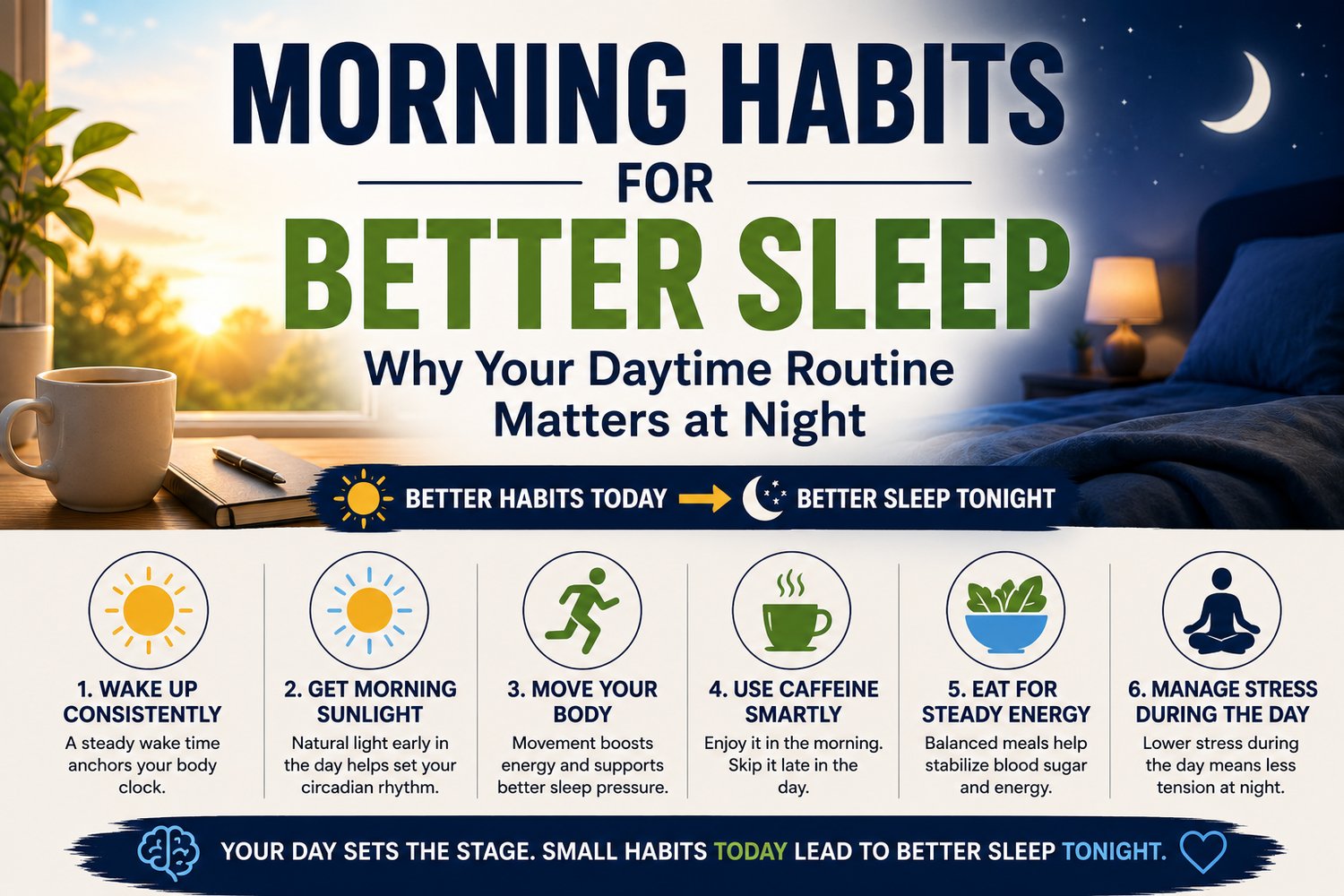
Morning Habits for Better Sleep: Why Your Daytime Routine Matters at Night
Most sleep advice starts at night.
Turn off your phone.
Dim the lights.
Take a shower.
Read a book.
Go to bed earlier.
All useful.
But here's the part people miss:
Your sleep tonight is influenced by what you do this morning and throughout the day.
Your wake time matters.
Your light exposure matters.
Your movement matters.
Your caffeine timing matters.
Even how long you spend napping can affect how sleepy you feel later.
That means a better bedtime routine is only half the equation.
If you want to make sleep easier at night, it helps to spend your day giving your body the right signals.
Our previous guide, How to Build a Better Bedtime Routine for Sleep, focused on the final hour or so before bed.
This article starts at the other end of the day.
Why Morning Habits Affect Nighttime Sleep
Sleep is controlled partly by two major systems:
Your circadian rhythm
and
Your sleep drive
Your circadian rhythm is your internal roughly 24-hour timing system.
Your sleep drive, sometimes described as sleep pressure, generally builds the longer you're awake.
The National Institute of General Medical Sciences explains that circadian rhythms are physical, mental and behavioral changes that follow a roughly 24-hour cycle and are strongly influenced by light and darkness. (nigms.nih.gov)
So if your day starts chaotically and your schedule changes constantly, your nighttime sleep can become less predictable too.
Think of daytime habits as the setup.
Nighttime is the result.
1. Wake Up at a Reasonably Consistent Time
If you're going to anchor one sleep habit, wake time is a strong candidate.
The CDC recommends going to bed and getting up at the same time every day. (cdc.gov)
NHLBI similarly recommends keeping weekday and weekend schedules relatively close when possible. (nhlbi.nih.gov)
That doesn't mean:
Wake up at 6:02 a.m. every single day forever.
It means avoiding huge swings whenever possible.
A schedule like:
Monday: 6:00 a.m.
Tuesday: 6:15 a.m.
Wednesday: 5:50 a.m.
Thursday: 6:10 a.m.
is fairly stable.
A schedule like:
Weekdays: 5:45 a.m.
Saturday: 11:30 a.m.
Sunday: 10:45 a.m.
creates a very different pattern.
Your body notices.
2. Get Morning Light
This is one of the most useful daytime habits for sleep.
Light is one of the strongest environmental signals affecting circadian timing.
NHLBI recommends spending time outside every day when possible, and CDC/NIOSH guidance notes that morning light can help shift circadian timing earlier. (nhlbi.nih.gov)
The practical version is simple:
Get some light early in the day.
You can:
- Open the blinds
- Step outside
- Take the dog out
- Drink coffee near a bright window
- Walk for 10–20 minutes
- Spend part of your commute outdoors if practical
You do not need to stare into the sun.
Please don't.
The goal is daytime light exposure, not retinal damage.
3. Move Early If You Can
You don't have to become a 5 a.m. workout person.
But some movement earlier in the day can help establish a healthy daytime pattern.
The CDC and NHLBI both include regular physical activity among healthy sleep habits. (cdc.gov)
Movement can be:
- Walking
- Strength training
- Cycling
- Yard work
- Mobility work
- Taking stairs
- Playing with your kids
- A short morning walk
A morning walk is particularly useful because it combines:
movement + daylight + routine
into one habit.
That's pretty efficient.
4. Don't Hit Snooze for 45 Minutes
A little snoozing isn't the end of the world.
But repeatedly waking, falling back asleep, waking again and repeating that cycle can make mornings feel more fragmented.
If you're constantly smashing snooze because you cannot function at your planned wake time, the bigger issue may be:
You're not getting enough sleep.
That's worth addressing directly.
Instead of trying to perfect your alarm strategy, ask:
Am I going to bed early enough?
Our guide to How Much Sleep Do You Need? A Practical Guide by Age & Lifestyle can help you think through that question.
If your body is screaming for another hour every morning, don't automatically treat it as a motivation problem.
5. Delay the "Emergency Caffeine" Mindset
A lot of morning routines look like:
Wake up exhausted
↓
Consume caffeine immediately
↓
Consume more caffeine later
↓
Try to survive afternoon
↓
Consume even more caffeine
↓
Can't sleep
↓
Repeat
Caffeine itself isn't the problem.
The pattern can be.
There is no universal rule requiring you to delay caffeine for a specific number of minutes after waking.
But if your entire day depends on escalating caffeine because you're chronically underslept, the better question is whether the sleep deficit needs fixing.
Caffeine can mask sleepiness.
It doesn't erase sleep need.
6. Use Caffeine Earlier Rather Than Later
Morning caffeine is generally less likely to interfere with nighttime sleep than caffeine consumed late in the day.
NHLBI notes that caffeine's effects can last for hours and recommends avoiding it later in the day if it interferes with sleep. (nhlbi.nih.gov)
So if you enjoy coffee:
Great.
Use it strategically.
The more sleep trouble you have, the more it makes sense to shift caffeine toward the earlier part of the day.
We're going to cover this in much more depth later in the pillar when we get to:
Caffeine and Sleep: How Long Does Caffeine Last & When Should You Stop Drinking It?
7. Eat and Hydrate Normally During the Day
Your sleep isn't happening in isolation.
Extreme daytime habits can spill into nighttime.
For example:
Skipping meals all day may leave you ravenous late at night.
Excessive fluid intake right before bed may increase nighttime bathroom trips.
Very heavy late meals may make some people uncomfortable when trying to sleep.
You don't need a special "sleep diet."
Just avoid creating a daytime pattern that forces your entire nutrition routine into the final hour before bed.
A more balanced daytime schedule often makes evenings easier.
8. Build Enough Activity Into Your Day
Sleep pressure generally builds as you remain awake.
A completely sedentary day can feel very different from a day where you've moved, worked, exercised and spent time outside.
That doesn't mean you need to exhaust yourself physically to earn sleep.
But regular daytime activity helps create a stronger distinction between:
day = active
and
night = rest
NHLBI recommends regular physical activity and spending time outside as part of healthier sleep habits. (nhlbi.nih.gov)
Again:
This doesn't need to be complicated.
Walk more.
Move more.
Train if you like.
Be awake during your waking hours.
9. Be Strategic With Naps
Naps can be useful.
They can also interfere with nighttime sleep if they're too long or too late for your personal sleep pattern.
NHLBI advises limiting naps or taking them earlier in the afternoon if nighttime sleep is difficult. (nhlbi.nih.gov)
That doesn't mean naps are bad.
It means:
If you're struggling to fall asleep at night, your 6 p.m. two-hour nap probably deserves scrutiny.
A short earlier nap is different from sleeping for hours late in the day.
Pay attention to what happens.
10. Don't Use the Weekend to Completely Flip Your Schedule
This is a common trap.
You wake early all week.
Then Friday and Saturday:
Stay up until 2 a.m.
Sleep until 11.
Repeat.
Then Sunday night:
Why am I not tired at 10 p.m.?
Because your schedule shifted.
NHLBI recommends limiting differences between weekday and weekend sleep schedules to about an hour when possible. (nhlbi.nih.gov)
Realistically, many people won't follow that perfectly.
That's okay.
But the bigger the weekend shift, the harder Monday morning may feel.
Think consistency, not perfection.
11. Get Outside More Than Once
Morning light is useful.
That doesn't mean you should spend the rest of the day in a cave.
Regular daytime light exposure helps reinforce the distinction between day and night.
NHLBI recommends spending time outside daily when possible. (nhlbi.nih.gov)
Try:
Morning walk.
Lunch outside.
Afternoon break.
Short walk after dinner while it's still light.
You don't need to schedule every minute.
Just stop treating daylight like an occasional luxury.
12. Manage Stress Before It Reaches Bedtime
Stress doesn't suddenly appear at 10:30 p.m.
It follows you there.
If you're overloaded all day and never give yourself any mental transition time, bedtime may become the first quiet moment your brain has to process everything.
Then:
Thoughts explode.
You remember tasks.
You replay conversations.
You plan tomorrow.
You worry.
One useful daytime strategy is to create space for those things before bed.
That might mean:
- Writing a task list after work
- Reviewing tomorrow's schedule earlier
- Taking a walk
- Journaling
- Doing a short decompression routine
- Talking through a problem
- Finishing important planning before nighttime
This won't eliminate stress.
But it can reduce the amount of mental housekeeping your brain tries to do at 11 p.m.
13. Separate Work From Sleep When Possible
Remote work has created a strange problem for many people.
Your:
office
living room
and sometimes
bedroom
can all be the same place.
That makes behavioral boundaries harder.
If possible, create a clear endpoint to work.
Close the laptop.
Leave the workspace.
Change clothes.
Take a walk.
Do something that marks:
Work is over.
That makes the eventual transition into your bedtime routine easier.
You don't need a home office.
You need some kind of boundary.
14. Don't Spend All Day Indoors Under Dim Light
Modern life makes it surprisingly easy to spend an entire day under weak indoor lighting.
Wake up.
Drive.
Office.
Drive.
House.
Screens.
Bed.
Your circadian system evolved with dramatic differences between bright daytime and dark nighttime environments.
Modern indoor life can blur that contrast.
You don't need to overcomplicate this.
Just get outside.
Especially if you currently spend almost no time in natural light.
15. Use Exercise as a Consistent Habit, Not a Sleep Punishment
Some people approach exercise like this:
I slept badly, so I'll destroy myself in the gym and force myself to sleep tonight.
That's not necessary.
Exercise works better as a consistent health habit than as punishment for poor sleep.
Build something sustainable.
Maybe:
- 30-minute walks
- Strength training 2–4 times per week
- Cycling
- Short daily movement breaks
- Weekend outdoor activity
You don't need to exercise specifically "for sleep."
It's one of those habits that helps multiple areas at once.
Morning Habits vs. Bedtime Habits
A useful way to think about sleep is:
Morning establishes rhythm.
Daytime builds sleep pressure.
Evening reduces stimulation.
Night provides sleep opportunity.
All four matter.
If your bedtime routine is excellent but your daytime routine is chaotic, there's still room for improvement.
Likewise, a perfect morning doesn't compensate for staying up until 2 a.m.
This is why our broader Sleep Hygiene: What It Is, What Actually Works & What’s Overrated guide treats healthy sleep as an all-day system rather than a collection of nighttime tricks.
What Does a Sleep-Friendly Morning Routine Look Like?
It can be very simple.
Example 1: The Minimalist Version
Wake: Around the same time each day.
Within first hour: Open blinds or step outside.
Morning: Eat, hydrate and move normally.
Caffeine: Keep most of it earlier in the day.
Done.
Example 2: The Morning Walk Version
6:00 a.m. — Wake.
6:10 — Water and coffee.
6:20 — 15-minute outdoor walk.
6:40 — Shower and get ready.
7:00 — Breakfast.
This combines:
light + movement + schedule consistency
without requiring a 90-minute "miracle morning."
Example 3: The Busy Parent Version
Wake.
Open blinds.
Get kids ready.
Take dog outside.
Drink coffee.
Walk briefly during lunch.
Keep caffeine cutoff reasonable.
No special routine required.
The point isn't to make your morning look impressive.
It's to send consistent daytime signals.
What If You Wake Before Sunrise?
That happens, especially in winter or for early-shift workers.
You may not have natural sunlight immediately available.
In that case:
Use bright indoor lighting when you wake.
Get outside when daylight becomes available.
Keep wake time consistent.
If you have persistent circadian timing problems, especially related to shift work, talk with a healthcare professional about whether more structured light therapy or other approaches are appropriate.
Don't blindly buy a light box and guess at timing if you're dealing with a significant sleep disorder.
What If You Work Night Shift?
Night shift changes the entire equation.
Your desired sleep period may occur during daylight hours.
That means light management becomes much more complicated.
You may need to:
- Control bright light exposure around sleep
- Use blackout curtains
- Keep your sleep period protected from interruptions
- Time caffeine carefully
- Maintain as much schedule consistency as practical
Shift-work sleep problems can be difficult to solve with generic advice because work timing may directly conflict with your circadian system.
If excessive sleepiness is affecting safety or functioning, professional evaluation is appropriate.
What If You Exercise at Night?
You've probably heard:
Never exercise before bed.
That's too absolute.
Some people can exercise in the evening without a problem.
Others feel highly alert afterward.
NHLBI recommends avoiding intense exercise in the final hour before bed, while regular exercise overall is encouraged. (nhlbi.nih.gov)
So use your own response.
If an evening workout consistently leaves you wired until midnight, move it earlier if possible.
If you exercise at 7 p.m. and sleep perfectly fine at 10:30, there's probably no need to create a problem that doesn't exist.
What If Morning Exercise Isn't Realistic?
Then don't exercise in the morning.
This isn't a morning-routine competition.
Exercise whenever you can maintain it consistently.
Lunch.
After work.
Early evening.
Weekends.
The important part is regular activity, not winning points for waking before sunrise.
Morning Light Doesn't Need to Become Another Obsession
This is worth saying because sleep advice can get weird.
You may see people specifying:
Exactly 8 minutes if sunny
17 minutes if cloudy
32 minutes in winter
You don't need to live like that.
The general principle is useful:
Expose yourself to normal daytime light, especially earlier in your waking period.
That's enough for most people.
You don't need a stopwatch.
Don't Judge Sleep by One Morning
Some mornings you'll wake tired.
That doesn't automatically mean:
Your routine failed.
Your sleep architecture is broken.
You need more supplements.
Your deep sleep was terrible.
One night can be affected by:
Stress.
Noise.
Illness.
Temperature.
Alcohol.
A late meal.
Kids.
Pets.
Random chance.
Our original article, What Is Sleep Quality? How to Know If You’re Actually Sleeping Well, explains why trends matter more than individual nights.
The same applies here.
Look at your mornings across a week or two.
Not one Tuesday.
Track Your Morning Habits and See What Changes
Morning habits are ideal for simple tracking because they're easy to identify.
Track:
- Wake time
- Morning light exposure
- Morning exercise or walking
- Caffeine timing
- Naps
- Bedtime
- Approximate sleep duration
- Morning energy
- Daytime energy
Then ask:
Do more consistent wake times correspond with easier sleep?
Do morning walks help?
Does late caffeine still seem to be the bigger problem?
Are naps interfering with bedtime?
You don't need perfect data.
You need enough information to spot patterns.
The FREE 7-Day Sleep Reset | Sleep & Recovery Starter Kit gives you a structured way to track sleep and daily behaviors for one week without turning your life into a sleep laboratory.
Longer-Term Tracking Can Reveal More
Some habits need more than seven days to evaluate.
For example:
You may be trying to:
Stabilize wake time.
Reduce weekend schedule swings.
Shift caffeine earlier.
Increase morning activity.
Build a more consistent evening routine.
The Sleep Recovery Planner | Sleep Tracker and Energy Journal combines a fillable PDF and Excel dashboard for tracking sleep, energy, caffeine and routines over time.
That makes it easier to answer:
Is my sleep system actually becoming more consistent?
That's more useful than relying on memory.
A Simple Daytime Sleep Checklist
You do not need to optimize every hour.
Start with these questions:
Did I wake around my normal time?
Did I get some daylight?
Did I move my body?
Did I keep caffeine early enough?
Did I avoid a long late nap?
Did I give myself enough sleep opportunity tonight?
If those basics are reasonably consistent, you're already doing a lot.
What Morning Habits Won't Fix
Daytime habits can support sleep.
They cannot solve every sleep problem.
If you:
Snore loudly.
Gasp during sleep.
Experience severe daytime sleepiness.
Have persistent insomnia.
Regularly wake exhausted despite adequate sleep opportunity.
Have unusual movements or behaviors during sleep.
there may be something more significant going on.
Don't keep adding morning sunlight and hoping it fixes an untreated sleep disorder.
Talk with a qualified healthcare professional.
Frequently Asked Questions
What morning habits help you sleep better?
Useful morning and daytime habits can include:
- Waking at a consistent time
- Getting morning or daytime light
- Exercising regularly
- Keeping caffeine earlier in the day
- Limiting long or late naps
- Maintaining a reasonably stable schedule
These habits can help support circadian timing and healthy sleep patterns.
Does morning sunlight help sleep?
Morning and daytime light exposure can help reinforce circadian timing because light is one of the primary environmental signals affecting the body's internal clock. (nigms.nih.gov)
You don't need to stare at the sun or follow an exact minute target.
Normal outdoor light exposure is a practical starting point.
What time should I wake up for better sleep?
There isn't one universal wake time.
Choose a time that fits your schedule and allows you to get enough total sleep.
Then keep it reasonably consistent.
Is it bad to sleep in on weekends?
Occasionally sleeping later isn't automatically a problem.
But large shifts between weekday and weekend schedules may disrupt your sleep-wake rhythm. NHLBI recommends keeping differences relatively small when possible. (nhlbi.nih.gov)
Does exercise help you sleep?
Regular physical activity is recommended as part of healthy sleep habits by organizations including the CDC and NHLBI. (cdc.gov)
You don't have to exercise in the morning specifically.
Consistency matters more.
Are naps bad for nighttime sleep?
Not necessarily.
But long or late naps can make nighttime sleep more difficult for some people. NHLBI recommends keeping naps earlier if nighttime sleep is a problem. (nhlbi.nih.gov)
Should I delay caffeine after waking?
There's no universal rule saying everyone must wait a specific amount of time after waking before drinking caffeine.
The more important practical issue for many people is avoiding caffeine late enough in the day that it interferes with nighttime sleep.
Key Takeaways
Better sleep doesn't start at bedtime.
It starts when you wake up.
A sleep-friendly daytime routine can be surprisingly simple:
Wake at a reasonably consistent time.
Get some daylight.
Move your body.
Use caffeine strategically.
Avoid long late naps if they interfere with sleep.
Keep weekends from completely flipping your schedule.
Handle some of your stress and planning before bedtime.
Then give yourself enough opportunity to sleep.
That's the system.
Morning supports your circadian rhythm.
Daytime builds sleep pressure.
Evening reduces stimulation.
Night gives you the opportunity to sleep.
You don't need to optimize every piece perfectly.
You need the pieces working in the same general direction.
Start With One Morning Habit
If your current morning routine is chaotic, don't rebuild your entire day tomorrow.
Pick one anchor.
Maybe:
Wake within the same 30–60 minute range each day.
or:
Take a 10-minute outdoor walk in the morning.
or:
Move your last caffeinated drink earlier.
Track what happens.
Then build from there.
The FREE 7-Day Sleep Reset | Sleep & Recovery Starter Kit gives you an easy way to establish your baseline and track the habits that may be influencing your sleep.
Previously in the Sleep & Recovery series:
What Is Sleep Quality? How to Know If You’re Actually Sleeping Well
How Much Sleep Do You Need? A Practical Guide by Age & Lifestyle
Sleep Stages Explained: REM, Deep Sleep & What Happens While You Sleep
Deep Sleep vs. REM Sleep: What’s the Difference & How Much Do You Need?
How to Sleep Better Naturally: 12 Habits That Actually Matter
Sleep Hygiene: What It Is, What Actually Works & What’s Overrated
How to Build a Better Bedtime Routine for Sleep
Next in the Sleep & Recovery series:
The Best Bedroom Environment for Sleep: Temperature, Light, Noise & Comfort
Medical Disclaimer: This article is for educational and informational purposes only and is not intended as medical advice, diagnosis or treatment. Persistent insomnia, excessive daytime sleepiness, loud snoring, gasping during sleep or other concerning sleep symptoms should be discussed with a qualified healthcare professional.