

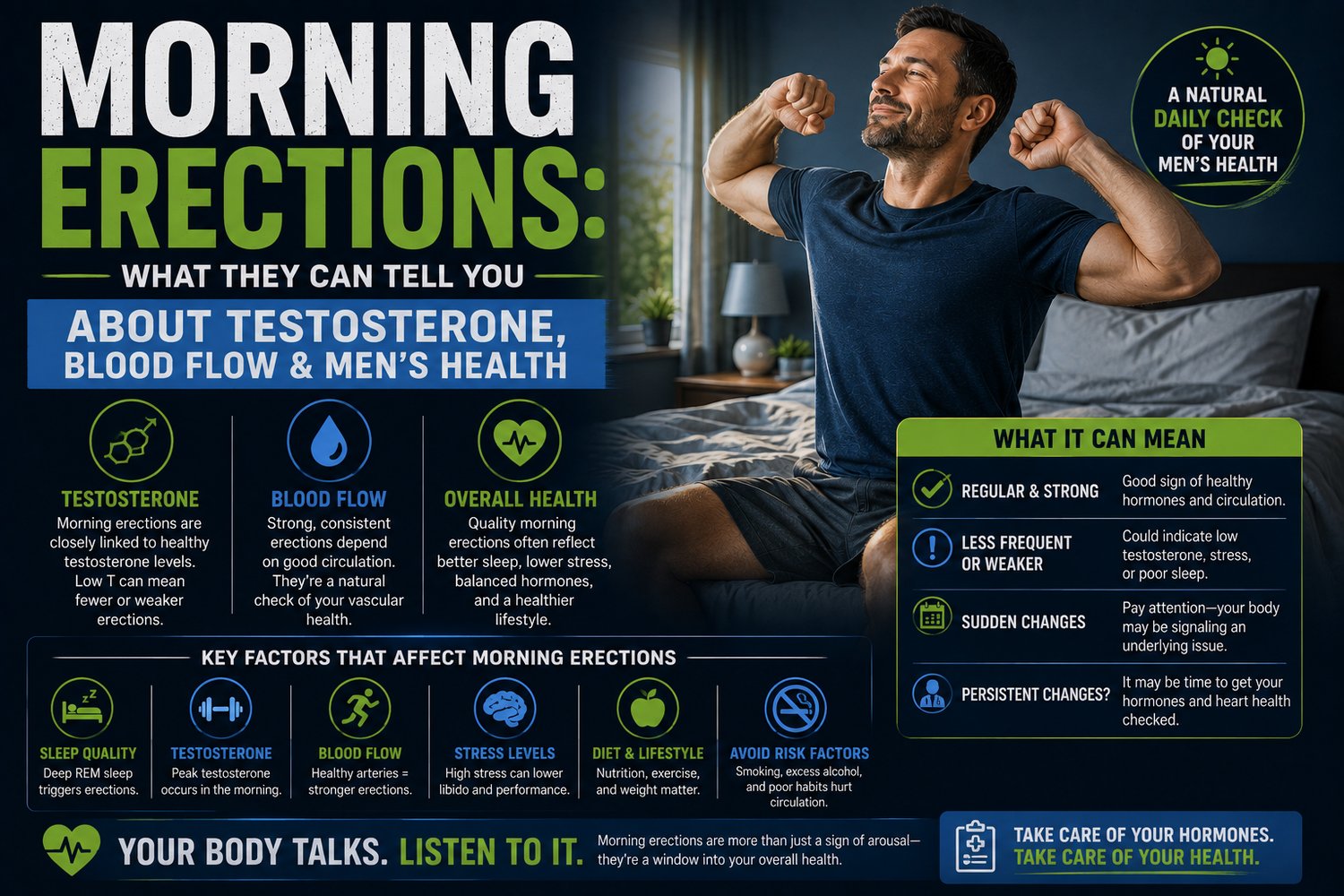
Morning Erections: What They Can Tell You About Testosterone, Blood Flow & Men's Health
Morning erections—often called “morning wood”—are usually nighttime erections that are still present when you wake up. They can provide useful clues about erectile function because normal erections depend on healthy blood flow, nerve signaling, erectile tissue, sleep, psychological function, and hormones.
But morning erections are not a medical test.
Having one doesn't prove that:
- Your testosterone is normal
- Your cardiovascular system is perfect
- You can't have erectile dysfunction
And missing one doesn't mean:
- Your testosterone is low
- You have ED
- Something is medically wrong
What matters much more is your normal pattern over time.
A persistent decline in spontaneous or morning erections—especially when accompanied by reduced libido, erectile dysfunction, or other symptoms—can be worth discussing with a healthcare professional.
For the broader sexual-health picture, read Erectile Dysfunction: Causes, Treatment & When to Get Help.
Why Do Men Get Morning Erections?
Morning erections are really a visible part of something that happens throughout the night.
Men commonly experience several erections while sleeping.
The medical term for nighttime erections is nocturnal penile tumescence.
These erections occur automatically and don't require you to:
- Have a sexual dream
- Be consciously aroused
- Think about sex
- Wake up wanting sex
If you happen to wake while an erection is occurring—or shortly afterward—you notice it as a morning erection.
So:
Nighttime erection + waking at the right time = morning erection.
REM Sleep Plays an Important Role
Nighttime erections are strongly associated with REM sleep, or rapid eye movement sleep.
REM sleep is also the stage most closely associated with vivid dreaming.
During REM, changes in the autonomic nervous system and nerve signaling can promote penile erection.
REM periods also tend to become longer later in the night.
That makes it more likely that you'll wake during or near a period when an erection is occurring.
This is one reason morning erections can vary from one day to another even when nothing is wrong.
You may simply wake during a different sleep stage.
Is Morning Wood Caused by a Full Bladder?
Not primarily.
You've probably heard:
“You wake up with an erection because you need to pee.”
A full bladder may make the erection more noticeable or influence nearby nerve activity.
But men normally experience erections repeatedly during sleep whether their bladder is full or not.
Morning erections are mainly part of normal sleep-related erectile physiology.
The fact that you also need to urinate at 6 a.m. doesn't mean urine created the erection.
What Do Morning Erections Tell You?
Morning erections can provide evidence that at least some of the physical systems needed for an erection are functioning.
Those systems include:
- Penile blood flow
- Nerve signaling
- Erectile tissue
- Sleep-related neurological activity
That can become useful when evaluating erectile dysfunction.
Suppose a man regularly has firm erections:
- During sleep
- In the morning
- During masturbation
but has difficulty maintaining an erection during partnered sex.
That pattern shows that his body is capable of producing erections under at least some circumstances.
It may make psychological or situational contributors more worth investigating.
Possible factors can include:
- Performance anxiety
- Relationship stress
- Sexual anxiety
- Depression
- Distraction
- Differences in arousal
But morning erections don't completely rule out a physical cause.
Sexual function rarely fits into one neat category.
Morning Erections Are One Clue—Not a DIY ED Test
This distinction is important.
You cannot reliably diagnose erectile dysfunction as:
Morning erections present = psychological ED
or:
Morning erections absent = physical ED
Reality is more complicated.
Physical and psychological factors can coexist.
A man can have vascular disease and performance anxiety.
A man can have normal nighttime erections but still have medication-related or situational sexual problems.
A man can also have fewer morning erections simply because his sleep has changed.
Use the pattern as information, not a yes-or-no diagnosis.
What If You Stop Getting Morning Erections?
Don't panic because you didn't notice one this morning.
One day means very little.
Possible simple explanations include:
- You woke during a different sleep stage
- You woke later or earlier than usual
- Your sleep was fragmented
- You simply didn't notice the erection
The more meaningful question is:
Has your usual pattern changed substantially over several weeks or months?
For example, suppose you used to notice morning erections regularly, but now:
- They're rare
- They're noticeably less firm
- Your libido has declined
- Sexual erections are becoming less reliable
- Other symptoms have appeared
That's more useful information than one random morning.
Do Morning Erections Become Less Frequent With Age?
They can.
Sleep architecture, erectile function, hormone levels, medication use, and chronic-disease risk all change with age.
So spontaneous erections may become somewhat less predictable over time.
But:
“I'm older now”
shouldn't automatically explain every significant change in sexual function.
If morning erections decline along with persistent erectile dysfunction, reduced libido, or other health changes, evaluation may still be appropriate.
Morning Erections and Testosterone
This is usually the question men actually want answered:
Does morning wood mean your testosterone is good?
Not exactly.
Testosterone contributes to sexual function, and loss of spontaneous erections is recognized as one possible symptom of testosterone deficiency.
Current Endocrine Society guidance includes erectile dysfunction and loss of spontaneous erections among symptoms that can occur with male hypogonadism.
But morning erections cannot tell you your testosterone level.
A man can still experience morning erections while having a relatively low testosterone result.
Another man can have normal testosterone yet experience fewer spontaneous erections because of:
- Poor sleep
- Vascular disease
- Diabetes
- Medication effects
- Neurological problems
- Psychological factors
So:
Morning erections = information.
Not:
Morning erections = testosterone of 700 ng/dL.
Losing Morning Erections May Be More Informative Than Feeling Tired
Some symptoms associated with low testosterone are extremely nonspecific.
Examples include:
- Fatigue
- Low motivation
- Difficulty concentrating
- Poor exercise performance
Those symptoms occur in many unrelated health and lifestyle situations.
Sexual symptoms can sometimes provide more specific information.
These may include:
- Reduced libido
- Erectile dysfunction
- Fewer spontaneous erections
That still doesn't make them diagnostic.
Current Endocrine Society guidance emphasizes that symptoms alone cannot diagnose hypogonadism. Testosterone deficiency requires compatible symptoms or signs together with consistently low, accurately measured testosterone levels.
When Might Testosterone Testing Make Sense?
Suppose you've noticed a persistent combination of:
- Fewer morning erections
- Reduced libido
- More difficulty achieving erections
- Other changes consistent with testosterone deficiency
At that point, testosterone becomes more reasonable to investigate.
Start with:
A diagnosis of testosterone deficiency still requires appropriate testing.
Current Endocrine Society recommendations call for at least two early-morning fasting testosterone measurements when diagnosing hypogonadism.
What If You Want to Check Your Testosterone?
For broader testing information, visit the HabitLogics Men's Bloodwork Hub.
The Everlywell Testosterone Test provides one at-home testing option.
An at-home result can provide information.
But:
A testosterone result is not automatically a diagnosis.
If the result is unexpectedly low or you're experiencing persistent symptoms, appropriate clinical follow-up matters.
Sleep Can Change Morning Erections
Because nighttime erections occur during sleep, sleep quality can directly influence what you notice in the morning.
Imagine that you're:
- Sleeping five hours per night
- Waking repeatedly
- Experiencing insomnia
- Working rotating night shifts
- Constantly changing your sleep schedule
Your nighttime erectile pattern—or your chance of waking during an erection—may change simply because your sleep is disrupted.
That's another reason:
No morning erection ≠ automatically low testosterone.
If sleep is poor, read Sleep for Men: Why Better Sleep Matters for Testosterone, Recovery & Health.
Sleep Apnea Can Complicate the Picture
Obstructive sleep apnea is especially relevant.
It can affect:
- Sleep quality
- Daytime energy
- Blood pressure
- Cardiovascular health
- Metabolic health
- Sexual function
Common warning signs include:
- Loud snoring
- Gasping during sleep
- Witnessed breathing pauses
- Morning headaches
- Severe daytime sleepiness
- Waking unrefreshed
Sleep disorders are also among the conditions associated with hypogonadism.
If morning erections have changed and you're sleeping terribly, don't immediately assume testosterone is the problem.
Investigate the sleep issue too.
Morning Erections and Erectile Dysfunction
Morning erections become particularly useful when looked at alongside erections in other situations.
Consider two simplified patterns.
Pattern 1: Morning Erections Are Normal, Sexual Erections Aren't
You regularly wake with firm erections.
You can also achieve erections during masturbation.
But during partnered sex, erections become unreliable.
That may increase suspicion of factors such as:
- Performance anxiety
- Psychological stress
- Relationship issues
- Situational arousal differences
Again, it doesn't prove the cause.
It simply gives the clinician useful context.
Pattern 2: Erections Have Declined Everywhere
You rarely experience:
- Morning erections
- Spontaneous erections
- Masturbatory erections
- Reliable partnered erections
That broader change may make physical contributors more important to investigate.
Possible areas include:
- Vascular health
- Diabetes
- Medications
- Neurological function
- Hormonal problems
- Sleep disorders
For the full evaluation and treatment picture, read Erectile Dysfunction: Causes, Treatment & When to Get Help.
Why a Doctor May Ask About Masturbation
If you're being evaluated for ED, a healthcare professional may ask whether you can achieve an erection:
- During masturbation
- With a partner
- During sleep
- Upon waking
That's not just nosiness.
They're looking for patterns.
If erections work normally under some conditions but not others, that can help guide the investigation.
Blood Flow Matters Too
An erection depends heavily on healthy blood flow.
That means persistent changes in erections can overlap with:
- High blood pressure
- Diabetes
- Atherosclerosis
- Smoking
- Obesity
- Cardiovascular disease
That's one reason the Erectile Dysfunction Guide emphasizes that persistent ED can sometimes provide useful cardiovascular information.
The penis isn't operating separately from the rest of your circulatory system.
Morning Erections Are Not a Heart Test
Don't take that idea too far.
Having morning erections doesn't mean:
“My cardiovascular system is perfect.”
Losing them doesn't mean:
“I have heart disease.”
Morning erections aren't a cardiovascular screening tool.
If you have risk factors such as:
- High blood pressure
- Diabetes
- Smoking
- Obesity
- High cholesterol
- Family history of cardiovascular disease
those deserve attention regardless of what happens when you wake up.
Diabetes Can Affect Erections
Diabetes can damage:
- Blood vessels
- Nerves
Both are important for erectile function.
If spontaneous and sexual erections have become less reliable and you also have diabetes or significant metabolic risk factors, broader evaluation may be more useful than ordering testosterone alone.
The Men's Bloodwork Dashboard can help organize testosterone, glucose, lipid, and other health markers over time.
Medications Can Change Erectile Function
Some medications can contribute to erectile problems.
Possible examples include certain:
- Blood-pressure medications
- Antidepressants
- Hormonal treatments
- Other prescription drugs
If erectile function changed soon after:
- Starting medication
- Increasing the dose
- Changing medications
tell your healthcare professional.
Don't stop needed medication on your own.
Sometimes there are alternatives.
Sometimes the medication has nothing to do with the change.
That's what evaluation is for.
Alcohol Can Affect Morning Erections
Alcohol can affect both sleep and sexual function.
A heavy night of drinking may:
- Reduce sleep quality
- Fragment REM sleep
- Affect nerve signaling
- Make erections less reliable
If your usual morning erection is missing after a night of heavy drinking, that one morning isn't a controlled testosterone experiment.
Look at your usual pattern.
Stress, Anxiety and Mental Health Matter
Stress can help explain why nighttime and partnered erections don't always behave the same way.
During sleep, you're not consciously worrying about:
- Work
- Money
- Your relationship
- Whether you'll maintain an erection
- Whether your partner is noticing
During sex, you might be.
Performance anxiety can interfere with arousal even when the physical ability to produce an erection is still present.
Depression can also affect:
- Libido
- Sexual interest
- Sleep
- Erectile function
And some antidepressant medications can create sexual side effects.
If sexual changes occur alongside persistent low mood or significant anxiety, don't reduce the entire situation to testosterone.
Mental health deserves appropriate attention too.
Does Porn Cause Loss of Morning Erections?
A lack of morning erections isn't a recognized diagnostic sign of pornography use.
Compulsive sexual behaviors or pornography may influence some people's:
- Sexual expectations
- Arousal patterns
- Anxiety
- Relationship dynamics
But nighttime erections are primarily physiological events occurring during sleep.
These are separate issues and shouldn't automatically be combined into one explanation.
Does Masturbation Reduce Morning Erections?
Not in any known clinically meaningful long-term way.
Sexual activity can produce temporary changes in arousal and refractory periods.
That doesn't mean ejaculation permanently drains a testosterone reserve that produces morning erections.
This is closely related to several myths discussed in Testosterone Myths.
Can TRT Restore Morning Erections?
It can in some men with appropriately diagnosed testosterone deficiency.
If low testosterone contributes to:
- Reduced libido
- Loss of spontaneous erections
- Other sexual symptoms
testosterone replacement may improve some symptoms.
But if the primary cause is:
- Severe vascular disease
- Diabetes-related nerve damage
- Medication effects
- Psychological factors
- Another non-testosterone problem
raising testosterone may not solve it.
That's why diagnosis comes before treatment.
Read What Is TRT? Testosterone Replacement Therapy Explained.
Don't Start TRT Just to Get Morning Wood Back
If your only concern is:
“I don't wake up with an erection as often as I did when I was 19.”
that alone isn't a reason to begin testosterone therapy.
Look at the broader clinical picture:
- Has libido changed?
- Are sexual erections less reliable?
- Are spontaneous erections generally reduced?
- Has sleep changed?
- Are other symptoms present?
- Is testosterone actually low?
Testosterone therapy is medical treatment for appropriately diagnosed hypogonadism—not a way to recreate every physiological pattern from adolescence.
Can ED Medication Increase Morning Erections?
It can.
Longer-acting ED medications such as tadalafil remain active for an extended period.
A man using tadalafil may therefore notice stronger or more frequent spontaneous or morning erections.
That doesn't necessarily mean the underlying cause of ED has disappeared.
The medication is still affecting erectile physiology.
For ED medication and other treatment options, see the Erectile Dysfunction Guide.
What Is Nocturnal Erection Testing?
In selected cases, clinicians can formally assess erections during sleep.
This is called nocturnal penile tumescence testing.
The basic idea is to measure whether erections occur during sleep and how strong or sustained they are.
If normal nocturnal erections occur but erections consistently fail during partnered sexual activity, psychological or situational contributors may become more likely.
If nocturnal erections are consistently impaired, physical causes may deserve more attention.
Most men with ED don't need formal nighttime-erection testing.
Medical and sexual history often provide enough information to guide the initial evaluation.
Do You Need to Track Morning Erections?
Usually, no.
You generally don't need a device measuring:
- Exact erection count
- Firmness
- Duration
- Nightly trends
unless a healthcare professional has a specific reason for collecting that information.
For ordinary awareness, something as simple as noticing:
- Normal for me
- Less frequent
- Rare
- Major persistent change
is usually enough.
Your penis does not need its own smartwatch dashboard.
What Health Information Is More Useful to Track?
If sexual function is changing, broader health trends may provide more useful context.
Consider tracking:
- Sleep
- Energy
- Weight
- Waist circumference
- Blood pressure
- Exercise
- Libido
- Erectile function
- Relevant bloodwork
The Men's Health & Performance Dashboard combines fitness, energy, body composition, recovery, and health tracking.
The Men's Bloodwork Dashboard is designed for organizing laboratory trends.
For a free starting point, use the FREE Men's Hormone & Energy Starter Kit.
Support the Systems Behind Healthy Erections
There isn't a special “morning wood protocol.”
Focus on health behaviors that matter regardless of whether they change your morning erections.
Sleep
Aim for adequate, consistent sleep and investigate signs of sleep apnea.
Exercise
Resistance train regularly and include aerobic activity.
Walk
Increase daily movement and support cardiovascular fitness.
Body Composition
Work toward a sustainable, healthy body composition when appropriate.
Blood Pressure
Know your blood pressure and treat hypertension appropriately.
Smoking
Don't smoke.
Alcohol
Avoid excessive intake.
Medical Care
Investigate persistent changes rather than guessing.
Those habits benefit much more than sexual function.
Strength Training Helps the Bigger Picture
Strength training isn't an ED treatment.
But it supports:
- Muscle
- Metabolic health
- Body composition
- Physical fitness
- Healthy aging
Use Strength Training for Men Over 30 if you're currently inactive.
For a more age-specific muscle guide, read Building Muscle After 40.
Walking Supports Cardiovascular Health
Because erections depend on vascular function, cardiovascular fitness matters.
Walking is one of the simplest ways to increase regular aerobic activity.
Read Walking for Men's Health.
Walking won't guarantee morning erections.
But it supports the cardiovascular system those erections rely on.
Body Composition Matters Too
Excess abdominal fat frequently overlaps with:
- Diabetes risk
- Cardiovascular risk
- High blood pressure
- Sleep apnea
- Lower testosterone in some men
Improving body composition when appropriate can benefit several health systems at once.
Read Why Belly Fat Gets Harder to Lose After 30.
You're not trying to lose weight specifically to produce an erection tomorrow morning.
You're improving the health systems behind sexual function.
When Should You Be Concerned About Losing Morning Erections?
Consider discussing the change with a healthcare professional if morning erections have declined persistently and you also notice:
- Erectile dysfunction during sex
- Reduced libido
- Fewer spontaneous erections in general
- Significant unexplained fatigue
- Loss of muscle or other possible hormone symptoms
- Diabetes or significant metabolic risk
- Cardiovascular risk factors
- Medication changes
- Other new health symptoms
The pattern matters more than one isolated morning.
What If Morning Erections Are Normal but Sex Isn't?
That can provide useful information.
It shows that your body is capable of producing erections under at least some conditions.
Possible contributors to partnered-sex difficulties may include:
- Performance anxiety
- Relationship problems
- Stress
- Depression
- Sexual anxiety
- Differences in stimulation or arousal
That doesn't mean the problem isn't real.
And it doesn't prove the cause is entirely psychological.
A healthcare professional or qualified therapist can help when the pattern persists.
What If Morning Erections and Sexual Erections Are Both Gone?
A persistent decline across multiple settings gives more reason to investigate possible physical contributors.
Areas worth considering can include:
- Cardiovascular health
- Diabetes
- Testosterone when appropriate
- Medication effects
- Neurological function
- Sleep disorders
Again:
Don't diagnose yourself from the symptom.
Use the symptom as a reason to investigate when appropriate.
Frequently Asked Questions
Why do men get morning erections?
Morning erections are usually nighttime erections that happen to still be present when you wake.
Erections occur automatically several times during normal sleep and are strongly associated with REM sleep.
What is nocturnal penile tumescence?
Nocturnal penile tumescence is the medical term for erections that occur during sleep.
These erections happen without conscious sexual stimulation and are part of normal male sexual physiology.
Does morning wood mean testosterone is high?
No.
Testosterone contributes to sexual function, and loss of spontaneous erections can occur with testosterone deficiency.
But morning erections cannot tell you what your testosterone level is.
Is it normal not to have morning erections every day?
Yes.
You may wake during a portion of sleep when an erection isn't occurring or simply fail to notice one.
A persistent change over time is more meaningful than whether you have one every morning.
Does having morning erections mean I don't have ED?
Not necessarily.
A man can have normal nighttime erections and still experience erectile dysfunction during partnered sexual activity.
Preserved nighttime erections simply provide useful information about the pattern.
Can low testosterone reduce morning erections?
Yes.
Reduced spontaneous erections can occur with testosterone deficiency, particularly when accompanied by reduced libido and other compatible symptoms.
Testing is required to determine whether testosterone is actually low.
Why did my morning erections suddenly stop?
Potential explanations can include:
- Sleep disruption
- Stress
- Medication effects
- Erectile dysfunction
- Medical conditions
- Hormonal problems
- Normal variation
One or two mornings usually aren't meaningful.
A persistent change accompanied by other symptoms is more worth investigating.
Are morning erections a sign of heart health?
They can provide some information about erectile blood-flow function, but they aren't a cardiovascular screening test.
Persistent erectile changes may still justify reviewing cardiovascular risk factors.
Does masturbation stop morning erections?
Masturbation doesn't appear to produce a clinically meaningful long-term loss of morning erections.
Short-term variation can occur, but ejaculation doesn't permanently deplete testosterone or erectile function.
Can TRT restore morning erections?
It may improve spontaneous erections in some men with appropriately diagnosed testosterone deficiency.
TRT isn't appropriate simply because morning erections become less frequent.
Key Takeaways
- Morning erections are generally sleep-related erections that remain present when you wake.
- Nighttime erections are a normal part of male sexual physiology.
- REM sleep plays an important role in nocturnal erections.
- Morning erections provide useful information but aren't a standalone medical test.
- Having morning erections doesn't prove testosterone or cardiovascular health is normal.
- Missing occasional morning erections is normal.
- A persistent decline—especially with ED, low libido, or other symptoms—can be worth evaluating.
- Loss of spontaneous erections can occur with testosterone deficiency, but it doesn't diagnose low testosterone.
- Sleep disorders, cardiovascular disease, diabetes, medications, psychological factors, and neurological problems can also affect erections.
- Pay attention to patterns rather than one morning.
Final Thoughts
Morning wood is easy to joke about.
But it's also a good example of how interconnected men's health really is.
Sleep.
Nerves.
Blood vessels.
Hormones.
Brain function.
All of those systems contribute.
You don't need to track every erection.
And you shouldn't panic because you didn't wake with one today.
But if something that used to happen regularly gradually disappears—and libido, sexual function, or other health markers are changing too—that's useful information.
Don't use it to diagnose yourself.
Use it to ask better questions.
Pay attention to patterns.
Test when testing makes sense.
Investigate persistent changes.
Then treat the actual problem rather than guessing.
Continue the Men's Sexual Health & Testosterone Series
For erectile dysfunction:
For testosterone:
- Low Testosterone Symptoms
- What Causes Low Testosterone?
- How Testosterone Is Tested and Diagnosed
- What Is TRT? Testosterone Replacement Therapy Explained
- How to Support Testosterone Naturally
- Testosterone Myths
For men's bloodwork:
For the broader health foundation:
- Complete Men's Wellness Guide
- Sleep for Men
- Strength Training for Men Over 30
- Walking for Men's Health
- Why Belly Fat Gets Harder to Lose After 30
Affiliate Disclosure
Some links in this article are affiliate links. If you purchase through one of these links, HabitLogics may earn a commission at no additional cost to you. Recommendations are included only where they naturally fit the topic.
Educational Disclaimer
This article is intended for educational purposes only and should not be considered medical advice. Changes in spontaneous erections or sexual function can result from vascular disease, diabetes, medications, hormonal conditions, sleep disorders, neurological problems, psychological factors, and other causes. Persistent changes in erections, libido, or sexual function should be discussed with a qualified healthcare professional.