

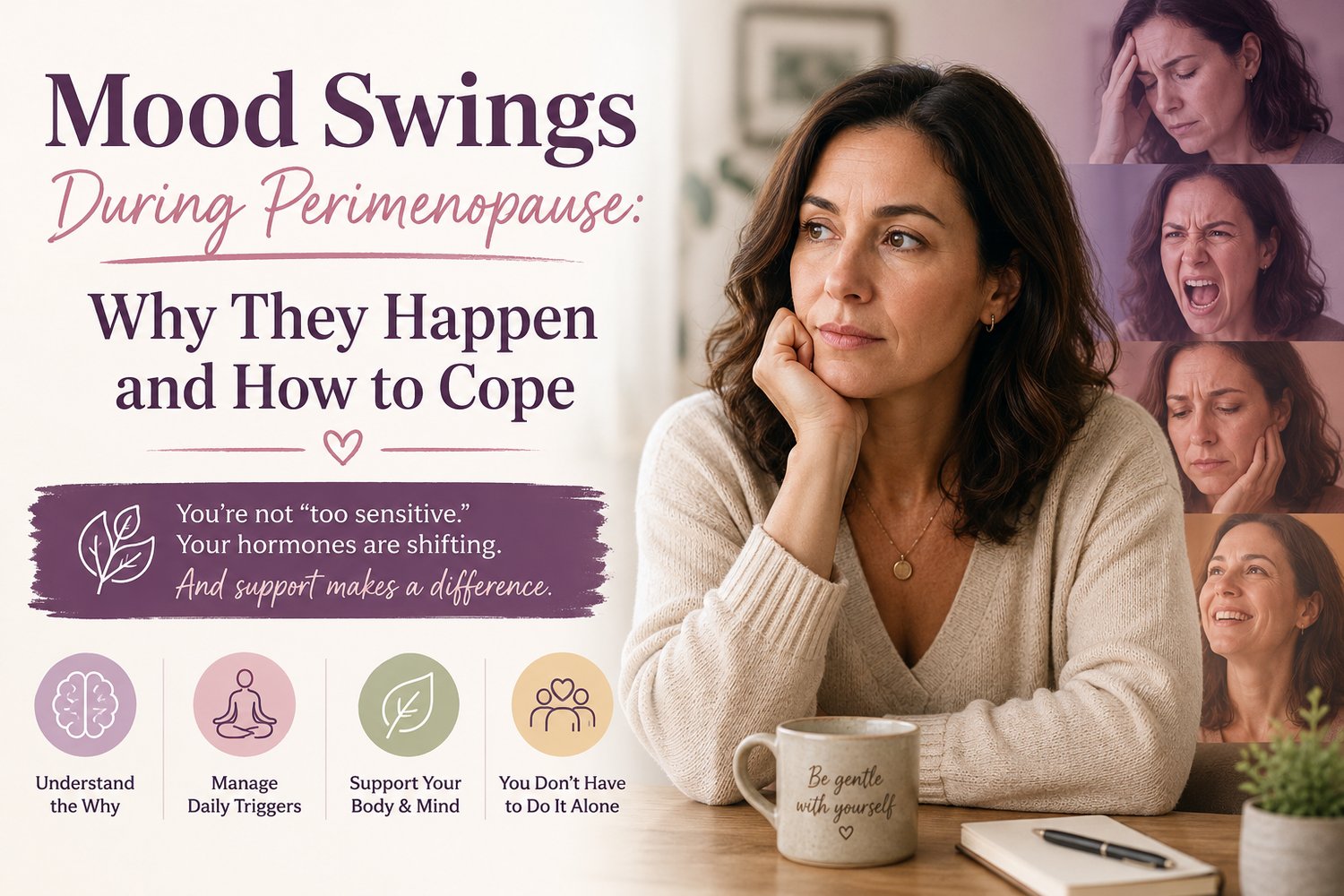
Mood Swings During Perimenopause: Causes, Anxiety, Depression & What Actually Helps
Mood swings during perimenopause can show up as irritability, anxiety, emotional sensitivity, crying more easily, feeling overwhelmed, or simply feeling less emotionally steady than you used to.
One day you feel completely like yourself.
The next, something minor makes you disproportionately angry.
Then you start wondering:
“Is this actually perimenopause—or is something else going on?”
The answer isn't always simple.
Hormonal changes during the menopause transition can contribute to mood symptoms, but sleep disruption, hot flashes, anxiety, depression, medications, relationship stress, work demands, caregiving, and other health conditions can overlap.
And one distinction matters more than anything else:
Mood changes can occur during perimenopause. Clinical depression and severe anxiety still deserve real treatment.
“It's probably hormones” should never become a reason to ignore significant mental-health symptoms.
For a broader symptom overview, read 35 Perimenopause Symptoms: Common Signs, What’s Normal & When to Get Help.
Are Mood Swings Common During Perimenopause?
Yes.
Many women report emotional changes during the menopause transition.
These can include:
- Irritability
- Emotional sensitivity
- Crying more easily
- Feeling overwhelmed
- Anxiety
- Reduced patience
- Low motivation
- Periods of sadness
- Feeling more reactive than usual
But there is no one universal “perimenopause personality.”
Some women experience significant mood changes.
Others notice very little.
And not every difficult emotion that appears during your 40s is caused by hormones.
The overall pattern matters.
Why Can Perimenopause Affect Mood?
There probably isn't one single mechanism.
Several factors can overlap.
Changing Hormone Patterns
Estrogen interacts with regions of the brain involved in mood regulation.
During perimenopause, estrogen levels can fluctuate considerably rather than simply decline in a straight line.
Some women appear to be more sensitive to those hormonal shifts than others.
That may help explain why one person experiences noticeable mood symptoms while another barely notices a change.
Hot Flashes and Night Sweats
Repeated vasomotor symptoms can be physically and emotionally exhausting.
If you're overheating several times every day—or waking repeatedly during the night—your mood may suffer even when hormones aren't acting directly on mood pathways.
Read Hot Flashes During Perimenopause: Causes, Triggers & Treatments That Actually Help.
Poor Sleep
Sleep and mood are deeply connected.
Several nights of poor sleep can contribute to:
- Irritability
- Reduced patience
- Anxiety
- Difficulty concentrating
- Lower frustration tolerance
- Emotional reactivity
- Low motivation
If sleep has become one of your biggest problems, read Sleep During Perimenopause: Why You Can’t Sleep & What Actually Helps.
Life Stress
Perimenopause often arrives during an unusually demanding period of adulthood.
You may simultaneously be dealing with:
- Work
- Teenagers or adult children
- Aging parents
- Financial pressures
- Relationship changes
- Your own health
- Changing roles or identity
Hormones aren't required for those things to affect your mood.
Sometimes the menopause transition simply lowers the margin you had for handling stress that was already there.
Mood Swings Aren't the Same as Depression
This distinction is critical.
A mood swing usually involves fluctuating emotion.
For example:
You feel unusually irritated one afternoon.
You're tearful that evening.
The next morning, you feel mostly fine.
Clinical depression is different.
Possible symptoms include:
- Persistent sadness
- Loss of interest or pleasure
- Hopelessness
- Feelings of worthlessness or excessive guilt
- Significant changes in appetite
- Sleep disturbance
- Low energy
- Difficulty concentrating
- Trouble functioning at work or home
- Thoughts about death or self-harm
The menopause transition appears to be a period of increased vulnerability to depression, particularly for women who have experienced depression previously.
That doesn't mean perimenopause automatically causes depression.
It means persistent symptoms deserve attention.
Does Perimenopause Increase Depression Risk?
For some women, yes.
Research suggests the menopause transition can represent a period of increased vulnerability to depressive symptoms.
Risk may be especially relevant in women with:
- A previous history of depression
- Previous significant mood symptoms related to reproductive hormone changes
- Major life stress
- Severe menopause symptoms
- Chronic sleep disruption
But depression remains a medical condition with multiple possible contributors.
You don't need to determine whether the depression is:
“really hormones”
before seeking help.
If symptoms meet the threshold for depression, they deserve treatment regardless of how much perimenopause contributed.
Can Perimenopause Cause Anxiety?
Perimenopause may contribute to new or worsening anxiety in some women.
Symptoms can include:
- Persistent worry
- Feeling on edge
- Racing thoughts
- Muscle tension
- Difficulty relaxing
- Restlessness
- Trouble sleeping
- Panic symptoms
- Physical sensations such as palpitations
But anxiety during midlife can also result from anxiety disorders, medications, thyroid conditions, sleep deprivation, caffeine, stressful circumstances, and other factors.
Again:
perimenopause can be part of the explanation without being the entire explanation.
What About Panic Attacks?
Some women report new or worsening panic symptoms during the menopause transition.
A panic attack may include sudden:
- Intense fear
- Racing heartbeat
- Chest tightness
- Sweating
- Shaking
- Shortness of breath
- Dizziness
- Feeling of losing control
Hot flashes can sometimes produce physical sensations—such as heat, sweating, or heart pounding—that overlap with panic symptoms.
That can make it difficult to tell what's happening in the moment.
New chest pain, severe shortness of breath, fainting, or other concerning symptoms should not automatically be labeled anxiety or perimenopause.
Why Does Everything Feel Worse After a Bad Night of Sleep?
Because sleep deprivation makes emotional regulation harder.
Imagine this cycle:
Night sweats → repeated awakenings → exhaustion → irritability → anxiety about sleep → even worse sleep.
The original problem may have been vasomotor symptoms.
But eventually several systems are feeding into one another.
That's why treating mood symptoms sometimes means treating:
- Sleep
- Hot flashes
- Depression or anxiety
- Stress
rather than looking for one magical “hormone-balancing” intervention.
Can Brain Fog Make Mood Worse?
Absolutely.
Struggling to find words, forgetting appointments, losing your train of thought, or feeling mentally slower can be frustrating and sometimes frightening.
That frustration can contribute to:
- Anxiety
- Reduced confidence
- Irritability
- Feeling overwhelmed
But common cognitive complaints during the menopause transition aren't the same thing as dementia.
Read Brain Fog During Perimenopause: Why It Happens & What May Help for the detailed discussion.
Could Something Else Be Affecting Your Mood?
Yes.
Don't automatically blame perimenopause.
Other possibilities can include:
- Depression
- Anxiety disorders
- Thyroid disease
- Anemia
- Medication side effects
- Alcohol or substance use
- Sleep apnea
- Chronic pain
- Other medical conditions
- Major life stress
If your emotional state has changed substantially, an evaluation may help identify other contributors.
The correct diagnosis matters because treatment differs.
What Actually Helps Perimenopause Mood Changes?
The answer depends on how severe the symptoms are and what is driving them.
Someone dealing with mild irritability after three nights of poor sleep doesn't necessarily need the same intervention as someone experiencing major depression.
Think in layers.
Start by Treating the Problem Behind the Mood Change
If sleep is terrible, work on sleep.
If night sweats are waking you repeatedly, treat the vasomotor symptoms.
If you're drinking heavily to manage stress, address that.
If you're experiencing clinical depression, treat the depression.
This sounds obvious, but menopause marketing often skips this step and jumps directly to:
“Your hormones are unbalanced.”
A symptom can have several contributors.
Treat the ones you can identify.
Exercise Can Support Mood
Regular physical activity is associated with better mental and physical health.
Useful options include:
- Walking
- Strength training
- Cardiovascular exercise
- Activities you actually enjoy
Exercise can support:
- Mood
- Sleep
- Stress management
- Cardiovascular health
- Muscle and bone health
That makes it worthwhile during perimenopause regardless of whether it directly fixes hormone-related mood symptoms.
Explore:
Walking During Perimenopause: Benefits for Weight, Mood & Health
and
Strength Training During Perimenopause: Benefits, Workouts & How to Start.
Nutrition Supports Health—But There Is No “Mood-Balancing” Menopause Diet
A balanced eating pattern matters for overall health.
That can include:
- Adequate protein
- Fruits and vegetables
- Fiber-rich foods
- Whole grains
- Healthy fats
- Regular meals
- Appropriate hydration
But there isn't a specific food that reliably corrects perimenopause mood symptoms by “balancing estrogen.”
Be especially skeptical of diets claiming to:
- Detox estrogen
- Fix cortisol
- Reset hormones
- Eliminate menopause anxiety
- Cure depression through food
Nutrition supports the system.
It doesn't replace mental-health treatment.
For practical nutrition guidance, read:
Best Diet for Perimenopause: What to Eat for Midlife Health
and
Protein During Perimenopause: How Much Do You Need?.
Stress Management Can Help Without Pretending Stress Is the Cause of Everything
You can't meditate your ovaries back to age 30.
You also can't eliminate every stressful responsibility from your life.
But improving how you respond to stress can still make daily life easier.
Options may include:
- Therapy
- Mindfulness
- Relaxation exercises
- Journaling
- Time outdoors
- Exercise
- Social support
- Setting boundaries
- Making deliberate time for enjoyable activities
The goal isn't to become completely unbothered by life.
It's to reduce unnecessary load and improve recovery.
Therapy Can Be Real Treatment, Not Just “Self-Care”
Psychotherapy can be useful when emotional symptoms become persistent or difficult to manage.
Depending on the problem, treatment approaches may include:
- Cognitive behavioral therapy
- Other evidence-based psychotherapies
- Counseling focused on anxiety, depression, stress, grief, or relationship difficulties
Therapy isn't only for severe crisis.
You don't need to wait until your life is falling apart to ask for help.
And if symptoms meet criteria for a mental-health condition, therapy is healthcare—not a lifestyle accessory.
What About Antidepressants?
Antidepressant medication may be appropriate when someone has depression or an anxiety disorder.
Common medication classes include:
- SSRIs
- SNRIs
- Other antidepressants depending on the individual
Some SSRIs and SNRIs are also used to treat hot flashes, which can occasionally make them particularly useful when vasomotor and mood symptoms overlap.
But medication selection should be based on:
- The actual diagnosis
- Other symptoms
- Side-effect profile
- Other medications
- Medical history
- Personal preference
The fact that someone is in perimenopause doesn't mean depression should be treated differently simply because hormones may have contributed.
Can Hormone Therapy Help Perimenopause Mood Swings?
Possibly—but this requires nuance.
Hormone therapy can dramatically improve hot flashes and night sweats in appropriate candidates.
If those symptoms are destroying sleep and quality of life, treating them may improve mood too.
Some research also suggests hormone therapy may improve depressive symptoms in certain women during the menopause transition.
But hormone therapy is not a universal antidepressant, and it shouldn't replace evidence-based depression or anxiety treatment when a mood disorder is present.
The evidence for anxiety is particularly inconsistent.
So:
Mood symptoms + appropriate menopause indication = hormone therapy may be part of the conversation.
Clinical depression alone = don't assume estrogen is the treatment.
Read Hormone Therapy for Perimenopause: Benefits, Risks, Types & Who It May Help for the broader treatment discussion.
What If You Already Take an Antidepressant?
Don't stop or change medication because you suspect your symptoms are now “hormonal.”
That can create a much bigger problem.
If your mood has changed despite treatment, talk with the clinician managing your medication.
They can assess whether the issue could involve:
- Your existing mental-health condition
- Menopause symptoms
- Sleep
- Medication effectiveness
- Medication side effects
- Another health problem
- Some combination of these
Treatment can be adjusted when appropriate.
But don't abruptly stop psychiatric medication on your own.
Does Hormone Therapy Replace Antidepressants?
No.
These medications have different jobs.
Hormone therapy is an evidence-based treatment for menopause symptoms such as vasomotor symptoms.
Antidepressants are evidence-based treatments for depression and several anxiety disorders.
Sometimes one treatment may influence several symptoms.
Sometimes both may be used.
The right choice depends on the actual diagnosis and treatment goals.
Track Mood Patterns Without Obsessing Over Them
Tracking can be useful when symptoms fluctuate.
You might record:
- Mood
- Anxiety
- Sleep quality
- Hot flashes
- Night sweats
- Menstrual-cycle changes
- Exercise
- Alcohol
- Major stressors
- Medication changes
Over a few weeks, you may notice patterns.
For example:
poor sleep → increased irritability
or
severe night sweats → anxiety and low mood the next day
or perhaps no clear relationship at all.
That's useful too.
The FREE Perimenopause Starter Kit includes symptom and habit tracking if you want a simple place to start.
For more detailed symptom monitoring, the Perimenopause Symptom Tracker includes printable and Excel tools for tracking mood, sleep, menstrual changes, hot flashes, symptoms, and patterns over time.
If you want a broader system combining sleep, stress, movement, and habit planning, the Perimenopause Lifestyle Reset Workbook covers those areas together.
When Is It More Than a Mood Swing?
Ask for professional help when emotional symptoms become persistent, severe, or disruptive.
That can include:
- Sadness lasting most days
- Loss of interest in activities you normally enjoy
- Persistent anxiety
- Panic attacks
- Hopelessness
- Significant changes in appetite or sleep
- Difficulty functioning at work
- Difficulty caring for yourself or others
- Major relationship disruption
- Feeling worthless
- Thoughts of death or self-harm
You don't need to determine whether those symptoms are caused by hormones before seeking care.
Severe symptoms deserve treatment regardless of the cause.
If you believe you may be in immediate danger or unable to keep yourself safe, seek emergency medical care immediately.
Stop Calling Everything “Just Hormones”
This is one of the worst habits in menopause discussions.
Yes, hormones matter.
But statements such as:
“Don't worry, it's just perimenopause.”
can become harmful when they're used to dismiss:
- Depression
- Anxiety
- Sleep apnea
- Thyroid disease
- Medication side effects
- Other medical or psychiatric conditions
Perimenopause should add useful context.
It shouldn't end the diagnostic process.
Common Perimenopause Mood Myths
“Mood Swings Mean I'm Losing Control”
Not necessarily.
Emotional reactivity can change during the menopause transition, particularly when sleep, stress, and physical symptoms are piling up.
But persistent or severe symptoms deserve evaluation.
“I Just Need to Be More Positive”
No.
Positive thinking isn't treatment for major depression or an anxiety disorder.
Coping strategies can help.
Clinical symptoms still deserve clinical treatment.
“If It's Hormonal, Antidepressants Won't Help”
Also false.
A hormone-related contribution doesn't make depression or anxiety immune to evidence-based mental-health treatment.
Certain antidepressants may also help vasomotor symptoms.
“Hormone Therapy Will Fix My Mood”
Maybe.
Maybe not.
Hormone therapy can improve mood indirectly when it improves severe hot flashes and sleep and may benefit certain depressive symptoms in some women.
It does not consistently treat all anxiety or depression.
“Once Menopause Is Over, My Mood Will Automatically Return to Normal”
Not necessarily.
Some menopause-related contributors may improve.
A separate depression or anxiety disorder doesn't necessarily disappear when your final period is behind you.
Frequently Asked Questions
Are mood swings common during perimenopause?
Yes.
Irritability, emotional sensitivity, anxiety, sadness, and other mood changes can occur during the menopause transition.
Severity varies considerably.
Why am I suddenly so irritable during perimenopause?
Several factors may overlap, including hormonal fluctuations, sleep disruption, hot flashes, stress, anxiety, and life circumstances.
There isn't always one single cause.
Can perimenopause cause depression?
The menopause transition appears to be a period of increased vulnerability to depression for some women, particularly those with a history of depression.
But depression is a medical condition with multiple possible contributors and deserves proper treatment.
Can perimenopause cause anxiety?
Perimenopause may contribute to anxiety symptoms for some women.
Sleep problems, stress, preexisting anxiety, medications, thyroid problems, and other factors can also contribute.
Can hormone therapy help anxiety?
Possibly for some women, but current evidence doesn't show a consistent anxiety benefit.
Hormone therapy should generally be chosen for an appropriate menopause indication rather than treated as a universal anxiety medication.
Can HRT help depression during perimenopause?
Some research suggests hormone therapy may improve depressive symptoms in selected women during perimenopause or early postmenopause.
However, it is not first-line treatment for every case of clinical depression.
Treatment should be individualized.
Can antidepressants be used during perimenopause?
Yes.
Depression and anxiety disorders can be treated with evidence-based medications during perimenopause when appropriate.
Certain SSRIs and SNRIs can also reduce hot flashes.
Can exercise help mood during perimenopause?
Regular physical activity supports mental and physical health and may improve mood, sleep, stress, and overall quality of life.
It shouldn't be presented as a substitute for treatment of severe depression or anxiety.
How do I know if it's hormones or depression?
You may not be able to determine that yourself—and sometimes both are involved.
Persistent sadness, loss of interest, hopelessness, significant anxiety, impaired functioning, or other substantial symptoms deserve professional evaluation regardless of whether perimenopause is contributing.
Key Takeaways
- Mood swings during perimenopause can include irritability, emotional sensitivity, anxiety, sadness, and feeling overwhelmed.
- Hormonal fluctuations may contribute, but sleep disruption, hot flashes, life stress, medications, and mental-health conditions can overlap.
- The menopause transition is a period of increased vulnerability to depression for some women.
- A previous history of depression can increase risk.
- Mood swings are not the same thing as clinical depression.
- Persistent depression or severe anxiety should not be dismissed as “just hormones.”
- Treating hot flashes and poor sleep may improve mood when those symptoms are major contributors.
- Exercise, sleep, nutrition, stress management, and social support can support emotional health but do not replace treatment for a mood disorder.
- Psychotherapy and antidepressant medications may be appropriate when depression or anxiety is present.
- Hormone therapy may improve mood for some women but isn't a universal antidepressant or anxiety treatment.
- Tracking symptoms can help identify patterns but shouldn't become a substitute for professional care.
- Thoughts of self-harm or inability to remain safe require urgent professional attention.
Continue Learning
If mood changes are part of a broader symptom picture, continue with:
- Sleep During Perimenopause: Why You Can’t Sleep & What Actually Helps
- Hot Flashes During Perimenopause: Causes, Triggers & Treatments That Actually Help
- Brain Fog During Perimenopause: Why It Happens & What May Help
- Hormone Therapy for Perimenopause: Benefits, Risks, Types & Who It May Help
- Healthy Habits During Perimenopause: What Actually Matters
Or return to the Complete Perimenopause Guide for the full HabitLogics perimenopause roadmap.
Educational Disclaimer
This article is intended for educational purposes only and is not medical advice, diagnosis, or treatment. Mood changes during the menopause transition can overlap with depression, anxiety disorders, sleep disorders, thyroid conditions, medication effects, substance use, and other medical or psychiatric conditions. Consult a qualified healthcare professional about persistent, severe, or concerning symptoms. Thoughts of self-harm, feeling unable to remain safe, or other acute mental-health symptoms require urgent professional or emergency evaluation.