

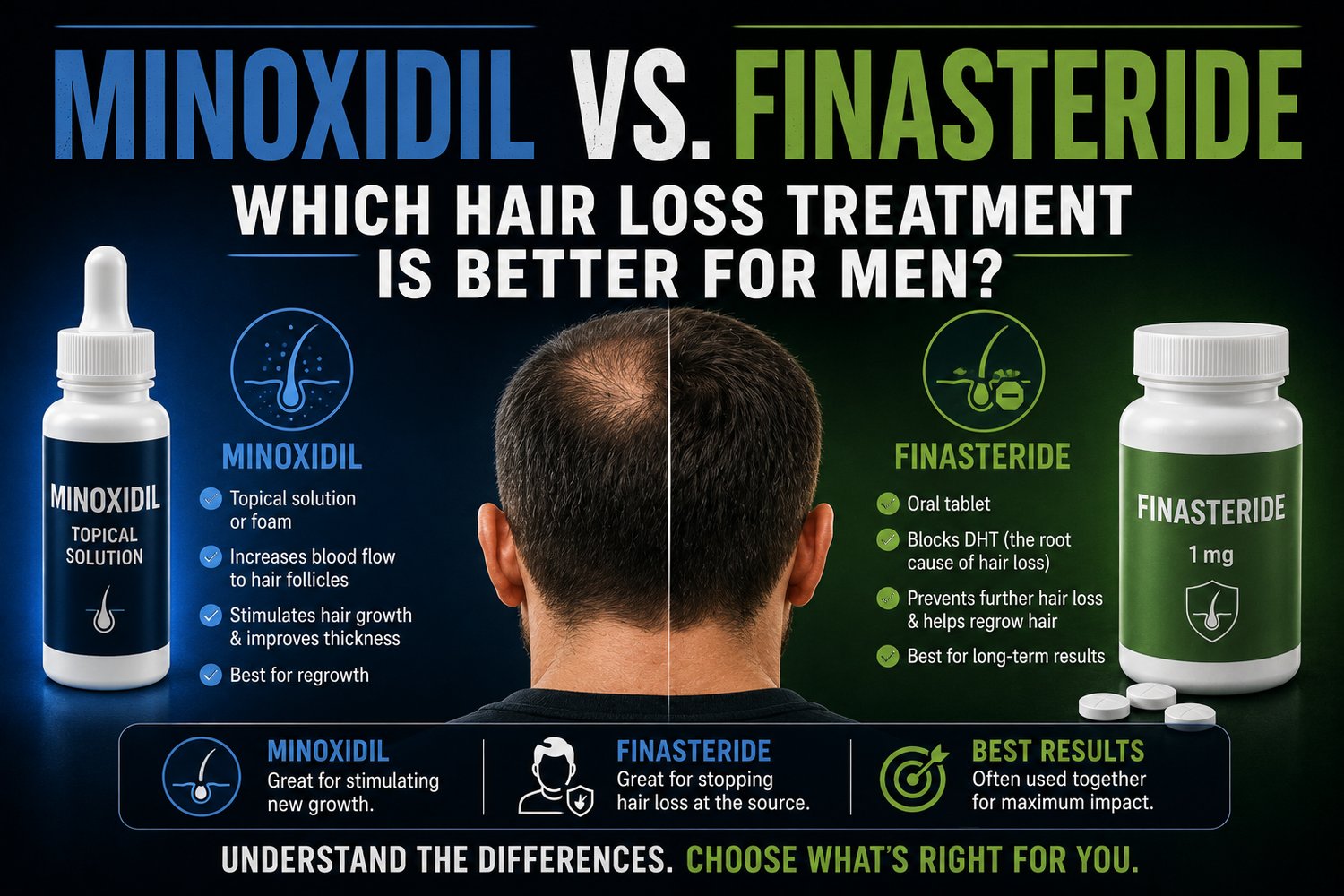
Minoxidil vs Finasteride: Which Hair Loss Treatment Is Better for Men?
If you're a man trying to keep your hair, two treatments appear almost immediately:
Minoxidil.
Finasteride.
Both can be used to treat male pattern hair loss.
Both have decades of clinical use behind them.
Both can help some men preserve or regrow hair.
And neither permanently cures the genetic process causing androgenetic alopecia.
But that's where the similarities mostly end.
Minoxidil primarily supports hair growth and follicle activity.
Finasteride reduces dihydrotestosterone, or DHT—the androgen pathway driving follicle miniaturization in genetically susceptible men.
That makes the real decision more interesting than:
“Which one grows more hair?”
A better question is:
“Do I want to stimulate growth, reduce the mechanism driving loss, or potentially do both?”
If you're not sure you actually have male pattern baldness, start with Why Men Lose Their Hair.
If you want the genetics and DHT mechanism first, read Male Pattern Baldness.
Minoxidil vs Finasteride: The Quick Answer
For typical male pattern hair loss:
Finasteride
Usually makes the stronger argument when your main goal is:
slowing the DHT-driven progression of male pattern baldness.
Minoxidil
Makes sense when your priority is:
supporting hair growth and density without intentionally lowering DHT.
Both
Can make sense because they address different parts of the problem.
The American Academy of Dermatology lists both topical minoxidil and oral finasteride among established FDA-approved treatments for male pattern hair loss in men. AAD reports that oral finasteride slows further hair loss in roughly 80%–90% of men who take it.
So the short answer is:
Finasteride usually wins for directly addressing progression.
Minoxidil wins for a non-DHT-blocking growth strategy.
Combination treatment may make the most biological sense when hair preservation is a high priority and both treatments are appropriate.
Now let's break that down properly.
What Is Minoxidil?
Minoxidil originally entered medicine as a treatment for high blood pressure.
Hair growth was noticed as an effect of the drug.
That eventually led to development of topical minoxidil for hair loss.
Today, topical minoxidil is available over the counter and is widely used for male pattern hair loss.
The most recognizable brand is:
Rogaine.
Generic versions are also widely available.
How Does Minoxidil Work?
Minoxidil's hair-growth mechanism is more complicated than:
“It increases blood flow.”
Its exact mechanism isn't completely understood.
But minoxidil appears to influence follicle biology and the hair-growth cycle, helping some miniaturized follicles produce:
- Thicker hair
- Longer-growing hair
- More visible hair
The major limitation is:
Minoxidil does not directly reduce DHT.
So if DHT-driven follicle miniaturization is the engine behind your male pattern baldness, minoxidil helps the follicles grow better without directly turning down that engine.
What Is Finasteride?
Finasteride is a prescription medication in a class called:
5-alpha-reductase inhibitors.
For male pattern hair loss, the FDA-approved oral finasteride product is typically used at:
1 mg daily.
Finasteride also has another approved use at a different dose for benign prostate enlargement.
For hair loss, its importance comes from what it does to DHT.
How Does Finasteride Work?
Your body converts some testosterone into DHT using an enzyme called:
5-alpha reductase.
Finasteride inhibits that enzyme.
That reduces DHT production.
In men genetically susceptible to androgenetic alopecia, DHT contributes to progressive miniaturization of scalp follicles.
So a simplified comparison looks like this:
Minoxidil
“Help these follicles grow better.”
Finasteride
“Reduce one of the signals causing these follicles to shrink.”
That's the biggest difference between them.
Which Is More Effective?
There isn't one universal response rate because results depend on:
- Genetics
- Age
- How early treatment begins
- Degree of miniaturization
- Location of loss
- Consistency
- Individual response
But oral finasteride has especially strong evidence for slowing progression.
AAD reports that it slows additional hair loss in approximately 80%–90% of men taking it, with some men also experiencing regrowth.
Topical minoxidil can also:
- Reduce shedding
- Improve density
- Stimulate some regrowth
But complete restoration is unlikely.
So if the question is:
“Which treatment more directly targets the disease mechanism?”
The answer is:
Finasteride.
If the question is:
“Which established topical treatment lets me avoid intentionally reducing DHT?”
The answer is:
Minoxidil.
Which Is Better for Keeping the Hair You Already Have?
Finasteride has the stronger argument here.
Male pattern baldness is progressive.
If DHT continues driving miniaturization in susceptible follicles, the most important long-term goal may be preventing those follicles from continuing to deteriorate.
That's what makes finasteride especially compelling for a man who says:
“My hair still looks pretty decent. I mostly want to stop losing it.”
Earlier treatment also matters because medications generally have more opportunity to help when follicles are still miniaturized rather than completely inactive.
Which Is Better for Regrowth?
Both can produce regrowth in some men.
Neither should be expected to recreate a completely bald juvenile hairline.
Minoxidil may:
- Improve density
- Increase apparent thickness
- Support growth from miniaturized follicles
Finasteride may allow some follicles to produce stronger hair after DHT exposure is reduced.
But medication works best where viable follicles remain.
An area that has been smooth and bald for years is much less likely to respond dramatically.
Which Is Better for a Receding Hairline?
The frontal hairline is one of the most frustrating areas to treat.
Most men want:
“Give me my 18-year-old hairline back.”
Neither drug can promise that.
Treatment is better at:
- Slowing ongoing recession
- Preserving remaining hair
- Improving miniaturized follicles
than rebuilding a hairline that's been gone for years.
Finasteride may be especially useful for slowing continued recession.
Minoxidil may help improve growth where follicles remain viable.
Which Is Better for Crown Thinning?
Both are commonly used for crown thinning.
Early crown loss can be especially responsive to preservation strategies because a surprising number of miniaturized hairs may still be present.
What looks like:
“I'm going bald back there.”
may actually contain many follicles still capable of producing hair.
This is exactly where waiting another five years can matter.
Topical Minoxidil Is the Easiest Option to Start
One major advantage of topical minoxidil is access.
It is:
- Available without a prescription
- Widely sold
- Available generically
- Familiar to most consumers
That makes it appealing if you want to begin treatment without taking a prescription medication that alters androgen metabolism.
The tradeoff is adherence.
You have to apply it consistently.
Oral Finasteride Is Often Easier to Take
For many men:
One tablet every day
is easier than:
Apply topical medication to the scalp every day indefinitely.
Convenience matters more than it sounds.
Because the theoretically best treatment does nothing if you don't consistently use it.
What Happens if You Stop Minoxidil?
The benefit generally doesn't last.
When topical minoxidil is discontinued, hair supported by treatment can gradually be lost and shedding can increase again. AAD notes that stopping minoxidil means losing its benefits over time.
This is not:
six months of therapy → permanently fixed genetics.
Male pattern baldness is an ongoing condition.
What Happens if You Stop Finasteride?
Similar principle.
Finasteride suppresses the DHT pathway while you take it.
Stopping treatment means that suppression does not continue permanently.
Hair preserved or improved during therapy may gradually be lost as androgenetic alopecia resumes.
Think:
management
not:
cure.
How Long Does Treatment Take?
Hair moves slowly.
Judge results over:
months
not:
weeks.
For either medication, take baseline photos.
Use:
- Same room
- Similar lighting
- Similar hair length
- Dry hair
- Front
- Temples
- Crown
Then compare periodically.
Don't photograph your crown every morning.
You're tracking hair.
Not monitoring a NASA launch.
Minoxidil Side Effects
Topical minoxidil is generally well tolerated.
Possible adverse effects can include:
- Scalp irritation
- Itching
- Dryness
- Scaling
- Unwanted hair growth on nearby skin
Some men also report increased shedding early after beginning treatment.
That can occur as follicles transition through growth-cycle phases.
Early shedding doesn't automatically mean treatment has permanently worsened your hair loss.
Persistent or severe shedding deserves evaluation.
Finasteride Side Effects
This is where the comparison becomes more complicated.
Potential finasteride adverse effects include sexual symptoms such as:
- Reduced libido
- Erectile difficulty
- Ejaculatory changes
Not every man experiences these problems.
But the risk is real enough to understand before treatment.
Online discussion tends to become ridiculous in both directions.
Extreme #1
“Finasteride is harmless. Side effects are imaginary.”
Extreme #2
“Take one pill and your life is destroyed forever.”
Neither approach helps.
It's prescription medication.
Discuss:
- Expected benefit
- Known risks
- Personal health history
- Fertility concerns
- Your tolerance for risk
with the prescribing clinician.
Can Finasteride Affect Mood?
Finasteride labeling and regulatory safety information include mental-health considerations.
If you experience significant new:
- Depression
- Mood changes
- Other concerning mental-health symptoms
after starting treatment, contact the clinician managing the medication.
The right response isn't arguing online about whether the symptom is “real.”
It's discussing it with the person prescribing the drug.
Does Finasteride Lower Testosterone?
Not in the simplistic way people often assume.
Finasteride reduces conversion of testosterone into DHT.
Its goal is not:
remove testosterone.
It's:
reduce another androgen derived from testosterone.
That's why:
Testosterone ≠ DHT.
For the full hormone explanation, read Male Pattern Baldness.
Finasteride and Fertility
Men actively trying to conceive—or already dealing with fertility problems—should bring that up before starting finasteride.
Hair treatment and reproductive planning shouldn't be handled as completely separate subjects if fertility matters to you.
A clinician can help weigh:
- Current fertility goals
- Existing reproductive concerns
- Treatment alternatives
- Whether additional evaluation makes sense
Don't assume:
“It's only a hair pill.”
Pregnancy Exposure and Finasteride
Finasteride can harm the development of a male fetus.
Pregnant people should not handle crushed or broken oral finasteride tablets.
Topical formulations introduce an additional practical issue because medication can potentially transfer from treated skin or surfaces.
The FDA specifically highlighted the risk of inadvertent exposure to others in its 2025 warning about compounded topical finasteride.
If topical finasteride is used in a household where pregnancy exposure is possible, follow the prescribing clinician's handling instructions carefully.
What About Topical Finasteride?
Topical finasteride has become extremely popular through telehealth hair-loss services.
The idea is attractive:
Target the scalp while potentially reducing systemic exposure.
But there's a critical distinction.
There is currently no FDA-approved topical finasteride formulation in the United States.
FDA warned in April 2025 that compounded topical finasteride can still be absorbed systemically and has been associated with adverse-event reports.
That doesn't mean topical finasteride should never be prescribed.
It means:
Topical finasteride is not an FDA-approved, risk-free version of oral finasteride.
It is a compounded prescription treatment that requires an informed discussion.
Strut Topical Finasteride Formula
Strut currently offers a compounded topical finasteride-based prescription formula for men.
Depending on the clinician-selected formulation, active ingredients may include:
- Finasteride
- Minoxidil
- Tretinoin
- Fluocinolone
- Biotin
Strut currently lists the formula starting at $59 per month, with the exact ingredients and strengths customized through clinician review.
This is particularly relevant if you're interested in:
- A topical prescription approach
- Finasteride plus minoxidil in one formulation
- Avoiding a separate topical minoxidil routine
- Discussing topical finasteride rather than oral finasteride
But again:
Compounded topical finasteride is not FDA-approved.
And topical exposure does not eliminate the possibility of systemic effects.
Explore Strut's Finasteride Hair Loss Formula →
HabitLogics may earn a commission if you purchase through this link, at no additional cost to you.
Oral Minoxidil Is a Different Decision
Oral minoxidil has become increasingly popular for hair loss.
But oral and topical minoxidil should not be treated as interchangeable versions of the same risk profile.
Oral minoxidil was developed as a blood-pressure medication.
For hair loss, lower-dose oral minoxidil is prescribed off-label.
Because the drug is systemic, potential considerations include:
- Blood-pressure changes
- Heart-rate changes
- Palpitations
- Fluid retention
- Unwanted body or facial hair
- Other cardiovascular concerns
Strut specifically warns that oral minoxidil may not be appropriate for some people with cardiovascular, blood-pressure, kidney, or fluid-retention problems.
This isn't:
“Topical foam is annoying, so I'll just take a pill instead.”
It is a different medical decision.
Strut Oral Minoxidil Tablets
Strut currently offers prescription oral minoxidil for hair loss at a listed 1.25 mg daily dose, with a 90-day supply shown at $55 at the time of this review. Hair-loss use is explicitly identified as off-label.
That can be appealing if:
- Topical application is difficult to maintain
- A clinician believes oral treatment is appropriate
- You understand the systemic risks
- Your cardiovascular and medication history have been reviewed
Explore Strut Oral Minoxidil Tablets →
HabitLogics may earn a commission if you purchase through this link, at no additional cost to you.
Topical Minoxidil vs Oral Minoxidil
This article's main minoxidil vs finasteride comparison refers to the established:
topical minoxidil vs oral finasteride
conversation.
Oral minoxidil changes the equation.
Topical Minoxidil
- FDA-approved hair-loss treatment
- Applied directly to scalp
- Lower systemic exposure
- Available without prescription
Oral Minoxidil
- Prescription medication
- Used off-label for hair loss
- Systemic exposure
- Cardiovascular screening matters
Same active ingredient.
Different route.
Different risk discussion.
Can You Use Minoxidil and Finasteride Together?
Yes.
Combination therapy makes biological sense because the medications attack different parts of the problem.
Finasteride
Reduces DHT-driven follicle miniaturization.
Minoxidil
Supports follicle activity and hair growth.
So instead of asking:
“Which one wins?”
a better question for some men is:
“Would targeting both mechanisms make sense for me?”
That decision depends on:
- Severity
- Treatment goals
- Risk tolerance
- Side effects
- Cost
- Medical history
- Adherence
Strut's Finasteride Formula Already Combines the Strategies
This is one reason Strut fits especially naturally into this comparison.
Its topical finasteride formula may include both:
Finasteride + Minoxidil
in the same clinician-selected compounded treatment, along with other possible ingredients.
So for a man interested in:
DHT reduction + growth stimulation
without maintaining two separate topical products, that is a legitimate option to discuss with a clinician.
It's still compounded.
It's still prescription treatment.
And the FDA topical-finasteride caveats still apply.
Explore the Strut Finasteride Hair Loss Formula →
Who Might Prefer Minoxidil Alone?
Topical minoxidil may make sense if you:
- Want an over-the-counter starting option
- Prefer not to use finasteride
- Don't want a treatment intentionally affecting DHT
- Are willing to apply medication consistently
- Have early thinning or reduced density
- Want the longest-established topical approach
For some men, that's enough.
Who Might Prefer Finasteride?
Oral finasteride may deserve serious consideration if:
- Your primary goal is slowing ongoing male pattern baldness
- You want to directly target the DHT pathway
- You're comfortable with prescription medication
- You understand the potential adverse effects
- Daily tablets fit your lifestyle better than topical treatment
AAD's reported 80%–90% rate of slowing further hair loss is a strong reason finasteride remains central to the male-pattern-hair-loss discussion.
Who Might Prefer Topical Finasteride?
A compounded topical finasteride option may appeal if:
- You want a topical prescription strategy
- You want a formula that may also contain minoxidil
- You don't want oral finasteride
- You understand topical finasteride can still be systemically absorbed
- You accept that compounded topical finasteride is not FDA-approved
That's a different decision from assuming:
“Topical = no systemic risk.”
It doesn't.
Who Might Prefer Oral Minoxidil?
Oral minoxidil may be discussed when:
- Topical treatment is difficult to adhere to
- Topical minoxidil hasn't produced the desired result
- A clinician considers systemic treatment appropriate
- Cardiovascular and medication history don't create unacceptable risk
It's an off-label option.
Not automatically an upgrade.
Who Might Consider Combination Treatment?
Combination therapy may make sense if:
- Hair preservation matters a lot
- You already have noticeable miniaturization
- You want both DHT reduction and growth stimulation
- You tolerate the treatments
- You understand that long-term use is usually required
More treatment also means:
- More cost
- More complexity
- More potential side effects
The goal isn't to use everything.
It's to use enough treatment to match your goals.
What About Dutasteride?
Dutasteride is another 5-alpha-reductase inhibitor.
It suppresses DHT more broadly than finasteride.
Its hair-loss use in the United States is generally off-label.
Some clinicians use it in selected patients.
Strut also currently offers oral and topical dutasteride-based hair-loss options, but I wouldn't make dutasteride the default starting point simply because it blocks more DHT.
Stronger pharmacologic effect doesn't automatically mean:
best first choice for everyone.
What About Hair-Loss Shampoo?
Hair-loss shampoo is easy to market.
“Wash away DHT.”
Sounds great.
Shampoo may help:
- Scalp condition
- Dandruff
- Hair appearance
But don't confuse cosmetic or scalp benefits with the evidence behind established drug therapies.
If shampoo produced the same clinical effect as finasteride with no meaningful downside, the entire hair-loss treatment market would look very different.
What About Biotin?
Biotin deficiency can cause hair problems.
Actual deficiency is uncommon.
Taking high-dose biotin when you're not deficient doesn't turn it into a treatment for androgenetic alopecia.
And large biotin doses can interfere with some laboratory testing.
Correct deficiencies.
Don't treat every supplement as hair medication.
What About Saw Palmetto?
Saw palmetto is often marketed as a:
“natural DHT blocker.”
Some research exists.
The evidence is far less established than for finasteride.
And:
Natural
does not mean:
- Proven
- Side-effect free
- Interaction free
If you're deliberately trying to alter androgen biology, it's usually better to understand exactly what you're using.
What About Microneedling?
Microneedling has been studied, particularly alongside minoxidil.
It may provide benefit in some treatment plans.
But protocols vary and the evidence base is less mature than for topical minoxidil or oral finasteride.
If you use microneedling:
- Keep equipment clean
- Follow an appropriate protocol
- Don't assume deeper means better
Repeatedly attacking your scalp isn't a growth strategy.
What About Hair Transplants?
Hair transplantation solves a different problem.
Medication tries to:
preserve and improve existing follicles.
Transplantation:
moves resistant follicles into areas where hair has already been lost.
For more advanced recession, both strategies may eventually be useful:
Medical treatment to preserve native hair + transplantation to restore selected areas.
A transplant doesn't stop your untreated native hair from continuing to miniaturize.
Can Either Treatment Restore Completely Bald Areas?
Usually not dramatically.
Medication works best when viable follicles remain.
If an area has been:
- Smooth
- Bare
- Extensively bald
for many years, there may be little follicular activity left to rescue.
This is why:
early treatment
often matters more than:
aggressive treatment after advanced loss.
Cost Matters Over Years
Hair treatment is usually long-term.
So don't compare only:
Month 1 introductory price.
Consider:
- Medication cost
- Telehealth or physician costs
- Follow-up
- Combination therapy
- Shipping
- Hair-care products
- Future procedures
At the time of this review, Strut currently lists:
- Its topical finasteride formula starting at $59/month
- Oral minoxidil 1.25 mg at $55 for a 90-day supply
Pricing can change.
And cheapest doesn't automatically mean best.
But monthly cost matters when you may use treatment for years.
Don't Let Telehealth Make the Medical Decision for You
Telehealth can make hair treatment much more convenient.
That's a good thing.
But convenience shouldn't replace understanding what you're taking.
Before starting through any telehealth company, ask:
- What's the active ingredient?
- What's the dose?
- Is it FDA approved for this use?
- Is the formulation compounded?
- Is the use off-label?
- What adverse effects should I know?
- What happens if I stop?
- How do I contact the clinician?
Buy treatment because it fits the problem.
Not because the checkout page looked convincing.
Exploring Online Hair-Loss Treatment?
Strut currently offers several men's hair-loss options through online clinician review, including:
- Compounded topical finasteride-based formulas
- Prescription oral minoxidil
- Other hair-loss treatments
Explore Strut Men's Hair Loss Options →
For the two treatments discussed most in this article:
Strut Finasteride Hair Loss Formula →
Strut Oral Minoxidil Tablets →
HabitLogics may earn a commission if you use these links and purchase treatment, at no additional cost to you.
A Rational Starting Decision
For a man with confirmed typical male pattern baldness, I'd think about the decision in this order.
1. How Much Do You Care About Preserving Your Hair?
If the answer is:
Not much
you may decide treatment isn't worth the ongoing commitment.
That's completely reasonable.
2. Are You Comfortable With Finasteride?
This is the biggest decision because finasteride directly targets DHT but introduces prescription-level tradeoffs.
3. Will You Actually Use Topical Minoxidil Consistently?
If you're going to apply it twice and forget about it for three weeks:
It's probably not going to do much.
4. Would a Topical Combination Be Easier?
For some men, a clinician-prescribed topical combination containing finasteride and minoxidil may simplify adherence.
5. Is Oral Minoxidil Worth Discussing?
Only as a separate prescription decision where systemic risks are appropriately reviewed.
6. Take Baseline Photos
Otherwise you're relying on terrible memory.
7. Give Treatment Time
Judge progress over months.
Not days.
Minoxidil vs Finasteride: Which Would I Choose?
If my primary goal were:
Stopping progression of typical male pattern baldness
I'd want to discuss finasteride seriously with a clinician because it directly targets the DHT pathway and has strong evidence for preserving hair.
If I wanted:
A readily available nonprescription option without intentionally lowering DHT
I'd start by looking at topical minoxidil.
If keeping my hair were a major priority and I tolerated both?
I'd seriously consider:
combination treatment
rather than pretending this has to be an either/or competition.
And if I wanted a topical prescription combination rather than separate products, something like Strut's compounded topical formula would be worth discussing—with the FDA's topical-finasteride cautions clearly understood.
That's not a prescription for you.
It's simply where the mechanisms point.
When to See a Dermatologist Before Either Treatment
Don't treat every type of hair loss as male pattern baldness.
Get professional evaluation if you have:
- Sudden hair loss
- Patchy loss
- Significant scalp pain
- Redness
- Scaling
- Scarring
- Unexpected eyebrow or beard loss
- Rapid diffuse shedding
- Other unexplained symptoms
Different hair-loss disorders require different treatment.
If you're unsure, return to Why Men Lose Their Hair.
Frequently Asked Questions
Is Finasteride Better Than Minoxidil?
For slowing DHT-driven male pattern baldness, finasteride has the stronger mechanism and strong evidence for reducing further loss.
AAD reports that oral finasteride slows additional hair loss in approximately 80%–90% of men who take it.
Minoxidil remains useful for stimulating growth and improving density.
Can You Use Finasteride and Minoxidil Together?
Yes.
They work through different mechanisms and are commonly combined.
Finasteride reduces DHT.
Minoxidil supports growth.
Some compounded topical products, including Strut's current formula, may contain both.
Does Minoxidil Lower DHT?
No.
Minoxidil is not a 5-alpha-reductase inhibitor.
It does not primarily work by reducing DHT.
Finasteride is the DHT-targeting medication in this comparison.
Does Finasteride Regrow Hair?
Some men experience regrowth.
Its biggest value is often:
slowing or stopping further progression.
Completely rebuilding advanced bald areas shouldn't be expected.
Does Minoxidil Regrow Hair?
It can improve growth and density in some men.
Continued treatment is generally required to maintain the benefit.
Is Topical Finasteride Safer Than Oral Finasteride?
Don't assume that automatically.
There is no FDA-approved topical finasteride product in the U.S., and FDA has warned that compounded topical finasteride can be systemically absorbed and has been associated with adverse events.
The risk-benefit tradeoff should be discussed with the prescribing clinician.
Is Oral Minoxidil Better Than Topical Minoxidil?
Not automatically.
Oral minoxidil is a systemic medication used off-label for hair loss.
It creates different cardiovascular and blood-pressure considerations than topical minoxidil.
It's a different treatment decision.
Do Hair-Loss Medications Have to Be Used Forever?
Not necessarily “forever.”
But if the underlying genetic process continues, the benefits of minoxidil and finasteride usually depend on continued treatment.
Stopping generally allows hair loss to resume.
Key Takeaways
- Minoxidil and finasteride are established treatments for male pattern hair loss.
- They work differently.
- Minoxidil supports follicle activity and hair growth.
- Finasteride reduces DHT, directly targeting a major mechanism of androgenetic alopecia.
- Oral finasteride has strong evidence for slowing progression.
- Topical minoxidil provides an established nonprescription treatment.
- Combination treatment can make sense because the mechanisms complement one another.
- Both generally require continued use to maintain benefits.
- Oral finasteride can cause sexual and other adverse effects.
- There is currently no FDA-approved topical finasteride formulation in the United States.
- Compounded topical finasteride can still be systemically absorbed.
- Oral minoxidil is used off-label for hair loss and has systemic cardiovascular considerations.
- Strut currently offers both a compounded topical finasteride-based formula and prescription oral minoxidil through telehealth.
- Earlier treatment generally provides more existing hair to preserve.
Final Thoughts
The minoxidil-versus-finasteride debate is slightly misleading.
They're not really trying to do the same job.
Minoxidil says:
Help these follicles grow.
Finasteride says:
Reduce the DHT signal driving their miniaturization.
For some men, minoxidil alone is enough.
For others, finasteride is more compelling because preventing continued loss is the main goal.
And for men who care strongly about preserving their hair, the most logical answer may be:
Both.
The real questions are:
How much does keeping your hair matter?
How comfortable are you with finasteride?
Are you willing to use treatment consistently?
Do you prefer topical or oral treatment?
What risks are you willing to accept?
Those questions matter a lot more than declaring one medication the winner of an internet argument.
Continue the Men's Hair Loss Series
Start with the causes:
Compare the broader treatment landscape:
Best Hair Loss Treatments for Men →
Explore treatment through Strut:
For the hormone connection:
For the complete pillar:
Affiliate Disclosure
Some links in this article are affiliate links. If you use one of these links and purchase treatment, HabitLogics may earn a commission at no additional cost to you. Affiliate relationships do not determine whether a treatment is medically appropriate.
Educational Disclaimer
This article is intended for educational purposes only and should not be considered medical advice. Male pattern hair loss should be distinguished from other causes of hair loss before treatment. Finasteride is a prescription medication and can cause adverse effects. Compounded topical finasteride is not FDA-approved and can still result in systemic exposure. Oral minoxidil is used off-label for hair loss and has systemic cardiovascular effects. Discuss prescription or compounded hair-loss treatment, fertility concerns, medication interactions, and potential side effects with a qualified healthcare professional or dermatologist.