

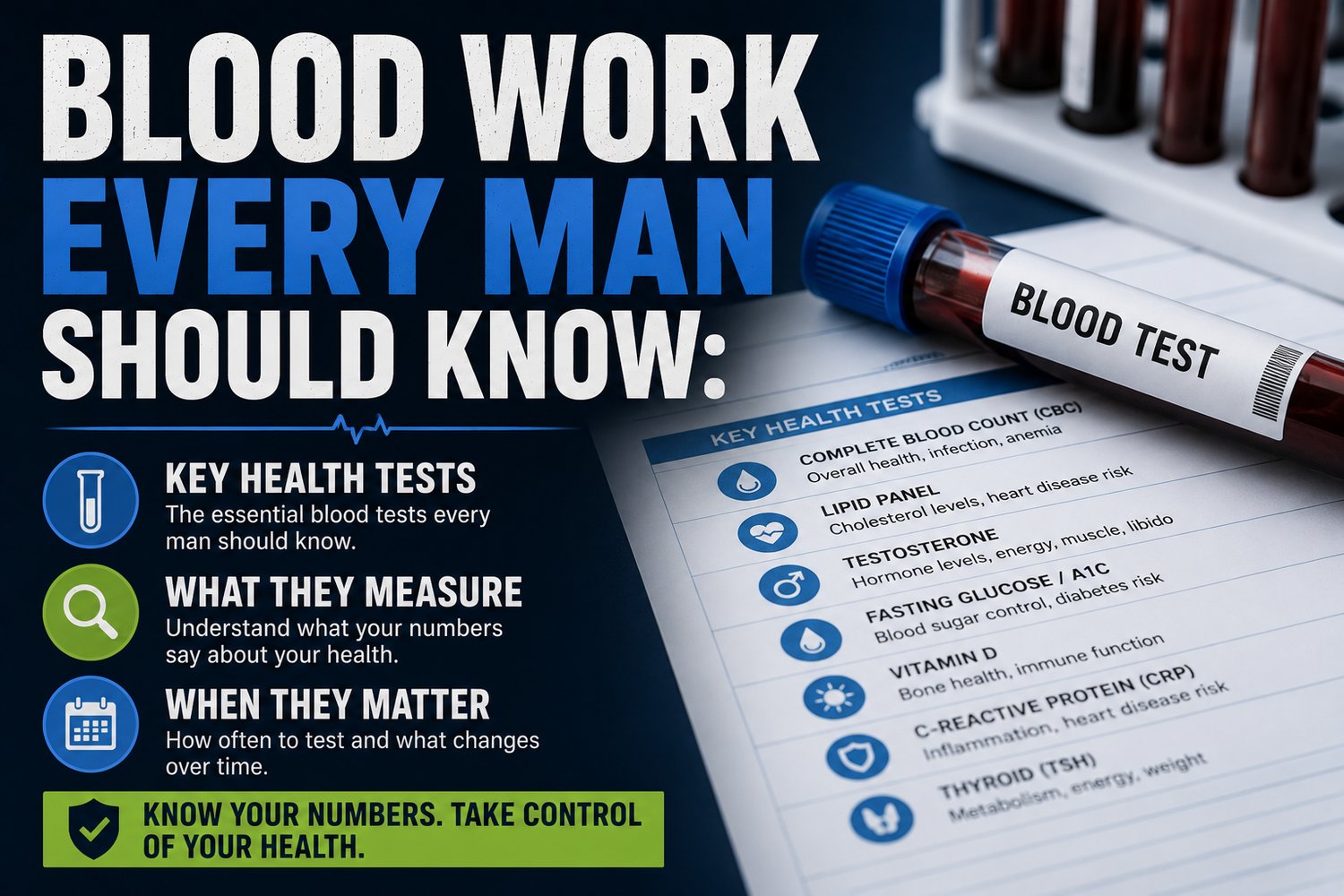
Blood Work for Men: Key Health Tests, What They Measure & When They Matter
Blood work for men commonly includes tests that evaluate cholesterol, blood sugar, blood cells, kidney function, liver-related markers, and other aspects of health. Additional testing—such as testosterone, thyroid markers, PSA, iron studies, vitamin levels, or more specialized cardiovascular tests—may make sense depending on your age, symptoms, medications, family history, and individual risk.
There is no single blood panel that every man needs every year.
That's important.
A lot of men's-health marketing makes it sound like you need dozens of biomarkers to understand your body.
You probably don't.
For many men, some of the highest-value health information comes from relatively ordinary things:
- Blood pressure
- Lipid panel
- Blood glucose or A1C when appropriate
- Complete blood count
- Metabolic testing
- Weight and waist trend
- Appropriate preventive screening
Then additional tests are added when there's an actual reason to order them.
Testosterone is a perfect example.
It can be extremely useful when symptoms suggest testosterone deficiency.
It isn't automatically the most important number in every man's bloodwork.
The goal of this guide is to help you understand what common blood tests measure, why they may be ordered, and where more specialized men's-health testing fits into the picture.
Blood Work Is Information—Not a Report Card
Laboratory values aren't grades.
You're not trying to earn:
A+ cholesterol
or:
100% testosterone.
A lab result is one piece of information interpreted alongside:
- Age
- Symptoms
- Medical history
- Family history
- Medications
- Previous results
- Lifestyle
- Other risk factors
One abnormal result doesn't automatically mean something is seriously wrong.
And one normal result doesn't guarantee perfect health.
The useful questions are:
What does this number measure?
Why was it tested?
Has it changed over time?
Does it fit with the rest of my health picture?
Reference Range Doesn't Always Mean “Healthy vs. Sick”
Most laboratory reports show a reference range beside each result.
It's tempting to interpret that as:
Inside range = healthy
Outside range = disease
Medicine isn't always that simple.
Some laboratory markers are interpreted according to:
- Disease-specific thresholds
- Cardiovascular risk
- Age
- Symptoms
- Individual treatment goals
- Other laboratory results
A mildly abnormal number may sometimes simply need to be repeated.
A result technically inside a laboratory range may still deserve attention depending on the situation.
Use reference ranges as context.
Don't treat them as a universal health scoring system.
The Core Blood Tests Many Men Will Encounter
These aren't necessarily required on the same schedule for everyone.
But they're among the most common and useful tests to understand.
1. Complete Blood Count — CBC
A complete blood count, or CBC, measures several important components of your blood.
Common CBC measurements include:
- Red blood cell count
- Hemoglobin
- Hematocrit
- White blood cell count
- Platelets
A CBC can help provide clues about problems such as:
- Anemia
- Infection
- Certain blood disorders
- Medication effects
- Other medical conditions
It's not specifically a men's-health test.
It's simply a broadly useful health test.
Hemoglobin
Hemoglobin is the oxygen-carrying protein inside red blood cells.
Low hemoglobin can occur with anemia.
Depending on the cause and severity, anemia can contribute to symptoms such as:
- Fatigue
- Weakness
- Shortness of breath
- Reduced exercise tolerance
Notice how easily those symptoms could be blamed on testosterone.
That's one reason persistent fatigue deserves a broader evaluation rather than immediately assuming:
“Low energy = low T.”
Hematocrit
Hematocrit measures the proportion of your blood volume made up of red blood cells.
This number becomes particularly important for men using testosterone replacement therapy.
Testosterone can stimulate red blood cell production and raise hematocrit.
If hematocrit becomes too high, the clinician managing TRT may need to reassess treatment.
That's why hematocrit isn't random “optimization data” for a man on testosterone.
It's part of responsible monitoring.
Read What Is TRT? Testosterone Replacement Therapy Explained for the full treatment and monitoring discussion.
White Blood Cells
White blood cells are part of the immune system.
High or low counts can occur for many reasons, including:
- Infection
- Inflammation
- Medication effects
- Immune disorders
- Bone-marrow conditions
- Other illnesses
An abnormal white blood cell count isn't a diagnosis by itself.
It needs to be interpreted alongside symptoms, the different types of white cells, previous results, and the rest of the CBC.
Platelets
Platelets help your blood form clots.
Platelet counts can become high or low for many different reasons.
Again, the CBC provides clues.
It isn't one test for one disease.
2. Basic or Comprehensive Metabolic Panels
Metabolic panels provide information about several major systems at once.
You may encounter a:
- Basic metabolic panel — BMP
- Comprehensive metabolic panel — CMP
A CMP generally contains everything in a BMP plus additional liver-related and protein measurements.
Depending on the panel, testing can include information about:
- Glucose
- Sodium
- Potassium
- Chloride
- Bicarbonate
- Calcium
- Kidney function
- Liver-related markers
- Proteins
These are among the most common laboratory panels used in routine medical care.
Kidney Function: Creatinine and eGFR
Your kidneys filter waste products from the blood.
Creatinine is one commonly measured marker used when evaluating kidney function.
Laboratories also frequently calculate an:
eGFR — estimated glomerular filtration rate
which estimates how effectively the kidneys are filtering blood.
Kidney disease can progress without obvious early symptoms, which makes appropriate testing valuable.
Muscular Men and Creatinine
There's an important wrinkle here.
Creatinine is related partly to muscle metabolism.
Muscle mass, exercise, diet, supplementation, hydration, and other factors can sometimes influence the result.
That does not mean:
“My creatinine is high because I lift, so I can ignore it.”
Abnormal kidney-function results deserve appropriate interpretation.
It simply means creatinine should be considered in context instead of automatically assuming one explanation.
Liver-Related Markers
A comprehensive metabolic panel commonly includes markers such as:
- ALT
- AST
- Alkaline phosphatase
- Bilirubin
- Albumin
These can provide information involving the liver and related body systems.
Abnormal results can occur for many reasons, including:
- Liver disease
- Alcohol use
- Medication effects
- Metabolic disease
- Infection
- Muscle injury in some circumstances
- Other health conditions
One mildly abnormal liver enzyme does not automatically mean you have a specific liver disease.
But it may justify repeat testing or further investigation.
Metabolic Fatty Liver Disease
Metabolic dysfunction-associated steatotic liver disease—often still casually called fatty liver—commonly overlaps with:
- Obesity
- Insulin resistance
- Type 2 diabetes
- Elevated triglycerides
- Other metabolic risk factors
This is one reason liver health shouldn't be viewed separately from:
- Waist circumference
- Blood glucose
- A1C
- Triglycerides
- Body weight
- Physical activity
Your body doesn't operate in isolated laboratory categories.
Electrolytes
Metabolic panels commonly measure electrolytes such as:
- Sodium
- Potassium
- Chloride
- Bicarbonate
Electrolytes are involved in:
- Fluid balance
- Nerve signaling
- Muscle function
- Acid-base regulation
Abnormalities can occur because of:
- Kidney problems
- Medications
- Dehydration
- Hormonal disorders
- Gastrointestinal losses
- Other illnesses
Don't automatically treat an abnormal electrolyte result with a sports drink or supplement.
Some electrolyte abnormalities require medical evaluation.
3. Lipid Panel
If long-term men's health is the goal, cholesterol deserves at least as much attention as testosterone.
A standard lipid panel usually includes:
- Total cholesterol
- LDL cholesterol
- HDL cholesterol
- Triglycerides
These values contribute to cardiovascular-risk assessment.
And cardiovascular health affects:
- Heart attack risk
- Stroke risk
- Kidney health
- Erectile function
- Long-term health and longevity
The important point is that cholesterol isn't interpreted in isolation.
Cardiovascular decisions may also depend on:
- Age
- Blood pressure
- Diabetes
- Smoking
- Family history
- Existing cardiovascular disease
- Other risk factors
LDL Cholesterol
LDL is commonly called:
“bad cholesterol.”
That's an oversimplification, but it remains a useful beginner shorthand.
LDL particles contribute to atherosclerotic plaque development.
Higher LDL can contribute to cardiovascular risk, but the importance of a specific LDL result depends partly on the person's overall risk.
A man with:
- Diabetes
- Hypertension
- Smoking
- Previous cardiovascular disease
may have a very different treatment discussion from a younger person with few other risk factors.
The red or green color on your laboratory portal isn't the whole cardiovascular assessment.
HDL Cholesterol
HDL is commonly called:
“good cholesterol.”
Higher HDL has historically been associated with lower cardiovascular risk.
But HDL isn't a score you need to maximize.
Cardiovascular health depends on the complete risk picture rather than trying to manipulate one HDL number.
Triglycerides
Triglycerides are another type of blood fat.
Elevated triglycerides can occur with factors such as:
- Excess calorie intake
- Heavy alcohol use
- Obesity
- Insulin resistance
- Diabetes
- Certain medications
- Genetic conditions
Triglyceride trends can be particularly useful when viewed alongside:
- Weight
- Waist circumference
- Glucose
- A1C
- Other lipid results
Heart Risk Is Bigger Than a Cholesterol Panel
A lipid panel is useful.
But cardiovascular risk also includes:
- Blood pressure
- Smoking
- Diabetes
- Age
- Family history
- Physical activity
- Body composition
- Existing cardiovascular disease
This is also why erectile dysfunction can sometimes deserve broader medical attention.
Persistent ED can provide useful information about vascular health.
Read Erectile Dysfunction: Causes, Treatment & When to Get Help.
4. A1C
Hemoglobin A1C, usually shortened to A1C, provides information about average blood glucose over roughly the previous three months.
It's commonly used for:
- Prediabetes screening
- Diabetes diagnosis
- Diabetes monitoring
Commonly used A1C categories are:
- Below 5.7%: normal range
- 5.7%–6.4%: prediabetes range
- 6.5% or higher: diabetes range
A diabetes diagnosis may require appropriate confirmation depending on the circumstances.
The useful part of A1C is that it can reveal a developing metabolic problem before you necessarily feel sick.
Why A1C Matters for Men
Poorly controlled blood glucose can eventually affect:
- Cardiovascular health
- Kidneys
- Nerves
- Eyes
- Sexual function
Diabetes is also a major contributor to erectile dysfunction because it can damage both blood vessels and nerves.
So if sexual health is one of your concerns, A1C may sometimes tell you more than an enormous “men's hormone panel.”
5. Blood Glucose
Blood glucose measures the amount of glucose circulating in your bloodstream at the time of the test.
Depending on why testing is being performed, you may have:
- Fasting glucose
- Random glucose
- Other glucose testing
Unlike A1C, which reflects a longer period, a single glucose measurement is more of a snapshot.
Results can be affected by circumstances such as:
- Food intake
- Illness
- Stress
- Medications
- Testing conditions
That's why one mildly unusual result may need to be interpreted or repeated rather than immediately turned into a diagnosis.
6. Testosterone — When There's a Reason to Test It
Now we get to the laboratory test that receives most of the attention in men's-health marketing.
Testosterone testing can absolutely be useful.
But testosterone deficiency isn't diagnosed because a man:
- Turned 40
- Feels tired
- Wants more muscle
- Wants a higher number
Professional guidance recommends diagnosing hypogonadism when a man has compatible symptoms or signs plus consistently low testosterone measurements.
A low result should generally be confirmed rather than treated as a permanent diagnosis after one blood draw.
Read Low Testosterone Symptoms for the symptoms that make testing more relevant.
How Is Testosterone Tested?
Total testosterone is usually the starting measurement.
For men with typical daytime schedules, testing is generally performed in the early morning, when testosterone is normally higher.
If a result is unexpectedly low, it should typically be repeated.
Current Endocrine Society guidance describes diagnosis as requiring at least two early-morning low testosterone measurements together with compatible symptoms or signs.
For the full process, read How Testosterone Is Tested and Diagnosed.
Free Testosterone and SHBG
Sometimes total testosterone doesn't tell the entire story.
SHBG, or sex hormone-binding globulin, is a protein that binds testosterone in the bloodstream.
When SHBG is unusually high or low, total testosterone can become more difficult to interpret.
In selected situations, clinicians may therefore look at:
- Total testosterone
- SHBG
- Free testosterone
Not every man needs all three.
And most men don't need an enormous hormone panel every few months simply because the tests exist.
Testing should answer a clinical question.
LH and FSH
If testosterone is confirmed low, clinicians often need to determine why.
Two useful hormones are:
- LH — luteinizing hormone
- FSH — follicle-stimulating hormone
Their pattern can help distinguish between:
Primary Hypogonadism
The main problem originates in the testes.
Secondary Hypogonadism
The problem involves signaling from the hypothalamus or pituitary gland.
This is why a low testosterone result can be the beginning of the investigation rather than the end.
Read What Causes Low Testosterone?.
Prolactin
Prolactin is another pituitary hormone.
Testing can be useful in selected men with confirmed low testosterone—particularly when the hormone pattern raises concern about a pituitary or secondary cause.
High prolactin can interfere with normal reproductive hormone signaling.
But prolactin isn't automatically part of every man's annual bloodwork.
It's a targeted test.
7. Thyroid Testing
The thyroid affects metabolism throughout the body.
A common first-line thyroid test is:
TSH — thyroid-stimulating hormone
Depending on the clinical situation, other thyroid tests may also be ordered.
Thyroid disorders can cause symptoms such as:
- Fatigue
- Weight changes
- Mood changes
- Temperature sensitivity
- Heart-rate changes
- Sexual changes
- Difficulty concentrating
Notice how many of those overlap with symptoms routinely marketed as “low T.”
Persistent fatigue deserves a broader view than testosterone alone.
8. PSA — When Prostate Screening Is Appropriate
PSA, or prostate-specific antigen, is a protein associated with prostate tissue.
PSA testing can help with prostate-cancer screening and evaluation, but it isn't simply:
“The prostate cancer test.”
PSA can increase for reasons other than cancer.
And prostate-cancer screening has both potential benefits and potential harms.
Those harms can include:
- False-positive results
- Additional testing
- Biopsy
- Overdiagnosis
- Overtreatment
That's why PSA screening is generally a shared decision, not something every man should blindly add to an annual laboratory panel at the same birthday.
Age, family history, personal risk factors, life expectancy, and preferences all matter.
An Abnormal PSA Doesn't Automatically Mean Cancer
An elevated PSA may lead to:
- Repeat PSA testing
- Additional risk assessment
- Urology referral
- Imaging
- Other diagnostic evaluation
It doesn't by itself establish prostate cancer.
Likewise, one normal PSA result doesn't guarantee that prostate cancer is impossible.
Screening identifies risk.
It isn't the final diagnosis.
PSA and TRT
PSA may also enter the conversation when testosterone therapy is being considered or monitored in men for whom prostate evaluation is appropriate.
That doesn't mean testosterone automatically causes prostate cancer.
It means prostate health can be part of responsible patient selection and monitoring.
Read What Is TRT? Testosterone Replacement Therapy Explained.
Other Blood Tests That May Be Useful When Indicated
The next group shouldn't be interpreted as:
“Every man needs these annually.”
These are tests that can be extremely useful when symptoms, medical history, medications, diet, or risk factors justify them.
Vitamin B12
Vitamin B12 is important for:
- Neurological function
- Red blood cell production
- DNA synthesis
Deficiency can contribute to:
- Anemia
- Fatigue
- Numbness or tingling
- Other neurological problems
Testing may be appropriate depending on factors such as:
- Diet
- Medications
- Gastrointestinal conditions
- Symptoms
- Previous abnormal results
B12 is useful when there's a reason to evaluate it.
It isn't automatically part of a universal men's-health panel.
Iron Studies and Ferritin
Iron is essential for normal red blood cell production and oxygen transport.
Iron deficiency can contribute to:
- Anemia
- Fatigue
- Weakness
- Reduced exercise tolerance
Depending on the situation, iron evaluation can involve:
- Ferritin
- Serum iron
- Transferrin saturation
- Other related measurements
Adult men generally shouldn't start iron supplementation simply because they feel tired.
If true iron deficiency is identified, why the deficiency exists may need investigation.
Possible causes can include blood loss or gastrointestinal disease.
Vitamin D
Vitamin D contributes to:
- Bone health
- Calcium metabolism
- Other physiological processes
Vitamin D testing may be useful in people with:
- Specific risk factors for deficiency
- Bone-health concerns
- Certain medical conditions
- Previous deficiency
- Other reasons identified by their clinician
Repeated vitamin D testing isn't automatically necessary for every healthy man.
Infection Screening
Preventive care can also include testing for infections such as:
- HIV
- Hepatitis B
- Hepatitis C
- Other sexually transmitted infections
Which tests make sense and how often they should be performed depends on:
- Age
- Previous testing
- Risk factors
- Sexual history
- Medical history
- Current preventive-care recommendations
Men's health isn't limited to hormones and metabolism.
Some of the Most Important Health Numbers Aren't Blood Tests
This is worth emphasizing.
You can order an impressive $1,500 blood panel and still miss some of the most important health information if you don't know:
- Your blood pressure
- Whether you smoke
- Your waist circumference
- Your physical activity
- Your body-weight trend
- Your cardiovascular fitness
Health isn't just a spreadsheet.
Blood Pressure
Blood pressure doesn't require a blood draw.
It's still one of the most important numbers to know.
High blood pressure can damage:
- Heart
- Brain
- Kidneys
- Blood vessels
The USPSTF recommends blood-pressure screening for adults and recommends confirming hypertension with measurements outside the clinic before beginning treatment when appropriate.
Yet blood pressure receives a tiny fraction of the attention that testosterone gets online.
Know your blood pressure.
Waist Circumference and Weight Trend
Body weight by itself is imperfect.
Waist circumference can add information about abdominal adiposity and metabolic risk.
Even more useful than one measurement can be the trend.
Ask:
- Is my waist increasing?
- Is my weight steadily rising?
- Is body composition improving?
- Are other metabolic markers moving with it?
Context makes measurements more useful.
Should Men Get ApoB or Lipoprotein(a)?
These are increasingly discussed in cardiovascular-health circles.
ApoB
Apolipoprotein B, or ApoB, reflects the number of atherogenic lipoprotein particles circulating in the blood.
It can provide additional cardiovascular-risk information in selected people.
Lipoprotein(a)
Lipoprotein(a), usually abbreviated Lp(a), is a largely genetically determined lipoprotein associated with cardiovascular risk.
These aren't meaningless “biohacker tests.”
They can be clinically useful.
But they should be viewed as tools that can refine cardiovascular-risk assessment—not replacements for understanding:
- Standard lipid values
- Blood pressure
- Diabetes status
- Smoking
- Family history
- Existing cardiovascular disease
Advanced markers should add to a strong foundation rather than distract from it.
Don't Order Every Biomarker You've Heard on a Podcast
Modern wellness content can create the impression that a standard medical evaluation is inadequate unless you know:
- ApoB
- Lp(a)
- Fasting insulin
- Cortisol
- DHT
- Estradiol
- hs-CRP
- Homocysteine
- Ferritin
- IGF-1
- Several dozen other values
Some of those tests can be useful.
That doesn't mean you need all of them.
More testing can also create:
- False-positive results
- Anxiety
- Unnecessary follow-up
- Expense
- Confusion
Before ordering a test, ask:
“What question am I trying to answer?”
and:
“What would I actually do differently based on the result?”
If neither you nor the person ordering the test can answer those questions, the measurement may not be adding much value.
At-Home Blood Testing
At-home and direct-access laboratory testing have made health information easier to obtain.
That can offer:
- Convenience
- Privacy
- Easier access
- A useful starting point in some situations
HabitLogics has a Men's Bloodwork Hub where you can explore testing resources.
If testosterone specifically is the concern, the Everlywell Testosterone Test provides one at-home option.
At-home testing can provide information.
It does not automatically provide a diagnosis.
Know the Limits of At-Home Testing
A test can answer:
“What did this sample measure?”
It may not answer:
“Why is this abnormal?”
or:
“What condition do I have?”
That distinction becomes especially important with:
- Hormones
- Borderline results
- Unexpected abnormalities
- Results that conflict with symptoms
Testosterone is a good example.
One low at-home testosterone measurement shouldn't trigger lifelong hormone treatment.
Appropriate diagnosis requires clinical context and confirmation.
How Often Should Men Get Blood Work?
There is no universal schedule.
Frequency depends on factors such as:
- Age
- Medical history
- Family history
- Medications
- Existing medical conditions
- Previous abnormalities
- Treatment you're receiving
- Individual preventive-care recommendations
A healthy younger adult may need a very different testing schedule from someone with:
- Diabetes
- Hypertension
- High cholesterol
- Kidney disease
- TRT
- Other chronic conditions
Don't turn:
“annual bloodwork”
into a universal biological law.
Use a schedule appropriate for your actual health.
TRT Requires More Specific Monitoring
Men using testosterone replacement therapy typically need more targeted monitoring than men who aren't.
Depending on the individual treatment plan, clinicians may follow:
- Testosterone
- Hemoglobin
- Hematocrit
- Blood pressure
- Symptoms
- PSA when appropriate
- Other individualized measures
TRT is one situation where longitudinal tracking can be particularly useful.
Read What Is TRT? Testosterone Replacement Therapy Explained.
If you've already been properly evaluated and are researching treatment services, you can also compare online TRT options.
HabitLogics may earn a commission if you purchase through links on our TRT provider page, at no additional cost to you.
Trends Matter More Than Random Screenshots
Modern healthcare records can become fragmented.
You might have:
- Testosterone in one portal
- Cholesterol from another lab
- A CBC from an annual physical
- A1C inside a PDF
- Blood pressure written in a note
Several years later, you can't easily answer:
Is my LDL improving?
Has my A1C been rising?
Is hematocrit gradually increasing on TRT?
Has kidney function been stable?
That's why longitudinal tracking can be useful.
The Men's Bloodwork Dashboard is designed to help organize testosterone, metabolic markers, lipids, body-composition measurements, and related health data over time.
Instead of only asking:
“Is this number normal?”
you can also ask:
“Where is this number going?”
One Abnormal Result Doesn't Always Mean Disease
Suppose one test shows:
- Mildly elevated ALT
- Slightly high glucose
- Borderline testosterone
- Unexpected creatinine
- Another minor abnormality
Don't immediately build a diagnosis around it.
Depending on the result and context, a clinician may:
- Repeat the test
- Review medications
- Look at symptoms
- Compare previous results
- Change testing conditions
- Order additional evaluation
Laboratory testing is part of medicine.
It isn't all of medicine.
One Normal Result Doesn't Make You Invincible Either
A normal A1C doesn't erase:
- Smoking
- Severe hypertension
- Significant obesity
Normal testosterone doesn't erase:
- Poor sleep
- High cholesterol
- Erectile dysfunction
- Depression
A reassuring cholesterol result doesn't mean cardiovascular prevention no longer matters.
Avoid tunnel vision.
Health comes from the entire picture.
Use Bloodwork to Make Decisions
Data is most useful when it informs action.
Instead of saying:
“I want better bloodwork.”
ask what a specific trend means.
A1C Rising?
Review:
- Nutrition
- Physical activity
- Weight
- Sleep
- Diabetes risk
- Medical management when appropriate
Triglycerides Rising?
Look at possible contributors such as:
- Weight gain
- Alcohol intake
- Diet
- Diabetes or insulin resistance
- Medications
Hematocrit Rising on TRT?
Discuss it with the clinician managing testosterone therapy.
Testosterone Low?
Confirm the result and determine why it's low.
Liver Markers Abnormal?
Investigate the cause rather than buying a “liver detox.”
Blood Pressure High?
Don't ignore it because the rest of your laboratory panel looks impressive.
Specific problem.
Specific response.
A Practical Men's Health Snapshot
You don't need 75 biomarkers to establish a useful baseline.
Depending on age and individual risk, a practical health picture may involve several categories.
Cardiovascular
- Blood pressure
- Lipid profile
- Smoking status
- Family history
Metabolic
- Weight and waist circumference
- Glucose testing when appropriate
- A1C when appropriate
Blood Health
- CBC when clinically appropriate
Kidney and Liver
- Metabolic panel when appropriate
Hormones
- Testosterone when symptoms justify testing
- Additional hormone testing when indicated
Preventive Screening
- PSA discussion when appropriate
- Infection screening based on risk and current recommendations
- Other age- and risk-appropriate preventive care
Lifestyle
- Sleep
- Strength training
- Aerobic activity
- Walking
- Nutrition
- Alcohol
- Smoking
That's already a substantial amount of useful health information.
Start Tracking for Free
If you're not ready for a full tracking system, the FREE Men's Hormone & Energy Starter Kit provides a simpler way to begin tracking:
- Bloodwork
- Energy
- Sleep
- Strength
- Nutrition
- Daily habits
The goal is establishing context rather than collecting numbers for entertainment.
For More Detailed Bloodwork Tracking
The Men's Bloodwork Dashboard focuses specifically on organizing:
- Testosterone
- Metabolic health
- Lipids
- Body composition
- Related health markers
For men who want to combine health measurements with broader fitness, recovery, energy, and body-composition tracking, the Men's Health & Performance Dashboard provides the wider system.
Frequently Asked Questions
What blood tests should men get?
There isn't one universal blood panel appropriate for every man.
Common testing may include a CBC, metabolic testing, lipid panel, and blood-sugar assessment depending on age, symptoms, medications, and individual risk.
Testosterone, thyroid testing, PSA, vitamin levels, iron studies, and other tests should be added when there's a reason to order them.
What blood tests are usually done at a men's annual physical?
There isn't a guaranteed set of laboratory tests performed at every physical.
Testing depends on your health history, age, risk factors, medications, previous results, symptoms, and the clinician's assessment.
Some men may need laboratory testing.
Others may not require every common panel every year.
Should every man have testosterone tested?
No.
Testosterone testing is most useful when symptoms or signs make testosterone deficiency plausible.
Professional guidance does not recommend routine testosterone screening of every asymptomatic man.
What time should testosterone be tested?
For men with typical daytime schedules, testosterone is generally evaluated with early-morning measurements.
If an initial result is low, it should usually be confirmed with another appropriately performed morning measurement.
What does A1C measure?
A1C estimates average blood glucose over approximately the previous three months.
It is commonly used for diabetes and prediabetes screening, diagnosis, and monitoring.
What is a normal A1C?
Common categories are:
- Below 5.7% — normal range
- 5.7% to 6.4% — prediabetes range
- 6.5% or higher — diabetes range
Diagnosis should still be interpreted appropriately by a healthcare professional.
What does a CBC test?
A complete blood count measures several components of blood, including:
- Red blood cells
- White blood cells
- Hemoglobin
- Hematocrit
- Platelets
It can help evaluate problems such as anemia, infection, and certain blood disorders.
What does a CMP test?
A comprehensive metabolic panel measures multiple substances and provides information involving:
- Glucose
- Electrolytes
- Kidney function
- Liver-related markers
- Proteins
- Calcium
- Other aspects of metabolism
Should men have PSA tested?
PSA screening isn't automatically appropriate for every man at the same age.
Whether testing makes sense depends on age, individual prostate-cancer risk, family history, health status, preferences, and current screening recommendations.
It should generally be an informed discussion rather than an automatic addition to every annual laboratory panel.
Should I get ApoB or Lp(a) tested?
ApoB and Lp(a) can provide additional cardiovascular-risk information in selected people.
Whether they're useful for you depends on your existing risk assessment, family history, lipid results, and what additional information would change management.
Should I fast before bloodwork?
It depends on which tests are being performed.
Some tests may be ordered fasting, while many others don't require it.
Follow the instructions from the clinician or laboratory rather than assuming every blood draw requires fasting.
Can I interpret my own lab results?
You can absolutely learn what laboratory markers mean and track your trends.
But unexpected or abnormal results should be interpreted alongside:
- Symptoms
- Medications
- Medical history
- Other laboratory results
- Testing conditions
A number by itself rarely tells the complete story.
How often should men get blood work?
There is no universal schedule.
Testing frequency depends on age, medical history, medications, family history, symptoms, previous abnormalities, and individual preventive-care needs.
Key Takeaways
- There is no single blood-test panel that every man needs every year.
- Common bloodwork can provide information about blood cells, cholesterol, blood glucose, kidney function, liver-related markers, and other aspects of health.
- A CBC measures red cells, white cells, hemoglobin, hematocrit, and platelets.
- Metabolic panels provide information about electrolytes, glucose, kidney function, and—in a CMP—additional liver-related and protein markers.
- Lipid results should be interpreted as part of overall cardiovascular risk rather than in isolation.
- A1C reflects average blood glucose over roughly three months.
- Testosterone should generally be tested when symptoms or signs justify evaluation rather than automatically in every man.
- Low testosterone requires proper confirmation rather than diagnosis from one random result.
- SHBG, free testosterone, LH, FSH, prolactin, thyroid testing, iron studies, vitamin levels, and other markers are useful when they answer a specific clinical question.
- PSA screening requires individualized decision-making rather than automatic testing for every man.
- Blood pressure, waist circumference, smoking, activity, and other non-laboratory measurements can be just as important as blood tests.
- Advanced biomarkers can refine risk assessment, but more data isn't automatically better.
- Trends are often more useful than isolated screenshots.
- Testing becomes valuable when the information leads to an appropriate decision.
Final Thoughts
You don't need to turn yourself into a laboratory project.
But you should probably know more about your health than:
“I feel fine.”
Understand your blood pressure.
Know whether cholesterol and cardiovascular risk need attention.
Pay attention to blood sugar.
Know what your CBC and metabolic tests are measuring.
Watch your weight and waist trends.
And if symptoms genuinely suggest a hormone problem, test testosterone correctly rather than guessing.
Then keep your results.
Compare them over time.
Look for meaningful trends.
Because the real value of bloodwork isn't seeing a number once.
It's recognizing:
This is improving.
This is stable.
This is getting worse.
This needs attention.
That's how health data becomes useful.
Continue the Men's Wellness Series
For testosterone and hormones:
- Low Testosterone Symptoms
- What Causes Low Testosterone?
- How Testosterone Is Tested and Diagnosed
- What Is TRT? Testosterone Replacement Therapy Explained
- How to Support Testosterone Naturally
For sexual and cardiovascular health:
- Erectile Dysfunction: Causes, Treatment & When to Get Help
- Morning Erections: What They Can Tell You About Your Health
- Why Belly Fat Gets Harder to Lose After 30
- Walking for Men's Health
For testing and tracking:
- HabitLogics Men's Bloodwork Hub
- Everlywell Testosterone Test
- Men's Bloodwork Dashboard
- Men's Health & Performance Dashboard
- FREE Men's Hormone & Energy Starter Kit
For the broader men's-health pillar:
Affiliate Disclosure
Some links in this article are affiliate links. If you purchase through one of these links, HabitLogics may earn a commission at no additional cost to you. Recommendations are included only where they naturally fit the topic.
Educational Disclaimer
This article is intended for educational purposes only and should not be considered medical advice. Appropriate laboratory testing and preventive screening depend on age, symptoms, medications, medical and family history, previous results, and individual risk. Laboratory reference ranges and screening recommendations can vary, and abnormal results should be interpreted by a qualified healthcare professional. Do not start, stop, or change medications, supplements, or hormone treatment based solely on information in this article.