

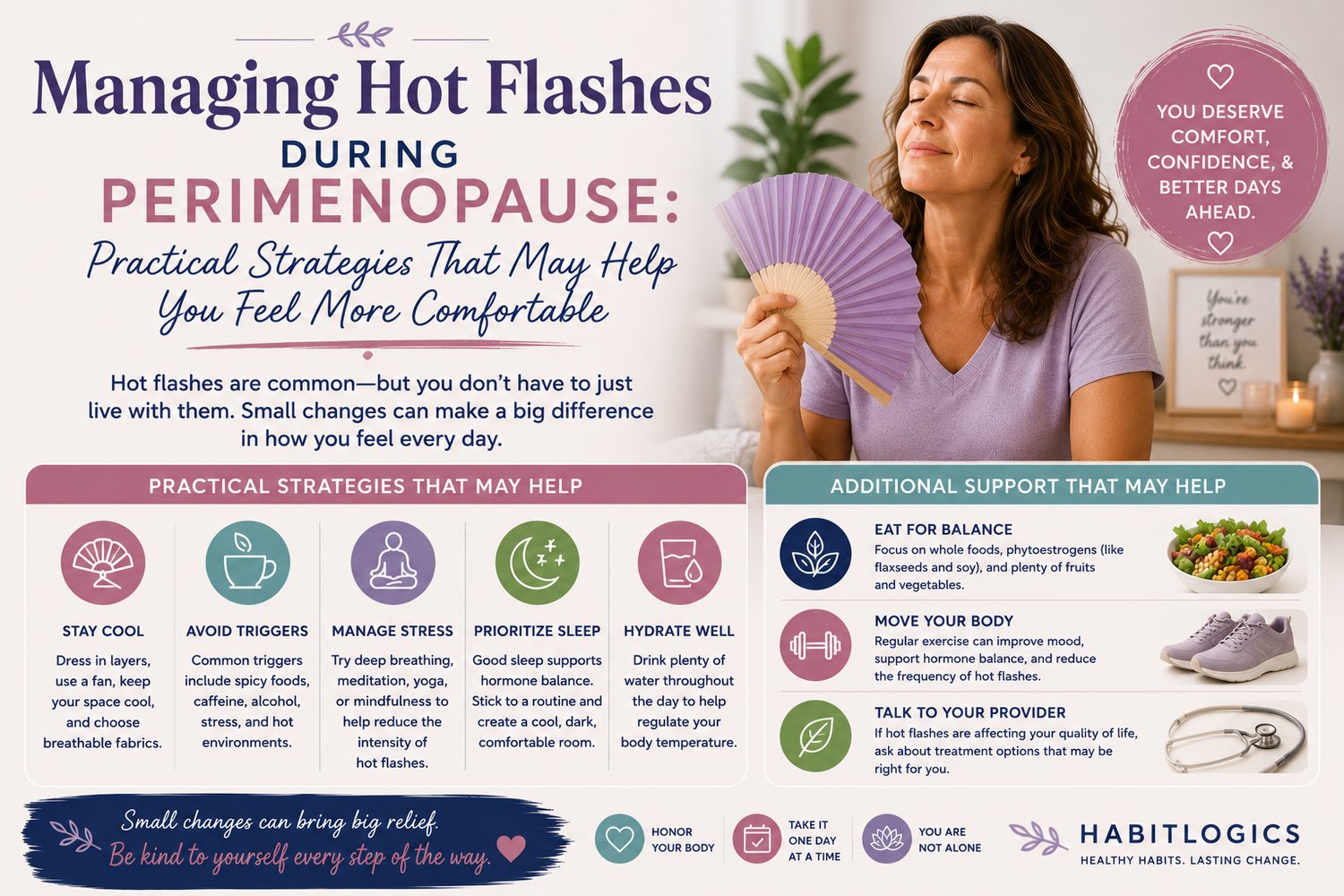
Hot Flashes During Perimenopause: Causes, Triggers & Treatments That Actually Help
Hot flashes during perimenopause can appear suddenly—one moment you're comfortable, and the next a wave of heat spreads across your face, neck, chest, or upper body.
You may start sweating.
Your skin may flush.
Your heart may seem to pound.
And once the heat passes, you may suddenly feel chilled.
Hot flashes are one of the hallmark symptoms of the menopause transition. When they happen during sleep, they're commonly called night sweats.
Some women have occasional mild episodes. Others experience hot flashes repeatedly throughout the day or night, disrupting sleep, work, exercise, and everyday life.
The important part is that you have more options than simply waiting for them to stop.
Cooling strategies and identifying personal triggers may make individual episodes easier to manage, while effective hormonal and nonhormonal medical treatments are available when hot flashes become bothersome.
If you're still figuring out whether your other symptoms fit the menopause transition, start with 35 Perimenopause Symptoms: Common Signs, What’s Normal & When to Get Help.
What Is a Hot Flash?
A hot flash is a sudden sensation of heat, usually involving areas such as the:
- Face
- Neck
- Chest
- Upper body
It may be accompanied by:
- Sweating
- Flushed skin
- A pounding or faster heartbeat
- Feelings of anxiety or uneasiness
- Chills after the heat passes
Individual episodes commonly last several minutes, although duration varies.
Hot flashes are also called vasomotor symptoms, or VMS.
That medical term matters because you'll see it used when reading about menopause treatments.
Are Night Sweats the Same as Hot Flashes?
Essentially, yes.
Night sweats are vasomotor symptoms that occur during sleep.
They can be especially disruptive because you're dealing with two problems at once:
The hot flash itself + interrupted sleep.
You might wake up:
- Overheated
- Sweating
- With damp clothing or bedding
- Throwing off blankets
- Unable to fall back asleep
Repeated episodes can leave you exhausted even when you technically spent eight hours in bed.
For the broader sleep picture, read Sleep During Perimenopause: Why It Changes & How to Sleep Better.
Why Do Hot Flashes Happen During Perimenopause?
Hot flashes aren't simply caused by being too warm.
During the menopause transition, changes in estrogen signaling affect the brain systems involved in regulating body temperature.
Researchers now understand that a signaling pathway involving neurokinin B and temperature-regulating neurons in the hypothalamus plays an important role.
In practical terms, your body's comfortable temperature range becomes narrower.
A small change that wouldn't previously have triggered much of a response can suddenly cause your body to act as though it needs to dump heat immediately.
Blood vessels near the skin widen.
You may flush.
You sweat.
Your body releases heat.
Then you may feel chilled afterward.
This newer understanding of the neurokinin pathway has also led to an entirely new class of nonhormonal medications specifically targeting vasomotor symptoms, which we'll discuss below.
When Do Hot Flashes Start?
Hot flashes can begin during perimenopause, before menstrual periods stop completely.
For some women they're one of the first obvious signs that something has changed.
Others experience irregular periods for quite a while before hot flashes appear.
And some women never experience significant hot flashes at all.
They can also continue after menopause.
So hot flashes aren't exclusively a “postmenopause” symptom.
If you're unsure where you are in the transition, read:
What Is Perimenopause? Signs, Stages, Symptoms & What to Expect
and
Perimenopause vs. Menopause: What’s the Difference?.
How Long Do Hot Flashes Last?
There are two different questions here.
How Long Does One Hot Flash Last?
A typical episode lasts several minutes, although individual experiences vary.
How Long Can You Keep Having Hot Flashes?
Much longer.
Vasomotor symptoms can continue for years during and after the menopause transition.
There isn't a universal countdown.
Some women experience symptoms for a relatively short period.
Others deal with them for many years.
That's one reason severe hot flashes shouldn't be treated as something you simply need to endure until your body eventually decides it's finished.
What Can Trigger a Hot Flash?
A hot flash doesn't always have an identifiable trigger.
Hormonal changes are creating the underlying susceptibility.
But some women notice that certain situations make an episode more likely or more uncomfortable.
Possible personal triggers can include:
- Alcohol
- Spicy foods
- Caffeine
- Hot beverages
- Warm rooms
- Hot weather
- Stressful situations
- Smoking
- Heavy or restrictive clothing
Here's the important part:
There isn't one universal hot-flash trigger list you need to eliminate from your life.
You may drink coffee without a problem.
Someone else may notice a consistent pattern after their second cup.
Alcohol may be an obvious trigger for one person and irrelevant for another.
Rather than banning everything you've ever enjoyed because a menopause website put it on a list, track your own patterns.
Does Avoiding Triggers Actually Treat Hot Flashes?
This distinction is worth making.
Avoiding a trigger that reliably provokes your own symptoms can obviously be useful.
If red wine consistently leads to a miserable evening of hot flashes, drinking less red wine is a reasonable experiment.
But broad trigger avoidance isn't considered one of the strongest evidence-based treatments for vasomotor symptoms.
In other words:
Personal trigger management can be practical.
That doesn't mean eliminating caffeine, spicy food, hot drinks, and every other possible trigger will make the underlying vasomotor symptoms disappear.
Track first.
Restrict second—if there's actually a pattern.
Cooling Strategies Can Improve Comfort
When a hot flash hits, making yourself cooler is common sense.
Practical options include:
- Dressing in removable layers
- Using a fan
- Keeping your bedroom comfortably cool
- Choosing lightweight sleepwear
- Using breathable bedding
- Keeping cold water nearby
- Changing damp clothing or bedding after severe night sweats
Cooling strategies can make an episode more tolerable.
That's different from saying they've been proven to substantially reduce the underlying frequency of vasomotor symptoms.
Use them for what they're good at:
comfort.
Does Exercise Reduce Hot Flashes?
Exercise is one of the best things you can do for your health during midlife.
But we shouldn't oversell it as a hot-flash treatment.
Regular physical activity supports:
- Cardiovascular health
- Muscle
- Bone health
- Physical function
- Mood
- Weight management
- Overall health
Exercise may also help some people feel better overall during the menopause transition.
But clinical evidence hasn't consistently shown exercise to be a reliable standalone treatment for reducing hot-flash frequency.
So:
Exercise because it's good for you—not because somebody promised that 10,000 steps will switch off your hot flashes.
For practical movement guidance, read:
Walking During Perimenopause: Benefits for Weight, Mood & Health
and
Strength Training During Perimenopause: Benefits, Workouts & How to Start.
Does Losing Weight Help Hot Flashes?
Weight and vasomotor symptoms have a complicated relationship.
Higher body weight has been associated with more bothersome vasomotor symptoms in some research, and structured weight loss may reduce symptoms for some women.
But weight loss isn't a guaranteed hot-flash treatment.
And this absolutely does not mean:
“You're having hot flashes because you need to lose weight.”
That's both inaccurate and unhelpful.
If weight management is one of your goals for broader health reasons, read Perimenopause Weight Gain: Why It Happens & What Actually Helps.
Does Stress Cause Hot Flashes?
Stress doesn't explain the underlying menopause-related hormonal changes that produce vasomotor symptoms.
But stress and anxiety can affect how symptoms are experienced, and some women notice hot flashes during stressful situations.
Stress-management practices can still be useful for overall well-being.
That might include:
- Mindfulness
- Relaxation
- Journaling
- Time outdoors
- Social support
- Therapy
- Other strategies that genuinely help you manage stress
Just don't confuse:
“This helps me cope better”
with
“This has been proven to stop vasomotor symptoms.”
They're both worthwhile outcomes.
They're not the same claim.
What Is the Most Effective Treatment for Hot Flashes?
For appropriate candidates, menopausal hormone therapy (MHT) remains the most effective treatment for bothersome vasomotor symptoms.
Hormone therapy can substantially reduce hot flashes and night sweats.
But treatment isn't simply:
“Hot flashes = take estrogen.”
The appropriate hormone regimen and whether hormone therapy makes sense at all depend on individual factors such as:
- Age
- Menopause stage
- Symptom severity
- Medical history
- Whether you have a uterus
- Personal risk factors
- Treatment preferences
If systemic estrogen is used by someone who still has a uterus, a progestogen is generally needed to protect the endometrium from the effects of estrogen.
There are also different routes of treatment, including oral and transdermal options.
And hormone therapy isn't appropriate for everyone.
That's why the useful question isn't:
“Is HRT good or bad?”
It's:
“What are the potential benefits and risks for this particular person?”
Read Hormone Therapy During Perimenopause: Benefits, Risks & What to Know for the full discussion.
What If You Don't Want—or Can't Use—Hormone Therapy?
This is where the old “hormones or suffer through it” framing badly underserves women.
Nonhormonal treatments exist.
Some are medications originally developed for other conditions that were later found to reduce vasomotor symptoms.
Others were developed specifically around the brain pathways involved in hot flashes.
Options a healthcare professional may discuss include:
- Certain SSRIs and SNRIs
- Gabapentin
- Oxybutynin
- Neurokinin-targeting medications
The appropriate option depends on your health history, other medications, symptoms, side effects, and preferences.
Let's separate these because they're not all the same thing.
Antidepressants for Hot Flashes
Certain antidepressants can reduce vasomotor symptoms even when the person taking them doesn't have depression.
These include certain:
- SSRIs — selective serotonin reuptake inhibitors
- SNRIs — serotonin-norepinephrine reuptake inhibitors
Some are used specifically for vasomotor symptoms, while others may be prescribed off-label.
This does not mean doctors think hot flashes are psychological.
These medications affect neurotransmitter pathways involved in temperature regulation.
The specific drug matters because side effects, drug interactions, and individual medical circumstances vary.
Gabapentin for Hot Flashes
Gabapentin is another nonhormonal medication that can reduce vasomotor symptoms for some people.
It was originally developed for seizures and is also widely used for nerve pain.
Its use for hot flashes is off-label.
That's an important distinction:
Off-label doesn't mean unproven or illegal.
It means the medication is being prescribed for a use that isn't specifically included in its FDA-approved indication.
Gabapentin can cause side effects such as dizziness or drowsiness, so whether it's a good option depends on the individual.
Oxybutynin for Hot Flashes
Oxybutynin is primarily used to treat overactive bladder, but research has shown that it can also reduce vasomotor symptoms.
Using it specifically for hot flashes is off-label.
Potential side effects—including dry mouth, constipation, and other anticholinergic effects—mean it isn't the right choice for everyone.
Again, “nonhormonal” does not mean “no risks or side effects.”
Fezolinetant: A Nonhormonal Medication Designed for Hot Flashes
Fezolinetant, sold under the brand name Veozah, represented a major change in nonhormonal hot-flash treatment when it was FDA approved in 2023.
Unlike antidepressants, gabapentin, or oxybutynin, it was developed specifically to target a pathway involved in vasomotor symptoms.
Fezolinetant blocks the neurokinin 3 (NK3) receptor, which plays a role in the brain's regulation of body temperature.
It is approved for moderate-to-severe vasomotor symptoms due to menopause.
There is an important safety issue, however.
Fezolinetant carries a boxed warning for hepatotoxicity, or liver injury.
Liver testing is required before treatment and periodically after treatment begins.
So while this is an important nonhormonal option, it's a prescription treatment requiring appropriate medical screening and monitoring—not a casual alternative to hormone therapy.
Elinzanetant: Another New Nonhormonal Option
The nonhormonal treatment landscape expanded again in 2025.
Elinzanetant, sold under the brand name Lynkuet, is another neurokinin-targeting prescription medication approved by the FDA for moderate-to-severe vasomotor symptoms due to menopause.
It works differently from traditional hormone therapy and gives patients another option when they prefer a nonhormonal approach or when hormone therapy isn't appropriate.
The fact that these newer treatments exist matters.
Menopause care is no longer accurately described as:
“Take hormones, try an antidepressant, or buy a fan.”
There are now multiple evidence-based treatment pathways worth discussing with a qualified healthcare professional.
What About Cognitive Behavioral Therapy?
Cognitive behavioral therapy (CBT) has evidence supporting its use for bothersome vasomotor symptoms.
This doesn't mean hot flashes are “in your head.”
CBT doesn't stop ovarian hormone changes.
Instead, it can help reduce how disruptive and distressing symptoms feel and improve coping and sleep.
That can be clinically meaningful.
For someone whose hot flashes are causing anxiety, poor sleep, or substantial distress, CBT may be one part of a broader management plan.
What About Supplements for Hot Flashes?
Menopause supplements are everywhere.
Common ingredients include:
- Black cohosh
- Soy isoflavones
- Red clover
- Evening primrose oil
- Flaxseed
- Multi-ingredient herbal blends
The marketing is considerably stronger than the evidence.
Major menopause guidance does not currently recommend supplements and herbal remedies as evidence-based treatments for vasomotor symptoms because results have generally been inconsistent or insufficient.
And there's another problem:
“Natural” doesn't mean risk-free.
Supplements can:
- Interact with medications
- Produce side effects
- Be inappropriate with certain health conditions
- Vary in purity or potency
If you're considering a supplement, discuss it with a healthcare professional or pharmacist—especially if you take medications or have an existing medical condition.
What About “Hormone-Balancing” Supplements?
Be skeptical.
Perimenopause isn't a vitamin deficiency caused by your hormones becoming “unbalanced.”
It's a normal biological transition involving changing ovarian function and hormone patterns.
A supplement company may use phrases like:
- Hormone balance
- Estrogen detox
- Adrenal support
- Menopause reset
- Cortisol balancing
Those phrases can sound scientific without demonstrating that the product actually treats vasomotor symptoms.
Ask a simpler question:
Has this specific treatment been shown to meaningfully improve hot flashes in good clinical research?
That's much harder for marketing copy to dodge.
Night Sweats Can Become a Sleep Problem
Night sweats deserve extra attention because repeated episodes can wreck sleep.
And once sleep deteriorates, you may also notice:
- Daytime fatigue
- Irritability
- Poor concentration
- Worse mood
- Reduced exercise motivation
- Lower tolerance for other symptoms
Practical nighttime strategies include:
- Keeping the bedroom comfortably cool
- Using lightweight or layered bedding
- Wearing breathable sleepwear
- Keeping a change of clothes nearby if episodes are severe
- Tracking when night sweats occur
But if you're waking repeatedly because of vasomotor symptoms, don't spend six months buying increasingly elaborate cooling pillows while ignoring treatments that actually reduce hot flashes.
Comfort measures have a role.
So does medical treatment.
Read Sleep During Perimenopause: Why It Changes & How to Sleep Better for the broader sleep strategy.
Track Your Hot Flashes Before Guessing at Triggers
If symptoms are frequent, a few weeks of tracking can be surprisingly useful.
Record:
- Time of day
- Hot-flash frequency
- Severity
- Night sweats
- Sleep disruption
- Alcohol
- Caffeine
- Meals or spicy foods
- Stress
- Exercise
- Medications
- Menstrual-cycle changes
You may discover an obvious trigger.
You may discover that there isn't one.
Both findings are useful.
The goal isn't to prove that you caused your own hot flashes with coffee.
It's to understand your pattern.
The FREE Perimenopause Starter Kit includes a simple symptom tracker plus a sleep and hot-flash log if you want an easy place to start.
For more detailed tracking, the Perimenopause Sleep & Hot Flash Planner includes printable and Excel tools for tracking hot flashes, night sweats, sleep quality, bedtime routines, and symptom patterns.
When Should You Talk With a Healthcare Professional?
You don't have to wait until you're miserable.
Consider discussing hot flashes with a healthcare professional if:
- They regularly interrupt sleep
- You're having frequent night sweats
- Symptoms interfere with work or daily activities
- Symptoms affect your quality of life
- You want to discuss hormone therapy
- You want a nonhormonal treatment
- You're unsure whether the episodes are actually hot flashes
- Symptoms are new or unusual for you
Hot flashes and night sweats can occur for reasons other than the menopause transition.
Other possible contributors can include:
- Certain medications
- Thyroid disorders
- Infections
- Some cancers or cancer treatments
- Other medical conditions
That doesn't mean an otherwise typical hot flash during perimenopause is alarming.
It means not every episode of unexplained sweating should automatically be diagnosed as menopause from an internet article.
Which Hot Flash Treatment Is Best?
There isn't one answer for everyone.
A useful way to think about the options is:
If Symptoms Are Mild
Comfort measures and tracking may be enough.
You may choose to:
- Dress in layers
- Keep your environment cooler
- Identify obvious personal triggers
- Improve sleep conditions
- Track symptoms
If Symptoms Are Bothering You
Talk with a healthcare professional about evidence-based treatment.
Options may include:
- Menopausal hormone therapy
- Certain SSRIs or SNRIs
- Gabapentin
- Oxybutynin
- Fezolinetant
- Elinzanetant
- CBT or other evidence-supported approaches
If Symptoms Are Severe
Don't assume severe symptoms are simply the price of getting older.
Effective treatments exist.
The best choice depends on your health history, symptom pattern, risks, preferences, and other medications.
Frequently Asked Questions
Are hot flashes normal during perimenopause?
Hot flashes are very common during the menopause transition.
But “common” doesn't mean you have to leave bothersome symptoms untreated.
Effective treatments are available.
What does a perimenopause hot flash feel like?
A hot flash usually involves a sudden sensation of warmth, often affecting the face, neck, chest, or upper body.
It may also cause sweating, flushing, a pounding heartbeat, and chills afterward.
How long does one hot flash last?
Most episodes last several minutes, although duration varies.
How many hot flashes a day is normal?
There isn't one normal number.
Some women experience occasional episodes.
Others experience multiple hot flashes every day and night.
Treatment decisions are usually based less on hitting a specific number and more on how much the symptoms bother you or interfere with your life.
Can you have hot flashes while you're still having periods?
Yes.
Hot flashes commonly begin during perimenopause, while menstrual periods are still occurring.
Can hot flashes continue after menopause?
Yes.
Vasomotor symptoms can continue for years after the final menstrual period.
Does caffeine cause hot flashes?
Caffeine may be a personal trigger for some people, but it isn't a universal cause.
If you suspect it matters for you, track symptoms before automatically giving up coffee.
Does alcohol make hot flashes worse?
Some women report alcohol as a trigger.
Again, individual patterns vary.
If symptoms repeatedly worsen after drinking, reducing alcohol is a reasonable experiment.
Does exercise stop hot flashes?
Exercise has major health benefits but hasn't consistently been shown to function as a reliable standalone hot-flash treatment.
Keep exercising.
Just don't expect the treadmill to replace medical treatment if your vasomotor symptoms are severe.
What is the most effective treatment for hot flashes?
Menopausal hormone therapy remains the most effective treatment for bothersome vasomotor symptoms in appropriate candidates.
Nonhormonal treatments are also available for people who can't use hormone therapy or prefer not to.
Are there nonhormonal medications for hot flashes?
Yes.
Options can include certain SSRIs and SNRIs, gabapentin, oxybutynin, and newer neurokinin-targeting medications such as fezolinetant and elinzanetant.
These treatments have different indications, side effects, interactions, and monitoring requirements, so treatment should be individualized.
Do menopause supplements work for hot flashes?
Evidence for commonly marketed supplements and herbal remedies is inconsistent or insufficient, and major menopause guidance doesn't recommend them as proven treatments for vasomotor symptoms.
Natural doesn't automatically mean effective—or safe.
Key Takeaways
- Hot flashes during perimenopause are vasomotor symptoms caused by changes in the body's temperature-regulation system.
- Night sweats are hot flashes that occur during sleep.
- Hot flashes can begin while you're still having menstrual periods and may continue after menopause.
- Personal triggers may include alcohol, caffeine, spicy foods, stress, or warm environments, but triggers vary considerably.
- Cooling strategies can improve comfort but shouldn't be confused with treatments proven to reduce vasomotor symptoms.
- Exercise is excellent for midlife health but isn't a reliably effective standalone hot-flash treatment.
- Menopausal hormone therapy remains the most effective treatment for bothersome vasomotor symptoms in appropriate candidates.
- Evidence-based nonhormonal options include certain SSRIs/SNRIs, gabapentin, oxybutynin, CBT, and newer neurokinin-targeting medications.
- Fezolinetant is a nonhormonal treatment but requires liver-safety monitoring.
- Elinzanetant provides another newer nonhormonal treatment option.
- Supplements and herbal remedies aren't supported as reliably effective hot-flash treatments.
- You don't need to wait until symptoms become unbearable before discussing treatment.
Continue Learning
If hot flashes are only one part of what you're experiencing, continue with:
- 35 Perimenopause Symptoms: Common Signs, What’s Normal & When to Get Help
- Sleep During Perimenopause: Why It Changes & How to Sleep Better
- Hormone Therapy During Perimenopause: Benefits, Risks & What to Know
- Mood Swings During Perimenopause: Why They Happen & What May Help
- Healthy Habits During Perimenopause: What Actually Matters
Or return to the Complete Perimenopause Guide for the full HabitLogics perimenopause roadmap.
Educational Disclaimer
This article is intended for educational purposes only and is not medical advice, diagnosis, or treatment. Hot flashes and night sweats can occur during the menopause transition but can also have other medical or medication-related causes. Prescription treatments have potential risks, side effects, contraindications, and drug interactions. Consult a qualified healthcare professional about persistent or bothersome symptoms and before starting or changing medical treatment.