

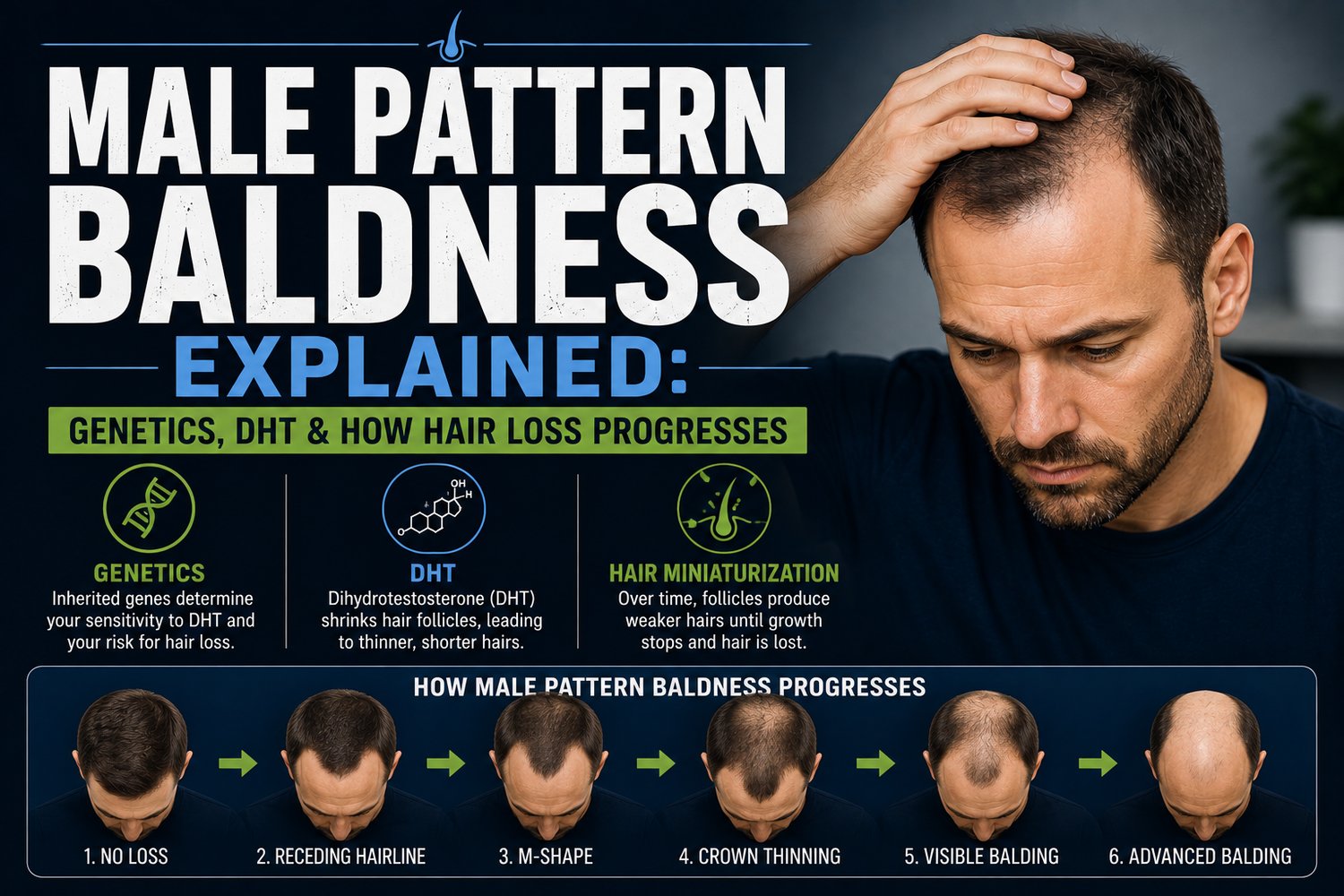
Male Pattern Baldness: Genetics, DHT & How Hair Loss Progresses
For most men who gradually lose hair, the explanation isn't stress, shampoo, hats, creatine, or automatically low or high testosterone.
It's male pattern baldness.
Also called androgenetic alopecia, male pattern baldness is the most common form of hair loss in men.
It usually follows a recognizable pattern:
- Receding temples
- A gradually higher hairline
- Thinning around the crown
- Reduced density across the top of the scalp
- Progressive loss over years
The process is driven by an interaction between:
- Genetics
- Androgen hormones
- Dihydrotestosterone, or DHT
- Sensitivity of individual hair follicles
- Time
The key idea is follicular miniaturization.
Genetically susceptible follicles become progressively smaller and begin producing hairs that are:
- Shorter
- Finer
- Less pigmented
- Less visible
Understanding that mechanism makes the treatment options much easier to understand too.
If you haven't already, start with Why Men Lose Their Hair, which covers male pattern baldness plus other causes such as telogen effluvium, alopecia areata, medication effects, nutritional problems, and scalp disorders.
What Is Male Pattern Baldness?
Male pattern baldness is a hereditary form of progressive hair loss.
Doctors call it androgenetic alopecia because both inherited susceptibility and androgen signaling are involved.
Unlike temporary shedding, the affected follicles don't simply release a hair and then return immediately to normal.
They gradually miniaturize.
Over repeated hair-growth cycles, a follicle that once produced a thick terminal hair may begin producing:
Thick hair
then:
Thinner hair
then:
Very fine hair
and eventually hair that is barely cosmetically visible.
That's why male pattern baldness usually progresses gradually rather than appearing overnight.
What Does Male Pattern Baldness Look Like?
The classic pattern usually appears in one or both of two areas.
Hairline Recession
Hair begins receding above the temples.
Over time, this can create the familiar:
M-shaped hairline.
Crown Thinning
Hair density gradually decreases around the vertex, or crown, toward the back-top portion of the scalp.
Eventually, frontal recession and crown thinning may expand toward one another.
The American Academy of Dermatology describes hereditary male hair loss as a recognizable thinning pattern affecting the hairline, top of the scalp, and/or crown.
Not Every Receding Hairline Means You'll Go Completely Bald
This is important.
Some men develop a slightly higher adult hairline and remain relatively stable for years.
Others continue progressing.
One snapshot doesn't tell you exactly where you'll end up.
Look for the trend.
Ask:
- Is the hairline continuing to move backward?
- Is the crown becoming more visible?
- Is density across the top declining?
- Are the hairs around the temples getting noticeably finer?
- Does the change look different in comparable photos taken months apart?
That's more useful than staring at one corner of your hairline after a questionable haircut.
Genetics Play a Major Role
Male pattern baldness is strongly influenced by genetics.
But the old rule:
“Look at your mother's father.”
is too simplistic.
Relevant genetic susceptibility can come through multiple parts of your family.
Look at:
- Father
- Brothers
- Maternal relatives
- Paternal relatives
- Uncles
- Grandfathers
A strong family history raises suspicion.
It still doesn't perfectly predict:
- When you'll start thinning
- How fast it will progress
- Which areas will be affected first
- How much hair you'll ultimately lose
Two brothers can have substantially different hair despite sharing the same parents.
What Does DHT Have to Do With Baldness?
Dihydrotestosterone, or DHT, is an androgen derived from testosterone.
An enzyme called 5-alpha reductase converts some testosterone into DHT.
DHT has normal physiological roles.
The problem is not that DHT exists.
The problem occurs when specific scalp follicles are genetically susceptible to its effects.
In those follicles, androgen signaling contributes to progressive miniaturization.
That's why the better model is:
Genetic susceptibility + DHT activity + sensitive follicles → progressive male pattern hair loss
not:
High testosterone → bald.
DHT Doesn't Destroy Every Hair Follicle
If DHT caused universal scalp baldness, almost every adult man would lose all his hair.
Obviously, that doesn't happen.
The key variable is follicle sensitivity.
Follicles around the:
- Temples
- Frontal hairline
- Crown
are often more vulnerable in genetically susceptible men.
Follicles around the:
- Sides
- Back of the scalp
tend to be much more resistant.
That difference also explains why hair transplantation can work.
Why Does Hair on the Sides and Back Usually Stay?
Hair-transplant surgeons typically use follicles from more resistant areas around the sides and back of the scalp.
Those follicles are moved into thinning areas.
The transplanted follicles generally retain much of their original biological behavior.
That's why someone can have:
- Significant baldness across the top
- Dense hair around the sides and back
and still have usable donor hair.
A transplant redistributes follicles.
It doesn't change the genetics of the remaining native hair.
Testosterone and DHT Are Not the Same Thing
Testosterone can be converted into DHT.
That doesn't mean blood testosterone alone determines hair loss.
Two men can have similar testosterone levels.
One starts balding at 25.
The other has dense hair at 55.
Their follicles may have very different genetic sensitivity to androgen signaling.
That's why you can't diagnose hormone status by looking at someone's scalp.
For the broader hormone myths, read Testosterone Myths.
Can You Have Low Testosterone and Still Go Bald?
Yes.
Male pattern baldness does not prove testosterone is high.
A man can have:
- Low-normal testosterone
- Average testosterone
- High-normal testosterone
and still develop androgenetic alopecia.
Likewise, a man with relatively high testosterone may retain excellent scalp hair.
Your circulating hormone level and your follicle response are related but separate questions.
Can TRT Accelerate Male Pattern Baldness?
Potentially, in genetically susceptible men.
Testosterone replacement therapy increases testosterone exposure.
Some testosterone can be converted into DHT.
If your scalp follicles are already highly susceptible to androgen-driven miniaturization, increased androgen exposure could potentially accelerate an existing tendency toward hair loss.
That does not mean:
TRT = baldness.
Some men use TRT for years with little noticeable hair loss.
Others see progression.
Genetics remain a major part of the equation.
If you're considering testosterone treatment, read What Is TRT?.
What Is Follicular Miniaturization?
Miniaturization is the process that makes androgenetic alopecia progressive.
Imagine a healthy follicle producing a thick terminal hair.
Over repeated growth cycles, a susceptible follicle produces hairs that become:
- Thinner
- Shorter
- Lighter
- Less cosmetically noticeable
The follicle may still be alive.
It's just producing weaker hair.
That's why early hair loss can sometimes look like:
lower density
rather than:
a completely bald area.
And that's also one reason earlier treatment can matter.
The Hair Growth Cycle Changes
Hair naturally progresses through several phases.
Anagen
Active growth.
Catagen
Transition.
Telogen
Rest.
Exogen
Shedding.
With androgenetic alopecia, affected follicles spend less time producing robust terminal hairs.
Repeated cycles gradually make the miniaturization more obvious.
This is a slow biological process.
Which is why treatment and progress tracking also require patience.
Why Hair Loss Can Feel Sudden
A lot of men say:
“My hair suddenly started disappearing.”
Often, it didn't.
You can lose a meaningful amount of density before it becomes obvious.
Then one day you:
- Stand under harsh overhead lighting
- Get your hair wet
- See a photo from behind
- Cut your hair shorter
- Notice the crown in a mirror
and suddenly the process becomes visible.
That doesn't necessarily mean all the loss happened in the last month.
Male Pattern Baldness Can Start Young
There is no rule that says male pattern baldness begins after 40.
Hereditary hair loss can begin surprisingly early.
For some men, recession or thinning begins in:
- Late teens
- 20s
- 30s
The American Academy of Dermatology notes that hereditary follicle shrinkage can begin as early as the teen years.
Starting younger can be frustrating.
But noticing progression earlier also means you may have more existing hair available to preserve.
Earlier Treatment Can Matter
Male pattern hair-loss treatments generally do better at:
preserving and strengthening follicles that still exist
than:
rebuilding areas that have been completely bald for many years.
AAD specifically emphasizes that early diagnosis and treatment can help prevent further follicle shrinkage and that restoration becomes more limited once follicles are severely miniaturized.
That doesn't mean you need to panic over the first sign of recession.
It means:
If keeping your hair matters, don't ignore obvious progression for ten years and expect medication to rebuild your teenage hairline.
The Norwood Scale
Male pattern hair loss is often described using the Hamilton-Norwood scale.
It categorizes progression from relatively mild recession to extensive loss across the top of the scalp.
You don't need to obsess over whether you're:
Norwood 2.3 vs. Norwood 2.6.
The concept is useful because it helps visualize progression.
Early Male Pattern Baldness
Early signs can include:
- Mild temple recession
- Slight thinning at the frontal hairline
- Small decreases in crown density
- Miniaturized hairs around affected areas
At this stage, styling may hide much of the change.
Moderate Male Pattern Baldness
Progression may include:
- Deeper temple recession
- More obvious crown thinning
- Reduced density across the top
- A narrower bridge of hair separating the frontal region from the crown
This is often when men begin seriously researching treatment.
Advanced Male Pattern Baldness
Eventually, frontal and crown loss may merge.
Hair may remain primarily around:
- Sides
- Back
Medication may still help preserve remaining susceptible hair.
But dramatic regrowth becomes increasingly difficult once advanced bald areas have been present for a long time.
Mature Hairline vs. Male Pattern Baldness
Not every adult hairline change is progressive baldness.
Some men develop a slightly higher, more angular adult hairline and then remain stable.
Male pattern baldness is more likely when you see continuing:
- Recession
- Density loss
- Miniaturization
- Crown thinning
When the distinction isn't clear, a dermatologist can often identify the pattern.
What Is Diffuse Thinning?
Not every man develops dramatic temple recession.
Some men experience more generalized thinning across the top of the scalp.
You may notice:
- More visible scalp
- Less volume
- Difficulty styling
- Thinner density across a broad area
while the frontal hairline remains relatively intact.
That can still be androgenetic alopecia.
The Crown Is Easy to Miss
You don't look directly at the crown every morning.
So crown thinning can progress quietly.
Often someone else notices first.
Or you notice it through:
- Photographs
- Security-camera footage
- Bright overhead light
- A second mirror
Taking occasional photos in:
- Similar lighting
- Similar position
- Similar hairstyle
can be considerably more useful than checking the crown every day.
How Is Male Pattern Baldness Diagnosed?
Diagnosis is often based primarily on:
- Pattern of loss
- Gradual progression
- Family history
- Scalp examination
- Evidence of miniaturization
Additional testing may be appropriate if the pattern is unusual or another cause is suspected.
Not every receding hairline needs:
- Testosterone testing
- Thyroid labs
- Vitamin panels
- A giant bloodwork package
Testing should answer an actual question.
When It Might Not Be Male Pattern Baldness
Consider medical evaluation if hair loss is:
- Sudden
- Patchy
- Painful
- Associated with major inflammation
- Associated with significant scaling
- Scarring
- Affecting eyebrows or beard unexpectedly
- Occurring after major illness
- Appearing after rapid weight loss
Those patterns may suggest something other than straightforward androgenetic alopecia.
Read Why Men Lose Their Hair for the broader differential.
Can Male Pattern Baldness Be Cured?
Not in the sense of:
Take a treatment once → permanently rewrite your genetic susceptibility → never think about your hair again.
Current treatments generally aim to:
- Slow progression
- Preserve existing hair
- Strengthen miniaturized follicles
- Produce partial regrowth
Benefits commonly depend on continued treatment.
That's especially important when thinking about the two major medications:
Minoxidil
and:
Finasteride.
The Two Major Medication Strategies
For male pattern baldness, minoxidil and finasteride dominate the treatment conversation.
AAD lists topical minoxidil and oral finasteride as FDA-approved treatments for male pattern hair loss in men.
They work very differently.
Minoxidil: Support Hair Growth
Topical minoxidil can:
- Reduce hair loss
- Stimulate some regrowth
- Improve existing hair thickness
It doesn't directly target the DHT pathway.
And complete restoration of advanced baldness is unlikely.
Treatment generally needs to continue to preserve its benefits.
Minoxidil can also be prescribed orally.
Oral minoxidil for hair loss is an off-label use.
Strut currently offers prescription oral minoxidil tablets for eligible patients through telehealth. Its current listing describes a 1.25 mg daily option and explicitly identifies hair-loss treatment as off-label.
Explore Strut Oral Minoxidil Tablets →
Because oral minoxidil has systemic effects, it requires clinician evaluation and shouldn't be treated like an over-the-counter hair supplement.
Finasteride: Target the DHT Pathway
Finasteride approaches male pattern baldness more directly at the androgen level.
It inhibits 5-alpha reductase.
That reduces conversion of testosterone into DHT.
Lower DHT exposure helps reduce one of the main signals driving miniaturization in susceptible scalp follicles.
AAD reports that oral finasteride slows further hair loss in approximately 80%–90% of men taking it, with some men also seeing regrowth.
Continued use is generally necessary to maintain benefit.
Exploring a Topical Finasteride Option?
Some men prefer exploring a topical rather than oral prescription strategy.
Strut currently offers a compounded topical finasteride hair-loss formula through telehealth.
Depending on the prescription, the formula may contain:
- Finasteride
- Minoxidil
- Tretinoin
- Fluocinolone
- Biotin
Strut states that the exact combination and strengths are selected by the clinician based on the patient's history and treatment goals.
Topical finasteride for hair loss is an off-label use, unlike FDA-approved oral finasteride for male pattern hair loss.
Explore Strut's Finasteride Hair Loss Formula →
HabitLogics may earn a commission if you purchase through a Strut link, at no additional cost to you.
Minoxidil vs. Finasteride Isn't Simply “Which One Works?”
They address different parts of the problem.
Minoxidil
Primarily supports hair growth and follicle activity.
Finasteride
Reduces the DHT pathway driving progression of male pattern hair loss.
Some men use:
- Minoxidil alone
- Finasteride alone
- Combination treatment
The right approach can depend on:
- Severity
- Pattern of loss
- Goals
- Side-effect tolerance
- Medical history
- Topical vs. oral preference
- Long-term adherence
For the direct comparison, read Minoxidil vs Finasteride.
What About Dutasteride?
Dutasteride is another 5-alpha-reductase inhibitor.
It suppresses DHT more extensively because it inhibits multiple forms of the enzyme.
In the United States, its use for hair loss is generally off-label.
It may be discussed in selected cases, but it isn't necessary to turn every first-line hair-loss conversation into:
Finasteride vs. dutasteride vs. seventeen other things.
Start with the established treatment framework.
Does Finasteride Lower Testosterone?
Finasteride does not simply “remove testosterone.”
It reduces conversion of testosterone into DHT.
That distinction matters.
Testosterone ≠ DHT.
They're related androgens.
They aren't identical hormones with identical effects.
The hair-loss benefit comes primarily from reducing the DHT pathway affecting susceptible follicles.
What About Finasteride Side Effects?
Potential adverse effects can include sexual side effects such as:
- Reduced libido
- Erectile difficulties
- Ejaculatory changes
Not every man experiences them.
And internet discussions often swing between two equally unhelpful extremes:
“Finasteride is completely harmless.”
and:
“Finasteride will permanently destroy every man's sexual function.”
Prescription medication deserves a more balanced discussion.
The decision should consider:
- Potential benefit
- Potential side effects
- Hair-loss severity
- How strongly you want to preserve hair
- Personal medical history
We'll address those tradeoffs directly in Minoxidil vs Finasteride.
What About Minoxidil Side Effects?
Topical minoxidil can cause problems such as:
- Scalp irritation
- Itching
- Unwanted hair growth on nearby skin
Some users notice temporary increased shedding after starting treatment.
That can happen as follicle cycles change and doesn't automatically mean treatment is making the hair loss worse.
Oral minoxidil has different systemic considerations because it is a cardiovascular medication.
That's why the oral version requires prescription screening.
Hair Transplants
Hair transplantation redistributes existing follicles.
For appropriate candidates with adequate donor hair, it can produce substantial cosmetic improvement.
But a transplant does not stop the genetic process affecting surrounding native hair.
That means someone can transplant the front successfully while continuing to lose untreated hair behind it.
Medical stabilization may therefore still be part of the long-term plan.
What About PRP?
Platelet-rich plasma involves injecting concentrated components from your own blood into the scalp.
Some studies suggest improvements in:
- Hair density
- Hair thickness
for some patients.
But:
- Protocols vary
- Cost can be high
- Repeated sessions may be needed
- Results are inconsistent
Think of PRP as a possible adjunct.
Not something every man with mild recession needs immediately.
What About Microneedling?
Microneedling creates controlled micro-injuries in the scalp.
It has been studied:
- Alone
- Alongside minoxidil
The evidence is interesting.
It still doesn't have the same established role as minoxidil and finasteride.
Technique and hygiene matter too.
Your scalp does not become more responsive just because you attack it more aggressively.
What About DHT-Blocking Shampoo?
This category is marketed very aggressively because:
“Wash your hair and block baldness”
sounds fantastic.
Shampoo can certainly help with:
- Scalp cleanliness
- Dandruff
- Hair appearance
- Certain scalp conditions
But don't assume a “DHT-blocking” shampoo produces the same pharmacologic effect as prescription finasteride.
That's a much bigger claim.
What About Biotin?
Biotin deficiency can cause hair problems.
Actual deficiency is uncommon.
Taking huge doses of biotin when you're not deficient has not been shown to reverse ordinary male pattern baldness.
High-dose biotin can also interfere with certain laboratory tests.
Correct deficiencies when they exist.
Don't turn every nutrient into a baldness medication.
How Long Does Treatment Take?
Hair moves slowly.
Meaningful changes generally require months, not days.
AAD notes that minoxidil may require roughly six to twelve months to assess full results in some men.
Strut likewise advises that its current topical finasteride-based formula may take roughly 2–4 months before early effects and 6–12 months for fuller results.
Use:
- Baseline photos
- Similar lighting
- Similar hairstyle
- Similar camera angle
and compare over months.
Not every Monday morning.
Consistency Matters
Both minoxidil and finasteride generally require continued treatment.
That's an important tradeoff.
Before starting, ask:
- Am I comfortable using this long term?
- Can I afford it consistently?
- Do I prefer topical or oral treatment?
- How much does maintaining my hair matter to me?
- Am I comfortable with the potential adverse effects?
There's no universally correct answer.
Exploring Online Men's Hair-Loss Treatment?
If your hair loss follows a typical male pattern and you're ready to discuss treatment, Strut offers telehealth evaluation for multiple men's hair-loss options.
Explore Strut Men's Hair Loss Options →
Their current lineup includes prescription and compounded treatment options such as topical finasteride-based formulas and oral minoxidil.
HabitLogics may earn a commission if you purchase through a Strut link, at no additional cost to you.
What If You Don't Want Treatment?
Then don't treat it.
Male pattern baldness itself isn't medically dangerous.
You can:
- Let it progress
- Change your hairstyle
- Cut it shorter
- Shave your head
Some men feel dramatically better when they stop fighting the hairline.
Others strongly prefer maintaining their hair.
Both are legitimate choices.
Treatment is largely about:
- Appearance
- Confidence
- Quality of life
- Personal preference
Treatment Should Match How Much You Care
If your reaction to thinning is:
“Whatever.”
lifelong medication may not be worth it to you.
If your reaction is:
“This bothers me a lot and I want to preserve as much as possible.”
then earlier evidence-based treatment becomes more attractive.
Neither reaction is wrong.
It's your hair.
Frequently Asked Questions
What Causes Male Pattern Baldness?
Male pattern baldness results from genetic susceptibility interacting with androgen activity—particularly DHT—at sensitive scalp follicles.
Those follicles progressively miniaturize and produce thinner, shorter hair.
Is Male Pattern Baldness Inherited From Your Mother?
Not exclusively.
Male pattern baldness has a complex genetic basis and can reflect family history from both sides.
Does High Testosterone Cause Male Pattern Baldness?
Not by itself.
Hair-follicle sensitivity to androgen signaling is a major factor.
Men with similar testosterone levels can have dramatically different hair.
Can Male Pattern Baldness Start in Your 20s?
Yes.
Hereditary hair loss can begin after puberty and may become noticeable in the teens or early adulthood.
Can Male Pattern Baldness Grow Back?
Some miniaturized follicles can produce thicker hair with treatment.
Treatment is generally more effective earlier.
Completely restoring advanced baldness with medication alone is unlikely.
Does Minoxidil Work?
It can.
Topical minoxidil is FDA approved for male pattern hair loss and can reduce shedding, stimulate some growth, and strengthen existing hair in some men.
Continued treatment is needed to maintain benefits.
Does Finasteride Work?
Yes, for many men.
AAD reports that oral finasteride slows further hair loss in approximately 80%–90% of men who use it.
Is Topical Finasteride FDA Approved?
Not as a standard FDA-approved hair-loss product in the way oral finasteride is.
Topical compounded finasteride preparations are used off-label.
Strut's current topical finasteride formula is one such compounded prescription option.
Is Oral Minoxidil FDA Approved for Hair Loss?
No.
Oral minoxidil is FDA approved as a blood-pressure medication and is prescribed off-label at lower doses for hair loss.
Strut currently offers oral minoxidil through clinician-supervised telehealth care.
Is Finasteride Better Than Minoxidil?
They work differently.
Finasteride reduces the DHT pathway driving male pattern hair-loss progression.
Minoxidil supports hair growth.
The best strategy depends on the patient and may involve one or both.
Read Minoxidil vs Finasteride.
Key Takeaways
- Male pattern baldness is androgenetic alopecia, the most common form of hair loss in men.
- Genetics and sensitivity to DHT are central to the process.
- Testosterone level alone does not determine whether you will go bald.
- Susceptible follicles progressively miniaturize and produce thinner, shorter hair.
- The temples, frontal hairline, and crown are commonly affected.
- Hair around the sides and back tends to be more resistant.
- Earlier treatment can provide more opportunity to preserve existing hair.
- Topical minoxidil and oral finasteride are FDA-approved treatments for male pattern hair loss in men.
- Topical compounded finasteride and oral minoxidil are additional off-label options used in clinical practice.
- Minoxidil and finasteride work through different mechanisms and may be used alone or together.
- Treatment generally needs to continue to maintain benefits.
- The decision to treat male pattern baldness is ultimately personal.
Final Thoughts
Male pattern baldness isn't your scalp suddenly running out of hair.
It's a gradual process.
Genetically susceptible follicles respond to androgen signaling—especially DHT—and become progressively smaller.
The hairs get finer.
Growth cycles become less productive.
Density drops.
Eventually, what once looked like a full hairline becomes noticeably thin.
That mechanism explains why treatment works the way it does.
Finasteride targets the DHT pathway.
Minoxidil supports hair growth.
Neither rewrites your genetics.
Neither is magic.
But if keeping your hair matters to you, identifying the process early gives you more opportunity to preserve what you still have.
Continue the Men's Hair Loss Series
Start with the broader causes:
Compare the two major treatment strategies:
Review the broader treatment landscape:
Best Hair Loss Treatments for Men →
If you're ready to explore treatment:
Explore Strut Men's Hair Loss Options →
Medication-specific options:
For the testosterone connection:
For the full men's-health pillar:
Affiliate Disclosure
Some links in this article are affiliate links. If you use one of these links and purchase treatment, HabitLogics may earn a commission at no additional cost to you. Affiliate relationships do not determine whether a treatment is medically appropriate.
Educational Disclaimer
This article is intended for educational purposes only and should not be considered medical advice. Male pattern baldness should be distinguished from other causes of hair loss before treatment. Prescription hair-loss medications can cause side effects and may not be appropriate for everyone. Oral minoxidil and topical compounded finasteride are off-label hair-loss treatments and should be used only under appropriate clinician supervision. Sudden, patchy, painful, scarring, or otherwise unusual hair loss should be evaluated by a qualified healthcare professional or dermatologist.