

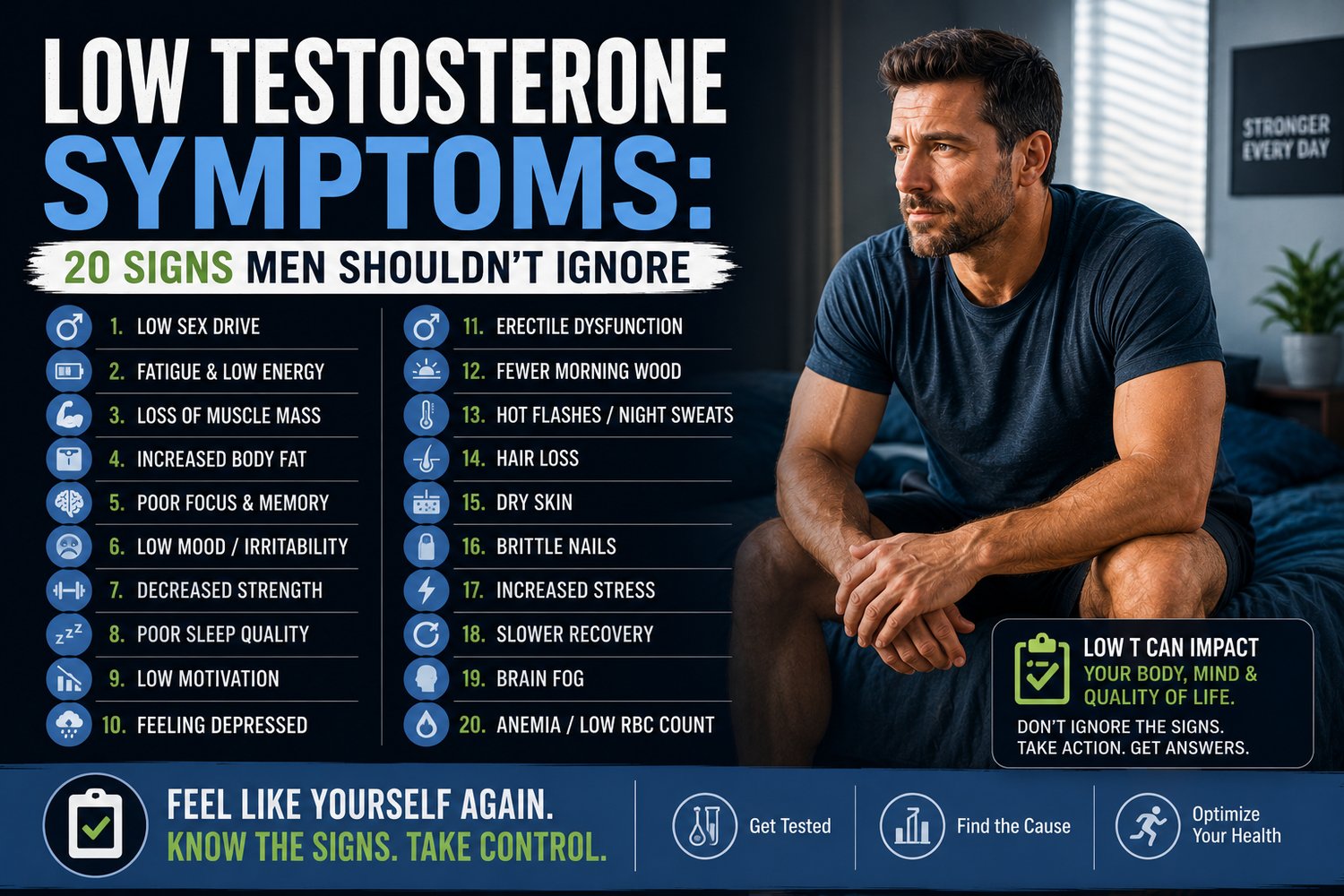
Low Testosterone Symptoms: 20 Signs Men Shouldn't Ignore
Low testosterone symptoms in men can include reduced sex drive, fewer spontaneous erections, erectile dysfunction, low energy, reduced muscle mass, infertility, mood changes, and loss of bone density. But many symptoms associated with low testosterone can also be caused by poor sleep, stress, medications, obesity, depression, chronic illness, and other health problems.
That's why symptoms alone can't diagnose low testosterone.
Low testosterone—also called testosterone deficiency or male hypogonadism—is generally diagnosed when a man has compatible symptoms or signs and consistently low testosterone measurements confirmed with appropriate testing.
That's an important distinction.
Low energy?
Less motivation?
Weight gain?
Poor workouts?
Lower sex drive?
Spend enough time looking at men's-health content online and you'll eventually be told all five mean the same thing:
Your testosterone is low.
Maybe.
But maybe not.
This guide covers 20 possible symptoms of low testosterone, which signs may be more informative, what else can mimic low T, and when testosterone testing may make sense.
Exploring Online TRT?
If you already have symptoms and lab results that have you considering testosterone treatment, you can compare online TRT options, provider features, lab requirements, treatment options, and other factors worth considering before signing up.
HabitLogics may earn a commission if you purchase through links on our TRT provider page, at no additional cost to you.
What Is Low Testosterone?
Testosterone is produced primarily by the testes under the direction of hormonal signals originating in the brain.
It plays important roles in:
- Sexual function
- Sperm production
- Muscle mass
- Bone health
- Red blood cell production
- Male physical characteristics
- Reproductive function
Male hypogonadism occurs when the body doesn't produce enough testosterone, enough sperm, or both.
There are two broad categories.
Primary Hypogonadism
Primary hypogonadism involves a problem originating primarily in the testes.
Secondary Hypogonadism
Secondary hypogonadism involves the hypothalamus or pituitary gland—the parts of the brain responsible for signaling the testes to produce testosterone.
That distinction matters because:
Low testosterone is a laboratory finding. Why testosterone is low is another question entirely.
Read What Causes Low Testosterone? Common Medical, Lifestyle & Age-Related Reasons for a deeper look at potential causes.
What Testosterone Level Is Considered Low?
Online discussions often make this more straightforward than it really is.
You'll frequently see 300 ng/dL presented as an absolute line separating normal testosterone from low testosterone.
Clinical diagnosis is more nuanced.
A threshold around 300 ng/dL is commonly used in clinical practice, but laboratory reference ranges and testing methods can vary. Testosterone results also need to be interpreted alongside symptoms, medical history, and repeat measurements.
In other words:
299 ng/dL doesn't automatically mean you're sick.
And:
301 ng/dL doesn't automatically mean everything is fine.
Professional guidance emphasizes diagnosing hypogonadism using compatible symptoms or signs together with consistently low, accurately measured testosterone levels.
If a result is low, confirmation with another appropriately timed measurement is generally important.
For the complete testing process, read How Testosterone Is Tested and Diagnosed.
20 Possible Symptoms of Low Testosterone
Not every man with testosterone deficiency experiences every symptom.
And not every symptom on this list carries the same diagnostic weight.
Some are relatively characteristic of testosterone deficiency, while others overlap with dozens of unrelated conditions.
Think of symptoms as clues, not a diagnosis.
1. Reduced Sex Drive
A persistent decline in libido is one of the more recognizable symptoms associated with testosterone deficiency.
That doesn't mean every fluctuation in sexual interest is hormonal.
Sex drive naturally varies and can also be influenced by:
- Stress
- Sleep
- Depression
- Relationship factors
- Medications
- Chronic illness
- Other hormonal problems
But a persistent, unexplained decline in libido—particularly when combined with other symptoms—can be a reasonable reason to discuss testosterone testing with a healthcare professional.
2. Erectile Dysfunction
Low testosterone can contribute to erectile dysfunction, but erections depend on much more than testosterone.
ED can also be associated with:
- Cardiovascular disease
- Diabetes
- High blood pressure
- Medications
- Nerve problems
- Psychological factors
- Alcohol
- Other medical conditions
Low testosterone is therefore one possible cause of ED, not the cause.
Persistent erectile problems deserve proper evaluation rather than automatically assuming testosterone replacement therapy is the answer.
For a deeper look, read Erectile Dysfunction: Causes, Treatment & When to Get Help.
3. Fewer Spontaneous or Morning Erections
A persistent reduction in spontaneous or morning erections can sometimes accompany testosterone deficiency.
Morning erections are influenced by hormones, sleep physiology, blood flow, nerve function, medications, age, and overall health.
So losing the occasional morning erection doesn't diagnose low testosterone.
But a persistent change—especially when it occurs alongside reduced libido or other sexual symptoms—can provide useful clinical information.
We cover this symptom in more depth in Morning Erections: What They Mean for Men's Health.
4. Low Energy or Persistent Fatigue
Fatigue is probably one of the most aggressively marketed symptoms of low testosterone.
Yes, low energy can occur with hypogonadism.
But fatigue is extremely nonspecific.
It can also result from:
- Insufficient sleep
- Obstructive sleep apnea
- Anemia
- Thyroid disorders
- Depression
- Chronic stress
- Nutritional deficiencies
- Certain medications
- Chronic illness
Don't let an advertisement turn:
“I'm tired”
into:
“I need testosterone.”
Persistent unexplained fatigue deserves investigation, but testosterone is only one possible piece of that investigation.
5. Reduced Muscle Mass
Testosterone contributes to maintaining muscle tissue.
Men with testosterone deficiency can experience reductions in lean body mass.
But if you're worried about losing muscle, first look at the entire picture.
Ask yourself:
- Am I resistance training consistently?
- Am I eating enough protein?
- Am I eating enough overall?
- Am I sleeping adequately?
- Am I progressively challenging my muscles?
- Have I recently lost significant body weight?
Low testosterone can contribute to muscle loss, but so can inadequate training and nutrition.
Read Strength Training for Men Over 30 and Protein for Men: How Much Do You Really Need? for the lifestyle side of the equation.
6. Reduced Strength
Muscle mass and strength aren't identical, but they often influence each other.
An unexplained decline in strength can occur alongside hormonal problems.
However, strength also declines when you:
- Stop training
- Lose significant body weight
- Eat too little
- Recover poorly
- Become less active
- Get injured
- Age without maintaining resistance training
One bad workout isn't evidence of low testosterone.
Look for persistent trends.
7. Increased Body Fat
Changes in body composition can occur with testosterone deficiency.
But this relationship goes both directions.
Excess body fat—particularly obesity—can itself be associated with lower testosterone levels.
Body composition is also affected by:
- Calorie intake
- Physical activity
- Sleep
- Age
- Medications
- Metabolic health
- Genetics
So:
Belly fat doesn't diagnose low testosterone.
For the broader body-composition issue, read Why Belly Fat Gets Harder to Lose After 30.
8. Reduced Facial or Body Hair
Adult men with hypogonadism may experience reduced facial or body-hair growth.
The important word is change.
Genetics play a major role in how much facial and body hair men naturally grow.
Having less beard growth than another man doesn't mean your testosterone is low.
A noticeable change from your own normal pattern may be more relevant.
9. Gynecomastia
Gynecomastia means enlargement of male breast tissue.
Hormonal changes can contribute to gynecomastia, but there are many potential causes.
A new breast lump, breast enlargement, pain, nipple changes, or other unexplained breast symptoms deserve appropriate medical evaluation rather than self-diagnosis.
10. Infertility
Testosterone is part of the male reproductive system, and hypogonadism can affect fertility.
This becomes especially important once treatment enters the conversation.
External testosterone can suppress sperm production.
That means men who are trying to conceive—or may want children in the future—should discuss fertility goals before beginning TRT.
Don't casually start testosterone because an online clinic tells you your level could be “optimized” without understanding the reproductive implications.
11. Low Mood
Some men with hypogonadism experience mood changes, including depressive symptoms.
But depression isn't synonymous with low testosterone.
Mood changes can have many causes and deserve to be evaluated on their own merits.
If your mood has changed significantly, don't postpone appropriate care while assuming hormones must be responsible.
12. Difficulty Concentrating
Some men with testosterone deficiency report difficulty concentrating or other cognitive complaints.
You've probably seen this marketed as:
“Low-T brain fog.”
Be careful with that label.
Poor concentration can also result from:
- Sleep deprivation
- Stress
- Depression
- Anxiety
- Medications
- Alcohol
- Chronic illness
- Numerous other health problems
Symptoms provide clues.
They don't provide a diagnosis.
13. Irritability or Mood Changes
Hormonal problems can sometimes contribute to emotional or mood changes.
But mood is influenced by almost everything.
Before assuming testosterone is responsible, consider:
- Sleep
- Stress
- Work
- Relationships
- Alcohol
- Mental health
- Medications
- Other health problems
Testosterone can be part of the picture without being the entire picture.
14. Reduced Motivation
This symptom appears constantly in testosterone marketing.
“Don't feel driven anymore? Low T.”
That's far too simplistic.
Motivation can decline because you're:
- Burned out
- Depressed
- Chronically stressed
- Sleeping poorly
- Overworked
- Dealing with unrelated life problems
- Experiencing another health condition
Reduced motivation may add context when it appears alongside more specific symptoms.
By itself, it's weak evidence of testosterone deficiency.
15. Loss of Bone Density
This symptom is less obvious but medically important.
Long-standing testosterone deficiency can contribute to reduced bone mass and osteoporosis.
Unlike libido or energy, you can't necessarily feel bone density declining.
That's one reason legitimate hypogonadism shouldn't be dismissed as merely an aesthetic or sexual problem.
Testosterone influences broader physiological systems.
16. Hot Flashes
Men can experience hot flashes.
Severe testosterone deficiency can sometimes produce hot flashes or similar symptoms.
It's not usually the first symptom men associate with low testosterone, but it can occur—particularly in situations involving significant androgen deficiency.
17. Changes in Testicular Size
Changes in testicular size can sometimes accompany conditions affecting testosterone production.
A healthcare professional evaluating suspected hypogonadism may examine the testes as part of a broader physical evaluation.
Don't attempt to diagnose testosterone deficiency based on appearance or testicular size alone.
18. Reduced Exercise Performance
Low testosterone can potentially contribute to changes in muscle, recovery, and energy.
But poor exercise performance is another highly nonspecific symptom.
Before assuming hormones, examine:
- Training consistency
- Programming
- Sleep
- Protein intake
- Total calories
- Hydration
- Stress
- Recovery
Read Sleep for Men and Strength Training for Men Over 30 if those foundations need work.
Build the foundation before blaming the hormone.
19. Persistent Fatigue Despite Improving Your Habits
This is different from simply feeling tired after sleeping five hours.
Suppose you've already:
- Improved your sleep
- Started exercising regularly
- Improved your diet
- Reduced excessive alcohol
- Worked on stress management
and you're still experiencing persistent fatigue alongside other symptoms potentially associated with testosterone deficiency.
At that point, further evaluation becomes more reasonable.
That still doesn't prove testosterone is the cause.
It means persistent unexplained symptoms deserve investigation.
20. A Pattern of Sexual, Physical and Other Symptoms
This may be the most important item on the entire list.
Testosterone deficiency becomes more clinically meaningful when there is a pattern of compatible symptoms, rather than one vague complaint.
For example, a man experiencing:
- Persistent low libido
- Fewer spontaneous erections
- Loss of muscle mass
- Other compatible symptoms
- Repeatedly low testosterone measurements
presents a very different picture from:
“I'm tired on Mondays.”
Diagnosis is based on the combination of appropriate symptoms or signs, laboratory findings, and clinical evaluation.
Which Low Testosterone Symptoms Are Most Useful?
Not every symptom carries equal diagnostic value.
Sexual symptoms such as:
- Reduced libido
- Fewer spontaneous erections
- Erectile changes
may be more informative than vague symptoms such as:
- Fatigue
- Poor motivation
- Difficulty concentrating
That doesn't mean fatigue or concentration problems aren't real.
It means they overlap with far more conditions.
A healthcare professional should evaluate the entire symptom pattern rather than counting boxes on a checklist.
Low Testosterone Symptoms vs. Normal Aging
Testosterone levels generally change as men age.
But aging also changes:
- Sleep
- Body composition
- Recovery
- Physical activity
- Muscle mass
- Sexual function
- Medication use
- Chronic disease risk
Those overlapping changes make it easy to attribute every difference after age 30 or 40 to testosterone.
Getting older doesn't automatically mean you need TRT.
And having a lower testosterone level than you had when you were 22 doesn't automatically mean you have hypogonadism.
The question isn't whether your testosterone has changed with age.
The question is whether you have a clinically meaningful testosterone deficiency that has been properly evaluated.
What Else Can Look Like Low Testosterone?
Many health and lifestyle problems can mimic portions of the low-testosterone symptom profile.
That's why going directly from symptoms to treatment is a bad diagnostic shortcut.
Poor Sleep
Poor sleep can contribute to:
- Fatigue
- Low motivation
- Poor concentration
- Worse workouts
- Mood changes
- Changes in sexual function
Sound familiar?
Start with Sleep for Men: Why Better Sleep Matters for Testosterone, Recovery & Health.
Sleep Apnea
Obstructive sleep apnea deserves particular attention.
It can cause severe daytime fatigue, impaired concentration, poor sleep quality, and other symptoms that can easily be mistaken for a hormone problem.
If you're:
- Snoring loudly
- Gasping during sleep
- Appearing to stop breathing at night
- Waking exhausted despite enough time in bed
don't simply order testosterone.
Talk with a healthcare professional about your sleep.
Obesity
Obesity is associated with lower testosterone levels in many men.
That creates a complicated relationship because testosterone deficiency can affect body composition while excess body fat can also influence hormone levels.
Lifestyle and metabolic health therefore remain important even when testosterone is being investigated.
Regular movement is one useful foundation. See Walking for Men's Health.
Medications
Certain medications can affect testosterone production or create symptoms that resemble low testosterone.
These can include some opioid medications and other drugs that influence hormonal function.
Never stop a prescribed medication because you think it's affecting testosterone.
Discuss your concerns with the healthcare professional managing that medication.
Acute or Severe Illness
Testosterone isn't a perfectly static number.
Illness and other physiological stressors can temporarily influence testosterone levels.
That's one reason the circumstances surrounding a blood test matter.
Poor Nutrition or Extreme Training
Severe calorie restriction, inadequate nutrition, or extreme amounts of exercise can affect reproductive hormones.
If you're dieting aggressively or training far beyond your ability to recover, a low result needs to be interpreted in that context.
Depression and Chronic Stress
Fatigue, low motivation, concentration problems, reduced libido, and sleep disturbances can also occur with depression and chronic stress.
Don't reduce every mental or emotional symptom to hormones.
Sometimes the appropriate treatment has nothing to do with testosterone.
Should You Get Your Testosterone Tested?
Testing becomes more reasonable when you have persistent symptoms or signs compatible with testosterone deficiency.
The process shouldn't be:
I'm tired → order TRT.
It should look more like:
Persistent symptoms → appropriate evaluation → testosterone testing → confirmation if low → investigate why → discuss treatment if indicated.
That's a much safer and more useful sequence.
Testosterone Testing Usually Requires More Than One Measurement
One low testosterone result generally shouldn't establish the diagnosis by itself.
Professional guidance recommends confirming low testosterone with repeat testing under appropriate conditions.
Why?
Because testosterone levels fluctuate.
Testing conditions matter.
Laboratory methods matter.
Your health at the time of testing matters.
Confirmation reduces the risk of treating a misleading or temporary result.
Read How Testosterone Is Tested and Diagnosed: A Practical Guide for Men for the complete process.
Why Morning Testosterone Testing Matters
Testosterone follows a daily rhythm and is generally highest earlier in the day, particularly in younger men.
That's why early-morning testing is commonly used when evaluating suspected testosterone deficiency.
Your healthcare professional may recommend specific timing or testing conditions based on your age, schedule, symptoms, and individual circumstances.
What About At-Home Testosterone Tests?
Some men prefer to begin with a convenient at-home test.
The Everlywell Testosterone Test provides one at-home testing option.
You can also visit the HabitLogics Men's Bloodwork Hub for additional bloodwork resources.
An at-home test can provide information.
It shouldn't be treated as a DIY diagnosis of hypogonadism or a reason to start testosterone on your own.
Abnormal results and persistent symptoms deserve appropriate medical follow-up.
Don't Just Test—Track
A laboratory result becomes more useful when you can see it in context.
Useful information might include:
- Previous testosterone results
- Weight
- Waist circumference
- Sleep
- Blood pressure
- Energy
- Symptoms
- Medications
- Other relevant laboratory markers
The Men's Bloodwork Dashboard is designed to help organize testosterone, metabolic markers, lipids, body composition, recovery, and other health data over time.
If you want a simpler starting point, download the FREE Men's Hormone & Energy Starter Kit.
What Happens If Your Testosterone Is Low?
Don't immediately jump from a low result to treatment.
The next question is:
Why is it low?
Clinicians may use additional testing to distinguish between problems originating primarily in the testes and those involving the pituitary or hypothalamus.
That can include measurements such as:
- LH
- FSH
- Additional hormone tests when appropriate
- Other testing based on symptoms and medical history
Certain situations may require additional investigation, imaging, fertility evaluation, or specialist care.
Read What Causes Low Testosterone? and How Testosterone Is Tested and Diagnosed for the next steps.
Low Testosterone Doesn't Automatically Mean TRT
Even confirmed low testosterone doesn't mean you should immediately order injections.
Treatment depends on factors such as:
- Why testosterone is low
- Your symptoms
- Fertility goals
- Medical history
- Potential contraindications
- Risks and benefits
- Patient preferences
TRT can be appropriate for men with properly diagnosed hypogonadism.
But it's prescription medical treatment—not a general men's wellness supplement.
If treatment is being considered, read What Is TRT? Testosterone Replacement Therapy Explained for the benefits, risks, fertility implications, treatment forms, and monitoring involved.
Fertility Matters Before TRT
This deserves repeating.
External testosterone can suppress the hormonal signals involved in sperm production.
If you want children now or may want them in the future, tell your healthcare professional before starting testosterone therapy.
Don't discover the fertility issue after treatment has already begun.
Can You Raise Testosterone Naturally?
Sometimes addressing an underlying reversible factor can improve testosterone levels.
Depending on the individual, important areas can include:
- Losing excess body fat
- Improving sleep
- Treating sleep apnea
- Resistance training
- Avoiding severe calorie restriction
- Improving overall metabolic health
But “natural testosterone support” isn't the same thing as treating every form of hypogonadism.
Lifestyle changes can't necessarily reverse testicular damage, pituitary disease, genetic conditions, or other established medical causes of testosterone deficiency.
Read How to Support Testosterone Naturally for a realistic look at what lifestyle can—and can't—do.
Build the Men's Health Foundation Either Way
Whether your testosterone is normal, borderline, low, or being medically treated, basic health habits still matter.
That includes:
- Adequate sleep
- Resistance training
- Regular walking
- Nutritious food
- Adequate protein
- Healthy body composition
- Stress management
- Appropriate preventive healthcare
Start with Healthy Habits Every Man Should Build Before Buying Supplements if that foundation isn't already in place.
The Testosterone Lifestyle Guide can also help organize sleep, nutrition, strength training, stress, and recovery without pretending lifestyle alone can treat every case of clinical hypogonadism.
Frequently Asked Questions
What are the symptoms of low testosterone in men?
Possible low testosterone symptoms include reduced libido, fewer spontaneous erections, erectile dysfunction, low energy, reduced muscle mass, reduced strength, infertility, mood changes, reduced facial or body hair, gynecomastia, and reduced bone density.
No individual symptom proves testosterone is low.
What are the first signs of low testosterone?
There isn't one universal first symptom.
Persistent sexual symptoms such as reduced libido or fewer spontaneous erections can be more suggestive of testosterone deficiency than nonspecific complaints such as fatigue or poor motivation.
Testing is required to determine whether testosterone is actually low.
Can you have low testosterone without symptoms?
A man can have a laboratory result below a reference range without obvious symptoms.
However, clinical diagnosis of hypogonadism generally requires compatible symptoms or signs together with consistently low testosterone measurements.
Is fatigue a symptom of low testosterone?
It can be.
But fatigue has many possible causes, including inadequate sleep, sleep disorders, depression, medications, nutritional problems, chronic illness, and other medical conditions.
Fatigue alone doesn't diagnose testosterone deficiency.
Does low testosterone cause erectile dysfunction?
Low testosterone can contribute to erectile dysfunction, but ED has numerous potential causes.
Persistent erectile problems should be evaluated rather than automatically attributed to testosterone.
Can low testosterone cause muscle loss?
Reduced muscle mass can occur with male hypogonadism.
However, inactivity, inadequate protein, calorie restriction, weight loss, aging, illness, and other factors can also contribute to muscle loss.
Does low testosterone cause weight gain or belly fat?
Testosterone deficiency can influence body composition, but belly fat and weight gain have many possible causes.
The relationship also works in the opposite direction: obesity itself can contribute to lower testosterone levels in some men.
What testosterone level is considered low?
A total testosterone level around 300 ng/dL is a commonly used clinical threshold, but diagnosis shouldn't be based on one number.
Reference ranges and testing methods vary, and testosterone results should be interpreted alongside symptoms and repeat measurements.
Can I diagnose low testosterone with an at-home test?
No.
An at-home testosterone test can provide information, but diagnosing hypogonadism requires appropriate clinical evaluation and confirmation.
If your result is low or you're experiencing persistent symptoms, discuss the result with a qualified healthcare professional.
Do low testosterone symptoms mean I need TRT?
No.
Symptoms don't establish the diagnosis, and even confirmed testosterone deficiency doesn't automatically determine the best treatment.
The cause of low testosterone, fertility goals, medical history, risks, and individual circumstances all matter.
Key Takeaways
- Low testosterone symptoms can include reduced libido, fewer spontaneous erections, erectile dysfunction, low energy, reduced muscle mass, infertility, mood changes, reduced body hair, and loss of bone density.
- Many low-T symptoms overlap with poor sleep, sleep apnea, obesity, depression, medications, stress, illness, and other health conditions.
- Symptoms alone can't diagnose testosterone deficiency.
- One low testosterone measurement generally isn't enough either.
- Diagnosis requires appropriate symptoms or signs plus consistently low testosterone levels confirmed with appropriate testing.
- Sexual symptoms may be more informative than vague complaints such as fatigue or poor motivation.
- If testosterone is genuinely low, determining why it's low matters.
- TRT can be appropriate for diagnosed hypogonadism, but it isn't automatically the next step after one low result.
- Fertility goals should be discussed before testosterone treatment.
Final Thoughts
Low testosterone is real.
So is low-testosterone marketing.
Don't confuse the two.
If you've experienced persistent changes in libido, spontaneous erections, sexual function, energy, muscle, or other compatible symptoms, they're worth taking seriously.
But don't diagnose yourself from a symptom checklist.
And don't let an advertisement diagnose you either.
Pay attention to patterns.
Address obvious health problems.
Test when testing makes sense.
Confirm unexpectedly low results.
Determine why testosterone is low.
Then decide what treatment—if any—makes sense with a qualified healthcare professional.
That's a stronger men's-health strategy than chasing a testosterone number because someone online told you every man needs “optimal T.”
Continue the Testosterone Series
Next, understand why testosterone can become low:
What Causes Low Testosterone? Common Medical, Lifestyle & Age-Related Reasons →
Then learn how low testosterone is actually confirmed:
How Testosterone Is Tested and Diagnosed: A Practical Guide for Men →
And if you're already researching treatment:
What Is TRT? Testosterone Replacement Therapy Explained →
For broader men's health, visit the Complete Men's Wellness Guide.
Affiliate Disclosure
Some links in this article are affiliate links. If you make a purchase through one of these links, HabitLogics may earn a commission at no additional cost to you. Recommendations are included only where they naturally fit the topic.
Educational Disclaimer
This article is intended for educational purposes only and should not be considered medical advice. Symptoms associated with testosterone deficiency can have many possible causes. Testosterone results should be interpreted in the context of symptoms, repeat testing, medical history, and appropriate clinical evaluation. Consult a qualified healthcare professional for individualized diagnosis or treatment.