

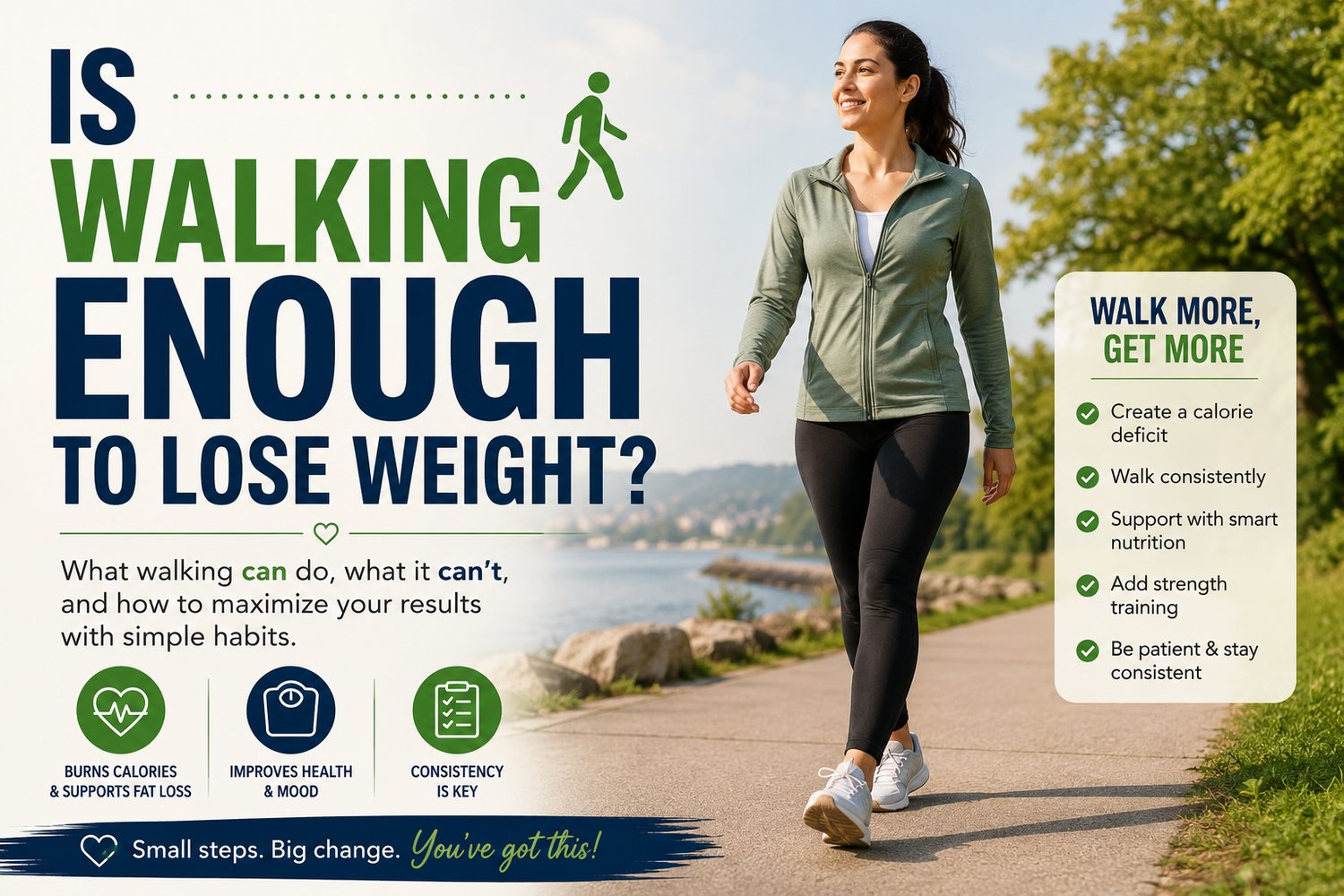
Is Walking Enough to Lose Weight?
Walking is one of the simplest ways to become more active.
You don't need a gym membership. You don't need complicated equipment. And unlike exercise programs that require substantial recovery, walking can often fit into your routine nearly every day.
But if your main goal is weight loss, there's an important question:
Is walking actually enough to lose weight?
The short answer
Walking can absolutely contribute to weight loss—but walking by itself doesn't guarantee it.
Walking increases the amount of energy you use, but weight loss ultimately requires your body to use more energy than you consume over time.
The CDC explains that physical activity increases calorie expenditure, while eating patterns also play a major role in creating the calorie deficit needed for weight loss.
That doesn't make walking ineffective.
Quite the opposite.
Walking can be an excellent foundation for weight loss because it's accessible, repeatable, and relatively easy to build into everyday life.
The real question isn't simply:
Does walking burn calories?
It does.
A better question is:
Can you build enough walking—and the habits around it—to produce results you can maintain?
Free Walking Weight Loss Starter Kit
Want a simple way to put this into practice?
The free HabitLogics Walking Weight Loss Starter Kit includes a progressive 30-day walking plan, step tracker, walking pace guide, and habit calendar.
Download the Free Walking Starter Kit
Why Walking Can Help With Weight Loss
Walking increases your daily energy expenditure.
The faster, farther, or longer you walk, the more energy you'll generally use. Your body weight, terrain, fitness level, and other factors also affect how much energy a particular walk requires.
But calorie burn isn't the only reason walking can be useful.
Regular physical activity is associated with benefits including improved cardiovascular health, sleep, blood pressure, mood, and reduced risk of several chronic diseases, according to the CDC's overview of physical activity benefits.
Walking can also replace time you would otherwise spend sitting.
And importantly:
It's something many people can realistically repeat.
A workout that burns a large number of calories but leaves you unwilling to do it again isn't necessarily more useful than a moderate activity you consistently perform week after week.
Research supports walking as a legitimate weight-management tool as well.
A systematic review and meta-analysis of randomized controlled trials examining brisk walking interventions in adults with obesity found reductions in body weight, BMI, waist circumference, and fat mass, although individual results varied.
Walking isn't a weight-loss trick.
It's physical activity that can become a meaningful part of your overall energy balance.
How Much Walking Do You Need?
There isn't one amount of walking that guarantees weight loss.
That's an important distinction.
Current federal physical activity guidelines recommend that adults get 150 to 300 minutes of moderate-intensity aerobic activity per week, or the equivalent amount of vigorous activity, along with muscle-strengthening activity at least two days per week.
Brisk walking can count toward those aerobic minutes.
If you're currently inactive, however, you don't need to jump immediately to the upper end of that range.
Start with what you can realistically sustain.
If you're wondering whether you need to chase 10,000 steps every day, read How Many Steps Do You Actually Need?.
The amount of activity needed specifically for weight management varies substantially between people.
That's why copying someone else's walking routine isn't necessarily the answer.
Start with your baseline.
Then pay attention to what happens.
Track → Identify → Adjust → Repeat.
That's much more useful than chasing a supposedly perfect number.
Do You Have to Walk Fast?
Not necessarily.
If you're currently sedentary, simply walking more than you do now is progress.
Federal physical activity guidance emphasizes that some activity is better than none.
As your fitness improves, however, increasing your pace can be one way to progress.
A useful way to judge moderate-intensity walking is the talk test.
At a moderate intensity, your breathing and heart rate should be noticeably elevated, but you should generally still be able to carry on a conversation.
You don't need to turn every walk into a workout.
Some walks can simply be movement.
Others can be longer, faster, or more intentional.
If you want to understand how pace changes the demands of your walk, see Best Walking Speed for Fat Loss: Does Walking Faster Burn More Fat?.
For another way to think about walking intensity, read Zone 2 Walking Explained: Why This Easy Pace Can Improve Fitness and Fat Loss.
What About Calories Burned From Walking?
It's tempting to look for a chart that says:
Walk X minutes → burn X calories → lose X pounds.
Real life isn't that precise.
Calories burned during walking vary based on:
- Body weight
- Walking speed
- Distance
- Incline and terrain
- Fitness level
- Duration
And even if a watch or calculator gives you an estimate, that number shouldn't be treated as a guaranteed amount of weight loss.
Your body weight changes in response to your overall energy balance over time, not one walk.
So instead of obsessing over whether today's walk burned 217 or 263 calories, focus on the behaviors you can actually control:
How often are you walking?
How long are you walking?
Are you gradually doing more?
Are your eating habits aligned with your goal?
And is your weight trend moving in the direction you want over several weeks?
Those questions are much more useful.
Why Walking Can Be Easier to Maintain
One of walking's biggest advantages has nothing to do with maximizing calorie burn.
It's convenient.
You can:
- Walk before work
- Take a short walk during lunch
- Walk after dinner
- Walk while listening to a podcast
- Walk with friends or family
- Walk while taking a phone call
- Park farther from an entrance
- Add short walking breaks during the day
You don't necessarily need to find an extra hour in your schedule.
You can build movement into a life you already have.
That matters because weight management isn't a 30-day project.
The habits that produce results need to survive normal life.
If starting isn't your problem but sticking with it is, see How to Stay Consistent With Walking: 12 Strategies That Actually Work.
Walking Also Helps You Move More Throughout the Day
Not all physical activity happens during formal exercise.
Non-Exercise Activity Thermogenesis (NEAT) refers to energy used during everyday activities outside of sleeping, eating, and structured exercise.
Think about:
- Walking through a store
- Taking the stairs
- Doing household chores
- Walking your dog
- Moving around at work
- Parking farther away
- Taking short movement breaks
These individual activities may seem insignificant.
Together, they can make the difference between spending most of your day sedentary and becoming a much more active person.
That's another reason walking doesn't have to mean one formal 60-minute workout.
Small bouts of movement count too.
Walking Alone Isn't Magic
This is where realistic expectations matter.
You can walk every day and still struggle to lose weight if your overall energy intake consistently exceeds what your body uses.
The CDC notes that while physical activity contributes to weight management, most weight loss occurs from decreasing calorie intake, and reaching and maintaining a healthy weight generally involves both regular physical activity and healthy eating patterns.
That doesn't mean you need an extreme diet.
It means walking should be viewed as part of a larger system.
That system might include:
- Regular walking
- Adequate protein
- Mostly nutrient-dense foods
- Appropriate portions
- Enough sleep
- Strength training
- More everyday movement
- Consistent routines
You don't need to optimize all of those at once.
Start with the biggest opportunities and build from there.
Why Protein Matters When You're Losing Weight
If you're trying to lose weight, the goal usually isn't simply to make the scale lighter.
Ideally, you want to lose body fat while preserving as much lean mass as reasonably possible.
That's where protein becomes important.
Protein can help support muscle maintenance and can also make meals more satisfying.
Walking and protein make a practical combination because neither requires an extreme lifestyle overhaul.
You can gradually increase your movement while building meals around satisfying sources of protein.
For a deeper look at how the two habits fit together, read Walking and Protein for Weight Loss: Why They Work Better Together.
You can also explore the Complete High-Protein Guide for more help building a realistic higher-protein eating routine.
If you want a structured system for combining both habits, the Walking + Protein Weight Loss System provides planning and tracking tools designed around walking and protein.
So, Is Walking Enough for You?
Instead of asking whether walking is theoretically enough for weight loss, look at what is actually happening in your own routine.
Here's a simple HabitLogics approach.
You're walking consistently and your weight trend is moving toward your goal
Keep going.
You don't need to make your routine harder simply because someone online says you should.
If the system is producing sustainable results, give it time to work.
You're walking consistently but your weight isn't changing
Don't immediately assume you need punishing workouts.
Look at the system.
Ask:
- How much am I actually walking each week?
- Has my walking routine become inconsistent?
- Could I gradually increase my duration or pace?
- What does my eating pattern look like?
- Am I unknowingly compensating for exercise by eating more?
- How much of the rest of my day is sedentary?
- Have I given the process enough time to identify a real trend?
Change one or two variables, then observe what happens.
You're losing weight but doing no resistance training
Walking is excellent aerobic activity, but it doesn't replace all forms of exercise.
Federal physical activity guidelines also recommend muscle-strengthening activity at least twice per week.
If preserving strength and muscle is important to you, adding resistance training may provide more value than simply adding another hour of walking.
You're barely active right now
Don't worry about optimizing everything yet.
Start walking.
Even a short walk can be a meaningful change if your current baseline is close to zero.
Build the habit first.
Optimize it later.
A Simple Beginner Walking Plan
You don't need to start with 10,000 steps or an hour-long daily walk.
Try this instead.
Week 1
- Walk 20 minutes
- 4 days per week
Week 2
- Walk 25 minutes
- 5 days per week
Week 3
- Walk 30 minutes
- 5 days per week
Week 4
- Walk 30–40 minutes
- 5 days per week
This isn't a prescription or a magic formula.
It's simply an example of progressive habit building.
If 20 minutes is currently too much, start lower.
If you're already comfortably walking 30 minutes every day, start higher.
Your starting point should reflect your actual starting point.
For help choosing a daily activity target, see How Many Steps Do You Actually Need?.
Common Walking Mistakes That Can Slow Progress
Walking is simple, but there are still ways to make it harder than necessary.
1. Expecting immediate weight loss
Your weight fluctuates for many reasons.
Pay more attention to trends over several weeks than individual weigh-ins.
2. Walking inconsistently
One huge walk on Saturday doesn't necessarily compensate for spending the rest of the week almost completely sedentary.
Build repeatable movement into your normal schedule.
3. Ignoring nutrition
Exercise doesn't make food irrelevant.
Walking and nutrition work together.
4. Doing too much too soon
Going from almost no activity to aggressive daily mileage can make walking harder to maintain and may increase discomfort or injury risk.
Progress gradually.
5. Treating step count as the only thing that matters
Steps are useful, but they're only one measure.
Walking duration, pace, terrain, consistency, and your overall activity level matter too.
6. Assuming harder is always better
You don't have to finish every walk exhausted.
A sustainable routine that you repeat is more valuable than constantly pushing yourself into workouts you dread.
For more troubleshooting, read 10 Walking Mistakes That Can Slow Your Progress—and How to Fix Them.
Walking After Meals
One particularly easy way to add more walking is to take short walks after meals.
Instead of trying to create one large block of exercise time, you might take a 10- or 15-minute walk after lunch or dinner.
That can make walking easier to attach to an existing routine.
Research has also examined post-meal walking for its effects on the blood glucose response after eating.
Read Walking After Meals for Blood Sugar: How a Short Walk Can Make a Difference for a closer look at the evidence and how to put the habit into practice.
Does It Matter What Time You Walk?
For weight loss, consistency is generally more important than finding one universally perfect time of day.
Morning walks may be easier for some people to complete before the day becomes busy.
Evening walks may fit naturally after work or dinner.
The better time is usually the one that fits your schedule well enough that you'll continue doing it.
If you're deciding where walking fits best in your routine, read Morning vs. Evening Walks: Which Time Is Better for Weight Loss and Health?.
If you prefer a time-based goal instead of tracking steps, see Walking 30 Minutes a Day: What Can Actually Change in 30 Days?
Build a Walking System, Not a Motivation Streak
Motivation changes from day to day.
Your environment and routines can reduce how much motivation you need.
Try attaching walking to something that already happens consistently.
For example:
Breakfast → 15-minute walk
Lunch break → walk around the building
Dinner → family walk
Favorite podcast → only listen while walking
You can also make the desired behavior easier:
- Keep walking shoes visible
- Schedule walks on your calendar
- Choose a backup indoor route for bad weather
- Track completed walks
- Set a minimum walk for busy days
The goal is to remove as many decisions as possible.
You're not trying to prove how motivated you are.
You're trying to make walking normal.
For more practical strategies, see How to Stay Consistent With Walking.
When Walking Might Not Be Enough
Walking can be an excellent foundation without needing to be your entire fitness program.
Depending on your goals, you may eventually benefit from adding:
- Strength training
- More weekly walking
- Faster walking intervals
- Hills or incline walking
- Other forms of cardio
- More everyday movement
- Nutrition changes
The key word is eventually.
You don't need to transform your diet, start lifting weights, hit 10,000 steps, walk hills, track macros, and exercise seven days per week starting Monday.
Build one reliable layer.
Then add another when there's a reason to.
Is Walking Better Than Running for Weight Loss?
Running generally uses more energy per minute than walking.
But that doesn't automatically make running the better choice for every person.
If you enjoy running and can perform it consistently, great.
If you hate running, repeatedly stop doing it, or prefer lower-impact activity, walking may be far easier to sustain.
Weight loss isn't determined by which exercise wins a calorie-burning contest.
It's determined by what your overall routine produces over time.
Key Takeaways
- Walking can contribute meaningfully to weight loss, but walking alone doesn't guarantee it.
- Weight loss depends on your overall energy balance over time.
- Adults should generally aim for 150–300 minutes of moderate-intensity aerobic activity per week for substantial health benefits, plus muscle-strengthening activity at least two days per week.
- You don't need a perfect step count to benefit from walking.
- Increasing duration, pace, frequency, or incline are all ways to progress.
- Nutrition and adequate protein can complement a walking routine.
- Strength training provides benefits that walking alone doesn't fully replace.
- Your own progress should help determine whether your current walking routine is “enough.”
- Track → Identify → Adjust → Repeat.
Frequently Asked Questions
Is walking every day enough to lose weight?
It can be.
Daily walking increases physical activity and energy expenditure, but whether you lose weight depends on your total energy balance over time.
If you're walking consistently and your weight trend isn't changing, you may need to increase activity, adjust your eating habits, or both.
How many steps should I walk to lose weight?
There is no universal step count that guarantees weight loss.
Your current activity level, body size, walking pace, eating habits, and other factors all influence your results.
Instead of chasing one magic number, establish your current baseline and gradually increase from there.
Read How Many Steps Do You Actually Need? for a deeper breakdown.
Is 30 minutes of walking a day enough?
Thirty minutes of brisk walking five days per week totals about 150 minutes, which reaches the lower end of the federal aerobic activity recommendation for adults.
However, the amount of activity needed specifically for weight management varies between individuals, and some people may need more activity, nutrition changes, or both.
Is walking better than running for weight loss?
Running generally burns more calories per minute, while walking is lower impact and may be easier for many people to perform frequently.
The better choice is usually the activity you can perform safely, consistently, and in enough volume to support your goals.
Should I walk before or after eating?
Both can work.
Choose the time that fits your schedule and makes walking easiest to repeat.
Short walks after meals can also be an easy way to break your total daily walking into smaller sessions.
Learn more in Walking After Meals for Blood Sugar.
Ready to Start Walking Consistently?
You don't need a complicated workout program to get started.
The free HabitLogics Walking Weight Loss Starter Kit includes:
- A progressive 30-day walking plan
- Daily step and walking trackers
- A simple walking pace guide
- A 30-day habit calendar
- Motivation and consistency tools
Download the Free Walking Weight Loss Starter Kit
Continue With the Complete Walking Guide
Want to go deeper into steps, walking speed, consistency, timing, Zone 2, nutrition, and other walking strategies?
Explore the Complete Walking Success Hub
Related Walking Guides
- How Many Steps Do You Actually Need?
- Zone 2 Walking Explained: Why This Easy Pace Can Improve Fitness and Fat Loss
- Best Walking Speed for Fat Loss: Does Walking Faster Burn More Fat?
- Walking After Meals for Blood Sugar: How a Short Walk Can Make a Difference
- Walking and Protein for Weight Loss: Why They Work Better Together
- 10 Walking Mistakes That Can Slow Your Progress—and How to Fix Them
- How to Stay Consistent With Walking: 12 Strategies That Actually Work
- Morning vs. Evening Walks: Which Time Is Better for Weight Loss and Health?
Recommended HabitLogics Resources
If you're ready to build a more structured walking habit, the 30-Day Walking Challenge Workbook provides a dedicated system for planning and tracking your walks.
If you want to combine walking with another high-impact weight-management habit, the Walking + Protein Weight Loss System combines walking, protein, habit-building tools, and progress tracking into one system.
This article is for general educational purposes and is not medical advice. If you have a medical condition, symptoms, mobility limitations, or concerns about starting or changing an exercise program, talk with a qualified healthcare professional.