

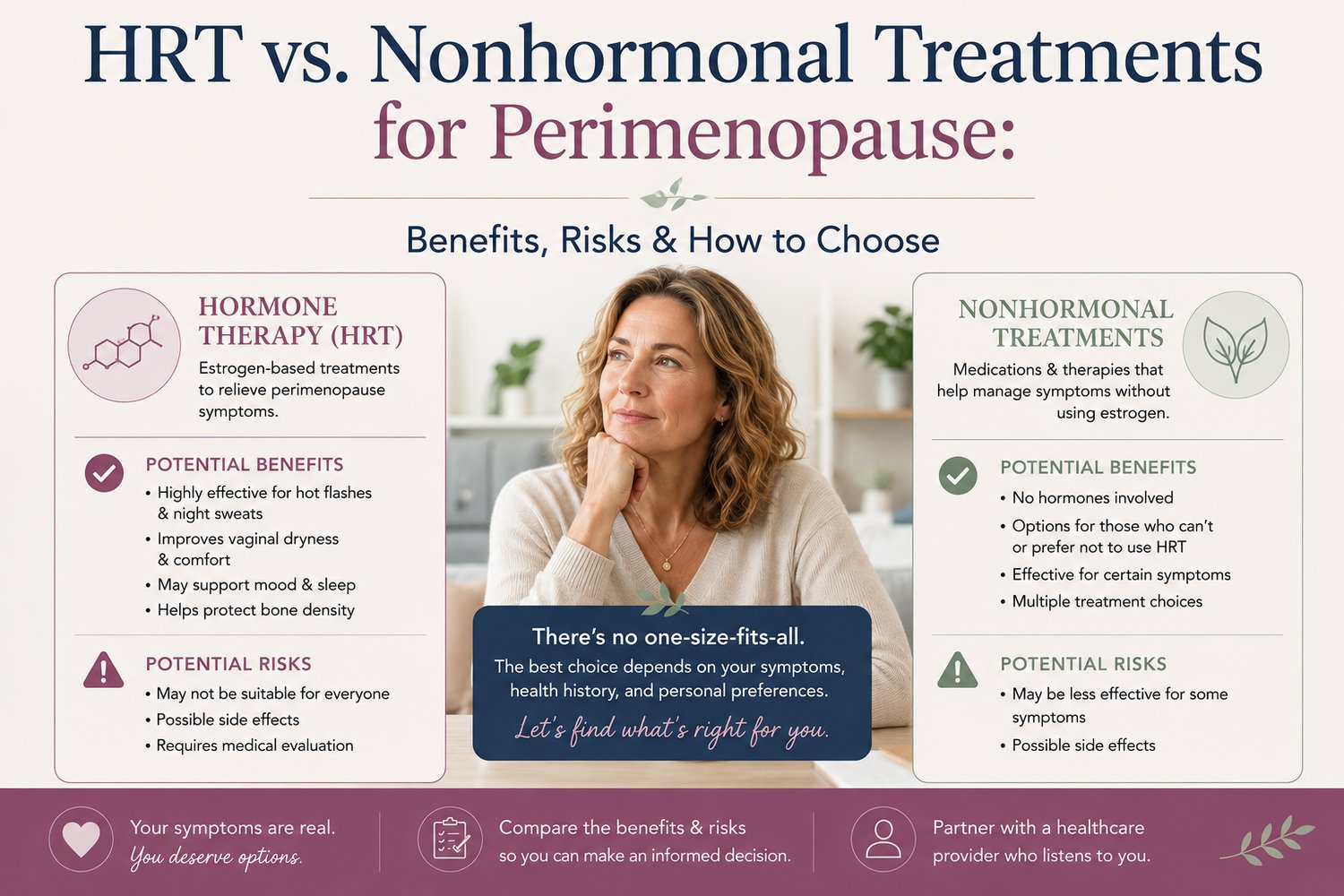
HRT vs. Nonhormonal Treatments for Perimenopause: Benefits, Risks & How to Choose
HRT vs. nonhormonal treatment for perimenopause isn't a choice between the “natural” option and the “medical” option—or between one treatment that's effective and another that's somehow second-rate.
Both hormonal and nonhormonal treatments have legitimate roles.
The better choice depends on:
- Which symptoms you're treating
- How severe they are
- Your medical history
- Whether you're still having periods
- Whether pregnancy is still possible
- Your personal risk factors
- Other medications
- Which side effects you're willing to accept
- Your own treatment preferences
For hot flashes and night sweats, menopausal hormone therapy remains the most effective treatment when it's medically appropriate. But several evidence-based nonhormonal options are available for women who can't use hormones, don't want them, or simply prefer another approach.
And for some perimenopause symptoms, the answer is neither HRT nor a nonhormonal hot-flash medication.
That's why this comparison needs more nuance than:
HRT = effective but risky
versus
nonhormonal = weaker but safer.
Neither statement is universally true.
For the full treatment roadmap first, read Perimenopause Treatment Options: Hormonal, Nonhormonal & Lifestyle Treatments Explained.
HRT vs. Nonhormonal Treatment: The Short Version
If you want the simplest answer:
Hormone Therapy May Make More Sense When:
- Hot flashes or night sweats are a major problem
- You also have other estrogen-responsive menopause symptoms
- You want the most effective treatment for vasomotor symptoms
- You don't have a medical reason that makes systemic hormone therapy inappropriate
- You and your clinician decide the expected benefits outweigh your individual risks
Nonhormonal Treatment May Make More Sense When:
- You prefer not to use hormone therapy
- Hormone therapy isn't medically appropriate
- You've had side effects from hormone therapy
- You're taking another medication that may conveniently treat overlapping symptoms
- Your main symptom has an effective nonhormonal treatment
- You prefer to try a nonhormonal route first
Neither list tells you which treatment you personally should use.
It tells you why different reasonable people can make different choices.
What Is HRT During Perimenopause?
HRT stands for hormone replacement therapy.
You'll also see:
- MHT — menopausal hormone therapy
- HT — hormone therapy
Menopausal hormone therapy generally uses estrogen to treat symptoms associated with the menopause transition.
If you still have a uterus and use systemic estrogen, a progestogen is generally added to protect the endometrium, because estrogen used alone can increase the risk of endometrial hyperplasia and cancer.
Treatment may be delivered through:
- Pills
- Patches
- Gels
- Sprays
- Other formulations
Hormone therapy can be used during perimenopause, not only after the final menstrual period. ACOG specifically describes HT as treatment for symptoms of menopause and perimenopause.
For the full HRT discussion, read Hormone Therapy for Perimenopause: Benefits, Risks, Types & Who It May Help.
What Are Nonhormonal Perimenopause Treatments?
“Nonhormonal” is a broad category.
It can include:
- Prescription medications
- Behavioral therapies
- Vaginal moisturizers and lubricants
- Symptom-specific medical treatments
- Lifestyle support
For hot flashes and night sweats specifically, evidence-based nonhormonal treatments can include medications such as:
- Certain SSRIs and SNRIs
- Gabapentin
- Fezolinetant
- Elinzanetant
- Oxybutynin in selected circumstances
Behavioral treatments such as menopause-specific cognitive behavioral therapy can also be useful. NICE's current 2026 guideline recommends menopause-specific CBT as an option alongside HRT, when HRT is contraindicated, or when someone prefers not to use it.
The important point is:
Nonhormonal treatment does not mean supplement.
Some of the strongest nonhormonal options are prescription medications.
Which Works Better for Hot Flashes: HRT or Nonhormonal Treatment?
If we're comparing overall efficacy for vasomotor symptoms, hormone therapy wins.
Systemic estrogen—with appropriate progestogen protection when needed—is considered the most effective treatment for hot flashes and night sweats.
That doesn't mean nonhormonal medications don't work.
They can.
But if someone is an appropriate candidate for hormone therapy and their main goal is maximum reduction of severe vasomotor symptoms, HT generally has the strongest efficacy.
So this is one comparison where we shouldn't create false equivalence.
Hormone therapy is the benchmark treatment for hot flashes.
Nonhormonal treatments are valuable alternatives—not proof that all options work equally well.
Why Would Someone Choose Nonhormonal Treatment Anyway?
Because maximum efficacy isn't the only thing that matters in medicine.
Someone may prefer a nonhormonal option because:
- They have a contraindication to systemic hormone therapy
- Their medical history makes HT less attractive
- They're uncomfortable using hormones
- They've tried HT and didn't tolerate it
- They're taking another medication that may also help
- They prefer the risk or side-effect profile of another option
- Their clinician recommends another approach
That's not “settling.”
It's choosing treatment around the actual patient rather than around a ranking chart.
Is Nonhormonal Treatment Safer Than HRT?
Not automatically.
This is probably the biggest misconception in the entire comparison.
Hormonal does not mean dangerous.
Nonhormonal does not mean safe.
Every medication has its own:
- Contraindications
- Adverse effects
- Drug interactions
- Monitoring requirements
Fezolinetant is a perfect example.
It's nonhormonal and effective for moderate-to-severe vasomotor symptoms.
It also carries an FDA Boxed Warning for rare but serious liver injury and requires appropriate liver testing and monitoring.
A treatment should be judged by its actual benefit-risk profile.
Not by whether the word hormone appears on the bottle.
When Might HRT Not Be Appropriate?
Systemic hormone therapy usually isn't recommended in certain situations.
ACOG lists histories including:
- Breast cancer
- Endometrial cancer
- Stroke
- Heart attack
- Blood clots
- Liver disease
as circumstances where systemic hormone therapy generally isn't recommended. Pregnancy is also a contraindication.
But even this needs nuance.
For example:
systemic estrogen
and
low-dose local vaginal estrogen
don't create identical systemic exposure.
So the answer shouldn't become:
“I have one risk factor, therefore every estrogen-containing treatment is permanently forbidden.”
Individual clinical evaluation still matters.
Does Age Matter When Choosing HRT?
Yes.
The benefit-risk profile of systemic hormone therapy isn't identical at every age and every stage.
Risks can depend on:
- Age
- Time since menopause
- Cardiovascular health
- Personal medical history
- Route
- Dose
- Whether estrogen is used alone or with a progestogen
This is one reason older studies created so much confusion: results from women beginning systemic treatment substantially later after menopause were often generalized to younger symptomatic women near the menopause transition.
HRT decisions should be individualized rather than treated as one universal risk category.
HRT Pills vs. Patches
Even within hormone therapy, you're not comparing one standardized treatment.
Route matters.
Oral Estrogen
Taken as a pill and processed through first-pass liver metabolism.
Transdermal Estrogen
Delivered through the skin, commonly by:
- Patch
- Gel
- Spray
ACOG notes that transdermal routes may pose less blood-clot risk than oral estrogen.
That doesn't automatically make patches appropriate for everyone.
It shows why the real decision isn't:
HRT or no HRT?
It's often:
Which HRT formulation, route, dose, and regimen makes sense?
What About Progesterone?
If you still have a uterus, systemic estrogen generally requires adequate endometrial protection.
That usually means a progestogen.
Without it, systemic estrogen can stimulate the uterine lining and increase endometrial cancer risk.
So comparing “estrogen” against a nonhormonal drug without considering whether progesterone or another progestogen is also part of the regimen can oversimplify the real treatment decision.
Hormone therapy is a regimen, not just estrogen.
SSRIs and SNRIs vs. HRT
Certain antidepressants can reduce vasomotor symptoms.
These include selected:
- SSRIs
- SNRIs
They can be useful when:
- HRT isn't appropriate
- Someone prefers nonhormonal treatment
- Depression or anxiety is also present
- The medication's broader effects fit the patient's needs
That doesn't mean hot flashes are psychological.
These medications affect neurotransmitter systems involved in temperature regulation.
But unlike hormone therapy, antidepressants can also introduce effects such as:
- Nausea
- Sexual side effects
- Sleep changes
- Headache
- Changes in appetite
- Discontinuation symptoms with some medications
The actual drug matters.
“Take an antidepressant instead” is not one standardized alternative.
What If You Have Both Hot Flashes and Depression or Anxiety?
This is where treatment becomes genuinely individualized.
Suppose someone has:
moderate hot flashes + clinically significant depression.
An SSRI or SNRI may become particularly attractive because one medication could potentially address both problems.
Another woman may have:
severe hot flashes + no depression + very disrupted sleep.
Hormone therapy may make more sense if she is an appropriate candidate.
Someone else may have:
severe depression + hot flashes + a medical contraindication to HRT.
Now we're making a different decision again.
Treat the whole person.
Not the article headline.
Gabapentin vs. HRT
Gabapentin is another evidence-supported nonhormonal option for vasomotor symptoms.
It may be particularly relevant when nighttime symptoms are bothersome.
Potential side effects can include:
- Drowsiness
- Dizziness
- Balance problems
- Fatigue
Its use for vasomotor symptoms is generally off-label.
That doesn't mean the use is improper.
Off-label means the FDA-approved indication is for another condition.
Compared with HRT, gabapentin doesn't provide estrogen's effects on other menopause-related tissues or bone.
Its job is narrower.
Sometimes narrower is exactly what you want.
Fezolinetant vs. HRT
Fezolinetant, sold as Veozah, is different from older nonhormonal options because it was developed specifically around the neurological pathway involved in vasomotor symptoms.
It works through the neurokinin 3 receptor rather than estrogen.
Potential advantages include:
- No estrogen exposure
- Specifically targets vasomotor symptoms
- FDA approval for moderate-to-severe VMS due to menopause
But there is an important tradeoff.
FDA strengthened its warning in December 2024 and added a Boxed Warning for rare serious liver injury. Liver testing is part of appropriate treatment and monitoring.
So if someone asks:
“Is Veozah safer than HRT?”
the correct answer isn't automatically yes.
They're different drugs with different risks.
The relevant question is:
Which risk-benefit profile makes more sense for this person?
Elinzanetant vs. HRT
The nonhormonal landscape expanded again in October 2025 when the FDA approved elinzanetant, sold as Lynkuet, for moderate-to-severe vasomotor symptoms due to menopause.
Elinzanetant targets neurokinin signaling and is taken at bedtime.
Its pivotal efficacy trials showed clinically meaningful reductions in moderate-to-severe vasomotor symptom frequency compared with placebo.
Common adverse effects in the clinical program included things such as:
- Headache
- Fatigue
- Dizziness
- Somnolence
- Nausea
depending on the study.
One important caveat for an article about perimenopause:
The pivotal elinzanetant trials used postmenopausal participants.
So I would not present Lynkuet as though its approval and evidence base specifically established treatment in women still actively transitioning through perimenopause.
It's a current nonhormonal menopause-treatment option worth knowing about, but exact eligibility and appropriateness belong with the prescribing clinician.
Oxybutynin vs. HRT
Oxybutynin is primarily a bladder medication.
Research has also found benefit for vasomotor symptoms, so it may be considered off-label in selected patients.
Potential drawbacks include anticholinergic adverse effects such as:
- Dry mouth
- Constipation
- Other tolerability issues
Again:
HRT treats vasomotor symptoms through hormonal replacement.
Oxybutynin happens to influence pathways that can reduce hot flashes.
They're not interchangeable therapies with identical side-effect profiles or secondary benefits.
What About Clonidine?
Older menopause resources often include clonidine in their nonhormonal treatment lists.
This is one place where recommendations differ and have evolved.
ACOG's general patient material still mentions clonidine among medications that may reduce hot flashes.
However, NICE's current 2026 guidance says not to routinely offer SSRIs, SNRIs, or clonidine as first-line treatment for vasomotor symptoms alone, and The Menopause Society's more recent nonhormonal evidence review does not recommend clonidine as a preferred VMS treatment.
That doesn't make clonidine imaginary.
It means better-supported choices are now available.
CBT vs. HRT
Cognitive behavioral therapy occupies a different category entirely.
CBT doesn't replace estrogen.
And it doesn't necessarily make hot flashes disappear.
Menopause-specific CBT can help reduce:
- Symptom bother
- Distress
- Sleep disruption
- The impact vasomotor symptoms have on daily life
NICE currently recommends menopause-specific CBT either:
- Alongside HRT
- When HRT is contraindicated
- When someone prefers not to use HRT
That gives us another important principle:
HRT vs. nonhormonal treatment isn't always an either/or decision.
Some approaches can be combined.
HRT vs. CBT-I for Sleep Problems
If your main complaint is:
“I can't sleep.”
don't automatically choose between estrogen and a sleeping pill.
First ask why.
If Night Sweats Keep Waking You
Reducing the vasomotor symptoms may improve sleep.
HRT may therefore help indirectly.
A nonhormonal VMS medication may too.
If You Have Chronic Insomnia
CBT-I—cognitive behavioral therapy for insomnia— may be the more appropriate direct treatment.
If You Have Sleep Apnea
Neither treatment addresses the underlying breathing disorder.
Read Sleep During Perimenopause: Why You Can’t Sleep & What Actually Helps.
HRT vs. Nonhormonal Treatment for Vaginal Dryness
This comparison changes again.
If vaginal dryness or painful sex is your only major menopause symptom, you may not need systemic hormone therapy.
Options can include:
Nonhormonal
- Vaginal moisturizers
- Lubricants
Hormonal
- Low-dose vaginal estrogen
Other prescription treatments also exist depending on symptoms and history.
ACOG specifically distinguishes systemic estrogen from local vaginal estrogen, which delivers low doses directly to vaginal tissue.
The goal is not to use the strongest possible treatment.
It's to use the right treatment for the problem.
What About Urinary Symptoms?
Genitourinary syndrome of menopause can also involve:
- Urinary urgency
- Irritation
- Recurrent UTIs
- Other urinary symptoms
Local vaginal estrogen may be useful for selected genitourinary symptoms.
But new burning, pain, blood in the urine, or suspected infection still deserves appropriate evaluation.
Don't assume every urinary problem in midlife is hormonal.
HRT vs. Antidepressants for Mood Symptoms
This comparison gets especially tricky.
Hormone therapy may improve mood for some women during the menopause transition, particularly when:
- Hot flashes improve
- Sleep improves
- Overall symptom burden falls
But HRT is not a universal antidepressant.
Clinical depression and anxiety disorders have established treatments including:
- Psychotherapy
- Antidepressant medication
- Other psychiatric care
If someone has an actual mood disorder, the treatment decision shouldn't become:
“Estrogen or antidepressant?”
Sometimes the appropriate answer is:
treat the mood disorder and treat the menopause symptoms.
Read Mood Swings During Perimenopause: Causes, Anxiety, Depression & What Actually Helps.
What About Brain Fog?
Neither HRT nor a nonhormonal hot-flash drug should be treated as a universal brain-fog medication.
Brain fog can overlap with:
- Poor sleep
- Anxiety
- Depression
- Vasomotor symptoms
- Medications
- Thyroid disease
- Anemia
- Sleep apnea
- Cognitive overload
Hormone therapy isn't recommended solely to prevent dementia or improve cognition in natural menopause.
Treating another symptom—such as severe night sweats—may indirectly improve mental clarity.
That's different.
Read Brain Fog During Perimenopause: Memory Problems, Causes & What Actually Helps.
HRT vs. Nonhormonal Treatment for Weight Gain
Neither is primarily a perimenopause weight-loss treatment.
HRT:
- Is not an obesity medication
- Shouldn't be prescribed simply to cause weight loss
Nonhormonal VMS drugs:
- Are also not weight-loss treatments
If excess weight or obesity is the issue, treatment belongs in a weight-management framework involving:
- Nutrition
- Activity
- Strength training
- Sleep
- Health conditions
- Anti-obesity medications when medically appropriate
- Other evidence-based treatment
Don't use menopause symptom medications for a job they weren't designed to do.
Read Perimenopause Weight Gain: Why It Happens, Belly Fat & What Actually Helps.
Does HRT Have Benefits Nonhormonal Treatments Don't?
Yes.
This is another reason a simple hot-flash efficacy comparison doesn't tell the whole story.
Systemic estrogen can also help:
- Prevent bone loss while treatment continues
- Treat certain other estrogen-responsive symptoms
Local estrogen can directly treat vaginal symptoms.
A nonhormonal VMS medication usually has a more specific job.
For example:
Fezolinetant treats vasomotor symptoms.
It doesn't function as estrogen replacement for:
- Bone
- Vaginal tissue
- Other estrogen-responsive tissues
Whether broader effects are a benefit or an unnecessary exposure depends on the patient.
Do Nonhormonal Treatments Have Advantages HRT Doesn't?
Yes.
The most obvious:
They don't require systemic estrogen exposure.
That may be valuable when:
- Estrogen is contraindicated
- Someone prefers to avoid hormones
- The clinical goal is narrowly treating vasomotor symptoms
Certain medications may also address overlapping problems.
For example, selected SSRIs or SNRIs may make sense when depression or anxiety is also being treated.
Again, broader isn't always better.
More targeted isn't always better either.
It depends on what you need.
Which Treatment Works Faster?
It depends on the medication, dose, symptom, and individual response.
This isn't a useful area for promising:
“Drug A works in exactly three days while HRT takes two weeks.”
Clinical trials report average changes across groups.
Your personal response isn't guaranteed to match the average timeline.
The more practical plan is:
- Start an appropriate treatment.
- Track symptoms.
- Allow the expected treatment interval.
- Reassess effectiveness and side effects with the prescriber.
If it isn't working well enough, treatment can often be adjusted.
What About Side Effects?
Both hormonal and nonhormonal treatments can produce them.
Possible HRT Side Effects
Can include:
- Breast tenderness
- Spotting or bleeding
- Bloating
- Headaches
ACOG notes that some bleeding and breast soreness may occur after starting therapy and that persistent problems can sometimes be addressed by adjusting treatment.
Nonhormonal Side Effects
Depend entirely on the medication.
Possible examples include:
SSRIs/SNRIs: nausea, sexual side effects, sleep changes
Gabapentin: dizziness, drowsiness
Fezolinetant: liver-safety concerns and monitoring
Elinzanetant: headache, fatigue, dizziness or somnolence among reported adverse effects
Oxybutynin: dry mouth, constipation and other anticholinergic effects
There is no side-effect-free column.
Do You Have to Stay on Treatment Forever?
Not necessarily.
Menopause symptoms can change over time.
Treatment should be periodically reassessed based on:
- Whether symptoms remain bothersome
- Whether the medication still works
- New health conditions
- New medications
- Changing risk factors
- Side effects
- Personal preference
ACOG recommends discussing the decision to continue hormone therapy with your clinician regularly rather than applying one mandatory stopping date to everyone.
The same principle broadly applies to other symptom treatments:
Keep treating a problem when the benefits justify the treatment.
Reassess when circumstances change.
Can You Combine HRT With Nonhormonal Treatment?
Sometimes.
“HRT vs. nonhormonal” makes a good search phrase.
Real medicine is often less binary.
Someone may use hormone therapy for vasomotor symptoms and still need:
- CBT-I for chronic insomnia
- An antidepressant for depression
- Lubricants for sexual comfort
- Other medications for unrelated conditions
Likewise, menopause-specific CBT may be used with HRT rather than instead of it. NICE explicitly includes that approach.
The goal isn't allegiance to one treatment category.
It's symptom control with an acceptable risk and side-effect burden.
What About Supplements Instead of Either Option?
This is where I'd become much more skeptical.
Supplements marketed for hot flashes may contain:
- Black cohosh
- Soy isoflavones
- Red clover
- Maca
- Herbal blends
The evidence is substantially less reliable than it is for established hormonal and nonhormonal medical treatments.
“Natural” isn't the third medically equivalent treatment arm.
If someone has mild symptoms and wants to try a low-risk comfort measure, that's one thing.
If someone has 10 severe hot flashes a day and hasn't slept properly in months, endlessly cycling through menopause supplements while avoiding evidence-based treatment is another.
Is Bioidentical HRT a Different Category?
Not really.
The word bioidentical describes molecular structure.
It does not automatically describe:
- Safety
- Effectiveness
- FDA approval
- Compounding
FDA-approved estradiol and micronized progesterone products can be bioidentical.
Custom-compounded BHRT also exists.
Those should not be treated as the same regulatory category.
ACOG recommends FDA-approved hormone therapies over routinely prescribed compounded BHRT when approved formulations are available.
Our next expansion article will tackle this distinction directly:
Bioidentical Hormones for Perimenopause: FDA-Approved vs. Compounded BHRT
What If You Want HRT but Don't Want Compounded Hormones?
Then say so.
There are FDA-approved menopausal hormone therapies available.
You do not need custom compounding simply because you want:
- Estradiol
- Micronized progesterone
- “Bioidentical” hormones
This is one of the most important questions to ask any menopause provider:
“Is the medication you're prescribing FDA-approved or compounded?”
And if it's compounded:
“Why is a compounded formulation being recommended instead of an approved product?”
That's a fair question.
Considering Telehealth Hormone Treatment?
Telehealth can be a convenient route for women who want to discuss hormone therapy without waiting for a traditional in-person menopause appointment.
A responsible service should still evaluate:
- Symptoms
- Medical history
- Medications
- Blood-clot risk
- Cancer history
- Cardiovascular risk
- Bleeding
- Pregnancy potential
- Whether systemic HT is actually appropriate
Online should change the logistics.
It shouldn't change the medical standard.
Strut Health
Affiliate disclosure: HabitLogics may earn a commission if you use this link, at no additional cost to you.
Strut Health offers online women's BHRT evaluation and treatment.
Strut's hormone treatments are compounded, which is important context when comparing options.
Compounded treatment can have legitimate uses, but ACOG recommends FDA-approved menopause hormone therapies over compounded BHRT when an approved formulation can meet the patient's needs.
So if you explore Strut—or any compounded hormone provider—ask why a compounded formulation is being recommended for you.
We'll cover that issue in detail in the dedicated bioidentical-hormone article.
How Do You Actually Choose Between HRT and Nonhormonal Treatment?
Here's the framework I'd use.
Step 1: Identify the Main Symptom
Is it:
- Hot flashes?
- Night sweats?
- Vaginal dryness?
- Insomnia?
- Depression?
- Heavy bleeding?
- Weight?
- Something else?
Don't treat a vague category called perimenopause.
Step 2: Determine Whether HRT Is Medically Reasonable
Review:
- Medical history
- Cancer history
- Cardiovascular history
- Blood-clot history
- Liver health
- Bleeding
- Pregnancy potential
- Other relevant risks
Step 3: Compare Expected Benefits
For severe hot flashes, hormone therapy generally provides the strongest symptom relief.
For another symptom, the comparison may look very different.
Step 4: Compare Downsides
Look at:
- Side effects
- Monitoring
- Drug interactions
- Risk factors
- Cost
- Convenience
Step 5: Include Preference
This matters.
Two medically appropriate treatments may exist.
One patient may strongly prefer avoiding systemic hormones.
Another may prefer using HRT rather than taking an antidepressant or other nonhormonal drug.
Patient preference is part of good medicine.
A Practical Decision Example
Imagine two women both experiencing eight hot flashes every day.
Woman A
She:
- Has no major contraindications to HRT
- Has significant night sweats too
- Wants the most effective symptom treatment
- Is comfortable with hormone therapy
Systemic HRT may be a very reasonable option to discuss.
Woman B
She:
- Has the same hot flashes
- Has a history making systemic estrogen less appropriate
- Wants a nonhormonal approach
A nonhormonal prescription treatment may make much more sense.
Same symptom.
Different patient.
Different decision.
That's why internet arguments about whether everyone should take HRT or nobody should take HRT are fundamentally broken.
What Questions Should You Ask Your Clinician?
If you're comparing hormonal and nonhormonal treatments, ask:
- Which of my symptoms is this treatment supposed to improve?
- How effective is it for that symptom?
- Am I a reasonable candidate for hormone therapy?
- What individual HRT risks apply to me?
- Would transdermal or oral estrogen make more sense?
- If I have a uterus, how will my endometrium be protected?
- What nonhormonal options could treat the same symptom?
- Which side effects are most relevant?
- Does the medication interact with anything I already take?
- Will I need monitoring or blood tests?
- Is the treatment FDA-approved for this use?
- If it's off-label, what evidence supports using it?
- How long should I try it before deciding whether it works?
- What happens if the first option doesn't work?
You don't have to arrive at the appointment having already chosen a side.
That's what the discussion is for.
Track the Symptom You're Actually Treating
If you're starting treatment, tracking can help answer:
Is this actually working?
For hot flashes, you might record:
- Daily frequency
- Severity
- Night sweats
- Sleep disruption
For mood:
- Anxiety
- Low mood
- Function
For vaginal symptoms:
- Dryness
- Pain
- Urinary changes
Don't track 37 unrelated things when you're trying to evaluate one treatment.
Measure the outcome the treatment is supposed to change.
The FREE Perimenopause Starter Kit includes basic symptom and hot-flash tracking.
For more detailed monitoring, the Perimenopause Symptom Tracker includes printable and Excel tools for symptoms, hot flashes, sleep, mood, menstrual changes, and treatment patterns.
Frequently Asked Questions
Is HRT better than nonhormonal treatment for perimenopause?
For hot flashes and night sweats, systemic hormone therapy is generally the most effective treatment when medically appropriate.
Nonhormonal treatments remain valuable alternatives when HRT isn't appropriate or isn't preferred.
For other symptoms, the best treatment may be different.
What is the best nonhormonal treatment for hot flashes?
There isn't one best choice for everyone.
Options include selected SSRIs/SNRIs, gabapentin, fezolinetant, elinzanetant and other treatments depending on individual circumstances.
Some recommendations differ by guideline and clinical context, so treatment should be individualized.
Is nonhormonal menopause medication safer than HRT?
Not automatically.
Each medication has its own risks, interactions and monitoring requirements.
For example, fezolinetant is nonhormonal but carries an FDA Boxed Warning regarding rare serious liver injury.
Can I take HRT if I'm still having periods?
Potentially, yes.
Hormone therapy can be used during perimenopause, although the regimen, bleeding pattern and contraception needs require consideration.
Does HRT work better than antidepressants for hot flashes?
Overall, hormone therapy remains the most effective treatment for vasomotor symptoms.
Selected antidepressants can still provide meaningful symptom reduction and may be preferable in certain circumstances.
Can antidepressants treat hot flashes if I'm not depressed?
Yes.
Certain SSRIs and SNRIs can reduce vasomotor symptoms independently of treating depression.
Is Veozah safer than HRT?
That isn't a useful universal comparison.
Veozah avoids systemic estrogen but has its own risks, including an FDA Boxed Warning for rare serious liver injury.
The appropriate choice depends on individual risks and preferences.
What is Lynkuet?
Lynkuet is the brand name for elinzanetant, a nonhormonal neurokinin-targeting medication FDA-approved on October 24, 2025, for moderate-to-severe vasomotor symptoms due to menopause.
Its pivotal clinical trials were conducted in postmenopausal women, which is worth recognizing when discussing treatment specifically during perimenopause.
Can HRT and nonhormonal treatments be used together?
Sometimes.
Treatment categories aren't always mutually exclusive.
For example, menopause-specific CBT may be used with HRT, and someone using HRT may still require separate treatment for depression or chronic insomnia.
Is CBT as effective as HRT?
Not in the same way.
HRT is the most effective treatment for reducing vasomotor symptoms.
CBT can help reduce symptom bother, distress and functional impact and can be used alongside or instead of HRT in selected circumstances.
Should I try lifestyle changes before medication?
Healthy habits are always worthwhile for general health.
You do not have to prove that you've exhausted every lifestyle trick before you're allowed evidence-based treatment for bothersome symptoms.
The right timing depends on how severe symptoms are and what you prefer.
What if HRT doesn't work?
The dose, route, regimen, diagnosis and treatment goal may need reassessment.
A clinician may consider adjusting therapy or using another hormonal or nonhormonal approach.
Failure of one treatment doesn't mean you simply have to tolerate the symptoms.
Key Takeaways
- HRT vs. nonhormonal treatment for perimenopause is an individualized medical decision, not a contest between “natural” and “medical” care.
- Systemic menopausal hormone therapy remains the most effective treatment for hot flashes and night sweats when medically appropriate.
- Nonhormonal options are important for women who cannot or prefer not to use systemic hormones.
- Selected SSRIs/SNRIs, gabapentin, neurokinin-targeting medications and other approaches can reduce vasomotor symptoms.
- Fezolinetant is nonhormonal but carries a Boxed Warning for rare serious liver injury.
- Elinzanetant was FDA-approved in October 2025 for moderate-to-severe vasomotor symptoms due to menopause; its pivotal trials were conducted in postmenopausal women.
- Hormonal and nonhormonal treatments have different side effects, contraindications and secondary benefits.
- “Nonhormonal” does not automatically mean safer.
- HRT can provide benefits that symptom-specific nonhormonal medications do not, including prevention of bone loss while systemic estrogen is used.
- Some nonhormonal medications may be especially attractive when they can address overlapping conditions such as depression or anxiety.
- Local vaginal estrogen and systemic hormone therapy are different treatments with different purposes.
- Hormonal and nonhormonal approaches can sometimes be combined rather than treated as mutually exclusive.
- Treatment should begin with the symptom you're trying to improve, not allegiance to one treatment category.
Continue Learning
If you're still deciding where to start, read Perimenopause Treatment Options: Hormonal, Nonhormonal & Lifestyle Treatments Explained.
For a deeper look specifically at hormone therapy, read Hormone Therapy for Perimenopause: Benefits, Risks, Types & Who It May Help.
For symptom-specific treatment:
- Hot Flashes During Perimenopause: Causes, Triggers & Treatments That Actually Help
- Sleep During Perimenopause: Why You Can’t Sleep & What Actually Helps
- Mood Swings During Perimenopause: Causes, Anxiety, Depression & What Actually Helps
Or return to the Complete Perimenopause Guide.
Affiliate Disclosure
HabitLogics may earn a commission from qualifying services purchased through affiliate links in this article, at no additional cost to you. Affiliate relationships do not determine how hormonal, nonhormonal, FDA-approved or compounded treatments are evaluated.
Educational Disclaimer
This article is intended for educational purposes only and is not medical advice, diagnosis, or individualized treatment guidance. Hormonal and nonhormonal prescription treatments have different indications, contraindications, side effects, drug interactions and monitoring requirements. Treatment eligibility can also depend on menstrual status, pregnancy potential and medical history. Discuss persistent or bothersome symptoms and prescription treatment decisions with a qualified healthcare professional.