

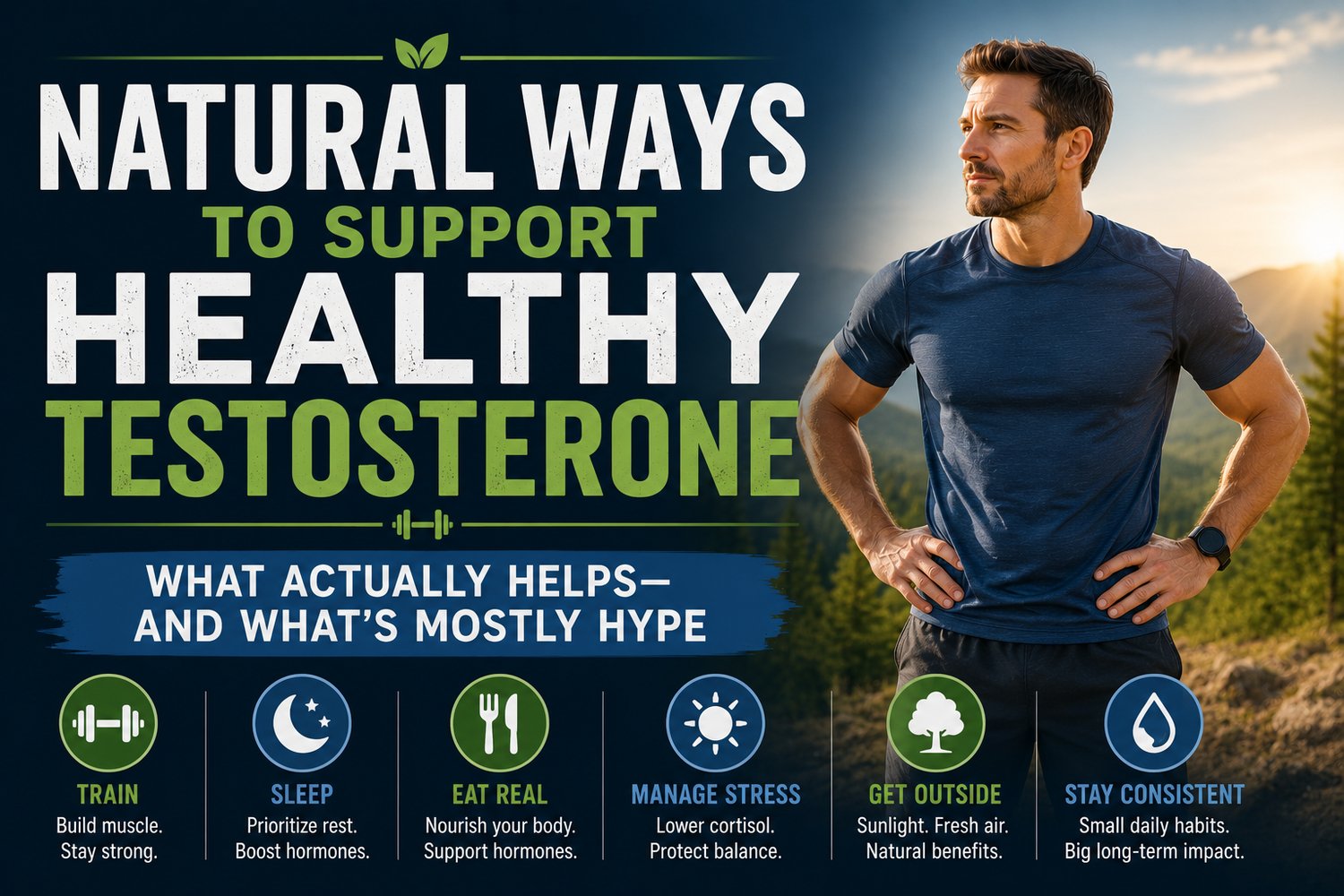
How to Support Testosterone Naturally: What Actually Helps
The most effective natural ways to support healthy testosterone are surprisingly basic: maintain a healthy body composition, get adequate sleep, treat sleep disorders, resistance train, stay physically active, eat enough calories and nutrients, avoid excessive alcohol, and correct genuine nutritional deficiencies.
What these habits generally cannot do is transform a normal testosterone level into a dramatically higher one or cure every medical cause of low testosterone.
That's where the internet gets this topic wrong.
Search for ways to increase testosterone naturally and you'll quickly encounter advice to:
- Take zinc
- Take magnesium
- Eat more eggs
- Avoid soy
- Take cold showers
- Use testosterone boosters
- Try exotic herbs
- Avoid plastic
- Follow elaborate “hormone optimization” routines
And yes, eventually somebody will probably tell you to sun your testicles.
The useful information gets buried underneath supplement marketing and internet folklore.
There are lifestyle factors worth addressing.
But natural testosterone support works best when you're correcting something that's actually hurting normal hormone function—such as obesity, inadequate sleep, severe calorie restriction, poor nutrition, excessive training, or another reversible health problem.
If you have true hypogonadism caused by testicular damage, pituitary disease, a genetic condition, or another established medical disorder, lifestyle alone may not restore normal testosterone production.
That's an important distinction.
If you're still figuring out where you are in the process, these guides come first:
- Low Testosterone Symptoms: 20 Signs Men Shouldn't Ignore
- What Causes Low Testosterone? Common Medical, Lifestyle & Age-Related Reasons
- How Testosterone Is Tested and Diagnosed
Now let's look at what you can actually control.
What Does “Increasing Testosterone Naturally” Really Mean?
This phrase gets abused.
Supporting testosterone naturally does not mean turning a healthy testosterone level of 550 ng/dL into 1,000 ng/dL through broccoli, squats, supplements, and cold showers.
A more realistic goal is to create conditions that support normal hormone function and correct factors that may be suppressing testosterone.
Those factors can include:
- Excess body fat
- Chronic under-eating
- Poor sleep
- Sleep disorders
- Inadequate nutrition
- Certain medications
- Excessive training without adequate recovery
- Heavy alcohol use
- Poor metabolic health
Some are modifiable.
Some require medical treatment.
And some aren't realistically reversible.
That's why the first step isn't finding the strongest “test booster.”
It's figuring out whether there is actually a problem to fix.
1. Lose Excess Body Fat if Needed
For men with obesity-related testosterone suppression, weight management may be one of the most meaningful lifestyle interventions available.
Excess body fat can affect reproductive hormones through several interconnected mechanisms involving:
- Insulin resistance
- Inflammation
- SHBG
- Estrogen metabolism
- Hypothalamic and pituitary signaling
- Sleep apnea and other obesity-related conditions
This relationship can work in both directions.
Low testosterone may influence body composition, while obesity can contribute to lower testosterone.
That doesn't mean every man carrying extra weight has low testosterone.
It also doesn't mean losing weight cures every form of hypogonadism.
But when obesity is a major reversible contributor, improving body composition can improve the hormonal environment along with many other aspects of health.
The bigger win is that sustainable weight management can also improve:
- Blood pressure
- Blood glucose
- Cardiovascular health
- Sleep
- Mobility
- Physical fitness
Those benefits matter whether your testosterone rises dramatically or not.
For practical activity strategies, start with Walking for Men's Health and Strength Training for Men Over 30.
2. Get Enough Sleep
If you're sleeping five hours per night and shopping for testosterone boosters, start with sleep.
Sleep supports normal hormone regulation and recovery.
Inadequate sleep can also produce many symptoms people automatically blame on low testosterone:
- Fatigue
- Reduced motivation
- Poor concentration
- Worse workouts
- Lower libido
- Poor recovery
- Irritability
Even with completely normal testosterone, chronic sleep deprivation can make you feel awful.
For most adults, building a stronger sleep routine includes:
- Allowing enough time for roughly 7–9 hours of sleep
- Keeping a reasonably consistent sleep and wake schedule
- Getting daylight earlier in the day
- Managing caffeine late in the day
- Creating a repeatable wind-down routine
- Keeping the bedroom dark, quiet, and comfortable
If sleep is a weak point, use Sleep for Men: Why Better Sleep Matters for Testosterone, Recovery & Health.
3. Don't Ignore Sleep Apnea
Sleep apnea deserves its own section because “low-T symptoms” and sleep-apnea symptoms can overlap heavily.
Warning signs can include:
- Loud habitual snoring
- Gasping during sleep
- Witnessed breathing pauses
- Waking repeatedly
- Morning headaches
- Severe daytime sleepiness
- Poor concentration
- Waking unrefreshed despite enough time in bed
Sleep disorders are associated with testosterone deficiency and can also contribute to fatigue, metabolic problems, blood-pressure issues, and cardiovascular risk.
If you suspect sleep apnea, don't try to biohack around it with:
- Testosterone boosters
- More caffeine
- Energy supplements
- Pre-workout
- TRT without proper evaluation
Get the sleep problem evaluated.
Treating an actual sleep disorder is considerably more important than adding another supplement.
4. Resistance Train Regularly
Strength training is one of the best investments a man can make in long-term health.
It helps support:
- Muscle mass
- Strength
- Bone health
- Physical function
- Insulin sensitivity
- Body composition
- Healthy aging
Does lifting weights permanently send your testosterone through the roof?
No.
Exercise can create short-term hormonal changes, but those temporary fluctuations shouldn't be confused with moving your baseline testosterone into an entirely different clinical category.
Strength training is valuable because strength training itself works.
You don't need to pretend every squat is hormone therapy to justify lifting.
A practical starting point for many men is two or more resistance-training sessions each week, gradually progressing over time.
Read Strength Training for Men Over 30 or Building Muscle After 40 for more.
5. Walk and Stay Physically Active
Walking doesn't get enough credit in hormone conversations because it isn't dramatic.
But regular movement can support:
- Weight management
- Blood glucose
- Cardiovascular health
- Sleep
- Stress management
- Daily calorie expenditure
- Metabolic health
Those things matter.
The point isn't:
“Walk 10,000 steps and boost testosterone by 47%.”
The point is that a physically active man with better metabolic health, better sleep, and a healthier body composition has addressed several factors that can influence hormone health.
Read Walking for Men's Health for a practical starting point.
6. Stop Crash Dieting
Losing excess body fat can be beneficial.
Starving yourself isn't.
Severe or prolonged calorie restriction can suppress reproductive hormone function, particularly when combined with:
- High training volume
- Very low body fat
- Poor sleep
- High stress
- Inadequate recovery
Your body responds to available energy.
If you're chronically under-fueled, some physiological systems can be downregulated.
Symptoms can include:
- Fatigue
- Reduced libido
- Poor recovery
- Worse training performance
- Loss of muscle mass
If weight loss is the goal, aim for a sustainable approach rather than trying to lose as much weight as possible as quickly as possible.
7. Eat Enough Protein
Protein isn't a testosterone booster.
But it supports several goals that matter for men's health:
- Preserving muscle
- Building muscle
- Recovery
- Satiety
- Healthy body composition
Useful protein sources include:
- Eggs
- Greek yogurt
- Cottage cheese
- Milk
- Chicken
- Turkey
- Lean beef
- Fish
- Beans
- Lentils
- Tofu
- Tempeh
For a deeper breakdown, read Protein for Men: How Much Do You Really Need?.
You can also use the Complete High-Protein Guide for meal ideas and practical strategies.
8. Don't Eliminate Dietary Fat
Your body requires dietary fat.
That does not mean:
- Eat unlimited saturated fat
- Start a carnivore diet
- Put butter in everything
- Avoid carbohydrates
It means an extremely restrictive diet that provides inadequate fat isn't a smart long-term nutrition strategy.
Include reasonable amounts of foods such as:
- Olive oil
- Nuts
- Seeds
- Avocados
- Eggs
- Fish
- Dairy if it fits your diet
The goal is nutritional adequacy and overall cardiovascular health.
Not turning dietary fat into another testosterone religion.
9. You Don't Need to Fear Carbohydrates
Carbohydrates regularly get dragged into hormone arguments too.
You don't need to eliminate carbohydrates to maintain healthy testosterone.
Foods such as:
- Potatoes
- Oats
- Rice
- Whole grains
- Fruit
- Beans
- Lentils
can fit into a healthy diet and help support exercise performance and energy needs.
If you prefer a lower-carbohydrate diet and it works well for you, that's fine.
But carbohydrates aren't inherently anti-testosterone.
10. Correct Real Nutrient Deficiencies
This is where supplements can genuinely make sense.
If you're deficient in a nutrient your body needs, correcting that deficiency is appropriate.
Nutrients commonly dragged into testosterone discussions include:
- Vitamin D
- Zinc
- Magnesium
But remember:
Correcting a deficiency is not the same as megadosing a supplement to “boost testosterone.”
If you're already getting enough zinc, swallowing much more zinc doesn't mean proportionally more testosterone.
The same logic applies to most nutrients.
More isn't automatically better.
And excessive supplementation can create its own health problems.
Read Healthy Habits Every Man Should Build Before Buying Supplements.
11. Limit Heavy Alcohol Use
Heavy alcohol consumption can affect multiple systems relevant to men's health, including:
- Sleep
- Liver health
- Nutrition
- Blood pressure
- Body composition
- Reproductive health
It can also make nearly every other healthy habit more difficult.
You don't necessarily need to interpret this as:
“One beer kills testosterone.”
That's not the point.
Look honestly at:
- How frequently you're drinking
- How much you're drinking
- Whether it worsens your sleep
- Whether it increases overeating
- Whether it affects training
- Whether alcohol is becoming a primary stress-management strategy
If intake is excessive, reducing it is a much more meaningful health intervention than looking for a testosterone supplement to compensate for it.
12. Avoid Anabolic Steroid Abuse
Using anabolic steroids or supraphysiologic doses of testosterone can suppress your body's own testosterone production.
External androgens signal the hypothalamus and pituitary to reduce LH and FSH.
That can result in:
- Suppressed natural testosterone production
- Reduced sperm production
- Testicular shrinkage
- Fertility problems
- Low endogenous testosterone after stopping
This isn't the same question as medically supervised testosterone replacement therapy for appropriately diagnosed hypogonadism.
Using hormones casually to “increase testosterone” can end up substantially suppressing your body's natural production.
13. Give Your Body Enough Recovery
Training is a stressor.
It's generally a productive one when appropriately programmed.
But suppose you combine:
- High-volume lifting
- Frequent hard cardio
- Severe calorie restriction
- Five hours of sleep
- A physically demanding job
- Chronic psychological stress
Eventually, recovery can become the limiting factor.
Possible signs include:
- Falling exercise performance
- Persistent fatigue
- Sleep problems
- Loss of motivation
- Chronic soreness
- Declining strength
More exercise isn't always better.
Training creates the stimulus.
Recovery allows you to adapt to it.
Sometimes the most useful “optimization” strategy really is going to bed and taking a rest day.
14. Manage Chronic Stress Without Obsessing Over Cortisol
Stress gets marketed almost as badly as testosterone.
You'll see claims like:
“Cortisol is destroying your testosterone.”
Human physiology is more complicated than that.
Chronic stress can negatively affect:
- Sleep
- Eating
- Alcohol use
- Exercise consistency
- Recovery
- Relationships
- Mental health
- Body weight
Those downstream effects can influence overall health and hormone function.
Practical stress-management strategies can include:
- Walking
- Exercise
- Time outdoors
- Better work boundaries
- Hobbies
- Social connection
- Relaxation practices
- Journaling
- Professional mental-health support when appropriate
You don't need a cortisol-blocking gummy.
15. Review Medications With Your Clinician
Some medications can contribute to testosterone deficiency.
Long-term opioids are a well-recognized example, and certain glucocorticoids and other medications can also affect reproductive hormone function.
That does not mean you should stop medication because you read an article about testosterone.
Instead, ask the clinician managing it:
- Could this medication be contributing?
- Does the dose matter?
- Is additional testing appropriate?
- Are there medically appropriate alternatives?
Medication decisions belong between you and the healthcare professional managing the condition.
16. Improve Your Overall Metabolic Health
Testosterone isn't an isolated system.
Obesity, type 2 diabetes, insulin resistance, cardiovascular disease, physical inactivity, and sleep problems frequently overlap.
Improving metabolic health may involve:
- Losing excess body fat when appropriate
- Strength training
- Walking more
- Eating a nutritious diet
- Improving sleep
- Managing blood pressure
- Managing glucose
- Keeping up with preventive healthcare
This is worth doing regardless of whether your testosterone increases.
A testosterone prescription doesn't replace the fundamentals of cardiovascular and metabolic health.
17. Don't Smoke
Smoking creates risks that extend far beyond testosterone.
It increases the risk of:
- Cardiovascular disease
- Lung disease
- Multiple cancers
- Premature death
- Numerous other health problems
Men's health is bigger than optimizing one hormone.
If you're worried enough about long-term health to research testosterone, smoking cessation deserves a much higher position on the priority list than nearly any supplement.
18. Aim for a Sustainable Body Composition
Very high body fat can contribute to lower testosterone.
At the opposite extreme, very low energy availability combined with aggressive dieting and excessive training can also disrupt reproductive hormones.
For most men, the goal shouldn't be:
As lean as humanly possible.
It should be:
Strong, active, metabolically healthy, and sustainable.
A body composition you can maintain while eating enough, sleeping well, training productively, and living normally is usually much more useful than chasing an extreme.
Testosterone Myths: What Doesn't Do Nearly as Much as Advertised
Now for the stuff that gets considerably more attention online than it deserves.
Do Testosterone-Boosting Foods Work?
There is no single food proven to create a dramatic, sustained increase in testosterone or treat clinical hypogonadism.
Foods frequently marketed as “testosterone foods” include:
- Oysters
- Eggs
- Red meat
- Ginger
- Garlic
- Pomegranate
Many of those can be perfectly nutritious foods.
That's a reason to eat them.
It isn't evidence that they're hormone therapy.
Build a nutritious overall diet instead of trying to engineer your endocrine system one ingredient at a time.
Do Eggs Increase Testosterone?
Eggs provide:
- Protein
- Fat
- Vitamins
- Minerals
They're a useful food for many people.
Eating more eggs doesn't turn your testes into a testosterone factory.
Healthy food and hormone medication aren't the same thing.
Does Soy Lower Testosterone in Men?
Normal dietary soy intake isn't supported as a meaningful testosterone-lowering threat for men.
Foods such as:
- Tofu
- Tempeh
- Edamame
- Soy milk
can provide useful protein and nutrients.
You don't need to avoid a nutritious food because somebody on social media called it “feminizing.”
Do Cold Showers Increase Testosterone?
There's no strong evidence that taking cold showers produces a meaningful sustained increase in baseline testosterone.
If you enjoy cold showers, use them.
Maybe they wake you up.
Maybe you enjoy the challenge.
Maybe they simply feel good.
Just don't confuse discomfort with hormonal effectiveness.
Do Ice Baths Boost Testosterone?
Cold-water immersion isn't a treatment for testosterone deficiency.
Cold exposure may have other uses in sport and recovery, but it doesn't replace:
- Adequate sleep
- Appropriate nutrition
- Healthy body composition
- Medical diagnosis
- Treatment of actual hypogonadism
And if maximizing muscle growth is a major goal, regularly jumping into intense cold immediately after resistance training may interfere with some of the adaptations you're trying to create.
You don't need an ice tub for healthy testosterone.
Does Sex Increase Testosterone?
Sexual activity can be associated with short-term hormonal fluctuations.
That isn't the same as producing a meaningful sustained increase in baseline testosterone.
Having more sex isn't a treatment for hypogonadism.
Does “NoFap” Increase Testosterone?
Claims that abstaining from ejaculation causes a major sustained increase in testosterone aren't supported by strong evidence.
Someone may choose abstinence for personal, behavioral, religious, relationship, or pornography-related reasons.
That's a separate question.
It shouldn't be sold as a proven testosterone treatment.
Do Over-the-Counter Testosterone Boosters Work?
Most testosterone boosters are marketed far more aggressively than the evidence supports.
Common ingredients include:
- Zinc
- Magnesium
- Fenugreek
- Ashwagandha
- Tongkat ali
- Tribulus
- Various herbal blends
Some individual ingredients have limited research suggesting possible effects in certain populations.
That's a very different claim from:
“This product reliably raises testosterone and treats low T.”
If you have genuine testosterone deficiency, the supplement aisle shouldn't be the end of the diagnostic process.
Testosterone-Booster Red Flags
Be particularly skeptical of a supplement that promises to simultaneously:
- Increase testosterone
- Build muscle
- Burn fat
- Improve erections
- Increase energy
- Improve mood
- Increase confidence
That's not one supplement.
That's an entire men's-health infomercial packed into a bottle.
Other warning signs include:
- Proprietary blends that hide individual doses
- Huge claims without strong evidence
- “Clinically proven” language based on unrelated ingredient studies
- No independent quality testing
- Before-and-after marketing
- Claims to treat medically diagnosed low testosterone
How Much Can Lifestyle Actually Raise Testosterone?
There isn't one useful number.
The answer depends heavily on where you're starting.
A man who already:
- Sleeps well
- Has a healthy body composition
- Eats adequately
- Exercises consistently
- Has good metabolic health
may have little room for lifestyle changes to raise testosterone substantially.
Another man who:
- Has obesity
- Sleeps five hours per night
- Has untreated sleep apnea
- Barely exercises
- Crash diets repeatedly
- Drinks heavily
has considerably more potentially reversible factors to address.
That's the key principle:
Lifestyle has the greatest opportunity to help when a modifiable lifestyle or health factor is contributing to the problem.
Lifestyle Can't Fix Every Cause of Low Testosterone
This is the limitation every “naturally boost testosterone” article should acknowledge.
Suppose low testosterone is caused by:
- Significant testicular damage
- A pituitary disorder
- Certain genetic conditions
- Cancer treatment
- Another permanent medical cause
Improving sleep, losing excess weight, lifting weights, and eating well can still make you healthier.
They may not restore normal testosterone production.
That's why you first need to understand what causes low testosterone.
Medical problems still require medical care.
When Should You Get Tested?
If you have persistent symptoms associated with testosterone deficiency, testing may make sense.
Potential symptoms include:
- Persistent low libido
- Fewer spontaneous erections
- Erectile changes
- Unexplained loss of muscle
- Other compatible physical changes
- Persistent symptoms that aren't explained by more obvious causes
Don't guess from symptoms alone.
Read How Testosterone Is Tested and Diagnosed before interpreting a testosterone result.
You can also visit the HabitLogics Men's Bloodwork Hub for testing resources.
The Everlywell Testosterone Test provides one at-home testing option.
Remember:
One test is data.
Diagnosing hypogonadism requires appropriate symptoms or signs, consistently low testosterone measurements, and clinical evaluation.
What If Lifestyle Isn't Enough?
Then lifestyle isn't enough.
That doesn't mean you failed.
Suppose you've been properly evaluated and have genuine hypogonadism caused by a condition that isn't realistically reversible through lifestyle.
Medical treatment may be appropriate.
Healthy habits and medical treatment aren't enemies.
You can:
Treat the medical problem + continue building a healthy lifestyle.
Read What Is TRT? Testosterone Replacement Therapy Explained to understand the potential benefits, risks, fertility implications, monitoring, and treatment options.
If you've already completed appropriate evaluation and are comparing treatment services, you can also compare online TRT options.
HabitLogics may earn a commission if you purchase through links on our TRT provider page, at no additional cost to you.
A Simple Testosterone-Supportive Lifestyle
You don't need an elaborate hormone protocol.
Focus on the basics.
Sleep
Allow enough time for consistent, adequate sleep.
Strength
Resistance train regularly and progressively.
Move
Walk frequently and include appropriate aerobic activity.
Eat
Get enough calories, protein, fiber-rich foods, healthy fats, fruits, vegetables, and other nutrient-dense foods.
Recover
Don't constantly combine aggressive dieting, hard training, poor sleep, and high stress.
Manage Body Composition
Lose excess body fat if appropriate without driving yourself to an unsustainably low body-fat level.
Reduce Harm
Avoid smoking, excessive alcohol, and anabolic steroid abuse.
Investigate Symptoms
If symptoms persist, test appropriately instead of guessing.
That's enough.
No weird protocol required.
A Practical 30-Day Testosterone-Supportive Reset
If your lifestyle currently feels scattered, spend the next month improving the fundamentals.
Sleep
Establish a reasonably consistent sleep and wake schedule and give yourself enough time to sleep.
Strength
Complete two or three resistance-training sessions per week.
Walking
Walk for at least 20–30 minutes on most days or gradually increase your overall daily movement.
Protein
Include a meaningful source of protein with each major meal.
Nutrition
Build most meals around minimally processed, nutrient-dense foods rather than extreme restriction.
Recovery
Give yourself adequate rest between difficult training sessions.
Alcohol
Reduce excessive intake.
Tracking
Pay attention to trends in:
- Sleep
- Energy
- Strength
- Weight
- Waist circumference
- Libido
- Other symptoms
Don't judge the month solely by whether a testosterone result changes.
Better sleep, improved strength, more energy, healthier body composition, and better fitness are worthwhile outcomes on their own.
The Testosterone Lifestyle Guide is designed around sleep, nutrition, strength, stress, and recovery if you want a more structured system.
For a free starting point, use the FREE Men's Hormone & Energy Starter Kit.
Frequently Asked Questions
Can you increase testosterone naturally?
Sometimes.
Lifestyle changes may improve testosterone when reversible factors such as obesity, sleep problems, severe calorie restriction, poor nutrition, or other health issues are contributing.
Lifestyle won't necessarily correct hypogonadism caused by permanent testicular damage, pituitary disorders, or certain genetic conditions.
What is the best natural way to increase testosterone?
There isn't one universal method.
For men with reversible lifestyle-related contributors, the highest-value areas are generally healthy body composition, adequate sleep, regular resistance training and physical activity, sufficient nutrition, and treatment of underlying health problems such as sleep disorders.
Does losing weight increase testosterone?
Weight reduction can improve testosterone in some men with overweight or obesity, particularly when obesity is contributing to suppressed reproductive hormone function.
That doesn't mean weight loss treats every cause of low testosterone.
Does lifting weights increase testosterone?
Resistance exercise can cause temporary hormonal changes after a workout.
Its more important benefits are improvements in muscle, strength, insulin sensitivity, body composition, bone health, and physical function.
Those benefits are worthwhile even without a dramatic long-term testosterone increase.
Does sleep increase testosterone?
Adequate sleep supports normal hormone regulation.
Improving chronic sleep deprivation may help when inadequate sleep is contributing to the problem.
Sleep isn't a cure for medically diagnosed hypogonadism caused by an unrelated disease.
What foods increase testosterone?
No individual food reliably produces a dramatic sustained increase in testosterone.
A nutritionally adequate diet that provides enough calories, protein, healthy fats, vitamins, minerals, fruits, vegetables, and other nutrient-dense foods supports overall health.
Do eggs increase testosterone?
Eggs are a nutritious source of protein, fat, vitamins, and minerals.
They aren't a treatment for low testosterone and shouldn't be expected to cause a major sustained testosterone increase.
Does soy lower testosterone?
Typical dietary soy intake isn't supported as a meaningful cause of low testosterone in men.
Soy foods can fit into a healthy, protein-rich diet.
Do cold showers increase testosterone?
There isn't strong evidence that cold showers cause a meaningful sustained increase in testosterone.
Cold exposure may be enjoyable or useful for other reasons, but it isn't a treatment for hypogonadism.
Do testosterone boosters work?
Most commercial testosterone boosters don't have strong evidence demonstrating that they reliably treat clinical testosterone deficiency.
Correcting a real nutrient deficiency is different from taking a supplement marketed as a testosterone booster.
Can low testosterone be reversed without TRT?
Sometimes.
It depends entirely on the cause.
Testosterone may improve when reversible contributors such as obesity, inadequate nutrition, acute illness, poor sleep, or another treatable factor improve.
Permanent or medical causes may require other treatment.
Should I try lifestyle changes before TRT?
That depends on why your testosterone is low.
Addressing reversible health factors is important, but medically diagnosed hypogonadism isn't something everyone should delay treating indefinitely while trying supplements and lifestyle hacks.
The appropriate sequence is:
Confirm the diagnosis → determine the cause → address reversible factors → discuss treatment when appropriate.
Key Takeaways
- Natural testosterone support is mostly about improving the conditions that allow normal hormone function.
- Lifestyle has the greatest opportunity to help when a reversible factor is contributing to low testosterone.
- Excess body fat, inadequate sleep, severe calorie restriction, poor nutrition, heavy alcohol use, and inadequate recovery are worth addressing.
- Strength training and regular movement are valuable for men's health even if they don't dramatically increase baseline testosterone.
- Correct genuine nutrient deficiencies instead of blindly megadosing supplements.
- There is no single testosterone-boosting food.
- Soy, cold showers, abstinence, and other internet hormone hacks are routinely exaggerated.
- Most commercial testosterone boosters have much weaker evidence than their marketing suggests.
- Lifestyle can't repair every medical cause of hypogonadism.
- Persistent symptoms should lead to proper testing rather than guessing.
- If genuine hypogonadism remains after appropriate evaluation, medical treatment may be reasonable.
Final Thoughts
The natural-testosterone conversation has become much more complicated than it needs to be.
You don't need:
- Exotic herbs
- Special foods
- Cold plunges
- Testosterone gummies
- Weird internet rituals
Start with things that improve your health regardless of what happens to your testosterone number.
Sleep.
Lift.
Walk.
Improve your body composition if needed.
Eat enough protein and nutritious food.
Don't crash diet.
Recover.
Limit excessive alcohol.
Don't smoke.
Correct deficiencies when they actually exist.
Then, if symptoms remain, test properly.
If testosterone is genuinely low, find out why.
And if legitimate medical treatment is appropriate, don't avoid it simply because you're determined to solve everything “naturally.”
The goal isn't to win a natural-testosterone contest.
The goal is better health.
Continue the Testosterone Series
Start with the diagnostic foundation:
- Low Testosterone Symptoms: 20 Signs Men Shouldn't Ignore
- What Causes Low Testosterone?
- How Testosterone Is Tested and Diagnosed
Understand treatment:
Build the lifestyle foundation:
- Protein for Men: How Much Do You Really Need?
- Sleep for Men
- Strength Training for Men Over 30
- Walking for Men's Health
- Healthy Habits Every Man Should Build Before Buying Supplements
For testing and tracking:
- HabitLogics Men's Bloodwork Hub
- Everlywell Testosterone Test
- Men's Bloodwork Dashboard
- Testosterone Lifestyle Guide
- FREE Men's Hormone & Energy Starter Kit
Next: Testosterone Myths: What's True, What's Not, and What Actually Matters
Affiliate Disclosure
Some links in this article are affiliate links. If you make a purchase through one of these links, HabitLogics may earn a commission at no additional cost to you. Recommendations are included only where they naturally fit the topic.
Educational Disclaimer
This article is intended for educational purposes only and should not be considered medical advice. Testosterone levels and symptoms can be affected by many medical, medication-related, and lifestyle factors. Do not start supplements, stop prescribed medications, or begin, stop, or change hormone therapy based solely on this information. Persistent symptoms or abnormal testosterone results should be evaluated by a qualified healthcare professional.