

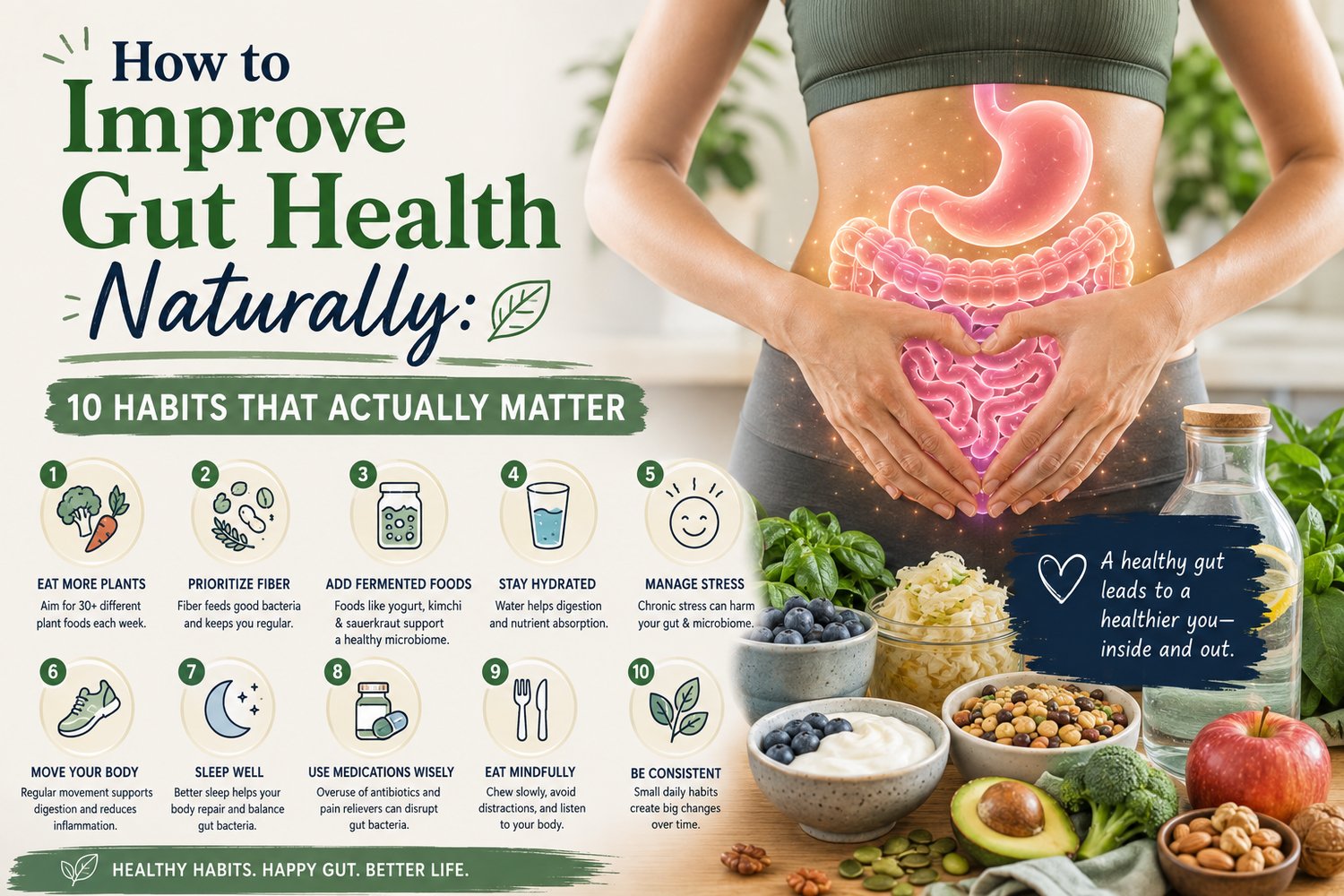
How to Improve Gut Health Naturally: 10 Habits That Actually Matter
Complete Fiber & Gut Health Guide Hub
Gut health advice has become wildly overcomplicated.
Depending on who you're listening to, you supposedly need:
- A probiotic
- A prebiotic
- A greens powder
- Fermented foods
- Bone broth
- Apple cider vinegar
- A microbiome test
- A detox
- A fasting protocol
- A complete elimination diet
before breakfast.
You probably don't.
For most people, supporting digestive health starts with much more ordinary habits:
- Eat enough fiber.
- Eat different plant foods.
- Increase fiber gradually.
- Drink enough fluids.
- Move regularly.
- Sleep.
- Manage stress.
- Avoid unnecessary restriction.
- Use medications appropriately.
- Pay attention to persistent symptoms.
The FDA sets the Daily Value for dietary fiber at 28 grams per day on a 2,000-calorie diet, and NIDDK specifically recommends adequate fiber, fluids, and regular physical activity as basic strategies that can help prevent constipation.
None of that is particularly exotic.
That's the point.
The habits most worth doing for your gut tend to look a lot like the habits worth doing for the rest of your health.
If you're just joining the series, start with 30 Plants Per Week Challenge | Gut Health Plant Diversity Tracker + Excel Dashboard is built specifically around tracking weekly plant diversity.
4. Build Meals Around Fiber Instead of Trying to Fix the Entire Day at Night
A common pattern looks like this:
Breakfast:
Almost no fiber.
Lunch:
Almost no fiber.
Snack:
Almost no fiber.
Dinner:
Emergency giant salad.
That's much harder than spreading fiber across the day.
A simpler meal structure might be:
Breakfast
Oats + berries + seeds
Lunch
Whole grain + vegetables + beans
Snack
Fruit + nuts
Dinner
Potatoes or brown rice + vegetables + another plant
You don't need every meal to be “gut healthy.”
You just need fiber-rich foods to show up repeatedly.
The upcoming High-Fiber Meal Builder & 30-Day Fiber Tracker combines meal planning with daily fiber tracking.
5. Drink Enough Fluids
Hydration gets turned into another wellness competition.
You don't necessarily need a gallon of water.
But fluid intake matters, particularly when you're increasing fiber.
NIDDK recommends drinking plenty of water and other liquids alongside adequate fiber as part of preventing and treating constipation.
Your needs depend on:
- Body size
- Activity
- Climate
- Diet
- Medications
- Medical conditions
You don't need to obsess over an exact universal number.
But if you're eating increasingly large amounts of fiber while drinking almost nothing?
Fix the obvious problem.
Don't Assume Every Beverage Is Ruining Your Gut
Water is useful.
But you don't need to treat every other beverage as toxic.
Coffee.
Tea.
Milk.
Other drinks.
They can all contribute to overall fluid intake depending on your health and preferences.
That doesn't mean:
- Sugary drinks
- Heavy alcohol intake
are nutritionally equivalent.
It simply means hydration advice doesn't need to become:
Plain water or failure.
6. Move Regularly
Exercise doesn't need to be marketed as a microbiome intervention to be worth doing.
Regular physical activity already supports:
- Cardiovascular health
- Metabolic health
- Weight management
- Fitness
It can also help with bowel regularity.
NIDDK specifically includes regular physical activity among the basic strategies that can help prevent constipation.
This doesn't require a brutal workout.
Walking counts.
A Short Walk Is a Great Gut-Health Habit
Try:
- 10 minutes after breakfast
- 10 minutes after lunch
- 10 minutes after dinner
Now you've accumulated 30 minutes without scheduling a formal workout.
If you're sedentary, this is probably more useful than purchasing a supplement marketed for digestive health.
Your digestive tract exists in the same body as your heart, muscles, and metabolism.
Treat the whole body.
7. Pay Attention to Sleep
Sleep isn't a direct fiber substitute.
But gut health doesn't exist independently from the rest of your lifestyle.
Poor sleep can influence:
- Food choices
- Stress
- Appetite
- Meal timing
- Physical activity
Research also suggests that sleep patterns and other lifestyle factors are associated with differences in the gut microbiome, although the relationships are complex and not fully understood.
You don't need to sleep for your bacteria.
Sleep because you need sleep.
Any microbiome benefit is secondary.
Stop Trying to “Hack” Sleep for Gut Health
You don't need:
- A microbiome sleep supplement
- A nighttime gut powder
- A special fasting window
Start with:
- A consistent wake time
- Enough time in bed
- Less late caffeine
- A darker, quieter room
- Fewer late-night interruptions when possible
The gut isn't exempt from the rule that boring habits usually beat hacks.
8. Manage Stress Without Blaming Everything on Cortisol
Stress can absolutely affect digestion.
The gastrointestinal system and nervous system communicate constantly.
That's why some people experience:
- Diarrhea before an important event
- Constipation while traveling
- Bloating during stressful periods
- Appetite changes during anxiety
Those symptoms are real.
But the solution isn't necessarily:
Buy a cortisol supplement.
Useful stress-management strategies can be much simpler:
- Walking
- Exercise
- Better sleep
- Time outside
- Talking with people
- Hobbies
- Therapy when needed
- Reducing avoidable sources of stress
You don't need to make stress another gut-health diagnosis.
The Gut-Brain Axis Is Real—But Don't Overstate It
Your gut and nervous system communicate through multiple pathways.
That's scientifically established.
What's not established is the idea that every:
- Mood problem
- Anxiety disorder
- Cognitive issue
can be solved by “healing the gut.”
Mental-health conditions deserve appropriate treatment.
Eating more beans can be part of a healthy lifestyle.
It is not a replacement for mental-health care.
9. Stop Randomly Eliminating Foods
This is one of the fastest ways to make gut health miserable.
You feel bloated.
You search online.
Now you're removing:
- Gluten
- Dairy
- Beans
- Nightshades
- Lectins
- FODMAPs
- Sugar
- Seed oils
Two weeks later your diet contains:
Chicken.
Rice.
And fear.
Certain therapeutic diets can absolutely have a role in diagnosed digestive conditions. NIDDK notes, for example, that IBS treatment may include individualized dietary approaches such as increased fiber, gluten avoidance in selected circumstances, or a low-FODMAP diet.
But that's different from eliminating foods randomly because they appeared on a social-media “gut inflammation” list.
Restrictive Diets Have Tradeoffs
Every food group you remove can reduce:
- Fiber
- Plant diversity
- Micronutrients
- Convenience
- Enjoyment
If there's a legitimate reason?
Fine.
If there isn't?
You may be solving a problem you don't have.
When symptoms repeatedly follow certain meals, tracking is often smarter than immediately banning entire categories.
The Bloating, Digestion & Food Trigger Tracker is designed to help track meals, symptoms, bowel habits, timing, stress, sleep, and possible patterns without pretending to diagnose food intolerances.
10. Stop Expecting Supplements to Do the Work of a Diet
This is probably the most important final habit.
Supplements can have legitimate uses.
But there is a massive gut-health industry built around selling:
- Probiotics
- Prebiotics
- Fiber powder
- Greens powder
- Digestive enzymes
- “Gut repair” products
- Herbal blends
before people have established the most basic habits.
If your diet contains:
- Very little fiber
- Few plants
- Mostly highly refined foods
adding a probiotic capsule doesn't magically transform the pattern.
Build the foundation first.
What About Probiotics?
Probiotics can have legitimate strain-specific uses.
But:
“Take a probiotic for gut health”
is too vague.
The effects can depend on:
- Species
- Strain
- Dose
- Condition
- Duration
And not everyone needs one.
We'll cover the distinction between probiotics and prebiotics in FREE 7-Day Fiber & Gut Health Kickstart.
Use it to:
- Find your baseline
- Track fiber
- Add plant variety
- Build a few repeatable habits
You're not trying to “reset your microbiome” in seven days.
You're trying to create a routine worth continuing on day eight.
Want a 30-Day System?
The Gut Health & Microbiome Tracker goes further by helping you track:
- Fiber
- Plant variety
- Hydration
- Meals
- Bowel habits
- Symptoms
- Lifestyle patterns
That can be especially useful if your issue isn't lack of information.
It's consistency.
A tracker won't heal your gut.
It can make it much easier to see whether you're actually doing the things you intended to do.
When “Improve Your Gut Health” Isn't Enough
Sometimes you're not dealing with a lifestyle problem.
You're dealing with a medical problem.
Digestive diseases include conditions such as:
- Celiac disease
- Crohn's disease
- IBS
- GERD
- Diverticular disease
- Other gastrointestinal disorders.
Do not assume all chronic digestive symptoms can be solved by:
more fiber + probiotics.
Different conditions require different management.
Symptoms That Deserve Medical Attention
Seek appropriate medical evaluation for symptoms such as:
- Blood in stool
- Black stool
- Severe abdominal pain
- Persistent vomiting
- Unintentional weight loss
- Persistent diarrhea
- Significant ongoing constipation
- New or progressive swallowing problems
- Symptoms that are repeatedly interfering with your life
There is a difference between:
occasional gas
and
persistent unexplained gastrointestinal symptoms.
Don't let wellness content blur that line.
A Simple Gut-Health Scorecard
Instead of rating your microbiome, rate the habits you can actually observe.
Ask:
Fiber
Am I regularly eating fiber-rich foods?
Variety
Am I eating more than the same four plants every week?
Hydration
Am I drinking enough?
Movement
Am I active most days?
Sleep
Am I chronically sleep deprived?
Stress
Do digestive symptoms clearly change during stress?
Symptoms
Are symptoms occasional—or persistent enough to need evaluation?
Supplements
Am I trying to buy my way around a poor diet?
That scorecard is more actionable than knowing the relative percentage of bacteria in one stool sample.
Frequently Asked Questions
What is the fastest way to improve gut health?
There isn't a proven overnight gut-health reset.
A more useful strategy is to gradually improve:
- Fiber intake
- Plant variety
- Hydration
- Physical activity
- Overall dietary quality
Then give the habits time.
What foods improve gut health?
Useful foods include fiber-rich plant foods such as:
- Beans
- Lentils
- Whole grains
- Fruit
- Vegetables
- Nuts
- Seeds
Different fibers can affect gut microbes differently, which is one reason variety matters.
How much fiber should I eat?
The FDA Daily Value is 28 grams per day based on a 2,000-calorie diet, although individual needs vary.
We'll cover personalized intake in What Is Gut Health? A Beginner’s Guide to Your Microbiome, Digestion & Everyday Habits
What Is the Gut Microbiome? How Your Gut Bacteria Affect Digestion & Health
Useful HabitLogics tools:
- FREE 7-Day Fiber & Gut Health Kickstart
- Gut Health & Microbiome Tracker | 30-Day Planner + Excel Dashboard
- High-Fiber Meal Builder & 30-Day Fiber Tracker
Educational Disclaimer
This article is intended for educational purposes only and should not be considered medical advice. Digestive symptoms can have many causes, and appropriate diet or treatment varies based on individual health conditions. Persistent, severe, worsening, or otherwise concerning gastrointestinal symptoms should be evaluated by a qualified healthcare professional.