

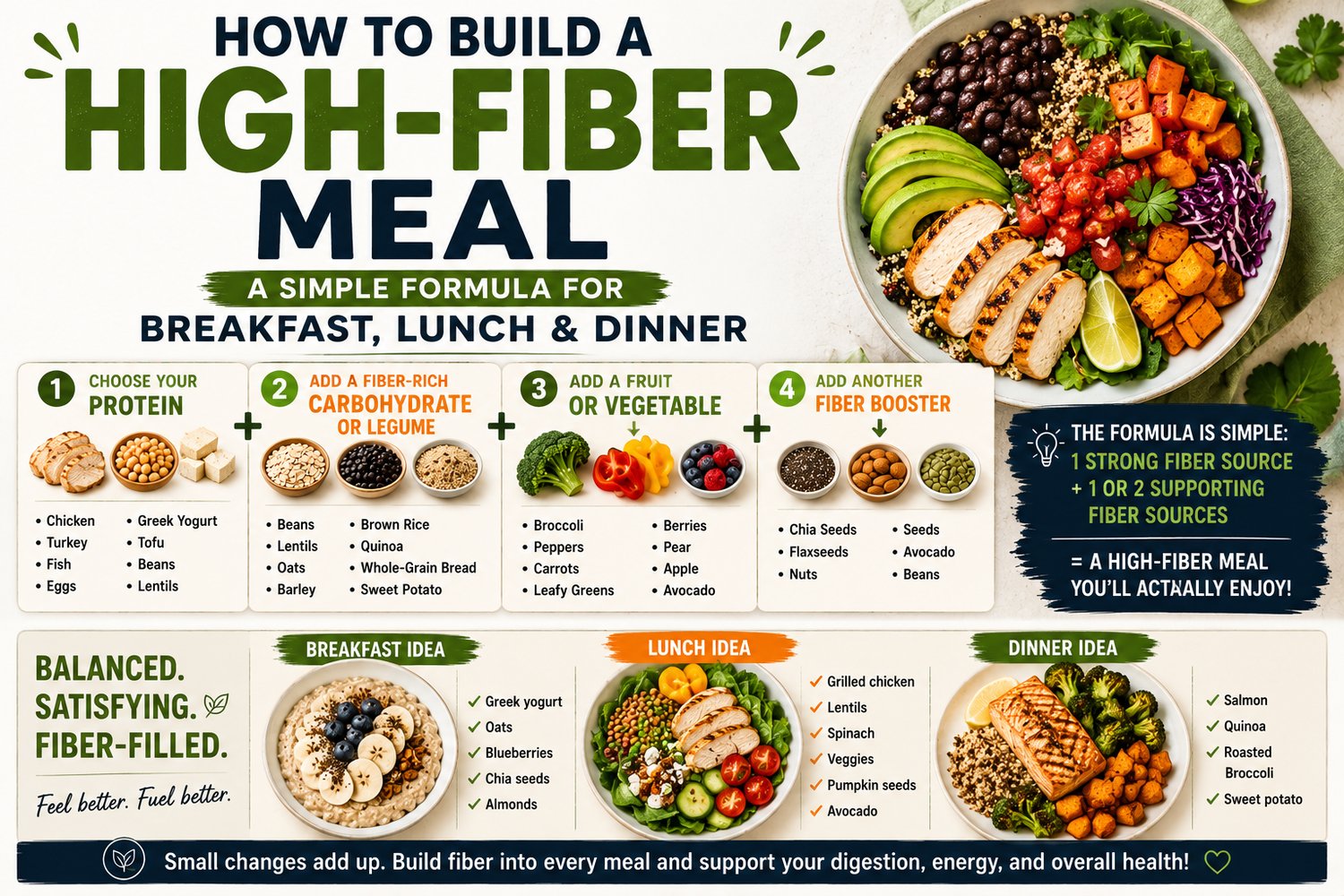
How to Build a High-Fiber Meal: A Simple Formula for Breakfast, Lunch & Dinner
Complete Fiber & Gut Health Guide Hub
You've learned which foods contain fiber.
You've figured out approximately how much fiber you need.
You've got high-fiber breakfast ideas.
You've got high-fiber snacks.
Now comes the part that actually determines whether any of this becomes useful:
How do you turn those foods into normal meals?
Because knowing that:
- Lentils contain fiber
- Raspberries contain fiber
- Oats contain fiber
- Broccoli contains fiber
doesn't automatically answer the question:
“What am I making for dinner?”
That's where a simple meal-building formula helps.
The FDA Daily Value for dietary fiber is 28 grams per day on a 2,000-calorie diet, although individual needs vary.
NIDDK notes that adults generally need about 22–34 grams of fiber per day depending on age and sex, with good sources including whole grains, legumes, fruits, vegetables and nuts.
You don't need to get all of that from one meal.
And you definitely don't need every ingredient on your plate to contain fiber.
Instead, build meals containing:
one strong fiber source + one or two supporting fiber sources.
That's enough to turn surprisingly ordinary meals into high-fiber meals.
If you need ideas for between meals, see High-Fiber Snacks: 25 Easy Ideas to Help You Reach Your Daily Fiber Goal.
Now let's build the actual meals.
The Basic High-Fiber Meal Formula
Here's the framework:
1. Choose Your Protein
Examples:
- Chicken
- Turkey
- Fish
- Eggs
- Greek yogurt
- Cottage cheese
- Tofu
- Beans
- Lentils
2. Add a Fiber-Rich Carbohydrate or Legume
Examples:
- Beans
- Lentils
- Oats
- Barley
- Brown rice
- Quinoa
- Whole-grain bread
- Whole-grain pasta
- Potato with skin
- Sweet potato
3. Add a Fruit or Vegetable
Examples:
- Broccoli
- Peas
- Carrots
- Brussels sprouts
- Peppers
- Berries
- Pear
- Apple
- Avocado
4. Add Another Fiber Booster if Needed
Examples:
- Chia
- Flax
- Nuts
- Seeds
- Beans
- Avocado
That's it.
You do not need:
protein + six vegetables + chia seeds + lentils + quinoa + fermented cabbage + mysterious gut-health powder.
You need a meal you actually want to eat.
Think “Fiber Anchor + Fiber Support”
This makes the formula even easier.
Every meal gets a:
Fiber Anchor
The food doing most of the work.
Then:
Fiber Support
One or two foods adding a few more grams.
For example:
Chicken Burrito Bowl
Fiber anchor: Black beans
Fiber support: Peppers + avocado
The chicken provides protein.
The rice provides carbohydrate.
Neither has to be the primary fiber source.
Your Protein Doesn't Need to Contain Fiber
This is an important concept.
Animal proteins generally contain essentially no dietary fiber.
That includes:
- Chicken
- Beef
- Fish
- Eggs
- Greek yogurt
That does not make them bad foods.
It simply means you need fiber elsewhere in the meal.
For example:
Low-Fiber Meal
Chicken + white rice.
Higher-Fiber Meal
Chicken + white rice + black beans + peppers.
Same basic meal.
Much more fiber.
Stop Trying to Make Every Food “High Fiber”
This is where nutrition gets unnecessarily complicated.
White rice isn't high fiber.
You can still eat it.
Eggs aren't high fiber.
You can still eat them.
Greek yogurt isn't high fiber.
You can still eat it.
The question isn't:
“Does every ingredient contain fiber?”
The question is:
“Does this meal contain enough fiber-rich food?”
That distinction makes eating well much easier.
How Much Fiber Should a Meal Have?
There isn't an official fiber requirement for individual meals.
But let's make this practical.
Suppose your daily goal is:
28 grams.
You could roughly distribute that as:
Breakfast
7 grams
Lunch
8 grams
Snack
4 grams
Dinner
9 grams
Total:
28 grams
That means meals containing roughly 6–10 grams of fiber can make hitting your daily goal significantly easier.
This isn't a rigid rule.
It's a useful planning range.
You Don't Need Exactly 8 Grams at Every Meal
Some days breakfast might contain:
12 grams.
Then lunch only has:
5 grams.
Fine.
Maybe dinner provides:
8 grams.
And snacks provide:
4 grams.
Still fine.
Fiber targets are about the overall dietary pattern.
Don't turn every plate into an accounting exercise.
Formula #1: Protein + Beans + Vegetable
This may be the easiest high-fiber meal formula of all.
Example:
Chicken
Protein.
Black Beans
Fiber + plant protein.
Peppers
More fiber.
Add:
- Rice
- Salsa
- Avocado
if you want.
Now you've got a burrito bowl.
Nothing about it feels like a special “high-fiber meal.”
It's just dinner.
Formula #2: Protein + Whole Grain + Vegetable
Example:
Salmon
Protein.
Barley
Fiber-rich grain.
Broccoli
Additional fiber.
That's a strong meal.
Or:
Chicken
Brown rice
Peas
Same principle.
NIDDK specifically lists whole grains such as whole-wheat bread and pasta, oatmeal and bran cereals among useful fiber sources.
Formula #3: Protein + Potato + Vegetable
Potatoes can absolutely belong in a high-fiber diet.
Try:
Chicken
Baked potato with skin
Broccoli
Add beans if you want even more fiber.
Now you've got an incredibly normal dinner that contributes meaningfully toward your fiber target.
No quinoa required.
Formula #4: Protein + Legume + Whole Grain
This one can become very high fiber.
Try:
Chicken
Lentils
Brown rice
Or:
Ground Turkey
Black beans
Whole-grain tortilla
Add vegetables and you've pushed the fiber even higher.
Beans, lentils and chickpeas are specifically identified by NIDDK as useful dietary fiber sources.
Formula #5: Protein + Two Vegetables + Grain
Example:
Steak
Roasted Brussels sprouts
Carrots
Brown rice
The vegetables and whole grain provide fiber.
The steak provides protein.
Again:
Different foods have different jobs.
Formula #6: Beans or Lentils as the Protein AND Fiber Anchor
Plant-based meals can be even simpler because legumes do double duty.
For example:
Lentil Curry
Lentils provide:
- Fiber
- Protein
- Carbohydrate
Add:
- Vegetables
- Rice
and you've got a complete meal.
Or:
Black Bean Tacos
Black beans.
Whole-grain or corn tortillas.
Vegetables.
Avocado.
Several fiber sources automatically.
High-Fiber Breakfast Formula
Breakfast is easy once you stop thinking in recipes.
Use:
Protein + whole grain + fruit + optional seed
For example:
Greek Yogurt
Protein.
Oats
Fiber.
Raspberries
More fiber.
Chia
More fiber.
Done.
For more combinations, see High-Fiber Breakfast Ideas: 20 Easy Ways to Start Your Day With More Fiber.
Savory High-Fiber Breakfast Formula
Prefer savory?
Use:
Eggs + whole grain + vegetable/fruit + legume
For example:
Eggs
Protein.
Whole-grain toast
Fiber.
Avocado
Fiber.
Black beans
More fiber.
Now breakfast can make a substantial contribution to your daily goal.
High-Fiber Lunch Formula
Lunch often needs to be:
- Fast
- Portable
- Meal-prep friendly
So use:
Protein + grain + beans + vegetable
Example:
Chicken Burrito Bowl
Chicken.
Rice.
Black beans.
Peppers.
Corn.
Salsa.
Avocado.
One bowl.
Several fiber sources.
High-Fiber Sandwich Formula
Sandwiches can work beautifully.
Start with:
Higher-Fiber Whole-Grain Bread
Then add:
Protein
Turkey, chicken, tuna or egg.
Then:
Vegetables
Lettuce.
Tomato.
Peppers.
Avocado.
Add fruit on the side.
Suddenly a basic sandwich lunch contributes meaningful fiber.
High-Fiber Salad Formula
Salad is where people sometimes make things harder than necessary.
Don't build:
lettuce + chicken
and expect a huge amount of fiber.
Lettuce is useful.
But you need stronger fiber sources.
Build:
Greens
Base.
Chicken
Protein.
Chickpeas
Fiber anchor.
Vegetables
Fiber support.
Nuts or Seeds
More fiber.
Now the salad actually contributes something substantial.
Beans Make Salads Much Better for Fiber
This is one of the easiest upgrades.
Take any salad.
Add:
- Chickpeas
- Black beans
- Kidney beans
- Lentils
Now you've added both:
fiber + plant protein.
Canned beans make this almost effortless.
Drain.
Rinse.
Add.
High-Fiber Dinner Formula
Dinner is usually where you have the most room to work.
Use:
Protein + starch + vegetable + optional legume
Example:
Salmon
Protein.
Potato
Fiber-containing starch.
Broccoli
Fiber.
Lentils
Additional fiber.
You don't need the lentils every time.
But adding legumes to several meals per week can make reaching your target dramatically easier.
High-Fiber Pasta Dinner
Pasta night doesn't need to disappear.
Try:
Whole-Grain Pasta
Fiber.
Ground Turkey
Protein.
Tomato Sauce
Plant food.
Vegetables
Peppers, mushrooms, spinach.
Lentils
Optional fiber boost.
Now you've turned pasta into a legitimately fiber-rich meal.
You Can Keep Regular Pasta Too
Don't like whole-grain pasta?
Use regular pasta.
Then add:
- Lentils
- Beans
- Vegetables
The meal can still contain plenty of fiber.
This is the same lesson as white rice.
Don't make one ingredient responsible for the entire meal.
High-Fiber Taco Night
Tacos are almost built for this.
Use:
Protein
Chicken, beef, turkey or beans.
Beans
Fiber.
Corn or whole-grain tortilla
Additional fiber.
Vegetables
Lettuce, peppers, tomato.
Avocado
More fiber.
You can build a very high-fiber meal without anyone at the table thinking:
We're eating gut-health food tonight.
That's ideal.
High-Fiber Burger Night
Yes.
Burger night.
Try:
Burger
Protein.
Whole-grain bun
Fiber.
Beans or bean salad
Fiber.
Vegetable side
More fiber.
Or:
Burger + baked potato with skin + vegetables.
You don't need to eliminate normal meals.
You need to improve their structure.
High-Fiber Pizza Night
Even pizza can fit.
Try adding:
- Peppers
- Mushrooms
- Artichokes
- Spinach
Then pair it with:
- Salad with chickpeas
- Fruit
- Vegetable side
The pizza itself doesn't need to carry your entire fiber target.
Look at the whole meal.
High-Fiber Soup Formula
Soup makes fiber incredibly easy.
Use:
Protein + beans/lentils + vegetables + whole grain or potato
Examples:
Chicken + white bean soup
Lentil vegetable soup
Turkey chili with beans
Beef + barley soup
Minestrone
Soup lets you combine multiple plants without feeling like you're eating enormous quantities of vegetables.
Chili Is a Fiber Cheat Code
Chili may be one of the easiest high-fiber dinners.
Add:
- Kidney beans
- Black beans
- Pinto beans
- Tomatoes
- Peppers
- Onions
Plus:
- Beef
- Turkey
if desired.
You've got protein, fiber and plant variety in one pot.
And leftovers.
Excellent.
High-Fiber Stir-Fry Formula
Try:
Protein
Chicken, shrimp, beef or tofu.
Vegetables
Broccoli, peppers, carrots, peas.
Grain
Brown rice or another whole grain.
Optional Legume
Edamame.
Now you've got several fiber sources.
And frozen stir-fry vegetables make this ridiculously easy.
Frozen Vegetables Make High-Fiber Meals Easier
You do not need to:
Wash.
Peel.
Chop.
Prepare.
every vegetable from scratch.
Keep frozen:
- Broccoli
- Peas
- Mixed vegetables
- Stir-fry blends
available.
Add them directly to meals.
Consistency beats culinary ambition.
Canned Beans Are One of the Best Fiber Shortcuts
Keep several cans around.
Black beans.
Chickpeas.
Kidney beans.
Cannellini beans.
Now you can add fiber to:
- Tacos
- Bowls
- Salads
- Soups
- Pasta
- Eggs
in about 30 seconds.
USDA MyPlate recipes similarly combine ingredients such as brown rice, vegetables and canned beans to build simple fiber-rich dishes.
Use Leftovers to Build Fiber Bowls
This is an excellent way to avoid food waste.
Suppose the refrigerator contains:
- Leftover chicken
- Rice
- Roasted vegetables
Add:
- Canned black beans
- Avocado
- Salsa
Done.
You've turned random leftovers into a high-fiber lunch.
MyPlate encourages mixing and matching staples such as grains, vegetables, fruits and canned or dried beans to repurpose leftovers into meals.
High-Protein + High-Fiber Meals
This is one of the strongest meal combinations you can build.
Ask:
Where's my protein?
Then:
Where's my fiber anchor?
Examples:
Chicken + black beans
Salmon + lentils
Greek yogurt + oats + berries
Eggs + whole-grain toast + avocado
Turkey chili + beans
Cottage cheese + fruit + chia
Simple.
Don't Confuse Protein Foods With Fiber Foods
A chicken breast might contain:
30+ grams of protein.
Great.
Fiber?
Essentially none.
Beans contain:
protein + fiber.
Vegetables contain:
fiber + micronutrients.
Whole grains contain:
fiber + carbohydrate.
This is why meals benefit from combining food groups rather than relying on one “superfood.”
High-Fiber Meals for Weight Loss
Fiber-rich meals can fit well into weight-management diets because many fiber-rich foods provide:
- Food volume
- Plant nutrients
- Structure
- Satiety
But high fiber does not automatically mean low calorie.
Consider:
Nuts
Fiber.
Also calorie-dense.
Seeds
Fiber.
Also calorie-dense.
Avocado
Fiber.
Also calorie-dense.
Peanut butter
Some fiber.
Very calorie-dense.
They're healthy foods.
Portions still matter.
Build Volume With Vegetables and Legumes
If weight loss is a goal, vegetables and legumes can be especially useful.
For example:
Instead of:
Large serving of rice + small serving of chicken
try:
Moderate rice + chicken + beans + vegetables.
You've added:
- Fiber
- Plant variety
- Food volume
without requiring an enormous meal.
You Don't Need to Replace Every Refined Grain
This deserves its own section because nutrition advice often becomes ridiculous here.
If you love:
White rice.
Eat white rice.
Then build fiber around it.
Example:
White Rice
Low fiber.
Black Beans
High fiber.
Peppers
Fiber.
Avocado
Fiber.
Chicken
Protein.
That's a perfectly reasonable high-fiber meal.
Whole Grains Are Still an Easy Upgrade
That said, if you enjoy:
- Brown rice
- Whole-wheat pasta
- Whole-grain bread
- Barley
- Oats
use them.
NIDDK specifically recommends whole grains among good dietary fiber sources.
The point isn't that refined grains are forbidden.
It's that whole grains provide another easy opportunity for fiber.
Read the Nutrition Facts Label
This is particularly useful for:
- Bread
- Tortillas
- Cereal
- Pasta
- Crackers
The FDA Daily Value for dietary fiber is 28 grams, and FDA considers 20% Daily Value or more per serving high and 5% or less low.
Since 20% of 28 grams is about:
5.6 grams
a packaged food containing roughly 6 grams of fiber per serving is making a substantial contribution.
You don't need every packaged food to hit that threshold.
But the label makes comparison easy.
Don't Trust “Multigrain”
Multigrain means:
multiple grains.
It does not necessarily mean:
high fiber.
Same with:
- Wheat bread
- Natural
- Made with whole grains
Look at the Nutrition Facts label.
Fiber grams are more useful than the marketing language on the front.
Beans Can Turn Almost Any Meal Into a Higher-Fiber Meal
Seriously.
Eggs
Add black beans.
Rice bowl
Add beans.
Salad
Add chickpeas.
Soup
Add lentils.
Tacos
Add beans.
Pasta
Add white beans.
Chili
Add several beans.
This is why legumes show up repeatedly throughout this pillar.
They're ridiculously practical.
Add Fruit to Meals Too
Fiber doesn't only come from vegetables.
Add:
- Berries to breakfast
- Apple with lunch
- Pear with a sandwich
- Orange after dinner
Sometimes the easiest way to add fiber to a meal isn't changing the entrée.
It's adding fruit.
NIDDK specifically identifies berries, apples with skin, oranges and pears as useful fiber sources.
Use Nuts and Seeds as Fiber Boosters, Not the Entire Meal
Nuts and seeds are excellent additions.
Try:
Salad
Add almonds.
Oatmeal
Add chia.
Yogurt
Add flax.
Grain bowl
Add pumpkin seeds.
But remember:
They're calorie-dense.
Think:
fiber booster
not:
half the bag because almonds are healthy.
Avocado Is Another Easy Fiber Booster
Avocado works in:
- Eggs
- Sandwiches
- Bowls
- Tacos
- Salads
- Toast
MyPlate includes avocado within its vegetable-group guidance for meal planning purposes.
It also adds fat, which can make meals more satisfying.
Again:
Portions matter if calories are important to your goal.
How to Upgrade a Low-Fiber Meal
Let's take ordinary meals and fix them.
Meal 1
Before
Chicken + white rice.
After
Chicken + white rice + black beans + broccoli.
Meal 2
Before
Eggs + toast.
After
Eggs + whole-grain toast + avocado + berries.
Meal 3
Before
Turkey sandwich.
After
Turkey on higher-fiber bread + vegetables + apple.
Meal 4
Before
Pasta + meat sauce.
After
Pasta + meat sauce + lentils + vegetables.
Meal 5
Before
Greek yogurt.
After
Greek yogurt + raspberries + chia.
You don't need completely new meals.
You need better versions of meals you already eat.
The “One More Plant” Rule
If meal planning feels overwhelming, try this:
Before eating, ask:
Can I add one more plant?
Examples:
Chicken + rice?
Add broccoli.
Eggs + toast?
Add berries.
Sandwich?
Add an apple.
Tacos?
Add black beans.
Yogurt?
Add chia.
This one question can gradually increase both:
- Fiber
- Plant variety
without turning eating into homework.
The “Beans Three Times a Week” Strategy
Another easy approach:
Instead of obsessing over daily numbers, intentionally include beans or lentils in:
three meals per week.
For example:
Monday
Black bean burrito bowl.
Wednesday
Lentil soup.
Saturday
Turkey chili with kidney beans.
That's already a major improvement for someone who currently eats legumes almost never.
The “Fruit Twice a Day” Strategy
Fruit is easy.
Try:
Breakfast
Berries.
Snack or Lunch
Apple.
Now you've added two fiber sources without cooking anything.
Combine that with:
- Vegetables
- Whole grains
- Beans
and your daily fiber target becomes much easier.
The “Vegetable at Lunch and Dinner” Strategy
Again:
Simple.
Not:
nine servings of vegetables.
Just:
Lunch
Include a vegetable.
Dinner
Include a vegetable.
Frozen counts.
Canned counts.
Cooked counts.
Fresh counts.
You're building consistency.
A Sample High-Fiber Day
Here's what this can look like.
Breakfast
Greek yogurt + oatmeal + raspberries + chia
Lunch
Chicken burrito bowl with rice + black beans + peppers
Snack
Apple + almonds
Dinner
Salmon + potato with skin + broccoli
Nothing unusual.
Nothing requiring a specialty supplement.
Just fiber distributed throughout the day.
Another Sample Day
Breakfast
Eggs + whole-grain toast + avocado
Lunch
Turkey sandwich on higher-fiber bread + pear
Snack
Popcorn
Dinner
Beef and bean chili + vegetables
Again:
Normal food.
That's the point.
A Budget-Friendly High-Fiber Day
High-fiber eating doesn't need to be expensive.
Breakfast
Oatmeal + banana
Lunch
Rice + black beans + frozen vegetables
Snack
Popcorn
Dinner
Potato + lentils + carrots + eggs
Foods like:
- Oats
- Beans
- Lentils
- Potatoes
- Popcorn
- Frozen vegetables
can be very budget-friendly fiber sources.
A High-Protein, High-Fiber Day
If protein is also a priority:
Breakfast
Greek yogurt + oats + berries + chia
Lunch
Chicken + black beans + rice + vegetables
Snack
Cottage cheese + pear
Dinner
Salmon + lentils + broccoli
Now you're deliberately building both nutrients into the day.
Increase Fiber Gradually
If you're currently eating:
10–15 grams per day
don't suddenly build:
10 grams into every meal.
NIDDK recommends adding fiber a little at a time so your body can adjust.
Start with:
One upgraded meal.
Then:
Two.
Then:
Three.
For a full strategy, see How to Increase Fiber Without Bloating, Gas or Digestive Discomfort.
Fluids Matter as Fiber Increases
NIDDK also recommends adequate water and other liquids to help fiber work better and make stool softer and easier to pass.
That doesn't mean you need to carry a gallon jug everywhere.
It means:
Don't dramatically increase fiber while consistently drinking very little fluid.
What If High-Fiber Meals Make You Bloated?
First look at:
- Portion size
- Speed of fiber increase
- Beans and legumes
- Added fiber ingredients
- Large amounts of raw vegetables
- Constipation
- Individual food tolerance
Don't immediately conclude:
Fiber is bad for me.
And don't eliminate six food groups simultaneously.
Change one variable.
Observe.
Adjust.
Track Food and Symptoms if You Can't Identify the Problem
If certain meals consistently cause:
- Bloating
- Gas
- Cramping
- Bowel changes
the Bloating, Digestion & Food Trigger Tracker can help you track:
- Foods
- Portions
- Fiber
- Symptoms
- Bowel habits
- Patterns
It's not a diagnostic tool.
It's a way to replace:
“Something I eat bothers me.”
with better information.
IBS May Require a More Individualized Approach
People with IBS may respond differently to different fiber types.
NIDDK notes that soluble fiber may be particularly helpful for IBS symptoms, while fiber increases can also contribute to gas for some people.
If you have diagnosed IBS or significant chronic gastrointestinal symptoms, individualized guidance from a healthcare professional or registered dietitian may be more useful than simply chasing the highest possible fiber number.
Use a Meal Builder Instead of Memorizing Recipes
Recipes are useful.
But knowing how to build a meal is more powerful.
Because tonight you might have:
Chicken.
Rice.
Beans.
Broccoli.
Tomorrow:
Turkey.
Potatoes.
Peas.
Friday:
Salmon.
Barley.
Carrots.
The ingredients change.
The structure doesn't.
That's how a nutrition habit becomes flexible.
The High-Fiber Meal Builder Can Do the Tracking for You
If you want a structured way to put this formula into practice, the High-Fiber Meal Builder & 30-Day Fiber Tracker is designed specifically for this.
It helps you:
- Set your fiber target
- Build meals
- Track daily fiber
- Monitor consistency
- See progress over 30 days
Instead of wondering:
“Was today actually high fiber?”
you can see the pattern.
Want the Meals Already Planned?
If meal building itself feels like too much work, the High-Fiber Meal Plan & Recipe System takes the next step.
It includes:
- 28-day meal plan
- Recipes
- Grocery lists
- Meal-planning tools
- Excel dashboard
That's the better fit if you want:
“Tell me what to eat.”
rather than:
“Teach me how to build it.”
Start Free if You're Still Learning
The FREE 7-Day Fiber & Gut Health Kickstart can help you establish:
- Your baseline fiber intake
- Daily habits
- Plant variety
- Easy opportunities for improvement
You don't need to overhaul your entire diet before starting.
Frequently Asked Questions
What makes a meal high in fiber?
A high-fiber meal usually contains several fiber-rich plant foods, such as:
- Beans
- Lentils
- Whole grains
- Fruit
- Vegetables
- Nuts
- Seeds
NIDDK identifies all of these categories as useful fiber sources.
Rather than relying on one food, combine several moderate sources.
How much fiber should be in a meal?
There is no official meal-specific requirement.
If your daily goal is around 28 grams, roughly 6–10 grams per meal can be a useful practical range when fiber is also coming from snacks.
Individual needs vary.
What is the easiest way to add fiber to a meal?
Some of the easiest additions are:
- Beans
- Frozen vegetables
- Fruit
- Higher-fiber bread
- Chia
- Lentils
Adding canned beans or a serving of fruit requires almost no additional cooking.
What is a high-protein, high-fiber meal?
Examples include:
- Chicken + black beans + vegetables
- Salmon + lentils + broccoli
- Eggs + avocado + whole-grain toast
- Greek yogurt + oats + berries + chia
- Turkey chili + beans
The protein source and fiber source don't need to be the same food.
Can I eat white rice on a high-fiber diet?
Yes.
White rice contains relatively little fiber, but the entire meal can still be fiber-rich.
Pair it with:
- Beans
- Vegetables
- Avocado
- Lentils
You do not need every ingredient to be high fiber.
Are potatoes good for a high-fiber meal?
Potatoes contribute dietary fiber, particularly when the edible skin is included.
Pair potatoes with:
- Vegetables
- Beans
- Lentils
to build a more fiber-rich meal.
Are beans the easiest way to increase meal fiber?
They're certainly one of the easiest.
Beans provide both:
- Fiber
- Plant protein
and can be added to:
- Bowls
- Tacos
- Soups
- Salads
- Chili
- Pasta
NIDDK specifically lists beans, lentils, soybeans and chickpeas as good fiber sources.
Do vegetables alone provide enough fiber?
They can contribute significantly, but you don't need to rely exclusively on vegetables.
Fiber also comes from:
- Whole grains
- Legumes
- Fruit
- Nuts
- Seeds
Using several categories usually makes reaching your target easier.
Key Takeaways
- The FDA Daily Value for dietary fiber is 28 grams on a 2,000-calorie diet.
- Adult fiber needs commonly fall around 22–34 grams depending on age and sex.
- Build meals around a fiber anchor + one or two supporting fiber sources.
- Your protein source does not need to contain fiber.
- Beans and lentils are especially useful because they provide both fiber and plant protein.
- Whole grains provide another easy opportunity to increase fiber.
- Fruit can increase meal fiber without requiring additional cooking.
- Frozen vegetables and canned beans absolutely work.
- You don't need to eliminate white rice, regular pasta or other lower-fiber foods.
- Look at the fiber content of the entire meal rather than judging individual ingredients.
- A practical meal may contain roughly 6–10 grams of fiber, depending on your overall daily target.
- High-protein and high-fiber eating work well together.
- Nuts, seeds and avocado can boost fiber but are calorie-dense.
- Use Nutrition Facts labels to compare packaged foods.
- FDA considers 20% DV or more per serving high in a nutrient.
- Increase fiber gradually if your current intake is low.
- Adequate fluids become particularly important as fiber intake increases.
- The best high-fiber meal is one that fits foods you already enjoy.
Final Thoughts
Building a high-fiber meal doesn't require a recipe.
You really need to answer three questions:
Where's my protein?
Where's my main fiber source?
Can I add one more plant?
That's it.
Chicken + rice?
Add beans and broccoli.
Eggs + toast?
Use whole-grain toast and add fruit.
Pasta?
Add lentils and vegetables.
Tacos?
Add black beans and avocado.
Greek yogurt?
Add berries and chia.
You don't need to completely change what you eat.
You need to make the meals you already enjoy work harder for you.
Do that consistently across breakfast, lunch and dinner, and suddenly reaching your fiber target becomes far less complicated.
Continue the Fiber & Gut Health Series
Already published:
- What Is Gut Health? A Beginner’s Guide to Your Microbiome, Digestion & Everyday Habits
- What Is the Gut Microbiome? How Your Gut Bacteria Affect Digestion & Health
- How to Improve Gut Health Naturally: 10 Habits That Actually Matter
- Fiber for Gut Health: Why It Matters & What It Actually Does
- How Much Fiber Do You Need Per Day? A Practical Guide for Men & Women
- 30 Best High-Fiber Foods: Easy Foods to Help You Reach Your Fiber Goal
- How to Increase Fiber Without Bloating, Gas or Digestive Discomfort
- High-Fiber Breakfast Ideas: 20 Easy Ways to Start Your Day With More Fiber
- High-Fiber Snacks: 25 Easy Ideas to Help You Reach Your Daily Fiber Goal
Coming next in the series:
High-Fiber Meal Plan: How to Eat More Fiber Without Overhauling Your Diet
Then we'll move deeper into plant diversity and the microbiome.
Useful HabitLogics resources:
- FREE 7-Day Fiber & Gut Health Kickstart
- High-Fiber Meal Builder & 30-Day Fiber Tracker
- High-Fiber Meal Plan & Recipe System
- Bloating, Digestion & Food Trigger Tracker
Educational Disclaimer
This article is intended for educational purposes only and should not be considered individualized medical or nutrition advice. Fiber needs and tolerance vary, especially for people with gastrointestinal conditions, bowel narrowing, a history of bowel obstruction, or specific dietary restrictions. Increase fiber gradually and seek appropriate medical care for persistent, severe or unexplained digestive symptoms.