

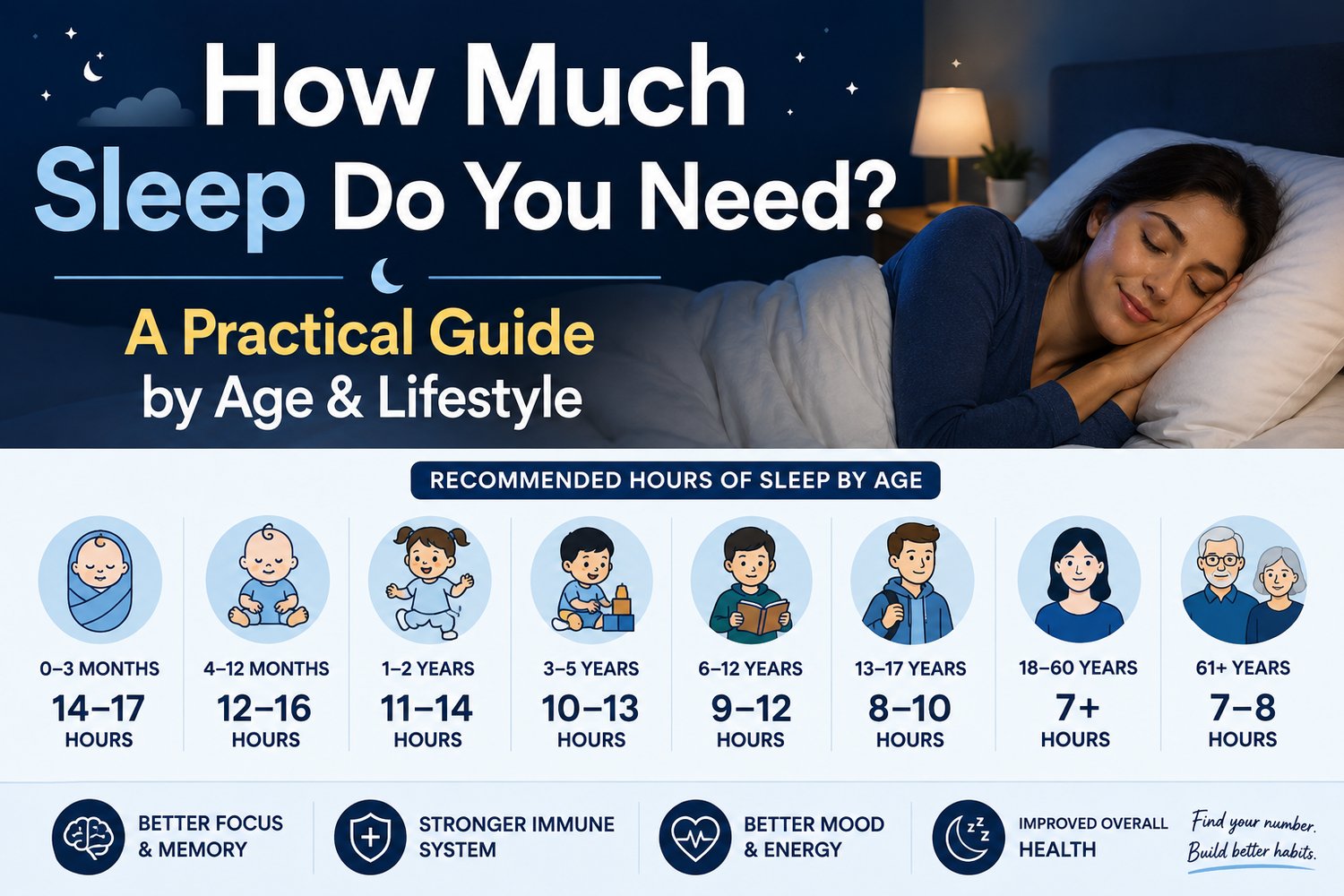
How Much Sleep Do You Need? A Practical Guide by Age & Lifestyle
The Complete Sleep & Recovery Guide
You've probably heard the rule:
Everyone needs eight hours of sleep.
It's simple.
It's memorable.
It's also not quite how sleep works.
Eight hours is a perfectly reasonable target for many people, but there isn't one exact amount of sleep that every human needs every night.
Sleep needs change throughout life. They can also vary somewhat between individuals and circumstances.
The CDC's current recommendations, for example, say adults ages 18–60 should generally get at least seven hours of sleep, while teenagers need considerably more.
And even knowing the recommended number doesn't answer the most important practical question:
How much sleep do YOU need to feel and function well?
That's what we're going to figure out.
How Much Sleep Do Adults Need?
For healthy adults, the American Academy of Sleep Medicine and Sleep Research Society recommend regularly getting seven or more hours of sleep per night to promote optimal health.
Notice what that recommendation doesn't say.
It doesn't say:
Every adult requires exactly eight hours and anything else is unhealthy.
The expert consensus process found that seven to nine hours was an appropriate range for adult health, while the final public-health recommendation established seven or more hours as the threshold for healthy adults.
The CDC breaks its recommendations down further by age:
- Adults 18–60: 7 or more hours
- Adults 61–64: 7–9 hours
- Adults 65 and older: 7–8 hours
Those numbers are useful starting points.
They're not personal prescriptions.
Recommended Sleep by Age
Sleep needs change dramatically throughout life.
According to current CDC recommendations:
Newborns, 0–3 months: 14–17 hours
Infants, 4–12 months: 12–16 hours, including naps
Toddlers, 1–2 years: 11–14 hours, including naps
Preschoolers, 3–5 years: 10–13 hours, including naps
School-age children, 6–12 years: 9–12 hours
Teenagers, 13–17 years: 8–10 hours
Adults, 18–60 years: 7 or more hours
Adults, 61–64 years: 7–9 hours
Adults, 65+ years: 7–8 hours
The AASM's pediatric consensus recommendations are similar, recommending 12–16 hours for infants ages 4–12 months, 11–14 for ages 1–2, 10–13 for ages 3–5, 9–12 for ages 6–12, and 8–10 for teenagers.
The obvious pattern:
We generally need less sleep as we move from infancy into adulthood.
But that doesn't mean sleep becomes unimportant once you're grown.
Seven hours isn't the finish line where sleep suddenly stops mattering.
Is 7 Hours of Sleep Enough?
For some adults, yes.
Seven hours falls within established recommendations for healthy adults.
But there's an important distinction between:
"Seven hours meets the general recommendation."
and
"Seven hours is definitely enough for me."
Those aren't necessarily the same thing.
If you're regularly getting about seven hours and you:
- Wake reasonably refreshed
- Stay alert during the day
- Don't constantly fight sleepiness
- Function well mentally and physically
- Don't need enormous amounts of caffeine to survive the afternoon
then seven hours may be working reasonably well for you.
If you're sleeping seven hours and walking around feeling like your battery is permanently stuck at 18%, that's useful information too.
Don't use the minimum recommendation to argue with your own body.
Do You Really Need 8 Hours of Sleep?
Maybe.
Eight hours sits comfortably within the amount of sleep considered appropriate for most adults.
But there's nothing magical about 8:00.
Someone might function very well with around seven and a half hours.
Another person might consistently feel best closer to eight and a half.
The AASM notes that individual sleep requirements can be influenced by genetic, behavioral, medical and environmental factors.
So instead of treating eight hours as a universal law, think of it as a useful reference point.
The better question is:
Am I consistently getting enough sleep for my body and lifestyle?
Sleep Need vs. Time in Bed
Here's another reason sleep math gets messy:
Eight hours in bed does not necessarily equal eight hours asleep.
Imagine you:
Go to bed at 10:00 p.m.
Scroll until 10:30.
Try to sleep.
Actually fall asleep around 10:50.
Wake twice during the night.
Wake for good at 5:50.
Stay in bed until your 6:00 alarm.
Technically:
10 p.m. → 6 a.m. = eight hours in bed.
But you didn't sleep for eight hours.
That's why simply subtracting bedtime from wake time can overestimate your actual sleep.
You don't need to calculate every minute obsessively, but it's worth recognizing the difference between:
sleep opportunity
and
actual sleep.
This also connects directly to What Is Sleep Quality? How to Know If You’re Actually Sleeping Well.
Sleep duration matters, but duration alone doesn't tell you whether your sleep is continuous, refreshing or sufficient for good daytime functioning.
Why Your Sleep Needs Can Change
Your ideal sleep amount isn't necessarily frozen for your entire adult life.
There are periods when you may need more recovery.
You're Recovering From Sleep Debt
If you've been consistently undersleeping, one longer night doesn't necessarily erase the consequences immediately.
The AASM specifically notes that sleeping more than nine hours may sometimes be appropriate for people recovering from sleep debt.
If you've spent an entire week sleeping five or six hours a night, sleeping longer on Saturday isn't evidence that you're "lazy."
Your body may simply be taking advantage of an opportunity to recover.
That doesn't make chronic weekday sleep deprivation a good strategy, though.
You're Sick or Recovering
Illness can change sleep needs.
The adult sleep consensus statement also notes that longer sleep may be appropriate for individuals with illnesses.
If your body is asking for more sleep while you're sick, forcing yourself to stick to some arbitrary eight-hour maximum isn't particularly useful.
Your Training or Activity Level Changes
Hard physical training creates recovery demands.
Sleep plays an important role in physical recovery, which is one reason athletes and highly active people often pay close attention to it.
That doesn't mean adding a workout automatically means you need precisely 43 additional minutes of sleep.
Human physiology isn't that tidy.
But if you've significantly increased your training load and suddenly find yourself needing more sleep, don't immediately treat that as a problem.
We'll dig much deeper into this later in the Sleep & Recovery pillar when we cover sleep and muscle recovery.
Stress Can Change How Rested You Feel
A stressful week can make eight hours feel very different from eight hours during a relaxing vacation.
Stress may make it harder to fall asleep, contribute to nighttime awakenings or simply leave you feeling mentally drained during the day.
That doesn't necessarily mean your biological sleep requirement suddenly changed dramatically.
It may mean your sleep quality or overall recovery changed.
That's an important distinction.
Can You Train Yourself to Need Less Sleep?
This idea is incredibly appealing.
If you could reduce your sleep from eight hours to five, you'd gain roughly three extra hours every day.
You could exercise.
Build a business.
Learn Spanish.
Finally organize that closet.
Watch half a season of something on Netflix.
Unfortunately, routinely restricting sleep doesn't mean your biological need for sleep simply disappears.
The AASM consensus concluded that regularly sleeping fewer than seven hours is associated with adverse outcomes including impaired performance, more errors and greater accident risk, along with multiple long-term health associations.
One of the traps with insufficient sleep is that getting used to feeling tired isn't the same thing as eliminating your need for sleep.
If you're routinely sacrificing sleep to manufacture more waking hours, there's a good chance you're borrowing those hours rather than creating them for free.
What About People Who Say They Only Need 5 Hours?
There are individual differences in sleep need.
But "I only need five hours" deserves some skepticism if it really means:
I sleep five hours, wake to an alarm, drink three coffees and crash on the couch every weekend.
That's not exactly compelling evidence.
For adults, regularly sleeping fewer than seven hours falls below the AASM recommendation.
Rather than comparing yourself with the coworker who claims to sleep four hours and feel incredible, pay attention to your own patterns and functioning.
And remember:
People also claim they can drive perfectly after six beers.
Self-assessment has limitations. 😂
How to Tell If You're Getting Enough Sleep
This is where the recommendations become practical.
Instead of asking only whether you hit seven or eight hours, look at what happens when you're awake.
You Usually Wake Feeling Reasonably Refreshed
You don't have to spring out of bed like a Disney character.
A little morning grogginess can happen.
But routinely waking completely exhausted despite adequate time in bed deserves attention.
You Aren't Constantly Fighting Daytime Sleepiness
If you regularly struggle to stay awake while reading, watching television, sitting in meetings or performing quiet tasks, your sleep deserves a closer look.
Significant daytime sleepiness can also be a sign of an underlying sleep disorder or another health issue, so don't automatically assume that simply going to bed earlier will solve it.
You Don't Need Extreme Weekend Catch-Up Sleep
Sleeping a little longer on weekends isn't automatically concerning.
But if you're sleeping six hours Monday through Friday and then routinely sleeping until noon Saturday and Sunday, your body may be telling you something about the rest of the week.
NHLBI recommends keeping weekday and weekend sleep schedules reasonably similar, ideally limiting the difference to about an hour when possible, because large schedule shifts can disrupt the body's sleep-wake rhythm.
Real life won't always cooperate.
The goal is consistency, not bedtime prison.
Your Energy Is Relatively Stable
Everybody has low-energy days.
But if you're constantly dragging yourself through the afternoon, relying heavily on caffeine and counting the minutes until you can lie down, investigate your sleep.
It may not be the only cause.
But it's worth examining.
How to Find Your Personal Sleep Sweet Spot
You don't need a laboratory.
Try a simple experiment.
For one to two weeks, track:
- Bedtime
- Approximate time you fell asleep
- Wake time
- Nighttime awakenings
- Approximate total sleep
- Morning energy
- Daytime energy
- Caffeine timing
- Exercise
- Unusual stress
- Alcohol or late meals
Don't change twelve things simultaneously.
First establish your baseline.
That's the same approach we introduced in our guide to sleep quality:
Track → Identify → Adjust → Repeat.
If you consistently sleep around 6½ hours and feel exhausted, try creating more sleep opportunity.
Maybe start with an additional 30 minutes.
Then watch what happens.
Do you wake more easily?
Does your afternoon energy improve?
Do you rely less on caffeine?
Does your mood feel more stable?
Does getting eight hours consistently feel noticeably better than seven?
That's much more useful than blindly deciding that some internet sleep calculator knows exactly how much sleep you personally require.
Start With Wake Time, Not a Fantasy Bedtime
Here's a practical way to approach sleep scheduling.
Most adults don't have unlimited control over when they wake up.
Work starts.
Kids need to get to school.
The dog has apparently signed a contract requiring breakfast at 5:47 a.m.
So start with your required wake time and work backward.
If you need to wake at 6:00 a.m. and you're aiming for around eight hours of actual sleep, you probably shouldn't be getting into bed at midnight.
And remember that you likely won't sleep every second you're in bed.
Your sleep schedule needs to provide enough opportunity for the amount of sleep you're targeting.
This sounds painfully obvious.
Yet one of the most common ways people become chronically sleep deprived is simply staying awake too long.
There isn't always a mysterious sleep problem.
Sometimes bedtime is just too late.
Consistency Matters Alongside Duration
Getting enough total sleep is important, but healthy sleep involves more than duration.
The AASM describes healthy sleep as involving adequate duration, good quality, appropriate timing and regularity, along with the absence of sleep disturbances or disorders.
That's why:
5 hours → 10 hours → 6 hours → 9 hours → 5 hours
isn't necessarily equivalent to establishing a reasonably consistent routine.
NHLBI recommends maintaining similar bedtimes and wake times from day to day.
You don't need to become obsessive.
But your body generally benefits from some predictability.
What If You Sleep 8–9 Hours and Still Feel Tired?
This is where simply telling people to "get more sleep" becomes inadequate.
If you're consistently giving yourself enough sleep opportunity but still wake exhausted, possibilities include:
- Poor sleep quality
- Frequent awakenings
- An inconsistent sleep schedule
- Medications or substances affecting sleep
- Stress
- Medical conditions
- Sleep disorders
Sleep apnea, for example, can repeatedly disrupt sleep even if someone spends plenty of time in bed.
Persistent daytime sleepiness despite apparently adequate sleep is worth discussing with a qualified healthcare professional.
Don't keep adding hours indefinitely and assume that's automatically the solution.
Sometimes the problem isn't how long you're sleeping.
It's what's happening while you're asleep.
Should You Track Your Sleep?
You don't have to.
But tracking can be extremely helpful when you're trying to answer:
How much sleep actually works best for me?
The trick is to use tracking as an investigation rather than a competition.
You don't need a perfect sleep score.
You don't need to hit exactly eight hours every night.
And you definitely don't need to wake at 3:14 a.m., look at your smartwatch and become stressed because you apparently haven't accumulated enough deep sleep.
That somewhat defeats the purpose. 😂
Look at trends instead.
If you'd like a structured starting point, the FREE 7-Day Sleep Reset | Sleep & Recovery Starter Kit helps you track your sleep and daily habits for a week so you can identify patterns before trying to change everything.
Going Beyond a 7-Day Baseline
A week can reveal obvious patterns.
Several weeks can reveal much more.
Maybe you discover that:
You consistently feel best after about 7½–8 hours.
Your energy drops after several consecutive short nights.
Late caffeine corresponds with more difficulty falling asleep.
Your weekend schedule is dramatically different from your weekday schedule.
Exercise days seem to produce better sleep.
Stressful days consistently affect your bedtime.
That's where longer-term tracking becomes useful.
The Sleep Recovery Planner | Sleep Tracker and Energy Journal combines a fillable sleep planner with an Excel dashboard so you can track sleep, energy, caffeine, evening routines and recovery patterns over time.
The point isn't collecting data for the sake of collecting data.
It's using that information to make better decisions.
What About Sleep and Weight Loss?
Sleep duration also becomes relevant when you're working on nutrition, exercise or weight management.
Regularly sleeping fewer than seven hours has been associated with weight gain and obesity, among other adverse health outcomes. That doesn't mean insufficient sleep automatically causes weight gain in every individual or that sleeping longer magically causes fat loss.
Weight regulation is far more complicated than that.
But sleep can interact with energy, appetite, food choices, exercise and recovery—all of which can make weight-management behaviors easier or harder to maintain.
If that's specifically what you're trying to understand, the Sleep + Weight Loss System is designed to track sleep alongside hunger, night eating and weight-management behaviors.
We'll also cover the science and practical implications much more deeply later in this series.
Frequently Asked Questions
Is 6 hours of sleep enough?
Six hours is below the AASM recommendation that healthy adults regularly obtain at least seven hours of sleep. The expert panel also concluded that six hours or less was inappropriate for supporting optimal adult health.
An occasional six-hour night happens. Regularly restricting yourself to six hours is different.
Is 7 hours of sleep enough?
Seven hours meets the minimum recommendation for healthy adults, and some people function well at around that amount.
Pay attention to how refreshed and alert you are rather than assuming seven hours must be ideal for you personally.
Is 8 hours of sleep enough?
Eight hours falls comfortably within the amount considered appropriate for most adults.
For many people, it's an excellent target.
It simply isn't a universal requirement.
Is 9 hours of sleep too much?
Not necessarily.
The AASM consensus statement notes that sleeping more than nine hours may be appropriate for young adults, people recovering from sleep debt and people who are ill. The health implications of regularly sleeping more than nine hours for other adults are less certain.
If you routinely require unusually long sleep and still feel exhausted, consider discussing that pattern with a healthcare professional.
Do older adults need less sleep?
Sleep recommendations change somewhat with age, but older adults still need substantial sleep. The CDC recommends 7–9 hours for adults ages 61–64 and 7–8 hours for adults 65 and older.
Do teenagers need more sleep than adults?
Yes.
The AASM recommends that teenagers ages 13–18 regularly get 8–10 hours of sleep per 24 hours.
Can I catch up on sleep during the weekend?
Sleeping longer after insufficient sleep may help with recovery, but routinely short-changing sleep during the week and dramatically shifting your schedule every weekend isn't an ideal long-term system.
NHLBI recommends keeping weekday and weekend schedules reasonably close when possible.
Key Takeaways
There isn't one magical number of hours that guarantees perfect sleep for everyone.
For healthy adults, seven or more hours per night is the established general recommendation. Many adults will function best somewhere around the commonly discussed seven-to-nine-hour range.
But the number is only your starting point.
The better questions are:
Am I getting enough sleep consistently?
Do I wake reasonably refreshed?
Am I alert during the day?
Am I constantly catching up on sleep?
What happens when I give myself a little more sleep opportunity?
Your ideal sleep routine isn't necessarily the one that produces exactly eight hours.
It's the one that consistently gives you enough good-quality sleep to recover and function well.
Start with the recommendations.
Then pay attention to your own patterns.
That's how you turn a generic sleep guideline into something useful.
Start Your Sleep Baseline
If you're unsure whether you're actually getting enough sleep, don't rely on memory alone.
Use the FREE 7-Day Sleep Reset | Sleep & Recovery Starter Kit to track your sleep, energy and habits for one week.
Then look for patterns.
That's considerably more useful than arguing with yourself every morning about whether 6 hours and 47 minutes "basically counts as seven."
Previously in the Sleep & Recovery series:
What Is Sleep Quality? How to Know If You’re Actually Sleeping Well
Next in the Sleep & Recovery series:
Sleep Stages Explained: REM, Deep Sleep & What Happens While You Sleep
Medical Disclaimer: This article is for educational and informational purposes only and is not intended as medical advice, diagnosis or treatment. Individual sleep needs can vary. If you consistently experience significant daytime sleepiness, persistent difficulty sleeping, unusually long sleep requirements, loud snoring or gasping during sleep, or other concerning symptoms, speak with a qualified healthcare professional.