

How Much Fiber Do You Need Per Day? A Practical Guide for Men & Women
Complete Fiber & Gut Health Guide Hub
If you've decided to eat more fiber, the obvious next question is:
How much do I actually need?
You'd think there would be one simple answer.
There isn't.
You may see:
25 grams.
28 grams.
30 grams.
38 grams.
And depending on the context, all of those numbers can be legitimate.
The FDA uses a Daily Value of 28 grams of fiber per day for a 2,000-calorie diet on Nutrition Facts labels.
The National Academies' Dietary Reference Intakes, meanwhile, set different Adequate Intakes based on age and sex. For adults, those range from 21 to 38 grams per day depending on the group.
So the useful answer isn't:
Everyone needs exactly 28 grams.
It's:
Most adults should be somewhere in roughly the 20s to upper 30s, with the appropriate target depending on age, sex, calorie needs, health, and individual tolerance.
And if you're currently eating 10 grams?
Your first goal probably shouldn't be obsessing over whether your theoretical target is 28 or 38.
It should be:
Eat more than 10.
If you're new to this series, start with What Is Gut Health?, What Is the Gut Microbiome?, and How to Improve Gut Health Naturally.
And for the deeper explanation of why we're focusing so heavily on fiber, read Fiber for Gut Health: Why It Matters & What It Actually Does.
Now let's figure out your number.
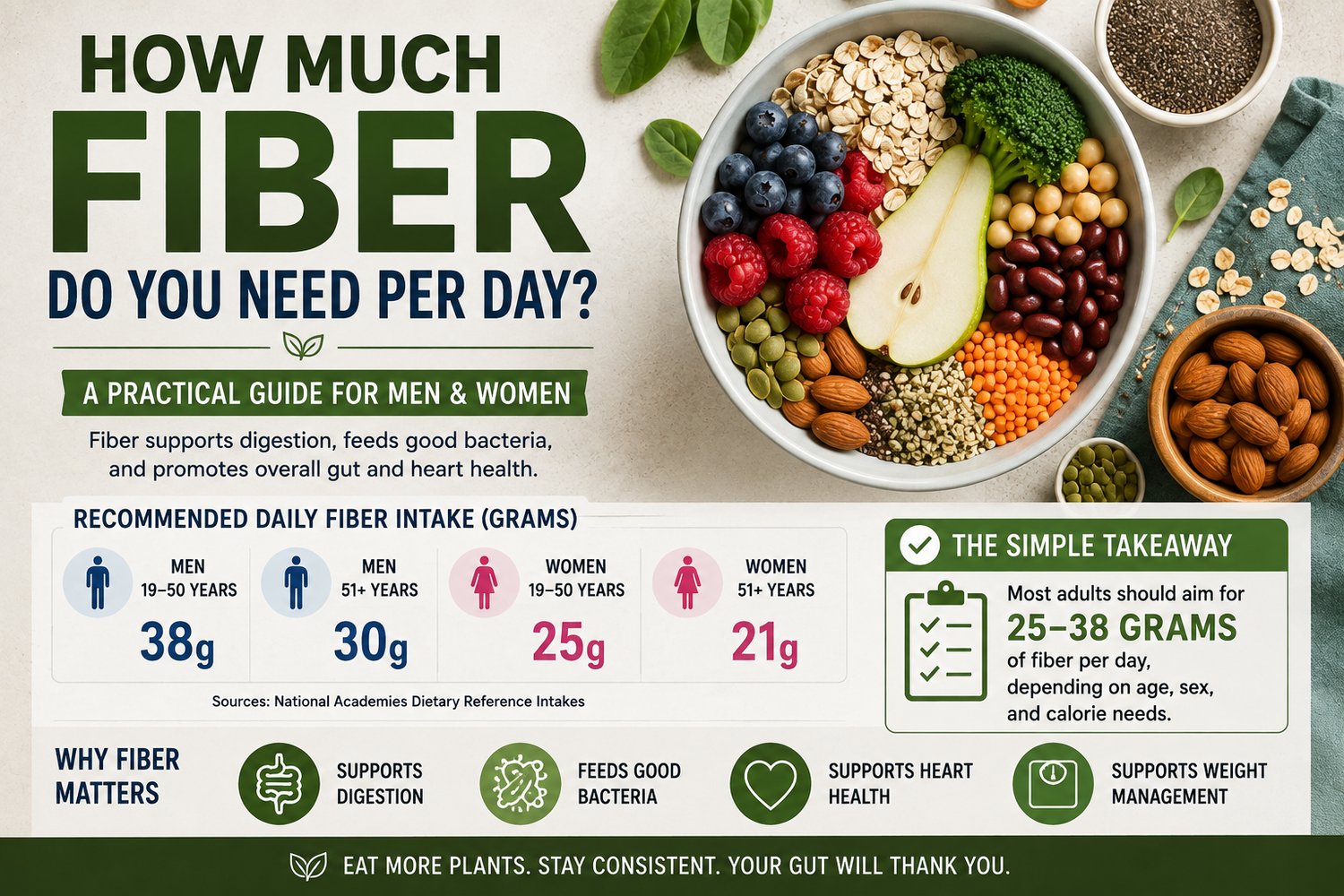
The Simple Answer: Aim for About 25–38 Grams of Fiber Per Day
For most adults, 25–38 grams per day is a useful general range.
The National Academies established Adequate Intakes of:
Men ages 19–50
38 grams per day
Men ages 51+
30 grams per day
Women ages 19–50
25 grams per day
Women ages 51+
21 grams per day
Pregnancy and lactation have separate targets.
These numbers aren't arbitrary.
The adult recommendations were developed using an intake of approximately 14 grams of fiber per 1,000 calories, based largely on evidence relating fiber intake to cardiovascular health.
That calorie connection helps explain why younger adult men have a higher numerical recommendation than older women.
It's not because men's intestines demand more fiber.
Average energy requirements differ.
Why Does the Nutrition Label Say 28 Grams?
Now you're standing in the grocery store.
You turn over a box of oatmeal.
And instead of:
38 grams for men
or
25 grams for women
the label is calculating percentages based on:
28 grams.
What's going on?
The FDA needs one standardized Daily Value so Nutrition Facts labels can tell consumers what percentage of a day's intake a serving provides.
For dietary fiber, that Daily Value is:
28 grams per day on a 2,000-calorie diet.
So:
28 grams = labeling benchmark
while:
your personal fiber goal may be somewhat higher or lower.
Both can be useful.
Think of 28 Grams as the Easy Reference Number
If you don't want to calculate anything?
Aiming around 28–30 grams of fiber per day is a perfectly reasonable practical starting point for many adults.
It's:
- Easy to remember
- Close to the FDA Daily Value
- High enough to require intentionally eating fiber-rich foods
- Achievable without constructing your entire life around fiber
Then you can adjust based on:
- Age
- Sex
- Calorie needs
- Digestive tolerance
- Medical guidance
Nutrition doesn't always require decimal-point precision.
Daily Fiber Recommendations by Age and Sex
For healthy adults, the National Academies' Adequate Intake values provide a more individualized benchmark.
Men 19–30
38 grams/day
Men 31–50
38 grams/day
Men 51–70
30 grams/day
Men over 70
30 grams/day
Women 19–30
25 grams/day
Women 31–50
25 grams/day
Women 51–70
21 grams/day
Women over 70
21 grams/day
Pregnancy
28 grams/day
Lactation
29 grams/day
Those are goals for total fiber intake—not requirements that every single day land exactly on the number.
Why Does Fiber Need Decrease After Age 50?
This one can look strange.
Does your digestive system suddenly stop needing fiber on your 51st birthday?
No.
The lower Adequate Intake is largely related to lower average energy intake with age.
The underlying framework is roughly:
14 grams of fiber per 1,000 calories.
Lower calorie requirements therefore produce a lower absolute fiber target.
That does not mean fiber becomes less important as you age.
Bowel regularity and overall dietary quality remain important.
What About the “14 Grams Per 1,000 Calories” Rule?
This can be a useful way to personalize your fiber target.
Using approximately:
14 grams fiber × every 1,000 calories
you get:
1,500 calories
About 21 grams fiber
1,800 calories
About 25 grams fiber
2,000 calories
About 28 grams fiber
2,200 calories
About 31 grams fiber
2,500 calories
About 35 grams fiber
2,700 calories
About 38 grams fiber
3,000 calories
About 42 grams fiber
This gives you a better sense of why recommendations aren't identical for everyone.
Someone eating 3,000 calories has considerably more food available in which to fit fiber than someone eating 1,500.
You Probably Don't Need to Calculate Fiber Per 1,000 Calories Every Day
It's useful for understanding the recommendation.
It is not necessary to turn every meal into algebra.
For most people:
- Pick a reasonable daily target.
- Track for a week or two.
- Learn which foods get you there.
- Stop obsessing over the exact number.
Eventually you should be able to recognize:
That was probably a high-fiber day.
or:
I barely ate any plants today.
without needing a spreadsheet for the rest of your life.
Your Current Intake Matters More Than Your Perfect Target
Suppose you're a 35-year-old man.
The reference target says:
38 grams.
But you're currently eating:
11 grams.
The difference between:
11 → 20 grams
is probably much more important right now than worrying about:
35 vs. 38.
Trying to immediately triple your fiber intake may also make you feel terrible.
NIDDK specifically recommends adding fiber a little at a time so your body can adjust.
Progress first.
Precision later.
Step 1: Find Your Fiber Baseline
Before deliberately changing anything, track your normal diet for about three days.
Include:
- Breakfast
- Lunch
- Dinner
- Snacks
- Drinks containing fiber
- Supplements
Then calculate the approximate fiber total.
Let's say you discover:
Day 1
12 grams
Day 2
15 grams
Day 3
13 grams
Average:
13.3 grams/day
Now you know what you're actually working with.
That's far more useful than saying:
“I eat pretty healthy.”
Step 2: Pick a Realistic First Target
If you're currently averaging:
13 grams
I wouldn't necessarily jump immediately to:
38 grams.
Try:
18–20 grams.
Once that's comfortable:
22–25 grams.
Then:
28–30 grams.
Then decide whether there's any practical reason to go higher.
You can gradually work toward the appropriate range without declaring war on your digestive system.
Step 3: Spread Fiber Across the Day
Trying to eat your entire fiber target at dinner is not particularly pleasant.
Imagine:
Breakfast:
2 grams.
Lunch:
3 grams.
Snacks:
1 gram.
Dinner:
32 grams.
Technically, you got there.
Your gastrointestinal tract may file a complaint.
Instead, distribute fiber.
For a 30-gram target:
Breakfast
7–8 grams
Lunch
8–10 grams
Snack
4–5 grams
Dinner
8–10 grams
Now no individual meal needs to become a fiber challenge.
What Does 30 Grams of Fiber Actually Look Like?
Thirty grams sounds like a lot when you think about fiber as an isolated nutrient.
It becomes much easier when you think in foods.
For example:
Breakfast
Oatmeal + berries + chia
Approximately 8–10 grams, depending on portions.
Lunch
Whole-grain wrap + black beans + vegetables
Approximately 8–10 grams.
Snack
Apple + almonds
Approximately 5–6 grams.
Dinner
Potato + broccoli + another vegetable
Approximately 7–9 grams.
Total:
Roughly 28–35 grams.
Nothing particularly strange happened.
You just ate plants throughout the day.
You Don't Need Bran Cereal at Every Meal
People sometimes hear:
high fiber
and picture an extremely specific diet.
You have far more options.
Fiber comes from:
- Fruit
- Vegetables
- Beans
- Lentils
- Peas
- Whole grains
- Nuts
- Seeds
NIDDK lists whole grains, legumes, fruits, vegetables, and nuts among useful dietary fiber sources.
So if you hate bran cereal?
Good news.
You never needed to eat it.
How Much Fiber Is in a “High-Fiber” Food?
Nutrition Facts labels make this fairly easy.
The FDA says:
5% Daily Value or less is considered low.
20% Daily Value or more is considered high.
Because the fiber Daily Value is 28 grams:
1 gram
About 4% DV
2 grams
About 7% DV
3 grams
About 11% DV
4 grams
About 14% DV
5 grams
About 18% DV
6 grams
About 21% DV
So a serving containing around 6 grams of fiber is legitimately doing a lot of work toward your daily target.
Stop Being Fooled by Front-of-Package Marketing
A package says:
MADE WITH WHOLE GRAINS
That sounds impressive.
Turn it around.
Fiber:
1 gram.
Well.
Apparently the whole grain made a brief appearance.
Use the Nutrition Facts label.
If fiber is one of your goals, check:
- Serving size
- Fiber grams
- % Daily Value
The front of the package is marketing.
The back gives you numbers.
Fiber Adds Up Faster Than You Think
You don't necessarily need one massive high-fiber food.
Suppose you get:
Breakfast:
6 grams
Lunch:
7 grams
Snack:
4 grams
Dinner:
9 grams
Evening snack:
3 grams
Total:
29 grams.
None of those meals individually needed to contain 15 grams.
Consistency across the day makes the target easier.
Beans and Lentils Are Fiber Cheat Codes
If you're struggling to reach your goal, legumes deserve attention.
Examples include:
- Black beans
- Chickpeas
- Kidney beans
- Lentils
- Split peas
They're useful because they provide:
Fiber + protein + carbohydrates + micronutrients
in one food.
And they're inexpensive.
Canned beans also count.
You do not receive extra microbiome points for soaking dried beans overnight.
Rinse them and eat them.
Fruit Is an Easy Fiber Upgrade
Fruit is one of the easiest additions because it requires almost no preparation.
Try:
- Berries with breakfast
- An apple with lunch
- A pear as a snack
- An orange after dinner
Whole fruit also provides:
- Water
- Vitamins
- Minerals
- Plant compounds
You don't need to avoid fruit because it contains sugar.
Whole fruit and candy are not metabolically interchangeable just because both contain carbohydrates.
Vegetables Count—but They Aren't Your Only Fiber Source
This is another common misconception.
People trying to eat more fiber often immediately create:
The World's Largest Salad.
Vegetables are great.
But you can make the target easier by combining them with:
- Beans
- Whole grains
- Fruit
- Nuts
- Seeds
Instead of relying entirely on lettuce to save you.
Whole Grains Can Quietly Add a Lot
Swapping:
White bread → higher-fiber whole-grain bread
or:
Refined cereal → oatmeal
or:
Low-fiber wrap → whole-grain wrap
can add several grams without substantially changing the meal.
Small swaps become meaningful when repeated daily.
Nuts and Seeds Are Useful—but Watch Portions
Chia and flax can add significant fiber.
Nuts also contribute.
But nuts and seeds are calorie-dense.
That's not a reason to avoid them.
It just means:
More isn't automatically better.
A tablespoon or two of seeds can fit beautifully into:
- Oatmeal
- Yogurt
- Smoothies
without turning breakfast into a 900-calorie fiber experiment.
Should You Count Fiber From Supplements?
Yes.
If you're taking a fiber supplement, it contributes to your total intake.
But pay attention to what the label actually says.
A serving may provide:
- 2 grams
- 3 grams
- 5 grams
- More
depending on the product and fiber type.
Don't assume:
One scoop = daily fiber requirement.
Read the label.
Do You Need a Fiber Supplement to Reach Your Goal?
No.
Many people can meet their fiber needs through food.
But a supplement can be useful if:
- Your food intake consistently falls short
- You have difficulty adding enough high-fiber foods
- A healthcare professional recommends a particular fiber
- You want a predictable supplemental amount
The bigger question is whether your overall diet is reasonably varied.
If your entire fiber intake comes from powder while you eat almost no plant foods, you've solved the number without necessarily solving the diet.
Is 50 Grams of Fiber Too Much?
Not automatically.
Someone eating a high-calorie diet rich in:
- Whole grains
- Legumes
- Vegetables
- Fruit
- Nuts
- Seeds
may naturally consume 40–50 grams.
If they tolerate it well?
Fine.
There isn't a universal point where fiber suddenly becomes toxic.
But deliberately chasing huge numbers doesn't automatically provide additional benefit.
And high intakes can create digestive problems for some people.
Your goal is not:
Maximum fiber.
It's:
Enough fiber within a healthy diet that your digestive system tolerates.
Can You Eat Too Much Fiber?
You can certainly eat more than you tolerate comfortably.
Potential issues from a rapid or excessive increase can include:
- Gas
- Bloating
- Abdominal discomfort
- Fullness
- Changes in stool frequency
Fiber can also become problematic if you're aggressively increasing intake while consuming inadequate fluids.
NIDDK recommends drinking plenty of water and other liquids when increasing fiber or using fiber supplements.
Again:
More isn't always better.
Fiber and Water Need to Work Together
When you increase fiber, pay attention to hydration too.
NIDDK specifically advises adequate liquids because they can help fiber work better and make stools softer and easier to pass.
That doesn't mean:
Fiber requires one gallon of water per day.
Fluid needs vary with:
- Body size
- Activity
- Climate
- Health
- Diet
The practical rule is simply:
Don't dramatically increase fiber while barely drinking anything.
What If You Hit Your Fiber Goal but Still Have Constipation?
Fiber is only one piece.
Constipation can have many causes.
NIDDK's management recommendations also include:
- Adequate fluids
- Regular physical activity
- Bowel training in some circumstances
- Medication when appropriate
Persistent constipation may require medical evaluation.
Do not assume:
30 grams didn't work, so I'll try 60.
Sometimes the answer isn't more fiber.
What If You Hit Your Fiber Goal but Feel Terrible?
Reduce the complexity.
Ask:
How quickly did I increase it?
Which foods changed?
Did I add a fiber supplement?
Did I suddenly start eating huge portions of legumes?
Am I constipated?
Am I drinking enough?
Then adjust one variable at a time.
If symptoms are persistent, severe, or unusual, seek appropriate medical evaluation.
Your daily fiber target is a guideline.
It is not something you need to force regardless of symptoms.
Fiber Goals Are Different With Certain Digestive Conditions
Generic fiber recommendations aren't appropriate for every medical situation.
People with conditions such as:
- Irritable bowel syndrome
- Crohn's disease
- Ulcerative colitis
- Bowel narrowing
- Certain post-surgical conditions
- Other gastrointestinal disorders
may require individualized dietary guidance.
That doesn't make fiber bad.
It means medical conditions require more nuance than a blog's general recommendation.
Don't Turn 28 Grams Into a Magical Number
This deserves emphasis.
If you eat:
27 grams
you didn't fail.
And if you eat:
29 grams
your microbiome doesn't throw a party.
Nutrition recommendations are useful targets.
Your overall pattern matters more than hitting exactly the same number every day.
Think in averages.
A Better Goal: Create a Fiber Range
Instead of:
I must hit 30 grams every day.
Try:
My target range is 25–35 grams.
Now:
27 grams = success.
31 grams = success.
34 grams = success.
You're far less likely to start eating random fiber at bedtime simply because your tracker says you're three grams short.
Your Fiber Goal Can Change With Your Diet
Suppose you're intentionally eating fewer calories for weight loss.
Your absolute fiber intake may naturally decrease somewhat.
That's one reason the roughly 14 grams per 1,000 calories framework can be useful.
But calorie restriction also makes food quality more important.
If you're eating fewer calories, you have fewer opportunities to obtain:
- Fiber
- Protein
- Vitamins
- Minerals
So choosing nutrient-dense foods matters.
Fiber and High-Protein Diets Can Absolutely Coexist
A high-protein diet does not need to become:
Chicken.
Eggs.
Greek yogurt.
Protein shakes.
Repeat.
Add:
- Berries
- Oats
- Beans
- Whole grains
- Vegetables
- Nuts
- Seeds
Now you can build meals around:
protein + fiber.
That's usually a much stronger meal structure.
A Simple High-Protein, High-Fiber Day
Breakfast
Greek yogurt + oats + berries + chia
Lunch
Chicken + black bean bowl + vegetables
Snack
Apple + almonds
Dinner
Lean protein + potato + broccoli
Optional snack
Fruit or higher-fiber cereal
Now you're supporting:
- Protein intake
- Fiber intake
- Plant variety
- Fullness
without needing separate diets for every goal.
What About Low-Carb Diets?
You can still eat fiber on a lower-carbohydrate diet.
Useful options include:
- Non-starchy vegetables
- Avocado
- Nuts
- Seeds
- Berries
- Certain legumes depending on the diet
But highly restrictive carbohydrate intake can make it harder to include some excellent fiber sources such as:
- Whole grains
- Beans
- Lentils
- Fruit
If you're restricting carbohydrates, pay attention to whether fiber intake unintentionally falls too.
Don't Confuse Net Carbs With Fiber Needs
Some food labels market:
NET CARBS
by subtracting fiber from total carbohydrates.
That may be useful for certain dietary approaches.
But your digestive system still cares that the fiber exists.
If you're only tracking net carbohydrates and never looking at fiber itself, you may miss an important part of the nutritional picture.
How to Reach 25 Grams of Fiber
One possible pattern:
Breakfast
Oatmeal + berries
~7 grams
Lunch
Whole-grain sandwich + vegetables
~6 grams
Snack
Apple
~4 grams
Dinner
Vegetables + potato
~8 grams
Total:
~25 grams
How to Reach 30 Grams of Fiber
Try:
Breakfast
Oats + chia + berries
~9 grams
Lunch
Chicken + black beans + vegetables
~9 grams
Snack
Pear
~5 grams
Dinner
Brown rice + broccoli
~7 grams
Total:
~30 grams
How to Reach 38 Grams of Fiber
For someone with a higher target:
Breakfast
Oats + berries + chia
~10 grams
Lunch
Lentil bowl + vegetables
~12 grams
Snack
Apple + almonds
~6 grams
Dinner
Whole grain + beans + vegetables
~10 grams
Total:
~38 grams
Again, exact numbers depend heavily on portions and products.
Use labels or a nutrition tracker if you need precision.
The Easiest Way to Increase Fiber by 5 Grams
You don't need a dietary overhaul.
Add one meaningful fiber source.
For example:
- A serving of beans
- A pear
- Berries + seeds
- A higher-fiber whole grain
- A fiber-rich snack
Five extra grams per day equals:
35 additional grams per week.
Small daily improvements matter.
The Easiest Way to Increase Fiber by 10 Grams
Add fiber to two meals.
For example:
Breakfast
Add berries + chia.
Dinner
Add beans.
Done.
You don't need to replace every food you currently enjoy.
Track Your Fiber Long Enough to Learn
Tracking forever isn't necessary for most people.
But tracking temporarily can teach you a lot.
You may discover:
- Your breakfast has almost no fiber.
- Beans make hitting your goal incredibly easy.
- Your “healthy” cereal only contains 2 grams.
- Weekends are dramatically lower than weekdays.
- You eat plenty of vegetables but very few legumes or whole grains.
That's useful information.
Start With the Free 7-Day Fiber & Gut Health Kickstart
If you don't know your current intake, start with the FREE 7-Day Fiber & Gut Health Kickstart.
Use the first few days to establish:
What am I actually eating?
Then start making small changes.
The goal isn't to transform your diet in one week.
It's to stop guessing.
Want to Track Fiber for a Full Month?
The High-Fiber Meal Builder & 30-Day Fiber Tracker gives you a more structured system for:
- Setting a fiber goal
- Tracking daily intake
- Building higher-fiber meals
- Monitoring progress
- Creating consistency
This is especially useful if you understand what to do but keep having:
8 grams Monday → 31 Tuesday → 12 Wednesday → 35 Thursday.
Consistency beats random fiber heroics.
Want to Track Digestion Alongside Fiber?
Sometimes the number isn't the only thing you care about.
You may want to know:
Does increasing fiber improve how I feel?
The Gut Health & Microbiome Tracker lets you monitor fiber alongside:
- Plant variety
- Hydration
- Meals
- Bowel habits
- Digestive symptoms
- Lifestyle habits
That makes it easier to see the bigger picture rather than treating fiber as an isolated number.
Frequently Asked Questions
How much fiber should I eat per day?
The FDA Daily Value is 28 grams per day based on a 2,000-calorie diet.
The National Academies provides more specific adult Adequate Intakes ranging from 21 to 38 grams per day, depending on age and sex.
How much fiber should men eat per day?
The National Academies recommends:
38 grams/day for men ages 19–50.
30 grams/day for men over 50.
Individual needs can vary.
How much fiber should women eat per day?
The National Academies recommends:
25 grams/day for women ages 19–50.
21 grams/day for women over 50.
Pregnancy and lactation have separate recommendations.
Is 30 grams of fiber a day enough?
For many adults, approximately 30 grams is a very reasonable daily intake.
Some groups have higher reference targets and others lower ones.
Rather than treating 30 grams as a universal prescription, compare it with your age, sex, calorie intake, health, and tolerance.
Is 50 grams of fiber per day too much?
Not necessarily.
Some people eating higher-calorie, plant-rich diets may naturally consume 40–50 grams and tolerate it well.
But there is no need to deliberately chase a very high fiber number simply because fiber is healthy.
Adequacy and tolerance matter more than maximizing intake.
Can I eat too much fiber?
Yes, particularly if you increase it rapidly.
Large increases may cause:
- Gas
- Bloating
- Fullness
- Digestive discomfort
- Changes in bowel habits
NIDDK recommends adding fiber gradually so your body can adjust.
Should I increase water when I increase fiber?
Pay attention to hydration as fiber intake rises.
NIDDK recommends drinking plenty of water and other liquids to help fiber work better, particularly when managing constipation.
Individual fluid needs vary.
Does fiber from supplements count?
Yes.
Supplemental fiber contributes to total fiber intake.
But whole fiber-rich foods also provide nutrients and plant compounds that an isolated supplement may not.
Use supplements as a tool rather than assuming they completely replace fiber-rich foods.
Do I need to track fiber every day?
Probably not forever.
Tracking for a week or two can teach you:
- Your normal intake
- Your best fiber sources
- Where your diet is consistently low
Once you know how to build meals that reliably reach your target, detailed tracking may become unnecessary.
Key Takeaways
- There is no single perfect daily fiber number for everyone.
- The FDA Daily Value is 28 grams per day on a 2,000-calorie diet.
- Men ages 19–50 have an Adequate Intake of 38 grams per day.
- Men over 50 have an Adequate Intake of 30 grams per day.
- Women ages 19–50 have an Adequate Intake of 25 grams per day.
- Women over 50 have an Adequate Intake of 21 grams per day.
- Fiber recommendations are roughly based on 14 grams per 1,000 calories.
- Your current intake matters when deciding how quickly to increase fiber.
- NIDDK recommends increasing fiber gradually rather than making a huge jump overnight.
- Spread fiber throughout the day instead of trying to consume your entire target in one meal.
- Whole grains, legumes, fruits, vegetables, nuts, and seeds are useful sources.
- Fiber supplements can help fill gaps but don't replace the nutritional variety of whole plant foods.
- Adequate fluids become particularly important as fiber intake rises.
- Your goal should be adequate, varied, well-tolerated fiber—not the largest number possible.
Final Thoughts
Fiber targets are useful.
Fiber obsession isn't.
For most people, the process should look something like this:
Find your baseline.
Then:
Increase gradually.
Then:
Build fiber into meals throughout the day.
Then:
Stop thinking about it so much.
If your target is 30 grams and you eat 27 today?
You're fine.
If you eat 34 tomorrow?
Also fine.
What matters is whether your normal diet consistently includes:
- Whole grains
- Beans and lentils
- Fruit
- Vegetables
- Nuts
- Seeds
in amounts your digestive system tolerates.
The target gives you direction.
Your habits are what actually get you there.
Continue the Fiber & Gut Health Series
Already published:
- What Is Gut Health? A Beginner’s Guide to Your Microbiome, Digestion & Everyday Habits
- What Is the Gut Microbiome? How Your Gut Bacteria Affect Digestion & Health
- How to Improve Gut Health Naturally: 10 Habits That Actually Matter
- Fiber for Gut Health: Why It Matters & What It Actually Does
Coming next in the series:
Soluble vs. Insoluble Fiber: What’s the Difference & Why You Need Both
Then we'll continue into practical fiber topics including:
Best High-Fiber Foods
How to Increase Fiber Without Bloating
Building High-Fiber Meals
Useful HabitLogics resources:
- FREE 7-Day Fiber & Gut Health Kickstart
- High-Fiber Meal Builder & 30-Day Fiber Tracker
- Gut Health & Microbiome Tracker | 30-Day Planner + Excel Dashboard
Educational Disclaimer
This article is intended for educational purposes only and should not be considered individualized medical or nutrition advice. Fiber needs and tolerance can vary, particularly for people with gastrointestinal disorders, certain medical conditions, or specific dietary restrictions. Persistent or concerning digestive symptoms should be evaluated by a qualified healthcare professional.