

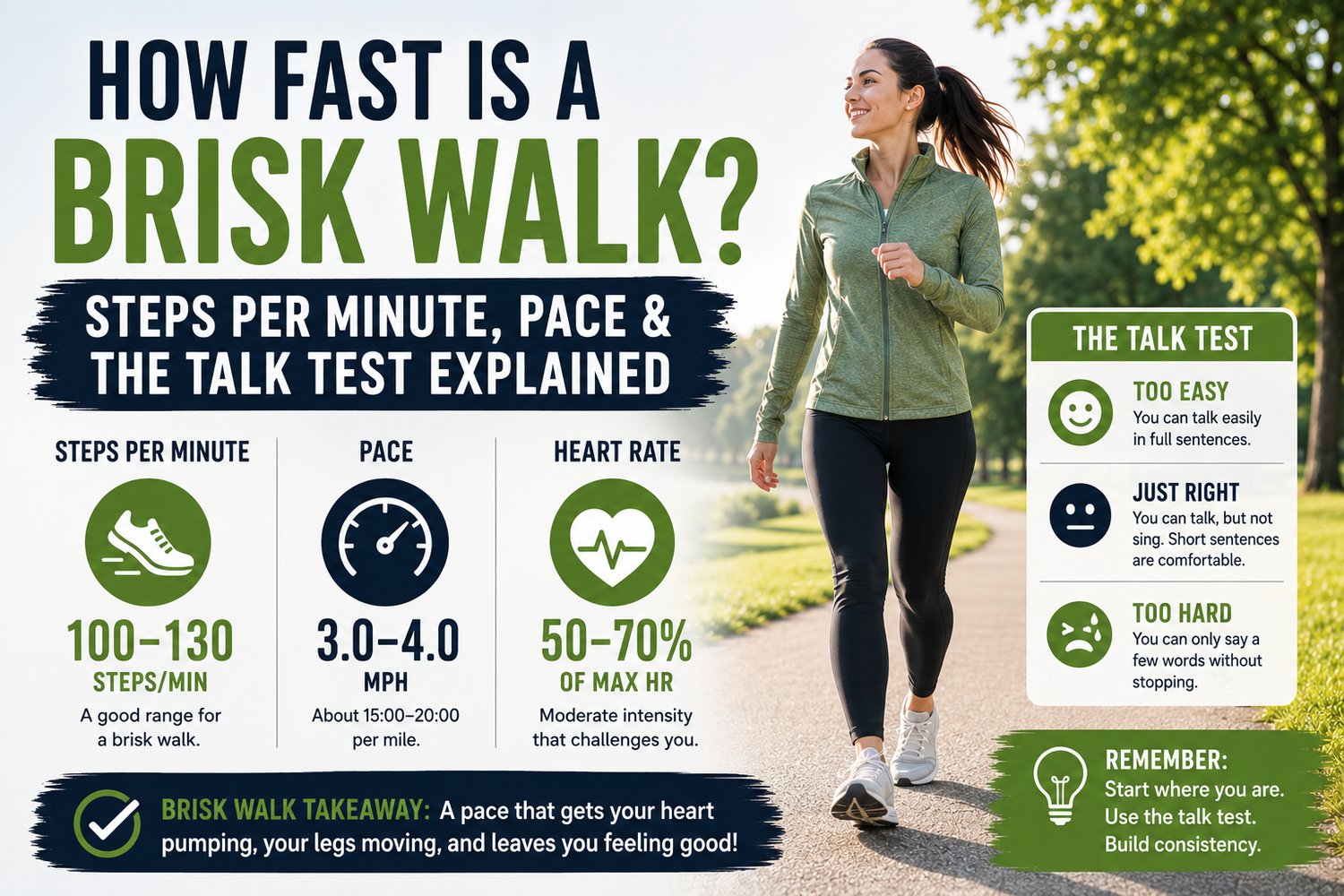
How Fast Is a Brisk Walk? Steps Per Minute, Pace & the Talk Test Explained
If you're wondering how fast a brisk walk is, the answer depends on more than miles per hour.
A brisk walk is generally a moderate-intensity walking pace—fast enough to noticeably raise your breathing and heart rate, but not so hard that you can't keep going.
For some people, that might be around:
3 mph
For others, it may be faster or slower.
Another useful benchmark is walking cadence. Research often uses roughly:
100 steps per minute
as a practical rule of thumb for moderate-intensity walking in adults.
But even that number isn't universal.
Your:
- Height
- Fitness level
- Age
- Terrain
- Incline
- Stride length
- Individual physiology
can all change how hard a given walking speed or cadence feels.
So the best way to identify a brisk walk isn't to rely on one magic number.
Use three signals together:
Pace + cadence + talk test
Let's break them down.
Quick Answer: How Fast Is a Brisk Walk?
A brisk walk generally means walking fast enough to reach a moderate level of effort.
A practical brisk-walking check looks like this:
- You're walking purposefully rather than strolling
- Your breathing is noticeably faster
- You can still speak in sentences
- Singing would be difficult
- You could maintain the pace for a reasonably long time
Research also supports approximately 100 steps per minute as a useful heuristic for moderate-intensity walking in many adults, although researchers repeatedly emphasize substantial individual variation.
That means:
100 steps/minute is a useful starting point—not a universal physiological law.
What Does “Brisk Walking” Actually Mean?
The phrase gets used constantly:
Take a brisk walk.
But “brisk” is a relative term.
The real question is:
Brisk compared with what?
For someone who normally walks slowly, increasing the pace slightly may create a substantial cardiovascular challenge.
For someone who walks quickly every day, that same speed may feel effortless.
That's why public-health definitions of exercise intensity often distinguish between:
absolute intensity
and:
relative intensity.
Absolute intensity looks at the energy cost of the activity itself.
Relative intensity asks:
How hard is this activity for you?
That distinction is important.
The same walking speed can be:
easy for one person
and:
moderately challenging for another.
Is 3 MPH a Brisk Walk?
For many adults, approximately 3 miles per hour is often used as a practical example of brisk or moderate-intensity walking.
But don't turn that into:
2.9 mph doesn't count and 3.0 mph does.
😂
Walking intensity doesn't suddenly transform at one exact treadmill setting.
Your experience at 3 mph depends on:
- Height
- Leg length
- Walking economy
- Fitness
- Incline
- Terrain
- Heat
- Fatigue
So:
If 3 mph noticeably raises your breathing while remaining sustainable
It may be a good brisk pace for you.
If 3 mph feels like a casual stroll
You may need to walk faster or add incline.
If 3 mph already feels very demanding
A slower pace may still provide moderate relative intensity.
The treadmill number is information.
Your body's response provides the context.
What Is Walking Cadence?
Walking cadence simply means:
how many steps you take per minute.
For example:
If you count:
50 steps in 30 seconds
multiply by two.
Your cadence is:
100 steps per minute.
Cadence gives us another way to describe walking intensity without needing GPS distance or treadmill speed.
And unlike miles per hour, you can measure it almost anywhere.
Is 100 Steps Per Minute a Brisk Walk?
For many adults, it's a useful rule of thumb.
A systematic review of walking-cadence research found that approximately 100 steps per minute was commonly sufficient to reach absolutely defined moderate intensity in adults.
A separate review of 38 studies found a strong relationship between cadence and walking intensity and concluded that 100 steps/minute is a consistent practical heuristic associated with moderate-intensity walking.
That's why you'll often see:
100 steps/minute
recommended as an easy brisk-walking benchmark.
But here's the important part:
It's a heuristic.
Not a diagnosis.
Why 100 Steps Per Minute Isn't a Universal Rule
Research has repeatedly found individual variation.
One review found that the cadence needed to reach moderate intensity could vary substantially depending on factors such as height. In one study included in the review, cadence associated with moderate intensity ranged approximately from 90 to 113 steps per minute across adults of different heights.
That makes intuitive sense.
A taller person often covers more ground with each step.
A shorter person may naturally take more steps per minute at the same walking speed.
So if your cadence is:
96 steps/minute
and the walk clearly feels moderately challenging...
don't panic because you didn't hit 100.
Likewise:
105 steps/minute
doesn't guarantee the walk is moderate intensity for everybody.
The HabitLogics Brisk Walk Check
Here's the simple method I'd use.
Don't rely on only one measurement.
Check three things.
Signal 1: Pace
Does the walk feel purposeful?
You're not wandering.
You're clearly moving faster than your normal casual pace.
Signal 2: Cadence
If you measure it, are you somewhere around the general moderate-intensity neighborhood?
For many adults:
~100 steps/minute
is a useful starting reference.
Don't treat it as mandatory.
Signal 3: Talk Test
Can you talk but not comfortably sing?
That is the practical test commonly used for moderate-intensity activity.
When all three line up:
purposeful pace + roughly appropriate cadence + moderate talk-test effort
you have a pretty good practical indication that you're brisk walking.
How to Measure Your Steps Per Minute
You don't need special equipment.
Method 1: Count for 60 Seconds
Walk normally.
Count every step for one minute.
Example:
102 steps
Your cadence is:
102 steps/minute.
Method 2: Count for 30 Seconds
Count steps for:
30 seconds
Then multiply by two.
Example:
49 steps × 2 = 98 steps/minute
Method 3: Count One Foot
Count every time your right foot hits the ground for 30 seconds.
Then multiply by:
4
Example:
25 right-foot strikes × 4 = 100 total steps/minute
That's often easier than counting every footfall.
Method 4: Use Your Watch
Some fitness watches display:
- Cadence
- Steps per minute
- Walking pace
That's convenient.
But again:
data is useful because it informs the effort—not because the device owns the definition of brisk walking.
Try the One-Minute Brisk Walking Test
Here's an easy experiment.
Step 1: Walk Normally for Two Minutes
Use your natural pace.
Notice how it feels.
Step 2: Increase Your Pace
Walk purposefully for one minute.
Don't run.
Step 3: Count Your Steps
Record:
Steps/minute: ______
Step 4: Check Your Breathing
Ask:
Could I talk?
Could I sing?
Could I sustain this pace for 20–30 minutes?
Step 5: Adjust
Barely breathing harder
Increase pace slightly.
Can talk, but singing would be difficult
You're likely in a useful moderate-intensity range.
Struggling to speak
Back off.
Now you have an actual personal brisk-walking reference instead of guessing from a generic treadmill chart.
Brisk Walking Pace vs. Steps Per Minute
These aren't the same thing.
Pace describes:
how much distance you're covering per unit of time.
Example:
3.2 mph
or:
18:45 per mile
Cadence describes:
how frequently you're stepping.
Example:
104 steps/minute
Two people can walk at the same speed with different cadences because their stride lengths differ.
A taller walker may:
take fewer, longer steps.
A shorter walker may:
take more, shorter steps.
Both can travel at the same speed.
That's why cadence shouldn't be interpreted without context.
What's a Normal Walking Speed?
Walking speeds vary considerably.
A person's preferred walking speed depends on:
- Age
- Height
- Fitness
- Terrain
- Mobility
- Health
- Walking purpose
Casual walking may be somewhere around:
2–3 mph
for many adults.
A purposeful brisk pace may be around:
3 mph or faster
for many people.
But again:
relative intensity matters more than forcing everyone onto the same speed.
If your fitness is currently low, a slower walk may still create the intended moderate effort.
Is 4 MPH a Brisk Walk?
Four mph is quite fast for walking.
For many people it may feel:
very brisk
or even:
difficult to maintain.
Some experienced walkers can sustain it comfortably.
Others may naturally begin transitioning toward jogging.
If 4 mph forces you into:
- Awkward mechanics
- Very short stride
- Excessive breathlessness
- A pace you can't sustain
you do not need to hit 4 mph just because someone online called it the “best walking speed.”
The goal is an appropriate exercise stimulus.
Not winning a treadmill speed contest.
How Fast Should Beginners Walk?
If you're new to exercise:
start below your ego.
😂
Don't worry about 100 steps/minute on Day 1.
Start with a pace you can comfortably maintain.
Once walking regularly feels manageable, increase the pace gradually.
For example:
Week 1
Comfortable walking
Week 2
Several minutes slightly faster
Week 3
Longer periods at a purposeful pace
Week 4
Experiment with brisk walking
That's a much better progression than:
Apparently brisk walking is 3.5 mph. Guess I'll do that for an hour tomorrow.
Does Height Affect Brisk Walking Cadence?
Yes.
Height and stride length can change the cadence required to reach a given absolute walking intensity.
The systematic review we discussed earlier found that height was significantly related to the cadence required for moderate-intensity walking.
In practical terms:
Taller people
May reach the same walking speed with fewer steps per minute.
Shorter people
May naturally require more steps per minute.
That's why:
100 steps/minute
works best as a rounded population-level cue rather than a personalized prescription.
Does Age Affect Brisk Walking Cadence?
Potentially.
The relationship between cadence and intensity can vary with age and physical capacity.
Some research suggests that older adults may need cadence targets different from those used in younger adults, which is another reason one universal number should be used cautiously.
And relative intensity becomes even more important.
A walking speed that feels easy to a healthy 30-year-old may be much more demanding for an older adult with reduced fitness or mobility.
Does Incline Change What Counts as Brisk?
Absolutely.
Imagine:
Walk A
3 mph on a flat treadmill.
Walk B
3 mph at a significant incline.
Same speed.
Very different cardiovascular demand.
That's why treadmill speed by itself doesn't fully describe exercise intensity.
If you add incline:
- Heart rate may rise
- Breathing may increase
- Muscular demand increases
- The same cadence may feel much harder
So don't assume you have to increase speed indefinitely.
Sometimes:
same speed + slight incline
is a much better progression.
Brisk Walking vs. Zone 2 Walking
These concepts overlap, but they aren't identical.
A brisk walk is generally a practical description of purposeful moderate-intensity walking.
Zone 2 is usually discussed in relation to physiological intensity zones.
For many people, brisk walking may fall somewhere around a useful Zone 2-style aerobic intensity.
For others:
brisk walking may be below Zone 2
or:
above it.
That's why we built an entire guide around that specific question:
Does Walking Count as Zone 2 Cardio? How to Know If You’re Actually in Zone 2
If you want the broader explanation of Zone 2 itself, read Zone 2 Walking Explained.
Brisk Walking vs. Fast Walking for Weight Loss
Walking faster generally increases energy expenditure per minute.
But that doesn't automatically mean:
walk as fast as physically possible.
A slightly slower pace you can maintain for 40 minutes may produce more total activity than an extremely fast pace you abandon after 12 minutes.
That's why weight loss depends on more than walking speed.
For the full comparison, read:
Best Walking Speed for Fat Loss: Does Walking Faster Burn More Fat?
Can a Slow Walk Still Count as Exercise?
Yes.
There's a difference between:
useful movement
and:
moderate-intensity exercise.
A slow walk can still:
- Add steps
- Reduce sitting
- Increase total movement
- Help you build a walking habit
- Provide low-fatigue activity
It just may not create the same cardiovascular training effect as brisk walking.
You don't need to choose one forever.
A good walking routine can contain:
easy walks + brisk walks + post-meal walks + structured aerobic sessions
depending on your goals.
Should Every Walk Be Brisk?
No.
This is another place people accidentally over-optimize.
You don't need to turn:
walking the dog
into:
CARDIO PROTOCOL 7B.
😂
Different walks can have different jobs.
Easy Walking
Use it for:
- Daily movement
- Recovery
- Social time
- Stress relief
Brisk Walking
Use it for:
- Moderate aerobic activity
- Fitness
- Purposeful exercise
Zone 2-Style Walking
Use it for:
- Structured sustained aerobic training
Faster Intervals
Use them occasionally if you enjoy higher-intensity walking.
A balanced walking week can include several intensities.
How Long Should a Brisk Walk Be?
You don't need a universal session duration.
A beginner might start with:
10 minutes
and gradually build.
An established walker might use:
20–40 minutes
or more depending on goals.
The broader federal recommendation for adults is at least 150 minutes of moderate-intensity aerobic activity per week, plus muscle-strengthening work on at least two days.
Brisk walking can contribute toward those aerobic minutes.
You don't need every minute to happen in one session.
What Does 100 Steps Per Minute Look Like?
Let's make the number concrete.
At:
100 steps/minute
you would accumulate approximately:
1,000 steps in 10 minutes
2,000 steps in 20 minutes
3,000 steps in 30 minutes
That's convenient because it also gives you a rough sense of how purposeful walking can contribute to your daily step count.
But don't confuse that with distance.
Your distance depends on your stride length.
Brisk Walking and the +1,000-Step Experiment
This connects nicely with another HabitLogics experiment.
If your brisk cadence happens to be around:
100 steps/minute
then roughly:
10 minutes of brisk walking
could add about:
1,000 steps.
That makes a short purposeful walk one easy way to raise your normal activity baseline.
If you want to test that idea for a month, read:
What Happens If You Add 1,000 Steps a Day? A Practical 30-Day Walking Experiment
Brisk Walking and the 30-Day Walking Challenge
You also don't need to begin your walking challenge at a brisk pace.
Beginners can establish the walking habit first.
Then gradually introduce purposeful walking as fitness improves.
That's exactly how the new HabitLogics challenge works:
30-Day Walking Challenge: A Beginner Plan That Starts With Your Baseline
Start from your baseline.
Build.
Then progress.
The HabitLogics Brisk-Walking Calibration Test
Here's the original tool I'd use if you want to identify your practical brisk pace.
Use a flat route or treadmill.
Round 1: Comfortable
Walk for:
3 minutes
at your normal comfortable pace.
Record:
Speed: ______
Cadence: ______
Effort: ______ / 10
Round 2: Purposeful
Increase your pace slightly.
Walk for:
3 minutes
Record:
Speed: ______
Cadence: ______
Effort: ______ / 10
Can you talk normally?
Round 3: Brisk Candidate
Increase slightly again.
Walk:
3 minutes
Record:
Speed: ______
Cadence: ______
Effort: ______ / 10
Use the talk test.
Can sing comfortably?
Probably still fairly light.
Can talk but singing would be difficult?
Good brisk-walking candidate.
Can only speak a few words?
Probably harder than typical moderate brisk walking.
Save Your Brisk-Walking Baseline
Once you've found a useful pace, save:
Speed: ______
Cadence: ______
Incline: ______
Average HR, optional: ______
Effort: ______
Talk test: ______
Now you don't need to rediscover your brisk pace every workout.
You have a reference.
And over time, something interesting may happen.
How to Know Your Fitness Is Improving
Repeat the same calibration periodically.
You may notice:
Same speed → lower effort
The walk has become easier.
Same cadence → easier breathing
Also potentially improved fitness.
Same effort → faster speed
You're covering more ground at the same perceived workload.
Same heart rate → faster pace
Potential sign your aerobic fitness has improved.
That's a much better use of walking data than obsessing over whether:
99 steps/minute
somehow failed while:
100 steps/minute
succeeded.
Should You Use a Metronome to Walk at 100 Steps Per Minute?
You can.
Research has explored auditory cues as a way to help people modify walking cadence, and systematic reviews note some evidence supporting cadence cueing strategies.
You could use:
- Metronome app
- Music playlist around the desired beat
- Watch cadence alert
But don't force an awkward walking pattern just to chase a number.
Your natural gait should still feel comfortable.
The cue is there to help you estimate intensity, not teach you to march like a malfunctioning robot.
😂
Common Brisk-Walking Mistakes
1. Treating 100 Steps/Minute as a Mandatory Minimum
It's a heuristic.
Individual variation matters.
2. Using Only Treadmill Speed
Incline and relative fitness change the workload.
3. Ignoring the Talk Test
Your breathing gives you useful information.
4. Walking So Fast Your Form Falls Apart
More speed isn't automatically better.
5. Making Every Walk Brisk
Easy movement still has value.
6. Comparing Your Cadence With Someone Taller or Shorter
Stride length changes the relationship.
7. Assuming Brisk Walking Automatically Equals Zone 2
They may overlap.
They are not identical concepts.
8. Forgetting That Fitness Changes
Your brisk pace today may eventually become your easy pace.
That's progress.
The HabitLogics Three-Part Brisk Walk Rule
If you remember nothing else, use this:
1. Purposeful Pace
You're clearly walking faster than a casual stroll.
2. Rough Cadence Reference
Around 100 steps/minute can be a useful starting heuristic for many adults.
3. Talk Test
You can speak in sentences, but singing comfortably would be difficult.
When those three generally agree:
you've probably found a practical brisk-walking intensity.
Then stop trying to optimize the definition and go walk.
😂
Key Takeaways
- A brisk walk is generally a purposeful moderate-intensity walking pace.
- Around 3 mph is often used as a practical example, but the appropriate speed varies substantially by person.
- Research consistently supports approximately 100 steps per minute as a useful heuristic for absolutely defined moderate-intensity walking in many adults.
- One hundred steps per minute is not a universal personal threshold.
- Height and stride length can change the cadence needed to reach a given walking intensity.
- The talk test provides a simple way to judge relative effort.
- Pace and cadence describe different aspects of walking.
- Incline can substantially increase walking intensity without increasing speed.
- Brisk walking and Zone 2 walking can overlap but are not automatically the same.
- Easy walking still provides useful movement.
- Not every walk needs to be brisk.
- Use the HabitLogics Pace + Cadence + Talk Test method.
- Track your own brisk-walking baseline and watch how it changes as fitness improves.
Frequently Asked Questions
How fast is a brisk walk?
For many adults, brisk walking may occur around 3 mph or faster, but there is no universal speed.
A brisk walk should noticeably increase your breathing while remaining sustainable.
How many steps per minute is brisk walking?
Around 100 steps per minute is commonly used as a practical benchmark for moderate-intensity walking in adults.
Individual needs vary.
Is 100 steps per minute fast?
For many adults, 100 steps per minute corresponds to purposeful moderate-intensity walking.
Whether it feels fast depends on your height, stride length and fitness.
Is 120 steps per minute brisk?
It certainly can be.
For many people, 120 steps per minute would represent brisk or relatively fast walking.
But cadence alone doesn't determine relative intensity.
Is 3 mph brisk walking?
It can be.
Three mph is often used as a general moderate-intensity walking example, but the intensity depends on the individual.
Is 4 mph considered brisk walking?
Four mph is very brisk for many people and may be difficult to sustain as a walk.
More experienced walkers may handle it comfortably.
How can I tell if I'm walking briskly without a watch?
Use the talk test.
You should notice faster breathing while still being able to carry on a conversation.
If you can sing comfortably, increase the pace slightly.
Is brisk walking good cardio?
Yes.
Brisk walking can count as moderate-intensity aerobic activity when it creates the appropriate exercise demand.
Does brisk walking count as Zone 2?
Sometimes.
It depends on your individual fitness and physiological response.
Read Does Walking Count as Zone 2 Cardio? for the full explanation.
How long should I brisk walk?
Start with an amount you can comfortably tolerate.
You might begin with 10–20 minutes and gradually increase as your fitness improves.
Try the 30-Day Walking Challenge
Want to put your brisk pace into an actual walking plan?
The HabitLogics challenge starts with your current activity level instead of forcing everyone into the same step goal.
Start the 30-Day Walking Challenge
Want to Test 30 Minutes a Day?
Use the HabitLogics Day 1 vs. Day 30 benchmark:
Walking 30 Minutes a Day: What Can Actually Change in 30 Days?
Want to Build Your Full Walking Routine?
How to Build a Sustainable Walking Routine You Can Maintain Long Term
Continue With the Complete Walking Guide
For the full HabitLogics Walking library:
Explore the Complete Walking Success Hub
Related Walking Guides
Best Walking Speed for Fat Loss · Does Walking Count as Zone 2 Cardio? · Zone 2 Walking Explained · How Many Steps Do You Actually Need? · What Happens If You Add 1,000 Steps a Day? · Is Walking Enough to Lose Weight?
Start With the Free Walking Starter Kit
The free HabitLogics Walking Weight Loss Starter Kit includes:
- A progressive walking plan
- Step and walking trackers
- Pace guidance
- A habit calendar
- Practical consistency tools
Download the Free Walking Starter Kit
Track Your Walking Progress
The HabitLogics Walking Weight Loss Dashboard gives you one place to track walking minutes, steps, distance, weight trends, measurements and weekly progress.
Explore the Walking Weight Loss Dashboard
This article is for general educational purposes and is not medical advice. Walking intensity and appropriate exercise levels vary by person. If you have a medical condition, significant mobility limitations, recurring pain or concerns about increasing walking intensity, talk with an appropriate healthcare professional.