

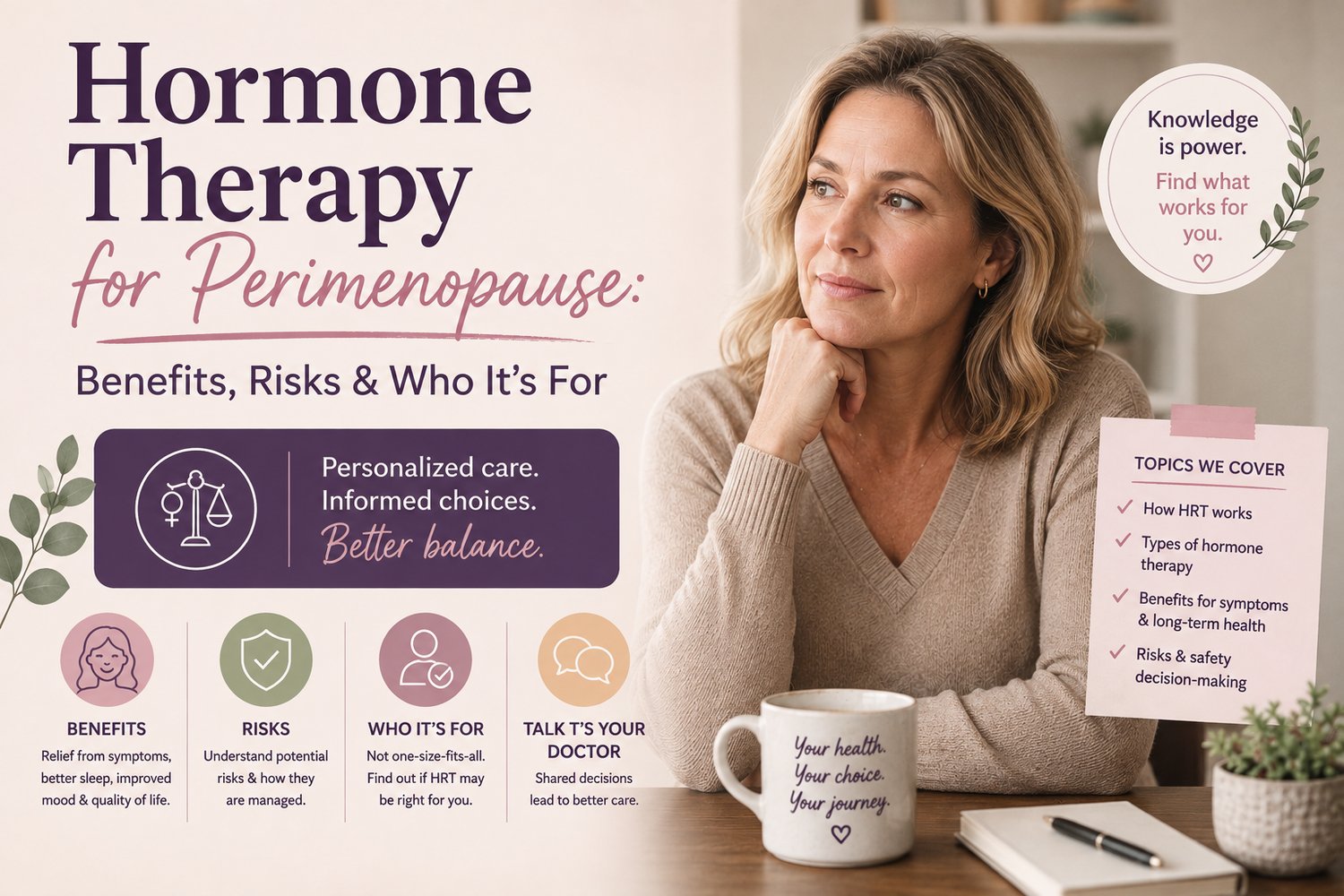
Hormone Therapy for Perimenopause: Benefits, Risks, Types & Who It May Help
Hormone therapy for perimenopause can be one of the most effective treatments for bothersome symptoms such as hot flashes and night sweats.
It can also be one of the most confusing.
Depending on where you get your information, hormone therapy may be described as either:
a dangerous treatment women should avoid
or
the missing hormone solution practically every woman over 40 needs.
Neither extreme is particularly useful.
Menopausal hormone therapy—often shortened to MHT, HT, or still commonly called hormone replacement therapy (HRT)—has well-established benefits, known risks, different formulations, and situations where it makes much more sense for some women than others.
It is not a universal anti-aging treatment.
It is not automatically dangerous.
And deciding whether it makes sense requires more than asking whether hormones are “natural.”
This guide explains what hormone therapy can actually treat during perimenopause, the difference between estrogen and progesterone, pills versus patches, systemic versus vaginal therapy, FDA-approved versus compounded “bioidentical” hormones, important risks, and what to discuss with a qualified healthcare professional.
If hot flashes are your main concern, also read Hot Flashes During Perimenopause: Causes, Triggers & Treatments That Actually Help.
What Is Menopausal Hormone Therapy?
Menopausal hormone therapy uses prescription hormones to treat symptoms and health effects associated with declining or changing ovarian hormone production around menopause.
Depending on the situation, treatment may involve:
- Estrogen
- Progesterone
- Another progestogen
- Estrogen plus a progestogen
- Local vaginal estrogen
- Different doses and delivery methods
The specific treatment depends heavily on:
- Which symptoms you're treating
- Whether you still have a uterus
- Your age
- Where you are in the menopause transition
- Medical history
- Personal risk factors
- Which route and formulation are being considered
The goal isn't to restore your hormones to what they were at 25.
It's to treat an actual symptom or health indication using an appropriate dose and formulation.
That's a very different idea from vaguely “optimizing hormones.”
Can You Take Hormone Therapy During Perimenopause?
Yes.
You do not need to wait until you've officially reached menopause to discuss hormone therapy.
Women with bothersome symptoms can sometimes begin treatment during perimenopause, while they are still having menstrual periods.
That may include women experiencing significant:
- Hot flashes
- Night sweats
- Sleep disruption related to vasomotor symptoms
- Other menopause-related concerns
The exact regimen may differ depending on whether periods are still occurring, contraception is needed, and other individual factors.
Remember:
Hormone therapy used for menopause symptoms is not automatically contraception.
Because pregnancy can still occur during perimenopause, contraception may remain necessary.
What Symptoms Does Hormone Therapy Treat Best?
Systemic menopausal hormone therapy is particularly effective for vasomotor symptoms, meaning:
- Hot flashes
- Night sweats
It can also improve sleep when repeated nighttime hot flashes are causing awakenings.
Other potential uses depend on the type of hormone therapy.
For example, estrogen treatment can also help prevent bone loss while it's being used.
Vaginal estrogen can be highly effective for symptoms associated with genitourinary syndrome of menopause (GSM), including:
- Vaginal dryness
- Burning or irritation
- Pain during sex
- Certain urinary symptoms
- Recurrent urinary tract infections in some women
But systemic hormone therapy and local vaginal estrogen should not be treated as though they're interchangeable.
They're different treatments with different levels of systemic exposure and different risk considerations.
What Hormone Therapy Does NOT Reliably Treat
Hormone therapy has legitimate uses.
That doesn't make it a cure for every unpleasant thing that happens during midlife.
It should not automatically be prescribed or marketed as:
- A weight-loss treatment
- A treatment for ordinary fatigue without identifying the cause
- A guaranteed cure for brain fog
- A general antidepressant
- A libido treatment for every woman
- An anti-aging treatment
- A way to restore “youthful hormones”
- A dementia-prevention drug
- A longevity treatment
Some women may feel better overall when severe symptoms improve.
For example:
fewer night sweats → better sleep → better energy and concentration
That doesn't prove estrogen directly cured fatigue or brain fog.
Distinguishing direct treatment effects from downstream improvements matters.
Estrogen vs. Progesterone: Why Having a Uterus Matters
One of the most important decisions in systemic hormone therapy is whether estrogen can be used alone.
If You Still Have a Uterus
Using systemic estrogen by itself can stimulate the endometrium—the lining of the uterus.
Over time, unopposed systemic estrogen can increase the risk of endometrial hyperplasia and endometrial cancer.
For that reason, women with an intact uterus who use systemic estrogen generally need adequate endometrial protection from a progestogen.
That may be progesterone or another progestogen depending on the regimen.
If You Have Had a Hysterectomy
Many women who no longer have a uterus can use systemic estrogen without a progestogen.
There are individual exceptions, so medical history still matters.
But the basic rule is worth remembering:
Systemic estrogen + uterus usually means endometrial protection is needed.
Progesterone and Progestogen Aren't Exactly the Same Word
You'll see these terms used constantly.
Progesterone is a specific hormone.
Progestogen is the broader category that includes progesterone and synthetic compounds with progesterone-like effects.
One commonly prescribed option is micronized progesterone, which has a molecular structure identical to naturally occurring progesterone.
That becomes important when we get to the word “bioidentical,” because FDA-approved products can absolutely contain hormones identical to hormones produced by the human body.
Compounding is not what makes a hormone bioidentical.
Systemic Hormone Therapy vs. Vaginal Estrogen
This distinction is extremely important.
Systemic Hormone Therapy
Systemic therapy delivers enough hormone into circulation to produce effects throughout the body.
Forms can include:
- Pills
- Skin patches
- Gels
- Sprays
- Certain rings
Systemic estrogen is used when whole-body symptoms such as hot flashes and night sweats need treatment.
Low-Dose Vaginal Estrogen
Local vaginal estrogen is used primarily for vaginal and urinary symptoms.
Forms can include:
- Creams
- Tablets or inserts
- Vaginal rings
Systemic absorption from low-dose vaginal estrogen is generally much lower than from systemic estrogen therapy.
That means its risk profile isn't identical to systemic treatment.
If someone only has vaginal dryness or painful sex, giving systemic hormone therapy simply because “estrogen helps menopause” may expose the rest of the body to more estrogen than is actually necessary.
Treatment should match the problem.
Pills vs. Patches: Does the Route Matter?
Yes.
“All estrogen is the same” is another oversimplification.
Systemic estrogen can be administered orally or through the skin.
Oral Estrogen
Oral estrogen passes through the liver before reaching systemic circulation.
That first-pass effect influences liver proteins and can affect clotting and other metabolic processes.
Transdermal Estrogen
Transdermal estrogen is absorbed through the skin.
Common forms include:
- Patches
- Gels
- Sprays
Because it bypasses first-pass liver metabolism, transdermal estrogen may have advantages for certain women, including a potentially lower blood-clot risk compared with oral estrogen.
That doesn't mean patches are automatically the best choice for everyone.
It means route is part of the risk-benefit conversation.
Is Hormone Therapy Safe?
There isn't an honest universal yes-or-no answer.
For many healthy women with bothersome menopause symptoms who begin systemic hormone therapy younger than 60 or within approximately 10 years of menopause onset, the benefit-risk balance is generally favorable when no contraindications are present.
That doesn't make it risk-free.
Risk can vary according to:
- Age
- Time since menopause
- Personal cardiovascular risk
- Blood-clot history
- Breast-cancer history and risk
- Whether estrogen is used alone or with a progestogen
- Oral versus transdermal delivery
- Dose
- Duration
- Other medical conditions
This is why asking:
“Is HRT safe?”
isn't quite enough.
A better question is:
“What are the likely benefits and risks of this specific hormone regimen for this specific woman?”
What Changed With the Hormone Therapy Warnings?
Hormone therapy has carried a lot of historical baggage.
After results from the Women's Health Initiative were released in the early 2000s, headlines broadly portrayed menopausal hormone therapy as dangerous.
The reality became much more nuanced as researchers examined:
- Age when therapy was started
- Time since menopause
- Estrogen alone versus estrogen plus a progestogen
- Baseline health risk
- Route of administration
- Duration of treatment
More recently, the FDA began updating hormone-therapy labeling to better reflect those distinctions.
That doesn't mean researchers suddenly decided hormone therapy has no risks.
It means broad warnings based on treating every formulation, age group, and clinical situation as though they're identical can be misleading too.
Hormone therapy deserves neither fearmongering nor hype.
What Did the Women's Health Initiative Actually Change?
The Women's Health Initiative (WHI) was a landmark set of large studies that changed menopause treatment dramatically.
One major trial studied conjugated equine estrogen plus medroxyprogesterone acetate.
Another studied estrogen alone in women who had undergone hysterectomy.
The average participant was older than the typical woman beginning hormone therapy specifically for new menopause symptoms.
That became important because the benefit-risk picture for a healthy woman starting treatment near menopause isn't necessarily the same as for someone beginning systemic hormones substantially later.
The WHI remains important.
But using “the WHI proved HRT is dangerous” as the entire discussion is no longer adequate.
Likewise, claiming “the WHI was completely wrong and HRT is harmless” isn't accurate either.
Medicine usually becomes more complicated as evidence improves, not less.
What Are the Major Risks of Systemic Hormone Therapy?
Potential risks depend on the individual and the regimen.
They can include concerns involving:
- Blood clots
- Stroke
- Gallbladder disease
- Breast cancer with certain regimens and durations
- Endometrial cancer when systemic estrogen is used without adequate endometrial protection in someone with a uterus
Risk isn't identical across every product or every woman.
For example, oral estrogen appears to carry more blood-clot risk than transdermal estrogen.
Breast-cancer risk differs between estrogen-alone and combined estrogen-progestogen therapy and changes with duration.
That's exactly why simplistic statements such as:
“HRT causes breast cancer”
or
“HRT doesn't cause breast cancer”
aren't good enough.
The regimen matters.
Does Hormone Therapy Increase Breast Cancer Risk?
This is one of the biggest concerns women have, and it deserves a nuanced answer.
The relationship depends heavily on which therapy is being used and for how long.
Combined systemic estrogen-plus-progestogen therapy is associated with an increased breast-cancer risk that becomes more relevant with longer use.
Estrogen-alone therapy in women without a uterus has shown a different risk pattern.
Your individual baseline risk matters too.
Factors such as family history, previous breast findings, genetics, alcohol use, age, breast density, and other factors may influence the conversation.
A clinician evaluating hormone therapy should consider your personal risk rather than treating “breast cancer” as a single generic warning.
Does Hormone Therapy Cause Blood Clots?
Systemic hormone therapy can affect venous blood-clot risk.
But again:
route matters.
Oral estrogen is associated with a higher risk of venous thromboembolism than transdermal estrogen.
That's one reason patches or other transdermal options may be considered for women with certain risk factors.
A previous clot is an especially important part of the medical history and may substantially change whether systemic hormone therapy is appropriate.
Does Hormone Therapy Cause Heart Disease?
Timing matters enormously here.
Hormone therapy is not recommended simply to prevent cardiovascular disease.
Starting systemic hormone therapy in an older woman many years after menopause has a different benefit-risk profile than starting it in an otherwise healthy woman near the menopause transition for bothersome symptoms.
Your cardiovascular risk factors matter too, including things such as:
- Blood pressure
- Smoking
- Diabetes
- Cholesterol
- Previous cardiovascular disease
- Age
Again, this isn't a “hormones good” or “hormones bad” question.
Who Should Be Especially Careful With Systemic Hormone Therapy?
Certain histories require particularly careful evaluation and may make systemic hormone therapy inappropriate or require specialist input.
Examples can include:
- Breast cancer
- Endometrial cancer
- Unexplained vaginal bleeding
- Previous blood clots
- Stroke
- Heart attack or established cardiovascular disease
- Active liver disease
The exact decision can depend on the diagnosis and which type of hormone treatment is being considered.
For example, low-dose vaginal estrogen isn't clinically equivalent to systemic estrogen exposure, so broad statements such as “anyone with condition X can never use any estrogen product” can also be too simplistic.
That is why individualized medical guidance matters.
What About Vaginal Estrogen After Breast Cancer?
This is an area where blanket internet advice becomes especially problematic.
Women with a history of breast cancer can experience significant genitourinary symptoms.
Nonhormonal moisturizers and lubricants are often considered first.
Whether low-dose vaginal estrogen can be considered after that depends on individual circumstances, cancer history, current medications, recurrence risk, symptoms, and shared decision-making with the relevant healthcare team.
That is very different from independently starting systemic estrogen.
If you have a history of hormone-sensitive cancer, menopause treatment should involve your healthcare professionals rather than advice from social media or a generic telehealth sales funnel.
Does Hormone Therapy Help With Bone Health?
Yes.
Systemic hormone therapy reduces bone loss and fracture risk while it is being used.
That can be an additional benefit when someone is already using hormone therapy for bothersome menopause symptoms.
But hormone therapy isn't automatically the best osteoporosis treatment for every woman.
Bone-health decisions also depend on:
- Age
- Bone density
- Fracture history
- Other osteoporosis risk factors
- How long hormone therapy is expected to continue
- Alternatives
For someone whose only issue is established osteoporosis, other medications may be more appropriate.
Does Hormone Therapy Help With Sleep?
It can—especially when vasomotor symptoms are disrupting sleep.
If someone wakes four times each night because of severe night sweats, reducing those night sweats may dramatically improve sleep.
That's different from saying estrogen is a universal insomnia medication.
Someone with:
- Chronic insomnia
- Sleep apnea
- Restless legs syndrome
- Anxiety
- Alcohol-related sleep disruption
may still need treatment specifically targeting those problems.
Read Sleep During Perimenopause: Why You Can’t Sleep & What Actually Helps for the full sleep discussion.
Does Hormone Therapy Help With Mood?
It may help certain women, but it isn't a universal treatment for depression or anxiety.
Mood symptoms during the menopause transition can be influenced by:
- Hormonal changes
- Hot flashes
- Sleep disruption
- Existing mental-health conditions
- Stress
- Medications
- Life circumstances
Someone who feels dramatically better after sleeping again because their night sweats were treated may understandably report better mood.
That doesn't make hormone therapy interchangeable with appropriate mental-health treatment.
Read Mood Swings During Perimenopause: Why They Happen & What May Help.
Does Hormone Therapy Help Brain Fog?
Hormone therapy is not recommended solely to prevent dementia or cognitive decline.
Some women report subjective improvements in concentration or mental clarity during treatment.
That can be influenced by improvements in:
- Hot flashes
- Sleep
- Mood
- Overall symptom burden
Persistent, severe, or worsening cognitive changes deserve proper evaluation rather than simply assuming estrogen is the missing ingredient.
Read Brain Fog During Perimenopause: Why It Happens & What May Help.
Does Hormone Therapy Cause Weight Gain?
Hormone therapy isn't generally considered a major cause of the midlife weight gain many women experience.
It also isn't a weight-loss drug.
Body composition during midlife is influenced by:
- Aging
- Energy intake
- Physical activity
- Muscle mass
- Sleep
- Medications
- Stress
- Hormonal changes
- Changes in fat distribution
Avoid both versions of the marketing:
“HRT will make you fat.”
and
“HRT will melt menopause belly fat.”
Neither is a useful summary of the evidence.
Read Perimenopause Weight Gain: Why It Happens & What Actually Helps.
How Long Can You Stay on Hormone Therapy?
There isn't one mandatory stopping age or universal maximum number of years.
Treatment should be reassessed periodically.
That includes reviewing:
- Whether symptoms still require treatment
- Dose
- Route
- New health conditions
- Changes in risk factors
- Side effects
- Personal preferences
Some women use hormone therapy for a few years.
Others continue longer because symptoms remain significant and the individualized benefit-risk balance remains acceptable.
“Everyone stops at 60” isn't a useful universal rule.
Neither is “once you start, you should stay on it forever.”
Do You Always Need the Lowest Possible Dose?
The practical goal is usually the lowest effective dose that adequately treats the indication, not simply the smallest number available regardless of whether it works.
Treatment should be individualized.
If symptoms aren't controlled, blindly celebrating that someone is on an ultra-low dose isn't particularly useful.
Likewise, using more medication than necessary doesn't create extra menopause points.
The treatment should actually solve the problem at an appropriate dose.
What Does “Bioidentical Hormone” Mean?
This term has been thoroughly mangled by marketing.
A bioidentical hormone has the same molecular structure as the corresponding hormone produced by the human body.
That does not mean it must be custom compounded.
FDA-approved prescription products can contain bioidentical hormones.
For example, FDA-approved formulations of:
- Estradiol
- Micronized progesterone
are commercially available.
So:
bioidentical ≠ compounded
and
compounded ≠ more natural or safer.
That's one of the most important distinctions in menopause marketing.
Are Compounded Bioidentical Hormones Better?
There is no good evidence that custom-compounded “bioidentical” hormone therapy is inherently safer, more effective, or more natural than FDA-approved hormone therapy.
Compounded medications have legitimate medical uses.
For example, compounding may be useful when a patient needs:
- A dosage form that isn't commercially available
- A specific formulation because of an allergy or intolerance
- Another individualized need that approved products can't meet
That's what compounding is for.
It shouldn't automatically be used simply because:
“customized hormones sound more personalized.”
FDA-approved products undergo standardized testing for:
- Safety
- Effectiveness
- Manufacturing quality
- Dose consistency
Compounded drugs are not FDA-approved.
That doesn't mean a compounded prescription is automatically bad medicine.
It means it should not be marketed as superior merely because it's compounded.
What About Saliva Testing to “Customize” Hormones?
Be skeptical.
Some hormone clinics market repeated saliva or blood testing as a way to create a perfectly individualized hormone cocktail.
But hormone levels fluctuate during perimenopause, and symptom treatment generally isn't guided by trying to reproduce a specific premenopausal laboratory number.
The goal isn't:
“Get estradiol to exactly X and progesterone to exactly Y.”
The goal is to use an evidence-based regimen that appropriately treats symptoms while managing risk.
Testing has legitimate uses.
“Optimizing every hormone number” is a different concept.
What About Testosterone During Menopause?
Testosterone often gets lumped into “BHRT” packages.
That's another area where indications matter.
Testosterone isn't a general treatment for:
- Low energy
- Brain fog
- Weight gain
- Motivation
- Anti-aging
- “Hormone optimization”
Evidence supports testosterone therapy for a much narrower indication in appropriately evaluated postmenopausal women with hypoactive sexual desire disorder (HSDD).
That doesn't mean every woman with lower libido needs testosterone.
Sexual desire can also be influenced by:
- Vaginal pain
- Sleep
- Relationship factors
- Medications
- Depression
- Stress
- Other medical issues
Hormone treatment should follow an actual diagnosis—not a wellness package.
What If You Can't or Don't Want to Use Hormone Therapy?
You still have options.
Hormone therapy isn't the only evidence-based treatment for menopause symptoms.
For hot flashes and night sweats, nonhormonal options can include:
- Certain SSRIs and SNRIs
- Gabapentin
- Oxybutynin
- Fezolinetant
- Elinzanetant
- Cognitive behavioral therapy and other evidence-supported approaches
For vaginal symptoms, options can include:
- Vaginal moisturizers
- Lubricants
- Other prescription treatments
For chronic insomnia, CBT-I may be appropriate.
The right alternative depends on what you're actually trying to treat.
Read Hot Flashes During Perimenopause: Causes, Triggers & Treatments That Actually Help for the detailed nonhormonal vasomotor-symptom discussion.
Lifestyle Changes and Hormone Therapy Aren't Opponents
Menopause content sometimes creates a bizarre false choice:
Treat symptoms medically
or
live naturally and take care of yourself.
You can obviously do both.
Lifestyle habits support long-term health regardless of whether you use hormone therapy.
Useful foundations include:
- Strength training
- Regular physical activity
- Adequate protein
- Fiber-rich, nutrient-dense foods
- Consistent sleep habits
- Not smoking
- Moderating alcohol when appropriate
- Preventive healthcare
Hormone therapy may treat symptoms.
Strength training helps preserve muscle and bone.
Walking supports cardiovascular fitness and activity.
Nutrition supports overall health.
They have different jobs.
Explore:
- Best Diet for Perimenopause: What to Eat for Midlife Health
- Protein During Perimenopause: How Much Do You Need?
- Walking During Perimenopause: Benefits for Weight, Mood & Health
- Strength Training During Perimenopause: Benefits, Workouts & How to Start
Considering Online Menopause Care?
Some women prefer discussing menopause treatment through telehealth rather than waiting for an in-person appointment.
That can be convenient, especially when the service includes evaluation by a licensed clinician and ongoing follow-up.
But the same medical standards still apply.
A telehealth menopause provider should evaluate:
- Your symptoms
- Medical history
- Current medications
- Relevant risk factors
- Whether hormone therapy is appropriate
- Which formulation actually makes sense
And you should know whether the medication being offered is FDA-approved or compounded.
One Online Option: Strut Health
HabitLogics is an affiliate partner with Strut Health. If you use the link below, HabitLogics may earn a commission at no additional cost to you.
Strut offers online menopause care that includes physician review and compounded BHRT options.
An important distinction before clicking:
Strut's compounded hormone medications are not FDA-approved.
That doesn't automatically make compounded treatment inappropriate, but FDA-approved hormone products are generally preferred when an approved product can meet the patient's needs because their safety, effectiveness, dose consistency, and manufacturing quality have been formally evaluated.
If you're considering compounded BHRT, ask the prescribing clinician why a compounded formulation is being recommended instead of an FDA-approved alternative.
That is a completely reasonable question.
Questions to Ask Before Starting Hormone Therapy
If you're considering treatment, useful questions include:
- What symptom are we specifically treating?
- Am I a good candidate for systemic hormone therapy?
- Do I need systemic treatment or would local treatment be enough?
- If I still have a uterus, how will my endometrium be protected?
- Would oral or transdermal estrogen make more sense for me?
- What benefits should I realistically expect?
- What risks apply specifically to my health history?
- Is this medication FDA-approved or compounded?
- If it's compounded, why is compounding medically necessary or preferable in my case?
- What side effects should I watch for?
- How will we know whether it's working?
- How often should treatment be reassessed?
- What nonhormonal alternatives could also treat my symptoms?
That's a much more useful conversation than:
“Can you balance my hormones?”
Red Flags in Hormone-Therapy Marketing
Hormone therapy itself is legitimate medicine.
That doesn't make every hormone clinic legitimate.
Be cautious when marketing promises:
- Guaranteed weight loss
- Reversal of aging
- Dementia prevention
- Permanent hormone “optimization”
- Better energy for everyone
- Personalized treatment based primarily on saliva testing
- Compounded hormones that are supposedly safer because they're “natural”
- One proprietary hormone formula for nearly every midlife symptom
- Testosterone for vague wellness goals
- Hormones without meaningful discussion of risks or contraindications
A good clinician doesn't need to frighten you away from hormone therapy.
They also shouldn't need to sell it as magic.
Frequently Asked Questions
Is HRT the same as menopausal hormone therapy?
Generally, yes.
You'll see HRT, HT, and MHT used to describe hormone therapy around menopause.
“Menopausal hormone therapy” is often the clearest term because the goal isn't necessarily to “replace” hormones back to youthful levels.
Can you take hormone therapy while still having periods?
Yes.
Hormone therapy may be used during perimenopause for appropriate candidates with bothersome symptoms.
The regimen may differ depending on menstrual patterns, contraception needs, and other individual factors.
Is hormone therapy the best treatment for hot flashes?
Systemic menopausal hormone therapy remains the most effective treatment for bothersome hot flashes and night sweats in appropriate candidates.
Nonhormonal treatments are available when hormone therapy isn't appropriate or isn't preferred.
Does everyone need progesterone with estrogen?
No.
People with an intact uterus who use systemic estrogen generally need adequate progestogen to protect the uterine lining.
Many women who have had a hysterectomy can use estrogen alone.
Is a patch safer than estrogen pills?
“Safer” is too broad, but route matters.
Transdermal estrogen avoids first-pass liver metabolism and appears to have a lower venous blood-clot risk than oral estrogen.
The best route depends on individual circumstances.
Are bioidentical hormones safer?
The word bioidentical doesn't tell you whether a product is safer.
FDA-approved estradiol and micronized progesterone products can be bioidentical.
Custom-compounded bioidentical hormones haven't been shown to be inherently safer or more effective than FDA-approved products.
Is compounded BHRT FDA-approved?
No.
Compounded medications themselves are not FDA-approved.
Compounding can have a legitimate role when an individualized formulation is medically necessary, but compounded hormones shouldn't automatically be considered superior to FDA-approved alternatives.
Does hormone therapy cause breast cancer?
The relationship depends on the specific regimen, duration, and individual baseline risk.
Combined estrogen-progestogen therapy and estrogen-alone therapy have different breast-cancer risk profiles.
This is an important individualized discussion rather than a simple yes-or-no claim.
Does hormone therapy prevent dementia?
Hormone therapy is not recommended solely to prevent dementia or cognitive decline.
Does hormone therapy make you lose weight?
No.
Hormone therapy isn't a weight-loss medication.
Treating bothersome symptoms may indirectly make healthy behaviors easier, but that's different from hormone therapy directly causing substantial weight loss.
How long can you stay on hormone therapy?
There isn't one mandatory stopping age or duration for every woman.
Treatment should be reassessed periodically based on symptoms, age, changing health risks, dose, route, and personal preferences.
Can you stop hormone therapy later?
Yes.
Some women eventually discontinue hormone therapy.
Others continue longer because symptoms persist and their individualized benefit-risk balance remains favorable.
Stopping treatment should be discussed with the prescribing healthcare professional.
Key Takeaways
- Hormone therapy for perimenopause can be used before menstrual periods have completely stopped.
- Systemic menopausal hormone therapy is the most effective treatment for bothersome hot flashes and night sweats in appropriate candidates.
- Hormone therapy isn't an anti-aging, weight-loss, or general “hormone optimization” treatment.
- People with an intact uterus who use systemic estrogen generally need adequate progestogen for endometrial protection.
- Systemic and low-dose vaginal estrogen have different uses and risk profiles.
- Route matters: oral and transdermal estrogen aren't identical from a risk perspective.
- The benefit-risk balance is generally most favorable for healthy symptomatic women who start treatment younger than 60 or within about 10 years of menopause onset and have no contraindications.
- Hormone-therapy risks vary by age, medical history, formulation, route, regimen, and duration.
- FDA-approved estradiol and progesterone products can be “bioidentical.”
- Compounded hormones are not FDA-approved and haven't been shown to be inherently safer or more effective than approved hormone therapies.
- Compounding can still have a legitimate role when an individual patient has a need that available FDA-approved products cannot meet.
- Nonhormonal treatments are available for women who cannot or prefer not to use hormone therapy.
- Treatment decisions should focus on a specific symptom or medical indication—not vague promises to “balance hormones.”
Continue Learning
If you're deciding how perimenopause symptoms should be treated, continue with:
- Hot Flashes During Perimenopause: Causes, Triggers & Treatments That Actually Help
- Sleep During Perimenopause: Why You Can’t Sleep & What Actually Helps
- 35 Perimenopause Symptoms: Common Signs, What’s Normal & When to Get Help
- Perimenopause vs. Menopause: What’s the Difference?
- Healthy Habits During Perimenopause: What Actually Matters
Or return to the Complete Perimenopause Guide for the full HabitLogics perimenopause roadmap.
Educational & Affiliate Disclaimer
This article is intended for educational purposes only and is not medical advice, diagnosis, or treatment. Menopausal hormone therapy is prescription treatment with potential benefits, risks, contraindications, and drug interactions that vary according to the individual and the specific regimen. Never start, stop, or change prescription hormone therapy without guidance from a qualified healthcare professional.
HabitLogics may earn a commission when you use certain links on this page, including links to Strut Health. Affiliate relationships do not change the distinction between FDA-approved and compounded hormone therapy or the need for individualized medical evaluation.