

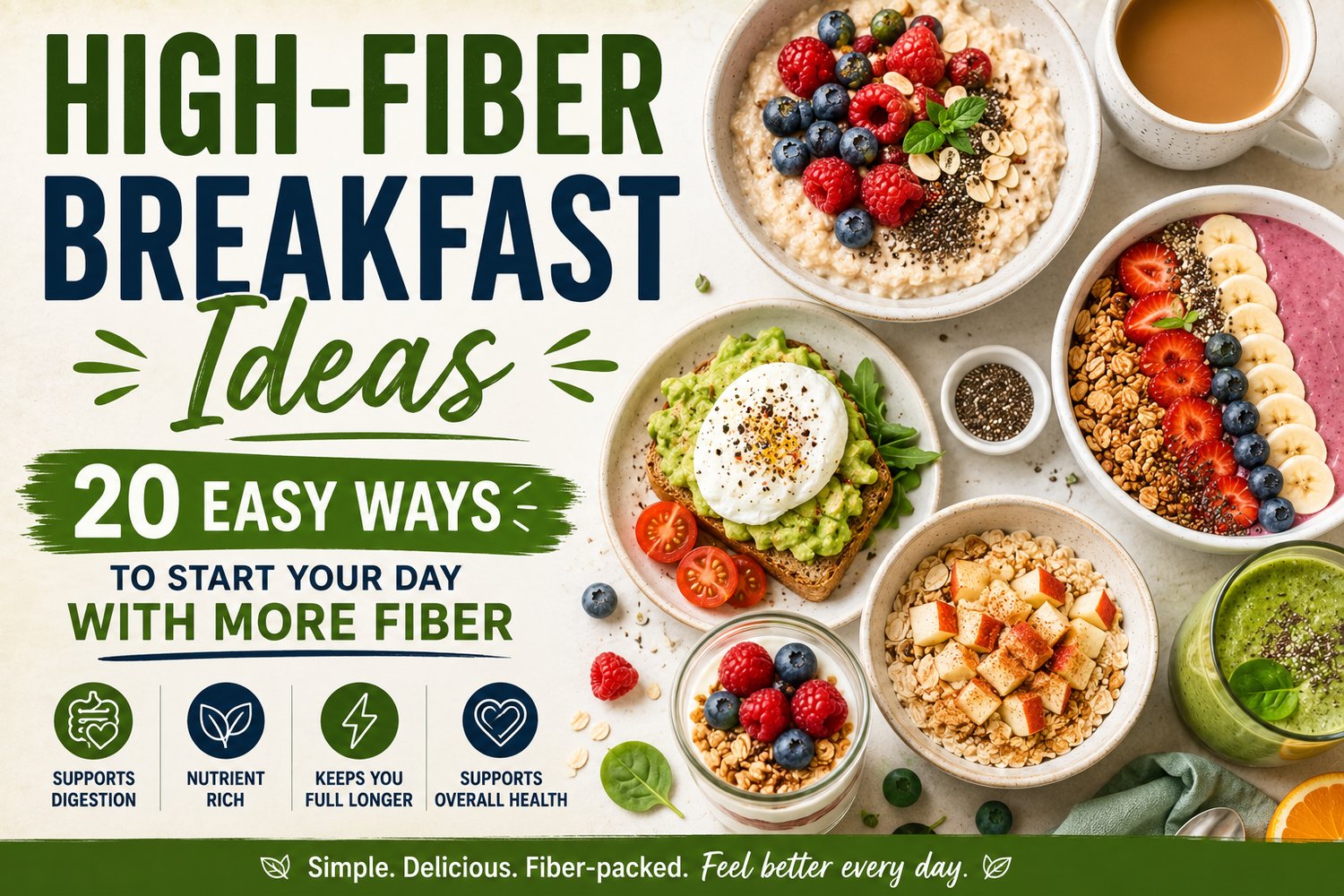
High-Fiber Breakfast Ideas: 20 Easy Ways to Start Your Day With More Fiber
Complete Fiber & Gut Health Guide Hub
Breakfast can make reaching your daily fiber goal dramatically easier.
It can also make it dramatically harder.
Consider a common breakfast:
Eggs.
Bacon.
Coffee.
Maybe a piece of white toast.
Plenty of protein.
Very little fiber.
There's nothing inherently wrong with those foods. But if breakfast contributes almost no fiber, you've got the rest of the day to make up the difference.
If your daily target is around 28–30 grams and breakfast provides:
1 gram
you've still got almost the entire goal waiting for you.
Now imagine breakfast provides:
8–10 grams.
Suddenly the rest of the day becomes much easier.
The CDC specifically recommends building a fiber-friendly breakfast with foods such as oatmeal, nuts, berries, avocado, whole grains and legumes.
And you don't need a complicated “gut health breakfast.”
You need a few reliable fiber sources that work with foods you already enjoy.
If you're still getting used to eating more fiber, read How to Increase Fiber Without Bloating, Gas or Digestive Discomfort before dramatically changing your breakfast.
Now let's build one.
How Much Fiber Should Breakfast Have?
There isn't an official fiber requirement specifically for breakfast.
Your target applies to the entire day.
NIDDK notes that adult fiber needs generally fall around 22–34 grams per day, depending on age and sex.
A practical breakfast goal for many people is:
About 5–10 grams of fiber.
That's not a medical recommendation.
It's simply a useful meal-building target.
If breakfast gives you 8 grams and your daily goal is 28 grams, you've already completed almost 30% of your day.
That's much easier than trying to find 20 grams after dinner.
Don't Turn Breakfast Into a Fiber Competition
Here's what I don't want you to do:
Oatmeal.
Plus 4 tablespoons of chia.
Plus flax.
Plus bran.
Plus raspberries.
Plus a fiber supplement.
Congratulations.
You've constructed a breakfast containing half the fiber in North America.
Your digestive system may not appreciate the accomplishment.
NIDDK recommends adding fiber gradually so your body has time to adjust.
Start with a reasonable amount.
You can always increase it later.
The Simplest High-Fiber Breakfast Formula
Instead of memorizing recipes, think:
Fiber base + fruit or vegetable + optional nuts/seeds + protein
For example:
Fiber Base
Oats.
Fruit
Raspberries.
Seeds
Chia.
Protein
Greek yogurt.
Done.
Or:
Fiber Base
Whole-grain toast.
Plant
Avocado.
Protein
Eggs.
Again:
Done.
Breakfast doesn't need a 14-step recipe.
1. Oatmeal With Berries
We'll start with the obvious one because it works.
Combine:
- Oatmeal
- Raspberries or blackberries
- Cinnamon
- Milk of choice
Oats provide fiber, while berries can add several additional grams depending on the type and serving size.
NIDDK lists both oatmeal and berries among good dietary fiber sources.
Want more protein?
Add:
- Greek yogurt
- Protein powder
- Milk
- Cottage cheese on the side
Simple.
2. Oatmeal With Berries + Chia Seeds
Take the previous breakfast and add:
1 tablespoon of chia seeds.
Now you've added another concentrated fiber source without substantially increasing the size of the meal.
A combination of oats, chia and berries is commonly used in high-fiber breakfast recipes; for example, UCLA's overnight-oats recipe combines rolled oats, chia, berries and flax.
This is one of the easiest ways to create a legitimately high-fiber breakfast.
Just remember:
If you don't normally eat chia?
Start modestly.
3. Overnight Oats
If the problem is:
“I don't have time to cook breakfast.”
Overnight oats solve that.
Mix the night before:
- Rolled oats
- Milk
- Greek yogurt
- Berries
- Cinnamon
Put it in the refrigerator.
Eat it tomorrow.
A USDA-developed overnight-oat recipe published by the University of Minnesota provides 9 grams of fiber and 17 grams of protein per serving using oats, berries, Greek yogurt and milk.
That's a pretty strong breakfast without requiring anything exotic.
4. High-Fiber Overnight Oats With Chia
Want to push the fiber higher?
Add:
- Chia
- Ground flax
- Fruit
- Nuts
The Department of Veterans Affairs has a high-fiber overnight-oats recipe using oats, chia, fruit and nuts that provides 13.5 grams of fiber per serving.
That's a substantial amount.
If you're currently eating very little fiber, though, you don't necessarily need to start there.
You can build up gradually.
5. Greek Yogurt + Raspberries + Chia
Don't like oatmeal?
No problem.
Try:
Greek yogurt
Protein.
Raspberries
Fiber.
Chia
More fiber.
Optional nuts
Fiber + healthy fats.
This is an excellent example of why high-protein and high-fiber eating work well together.
The yogurt itself isn't providing much fiber.
It doesn't need to.
The plants handle that job.
6. Greek Yogurt + Berries + High-Fiber Cereal
This may be even easier.
Use:
- Greek yogurt
- Berries
- A higher-fiber cereal
Think of it like a parfait.
You get:
protein + fiber + crunch
without cooking anything.
When choosing cereal, check the Nutrition Facts label instead of trusting words like:
whole grain
or
multigrain
on the front of the box.
Fiber content can vary dramatically.
7. Chia Pudding
Chia seeds absorb liquid and develop a pudding-like texture.
Combine:
- Chia
- Milk
- Vanilla
- Cinnamon
Refrigerate.
Then add:
- Berries
- Banana
- Nuts
Chia is fiber-dense, so this breakfast can become very high in fiber quickly.
Again:
More isn't automatically better.
Start with a normal serving rather than constructing a chia brick.
8. Whole-Grain Toast + Avocado
Not everyone wants sweet breakfast.
Try:
Whole-grain toast + avocado.
Now you've combined two fiber sources.
The CDC specifically suggests avocado toast as a fiber-friendly breakfast option.
Add:
- Egg
- Cottage cheese
- Smoked salmon
for protein.
The result is a balanced savory breakfast without oatmeal anywhere in sight.
9. Avocado Toast + Chickpeas
Want even more fiber?
Add chickpeas.
Try:
- Whole-grain toast
- Mashed avocado
- Chickpeas
- Seasoning
The CDC specifically gives avocado toast topped with chickpeas as an example of a fiber-friendly breakfast.
Now you've got:
- Whole grain
- Fruit
- Legume
in one meal.
That's a lot of plant variety before 9 a.m.
10. Eggs + Whole-Grain Toast + Fruit
This is probably one of the easiest upgrades for someone who already eats eggs.
Instead of:
Eggs + white toast
try:
Eggs + higher-fiber whole-grain toast + fruit.
You don't need to stop eating eggs because they contain no fiber.
Eggs provide protein.
The toast and fruit provide fiber.
Different foods have different jobs.
11. Eggs + Avocado + Whole-Grain Toast
Another easy savory option:
- Eggs
- Avocado
- Whole-grain toast
Add berries or another fruit if you want even more fiber.
This breakfast provides:
- Protein
- Fiber
- Fat
- Carbohydrate
and requires very little planning.
12. Vegetable Omelet + Whole-Grain Toast
An omelet can become a fiber-containing meal by adding:
- Spinach
- Peppers
- Mushrooms
- Tomatoes
- Onions
Then pair it with:
whole-grain toast.
Eggs still aren't providing fiber.
The plants are.
That's perfectly fine.
You don't need every ingredient to contribute to every nutrition goal.
13. Breakfast Burrito With Beans
Beans don't have to wait until lunch.
Try:
- Eggs
- Black beans
- Peppers
- Salsa
- Whole-grain tortilla
Beans are among the fiber-rich legumes recommended by NIDDK and CDC.
And they're especially useful because they provide both:
fiber + plant protein.
This can also be meal-prepped and frozen.
14. Breakfast Tacos With Black Beans
Same idea.
Use:
- Corn or whole-grain tortillas
- Eggs
- Black beans
- Salsa
- Avocado
Now you've got multiple plant foods in a breakfast that feels nothing like stereotypical “health food.”
This is important.
Your gut does not require breakfast to be beige oatmeal every morning.
15. Whole-Grain Toast + Peanut Butter + Banana
Here's a breakfast that takes approximately two minutes.
- Whole-grain toast
- Peanut butter
- Banana
You get fiber from:
- Bread
- Banana
- Peanut butter
plus protein and fat from the peanut butter.
If you're in a hurry?
This is far better than deciding you don't have time for breakfast and buying something random two hours later.
16. Whole-Grain Toast + Peanut Butter + Berries
Same concept.
Swap banana for:
- Raspberries
- Strawberries
- Blackberries
You can put them directly on the toast or eat them alongside it.
Raspberries in particular can make a substantial fiber contribution. NIDDK lists one cup of raspberries at about 8 grams of fiber in its examples of fiber-rich foods.
You don't need a full cup every time.
Even smaller portions contribute.
17. High-Fiber Cereal + Berries
Cereal can absolutely be part of a high-fiber breakfast.
The trick is choosing the right cereal.
Compare labels.
Look for meaningful fiber per serving.
Then add:
- Berries
- Milk
- Nuts
Now you've layered multiple fiber sources.
NIDDK lists bran cereals and whole grains among useful sources of dietary fiber.
18. Bran Cereal + Fruit
Bran cereal can contain a lot of fiber.
Potentially a lot.
NIDDK lists a half-cup serving of certain unsweetened high-fiber cereals at around 14 grams of fiber.
That also means:
If you're not used to fiber, don't necessarily pour yourself a giant bowl on day one.
You can:
- Mix it with another cereal
- Start with a smaller portion
- Add fruit
and gradually increase.
19. Smoothie With Berries + Chia + Oats
A smoothie can be a legitimate fiber-containing breakfast if you blend the whole foods rather than removing the pulp through juicing.
Try:
- Berries
- Chia
- Oats
- Milk
- Greek yogurt or protein powder
Now you've got:
fiber + protein
in a portable breakfast.
You can also add:
- Banana
- Ground flax
- Nut butter
depending on your calorie and nutrition needs.
20. Breakfast Bowl With Sweet Potato + Eggs + Black Beans
This one is excellent if you prefer savory food.
Use:
- Roasted sweet potato
- Eggs
- Black beans
- Peppers
- Avocado
- Salsa
Now breakfast contains:
- Vegetables
- Legumes
- Avocado
- Protein
It's also easy to meal prep.
Cook the sweet potatoes and beans ahead of time.
Reheat.
Add eggs.
Done.
Bonus: Apple + Peanut Butter + Greek Yogurt
Maybe you don't want a traditional breakfast at all.
Fine.
Try:
- Apple
- Peanut butter
- Greek yogurt
NIDDK lists apples with the skin among useful fiber sources; one medium apple in its food examples provides roughly 4.8 grams of fiber.
Add a few nuts or seeds if you want more.
Breakfast doesn't have to look like breakfast.
Bonus: Cottage Cheese + Berries + Chia
Cottage cheese gives you:
protein.
Berries give you:
fiber.
Chia adds:
more fiber.
Again, this is the basic strategy:
Pair a protein-rich food with fiber-rich plants.
Simple.
Bonus: Leftovers
This is apparently controversial.
There is no law requiring breakfast to consist of:
- Eggs
- Cereal
- Oatmeal
- Pancakes
If you have leftover:
Chicken.
Rice.
Black beans.
Vegetables.
Eat it.
Your digestive system has no idea what time society decided tacos become acceptable.
The Best High-Fiber Breakfast Foods to Keep Around
You don't need all 20 breakfasts.
Keep a handful of useful ingredients available:
- Oats
- Berries
- Apples
- Bananas
- Chia
- Ground flax
- Whole-grain bread
- Higher-fiber cereal
- Black beans
- Avocado
- Nuts
NIDDK identifies whole grains, legumes, fruits, vegetables and nuts as useful dietary fiber sources.
Pick the ones you actually enjoy.
The Easiest Breakfast Fiber Upgrade
If your current breakfast is:
Greek yogurt
add:
berries.
If it's:
eggs
add:
whole-grain toast.
If it's:
oatmeal
add:
berries or chia.
If it's:
toast
choose:
higher-fiber bread + fruit.
If it's:
a smoothie
add:
berries + chia + oats.
Don't redesign your life.
Upgrade the meal.
Aim for Multiple Fiber Sources
One of the easiest ways to build a strong breakfast is using:
two or three modest fiber sources
instead of one enormous one.
For example:
Oats
Some fiber.
Berries
More fiber.
Chia
More fiber.
Now the total becomes meaningful.
Or:
Whole-grain toast
Fiber.
Avocado
Fiber.
Black beans
Fiber.
Again:
Multiple sources.
No single ingredient needs to carry the entire breakfast.
High Protein + High Fiber Is an Excellent Breakfast Combination
A breakfast containing fiber but almost no protein may not keep everyone satisfied for long.
And a breakfast containing lots of protein but no fiber misses another opportunity.
So ask two questions:
Where's my protein?
Where's my fiber?
Examples:
Greek yogurt + berries + chia
Eggs + avocado + whole-grain toast
Cottage cheese + berries + nuts
Breakfast burrito with eggs + beans
Protein smoothie + oats + berries
That's a very useful meal-building framework.
How to Add Fiber to a High-Protein Breakfast
Already focused on protein?
Good.
Don't throw away what works.
Add fiber around it.
Protein Shake
Add berries + chia.
Eggs
Add avocado + whole-grain toast.
Greek Yogurt
Add berries + flax.
Cottage Cheese
Add fruit + nuts.
Breakfast Meat + Eggs
Add whole-grain toast + fruit.
Protein and fiber aren't competing goals.
They work beautifully together.
High-Fiber Breakfast for Weight Loss
No breakfast automatically causes weight loss.
Weight loss still depends on overall energy intake over time.
But fiber-rich foods can contribute to a filling dietary pattern.
Useful combinations include:
- Greek yogurt + berries
- Eggs + whole-grain toast + fruit
- Oatmeal + berries + protein
- Cottage cheese + fruit + chia
Pay attention to calorie-dense additions such as:
- Nuts
- Nut butter
- Seeds
- Avocado
They're nutritious.
They're also calorie-dense.
You don't need four tablespoons of peanut butter simply because breakfast contains fiber now.
High-Fiber Breakfast for Constipation
If constipation is your main concern, breakfast can be an easy opportunity to include:
- Oats
- Whole grains
- Fruit
- Nuts
- Seeds
NIDDK recommends fiber-rich foods and adequate fluids as part of dietary management for constipation.
But remember:
More fiber isn't automatically the answer to every case of constipation.
If symptoms persist or worsen, seek medical guidance rather than endlessly increasing fiber.
Don't Forget Fluids
If you're turning breakfast from:
1 gram of fiber
into:
10 grams
pay attention to hydration too.
NIDDK recommends adequate water and other liquids to help fiber work better and make stools softer and easier to pass.
Coffee contributes fluid.
So does tea.
So does milk.
You don't need a gallon jug beside your oatmeal.
Just don't dramatically increase fiber while barely drinking anything all day.
What If Oatmeal Makes You Bloated?
Oatmeal is healthy.
That doesn't mean everyone needs to tolerate a giant bowl.
Try:
- Smaller portion
- Fewer toppings
- Less chia
- Cooked oats instead of a massive overnight-oat portion
- Gradual increases
And remember:
If you went from almost no fiber at breakfast to:
oats + chia + flax + berries + nuts
the problem may simply be the size of the increase.
Not oatmeal itself.
What If Chia Seeds Make You Bloated?
Reduce the amount.
You do not need several tablespoons.
Start smaller.
If you still experience persistent symptoms?
Use another fiber source.
There is nothing uniquely mandatory about chia.
Your gut-health plan does not fail because you prefer oatmeal and berries.
What If I Hate Oatmeal?
Then don't eat oatmeal.
Seriously.
You still have:
- Whole-grain toast
- Avocado
- Beans
- Fruit
- Chia pudding
- Higher-fiber cereal
- Breakfast burritos
- Smoothies
- Sweet potatoes
- Vegetables
There is no required gut-health breakfast.
A sustainable breakfast you enjoy beats forcing yourself to eat oatmeal for three weeks before abandoning it.
What If I Don't Eat Breakfast?
That's okay too.
You don't need breakfast specifically to reach your fiber goal.
Your first meal might be at:
10 a.m.
Noon.
2 p.m.
The principle remains the same:
Build fiber into your first meal.
If you practice intermittent fasting, you can still reach your daily fiber target during your eating window.
It may simply require being more intentional because you have fewer meals.
Meal Prep Makes High-Fiber Breakfast Much Easier
You don't need to cook every morning.
Prep:
Overnight Oats
Several jars at once.
Breakfast Burritos
Freeze them.
Berries
Buy frozen.
Beans
Use canned.
Sweet Potatoes
Roast several at once.
Chia Pudding
Prepare the night before.
The easier your breakfast is, the more likely you are to repeat it.
Frozen Berries Are Perfectly Fine
Frozen berries are one of the best convenience foods for high-fiber breakfasts.
Use them in:
- Oatmeal
- Smoothies
- Yogurt
They're:
- Available year-round
- Often less expensive
- Already washed and prepared
You don't need $8 organic raspberries in January to support your gut.
Canned Beans Are Perfectly Fine Too
If you're making savory breakfast:
Use canned beans.
Drain.
Rinse.
Add them.
The goal is eating legumes consistently.
Not proving that you're willing to soak beans overnight.
Watch the “Healthy” Breakfast Trap
Some breakfasts sound incredibly healthy:
Granola.
Smoothie bowl.
Nut butter.
Chia.
Nuts.
Seeds.
Avocado toast.
All can be nutritious.
They can also become extremely calorie-dense when combined in huge portions.
High fiber doesn't cancel calories.
Build a breakfast appropriate for:
- Your appetite
- Your calorie needs
- Your goals
More ingredients isn't automatically better.
Check the Nutrition Facts Label
Packaged breakfast foods vary enormously.
Two breads can look almost identical.
One has:
1 gram fiber per slice.
The other:
4 grams.
Two cereals?
One:
2 grams.
Another:
10 grams.
Labels make these decisions easy.
Don't let packaging make them for you.
Build Your Own Breakfast Fiber Target
If your daily goal is around:
28 grams
you might aim for:
Breakfast
7–9 grams
Lunch
7–9 grams
Snack
3–5 grams
Dinner
8–10 grams
That gets you there without requiring any single meal to become extreme.
If your personal target differs, adjust accordingly.
A Simple 5-Day High-Fiber Breakfast Rotation
Don't want 20 choices?
Use five.
Monday
Oatmeal + berries + chia
Tuesday
Eggs + avocado + whole-grain toast
Wednesday
Greek yogurt + berries + higher-fiber cereal
Thursday
Breakfast burrito with eggs + black beans
Friday
Smoothie with berries + oats + chia
Then repeat.
You've created variety without needing a Pinterest-worthy breakfast every morning.
A Budget-Friendly High-Fiber Breakfast Rotation
Fiber does not need to be expensive.
Use:
Oats
Cheap.
Bananas
Usually inexpensive.
Peanut Butter
Calorie-dense but affordable per serving.
Whole-Grain Bread
Easy.
Canned Beans
Cheap.
Frozen Berries
Often cheaper than fresh.
Eggs
Useful protein source.
You can build excellent breakfasts without buying specialty gut-health products.
Track Your Breakfast for One Week
If you want to understand how much breakfast contributes to your daily fiber intake, track it for seven days.
Ask:
How much fiber did breakfast provide?
Which breakfasts kept me satisfied?
Which ones were easiest?
Which ones caused digestive discomfort?
Which ones would I realistically repeat?
You're trying to find your defaults.
Not create 365 different breakfasts.
Start With the FREE 7-Day Fiber & Gut Health Kickstart
The FREE 7-Day Fiber & Gut Health Kickstart is a good place to begin if you're still figuring out:
- Your current fiber intake
- Your daily habits
- Your plant variety
- Where your easiest improvements are
Breakfast is often one of the first places you'll spot an opportunity.
Build Higher-Fiber Meals With the 30-Day Tracker
If you want a more structured system, the High-Fiber Meal Builder & 30-Day Fiber Tracker helps you:
- Set your daily fiber goal
- Build fiber-rich meals
- Track your intake
- Monitor consistency
Instead of wondering whether your diet is “high fiber,” you can actually see the numbers.
Want the Meal Planning Done for You?
If your problem isn't understanding fiber but deciding:
“What am I actually going to eat?”
the High-Fiber Meal Plan & Recipe System gives you:
- A 28-day meal plan
- Recipes
- Grocery lists
- Planning tools
- An Excel dashboard
That's the more practical option if you want a full eating system rather than individual breakfast ideas.
Frequently Asked Questions
What is a good high-fiber breakfast?
A good high-fiber breakfast combines several fiber-rich foods, such as:
- Oats
- Berries
- Whole grains
- Chia
- Flax
- Avocado
- Beans
- Fruit
NIDDK lists whole grains, legumes, fruits, vegetables and nuts among good dietary fiber sources.
How much fiber should breakfast have?
There isn't an official breakfast-specific requirement.
A practical goal for many people is around 5–10 grams, depending on your overall daily fiber target.
Your total daily needs vary with age and sex.
What breakfast has 10 grams of fiber?
Several combinations can reach roughly that range depending on portions, including:
- Oatmeal + berries + chia
- Overnight oats + fruit + seeds
- Higher-fiber cereal + berries
- Whole-grain toast + avocado + beans
A VA overnight-oats recipe using oats, chia, fruit and nuts provides 13.5 grams per serving, showing how quickly multiple fiber sources can add up.
Are eggs high in fiber?
No.
Eggs contain essentially no dietary fiber.
But they can still fit perfectly into a high-fiber breakfast when paired with:
- Whole-grain toast
- Avocado
- Beans
- Fruit
- Vegetables
You don't need every food to provide fiber.
Is oatmeal a good high-fiber breakfast?
Yes.
Oatmeal provides dietary fiber and is easy to combine with other fiber-rich foods such as:
- Berries
- Chia
- Flax
- Nuts
- Fruit
NIDDK includes oatmeal among recommended whole-grain fiber sources.
What can I eat instead of oatmeal for fiber?
Try:
- Whole-grain avocado toast
- Higher-fiber cereal
- Chia pudding
- Breakfast burritos with beans
- Fruit + Greek yogurt + seeds
- Whole-grain toast + peanut butter
- Vegetable omelets + whole grains
Oatmeal is useful.
It isn't mandatory.
Is Greek yogurt high in fiber?
Plain Greek yogurt generally contains little or no fiber.
But it's an excellent protein base for fiber-rich additions such as:
- Berries
- Chia
- Flax
- Nuts
- Higher-fiber cereal
Think:
protein base + fiber toppings.
Are smoothies high in fiber?
They can be.
Smoothies made with whole:
- Fruit
- Berries
- Oats
- Chia
- Flax
can provide meaningful fiber.
The amount depends entirely on the ingredients and portions.
What's a high-protein, high-fiber breakfast?
Good options include:
- Greek yogurt + berries + chia
- Eggs + whole-grain toast + avocado
- Cottage cheese + fruit + flax
- Breakfast burrito with eggs + beans
- Protein smoothie + berries + oats
Protein and fiber work very well together in breakfast meals.
Key Takeaways
- Breakfast is an easy opportunity to make progress toward your daily fiber target.
- NIDDK identifies whole grains, legumes, fruit, vegetables and nuts as good fiber sources.
- A practical breakfast target for many people is around 5–10 grams of fiber, although there is no official breakfast-specific requirement.
- Oats, berries, chia, flax, whole-grain bread, beans and avocado are easy breakfast fiber sources.
- A USDA-developed overnight-oats recipe containing oats, berries and Greek yogurt provides 9 grams of fiber and 17 grams of protein.
- Eggs and Greek yogurt contain little or no fiber but can still be excellent parts of high-fiber breakfasts.
- Pair protein-rich foods with fiber-rich plants.
- You don't have to eat oatmeal to have a high-fiber breakfast.
- Savory options such as breakfast burritos, beans, avocado toast and vegetable omelets work too.
- Frozen berries and canned beans make fiber easier and more affordable.
- High-fiber breakfast foods can still be calorie-dense, so portions matter.
- If you're currently eating very little fiber, increase it gradually rather than dramatically changing breakfast overnight.
- Adequate fluids are important as fiber intake increases.
- The best high-fiber breakfast is one you enjoy enough to repeat consistently.
Final Thoughts
You don't need the perfect gut-health breakfast.
You need a few breakfasts that make hitting your fiber target easier.
Maybe yours is:
Oatmeal + berries + chia.
Or:
Eggs + avocado + whole-grain toast.
Or:
Greek yogurt + berries + cereal.
Or:
Breakfast burrito + black beans.
Pick two or three.
Keep the ingredients around.
Repeat them.
If breakfast consistently gives you 7–10 grams of fiber, you've made the rest of your day much easier without having to think about fiber constantly.
And that's really the goal.
Fiber shouldn't become another nutrition project you manage every waking hour.
Eventually, it should simply become part of how you eat.
Continue the Fiber & Gut Health Series
Already published:
- What Is Gut Health? A Beginner’s Guide to Your Microbiome, Digestion & Everyday Habits
- What Is the Gut Microbiome? How Your Gut Bacteria Affect Digestion & Health
- How to Improve Gut Health Naturally: 10 Habits That Actually Matter
- Fiber for Gut Health: Why It Matters & What It Actually Does
- How Much Fiber Do You Need Per Day? A Practical Guide for Men & Women
- 30 Best High-Fiber Foods: Easy Foods to Help You Reach Your Fiber Goal
- How to Increase Fiber Without Bloating, Gas or Digestive Discomfort
Coming next in the series:
High-Fiber Snacks: Easy Ideas to Help You Reach Your Daily Fiber Goal
Then:
How to Build a High-Fiber Meal Without Overcomplicating It
30 Plants Per Week: Does Plant Variety Really Improve Gut Health?
Useful HabitLogics resources:
- FREE 7-Day Fiber & Gut Health Kickstart
- High-Fiber Meal Builder & 30-Day Fiber Tracker
- High-Fiber Meal Plan & Recipe System
Educational Disclaimer
This article is intended for educational purposes only and should not be considered individualized medical or nutrition advice. Fiber needs and tolerance vary, particularly for people with gastrointestinal conditions or specific dietary restrictions. Increase fiber gradually, and seek appropriate medical care for persistent, severe or unexplained digestive symptoms.