

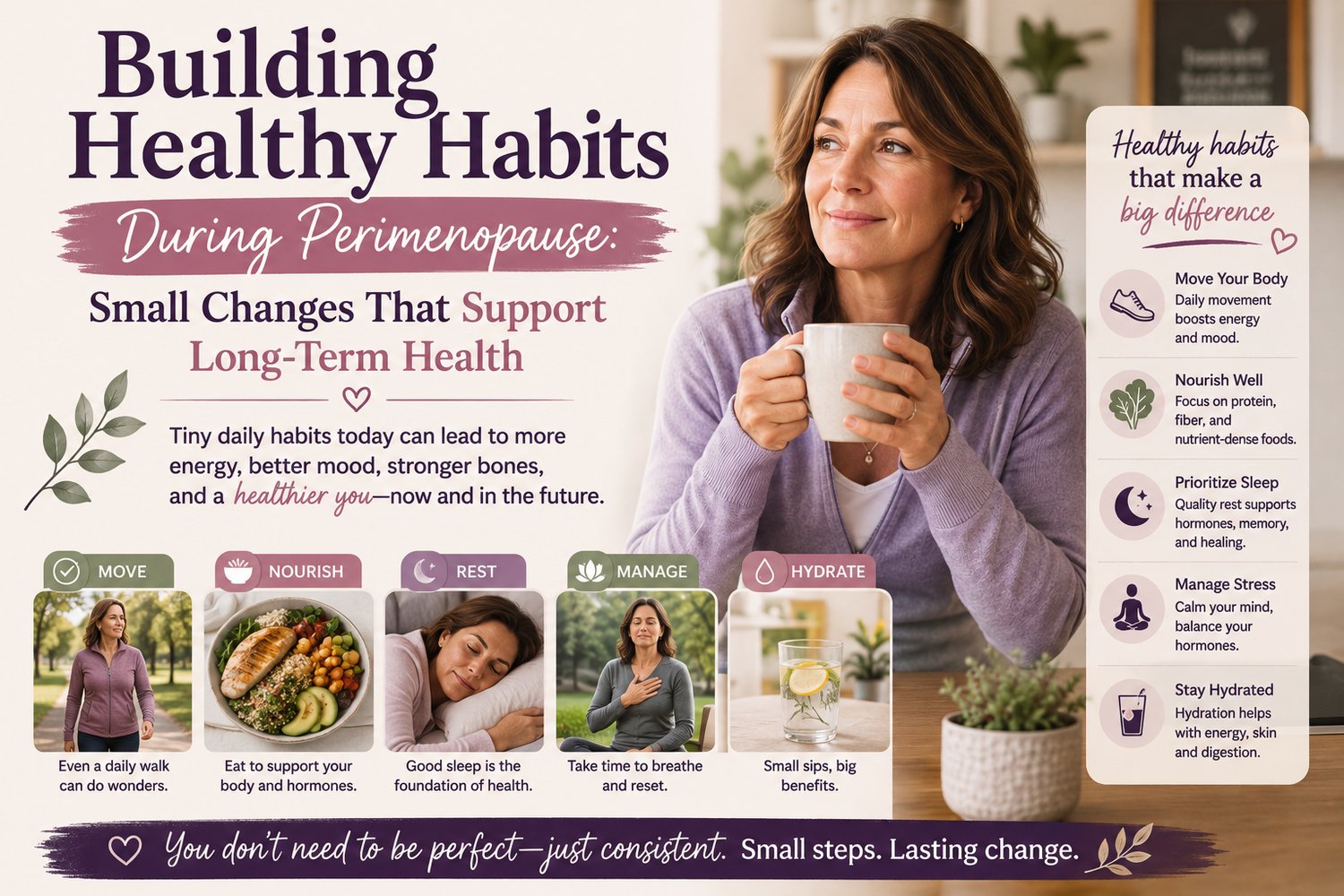
Healthy Habits During Perimenopause: What Actually Matters & How to Build a Routine
Healthy habits during perimenopause cannot stop menopause, balance your hormones back to their previous levels, or guarantee that you'll never experience hot flashes, poor sleep, weight changes, or other symptoms.
What they can do is considerably more useful.
A strong midlife lifestyle can help support:
- Heart health
- Muscle and strength
- Bone health
- Metabolic health
- Sleep
- Mental well-being
- Physical function
- Healthy aging
And none of that requires building a perfect “menopause routine.”
For most women, the highest-value habits are surprisingly familiar:
Move regularly.
Strength train.
Eat well.
Sleep as well as you can.
Don't smoke.
Pay attention to alcohol.
Keep up with preventive healthcare.
Treat symptoms that actually need treatment.
The hard part usually isn't knowing these things.
It's turning them into a routine that survives work, family, stress, bad sleep, travel, and ordinary life.
That's what this guide is about.
What Healthy Habits Matter Most During Perimenopause?
If you strip away the menopause marketing, the major priorities are:
1. Regular aerobic activity
Walking and other aerobic exercise support cardiovascular fitness and overall health.
2. Strength training
Resistance exercise helps preserve muscle, strength, bone health, and physical function.
3. A nutrient-dense diet
Prioritize adequate protein, fiber-rich foods, fruits, vegetables, whole grains, healthy fats, and foods supplying important nutrients such as calcium.
4. Sleep
Protect sleep habits—but also recognize when insomnia, night sweats, sleep apnea, or another sleep disorder needs actual treatment.
5. Weight and metabolic health when relevant
Not everyone needs to lose weight. But blood pressure, blood glucose, cholesterol, abdominal fat, activity, and other cardiometabolic factors become increasingly important during midlife.
6. Mental health
Stress management can help, but depression and anxiety deserve evidence-based treatment when present.
7. Preventive healthcare
Midlife is a good time to pay more—not less—attention to blood pressure, metabolic health, cancer screening, bone risk, vaccines, and other individualized preventive care.
Those are the foundations.
Not detox tea.
Not “estrogen cleansing.”
Not a 37-step morning routine.
Healthy Habits Support Health—They Don't Cure Perimenopause
This distinction is central to the entire HabitLogics approach.
Lifestyle changes can support health during the menopause transition.
They do not:
- Stop ovarian aging
- Prevent menopause
- Guarantee weight loss
- Eliminate every hot flash
- Treat every case of insomnia
- Cure depression
- Reverse osteoporosis
- Replace necessary medication
If your hot flashes are severe, treatment exists.
If you have chronic insomnia, sleep hygiene alone may not be enough.
If you're depressed, going for a walk is not a substitute for mental-health treatment.
If you have osteoporosis, eating yogurt and lifting dumbbells may be part of your care—but not necessarily all of it.
Healthy habits and medical treatment aren't opponents.
They have different jobs.
Start With Movement
Physical activity is one of the broadest health investments you can make during midlife.
Current WHO guidance recommends adults aim for approximately:
150–300 minutes of moderate aerobic activity per week
or:
75–150 minutes of vigorous aerobic activity
plus:
muscle-strengthening activity involving major muscle groups on at least two days per week.
You don't need to hit those numbers immediately if you're currently inactive.
WHO also emphasizes that some activity is better than none and that all physical activity counts.
Start with your baseline.
Build from there.
Walking Is One of the Easiest Places to Start
Walking is useful because it has relatively few barriers.
You can do it:
- Outside
- On a treadmill
- During lunch
- After dinner
- At a park
- With someone else
- In short blocks throughout the day
It supports aerobic fitness and can help you become less sedentary.
You do not need exactly 10,000 steps.
You do not need a special menopause walking speed.
And you do not need every walk to become an intense workout.
Read Walking During Perimenopause: Benefits for Heart Health, Weight, Mood & Fitness.
Strength Training Deserves Equal Billing
Walking is excellent.
It doesn't provide the same resistance stimulus that strength training does.
Resistance training helps support:
- Muscle
- Strength
- Bone health
- Balance
- Physical function
- Healthy aging
For many beginners, two full-body sessions per week is already a legitimate start.
Three can work well too.
You don't need:
- Six gym days
- Maximal weights
- A complicated split routine
You need resistance that gradually becomes challenging enough to produce adaptation.
Read Strength Training During Perimenopause: Benefits, Workouts & How to Start.
Stop Making Cardio and Strength Training Compete
This social-media argument needs to die.
Women in perimenopause do not need to choose between:
walking/cardio
and:
lifting weights.
They serve different purposes.
Aerobic exercise supports:
- Cardiorespiratory fitness
- Cardiovascular health
- Endurance
Resistance training supports:
- Muscle
- Strength
- Bone loading
- Physical function
Current adult exercise recommendations include both.
A strong weekly routine can contain both without turning fitness into a second job.
Build Meals Around Useful Nutrition Fundamentals
You do not need a special hormonal meal plan.
A useful eating pattern generally includes:
- Adequate protein
- Vegetables
- Fruit
- Fiber-rich carbohydrates
- Healthy fats
- Calcium-rich foods
- Nutritional variety
For someone trying to manage weight, portions and overall calorie intake matter too.
For someone experiencing heavy menstrual bleeding, iron status may deserve attention.
For someone following a plant-based diet, nutrients such as B12, iron, calcium, vitamin D, and protein may need more deliberate planning.
The details vary.
The foundation doesn't have to be complicated.
Read Best Diet for Perimenopause: What to Eat for Weight, Muscle, Bone & Heart Health.
Protein Is Useful—But It's One Piece
Protein gets enormous attention during midlife.
Some of that is deserved.
It supports:
- Muscle
- Recovery
- Fullness
- Bone health as part of a complete diet
But you don't need to turn your entire diet into protein products.
For many healthy midlife women, roughly 1.0–1.2 g/kg/day is a practical range often discussed for supporting muscle and healthy aging, although individual needs vary.
The standard adult RDA remains 0.8 g/kg/day.
Most importantly:
protein + resistance training
is a stronger muscle-preservation strategy than obsessing over protein alone.
Read Protein During Perimenopause: How Much Do You Need for Muscle, Fullness & Healthy Aging?.
Fiber Deserves More Attention Too
Protein tends to dominate fitness conversations.
Fiber quietly does a ridiculous amount of useful work.
Fiber-rich foods support:
- Digestive health
- Cholesterol management
- Blood-sugar regulation
- Fullness
- Overall dietary quality
Useful foods include:
- Beans
- Lentils
- Vegetables
- Fruit
- Oats
- Whole grains
- Nuts
- Seeds
Your midlife nutrition strategy shouldn't be:
protein at the expense of everything else.
Often, protein + fiber is the more useful meal-building framework.
For a deeper dive, visit the Complete Fiber & Gut Health Guide.
Protect Bone Health Before You Can Feel a Problem
Bone loss doesn't announce itself.
You generally don't wake up one morning and think:
“Ah yes, my bone mineral density is down 4%.”
That's why prevention matters.
Useful foundations include:
- Resistance training
- Weight-bearing activity
- Adequate calcium
- Adequate vitamin D
- Adequate protein
- Avoiding smoking
- Appropriate screening based on age and risk
The years around and after menopause are particularly relevant because lower estrogen exposure contributes to accelerated bone loss.
Exercise and nutrition support bone health.
They don't eliminate osteoporosis risk.
Heart Health Becomes Increasingly Important
Perimenopause content spends a lot of time discussing:
- Weight
- Hot flashes
- Belly fat
- Sleep
Sometimes heart health barely gets mentioned.
That's backwards.
Federal women's-health guidance notes that changes around menopause and aging can increase risks involving heart disease, stroke, and osteoporosis.
Midlife is a good time to know your:
- Blood pressure
- Cholesterol
- Blood glucose
- Family history
- Smoking status
- Physical-activity level
You don't need to become obsessed with biomarkers.
You should know whether the big ones are moving in the wrong direction.
Don't Smoke
This deserves to be stated plainly.
If you smoke, quitting is one of the highest-value things you can do for long-term health.
Smoking affects:
- Cardiovascular disease risk
- Cancer risk
- Bone health
- Respiratory health
- Menopause timing
No menopause supplement competes with smoking cessation as a health intervention.
If you don't smoke, great.
Keep not smoking.
Pay Attention to Alcohol
Alcohol often gets treated as either:
completely harmless
or:
something nobody is ever allowed to enjoy.
Neither framing is particularly useful.
Alcohol may affect things relevant to perimenopause, including:
- Sleep
- Hot flashes for some women
- Weight
- Blood pressure
- Cancer risk
- Mood
If you drink, pay attention to what it does to you.
Someone already struggling with night sweats, poor sleep, and weight management may discover that regular alcohol is making all three harder.
That information is useful.
Sleep Hygiene Matters—But Don't Stop at Sleep Hygiene
Good sleep habits include things like:
- Maintaining a fairly consistent wake time
- Keeping the bedroom dark and comfortable
- Managing caffeine timing
- Limiting alcohol near bedtime
- Getting daylight during the day
- Staying physically active
Those create better conditions for sleep.
But chronic insomnia is not always solved by having a darker bedroom.
If you've struggled for months with:
- Falling asleep
- Staying asleep
- Early waking
- Daytime impairment
then CBT-I may be appropriate.
If you snore loudly, gasp, stop breathing during sleep, or remain extremely sleepy during the day, sleep apnea should be considered.
If night sweats are waking you, treating the hot flashes may be more important than adding another bedtime routine.
Read Sleep During Perimenopause: Why You Can’t Sleep & What Actually Helps.
Treat Hot Flashes When They Need Treatment
You can:
- Keep the room cooler
- Dress in layers
- Track personal triggers
Those may improve comfort.
But severe vasomotor symptoms have actual medical treatments.
Options may include:
- Menopausal hormone therapy
- Certain SSRIs or SNRIs
- Gabapentin
- Oxybutynin
- Fezolinetant
- Elinzanetant
- Certain behavioral approaches
You don't earn a healthier lifestyle badge by suffering through untreated symptoms.
Read Hot Flashes During Perimenopause: Causes, Triggers & Treatments That Actually Help.
Stress Management Has a Job—Just Not Every Job
Stress management can improve:
- Coping
- Emotional well-being
- Sleep
- Decision-making
- Quality of life
Useful approaches can include:
- Exercise
- Time outdoors
- Therapy
- Journaling
- Relaxation
- Social connection
- Hobbies
- Setting boundaries
What stress management does not do is reverse menopause.
Be skeptical when someone tells you that:
“Your cortisol is the real reason for all your perimenopause symptoms.”
Stress matters.
It isn't a universal explanation.
Mental Health Is Healthcare
Mood changes can occur during the menopause transition.
That doesn't mean depression and anxiety should simply be managed with:
- Gratitude journals
- Walking
- Better food
- Meditation
Those things can support emotional health.
Clinical depression or significant anxiety may require:
- Psychotherapy
- Medication
- Medical evaluation
- Treatment of overlapping sleep or menopause symptoms
Read Mood Swings During Perimenopause: Causes, Anxiety, Depression & What Actually Helps.
Social Connection Matters More Than It Gets Credit For
Healthy aging isn't entirely an individual project.
Social connection can support:
- Emotional health
- Stress resilience
- Physical activity
- Quality of life
- Healthy routines
That can mean:
- Friends
- Family
- Walking partners
- Exercise groups
- Community involvement
- Clubs
- Volunteering
- Regular social plans
You don't need an enormous social network.
A few meaningful connections matter.
Preventive Healthcare Is Part of a Healthy Lifestyle
This is one of the places where wellness culture gets weird.
Someone may spend hundreds of dollars on:
- Supplements
- Wearables
- Functional labs
- Cold plunges
- Red-light devices
while ignoring:
- Blood pressure
- Cholesterol
- Diabetes screening
- Cancer screening
- Vaccinations
- Bone-health risk
Federal women's-health guidance specifically recommends continuing routine preventive care during and after menopause, including attention to blood pressure, cholesterol, diabetes risk, cancer screening, vaccines, and bone health based on individual circumstances.
The boring stuff counts.
A lot.
Don't Use Perimenopause to Explain Every New Symptom
This is another healthy habit:
remain appropriately skeptical.
Fatigue might be related to poor menopause sleep.
It might also involve:
- Anemia
- Thyroid disease
- Sleep apnea
- Depression
- Medication effects
Palpitations may occur during hot flashes.
They can also have cardiac or thyroid causes.
Heavy bleeding can occur during perimenopause.
It can also deserve medical evaluation.
Brain fog is common.
Rapid cognitive deterioration isn't something to casually blame on estrogen.
Knowing you're in perimenopause should add context.
It shouldn't end your curiosity about your health.
Symptom Tracking Can Help—If You Actually Use the Information
Tracking isn't automatically beneficial because you filled out a spreadsheet.
It becomes useful when it helps answer a question.
For example:
Does alcohol worsen my night sweats?
Are bad brain-fog days consistently following terrible sleep?
Have my periods become progressively heavier?
Is my new bedtime routine actually changing anything?
Useful things to track can include:
- Periods
- Hot flashes
- Sleep
- Mood
- Symptoms
- Exercise
- Medications
- Possible triggers
You don't need to track everything forever.
Collect enough information to make a decision.
The FREE Perimenopause Starter Kit includes basic symptom, sleep, hot-flash, and habit tracking if you want a simple starting point.
For deeper symptom monitoring, the Perimenopause Symptom Tracker includes printable and Excel tools.
How Do You Actually Build These Habits?
This is where the article earns its own existence.
Knowing what to do is one problem.
Making it happen consistently is another.
Start with behavior, not aspiration.
Instead of:
“I need to exercise more.”
choose:
“I will walk for 20 minutes after dinner Monday through Friday.”
Instead of:
“I need to eat healthier.”
choose:
“I will include a protein source at breakfast.”
Instead of:
“I need better sleep.”
choose:
“I will get up at roughly the same time every morning.”
Specific behaviors are easier to repeat than vague intentions.
Start With One or Two Changes
Do not launch:
- A new diet
- 10,000 steps
- Three strength workouts
- Meditation
- Meal prep
- Alcohol elimination
- A perfect bedtime routine
all on Monday.
That's an excellent plan if your goal is to be sick of your new lifestyle by Thursday.
Pick one or two actions.
Repeat them.
Then build.
Make the Habit Smaller Than Your Motivation
On an enthusiastic day, you may be willing to:
walk 60 minutes.
That doesn't mean 60 minutes should be your minimum habit.
Maybe the baseline is:
10 minutes.
If you want to keep going, great.
But defining a smaller minimum gives the habit somewhere to go on difficult days.
Think:
minimum version
rather than:
perfect version.
Attach New Habits to Existing Routines
Existing routines give new behaviors a cue.
Examples:
After breakfast → take medication
After lunch → walk 10 minutes
After work → change into workout clothes
Before grocery shopping → plan dinners
After brushing teeth → prepare bedroom for sleep
You are using something that already happens to remind you of something new.
That removes some reliance on memory and motivation.
Put Important Habits on the Calendar
If strength training matters, give it a time.
Not:
“I'll lift sometime this week.”
Instead:
Tuesday at 6 p.m.
Saturday morning.
The same principle works for:
- Grocery shopping
- Meal prep
- Walking
- Medical appointments
- Bedtime routines
Important things are easier to protect when they exist somewhere other than your intentions.
Make Your Environment Do Some of the Work
Environment can make a behavior easier or harder.
Examples:
Want to walk?
Keep shoes somewhere visible.
Want to eat more protein at breakfast?
Buy the food before Monday morning.
Want to strength train at home?
Leave the equipment accessible.
Want to sleep without checking your phone at 2 a.m.?
Don't charge it next to your face.
Want fewer impulse snacks?
Stop putting them at eye level directly in front of you.
Willpower is useful.
Designing around predictable human behavior is better.
Build a Backup Version
Your routine should survive imperfect days.
For example:
Walking
Normal:
30 minutes outside
Backup:
10 minutes on the treadmill
Strength
Normal:
full workout
Backup:
one set each of squat, row, push, hinge
Dinner
Normal:
planned home-cooked meal
Backup:
rotisserie chicken + frozen vegetables + microwave potato
Sleep
Normal:
full wind-down routine
Backup:
phone away + lights down + consistent wake time
A routine without a backup plan is often just a routine for easy days.
Use Tracking to Measure Consistency, Not Perfection
Instead of asking:
“Was this week perfect?”
track:
How many times did I do the behavior?
Example:
Walking goal:
4 times
Result:
3
That's not failure.
That's 75% execution and useful information.
Maybe four wasn't realistic.
Maybe Wednesday needs a different time.
Habits improve through feedback.
Not self-criticism.
Don't Confuse a Miss With a Collapse
Missing one workout isn't the problem.
What often creates the problem is:
“Well, this week is ruined.”
One meal doesn't determine your diet.
One missed walk doesn't determine your activity.
One bad night's sleep doesn't erase your sleep routine.
Return at the next opportunity.
You don't need Monday.
Build a Minimum-Viable Perimenopause Routine
If you want the simplest version possible, start here.
Movement
Work gradually toward regular aerobic activity.
Walking counts.
Strength
Train major muscle groups at least twice per week.
Food
Include:
- Protein
- Fiber-rich plants
- Nutrient-dense meals
most of the time.
Sleep
Protect consistent sleep opportunities and address persistent sleep disorders.
Alcohol and Smoking
Don't smoke.
Keep alcohol moderate or reduce it if it worsens symptoms or health goals.
Healthcare
Stay current with appropriate screening and preventive care.
That's already a very strong foundation.
Everything else is refinement.
A More Structured Weekly Routine
Here's one example.
Monday
30-minute brisk walk
Tuesday
Full-body strength training
Wednesday
20–30-minute walk
Thursday
Walk + basic meal planning
Friday
Full-body strength training
Saturday
Longer walk or enjoyable activity
Sunday
Groceries + simple food prep + review upcoming week
Daily priorities might include:
- Protein at meals
- Fiber-rich foods
- Reasonable hydration
- Regular movement
- Consistent wake time
You can customize all of this.
The structure matters more than the exact days.
What If You Have No Energy?
First, don't automatically assume the answer is:
“push harder.”
Persistent fatigue can come from:
- Sleep disruption
- Night sweats
- Anemia
- Heavy menstrual bleeding
- Thyroid disorders
- Depression
- Sleep apnea
- Medications
- Other medical conditions
If you're simply tired after a rough day, doing a smaller version of your habit may help maintain consistency.
If you're persistently exhausted, investigate why.
Healthy habits aren't supposed to become a way to ignore medical problems.
What If Symptoms Keep Derailing Your Routine?
Treat the symptoms.
This matters.
If night sweats are destroying your sleep and therefore wrecking your workouts:
address the night sweats.
If heavy bleeding is causing iron deficiency:
address the bleeding and iron deficiency.
If depression is making basic functioning difficult:
treat the depression.
You do not have to perfect your lifestyle before you're allowed medical care.
Sometimes medical treatment makes the healthy routine easier to maintain.
Beware the “Perfect Menopause Routine”
You may see routines involving:
5:00 a.m. wake-up
Cold plunge
Sunlight
Protein immediately
Weighted walk
Heavy lifting
Sauna
Supplements
Meditation
Intermittent fasting
Perfect bedtime
Could someone enjoy that?
Sure.
Do women need it to navigate perimenopause successfully?
Absolutely not.
A routine is useful when it supports your health and fits your life.
Complexity is not evidence.
What About Supplements?
Supplements should solve an identifiable problem.
Examples might include:
- Vitamin D when intake/status is inadequate
- Iron when deficiency is identified
- Calcium supplementation when dietary intake is insufficient and supplementation is appropriate
- Other nutrients for a documented or likely need
You do not automatically need:
- A menopause multivitamin
- Cortisol support
- Hormone detox
- Adrenal supplements
- Fat burners
- Sleep gummies
because you're in perimenopause.
“Designed for women over 40” is marketing language.
Ask what the product actually does.
Frequently Asked Questions
What are the best healthy habits during perimenopause?
The highest-value habits generally include regular aerobic activity, resistance training, nutritious eating, adequate protein and fiber, healthy sleep practices, not smoking, appropriate alcohol use, mental-health care, and preventive healthcare.
What is the most important habit during perimenopause?
There isn't one.
If you're sedentary, increasing activity may produce enormous benefit.
If you already exercise but sleep five hours a night, sleep may deserve more attention.
If you have untreated high blood pressure, addressing that may matter more than optimizing your protein intake.
Start with your biggest actual gap.
How much exercise should I get?
General adult guidance recommends approximately 150–300 minutes of moderate aerobic activity per week, or 75–150 minutes vigorous, plus muscle-strengthening activity on at least two days.
Build gradually if you're currently inactive.
Do I need 10,000 steps?
No.
Step count is simply one way to measure activity.
Increase movement relative to your current baseline.
Do I need to strength train?
Resistance training is strongly recommended as part of adult physical activity and becomes especially useful for maintaining muscle, strength, bone health, and function during midlife.
Do I need a special perimenopause diet?
No.
A balanced eating pattern built around adequate protein, fiber-rich foods, vegetables, fruit, healthy fats, and nutrient-dense carbohydrates is a strong foundation.
Do healthy habits reduce hot flashes?
Some lifestyle habits may help overall health and comfort, but exercise, diet, and cooling strategies shouldn't be presented as reliably effective treatments for vasomotor symptoms.
Medical and evidence-based nonhormonal treatments are available when symptoms are bothersome.
How long does it take to build a habit?
There isn't one universal “21-day” or “66-day” rule that applies to every behavior and person.
Complex behaviors may take longer to become automatic than simple ones.
Focus on repetition and making the behavior easy to repeat rather than waiting for a magical day when motivation is no longer necessary.
Should I track symptoms every day?
You can if it helps answer a question.
You don't need to track forever.
Use tracking long enough to identify meaningful patterns or provide useful information for a healthcare professional.
Do I need supplements during perimenopause?
Not automatically.
Supplementation should generally address an actual nutritional or medical need.
Is lifestyle enough to manage perimenopause?
Sometimes symptoms are mild enough that lifestyle support is all someone wants.
Other women benefit significantly from medical treatment.
Lifestyle and medical treatment can be used together.
Key Takeaways
- Healthy habits during perimenopause support long-term health but do not stop or cure the menopause transition.
- The highest-value foundations include aerobic activity, resistance training, nutritious eating, sleep, mental health, avoiding smoking, appropriate alcohol use, and preventive care.
- Adults should generally aim for 150–300 minutes of moderate aerobic activity weekly plus muscle-strengthening exercise at least twice per week.
- Walking and strength training complement each other.
- Protein is useful, but fiber, fruits, vegetables, healthy fats, and overall diet quality matter too.
- Sleep hygiene is useful, but persistent insomnia or sleep apnea deserves proper evaluation and treatment.
- Lifestyle habits should not replace appropriate treatment for severe hot flashes, depression, osteoporosis, abnormal bleeding, or other medical concerns.
- Preventive healthcare becomes increasingly important during midlife.
- Build one or two specific behaviors at a time instead of attempting a complete lifestyle transformation overnight.
- Make healthy habits easier through scheduling, environmental design, and backup plans.
- Track consistency rather than demanding perfection.
- A routine that survives imperfect days is more useful than an impressive routine you can't sustain.
Put the Habits Into Practice
If you want a structured system for turning the lifestyle pieces into an actual routine, the Perimenopause Lifestyle Reset Workbook includes printable and Excel tools for walking, strength training, sleep, stress, habit building, and wellness planning.
If you're not ready for a full planning system, the FREE Perimenopause Starter Kit gives you a simpler starting point with symptom tracking, a sleep and hot-flash log, habit planning, and a wellness guide.
Continue Learning
Go deeper into whichever part of your routine needs the most attention:
- Walking During Perimenopause: Benefits for Heart Health, Weight, Mood & Fitness
- Strength Training During Perimenopause: Benefits, Workouts & How to Start
- Best Diet for Perimenopause: What to Eat for Weight, Muscle, Bone & Heart Health
- Protein During Perimenopause: How Much Do You Need for Muscle, Fullness & Healthy Aging?
- Sleep During Perimenopause: Why You Can’t Sleep & What Actually Helps
- Perimenopause Weight Gain: Why It Happens, Belly Fat & What Actually Helps
Or return to the Complete Perimenopause Guide for the full HabitLogics roadmap.
Educational Disclaimer
This article is intended for educational purposes only and is not medical advice or individualized lifestyle treatment. Exercise, nutrition, sleep, weight-management, screening, and treatment needs vary according to age, health history, medications, fitness, menstrual status, pregnancy potential, symptoms, and other factors. Healthy lifestyle habits support health but do not replace appropriate evaluation or medical treatment for persistent, severe, or concerning symptoms.